213 résultats
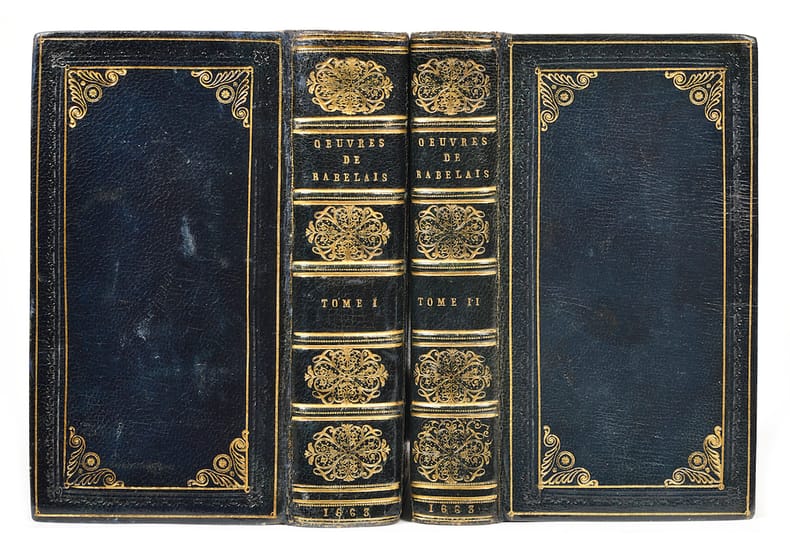
166329831S.l. [Amsterdam], s.é. [Daniel Elzevier / Elsevier], 1663. 2 vol. au format in-16 étroits (142 x 73 mm) de 12 ff. n.fol., 488 pp. et 5 ff. n.fol. ; 1 f. n.fol., [457 pp.], et 4 ff. n.fol. Reliures de l'époque plein veau moucheté brun, filet à froid encadrant les plats, dos à nerfs orné de filets gras à froid, doubles caissons d'encadrement dorés, large décor fleuronné doré, titre doré, tomaison dorée, palette dorée en queue, tranches mouchetées.
1666UDG-214RABELAIS (François). Oeuvres. S.l., s.n. [Elzevier], 1666. 2 volumes in-16, seconde édition elzévirienne "Augmentée de la vie de l'Auteur & de quelques Remarques sur sa vie & sur l'histoire. Avec l'explication de tous les mots difficiles". On retrouve dans cette édition la célèbre figure gravée dite "de la dive bouteille", page 833, le poème "Ô bouteille pleine toute de mystères" gravée sur la panse. Page de titre en rouge et noir à la sphère pour le premier tome, en noir pour le second. Reliure hollandaise plein vélin à rabats d'époque, dos lisse avec auteur, tomaison, date et éditeur manuscrit. Annoté sur la garde "A Leyde par les Elzeviers". Ex-libris manuscrit Le Tellier. "elle est aussi belle que celle de 1663 et sort probablement des mêmes presses. La Vie de Rabelais et les notes sont attribuées à Pierre du Puy." (Tchemerzine IX, p.317) Tchemerzine précise également qu'il existe un tirage sur papier fort, ayant jauni avec le temps, et un tirage sur papier fin, celui-ci vraisemblablement sur papier fin. (légers trous au dos de la reliure du premier volume)
166310240[Amsterdam], [Louis & Daniel Elzevier], 1663. 2 volumes in-12 (131 x 74 mm), 12 ff. n. ch., 490 pp. chiffrées 488, 5 ff. n. ch. ; 1 f. n. ch., pp. 489 à 945, 4 ff. n. ch. Maroquin bleu nuit, encadrement de roulettes dorées et à froid sur les plats, fer décoratif doré en écoinçon, dos à nerfs richement orné en caissons, titre, auteur, tomaison et date dorés, filet doré sur les coupes, roulette dorée sur les chasses, tranches dorées, auréole fauve pp. 248-249 du tome 1 (reliure de la première moitié du XIXe siècle).
Facsimiles, orig. cloth. The largest Elzevier collection ever assembled. This catalogue contains 3,464 entries fully described by Rahir for the French bookselling firm of Damasc?ne Morgand.
196539132Nieuwkoop, de Graaf, 1965. XXIV, 491 S., 1 Bl. Mit zahlreichen Abbildungen. Gr.-8° (24,5 x 16,5 cm). Original-Leinwand.
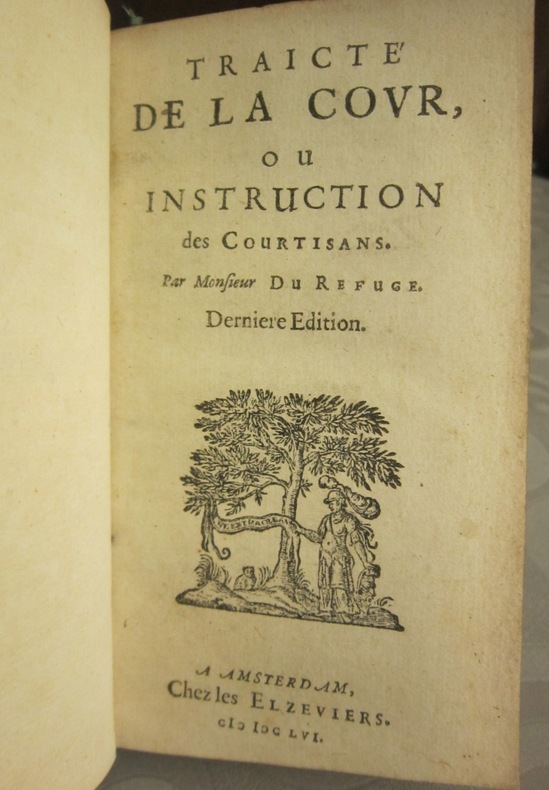
1656003202A Amsterdam, chez les Elzéviers, 1656
1652001193Leiden, et Amsterdam Jean & Daniel Elsevier, et Jean Blaeu 1652
1665335681665 Parisiis - E Typographia Regia- 1665 - 1 volume in4 de 20 + 219 pages - Reliure pleine basane brune d'époque - Dos cinq nerfs orné de fleurons - dentelles sur les coupes - tranches mouchetées - petit accroc à la coiffe supérieure - quelques épidermures - page de titre anciennement restaurée en marge basse sur 5 cm sans atteinte au texte - petit trou de vers au 10 dernières pages sans atteinte au texte -
pp. [16], 310, [34] + Engraved title page by Duysent. Foxed. Latin text. 24mo. 14 cm. Lovely 18th century full leather binding, joints cracked. Copinger 4054; Willems 412n. Edited by Marcus Zuerius Boxhorn (1612-1653), to whom the dedication is addressed. The Elzeviers published four distinct editions under this date. This issue is the second reimpression. Early manuscript ownerships. Scarce. The Dutch family of Elzevier (Elzevir; Elsevier) were the foremost printers of their time. They produced a vast variety of well printed scholarly and popular books; many in a very small handy format. Louis Elzevier, the founder of the firm, produced his first book in Leiden in 1583. The 'golden age' of Elzevier printing was between 1620 and 1680. The Elzevier dynasty probably produced their last publication in 1770. **PRICE JUST REDUCED! SMALL BOX 6
pp. (16), 310, (34). Duysendt engraved title + Woodcut Illustration. Small 24mo. [120 x 65 mm.] Old English full leather binding. Spine worn. All edges gold gilt. Edited by Marcus Zuerius Boxhornius. The second of four Elzevier editions issued in 1634. Willems 412. "Jolie edition peu commune" - Brunet V:85. "A beautiful little volume" - Dibdin II: 384. Sallust was a famed Roman historian and politician . He was tribune of the people (52 B.C.) and praetor (46). He was ejected (50) from the senate ostensibly for adultery, but more probably because of his partisanship for Caesar. He served with Caesar after his praetorship and was his governor in Numidia; he was subsequently accused of misusing his governorship for personal gain. His principal works are the Bellum Catilinae, on the conspiracy of Catiline and his account of the Jugurthine War, Bellum Jugurthinum. His history of Rome is extant only in fragments; it probably covered the period 78 B.C. to 67 B.C. As a historian Sallust was important as one of the first to write historical monographs dealing with sharply limited events and periods. Although his style is consciously archaic, it is distinguished by its terseness and directness. His character sketches are particularly impressive and vivid, and his work has found as many imitators as critics - Columbia Encyclopedia. Very Scarce. **PRICE JUST REDUCED! SMALL BOX 2/Ron4
16343483Lugduni Batavorum, ex officina Elzeviriana. 1634. in-12 (13 x 7,7 cm), 8 ff., 310 pp., 17 ff., maroquin rouge, dos à cinq nerfs orné, triple filet encadrant les plats, roulette sur les coupes, dentelle intérieure, tranches dorées sur marbrures (reliure ancienne) titre-frontispice et portrait de l'auteur, bandeaux, cul-de-lampe, lettres ornées. Notes bibliophiques manuscrites en début d'ouvrage. Exemplaire aux armes sur les plats de Nicolas Lambert de Thorigny, Président du Parlement. Ex-Libris Mortimer L. Schiff.
1634GIT00c76Lugduni Batavorum ex Officina Elzeviriana Anno 1634. Peti in-12 8ff n ch 310pp 17ff n ch. Plein vélin ivoire, plats encadrés d'un filet bleu, relié au début du XIXe siècle. Orné d'un beau frontispice gravé par CC Duysent et d'un portrait de Salluste d'après une médaille de l'époque.
Lugduni Batavorum, ex officina Elzeviriana, 1634, in-12 piccolo, legatura coeva in piena pelle, dorso a 4 nervi con titolo e fregi in oro, tagli rossi, pp. [24], 310, [38]. Con frontespizio calcografico inciso da Cornelius Claesz Duysend e un ritratto xilografico dell'autore a c. *8v. Screpolature alla pelle della legatura, per il resto bell'esemplare.
Amstelodami, apud Ludovicum Elzevirium, 1649, in-12 piccolo, ottima legatura coeva in piena pelle, dorso a 5 nervi con titolo e ricchi fregi fitomorfi in oro negli scomparti, tagli spruzzati, pp. [20], 472, [6], l'ultima carta bianca. Con frontespizio calcografico e una tabella tipografica ripiegata f.t. Non è stata legata una ulteriore ultima carta bianca. Willems 1091. Bell'esemplare.
187626459BLeipzig:, Schulze., [1876]. 12°. 14,7 x 10 cm. 439 S. Leinen mit goldgeprägtem Rückentitel und Verlagsangabe, beide Deckel mit goldgeprägten Deckelvignetten und Rahmung, Kopfgoldschnitt. Lesebändchen. [3 Warenabbildungen] Ecken, Kapitale und Gelenke etwas beschabt. Rücken etwas berieben. Das Lesebändchen etwas verkürzt. Kleines Buchbinderschildchen auf Vorsatz, kleiner Namenseintrag von alter Hand auf dem Vortitel, teils minimal stockfleckig, fester Buchblock. Insgesamt (= Elzevier-Ausgabe).
12°. 14,7 x 10 cm. 439 S. Leinen mit goldgeprägtem Rückentitel und Verlagsangabe, beide Deckel mit goldgeprägten Deckelvignetten und Rahmung, Kopfgoldschnitt. Lesebändchen. (= Elzevier-Ausgabe). Ecken, Kapitale und Gelenke etwas beschabt. Rücken etwas berieben. Das Lesebändchen etwas verkürzt. Kleines Buchbinderschildchen auf Vorsatz, kleiner Namenseintrag von alter Hand auf dem Vortitel, teils minimal stockfleckig, fester Buchblock. Insgesamt guter Zustand. Enthält Gedichte der 1., 2. und 3. Periode. - Hübsche Zierleisten und Schlußstücke.
1658260Leide Elzevier 1658 Chambolle-Duru Un volume in-12, reliure de Chambolle-Duru plein maroquin vert, dos à nerfs, titre doré, caissons ornés, double filet doré sur les coupes, triple filet doré sur les plats, dentelle intérieure, tranches dorées, [2ff.] bl., titre gravé sur cuivre, [2ff.] dédicace, [11ff.] préface, [4ff.] table, 559 pp., [2ff.] blancs. Très bel exemplaire.
16433048(Leiden), (Elzevir), 1643. 12mo. Mit gest. Titel. 17 Bl., 559 S. Pgt. d. Zeit m. am Vorderschnitt überlappenden Pergamentkanten u. hs. Rückentitel.
16431122Suivant la copie imprimée à Paris (Leyde, Elzevier), 1643, petit-in-12 ; plein vélin à recouvrements, titre manuscrit (reliure de l’époque) ; (18) feuillets y compris le titre gravé, 559 pages.
38199Amstelodami ( Amsterdam ) Apud Ludovicum & Danielem Elzevirios 1658 in 16 (11,5x6) 1 volume reliure plein veau fauve, dos lisse très orné, pièce de titre de maroquin rouge, tranches teintées, 480 pages. Bel exemplaire ( Photographies sur demande / We can send pictures of this book on simple request )
1631GIT00c7eLugd Batavorum ex Officina Elzeviriana A° 1631. In-24 334pp 20ff n ch. Plein vélin ivoire époque, dos lisse portant le titre manuscrit. Orné d'un beau titre-frontispice allégorique. Manque de vélin sur la coiffe supérieure et en tête des plats, exemplaire en partie déboîté de sa reliure, annotations manuscrites anciennes sur les feuillets blancs.
pp. 369, (13) + Engraved title. One leaf torn across the top with loss of about 10 lines. Old damp stain. 32 mo. [115 x 66 mm.]. Worn contemporary paper boards binding. Little is known about Suetonius' life except that he was briefly the private secretary of Emperor Hadrian. His work, De vita Caesarum [Concerning the Lives of the (Twelve) Caesars] survives almost in full. In it he does little to hide the sexual activities or moral depravity of the Roman court. There are also fragments of a much larger collection of biographies, De viris illustribus [Concerning Illustrious Men]. He gathered together all sorts of anecdotes, and the resultant biographies are lively and informative. The Dutch family of Elzevier (Elzevir; Elsevier) were the foremost printers of their time. They produced a vast variety of well printed scholarly and popular books; many in a very small handy format. Louis Elzevier, the founder of the firm, produced his first book in Leiden in 1583. The 'golden age' of Elzevier printing was between 1620 and 1680. The Elzevier dynasty probably produced their last publication in 1770. Willems 1118; Rahir, Les Elzevier, 1133. Small Box OST 5
1640M125731640 Elsevier Couverture rigide 1640 Lugdun Batavor , Ex Officina Elseviriana, 1640 , in16 plein veau , dos lisse orné, filet sur les plats , dentelle sur les gardes , tranches dorées Tome II des oeuvres . Complet pour l " Histoire " . Paginé de 403 à 746 .Ex libris . Très léger travail de ver sur les mors inférieurs. Bel exemplaire Langue: Français
pp. (20), 96, (24). Solitaire printer's mark. Small 24mo. [122 x 70 mm.] Early plain vellum binding. A guide to princely behavior, first issued by Elzevier the year before. The Dutch family of Elzevier (Elzevir; Elsevier) were the foremost printers of their time. They produced a vast variety of well printed scholarly and popular books; many in a very small handy format. Louis Elzevier, the founder of the firm, produced his first book in Leiden in 1583. The 'golden age' of Elzevier printing was between 1620 and 1680. The Elzevier dynasty probably produced their last publication in 1770. Willems 442. **PRICE JUST REDUCED! SMALL BOX 2/SH U10
pp. 624, (24). Engraved title. 24mo. [116 x 60 mm.] Contemporary full leather binding with elaborately gilt spine. Manuscript Ex Libris of Ludovici Brisout de Barneville, Counselor to the Royal Court, 1836. This is supplementary work to the Elzevier 1634-1640 edition of Tacitus. Dibdin II:452; Willems 1094. Tacitus was one of the greatest of Roman historians. He was a friend of Pliny the Younger a nd married the daughter of Cnaeus Julius Agricola. In A.D. 97 he was appointed substitute consul under Nerva, and later he was proconsul of Asia. The first of his works was the Dialogus [dialogue], a discussion of oratory in the style of Cicero, demonstrating to some degree why Tacitus was celebrated as an eloquent speaker; this work was long disputed, but his authorship is now generally accepted. Tacitus then wrote a biography of Agricola, expressing his admiration for his father-in-law as a good and able man. His small treatise De origine et situ Germanorum [concerning the origin and locatio n of the Germans], commonly called the Germania or Germany, supplies (along with the earlier account of Julius Caesar) the principal written material on the Germanic tribes. It is a picture of the sim ple Germans glorified by comparison with the corruption and luxurious immorality of the Romans. This moral purpose and severe criticism of contemporary Rome, fallen from the virtuous vigor of the old republic, also underlies his two long works, commonly called in English the Histories and the Annals. The extant books of the Histories cover only the reign of Galba (A.D. 68?69) and the beginning (to A.D. 70) of the reign of Vespasian but give a thorough view of Roman life?persons, places, and events. The surviving books of the Annals tell of the reign of Tiberius, of the last years of Claudius, and of the first years of Nero. The account contains incisive character sketches, ironic passages, and eloquent moral conclusions. The declamatory writing of the Dialogus is replaced in the historical works by a polished and highly individual style, a wide range of vocabulary, and an intricate and startling syntax - Columbia Encyclopedia. **PRICE JUST REDUCED! SMALL BOX 2/RON3