153 résultats
1464<p>London: Macmillan and Co. 1895. Octavo. A sensuously romantic but chaste gift binding in full vellum with the initials " J. J. de W." in gilt on the front cover and " 25. June 1895 d. d. G. B. R." on the back cover. 184 pages. The gilt titled spine has an ornament of a single gilt inverted lily blossom on a sinuous stem with the date 1895 in gilt at the foot of the spine. Small gilt lily blossoms also adorn the corners of both covers. Vellum turn-ins with double gilt rules. Top edge gilt. Although this binding is unsigned it was obviously the work of a skilled binder producing a gift volume to represent the affection of the presenter and hopefully the cherished regard of the receiver.</p> hardcover
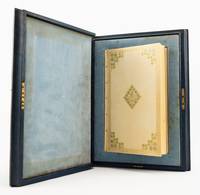
1937ST21066London: William Heinemann Limited 1937. FIRST EDITION. Book: 245 x 152 mm. 9 3/4 x 6"; Case: 330 x 235 mm. 13 x 9 1/4". 3 p.l. 34 pp. <br/> LOVELY CONTEMPORARY STIFF VELLUM GILT AND PAINTED covers with delicate gilt frame sprays of flower and leaves at each corner outlined in gilt and painted blue and green central lozenge outlined in gilt dots and framed by painted flowers and leaves a large initial "A" in gilt at center smooth spine divided into compartments with gilt and painted floral ornament turn-ins with gilt floral roll sky blue silk endleaves all edges gilt. Housed in a fine oversized blue morocco case designed to look like a book with gilt lettering on the upper cover raised bands gilt ruled compartments and lettering to spine the interior constructed and padded to hold the smaller book and lined with blue velvet spine of case a bit sunned corners a little rubbed clasp no longer functional. A FINE COPY clean and fresh internally in a pristine binding.<br/> <br/> With very considerable visual and tactile appeal this is a gracefully bound copy of the the final book of verse issued by Richard Aldington published before he turned exclusively to writing prose. A leading poet of the early 20th-century Imagist school Aldington né Edward Godfree Aldington 1892-1962 was a prolific writer whose 50-year career produced novels biographies translations and literary criticism as well as sharp minimalist free verse. He was part of the contemporary London avant-garde crowd being close friends with Ezra Pound T. S. Eliot Amy Lowell and D. H. Lawrence; and he was especially close to the poet H. D. Hilda Doolittle his first wife from 1913-38. As literary editor of the leading Modernist periodical "The Egoist" he was an integral part of the pre-World War I literary scene and his first largely autobiographical work "Death of a Hero" 1929 was considered by George Orwell and Lawrence Durrell to be the best of the English Great War novels. The poems here were written in the mid-1930s when Aldington had decamped to the United States after the woman he loved Netta Patmore rejected his proposal of marriage. While tracing his grief and longing the verses also build the image of a "crystal world" created by the love of an ardent couple concluding that "Only from the purity of extreme passion / And alas the purity of extreme pain / Can you build the crystal world." Happily Aldington's beloved Netta to whom the work is dedicated reversed her decision and agreed in 1938 to help him build their crystal world together. The present lovely binding is unsigned but the delicate precise tooling and elegant design indicate the work of very talented hands. The romantic contents and the rather feminine aspect of the binding suggest that this was a gift from one lover to another perhaps a recipient sharing the initial "A" with our author. And the oversized and extravagant custom case indicates how much this object was treasured. William Heinemann Limited unknown
1891ST15049London: Seeley and Co 1891. No. 85 OF 160 COPIES ON LARGE PAPER. 382 x 275 mm. 15 x 10 3/4". 4 p.l. 111 1 pp. <br/> Publisher's gilt-stamped vellum upper cover with titling and the Tennyson coat of arms BOTH COVERS WITH LOVELY HAND-PAINTED DESIGN BY JOHN T. BEER upper cover with urn at foot and blooming rose branches emanating from a medallion bearing the date 1902 and curving around the title and escutcheon lower cover with branches of apple blossoms dividing the board into quadrants each inhabited by a bird in flight smooth spine with gilt titling edges untrimmed. With frontispiece photographic portrait of Tennyson 31 vignettes in the text and 14 copper-plate engravings after drawings by Edward Hull. Verso of title page and limitations page with ink stamp of Gloucester County Library. Weber "The Fore-Edge Paintings of John T. Beer" 195. Small scratch near head of front joint minor soiling and rubbing to edges of boards mild foxing mostly marginal and not affecting copper engravings otherwise an excellent copy clean and fresh internally with wide margins the binding especially bright the pretty decoration perfectly preserved. AN EXTREMELY ATTRACTIVE COPY.<br/> <br/> This very large format deluxe illustrated work describing the places associated with England's beloved Poet Laureate Alfred Lord Tennyson is enhanced by former owner John T. Beer's Arts & Crafts-style embellishments to the vellum binding. After retiring from a successful career as a clothier Merseyside book collector Beer ca. 1826-1903 occupied himself decorating books from his library mostly with fore-edge paintings but in a score of instances with painted bindings. Jeff Weber considers Beer "one of the most highly skilled artists of fore-edge paintings" noting that he was the first artist to put his signature to such works. Weber's catalogue raisonnée of Beer's works lists 189 fore-edge paintings 22 painted bindings including this one #195 and three bindings designed by Beer and executed by Fazakerley of Liverpool. The design here is clearly influenced by the Arts & Crafts movement and Beer owned several works by William Morris including a Kelmscott Press "Godefrey of Bologne" on the vellum covers of which he had painted a design of tulips and lilies. Among the locations discussed and pictured in the "The Laureate's Country" are Tennyson's childhood homes in Somersby and Bag Enderby Trinity College Cambridge where he matriculated and his estates Farringford on the Isle of Wight and Aldworth in West Sussex. Seeley and Co unknown
190273377London: Edwin Arnold 1902. Limited to 165 numbered copies on vellum at the Essex House Press under C. R. Ashbee. Small octavo. 45 1 pp. Hand-colored frontispiece and two full-page hand-colored illustrations and eighty-five hand-colored ornamental letters by Edith Harwood. Tail-piece. Caslon type. Publisher's vellum with rose and gilt lettering to front cover. Bit of natural mottling to vellum. Custom folding cloth chemise and slipcase. A very good copy.Great Poems Series No. 6. "In 1886 C.R. Ashbee established the Guild of Handicraft at Essex House London. Around the same time Ashbee created the Essex House Press. The Essex House Press published its first book in 1898. The work of the press was very much a part of the Arts and Crafts Movement. Ashbee continually linked the aims of the press with those of John Ruskin and William Morris and described the object of the movement as “making useful things…making them well and…making them beautiful.†The critics however were not so sure about the work of Essex House Press calling it “articraftiness.†Later booklovers came to admire much of its work. Some of the presses and some of the workmen for Essex House Press came from the Kelmscott Press after its demise in 1897 following the death of William Morris. Ashbee designed his own typeface called “Endeavor†for the press. In 1902 the press moved to Glouscestershire. The Essex House Press closed in 1910 having produced more than seventy titles." Univ. of Utah Edwin Arnold hardcover
1910ST14374England ca. 1910. 392 x 287 mm. 15 3/8 x 11 1/4". 32 leaves with text in an attractive italic hand all separated by tissue guards. <br/> SUMPTUOUS OLIVE GREEN STRAIGHT-GRAIN MOROCCO ELABORATELY GILT BY ZAEHNSDORF stamp-signed on front doublure and with their exhibition stamp on rear turn-in covers with densely stippled floral roll border enclosing a large frame formed by drawer handle tools and floral tools on a stippled ground; central panel with large cornerpieces rampant with flower tools circlets volutes and much stippling; raised bands spine compartments heavily gilt in a similar style gilt titling RED MOROCCO DOUBLURES with opulent dentelle frame surrounded by gilt-tooled green morocco turn-ins red watered silk endleaves with gilt edging all edges gilt.ma WITH 76 BLACK & WHITE PHOTOGRAPHIC REPRODUCTIONS OF PORTRAIT MINIATURES BY RICHARD COSWAY ANDREW PLIMER AND OTHERS mounted and enclosed by hand-painted burnished gold frames EACH PORTRAIT WITH HAND-ILLUMINATED TITLE in red blue green and burnished gold. Verso of front endleaf with book label of Thomas Agnew & Sons Old Bond Street Library. A bit of wear to front joint a little rubbing to extremities occasional mild rumpling to head or tail of vellum leaves isolated small marginal smudges otherwise a fine specimen the vellum creamy and bright the illuminations shining and the binding quite sound and lustrous with gold.<br/> <br/> Composed of vellum leaves this is a unique luxurious catalogue of a miniatures collection with delicate script lovely illumination and a stately binding by one of London's foremost workshops. State-of-the-art photographic reproductions of mostly 18th century miniatures are juxtaposed here with calligraphy and illuminations harking back to Medieval bookmaking. Each portrait is surrounded by a gold frame and accompanied by a hand-written description with an illuminated title giving biographical details of known subjects and a physical description of the miniatures whenever they are labelled simply "Portrait of a Lady" or "Portrait of a Gentleman." The scale of this production--which is nearly twice the size of most illuminated manuscripts of the early 20th century--and the splendor of the binding point to a patron of considerable means likely either the proprietors of or a client of the Agnew art dealers. The Agnew firm began as printsellers in Manchester in 1817 but over the course of the 19th century became one of the principal British galleries under the leadership of the founder's son William. A London branch opened in 1860 and the Bond Street flagship in 1875. William Agnew 1825-1910 did much to foster the careers of British artists Holman Hunt Frederick Leighton and Edward Burne-Jones and his clients included Henry Tate whom he encouraged to found the celebrated Tate Gallery. The binding here is a superb example of the work of the Zaehnsdorf firm long a top-ranked English bindery. Born in Pest Hungary Joseph Zaehnsdorf 1816-86 served his apprenticeship in Stuttgart worked at a number of European locations as a journeyman and then settled in London where he was hired first by Westley and then by Mackenzie before opening his own workshop in 1842. His son and namesake took over the business at age 33 when the senior Joseph died and the firm flourished under the son's leadership becoming a leading West End bindery. Over the years Zaehnsdorf employed a considerable number of distinguished binders including the Frenchman Louis Genth who was chief finisher from 1859-84 and trained a number of others including Roger de Coverly and Sarah Prideaux. A family-run business until 1947 the Zaehnsdorf bindery continued to produce consistently attractive and innovative designs executed with unfailing skill. It is generally understood that the firm reserved the use of its oval stamp showing a binder at work seen here for their finest bindings including those entered in exhibitions. unknown
1915ST17129-042Chicago: Written and Illuminated for The Renaissance Society ca. 1915. 216 x 153 mm. 8 1/2 x 6". ii 28 pp. 1 leaf colophon. Single column 18 lines in an attractive calligraphic hand. <br/> VERY PRETTY VIOLET CRUSHED MOROCCO GILT AND INLAID for The Renaissance Society stamp-signed in gilt on front doublure smooth spine with gilt titling FULL MOROCCO DOUBLURES consisting of a green morocco panel framed by purple morocco with gilt dots and scrolling floral motifs at each corner each with an inlaid white morocco flower cream-colored watered silk endleaves. In a lavender buckram chemise and matching purple morocco-backed slipcase with raised bands and gilt lettering. With many one-line initials in pink each leaf with a different two- to four-line initial in a different style with both painted and gilt elements and exuberantly decorated most leaves with a panel or "L"-shaped border ranging from simple lines to elaborate decorative bars a few borders with small landscapes and a total of FOUR FIGURAL SCENES decorative title page with colorful initials lettering and decorative flourishes text beginning with A HALF-PAGE MINIATURE OF ST. JEROME AT HIS DESK surrounded by A FULL BORDER of flowers gilt detailing and stylized heads of putti all by Louis Bauhan. Front free endpaper with bookplate of Phoebe Boyle. Leather with a slight chalky appearance silk endleaves starting to fray at fore edge a few leaves with a hint of waviness but THE MANUSCRIPT IN BEAUTIFUL CONDITION the vellum entirely clean and the paint especially bright and fresh.<br/> <br/> Exuberantly decorated by a major illustrator of the period this manuscript was commissioned and bound for The Renaissance Society of Chicago before making its way into the superb collection of American bibliophile Phoebe Boyle. The text here comes from a poem by "Atlantic Monthly" writer and editor Thomas Bailey Aldrich 1836-1907 imagining the agony and the ecstasy of St. Jerome as he sat down to write his translation of the Bible. The illumination though certainly inspired by the decorative programs of Medieval manuscripts is decidedly modern in appearance drawing on the Art Nouveau movement and utilizing bold color combinations and whimsical design motifs. It is not clear why the illustrator here Louis Bauhan 1855-1941 has used the ananym "Siuol Na-Huab" because there is no reason to hide responsibility for producing the clean elegant script the imaginative marginal decoration and the finished human and animal images that enliven the manuscript. Bauhan was a very successful painter and illustrator perhaps best known to the public as art editor of "Cosmopolitan Magazine" under John Brisben Walker who edited and published the magazine from 1889 to 1905. In 1881 Bauhan helped to found the Kit-Kat Club of New York a bohemian artists' and cultural association; he was persistently in demand as a book illustrator; and among other things he painted landscapes and portraits in oil. The colophon here states that the manuscript was written and illuminated for The Renaissance Society--an artistic group associated with the University of Chicago whose mission was to cultivate and promote modern art--and it was given an appropriately luxurious binding by the same organization. The manuscript was obviously valued highly enough to join the collection of Phoebe A. D. Boyle a client George Sutcliffe described as "rivalling the Medici in her patronage of the production of beautiful books." Shepherd "The Cinderella of the Arts" p. 63 Stephen Ratcliffe describes the Boyle collection as "unrivalled" for its jewelled bindings and modern illuminated manuscripts and any book from the Boyle collection which was put together with the greatest taste and discrimination is recognized as desirable beyond its intrinsic literary merit. Written and Illuminated for The Renaissance Society unknown
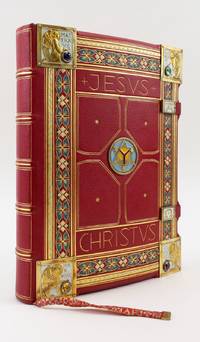
1925ST16974Flensburg ca. 1925. 325 x 240 mm. 12 7/8 x 9 1/2". 4 p.l. first two blank 4 leaves 144 pp. 4 leaves last blank. Single column 31 lines in a fine calligraphic hand. <br/> FLAMBOYANT DEEP RED MOROCCO ELABORATELY INLAID AND GILT BY W. A. PETERSEN stamp-signed on rear turn-in covers framed by inlaid white morocco strip tooled with gilt triangles enclosing sides in a bead-and-lozenge pattern of gilt-outlined mandorlas containing a red cross on a blue background alternating with an inlaid white lozenge upper cover with brass and enamel cornerpieces featuring the symbols of the four Evangelists each of these set with a colored glass gem central panel divided into four compartments each containing a small star tool central brass and enamel medallion with a six-pointed star emblazoned with a sun and a red enamel "Y" two straps with brass and enamel clasps marked with Alpha and Omega lower cover with brass cornerpieces raised bands spine with gilt-ruled compartments turn-ins tooled with plain and dotted gilt rules and gilt stars deep pink moiré silk doublures shot with gold thread all edges gilt. In a box with a velvet-lined maroon buckram base and green marbled paper lid. With many initials of various sizes painted blue red green purple maroon or gilt three three-line initials in gold on a colored ground with the shape of a cross one two-line initial and 13 four- to six-line initials in gold on a multi-colored ground in a geometric design SEVEN HISTORIATED INITIALS each measuring seven to 11 lines in length FIVE MINIATURES MEASURING A THIRD TO THREE-QUARTERS OF THE PAGE each featuring a scene from the life of the Virgin or the life of Christ SIX FULL-PAGE ILLUMINATIONS incorporating text of different sizes and fonts many colors and patterns five of which contain a large central gilt circle the first of these completely filled with gold the others with a religious symbol in pen on bare vellum every page with a unique border composed of a thin frame with different geometric designs in gold and color some pages with an additional column of floral and foliate designs running down the left side of the text within the border plus additional flourishes elsewhere. Text in multiple sizes and fonts occasional words or phrases penned in color or gold. Boards somewhat bowed as often with bindings on vellum works occasional naturally occurring variations in the grain of the vellum a few instances of faint thumb smudging in corners but A BEAUTIFUL MANUSCRIPT IN ESPECIALLY FINE CONDITION the vellum smooth and fresh the illuminations shimmering and the binding unworn.<br/> <br/> Replete with gold illumination and bright colors evoking the appearance of Medieval manuscripts and stained glass this is an exquisitely produced work relating the life and words of Christ divided into five thematic parts: Light Word Spirit Death and Resurrection. Each part opens with a sumptuous full-page illumination reminiscent of the "carpet page" painting found in early Insular manuscripts; in the present work our artist fills the frame with a dazzling mixture of text and decorative patterns around a lustrous gilt medallion calling to mind the sun a resplendent halo or the Host. Although much of the decoration both on these full-page illuminations and elsewhere in this work remind one of Medieval manuscripts and are often composed of geometric designs and colors suggestive of stained glass the overall style here is decidedly modern. The palette is fresh and bold while the emphasis on strong lines and patterns shows the influence of the reigning Art Deco movement with echoes of the Art Nouveau movement that preceded it. Traditional biblical narratives in the form of historiated initials and miniatures are also presented here in refreshing ways: the image of the Sermon on the Mount for example places the viewer directly among the masses; we experience the event as a member of the audience would looking over the shoulders of the people in front of us to see Christ orating from a small hill silhouetted against a bright pink sky. Another memorable image--and the largest figural composition in this manuscript--is the Crucifixion. Though he has used a fairly standard composition the artist plays with our perception of space by setting the scene on a dark blue ground that envelopes the figures in a shadowy void; the only light source seems to come from the gold lettering immediately above the cross radiating off the face of Christ and to a lesser degree off the grief-stricken faces of John the Evangelist and the Virgin. All are pictured without haloes thus emphasizing the humanity of Christ over his divinity. As a whole this manuscript is extremely impressive in terms of artistry and technical execution and the prolific decoration and calligraphic variety hold the viewer's interest page after page. The equally impressive binding--modelled after the look of a Medieval Gospel book complete with enamel-like bosses and jewels--is fitting for a work that pays homage to the past while celebrating contemporary art and style. The life and work of calligrapher and illuminator Johann Holtz 1875-1944 is poorly documented but he seems to have been active in Flensberg Germany; he also worked as a graphic artist. Binder W. A. Petersen has proven equally illusive but we know that his workshop was also located in Flensburg. Given the town's close proximity to Denmark we might speculate whether Petersen was somehow related to the Copenhagen-based binder Immanuel Petersen who took over from master binder D. L. Clément in 1877. Despite the lack of biographical information on our artist and binder the work here needs no provenance information to be pleasing in every way from the gleaming binding to the beautifully preserved and magnificently illuminated contents. unknown
195474499Philadelphia: American Dredging Company 1954. A lovely calligraphic memorial resolution calligraphed by by W. G. Strickland of Philadelphia. Octavo 6 3/4 x 9 1/2 inches. 6 leaves of vellum of which four bear the memorial versos only. Capitals done in gilt and blue. Opening leaf elaborately decorated. Final leaf signed by each Member of the Board. Original black pebbled morocco gilt turn-ins white moire silk doublures matching slipcase. An excellent example of this form of the Golden Watch.The American Dredging Company of Philadelphia began operations in 1867 and soon became the largest dredging company in the country. E. Homan Stroud joined the company in 1904 and rose through the ranks to become its president in 1944. He died on June 24 1954 and this memorial was dated the day after. Apparently there were two copies as it states near the rear that a copy shall be given to his widow. [American Dredging Company] hardcover
1915ST20770London: Especially written out and illuminated by Alberto Sangorski ca. 1915. 249 x 165 mm. 9 3/4 x 6 1/2". 18 2 pp. 2 leaves blank colophon. <br/> Attractive dark green crushed morocco gilt by Riviere & Son stamp-signed on front turn-in covers with wide frame and central panel tooled in gothic architectural motifs raised bands spine compartments with double gilt rules gilt lettering turn-ins framed by gilt fillets and dots scarlet watered silk pastedowns and endleaves all edges gilt old repair to head of spine. With one burnished gold initial "A" with intricate penwork embellishment in red and blue THE WORD "FOR" WRITTEN IN LARGE BURNISHED GOLD LETTERS SIX TIMES all with delicate penwork embellishment in blue or green TWO WITH A FAIRY-WINGED PUTTO perched on the crossbar of the "F" another "FOR" written in blue THE "F" IN BURNISHED GOLD ON A BACKGROUND OF BRUSHED GOLD WITH A PINK ROSE SPRIG a tailpiece of white jasmine blossoms entwined with a spray of lilac blooms FOUR ESPECIALLY FINE BRIGHT OVAL VIGNETTES approximately 90 mm. across SHOWING LOVELY GARDENS one of these accompanied by A HALF BORDER OF HUCKLEBERRY VINE another at the front as part of A SUPERB DOUBLE-PAGE OPENING FEATURING A PROFUSION OF PINK ROSES forming a frame around a gilt-edged cartouche bearing the title in blue surrounded by delicately blue and brown tendrils on the left AND A FRAME OF GRAPEVINES BEARING SUCCULENT PURPLE FRUIT ON A BRUSHED GOLD BACKGROUND on the right an oval view of a lake and mountains at its foot this frame enclosing text beginning with the words "GOD ALMIGHTY" in thickly burnished gold accented with curling blue and brown acanthus leaves and blue penwork. One page with trivial thumb smudge faint variations in shade of the vellum but A SUPERB SPECIMEN the vellum smooth and creamy the paint and gold bright and the virtually unworn binding with shining gilt.<br/> <br/> Featuring several gorgeous moments this is a luxurious and appropriately luxuriant illuminated manuscript of Bacon's prescription for the ideal princely garden. The most prominent modern creator of illuminated manuscripts our artist Alberto Sangorski 1862-1932 started his professional life as secretary to a goldsmith's firm before being attracted to the book arts at the age of 43. He began doing illuminated manuscripts that were then bound by his brother Francis' firm Sangorski & Sutcliffe with the colophon crediting the manuscript to the firm rather than acknowledging Alberto's contribution. Partly because of this failure to recognize his work Alberto had a falling out with Francis sometime around 1910 at which time he took his talents to Riviere the chief competitor to his brother's bindery. Robert Riviere began as a bookseller and binder in Bath in 1829 then set up shop as a binder in London in 1840; in 1881 he took his grandson Percival Calkin into partnership at which time the firm became known as Riviere & Son and the bindery continued to do business until 1939. Riviere was happy to allow Albert to add a colophon proclaiming as here that "This manuscript . . . was designed written out and illuminated by Alberto Sangorski." The decoration in the present work has an airy light-hearted aura with the bright gold lettering the delicate intricate penwork and the whimsical fairies conveying considerable joy and playfulness. And the beauty of the manuscript is heightened by the extremely fine condition here. Especially written out and illuminated by Alberto Sangorski unknown
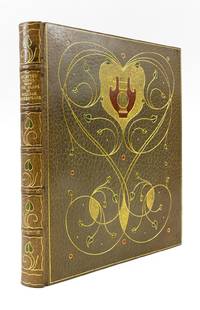
1920ST16608<p>London: Designed written out and illuminated by Alberto Sangorski Colophon 1920. 255 x 212 mm. 10 1/8 x 8 1/2". 25 3 pp.</p><p>ELEGANT LIGHT OLIVE GREEN CRUSHED MOROCCO GILT AND INLAID by Riviere for London bookseller Charles J. Sawyer stamp-signed "Chas. J. Sawyer Ltd. London" on front turn-in upper cover with inlaid mahogany-brown morocco lyre at head "strung" with gilt fillets and surrounded by dense gilt stippling six gilt fillets emanating from the top of this ornament and curling extravagantly below it with inlaid green morocco leaves at the tips of its extensions and inlaid red dots accenting the perimeter raised bands spine compartments with gilt and inlaid leaf sprig gilt titling turn-ins framed with five gilt fillets stippled and inlaid cornerpieces ivory moiré silk doublures and endleaves. In a fine full morocco plush-lined box with raised bands and gilt titling. ILLUSTRATED THROUGHOUT WITH EIGHT LARGE MINIATURES within extraordinarily elaborate illuminated borders FIVE FINE ROUNDELS FOUR LARGE HISTORIATED INITIALS a portrait of a young woman a leaping stag a skull and a landscape with a castle tower AND 25 ILLUMINATED INITIALS all with burnished gold. New expertly matched silk guards. SIGNED by Sangorski in the colophon following the statement: "This manuscript will not be duplicated." With an early typescript list of the contents laid in at front. Ratcliffe "Alberto Sangorski" SJR 338 attributing the binding to Riviere. ◆Spine slightly sunned to olive brown just a hint of sunning to head and fore edges of boards spine with half a dozen barely perceptible tiny dark spots but A VERY FINE COPY OF AN EXTRAORDINARILY BEAUTIFUL MANUSCRIPT the binding unworn and lustrous and the interior pristine with vellum clean and bright and the paintings perfectly preserved.<br /><br />Written out decorated and painted by one of the most accomplished illuminators of the modern era this attractively bound work celebrates some of Shakespeare's best-known plays with sumptuous miniatures that are in a perfect state of preservation. Songs from "The Tempest" "As You Like It" "Hamlet" "A Midsummer Night's Dream" and other works provide the inspiration for the many delightful miniatures seen here which display an impressive variety of portraits outdoor views and figural scenes--everything from reclining nudes to a particularly lush scene in which a group of spirited hunters return from the woods. The illustrations are all painted with exquisite attention to detail and demonstrate the artist's innate understanding of color rendering each composition delicate yet vigorous and vibrantly hued. All Sangorski manuscripts with miniatures are painted with great skill but this one is particularly arresting. Alberto Sangorski 1862-1932 started his professional life as secretary to a goldsmith's firm became attracted to the book arts at the age of 43 and began doing illuminated manuscripts that were then bound by his brother Francis' firm Sangorski & Sutcliffe. Sometime around 1910 Alberto and Francis had a falling out and the artist went to work for Riviere the chief competitor to his brother's firm. <br /><br />The gracefully tooled binding here was commissioned by London bookseller Charles J. Sawyer 1876-1931 who opened his shop in 1894. According to Brown and Brett's "The London Bookshop" Sawyer provided "anything suitable for a gentleman's library" with specialties in "rare items early English literature fine bindings and sporting and colour-plate books." While the binder fulfilling the commission did not sign this work Sangorski bibliographer Stephen Ratcliffe attributes it to Riviere & Son and there are examples of Riviere bindings decorated in this Art Nouveau style. But the design here with its delicate curving lines creating uncommon shapes also resembles the work done by members of the Guild of Women Binders. Whoever the artisans involved the binding is attractively designed and executed using premium materials and it provides a pleasing cover for the glorious illuminations within.</p> [D]esigned, written out, and illuminated by Alberto Sangorski [Colophon]
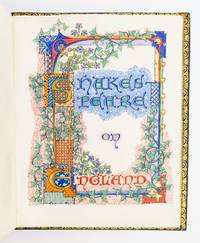
1944ST19310Sheffield England December 1944. 265 x 215 mm. 10 1/2 x 8 1/2". 6 leaves illuminated on rectos final leaf also illuminated on verso with colophon. <br/> VERY ATTRACTIVE DARK BLUE MOROCCO GILT stamped-signed "Bound by Slinn" on front pastedown upper cover with monogram of Edwin Goddard Stokes framed by gilt-ruled compartments containing gilt lettering elaborate gilt foliage and a gilt crown tool at top the panel surrounded by a double gilt rule frame and dogtooth roll border with additional foliate tools rear cover with quatrefoil design in floral tools and pointillé dogtooth roll border smooth spine with gilt-ruled compartments. In a rather worn felt-lined brown paper wallet case with handwritten titling on spine. Each recto with one or two large two- to three-line initials either painted or gilt TITLE PAGE WITH A FULL BORDER and others with a large complex border all of them elaborately painted with a variety of patterns styles motifs and with gilt embellishments one border incorporating three coats of arms AND ANOTHER PAGE WITH A QUARTER-PAGE MINIATURE OF A KNIGHT ON HORSEBACK. Trivial wear at top of front joint otherwise in pristine condition.<br/> <br/> This is a charming modern illuminated manuscript penned during WWII that contains two excerpts from Shakespeare in praise of "this other Eden demi-paradise" called England--specifically passages from John of Gaunt's dying speech in "King Richard II" and lines from "King John." As stated in the colophon the manuscript "was Designed Written out and Illuminated by John Wilfred Clarke of Ecclesall Sheffield for his great friend Edwin Goddard Stokes of Ringinglow Sheffield." Clarke d. 1954 was a municipal engineer and town planner by trade professions for which skill in the visual arts particularly draftsmanship is not only preferred but required. He was clearly a talented amateur with a flair for pattern and design. Though he incorporates elements found in Medieval manuscripts--trailing ivy leaves penwork decoration tessellation and line enders--the style is at the same time modern utilizing bold color combinations and layered shapes and patterns. Given the artist's location it is quite possible that he was involved with the Sheffield School of Art which was founded in 1843 and offered classes in fine arts and crafts. We know that the binder Walter Slinn d. 1964 was a staff member at the school as well as a prominent local bookbinder. Nationalistic sentiments are made clear in the choice of material celebrating England in Shakespeare's voice and this manuscript is all the more poignant when seen in the context of its time and place. Sheffield an industrial city was a major producer of steel and armaments during WWII --and thus a high-value target for German air raids. The so-called "Sheffield Blitz" of 1940 resulted in hundreds of deaths and nearly 80000 damaged homes. In December of 1944 when this manuscript was completed the end of the war was not yet in sight. Despite the bleak circumstances the manuscript radiates color light and hope. The recipient of Clarke's attractive manuscript was Edwin Goddard Stokes 1902 - ca. 1957 one of the sons of the prominent Sheffield businessman Robert James Stokes founder of R. J. Stokes & Co. a tile company that still flourishes in the city now. It is clear that this item was carefully looked after by this "great friend" of the artist. So far as we have been able to determine Clarke is an unrecorded artist except for the present Shakespeare work and one other similar manuscript featuring excerpts from Chaucer now in Stanford University Library. unknown
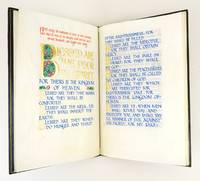
1939ST17129-020Wimbledon Surrey September 1939. 373 x 255 mm. 14 3/4 x 10". 12 vellum leaves seven with text and illuminations. Single column approximately 30 lines in a fine calligraphic hand. <br/> Attractive contemporary dark blue crushed morocco covers with gilt and blind rules raised bands with gilt rules gilt-ruled turn-ins vellum pastedowns. Text in blue black green and red a few lines with larger lettering in gilt several two-line initials in colored ink five two-line initials in red or blue with floral decorations opening pages with eight two-line initials in gold the lines here of a larger size than rest of text six three-line initials in gold filled and surrounded by floral decoration three four- to six-line gilt initials with more intricate floral decorations one of these with gilt stippling and two surrounded by a gilt frame and ONE VERY LARGE 80 x 45 mm GILT "B" decorated with stippling filled with two-tone green leaves pink flowers and large gold bezants. First leaf with ink inscription "Presented by Dr. W J Pearson / in appreciation of the work of / Ashridge Hospital 1939-1946"; two silk guards. Boards with a hint of soiling but A BEAUTIFUL MANUSCRIPT IN OUTSTANDING CONDITION the paint lovely and bright and the gold sparkling.<br/> <br/> This beautifully executed manuscript by a notable female calligrapher and illuminator features the oft-quoted and much-loved biblical text known as the "Sermon on the Mount" in which Matthew relates various moral teachings attributed to Christ. The text is written in an extremely pleasing and regular upright script throughout but the first opening listing the nine Beatitudes in capital letters is especially striking. Opening with the largest and most attractive initial in the manuscript it begins with "Blessed are the poor in spirit" in prominent gilt lettering; this is followed by the other blessings each beginning with a smaller gilt "B" initial written entirely in blue capital letters. The rest of the text penned primarily in black ink but accented with cheerful gilt initials and occasional colored lettering exudes a sense of order and simple elegance befitting the contents. Illuminator and calligrapher Violet Wilson was born in Wimbledon in 1902. She studied calligraphy under Claire G. M. Evans who had been a pupil of Graily Hewitt known for his work with the Ashendene Press and one of the principal British calligraphers and teachers of lettering in the first half of the 20th century. Wilson became a member of the Society of Scribes and Illuminators in the U.K. in the 1930s. The San Francisco Public Library has examples of her work in its Harrison Collection of Calligraphy and another illuminated copy of the "Sermon on the Mount" made in 1957 was included in the Baltimore Art Museum's 1965 exhibition and catalogue titled "Two Thousand Years of Calligraphy." The catalogue entry no. 213 notes that Wilson preferred to work on books and decorative maps and exhibited her work in many countries. According to the presentation inscription in the present work this manuscript was given to Ashridge Hospital--formerly a monastery and royal residence--by the distinguished physician Dr. Wilfred John Pearson 1884-1957 who had headed one of the London sectors of the Emergency Medical Service during World War II. His obituary in the "British Medical Journal" declared him "one of the striking figures of his time.". unknown
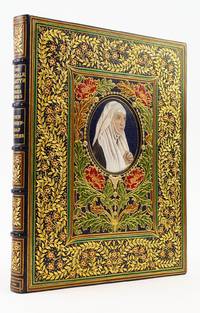
1914ST18714London 1914. 265 x 207 mm. 10 1/2 x 8 1/4". 41 3 blank pp. 1 leaf colophon. <br/> RESPLENDENT IN DARK BLUE MOROCCO RICHLY GILT AND ONLAID BY RIVIERE & SON stamp-signed on front doublure covers with wide frame of swirling gilt vines bearing red morocco blossoms and blue and green berries bordered by strips of green and tan morocco central panel of upper cover with recessed oval containing a portrait of a young nun sculpted in leather with painted details this encircled by an onlaid ivory morocco rosary and surrounded by an exuberant spray of red morocco poppies with green and tan leaves central panel of lower cover with an arch-backed black morocco cat beneath the arch of a gray morocco horseshoe at center a black and red witch's hat above the horseshoe and the whole on a very densely stippled gilt ground incised with calligraphic curls and set with nine silver stars around the cat this centerpiece surrounded by curling gilt vines bearing red morocco and gilt posies raised bands spine compartments framed with tan morocco and containing a gilt and onlaid floral sprig TAN MOROCCO DOUBLURES bordered by a strip of purple morocco this with onlaid green morocco frame adorned with gilt latticework densely stippled gilt cornerpieces set with purple morocco passionflowers all accented with inlaid circles of purple navy and green in varying sizes leather hinges apricot watered silk endleaves all edges gilt. In the original silk- and velvet-lined green morocco box. Numerous two- to three-line initials in red blue or burnished gold three three-line illuminated initials 11 five- to six-line initials in shades of purple blue and green with highlights of pink and burnished gold two of these with extensions running the length of the text and two incorporated into full borders four very large initials 12 lines or more in colors and gold five full borders that on title page incorporating a small oval miniature of Whittier and TWO FULL-PAGE MINIATURES one of a young nun at prayer the other of two lovers walking in a forest. Calligraphed colophon SIGNED by Sangorski stating: "This manuscript . . . was designed written out and illuminated by Alberto Sangorski for Messrs. R. Rivière & Son Bookbinders & Booksellers to his Majesty King George V. London. This manuscript will not be duplicated. This manuscript was executed by me." From the collection of Phoebe A. D. Boyle her sale at Anderson Galleries 19-20 November 1923 lot 368. Front flyleaf with engraved bookplate of comic book pioneer M. C. Gaines 1894-1947; typed description from "Kolb Collection" Louis Kolb laid in. Ratcliffe "Albert Sangorski Bibliography" SJR 245. Vellum a bit wavy as is typical but A BEAUTIFUL COPY the leaves creamy and bright being painted with rich colors and glittering gold and IN A FLAWLESS BINDING.<br/> <br/> This is an outstanding example of the artistry of Alberto Sangorski and that of the binders gilders and finishers of Riviere & Son the volume being executed at the zenith of their creative powers and formerly owned by the most important collector of Sangorski's manuscripts. Sangorski has written out and illuminated three poems by American author John Greenleaf Whittier: "The Female Martyr" inspired by an 18-year-old nun from the Sisters of Charity who died nursing cholera victims; "The Witch's Daughter" set in Puritan New England; and "Memories" a lover's touching reminiscences of youthful romance. In addition to elaborate initials and borders in his preferred palette of blues purples and greens brightened with burnished gold Sangorski has created two full-page paintings one of the beautiful young nun at prayer the other of youthful sweethearts strolling arm-in-arm through a wood. <br /> <br /> Alberto Sangorski 1862-1932 started his professional life as secretary to a goldsmith's firm became attracted to the book arts at the age of 43 and began doing illuminated manuscripts that were then bound by his brother Francis' firm Sangorski & Sutcliffe. Sometime around 1910 Alberto and Francis had a falling out and the artist went to work for Riviere the chief competitor to his brother's firm. Like the manuscript here our binding by Riviere is the work of many months with hundreds of individual inlays onlays and applications of gilt. Robert Riviere began as a bookseller and binder in Bath in 1829 then set up shop as a binder in London in 1840; in 1881 he took his grandson Percival Calkin into partnership at which time the firm became known as Riviere & Son and the bindery continued to do business until 1939. New York collector Phoebe A. D. Boyle was the widow of a canvas manufacturer who had made a fortune providing tents to the U.S. Army in the Civil War. George Sutcliffe described this important client as "rivalling the Medici in her patronage of the production of beautiful books." Stephen Ratcliffe deems the Boyle collection as "unrivalled" for its jewelled bindings and modern illuminated manuscripts; 33 of Alberto Sangorski's creations appeared in her sale at Anderson Galleries in 1923 and during World War I she was one of the only customers for extravagant productions like the present item. Any book from the Boyle collection which was put together with the greatest taste and discrimination is recognized as desirable beyond its intrinsic literary merit. unknown
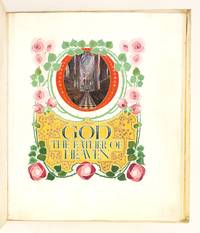
1907ST16456Birmingham 1907. 312 x 275 mm. 12 3/8 x 10 3/4". 16 leaves illuminated on rectos only. <br/> Pleasing original full vellum over bevelled boards covers ruled in gilt and with gilt crosses in each corner gilt lettering on upper cover smooth spine gilt rules dividing compartments with central gilt cross thick vellum turn-ins ruled in gilt bright purple silk endpapers front joint very expertly repaired. Calligraphic lettering mostly in black green and red a few one-line initials and many three-line initials in blue or purple with red penwork several slightly larger purple or blue initials infilled with ivy of various colors and dotted with gold EACH PAGE WITH A DIFFERENT ARTS & CRAFTS-INSPIRED FLORAL BORDER consisting of multi-colored blossoms and acanthus as well as meandering vine-stems and highlighted with gold bezants or stippled gold ONE LEAF WITH A 90 MM. INITIAL INHABITED BY A REALISTIC CATHEDRAL INTERIOR the large lettering below it on a gold ground with etched patterns and painted purple ivy leaves the text and the initial surrounded by pink roses green leaves and thorny vines. ◆Corners a bit bumped vellum with a few shallow scratches slightly soiled in a few places other minor signs of use but the binding still quite clean and attractive; perhaps a hint of thumb-soiling to margins of a couple leaves but the contents in nearly perfect condition.<br/> <br/> This is a beautiful and engaging manuscript with imaginative illuminations by the little-known but extremely talented illuminator calligrapher and cartographer Ernest Costain Clegg 1876-1954. The text here reproduces the Great Litany of the Church of England derived from the Book of Common Prayer and composed of short divine petitions. Each leaf contains a different and unique border featuring stylized floral motifs often with curving vines encircling the text and a cheerful color palette consisting of clear pastels that beautifully offset the darker inks used in the text. The generous use of gold on the first leaf of text and gilt details throughout the borders provide a dimension of luxury without overshadowing the prayers themselves. Clegg draws on the Medieval tradition of manuscript illumination but this work also shows the influence of the Arts & Crafts movement of the 19th century especially in the beautiful initial inhabited by a realistic Cathedral interior pierced with light--a feature that invites comparison with the superlative work of Alberto Sangorski. But Clegg's reliance on a variety of floral decoration in his borders makes this manuscript more feminine than the typical work of Sangorski. Ernest Clegg entered the military in his early twenties serving in the Boer War 1899-1902 then returned to England to train at the Birmingham School of Art. In 1909 he went to work for Tiffany's of New York as a jewelry designer. Clegg also served in the English forces during the First World War; afterwards in America his popularity in the veteran community led to more commissions and a thriving artistic career. Clegg is perhaps best known for illustrating the poem "In Flanders Fields" written by John McCrae but he also found success as a cartographer producing among other works a well-known map of Charles Lindbergh's flight across the Atlantic in 1927. unknown
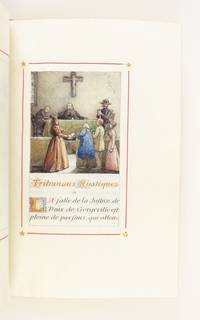
1896ST17129-026Paris 1896. 200 x 135 mm. 7 7/8 x 5 3/8". 11 leaves. Single column 16 lines plus headline in a thin graceful italic script. <br/> Attractive red crushed morocco by Marcellin Lortic stamp-signed on front doublure covers framed by multiple-rule gilt strapwork raised bands spine compartments with gilt French fillet gilt titling vellum doublures with gilt frame in the Romantic style leather hinges vellum endleaves all edges gilt. In matching morocco-trimmed slipcase. Title in burnished gold embellished with red and blue penwork text with red-ruled border and burnished gold stars at corners numerous one-line burnished gold initials with red or blue penwork two-line opening initial in burnished gold on a blue white and pink background and A HALF-PAGE MINIATURE measuring 71 x 64 mm. SHOWING A COURTROOM SCENE. Front free endleaf with morocco bookplate of Robert Hoe. ◆Just the slightest hint of rubbing to joints but A VERY FINE SPECIMEN entirely fresh bright and clean inside and out.<br/> <br/> This elegant little manuscript in French recounts Guy de Maupassant's satirical tale of a trial in the provinces; it was created by a man who knew the inside of a courtroom all too well. Bouton 1819-1901 was a young rebel during the 1848 Revolution who spent five years in jail for his participation in a bombing in Paris. Oddly enough the dedicated republican was also an expert on heraldry and paleography publishing pamphlets on those subjects as well as on politics and producing manuscripts like the present one. De Maupassant 1850-1893 is generally acknowledged as one of the great masters of the short story. In the present tale a wealthy older woman who had tried to buy a young peasant's love by giving him land sues unsuccessfully for the return of her property when the object of her affection forsakes her for a younger woman. According to Beverly Chew the library of Robert Hoe 1839-1911 founding member and first president of the Grolier Club was "the finest America has ever contained." Hoe acquired illuminated manuscripts early printing he owned a Gutenberg Bible on paper and one on vellum fine bindings French and English literature and Americana and when his library was sold in 1911-12 it fetched nearly $2 million a record that held until the Streeter sale more than 50 years later. Hoe owned several Bouton manuscripts of de Maupassant stories and the Morgan Library also has Bouton creations. The Lortic name was made famous in the history of French binding by Pierre Marcellin Lortic 1822-92 a leading Parisian binder for 40 years; the binder here was Lortic's son Marcellin or "Lortic Fils" 1852-1928. unknown
a5097632x16 cm folded in sixths. Sepia-toned ink manuscript letter in Latin on one third of inside surface with heading in manuscript on outside. Original cord with metal seal formed over and around the strings holding string ends together. Seal is about 1.3 inches in diameter. One side of seal shows a King and Pope. and reads: Veneti .DVX.Hierpriolus. Verso reads HIH Ronimus Priolus Die Grad VX Venetiar et C with narrow decorated circular border around edge. Text appears to concern political affairs. Girolamo Priuli 1486 - 1567 was Doge in Venice 1559-1567. Legible. Highly unusual item. Rare and Unique. Pictures available on request. . unknown
3943Hardcover. Very Good. Published circa 1900 gift inscription dated 1908. 22 pp. Little book measuring apx. 5.5" x 3". Presumably very scarce. The binding is lovely: full vellum with both front and rear panels painted in colors and heightened with gold. Light wear. <br/><br/> hardcover
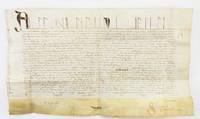
1502ST17895Rome 10 August 1502. 305 x 513 mm. 12 x 20 1/4". Single column 29 lines in a papal documentary script plus signatures at bottom. <br/> First line of text much larger and with elongated letters and calligraphic flourishes. WITH THE ORIGINAL LEAD SEAL AND HEMP TIES ATTACHED. Verso with several ink notations in different contemporary and later hands recto with a long ink line in one margin and the letter "A" in the other both by a later hand. Several folds to vellum as usual one-inch tear near where the hemp tie is attached a couple of small holes in the large "A" at the top of the document seal a little worn around edges and to the contours of the faces but overall in excellent condition with no major issues the vellum especially clean and bright.<br/> <br/> Issued to the overseer of a church in Frilingen probably modern Freilingen in Germany this bull orders the return of the vacated ecclesiastical seat and benefices of the church of St. James in Hergelzhausen in the diocese of Frilingen to two people. The church's rector Andrew Kuefuelz is to receive the position and things that once belonged to Leonard Walter the procurator while George Maltzel of Erding a priest of the same church is to receive the provisions and annual rents pertaining to the church. A member of the powerful Borgia family Rodrigo Borgia 1431-1503 served as vice-chancellor to five successive popes before being elected to the papacy in 1492 taking the name Alexander VI. One of two Borgias to ascend to the papacy the other was Callixtus III who died after just three years as pope Alexander held his own among a notorious family known for scandal. He led a sordid personal life--he was accused of participating in an orgy when he was a cardinal and openly admitted to fathering several children by his mistresses--and his reign was characterized by acts of nepotism and promoting his own family's interests above all else--especially with matters related to foreign policy. However he was also known as a patron of the arts having commissioned work by Raphael Michelangelo and Pinturicchio adopted a rather tolerant attitude toward Jews during this period and succeeded in cracking down on crime in Rome. The Papal Bull takes its name from the lead seals called "bullae" that were issued with official documents of the papacy as a way of ensuring their authenticity. Apart from the rare Solemn Privilege like Innocent III's famous granting of England in 1214 to his involuntary vassal King John there are three other categories of Papal Bulls: Simple Privileges also called Solemn Letters Letters of Grace which confirm privileges and rights and Mandates. The present item is of this final type differentiated by its use of hemp ties as opposed to silk. unknown
1740ST12778-0377Rome 1740. 180 x 312 mm. 7 x 12 1/4". Single column 18 lines in an arcane "scrittura bollatica." <br/> Elaborate lettering across top line of text and at lower right corner. Lower margin with several signatures in ink; verso with brief notes in ink; remains of hemp tie for appended seal which has been cut away. With faint folds a little natural yellowing to vellum but in fine condition.<br/> <br/> Appearing almost as a dancing musical score this is Papal Bull that leaves a lot to be deciphered. The document is written in the so-called "scrittura bollatica" which the Catholic Encyclopedia calls "an archaic and very artificial type of writing . . . with manifold contractions and an absence of all punctuation which was practically undecipherable by ordinary readers." The script was used from after the Reformation until it was discontinued through papal edict by Leo XIII in 1878. Apart from the name of the issuing pope and the date the only readily identifiable part of the text here is the name of the Archbishop of Naples the addressee on the top line. We acquired this document along with several other bulls addressed to this archbishop all having to do with marriage dispensations and we suspect that the present item probably contains similar content. The esteemed polymath Pope Benedict XIV born Prospero Lorenzo Lambertini 1675-1758 headed the Catholic Church from 1740 until his death. A scholar and reformer he worked to modernize church administration promote scientific study and improve relations with secular rulers. unknown
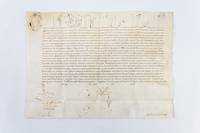
1622ST12778-0281Rome 1622. 295 x 410 mm. 11 5/8 x 16 1/8". Single column 23 lines in a papal chancery hand. <br/> Elaborate lettering across top line of text. Lower margin with several signatures in ink; verso with brief notes in ink; lacking the original hemp tie and lead seal. Two tears at bottom of the document where ties were removed not affecting text vellum lightly soiled but in excellent condition overall.<br/> <br/> Addressed to the Archbishop of Naples this Papal Bull grants a marriage dispensation between Fabritio Virgopia and Judith Cuono. An online search finds nothing about the couple named here but the document reveals that they were petitioning for a dispensation because they fell into the second and third degrees of consanguinity meaning that they shared at least one common ancestor. Although marrying within four degrees of consanguinity was prohibited by the church it was not uncommon for the Holy See to issue dispensations as here allowing such marriages to take place—particularly for the privileged classes. The Papal Bull takes its name from the lead seals called "bullae" lacking in the present example that were issued with official documents of the papacy as a way of ensuring their authenticity. Apart from the very rare Solemn Privilege like Innocent III's famous granting of England in 1214 to his involuntary vassal King John there are three categories of Papal Bulls: Simple Privileges also called Solemn Letters Letters of Grace which confirm privileges and rights but are somewhat smaller and Mandates which are differentiated by their use of hemp ties as opposed to silk as would have been the case here. Pope Gregory XV born Alessandro Ludovisi 1554-1623 ruled for just over two years from 1621-23. His brief papacy was marked by efforts to support the Catholic Counter-Reformation including the establishment of the Congregation for the Propagation of the Faith to oversee missionary work. He also played a key role in the election of Holy Roman Emperor Ferdinand II canonized notable saints such as Ignatius of Loyola and Francis Xavier and issued the last papal mandate concerning witchcraft. Documents issued by Gregory XV are unsurprisingly rare given the shortness of his rein: we could trace just one sold at auction since 1995. unknown
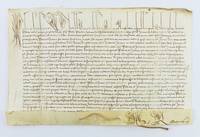
1614ST12778-0352Rome 1614. 203 x 319 mm. 8 x 12 5/8". Single column 25 lines in a papal chancery hand. <br/> With braided cloth tie for appended seal now gone. Elaborate lettering all across top line of text especially the first 8-line initial and at lower right corner. Lower margin with several signatures in ink behind the fold; verso with brief notes in ink; remains of hemp tie for appended seal which has been cut away. Three vertical and one horizontal fold creases faint overall yellowing to verso possible erasure correction in second line of text otherwise the page bright and the hand clear.<br/> <br/> Addressed to the Archbishop of Naples this Papal Bull grants a marriage dispensation between Pietro Palladino and Giovanna Cabalone. An online search finds nothing about the couple named in the present document but they were apparently high-ranking Neapolitan citizens who had the means to procure a Papal intercession. Likewise the particular impediment prohibiting the marriage is not apparent here. This type of document takes its name from the lead seals called "bullae" that were issued with official documents of the papacy as a way of ensuring their authenticity. Apart from the very rare Solemn Privilege like Innocent III's famous granting of England in 1214 to his involuntary vassal King John there are three categories of Papal Bulls: Simple Privileges also called Solemn Letters Letters of Grace which confirm privileges and rights but are somewhat smaller and Mandates which are differentiated by their use of hemp ties as opposed to silk as here. A member of the influential Borghese family Pope Paul V born Camillo Borghese 1550-1621 reigned as head of the Catholic Church for 16 years from 1605 until his death. As a staunch defender of the rights and privileges of the church he often came into conflict with secular leaders. He is perhaps best remembered for financing the completion of St. Peter's Basilica and for his involvement in the Galileo controversy in which he warned the scientist against advocating heliocentrism. unknown
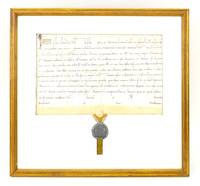
ST16379-036Rome 2 December 1210. 206 x 293 mm. 8 1/8 x 11 1/2". 12 lines in a papal documentary script. <br/> Attractively framed. Lead bulla suspended on silk threads. Very light rubbing to ink in places one horizontal and three vertical creases each with a tiny hole where the folds meet lead seal showing a bit of wear around edges and to protuberances of the faces but these faults all quite minor and on the whole an excellent specimen.<br/> <br/> Beautifully preserved and with the original lead bulla still attached this document issued by one of the most powerful popes of the Middle Ages resolves a dispute between the monastery attached to the Lateran Palace and the priory of Santi Quattro Coronati Four Holy Martyrs. The two groups seem to have been in conflict over their respective parish boundaries and the inclusion or exclusion of certain churches and therefore the tithes and legal dues stemming from those churches within their particular networks of influence. According to this bull the cardinal priest of Sts. Peter and Paul was charged with hearing their petitions; based on his report Pope Innocent III decrees that the boundaries of the priory's parish will extend to the church of St. Nicholas "de formis" on one side and the arch of John the Baptist "intra formis" on the other side with "de formis" and "intra formis" possibly referring to their relative position to certain aqueducts in the city. The document also notes that it does not alter parish boundaries as formerly defined by Pope Calixtus II r. 1119-24. The present item falls into a category of papal documents known as "litterae solemnes" comprising solemn letters and simple privileges. Though somewhat shorter and less formal than the so-called "Great Bulls" which were very large and included many marks and signatures for authentication "litterae solemnes" still followed strict rules in terms of format and appearance and included a lead seal displaying the pope's name on one side and the visages of Sts. Peter and Paul on the other as here. For a full overview of papal bulls and their various formats see Clemens & Graham "Introduction to Manuscript Studies" pp. 230-36. Innocent III born Lotario dei Conti di Segni 1160 or 1161-1216 was considered the most powerful person in Europe during his reign 1198-1216 having done much to consolidate the power of the Holy See and exert influence over the affairs of nations near and far. Notably he proclaimed the supremacy of the church over secular authority launched the Fourth Crusade which ended in the sacking of Constantinople presided over the Fourth Lateran Council excommunicated King John of England and nullified the Magna Carta and vigorously suppressed heretical sects such as the Cathars. Papal bulls issued by Innocent III seem to be of the utmost rarity on the market; we could find just one other example recorded by ABPC and RBH as sold in the past 100 years going for a hammer price of €9000 $10999 in 2013. unknown
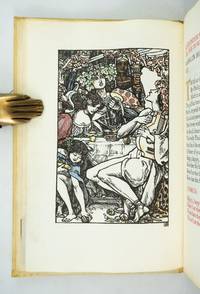
1904ST20796London: Essex House Press 1904. No. 1 OF 140 COPIES all on vellum. 195 x 131 mm. 7 3/4 x 5 1/8". 1 p.l. frontispiece 3-11 2 pp. <br/> Original stiff vellum over thin boards front cover with embossed rose design. In custom-made linen clamshell box with red morocco label on spine. Hand-colored woodcut frontispiece and final tailpiece both by Reginald Savage hand-painted initials in burnished gold red blue or green. Printed in black and red. Front pastedown with red morocco bookplate of William Andrews Clark Jr.; front endleaves with evidence of bookplate and inscription removal. Tomkinson p. 76; Ransom p. 268; Franklin p. 200. A VERY FINE COPY clean bright and free of the splaying that very frequently afflicts the boards of this work.<br/> <br/> This is a most appealing example of the luxurious hand-crafted volumes produced under the auspices of the Essex House Press with our copy coming from the library of a noted Dryden collector. The book is the 11th from the Essex House series of 14 "Great Poems in the English Language" a group of lovely little works all printed on vellum and with delightful colored illustrations and historiated initials. Generally considered to be the best example in English of the choric hymn the present work is set at a feast given by Alexander the Great who finds himself entranced by the poet and lyrist Timotheus. The great leader is lost in reveries of exploits and victory he sighs and cries over battles lost and warriors slain and he finds inspiration for new conquests. Our printer C. R. Ashbee founded the Essex House Press in 1898 by purchasing the presses and other production equipment though not the type formerly owned by the Kelmscott Press which had shut down at the death of William Morris. Ashbee printed books for 12 years with vellum ink and paper identical to that used by Kelmscott in an effort to carry on the tradition Morris had established. But the Essex House Press because it was conceived of and continued as part of a larger enterprise involving various artisans at work in a group of workshops at Ashbee's Guild of Handicrafts located at Essex House in London's Mile End Road always had its own special identity a fact which Cave reflects when he calls it the "Arts and Crafts press 'par excellence.'" The illustrator here Reginald Savage fl. 1886-1904 is deemed by Houfe "a talented and imaginative designer and woodcut artist" and Houfe notes that he was also commended by his fellow illustrator Walter Crane 1845-1915 for his "weird designs." Former owner William Andrews Clark Jr. 1877-1934 put together one of the most distinguished collections of English and French literature of his day. He had strong holdings in many areas but especially in Shakespeare and the other Elizabethans in Dryden in Oscar Wilde and in the French drama. After a fire in his home in 1923 Clark constructed a separate fireproof building to house his collection; in 1926 this library building with its distinguished collection was deeded to the University of California and now serves as a prominent center for literary research. Essex House Press unknown
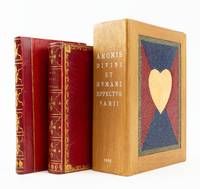
1626ST19298Antwerp: M. Snyders 1626. FIRST EDITION. 135 x 82 mm. 5 1/4 x 3 1/4". 39 of 40 leaves lacking C4. Two volumes one as issued the other a companion volume containing related plates without any title page. <br/> Very pretty late 18th or early 19th century red morocco covers bordered by delicate cresting roll with leaf cornerpieces smooth spine gilt in compartments with leafy centerpieces gilt lettering turn-in with gilt floral roll pale blue watered silk endleaves all edges gilt. Supplemental volume in late 19th century red half morocco over red paper boards similarly tooled spine. Housed together in a custom-made modern wooden box with sliding panel closure a heart mosaic in multi-colored hard-grain leather on its sides. Amoris Divini WITH engraved title page and 38 of 39; lacking plate XXXIV ENGRAVED PLATES 35 OF THEM ON VELLUM ALL DELICATELY COLORED AND HEIGHTENED IN GOLD plates 19 29 30 31 and 36 bound after text pages for plates 31 36 29 30 and 34 respectively; second volume with 45 plates on paper though without any text including many of these same emblems apparently from a later edition of this work ALL DAINTILY HIGHLIGHTED WITH GILT. Front pastedown of first volume with monogram book label in colors and gilt verso of front free endpaper with oval armorial bookplate "Ex Museo Van Der Helle" see below. De Vries "De Nederlandsche Emblemata" 121; Landwehr "Low Countries" 33; Praz p. 254; Brunet I 240 this copy; Delbergue-Cormont "Bibliothèque de M. Van der Helle" Paris 10 Février 1868 lot 69 this copy. Amoris spine very slightly dulled occasional hints of marginal thumbing but A LOVELY COPY clean and fresh internally with rich colors and glistening gold in a well-preserved binding; supplemental plates with faint marginal browning but excellent internally the engravings gently shimmering with gold and the binding with few signs of wear.<br/> <br/> The main volume here comprises a collection of emblems illustrating concepts of human and divine love; it is made all the more special by being printed on vellum beautifully hand colored and then delicately highlighted with gold. The emblems depict Divine Love as a beardless young man with nimbus who always represents love in its purest form. Human love or worldly love is variously embodied in a winged Cupid sometimes blindfolded who represents erotic love and who is accompanied by symbols of treasure or power that represent worldly desires. Landwehr Praz and De Vries make no mention of a vellum edition but Brunet describes one copy on vellum painted in colors and gold which he says sold at the Duriez auction. That book appeared as lot 3216 in "Catalogue des livres imprimés et manuscrits composant la bibliothèque de feu M. L.-M.-J. Duriez de Lille membre de la Société des Bibliophiles français" Paris J.-S. Merlin 1827 where its binding description matches our copy. Having uncovered no other hand-colored copies on vellum in auction records or in OCLC we think it quite likely that the present volume is in fact the Duriez copy. Louis Duriez 1753-1825 was a Lille lawyer of sufficient skill and cleverness to move without incident from serving as lieutenant provost for his district under King Louis XVI to becoming receiver of the district of Lille after the revolution 1791 and purchasing the estate of an aristocrat which had been seized by the state. He rose to successively more important and remunerative governmental positions and was named Knight of the Royal Order of the Legion of Honor in 1814. In 1820 he was one of the founding members of the Société des Bibliophiles français an elite group limited to 24 scholarly collectors. After his death his collection of more than 5000 carefully chosen works was dispersed at 59 auctions held between 22 January and 1 April 1828 at Maison Silvestre in Paris. A perusal of the lots on offer finds a strong emphasis on fine bindings works on vellum and illustrated books many noting hand coloring. The emblems in the second thinner book here on paper without coloring--but with gold highlighting allow the reader to experience the pleasure to be found in comparing the degrees of decoration and opulence of the two volumes. These illustrations likely come from one of the later printings of this title each of which added new emblems to the original 39 called for in Landwehr and Praz. It is not clear when or by whom this second volume was wedded to the first. After its presumed residence in the Duriez collection our copy of the 1626 edition and perhaps its sidecar volume moved to another distinguished library--that formed by the scholarly and erudite French collector M. Van Der Helle of Lille who amassed a collection particularly rich in illustrated books and works on vellum. In the catalogue for the sale of his library in 1868 Paris auction house Delbergue-Cormont described him as a bibliophile "of the school of Renouard . . . who only liked irreproachable copies." We bought this item without being warned that it is slightly defective but given its distinguished provenance and the many other features it has going for it we did not ask the seller to take it back. M. Snyders unknown
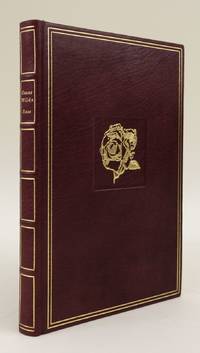
1982ST16482Bayreuth: Printed by Chr. Scheufele Offizin Stuttgart for Bear Press 1982. No. 1 OF 10 COPIES ON VELLUM plus a "special" edition of 25 copies and 185 copies on Kochi Japanese paper. 223 x 148 mm. 8 7/8 x 5 3/4". 50 pp. 2 leaves.Translated and with an afterword by Wolfram Benda. <br/> Publisher's fine burgundy morocco by Erwin Lehr upper cover with gilt rose in recessed square flat spine with gilt titling turn-ins with gilt fillet frame pale yellow silk pastedowns. In the original burgundy suede slipcase. With three large initials in burnished gold and four signed and numbered original etchings by Peter Klitsch. Printed in red and black. Signed in the colophon by the artist the binder and the publisher/translator. In mint condition.<br/> <br/> This is the splendid deluxe version of a finely crafted private press edition of Wilde's fairy tales "The Nightingale and the Rose" "The Happy Prince" and "The Selfish Giant." It is the third work issued by the Bear Press founded in 1979 by literary scholar Wolfram Benda and still in operation. According to the firm's website "at a time when the craftsmanship and ethos of the artisan in bookmaking have been damaged by ever-increasing industrialization and neglect . . . The Bear Press . . . tries to achieve the highest possible degree of technical and artistic perfection in its printed works." The font used to print the text and the artist chosen to illustrate each work are carefully selected to express "the individual author's personality and intention." Even the discriminating aesthete Wilde 1854-1900 would be pleased with the choices here especially for the luxurious vellum printing: the type is set in refined Walbaum Antiqua and shown off with special effect by the creamy leaves; the etchings by Austrian artist Peter Klitsch b. 1934 are meticulous detailed and reminiscent of the work of Wilde's friend Aubrey Beardsley; and the binding is the epitome of tasteful restraint flawlessly executed with premium materials. <br /> <br /> The three tales here first appeared in 1888 and are bittersweet in their themes of love and self-sacrifice. His stories for children were one of Wilde's early successes and DNB notes "Their permanent place in child affections refutes the vulgarism that Wilde's literary reputation arose from his legal notoriety. In all cases the fairy tales are on the child's side celebrating the courage and generosity of the poor and vulnerable while their satire mocks the kind of pomposity and hypocrisy children can recognize." We have been able to trace just two other copies of the vellum printing at auction in ABPC and RBH. [Printed by Chr. Scheufele Offizin, Stuttgart, for] Bear Press unknown