Vitela, MichaelBiblio.com

153 résultats
1713268612.Gpaperback. Good. Access codes and supplements are not guaranteed with used items. May be an ex-library book. paperback
2001SONG1646961293M & M Limitless Online Inc 2020-01-20. hardcover. Used: Good. 6.00x0.50x9.00. Buy with confidence. Excellent Customer Service & Return policy. M & M Limitless Online Inc hardcover
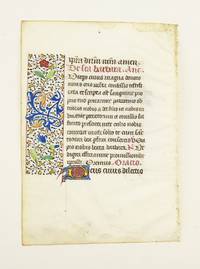
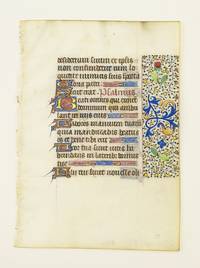
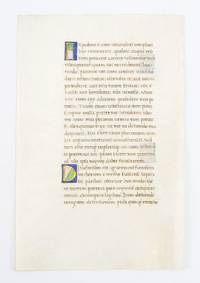
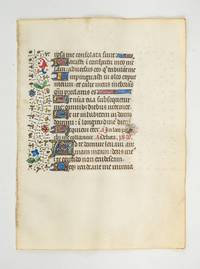
1450ST11774DParis ca. 1450. 159 x 108 mm. 6 1/4 x 4 1/4". Single column 15 lines per page in an excellent gothic book hand. <br/> Rubrics in red each leaf with two or more two-line initials in burnished gold on red and blue ground with white tracery some also with one-line initials and line fillers similarly decorated one or both sides with a swirling panel border featuring flowers leaves strawberries and many burnished gold ivy leaves on hairline stems. Isolated trivial stains or imperfections but VERY BRIGHT CLEAN AND FRESH.<br/> <br/> In fine condition beautifully decorated and sparkling with gold these leaves are marvelous examples of a high-quality Parisian Book of Hours made for a person of means. The borders here are especially pleasing with skeins of hairline vines accented by burnished bezants and ivy bright blue and gold acanthus pale green leaves and cheerful red blossoms. For leaves at other price points please check our website. unknown
1450ST11774EParis ca. 1450. 159 x 108 mm. 6 1/4 x 4 1/4". Single column 15 lines per page in an excellent gothic book hand. <br/> Rubrics in red each leaf with line fillers and multiple one- and two-line initials in burinshed gold on red and blue ground with white tracery one or both sides with swirling panel border featuring flowers leaves strawberries and many burnished gold ivy leaves on hairline stems. Isolated trivial stains or imperfections but VERY BRIGHT CLEAN AND FRESH.<br/> <br/> In fine condition beautifully decorated and sparkling with gold these leaves are marvelous examples of a high-quality Parisian Book of Hours made for a person of means. The borders here are especially pleasing with skeins of hairline vines accented by burnished bezants and ivy bright blue and gold acanthus pale green leaves and cheerful red blossoms. For leaves at other price points please check our website. unknown
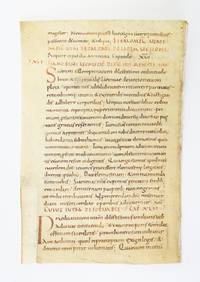
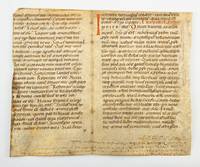
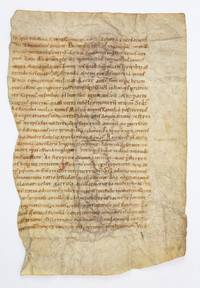
ST17767BEGermany second quarter of ninth century. Each leaf approximately 305 x 205 mm 12 x 8". Single column 29-30 lines in a large and extremely legible Caroline minuscule. <br/> Rubrics in red each leaf with one or more large initials in red. Text with a few contemporary corrections and erasures. Accompanied by a copy of a letter from Bernhard Bischoff dating the manuscript leaves. ◆Vellum a little toned and soiled one leaf with an old repair to the bottom third of the outer margin minor folds small stains and other trivial imperfections but IN EXTREMELY FINE CONDITION the lettering clear and legible the vellum in excellent shape and the margins surprisingly comfortable.<br/> <br/> These are nothing short of magnificent specimens and remarkable survivals with wide borders all around with entirely clear and distinct script with only minimal overall dust soiling and with strength and freshness to the vellum; the leaves present a powerful redolence of a time as far in the past as one could optimistically hope to encounter among Western manuscript artifacts in the marketplace. The script here is an outstanding example of the highly legible Caroline minuscule that dominated Europe in the ninth century characterized by clear letter forms ample spacing between letters and between lines and very few abbreviations the most common occurrence being "&" for "et" occurring anywhere in a word. The parent manuscript was almost certainly a Homiliary containing sermons by various Christian authors to be said throughout the year with the present leaves containing passages from part of Leo I Sermo XCV and parts of a tractatus on Luke by Ambrose as well as other lections readings for the Vigil of the Feast of St Peter and the Feast of the Octave of Pentecost and the opening of a sermon of Leo I for Feria IV mensis IV; four other sister leaves are known and contain additional passages from Leo I and Ambrose as well as Pope Gregory I and readings for various feast days. The presence of these texts suggest that the leaves might have come from a Homiliary originally composed by Paul the Deacon at the behest of Charlemagne a version that was widely circulated throughout the Carolingian Empire in the eighth and ninth centuries. Although the scriptorium in which these leaves were produced has yet to be determined we can say with confidence that they date to the second quarter of the ninth century due to the style of the script as stated in the accompanying letter by esteemed paleographer Bernard Bischoff. Much of their history over the last 12 centuries remains a mystery but we do know that three of the extant leaves were in the possession of dealer Bruce Ferrini by 1989 with his stock number beginning "VM" and two bear the stock numbers and price codes of Quaritch. All were acquired by Martin Schøyen and became part of the renowned Schøyen collection MS 587. Very early leaves such as these often survive only because they come from manuscripts that were dismembered with the leaves then being reused as binding scrap; when later recovered they are typically in lamentable condition. The present leaves by contrast met no such fate--they have always been intact and untouched by the binder and so show none of the staining and trimming that are almost always present with repurposed leaves from demolished manuscripts. This notably fine state of preservation is rarely seen on the market. As a consequence these specimens are not only among the earliest leaves we have ever offered for sale but also some of the most extraordinary survivals we have ever acquired. We have bought and sold only a handful of ninth century leaves in our 45 years in business; in the present case because we were extremely lucky to acquire a small collection of six leaves from a single source we are able to offer them here at an advantageous price point. unknown
51320148like new. unknown
ST13657aFrance second half of the 13th century. Each leaf measures 330 x 240 mm. 13 x 9 3/8". Double column 38 lines of text in a proto-gothic hand. <br/> Rubrics in red running title and numerous paragraph marks in red and blue one leaf with one two-line initial in blue with red pen flourishes. Margins with several text corrections one leaf with a catch-word. Faint soiling and a few negligible stains touching text not affecting legibility but overall FINE SPECIMENS with very few flaws.<br/> <br/> Containing part of a popular treatise on the Vices these well-preserved and attractive large format leaves come from a manuscript that may have been contemporary to the life of the author William Perault ca. 1190-1270. Although the so-called "Seven Deadly Sins" that we still recognize today remained a popular moral paradigm throughout the Middle Ages it was by no means canonical. Authors were free to borrow manipulate and elaborate on the topic at will resulting in a profusion of treatises and competing systems of morality. This work by Perault Latin: Peraldus was a particularly prominent treatise that not only survived the Middle Ages but later went into print in several editions. The "Summa of Vice" expounds upon the Seven with which most of us are familiar--Pride Envy Anger Sloth Greed Gluttony and Lust--but it also includes an eighth sin which Perault called "peccatum linguae" or "the sin of the tongue." The present leaves consider the sin of Pride Superbia the most severe and dangerous of all the vices in Medieval imagery it is often depicted as the root of all other sins with some interesting discussion of garish dress make-up hair coloring and wigs. unknown
2406172074.Gpaperback. Good. Access codes and supplements are not guaranteed with used items. May be an ex-library book. paperback
3734759889.Gpaperback. Good. Access codes and supplements are not guaranteed with used items. May be an ex-library book. paperback
3752831928.Gpaperback. Good. Access codes and supplements are not guaranteed with used items. May be an ex-library book. paperback
3752897015.Gpaperback. Good. Access codes and supplements are not guaranteed with used items. May be an ex-library book. paperback
A9786199164006Paperback / softback. New. paperback
1822mon0003529457Chez de Bure Freres 1822. Paperback. Good. . Extremely scarce in any condition. 5 volumes in 4 physical books II and III in one. Fragile but fully intact. Some chipping at edges. Pages clean. Chez de Bure Freres paperback
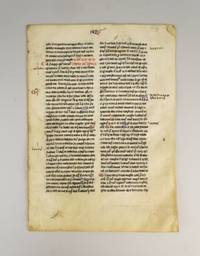
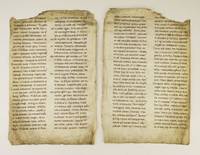
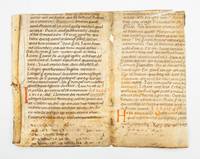
ST15769aPerhaps France mid-12th century. Each leaf measures approximately 370 x 240 mm. 14 1/2 x 9 1/2". Double column 32 lines in a fine proto-gothic hand. <br/> See: Thompson "An Introduction to Greek and Latin Paleography" p. 436. ◆Recovered from a binding and thus with one side of each leaf somewhat browned soiled and with a few creases one leaf with several small blotches of red paint in the text not affecting overall legibility one corner of each leaf torn away affecting running title and one to two lines of text other trivial defects but still very nice specimens with clear and legible script and one side of each leaf quite clean and well preserved.<br/> <br/> Once part of a large and elegant Romanesque Bible these leaves are excellent examples of a high quality proto-gothic book hand. Sometimes referred to as "praegothica" or "late Caroline" the proto-gothic script is characterized by letterforms that are more or less unchanged from Caroline minuscule but with a number of traits starting to show elements of gothic script--most notably the addition of feet appearing here as an upward flick of the pen on the bottom of minims but also including the use of more abbreviations the fusion of certain letter combinations a more elongated "o" and a straight-backed "a." Whatever the level of its evolution the script here has very pleasing rounded letterforms that are highly legible and generously spaced. Though the vellum is not unmarred by its former life as binding material the script here has not lost any of its beauty revealing a hand that is practiced regular and distinctly pleasing to the eye. As Thompson notes "In the twelfth century the scribes seem to have vied with each other in producing the best types of book-writing of which they were capable with the result that remarkable precision in the formation of the letter was attained and that the century may be named as excelling all others for the beauty of its MSS." Our leaves come from Deuteronomy the Old Testament book consisting primarily of three sermons made by Moses just before entering the Promised Land. One leaf contains brief summaries of chapters 2-18 with some chapters numbered in the margins while the other leaf contains part of the first of Moses' speeches in which he recalls the Israelites' 40-year journey through the wilderness. unknown
ST19578Northern Italy last quarter of 15th century. Each leaf measuring 250 x 164 mm. 9 7/8 x 6 3/8". Single column 24 lines in a handsome humanist hand. <br/> Each leaf with three to four large initials one measuring two lines all others three lines in burnished gold in-filled with pink and green paint with white embellishment on blue ground with white embellishments. See: Baldwin "Medieval Rhetoric and Poetic" pp. 216-23. ◆Insignificant wrinkling and a couple faint creases to vellum tiny snag along top edge of each leaf but IN VERY FINE CONDITION the vellum especially clean and bright the paint and ink fresh and the margins generous.<br/> <br/> Written in a beautiful humanistic script enclosed by wide margins and adorned with tasteful gilt initials these leaves come from what must have been a particularly fine manuscript made for a person of means. The text comes from the "Candelabrum" of Bene of Florence an early 13th century treatise on rhetoric and the art of elegant writing. The work consisted of eight parts instructing readers on word choice composition rhythm style and other important considerations in the construction of effective letters and prose. Apart from their enormous aesthetic appeal the present leaves are of great interest because few manuscripts of the text have survived. The style of the initials--elegant burnished gold on a ground of pale pink green and sapphire blue with whisps of white embellishments--suggest that the manuscript was executed in Northern Italy perhaps Milan Bologna or Florence by a craftsman of great technical skill. Fine examples of humanistic script are becoming increasingly difficult to find on the market and the present examples are among the loveliest we have ever acquired. unknown
ST20509c-dGermany Late 11th or early 12th century. Larger bifolium measures 221 x 275 mm. 8 7/8 x 10 3/4".; smaller bifolium measures 207 x 275 mm. 8 1/8 x 10 3/4". Single column 25-27 lines in a late Caroline hand. <br/> Rubrics in orange each bifolium with one or more one-line initial in orange and one or more large four- to five-line initials in orange. With marginal notations in a later hand. Recovered from a binding and thus with some soiling abrasions glue residue and other small problems as well as limited loss of legibility in a few places; the pages nearly complete but with a couple of letters and/or lines cut away from one side of each bifolium; even with the problems very good specimens overall the letters on the better side quite clear and readable in each case.<br/> <br/> Once part of a Lectionary a collection of scriptural readings appropriate for Masses and other ceremonial occasions through the year these attractive mostly legible binding fragments display an excellent transitional script with both Caroline minuscule and proto-gothic characteristics. The present examples include short lessons or "lectiones" taken from the Old and New Testaments including among other passages excerpts from John in which Christ casts the sellers out of the temple and Daniel relating the prayers of the three men who refused to bow to Nebuchadnezzar's golden idol. The lovely script here shares much in common with the pure Caroline miniscule of earlier centuries--particularly in the overall legibility of the text the space between individual letters and the limited use of ligatures and abbreviations; also of note is the exclusive use of the long "s" unless at the beginning of a sentence and the ampersand as a general abbreviation for the letters "et" occurring anywhere in a word e.g. "propheta" written "proph&a" here. Evidence of a progression toward proto-gothic script can be observed here in the appearance of certain letter forms such as the closed "g" a more oval "o" and the use of two forms of "d" both upright and Uncial the latter with a sloping shaft. There is added interest here in the form of marginal notations in a later hand--probably dating from the time these bifolia were in situ as binding waste. The price given here is for one bifolium. unknown
ST20509a-bGermany Late 11th or early 12th century. Largest bifolium measures 221 x 275 mm. 8 7/8 x 10 3/4". Single column 25-27 lines in a late Caroline hand. <br/> Rubrics in orange each bifolium with one or more one one-line initial in orange and one or more large four- to five-line initials in orange. With marginal notations in a later hand. Recovered from a binding and thus with some soiling abrasions glue residue and other small problems; the pages nearly complete but with a couple of letters and/or lines cut away from one side of each bifolia with more extensive abrasions on one side affecting legibility but very good specimens overall the better side in each case quite clear and readable.<br/> <br/> Once part of a Lectionary a collection of scriptural readings appropriate for Masses through the year and other ceremonial occasions these attractive mostly legible binding fragments display an excellent transitional script with both Caroline minuscule and proto-gothic characteristics. The present examples include short lessons or "lectiones" taken from the Old and New Testaments including among other passages excerpts from John in which Christ casts the sellers out of the temple and Daniel relating the prayers of the three men who refused to bow to Nebuchadnezzar's golden idol. The lovely script here shares much in common with the pure Caroline miniscule of earlier centuries--particularly in the overall legibility of the text the space between individual letters and the limited use of ligatures and abbreviations; also of note is the exclusive use of the long "s" unless at the beginning of a sentence and the ampersand as a general abbreviation for the letters "et" occurring anywhere in a word e.g. "propheta" written "proph&a" here. Evidence of a progression toward proto-gothic script can also be observed here in the appearance of certain letter forms such as the closed "g" a more oval "o" and the use of two forms of "d" both upright and Uncial the latter with a sloping shaft. There is added interest here in the form of marginal notations in a later hand--probably dating from the time these bifolia were in situ as binding waste. unknown
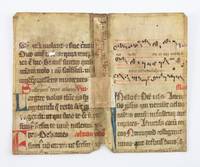
1415ST19350-056Germany and Low Countries 14th & 15th centuries. Smallest piece: 209 x 152 mm. 8 1/8 x 5 7/8"; largest piece: 372 x 235 mm. 14 3/4 x 9". <br/> Recovered from bindings and thus with uneven trimming and occasional small holes resulting in loss staining and toning to vellum some leaves with remnants of pastedowns obscuring the script but generally the leaves quite legible substantially complete and in presentable condition.<br/> <br/> This packet contains five vellum manuscript leaves all complete or nearly so all with musical notation and all serving as linings or covers of a binding when reused in their second lives. Prepared with an academic audience in mind the group presents an excellent opportunity for libraries teachers and students to develop or expand their teaching or personal collections. In addition to their obvious value as manuscripts containing the text and music of the Medieval period these leaves are also of educational importance as physical artifacts demonstrating the reuse of manuscript material in the production of later bindings. The shape of each binding is still easily discernable and a few of these specimens even include early spine labels and ink notations as well as paper remnants used in the bookbinding process. unknown
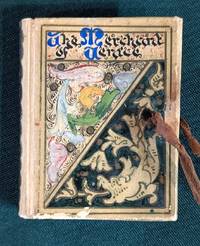
50727Venice: S. Rosen - Publisher Piazza S. Marc MDCCCCVI. 1906 . Scarce miniature book with hand-painted decoration. 2.75" x 2.25" x 0.5" 7.2cm x 5.8cm x 1.4cm. pp.256. Soiled vellum binding in very good condition. Both boards and spine with hand-painted decoration. Original leather tie still attached. Patterned endpapers. Gift inscription in red to front free-endpapers: "Of great value. Hand painted cover. From Father brought from Venice July 1909. A.D. To Ailen Mary Danby." Portrait frontis. Clean English text throughout plus a further 3 full-page illustrations. VG . Venice: S. Rosen - Publisher Piazza S. Marc, MDCCCCVI. [ 1906 ] . hardcover
19023402<p>F. Lumachi publisher. 1902. Florence. Full vellum limp with leather ties. This is a nice example of one of the Florence gift bindings done around the turn of the century. The front cover is hand painted titling and decoration in a fine hand. A slight bit of discoloration to the vellum otherwise a clean unmarked copy. Yapp edges all ties present.</p> F. Lumachi hardcover
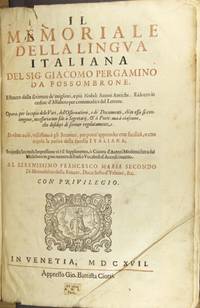
161743152Venetia: Apresso Gio. Battista Ciotti 1617. Seconda impressione two parts in one folio pp. 12 609 1 8 236; a6 A-2N8 2O-2p6 †4 A-O8 P6; V4 of the first section missigned R4 with manuscript cancellation; woodcut printer's device initials and head- and tail-pieces; title page printed in red and black; text in double columns; full contemporary vellum soiling calf bands manuscript spine title and ornamentation; vertical hatch marks to upper cover edges quite rubbed and worn; endpapers supplied title page edges rather ragged minor worming to preliminaries else textblock mostly very good. Small period manuscript paper label "Ad usum A.M.L. Parm." mounted to bottom of title page. Zaunmüller p. 209. OCLC does not locate any copies in the United States. Apresso Gio. Battista Ciotti unknown
161771548Venetia: appresso Gio. Battista Ciotti 1617. pergamino. Folio. appresso Gio. Battista Ciotti unknown
ST19350-049Germany 14th century. 132 x 164 mm. 5 1/4 x 6 3/8". Double column 12 extant lines in a gothic book hand. <br/> Rubrics and four-line staves in red capitals touched in red four large initials in red or blue. Spine with two old paper labels one with ink titling. Vellum a bit soiled a couple small holes ink a little faded on verso paper remnants on verso obscuring a few lines but still a good specimen demonstrating use and reuse of Medieval manuscripts.<br/> <br/> From a noted Missal that had outlived its use this manuscript leaf was later repurposed as a cover for a 17th century printed book. The spine label indicates it was a copy of Jacob Bidermann's "Herodiados libri tres" a lengthy Latin poem relating the story of John the Baptist and Herod first published in 1622. unknown
ST19350-006Germany 12th century. 272 x 185 mm. 10 3/4 x 7 1/4". Single column 28 lines in a late Caroline hand. <br/> ◆Leaf trimmed irregularly along one side about 18 lines lacking a letter or two vellum a bit wrinkled and worn text a little faded in places but still very presentable and the text almost entirely legible.<br/> <br/> Penned in a pleasing and very legible late Caroline hand this leaf has sustained very little loss and is remarkably well preserved for having been previously reused as binding scrap. Although the text includes several abbreviations that are commonly found in proto-gothic scripts the hand also shares a number of similarities with the Caroline minuscule that dominated Western Europe scribal hands in earlier periods including a long "s" with the shaft on the line and the use of the ampersand as a general abbreviation for the letters "et" occurring anywhere in a word. The text here comes from Pope Gregory the Great's "Moralia" conceived as a commentary on the book of Job and begun when Gregory was just a young papal envoy to Constantinople. It is a guide to the Christian life written in simple direct language which transforms the thought of Augustine into a practical manual of behavior. unknown
1475ST19653GNorthern France ca. 1475. 155 x 110 mm. 6 x 4 1/4". Single column 16 lines in a gothic book hand. <br/> Rubrics in dark pink some leaves with line fillers in pink and blue with white embellishment and gilt bezants each leaf with at least one and some with many one- to three-line initial either in gilt on a pink and blue ground with white embellishment or painted blue with white embellishment filled with flowers or ivy on a gilt ground most leaves with one panel border of hairline vines gilt ivy and bezants and painted flowers. Occasional light soiling wrinkling and other very minor imperfections but in fine fresh condition overall very clean and with wide margins.<br/> <br/> Undoubtedly the work of a top atelier these lovely manuscript leaves have been written and decorated with a high degree of skill. Many of the leaves feature numerous glittering initials and the delicate panel borders add a bit of extra sparkle to the page. unknown