153 résultats
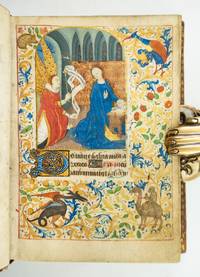
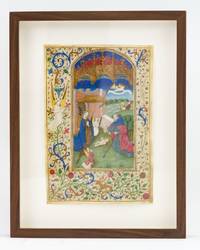
1470ST17765Delft ca. 1470. Leaf: 172 x 115 mm. 6 3/4 x 4 1/2". Frame: 242 x 190 mm. 9 1/2 x 7 1/2". <br/> In an attractive wooden frame. A FINELY PAINTED MINIATURE OF THE NATIVITY within an arch-topped compartment the parents of the Christ Child kneeling before him as he lies on the ground outside the stable Joseph uncharacteristically supporting himself with a cane in his left hand and holding a long burning candle in his right two diminutive angels in attendance the head of an ass sticking out of the stable window in the background to the left AND IN THE RIGHT BACKGROUND A CHARMING DEPICTION OF THE ANNUNCIATION TO THE SHEPHERDS ALL OF THIS BENEATH A VERY DETAILED ARCHITECTURAL CANOPY suspended in the sky AND THE WHOLE WITHIN A FULL BORDER of acanthus leaves and other foliage and flowers in reds blues greens yellows and brushed gold along with very many small burnished gold ivy leaves and buds on hairline stems a small stag in the bottom border and a large delicately shaded angel who mirrors the Virgin's pose in the left border verso blank. ◆A hint of soiling to edges of vellum but IN VERY FINE CONDITION without any paint erosion with the colors rich and true and with the burnished gold still shimmering.<br/> <br/> Notable for its attractive color scheme fine craftsmanship and unusual composition this vibrant leaf was produced by a talented artist belonging to the stylistic group known as the Masters of the Delft Half-Length Figures. The lack of text and blank back of this leaf clearly suggest that it was produced as a singleton intended for insertion in a Book of Hours and its subject matter indicates that it would have faced the opening for the third hour of the day Prime. The present depiction of the Nativity is out of the ordinary in that it is combined with another scene the Annunciation to the Shepherds a subject that usually begins Terce in the Hours of the Virgin. It is a testament to the artist's ingenuity and compositional skills that he has managed to incorporate these two scenes so seamlessly; in fact rather than pulling focus from the main subject celebrating the birth of Christ this secondary scene adds additional interest to the picture and amplifies the storyline. Though the Annunciation to the Shepherds takes place at a distance from the Nativity we immediately grasp their connection and can see how arrival of humanity's savior was felt far beyond the manger. It is also interesting to note how much the artist has emphasized the figure of Joseph. Not only does he take up as much space as the Virgin but the candle and cane he holds frame the Christ child and communicate a strong suggestion of a protective parent the Virgin is doing her part by praying hard but she is more passive. In addition to its engaging subject matter there is a high level of artistic achievement here including delicately molded figures impressively detailed architectural elements and a lovely color palette. The elegant hand seen in this miniature manifests a quiet sophistication that distinguishes this artist as a particularly talented member of his circle. Active from about 1450-80 the Masters of the Delft Half-Length Figures were named by James Marrow after the angels and other figures whose upper bodies are typically found emerging from a cloud within the borders. Although the present leaf uncharacteristically contains a full-length angel in the border it shares other stylistic similarities such as the elaborate architectural canopy hovering over the main composition; and it particularly resembles the work of the artist of Keble College MS 77 an illuminator described in "The Golden Age of Dutch Manuscript Illumination" as "one of the more articulate of the group" whose "figures are more fully modelled and his palette . . . deeper and brighter" than that of his contemporaries. Because of the complexity of the subject matter and the high level of artistic accomplishment seen here this leaf was probably part of an elaborate Book of Hours produced in response to an important commission. unknown
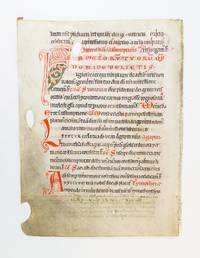
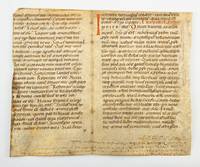
ST20837bGermany late 12th or early 13th century. 335 x 224 mm. 13 1/4 x 8 7/8". Double column 29 lines in an elegant proto-gothic book hand. <br/> Rubrics in red several two-line initials in red. Recovered from a binding and so the vellum a bit soiled creased and wavy recto with a lighter patch where a title label was once situated light stains and glue and paper residue on the verso but overall the leaf remarkably clean entirely legible and surprisingly well preserved.<br/> <br/> Once serving as a cover for a later book this leaf comes from a nearly contemporaneous copy of Peter Lombard's "Sentences" considered the most important theological book of the 12th century. Written between 1155 and 1158 and arranged topically Lombard's "Sententiae" summarize past learning about Christian doctrine by quoting authorities in an attempt to resolve textual disagreement by dialectical analysis. As a source collection that continued to spark discussion Lombard's great work enjoyed sustained success as a theological textbook until the 17th century and inspired numerous commentaries including those of Aquinas and Luther. This leaf comes from Book IV "On the Doctrine of Signs" which is primarily concerned with the seven sacraments: Baptism Confirmation the Eucharist Penance Extreme Unction Sacred Orders and Matrimony. The script is an upright and very legible proto-gothic book hand with a few distinctive letter forms and abbreviations that may help determine a more definitive point of origin these include a "g" with a downward cross on its tail and a conjoined "qe" for "que". It is unusual and very lucky that this leaf survives completely intact as Medieval manuscripts used in later bindings were often cut down in size to make smaller covers or used as waste paper for pastedowns or other binding elements. unknown
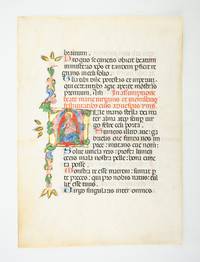
ST20973Italy 15th century. 364 x 260 mm. 14 3/8 x 10 1/4". Single column 22 lines in a rounded gothic book hand. <br/> Rubrics in red versal initials alternating red and blue with purple penwork one three-line initial in blue with purple penwork A SIX-LINE "A" DEPICTING THE ASSUMPTION OF THE VIRGIN the initial painted pink with red green and blue nodes and acanthus on a burnished gold ground with extensions running the length of the text column incorporating more acanthus and small gold embellishments with sprays of the gold leaves at the top bottom and center. A little rubbing to the paint negligible soiling and small spots to margins but in excellent condition overall.<br/> <br/> This very large handsomely preserved leaf features a strikingly attractive initial of the Virgin opening the beloved hymn "Ave Maris Stella" "Hail Star of the Sea". Dating back to at least the ninth century and traditionally associated with the hour of Vespers on Marian feast days as here the hymn praises the Virgin's purity meekness and mercy calling upon her as the "Nurturing Mother of God" to dispel evil and free us from our sins. Inside the gilt and painted initial is a lovely portrait of the Virgin who is depicted seated against a red mandorla dressed in pink and wrapped in a green and blue mantle--perhaps a reference to the colors of the ocean. Her hands are raised in prayer fingers lightly touching above her heart and her well-defined features appear both strong and serene. Judging from the size of the initial liberal use of gold and the wide margins of this leaf the original manuscript must have been a costly item produced for a wealthy church or monastery. unknown
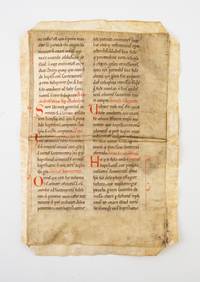
ST19350-013Germany early 13th century. 273 x 193 mm. 10 3/4 x 7 1/2". Single column 31 lines text in two sizes in a gothic hand. <br/> Rubrics in red several one- and two-line initials in red and two larger initials in red. A few lines with neumes later notations in the margins now quite faded. ◆Vellum a bit soiled and creased as expected fading to four or five lines where the spine was placed several notches along one edge other imperfections due to its reuse as binding scrap but still an excellent specimen that is almost entirely legible.<br/> <br/> Written in a neat and attractive hand this sizable leaf from a Missal remains mostly quite legible with all its rubrication intact despite having been used as part of a binding. A few lines also show musical notation from the earliest generation of neumes. They are described as "in campo aperto" which means literally "in an open field" because they and they alone occupy the space or "field" above the text. They are also described as adiastematic because they appear in a straight line whereas later diastematic neumes reflect changes in pitch by being placed in a higher or lower vertical position above the text. At the time the present leaf was written out the neumes here simply served as an "aide memoire" to the singer who had already learned the melody orally. unknown
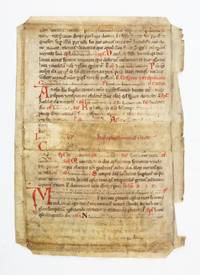
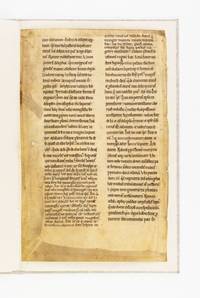
ST17236Germany mid- to late 12th century. 290 x 217 mm. 11 3/8 x 8 1/2". Single column 21 lines in an attractive proto-gothic book hand. <br/> Rubrics in red several one-line initials in red five red initials measuring two to four lines long and with penwork embellishment A LOVELY SEVEN-LINE WHITE-VINE INITIAL outlined in red and with a pale yellow wash along the edge the lower half of the ground filled with green wash. Lower margins with notations in later Medieval hands. ◆A handful of original holes in the vellum no doubt from stretching the skin during processing with the scribe writing around the flaws where necessary a little soiling to lower outside corner one or two negligible spots otherwise IN FINE CONDITION the ink unusually rich and the paint very bright.<br/> <br/> From a Sacramentary a service book that contained the prayers said during Mass subsumed by the Missal in the 13th century this early leaf was once part of an attractive manuscript of very high quality. The very large and superb "F" opens the Mass for the Feast of the Assumption and the other readings here include Masses for Sts. Hippolytus and Cassian celebrated on 13 August; St. Eusabius 14 August; Vigil of the Assumption of the Virgin 14 August; Assumption of the Virgin 15 August; St. Agapitus 18 August; and the beginning of the Mass for Sts. Timothy Hippolytus and Symphorian 22 August. Sister leaves from this same manuscript have previously appeared in Sam Fogg Cat. 16 "Text Manuscripts and Documents 2200BC to 1600AD" 1995 nos. 30 and 31; Maggs Bros. European Bulletin 20 1995 no. 37; Quaritch Cat. 1270 "Bookhands of the Middle Ages VI" 2000 nos. 69 and 70; Sotheby's 6 December 2001 lot 8; and Bloomsbury 6 December 2017 lot 16. The Fogg description notes that similar initials can be seen in French German and Flemish manuscripts of the period "but very few manuscripts have the special characteristics of this one." For example the initials on the sister leaves described by Fogg contain atypically mauve and green as well as an "unusual . . . exterior contoured ground which is not confined by any geometric form." This means there is no line or shape to box in or define the capital's form; rather it appears as if surrounded by an aura or gentle shadow. Our initial contains a green ground only no mauve but the same unusual and attractive yellow aura. It is rare to find Romanesque leaves of this size and caliber in such fine condition and the present leaf with its beautiful regular proto-gothic hand exceptional white-vine initial and several large decorative initials in red is especially desirable. unknown
ST17768<p>England second half of 12th century but before 1180. 313 x 198 mm. 12 1/4 x 7 3/4. Double column 32 lines in a lovely late Caroline hand verso with some lines erased and corrected in a smaller hand. <br />Mounted in a fine tan cloth folder between sheets of textured acid-free paper. Front pastedown with book label of the Schøyen Collection with their shelf mark MS 237 written in ink. ◆Recovered from a binding and thus with overall toning and soiling recto somewhat browned from binder's glue but almost entirely confined to three margins and the verso virtually unaffected other trivial imperfections but in surprisingly good condition given its history the very rich ink especially dark and well preserved.<br /><br />This is an exceptionally lovely example of an early English book hand standing at the crossroads of the Caroline and proto-gothic calligraphic traditions. According to Thompson "In the twelfth century the scribes seem to have vied with each other in producing the best types of book-writing of which they were capable with the result that remarkable precision in the formation of the letters was attained and that the century may be named as excelling all others for the beauty of its MSS." "Greek and Latin Paleography" p. 436 The present leaf certainly lives up to this description being notable for its exceptionally neat and legible script written with uncommonly pretty and regular letter forms by a practiced and confident hand. The Caroline tradition is apparent in certain tendencies such as the use of "&" for "et" and the lack of biting curves between letters while a shift toward the proto-gothic can be seen in the vertical and compressed letter forms as well as the increased use of abbreviations and ligatures. Although the present work has often been credited to Haymo of Halberstadt due to a longstanding error in attribution reaching back to the 15th century modern scholarship now recognizes Haimo of Auxerre a monk at the Abbey of Saint-Germain in Auxerre d. ca. 875 as its true author. A prominent theologist and writer during the Caroline Renaissance Haimo produced a number of influential commentaries on various books of the Bible. The provenance on this leaf can be traced back as far as the mid-19th century when it was auctioned at Sotheby's on 21 August 1858 lot 119.2 sold as part of an album containing various leaves and fragments put together by Philip Bliss 1787-1857 registrar of the University of Oxford. It then went into the celebrated collection of Sir Thomas Phillipps 1792-1872 and was eventually sold by the Robinson Brothers on 24 April 1911 lot 390.3. This leaf has previously appeared in Quartich's catalogue 1036 "Bookhands of the Middle Ages" no. 79.5 and was most recently in the collection of Martin Schøyen his MS 237.</p>
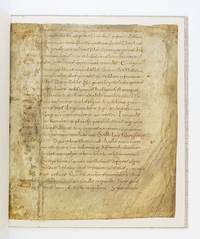
ST17766Probably Germany third quarter of ninth century. 285 x 245 mm. 11 1/4 x 9 3/4". Single column 25 lines in a Caroline minuscule book hand. <br/> Tipped into a paper folder and presented in a tan cloth binding with ink notation on spine and a small sticker on upper cover. Rubrics in red. Front pastedown of folder with the bookplate of the Schøyen collection. With several pages of typed and handwritten notes including Bernard Rosenthal's cataloguing and a copy of a letter from Bernhard Bischoff to Rosenthal concerning the dating of the leaf. ◆Recovered from a binding and thus with some expected browning staining and wrinkling a long vertical fold through the text touching a couple letters of each line recto with the first few words of each line roughened and somewhat obscured a couple of other words a bit hard to make out but the vast majority of text very legible with fore and tail margins very ample and in all quite a good specimen representing a remarkable survival.<br/> <br/> Featuring a lovely Caroline miniscule hand this very early leaf from a Lectionary may have been made for the use of a particular church or individual and comes with recent distinguished scholarship and provenance. Although the text here contains familiar passages from the Old and New Testaments their juxtaposition in this context presents a bit of a conundrum: as the enclosed cataloguing explains the story of the wicked husbandmen from Matthew followed by the story of Esau surrendering his birthright to Jacob from Genesis "is an irregular and indeed unrecorded liturgical sequence of texts and suggests that this particular collection of lections was compiled for a particular church or private chapel." It is also possible that the Lectionary was made for the use of an individual rather than an institution with certain needs or preferences—perhaps a scholar or theologian or even a Carolingian nobleman many of whom were literate and educated. The hand here is an excellent example of the legible and elegant Caroline minuscule that dominated Western Europe in this period; distinctive letter forms include clubbed ascenders such as on the letters "b" "d" and "l" a long "s" with the shaft on the line and the use of the ampersand as a general abbreviation for the letters "et" occurring anywhere in a word for example "conter&" for "conteret". Termed the "integrated ampersand" this usage is especially characteristic of Caroline minuscule manuscripts of the late eighth and ninth centuries. Our leaf comes with bookseller Bernard M. Rosenthal's catalogue description noting that it was "Purchased from Schab New York Feb. 1969." William H. Schab was a book and art dealer in the firm of Gilhofer and & Ranschburg in Vienna before fleeing Austria in 1938 and settling in New York where he founded his own business. Also included here is a copy of a handwritten note regarding the date of the present leaf from renowned paleographer Bernard Bischoff. The leaf was also featured in Quaritch's 1991 catalogue 1147 Bookhands of the Middle Ages V no. 25.5 and was until recently part of the Schøyen Collection their MS 623. Four additional pages of cataloguing are also included here. Despite having been used as binding scrap at some point in its life this leaf is very well preserved with no words lost from trimming with distinctly visible ink and in a clear and very pleasing hand. unknown
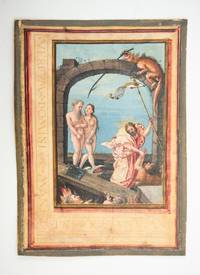
1540ST20622Germany ca. 1540. 183 x 133 mm. 7 1/8 x 5 1/4". <br/> WITH A FULL-PAGE MINIATURE DEPICTING THE HARROWING OF HELL featuring a naked Adam and Eve on the left and on the right Christ bending down to rescue John the Baptist the figures framed by a stone archway supporting a hairy creature who aims the point of a spear directly at Adam and Eve the miniature in a thin brown frame with gilt lines surrounded on two sides by the words "VERBUM DOMINI MANET IN ETERNUM" in gilt all framed in gray and red washes with double rules of black and gilt. Light soiling to frame a little flaking to the gray border and a couple of small scuffs and smudges elsewhere verso with spotting but the miniature vibrant and well preserved with only very trivial imperfections.<br/> <br/> A close copy of an early 16th century engraving by Albrecht Dürer this powerful miniature depicting the Harrowing of Hell is an intriguing artifact that ties together manuscript art print culture and the Reformation. The image depicts an apocryphal tale in the Gospel of Nicodemus in which Christ following his death but before his Resurrection descends into Limbo in order to save righteous souls who had passed away before him particularly figures from the Old Testament. Christ appears here in pale pink robes carrying a long staff with a cross and banner adorning the top. Having just brought down the gates of Hell he stoops to rescue John the Baptist here dressed in furs from its depths. A naked Adam and Eve covering their loins stand at the left of the composition--Adam now a gray-bearded old man as a reflection of sin and mortality but Eve still as she was at the Expulsion in keeping with the period's inclination to retain the classically idealized youthful feminine form. Above them is a stone arch upon which a dog-like demon perches stealthily aiming a spear directly at the oblivious couple. Another demon snaps its jaws at the feet of Christ and we can see a lick of flames below the broken gate as more captive souls clamor to escape. The painting is skillfully done showing the artist's facility with anatomy proportion and foreshortening. The bodies of Adam and Eve are particularly excellent with lovely skin tones and convincing molding. The composition is clearly based on an engraving by Dürer published in 1513 as part of a major series of 16 images known as the "Engraved Passion." In translating a black & white print into a full-color painting the artist here dispensed with a few details seen in Dürer's work such as the shadowy figure behind Adam and Eve and the stigmata on Christ's hand; however the overall composition deviates little from the original suggesting that the artist may have been working from an actual engraving. Although this leaf contains just a few words in the form of a border inscription--"Verbum Domini manet eternum" "the Word of the Lord endures forever"--they are monumentally important. This line from Isaiah 40:8 and 1 Peter 1:25 became the motto of the Lutheran Reformation appearing on art clothing coins and even armor of the 16th century. The Schmalkaldic League an influential group of allied Lutheran principalities in the Holy Roman Empire at the time also adopted it as their motto. Given the dominance of print materials during the Reformation period our hand-painted miniature--possibly produced as a frontispiece--must have been a very special commission. It is also an object that is prime for further study touching on aspects of book production religious art and the transmission of images and ideas in the early modern period. unknown
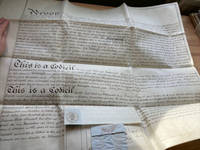
49886Great Waldingfield Sudbury Suffolk: Reverend Francis Cresswell 22nd December 1841 Probate. 22" x 27". 2 vellum sheets written on one side. Two vertical folds and three horizontal folds. Plus the probate certificate is attached including the paper/wax seal. Family history records show Francis Cresswell was born in 1762. He married Jane Okes on October 12 1807 in Cambridge Cambridgeshire England. He died on November 17 1841 in Suffolk England having lived a long life of 79 years and was buried in Great Waldingfield Suffolk. "1807 - Francis Cresswell S.T.B. Clare College Cambridge; B.A. 1785; M.A. 1788; B.D. 1796; Fellow and Tutor; was instituted March 24 1807 enjoying the benefice thirty-five years.He died Nov. 17. and was burried here November 24 1841 aged 78 years. There is a tablet in the church. In the churchyard West of the church is a stone with the initials: "F.C." 1841 J.C. 1870. The Parish register gives Francis Cresswell buried 24 Nov. 1841 aged 78. Jane Cresswell of Melford late of Great Waldingfield buried Feb 5 1870 aged 91." - See Rectors of Great Waldingfield By Rev. Francis Haslewood . Great Waldingfield, Sudbury, Suffolk: Reverend Francis Cresswell 22nd December 1841 (Probate) hardcover
3752897015.Gpaperback. Good. Access codes and supplements are not guaranteed with used items. May be an ex-library book. paperback
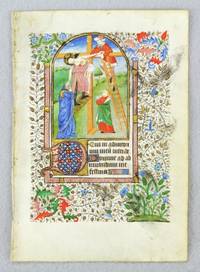
1420ST12005fFrance probably Paris ca. 1420. 210 x 146 mm. 8 1/4 x 5 3/4". Single column recto with five lines of text verso with 16 lines all in a very pleasing very regular gothic book hand. <br/> Attractively matted. Rubrics in red verso with a one-line and two two-line initials as well as a line filler in colors and burnished gold recto with a one-line initial and a line filler in the same style and with a quite large five-line "D" in pink and white with enclosed floral diapering all on a burnished gold ground the same side WITH A LOVELY FULL BORDER of swirling hairline stems bearing numerous leaves and berries of burnished gold and with sprays of acanthus leaves and flowers in multiple colors spilling from the corners this ENCLOSING A POIGNANT ARCH-TOPPED MINIATURE OF THE REMOVAL OF CHRIST FROM THE CROSS measuring approximately 85 x 60 mm. the miniature within a thin gold frame and enclosed in turn on three sides by bars in colors and gold the scene showing two men on ladders unfastening Christ's lifeless body from the cross while Joseph of Arimathea waits below clutching cloth to be used for a burial shroud as the Madonna at the lower left of the picture reaches up to clasp her son's bloody arm. With a small cross stitched in white thread in each upper corner. ◆A little soiling right along hinge edge a few smudges in the border a couple of tiny flakes of paint missing from the cross and the sky otherwise fine the vellum clean and fresh the colors rich and the gold lustrous.<br/> <br/> This is an especially sorrowful scene depicted with power grace and sensitivity by an artist demonstrating very considerable skill in composition and execution. The scene is well designed with the cross providing a device for focus at the center of the miniature. Nicodemus identified by his expensive attire is atop a ladder behind the cross lowering Christ's limp body onto the shoulder of another man probably a servant whose ladder is set against the front. Despite the fact that the corpse is more bones than flesh the artist has made it seem a heavy burden draped over the shoulder of the man as he walks backward down his ladder. Fully stretched out Christ's left arm is held for balance by Nicodemus at the top right while the other arm hangs down toward the Virgin. While we can only see her back her image evokes great pathos as she reaches up with both hands to grasp the mangled arm of her son his blood running from his hand onto hers. Joseph of Arimathea whose position anchors the right side of the picture looks on with concern tightly holding linen to shroud the body. St. John and Mary Magdalen conventional participants in the Deposition are not present in this miniature. While it is possible and even likely that the same artist produced this scene and the miniature of Christ Carrying the Cross this one is better as the faces are more deftly painted and the folds in the various garments are more clearly defined. unknown
1516ST20620Northern France late 15th or early 16th century. 176 x 128 mm. 7 x 5". Single column 23 lines in a neat batârde hand. i blank 101 ii blank leaves. Lacking one leaf after f. 87 possibly containing a miniature otherwise complete. Contents: Calendar f. 1r; Gospel Lessons f. 7r; Passion according to John f. 10v; Hours of the Virgin f. 15v; Penitential Psalms and Litany f. 45r; Office of the Dead f. 54v; Hours of the Cross f. 68v; Hours of the Holy Spirit f. 70v; Prayers to the Trinity St. Veronica "Obsecro Te" "O Intemerata" and "Stabat Mater" f. 72v; Suffrages f. 79r; Prayers in French to be said on various occasions f. 86v; verse prayer in French beginning "Royne des cieulx glorieuse" f. 90r; additional prayers in French and Latin f. 93v. <br/> Attractive 19th century vellum with lacy gilt border raised bands ruled in gilt gilt lettering tan silk endleaves all edges gilt. Housed in a felt-lined reddish-brown pebbled morocco clamshell box with gilt lettering on spine. Rubrics in red numerous one- and two-line initials in painted gold on burgundy or blue ground WITH 27 SMALL MINIATURES one miniature of Christ Carrying the Cross measuring 60 x 68 mm. the rest depicting saints and measuring between eight and nine lines each surrounded by a full border of acanthus flowers and small dots on bare or painted vellum and 14 LARGE MINIATURES EACH OPENING WITH A FULL BORDER either with acanthus and flowers as before or architectural some borders embellished with figures animals or hybrids two with a small scene in the lower margin and about a dozen with the added coats of arms and/or mottos of Jean Boutin. The subjects of the large miniatures include the following: St. John of Patmos f. 7r; Annunciation f. 15v; Visitation f. 23r; Nativity f. 27v; Annunciation to the Shepherds f. 29v; Adoration of the Magi f. 31v; Presentation in the Temple f. 33v; Flight into Egypt f. 35v; Death of the Virgin f. 38v; Bathsheba bathing f. 45r; Funeral Mass f. 54v; Crucifixion f. 68v; Pentecost f .70v; Trinity f. 72v. See: Fairfax-Murray "French" p. 265-266. Vellum binding soiled but perfectly sound. Small portions of some border figures and perhaps three or four miniatures touched up in the 16th century see below occasional chipping to white paint small hole in the border of ff. 11 & 29 light scattered spotting fading thumb soiling and other minor issues but an attractive and substantially complete manuscript the illumination extensive and mostly well preserved.<br/> <br/> This heavily illustrated Book of Hours is a lovely example of provincial illumination; it calls attention in an interesting way to the influence of printed books on manuscript art; and it contains intriguing traces of an early prominent owner. Our manuscript contains a total of 41 large and small miniatures by a skilled artist who clearly had some training and familiarity with the prevailing styles of the time. The overall appearance of the work suggests the artist or workshop was located in Northern France and although the figures and backgrounds are indicative of a provincial hand the rich colors profuse use of liquid gold and sumptuous borders are unmistakable marks of luxury. The image of the Trinity is particularly lovely demanding the viewer's attention with God the Father's piercing gaze and conveying the majesty of the subject with a patterned throne set against a starry sky. Of special interest here are the compositions of the large miniatures many of which seem to have been copied from printed Books of Hours of the period. When we talk about the transition from manuscripts to print culture in the late-15th and 16th centuries the discussion often focuses on how the art of manuscripts influenced the appearance of printed works. There is no better example than Books of Hours which in printed editions often mimic the look of their manuscript predecessors in appearance and the way many were finished by hand. However as the present example demonstrates the opposite was also true as printed works inevitably made their way into the hands of manuscript artists. Some even worked simultaneously both as illustrators for publishers working with metal- and woodcuts and as manuscript painters. As a reflection of this point in the present work we find distinct similarities between our miniatures and a series of metalcuts used by Philippe Pigouchet for the publisher Simon Vostre beginning in 1496 Fairfax-Murray's set 2. According to Fairfax-Murray "These cuts . . . were evidently very favourably received by Pigouchet's rivals and imitators for one finds several close copies and adaptations in the various productions of other presses" including a very close imitation of woodcut images commissioned by the publisher Antoine Vérard. Evidently the popularity of these plates extended to manuscript artists and it is fascinating to see the adaptation of each composition to suit the painter's own style and the patron's needs. Most of the compositions in our manuscript are essentially simplified versions of the printed miniatures retaining the central figures their gestures garments and props but with complex backgrounds eschewed as are extra figures deemed unnecessary to fulfill the narrative. The resulting miniatures are far less busy than their printed counterparts allowing the viewer to focus on the central story. In a few instances the artist has added small scenes beneath the large miniatures. An example on f. 35 depicts the so-called "Miracle of the Wheat" featuring harvesters misleading Herod's soldiers by truthfully saying that the fleeing Holy Family passed by when their now miraculously matured crop was just being sown. This kind of inclusion may have been influenced by the copious small metalcut scenes that decorate the borders of numerous printed Books of Hours of this period. The text here follows a fairly typical structure but includes prayers in French to be said for each day of the week and on various occasions such as when one awakens or when one leaves a house. Also in French are additional verses to the Virgin--one of which is credited to the Franciscan preacher Jean Tisserand d. 1497 who founded an order for repentant women. Another accessory prayer included here f. 98 appeared in both prayer books and conjuring manuals of the period straddling the line between religion and popular magic. Based on an apocryphal encounter between Pope Leo III and Charlemagne during the Battle of Roncevaux this prayer was often used as a protective amulet against all manner of evil; here it is said to "conquer demons and one's enemies." Although we do not know for whom this manuscript was originally made the book shows a number of marginal customizations in the form of different coats of arms the motto "Soit avenu" "Let it come to pass" and the name of Jean Boutin written on ff. 23 and 35. This owner could have been Jean Boutin Sieur de la Court et de Chamballan and Mayor of Nantes from 1575-76. In addition to the marginal customizations the manuscript may possibly have some very neat replenishing of white facial paint in a handful of marginal figures and perhaps in a very small number of the miniatures. Using magnification and strong light we are unable to find convincing evidence that this retouching took place at least in the miniatures and if it was we think it was done quite early perhaps in the 16th century. Worst case it would necessarily be termed subtle and skillful enough to cause uncertainty now and whatever the verdict is in this respect the manuscript remains very fresh and attractive features attractively executed paintings is complete but for one leaf and would provide ample room for additional research. unknown
1450ST20835Flanders ca. 1450. 109 x 81 mm. 4 1/4 x 3 1/8". Single column 14 lines in a gothic book hand. 161 leaves. COMPLETE. Contents: Calendar f. 1r; Mass of the Holy Spirit f. 14r; Mass of the Holy Cross f. 23r; Requiem Mass f. 30r; Prayer on the Seven Last Words of Christ by the Venerable Bede f. 36v; Passion according to John f. 40v; blank f. 53; Hours of the Holy Cross f. 55r; Mass of the Virgin Mary f. 60r; Gospel Lessons f. 66v; Hours of the Virgin f. 73r; Penitential Psalms f. 126r; Litany f. 138r; Office of the Dead f. 144r. <br/> PLEASING NEAR-CONTEMPORARY BLIND-ROLLED CALF apparently with some old skilled restoration to joints spine and corners covers with rolled vine border surrounding a panel of three columns bearing a roll with parts of the inscription "AVE MARIA GRACIA PLENA" each word separated by one of four small motifs a flower a human profile the lamb of god and a sitting animal--perhaps a lion raised bands compartments with part of the same inscription roll. Lacking the original ties. Housed in a very attractive custom-made brown calf folding case with blind-stamped lettering on the spine interior lined in suede the whole within a calf-lipped suede-lined matching slipcase. Rubrics in red numerous one-line initials in blue with red penwork or gold with dark blue penwork many two-line initials in burnished gold on pink and blue ground with white embellishments several larger "I" initials between four and 11 lines in burnished gold on pink and blue ground with white embellishments 12 six- to seven-line initials some painted pink or blue with white embellishments and filled with flowers and tendrils on a gold ground or the initial in burnished gold on pink and blue ground with white embellishments EIGHT LARGE MINIATURES each inside a thin gold frame and with a three-quarter border of gilt leaves hairline vines and floral spays each facing page with a similar three-quarter border the subjects of the miniatures being: the Holy Spirit in the form of a dove f. 13v; St. Helena and the True Cross f. 22v; Raising of Lazarus f. 29v; Crucifixion f. 54v; Virgin and Child Enthroned f. 59v; Annunciation f. 72v; Last Judgment f. 125v; Funeral Mass f. 143v. Prickings visible in fore margins. See: Defoer et. al "The Golden Age of Dutch Manuscript Illumination" pp. 75-86. Just minor wear to the solid very pleasing early binding. A little chipping almost always mild to four of the miniatures with square frames the fifth the Annunciation somewhat rubbed and faded the three domed miniatures perfectly intact vellum with minor soiling and thumbing in places especially in lower corners of leaves in second half other trivial imperfections but overall a very well-preserved manuscript with no major issues.<br/> <br/> This enchanting little prayer book features eight attractive miniatures large gleaming burnished gold initials and a pleasing period binding--all in an excellent state of preservation. The miniature program here can be attributed to the so-called Masters of Otto van Moerdrecht the name given to a variety of Dutch artists active in the 1430s and '40s all working in a similar mode rather than to a specific master or workshop. According to Defoer et al. the work of these miniaturists "exhibit varied compositional formulas and bright highly contrasting colors . . . . The small somewhat doll-like figures appear rather wooden but their expressive gestures give the scenes a varied and vivid character." Two artistic hands are responsible for the present miniatures. The artist behind the first three miniatures all set within domed gilt frames the Holy Spirit St. Helena and Raising of Lazarus shows particular skill with a very smooth application of color figures with long eloquent hands and faces with subtle white highlighting. A second artist was responsible for the remaining five miniatures set within square golden frames Crucifixion Virgin and Child Enthroned Annunciation Last Judgment and Funeral Mass. Though this hand is less polished and the miniatures slightly smaller in size the scenes are all quite charming and attractively colored with vivid splashes of bright orange bubblegum pink sky blue and pale green. It is worth noting that the miniatures differ not only because of the artists' degree of success but also because of their condition: whereas the five are generally well preserved the other three are in a virtually perfect state. In addition to the central text of the Hours of the Virgin this manuscript contains several Masses each of which is preceded by a miniature. Perhaps the most interesting of these is the Mass of the Holy Cross which is paired with a miniature of St. Helena mother of Constantine the Great. According to Christian tradition Helena found the wooden cross used in the Crucifixion while she was travelling in Jerusalem in the fourth century. Constantine built the Basilica of the Holy Sepulchre in its honor and installed the relic there to be venerated. Britannica says that the adoration of the True Cross led to wide-spread sale of its fragments sought after as objects of devotion. It is unusual to find St. Helena depicted in a Book of Hours and this image is especially appealing with Helena in a beautiful red robe crown and halo embracing a large wooden cross in the center of the composition. The background is reminiscent of the work of the Gold Scrolls group with small swirls of liquid gold swimming in a scarlet sky the same scrolling motif graces the Holy Dove miniature. There is no indication of former ownership in this manuscript although the Calendar presents a few unusual saints that confirm a Flanders connection. These include St. Amandus in red known as the "Apostle of Flanders" on 2 February; St. Guido known as the "Poor Man of Anderlecht" on 9 September; St. Bavo in red patron saint of Ghent where a Cathedral is named in his honor on 10 October; and St. Eligius patron saint of goldsmiths and metalworkers on 1 December. The binding here is very close to contemporary and probably dates to the late 15th century. Neither the floral roll nor the "Ave Maria" roll seems to appear in EBDB. Similar rolls include r001954 r000623 and r000670 but ours is the only one with four different and charming tools one of each used between every "Ave" and "Maria." For a manuscript only slightly bigger than the palm of one’s hand this Book of Hours has a great deal to offer. In addition to its early binding and lovely illumination by an influential group of artists great care has been put into its preservation so that it resolutely endures for our pleasure and for owners in the centuries to come. unknown
1470CLe2501Low Countries probably Bruges ca. 1470-80. 186 x 135 mm. 7 3/8 x 5 1/4". Single column 20 lines in a gothic book hand. i blank 108 i blank leaves bound too tightly for a close collation but APPARENTLY COMPLETE. Contents: Calendar f. 1r; Gospel Lessons f. 7r; Hours of the Holy Cross f. 11r; Hours of the Holy Spirit f. 15r; Mass of the Virgin 18r; "Obsecro te" f. 21r; "O Intemerata" f. 23r; Suffrages f. 24r; Hours of the Virgin f. 33r; Office of the Virgin as said throughout Advent f. 71r; Penitential Psalms f. 76r; Litany and petitions f. 81v; Office of the Dead f. 87r. <br/> HANDSOME RENAISSANCE ENTRELAC BINDING upper joint and parts of spine very skillfully repaired covers with a gilt floral border surrounding a central panel of gilt strapwork design with traces of original polychrome painting raised bands spine gilt in compartments original bosses and catchplates clasps renewed all edges gilt. Rubrics in red numerous one-line initials in blue with red penwork or gold with dark purple penwork many two-line initials in burnished gold on pink and blue ground with white highlights most of these with floral sprays extending into the margins 22 SMALL MINIATURES measuring approximately 45 x 37 mm. each with panel borders of colorful acanthus and flowers at the top and bottom of the page connected by a strand of gilt bezants and 14 FULL-PAGE MINIATURES each surrounded by a full border of acanthus flowers and bezants the facing pages also with full borders and a large six-line initial painted pink or blue filled with swirling vines and flowers on gilt and painted ground. Subjects of the large miniatures being: Crucifixion f. 10v; Pentecost f. 14v; Virgin and Child f. 17v; Annunciation f. 32v; Visitation f. 42v; Nativity f. 49v; Annunciation to the Shepherds f. 52v; Adoration of the Magi f. 55v; Presentation in the Temple f. 58v; Massacre of the Innocents f. 61v; Flight into Egypt f. 66v; Coronation of the Virgin f. 70v; David in Prayer f. 75v; Raising of Lazarus f. 86v. Front pastedown with a 16th century inscription see below; rear pastedown with a 17th century ownership inscription in ink signed François le Paige. Lower joint a bit rubbed margins with a little soiling and occasional wrinkle fore-edge border rule just grazed by binder in a few places the other borders quite ample miniatures with tiny chips light fading or rubbing in a couple places etc. but IN EXCELLENT CONDITION the attractive period binding very well preserved with boards showing virtually no signs of wear the vellum generally clean and bright and the miniatures fresh and richly colored.<br/> <br/> This is an extensively illustrated Book of Hours preserved in an especially attractive early binding with richly colored miniatures attributed to the Master of Philip of Cleves' "Book of the Hunt." Active in the Low Countries from approximately 1470-90 this artist was patronized by some of the area's wealthiest elite and is known to have collaborated with another important illuminator called the Bruges Master of 1482. Some trademarks of our painter include faces with subtle blue shading; high arched eyebrows; thin golden halos; and women with very straight shoulder-length hair highlighted with strands of gold. Outdoor scenes often contain narrative elements in the distance such as the figures of a young David and Goliath in the miniature of King David at Prayer or pagan idols dropping from a column in the Flight into Egypt recalling a popular apocryphal tale of pagan relics miraculously falling to pieces as the Holy Family passes by. Some miniatures of note in addition to these two are the Raising of Lazarus for the Office of the Dead--a popular alternative to funeral images particularly among Flemish illuminators--and the Massacre of the Innocents for the hour of Vespers a particularly violent episode in which King Herod commands his soldiers to slaughter the male infants of Bethlehem. Like other miniatures in this work the action in these scenes is spread out between the fore middle and background creating a multi-layered narrative that invites the eye to explore and meditate. The artist's color palette in this manuscript is quite memorable and includes a bright mustard yellow pale green and cherry blossom pink. The Coronation of the Virgin makes particularly strong use of color with a sunset-like gradient giving way to billowy blue clouds. The Annunciation miniature also demonstrates the Master's facility with color; here the Angel Gabriel's red and green wings are fully extended while the Virgin is radiant against a golden yellow wall covering. In addition to the large compositions we are treated to 22 smaller miniatures depicting the Evangelists and saints each of which is charming in its more confined presentation. Although the saints found in the Suffrages are quite typical for a Book of Hours the Calendar is another story. Despite being rather sparsely filled out the calendar here includes several feast days some of them unusual enough to provide additional insight into the manuscript's localization and use. For example there is St. Landoaldi 19 March a missionary to Northern France and Belgium and St. Winnoc 6 November the son of a Breton king with a former abbey in the far north of France. The calendar is idiosyncratic in other ways as well with saints' names that are repeated and others that are either extremely obscure or whose dates seem to be wrong. Whatever the case additional research into the calendar would undoubtedly prove revealing. We are fortunate to have some early provenance information written into this Book of Hours. The inscription on the front pastedown reads: "This last day of September 1590 we name erased but Claude le Paige lieutenant of the guards of his highness of Bar le Duc on the one hand and Alix de la Taxe on the other hand have married in front of the holy Catholic church at the place of Mirecourt." Below this inscription are notes indicating the ages of the bride and groom 17 and 36 respectively as well as the dates of their deaths: he died on 9 May 1610 and she on 14 September 1622. Located in the strategically important Meuse region in northeastern France the Duchy of Bar-le-Duc unified with Lorraine in 1480 and became extremely wealthy during the 16th century. Although we do not know for whom the manuscript was originally made it seems quite possible that it was commissioned for a forebear of the named Bar-le-Duc spouses and was perhaps passed down through later generations of the family. The signature on the pastedown indicates that François le Paige son of Claude and Alix inherited the book from his parents. This manuscript was lavishly and tastefully bound early in the 16th century and has survived in excellent condition to the present day. This binding would originally have been painted but even without its original colors it is still quite attractive perhaps even splendid. In excellent condition inside and out the manuscript is a fortunate survival and a testament to generations of careful stewardship. unknown
ST20295Northern France probably Paris third quarter of 15th century. 130 x 100 mm. 5 1/8 x 3 7/8". Single column 15 lines in an elegant gothic book hand. 280 leaves. First four leaves misbound lacking at least seven leaves five of which probably contained miniatures. Contents: Devotion to the Passion f. 1r; blank f. 4; Calendar f. 5r; Gospel Lessons f. 17r; "Obsecro te" and "O intemerata" f. 23r; blank f. 23; Hours of the Virgin lacking opening leaves for Terce Nones and Vespers f. 33r; Penitential Psalms and Litany f. 100r; Hours of the Cross lacking preliminary leaf f. 120r; Hours of the Holy Spirit p. 123r; Office of the Dead lacking preliminary leaf f. 127r; "Sept Vers de Saint Bernard" and Suffrages f. 176v; series of devotional prayers in Latin and French including the Hours of the Conception an indulgence devotional poems in French prayers for specific occasions such as when facing tribulations going to confession protection against storms and for friends abroad the Stabat Mater the Seven Joys of the Virgin Gospel sequences "Le chemin de paradis" and many others f. 199r; blank f. 280. <br/> ESPECIALLY BEAUTIFUL MID-19TH CENTURY LIGHT BROWN MOROCCO LAVISHLY GILT IN THE "FANFARE" STYLE BY CAPÉ stamp-signed in gilt on front turn-in covers with large green and red morocco inlaid panels gilt strapwork scrolling and small star tools raised bands spine compartments with red or green morocco inlay surrounded by gilt scrolling embellishments gilt lettering RED MOROCCO DOUBLURES gilt in the style of Duodo with repeating pattern of flowers encircled by vines marbled endleaves modern paper and vellum flyleaves all edges gilt. Housed in a fine suede-lined pebble-grained leather pull-off case with gilt lettering on spine. Light red ruling and rubrics numerous line-fillers in blue and pink with gilt embellishments many one- and two-line initials in burnished gold on pink and blue ground three four-line initials in pink or blue filled with ivy leaves on a burnished gold ground two of these with a gilt and painted baguette along the outer edge of text and all with a three-quarter border of hairline vines flowers acanthus and gold leaves the majority of the leaves with a panel border of hairline vines and flowers on one side one historiated initial painted blue on a burnished gold ground depicting the Virgin accompanied by a gilt and painted baguette and three-quarter border FOUR SMALL MINIATURES DEPICTING THE APOSTLES each with a gilt and painted baguette and surrounded by a three-quarter border and EIGHT LARGE ARCH-TOPPED MINIATURES above a three-line initial painted blue or pink on gold ground a gilt "L" shaped bar border incorporating colorful flowers and a full border of border of hairline vines flowers acanthus and gold leaves and A HALF-PAGE RECTANGULAR MINIATURE with a border along the lower half. The subjects of the large miniatures include: the Mass of St. Gregory f. 1r; Annunciation f. 33r; Visitation f. 57r; Nativity f. 70r; Adoration of the Magi f. 80v; Crowning of the Virgin f. 94v; David in Prayer f. 100r; Pentecost f. 123r; and a rectangular miniature of the Holy Wound or perhaps the Bleeding Host of Dijon f. 241v. Isolated light rubbing and negligible chips to miniatures the dark blue paint appearing slightly worn in places as is often the case occasional faint smudges to borders and other imperfections but all of these trivial. IN THOROUGHLY FINE CONDITION INTERNALLY--the paint fresh the vellum clean and the margins quite comfortable--AND THE EXTRAORDINARILY FINE BINDING FLAWLESS.<br/> <br/> In a spectacular 19th century binding this lovely thick little Book of Hours was executed by a talented follower of Maître François and the Master of Jean Rolin and contains a large number of prayers and devotional texts many of them in French. The manuscript includes a fine array of large and small miniatures executed with a colorful palette and careful attention to detail. Particularly noteworthy is the excellent molding of faces. Each figure--no matter their station or importance to the scene--displays unique characteristics that give us a sense of their age sentiments and demeanor. This is an impressive feat given the small scale of the compositions and this individualization adds a great deal of value to the miniatures as well as the viewer's emotional experience connecting to the images. Our artist owes much to the work of the so-called Maître François and slightly before him the Master of Jean Rolin the latter an eponym attached to the illuminator of missals done for Rolin cardinal-bishop of Autun d. 1483. Perhaps of Burgundian origin the Master of Jean Rolin completed his artistic education in Paris probably in the workshop of the Bedford Master and afterward established his own atelier in Burgundy. There he played a key role in the transition from the Bedford Master's slightly more gothic style to the more thoroughly Renaissance style of Maître François who ran the most successful Parisian workshop during the years between 1460 and 1480 producing illuminated manuscripts small and large sacred and secular. Characteristic of Maître François's style are richly colored scenes interiors depicted with considerable detail women and children with pale porcelain complexions and male figures with darker weathered flesh tones--all of which can be seen in the present work. The final miniature present in this work however seems to have been executed by a different artist altogether being rather more flat in appearance and without the detailed facial molding noted earlier. About two-thirds of the manuscript follows fairly regular arrangement of texts with the exception of the Mass of St. Gregory which is misbound at the beginning of the volume. Then following the Suffrages are approximately 80 leaves of devotional texts in Latin and French including popular verses such as the "Seven Joys of the Virgin" and the "Stabat Mater" as well as more unusual texts such as the Hours of the Conception prayers for specific occasions or protections--for example against storms "Contre tempeste" and when one passes over water "Quant on passe par eaue"--indulgences and other related texts. Two of the more interesting passages are "Le chemin de paradis" a French prayer beginning "Qui en paradis veult aller" and a series of Latin poems that claim to be copied from originals found at the church of St. Paul in Rome. These copious additional prayers suggest a high degree of customization for a client who may have been particularly religious or at least very concerned with self-preservation! and they present intriguing possibilities for further study. The manuscript was rebound sometime in the middle years of the 19th century by Capé d. 1867 one of the most distinguished binders in France in his day. He was especially well known for the delicacy of his work which can be observed to great effect in the present example. He was the binder to the Empress Eugenie and Béraldi calls him "the Bozérian of the second Empire." His work has always been highly sought after and it resides in all of the great collections where bindings are considered important. This volume seems to have been sold to bookseller Francis Edwards as lot no. 95 at Sotheby's sale on 3 April 1957 and has been in private hands ever since. The manuscript is a little jewel inside and out and has obviously been a treasured vessel of prayer and art for generations of owners. unknown
1470ST20836Western France Angers ca. 1470. 122 x 88 mm. 4 3/4 x 3 1/2". Single column 15 lines in a neat bâtarde hand. 152 leaves first and last three are ruled blank leaves; leaf count does not include the first blank endleaf erroneously included in the modern pencil foliation. COMPLETE. Contents: early ownership inscriptions f. 2v Calendar f. 5r Hours of the Virgin f. 17r Extract from the Gospel of John f. 55v Obsecro Te f. 57r Penitential Psalms and Litany f. 61r Office of the Dead f. 78r series of devotional prayers in Latin to the Virgin Mary Christ and the Archangel Michael f. 115r O Intemerata f. 134v series of devotional prayers in Latin f. 138r ruled blank leaves with family records of Jacques Bille f. 150v. <br/> Pleasing early 19th century caramel colored straight-grain morocco covers bordered with a double gilt rule smooth spine gilt in compartments divided with a double gilt rule and dotted roll and cross centerpieces neat early repair to head of spine turn-ins gilt marbled endpapers all edges gilt. Housed in a 20th century felt-lined slipcase with a gilt monogram on front. Ruled in red rubricated in red and blue two one-line burnished gold initials on a blue or pink ground one three-line blue and red penwork initial eight three- to four-line initials in pink and blue filled with ivy leaves on a burnished gold ground these pages with three-quarter borders of acanthus leaves dense rinceaux colorful fruit and flowers gold ivy leaves and bezants and WITH FOUR ARCH-TOPPED MINIATURES above a three- or four-line initial painted blue or pink on gold ground each surrounded by a full border of painted gold and brightly colored acanthus leaves vines and flowers studded with burnished gold bezants three borders inhabited with fantastical creatures the subjects of the miniatures including the Annunciation f. 17r; King David in Prayer f. 61r; a funeral procession f. 78r; and the Pietà f. 115r. Verso of first leaf with signature of Jacques Bille or Billes and the following page with a note in a different contemporary hand with the day and year erased and written over: "Ces presentes heures sont a iaques bille qui les trouvera si les luy Rende et il paiera voluntriers le VIII le jour de la sainct martin. Tesmoion son seign manuel cy mis le huytiesme jour de Avril L'an mil cinqcens et seze" "These present hours belong to Jaques Bille; whoever finds them should return them to him and he will gladly pay on the eighth the day of Saint Martin. Witness his manual signature placed here on the eighth day of April in the year one thousand five hundred and sixteen" followed by Bille's signature; third blank leaf with the ownership inscription "Tussanus Philippus Adeline Presbyter anno 1763"; verso of final text leaf and next three blanks with family records see below. Superficial crease to spine other insignificant signs of use to the leather but the binding sound and attractive. A hint of thumbing at lower corners of first half of the manuscript miniatures with a few isolated minor spots of rubbing not affecting faces otherwise in very fine condition internally the paint bright and fresh and the vellum clean.<br/> <br/> Almost certainly made in western France and with early ownership inscriptions tying it to that area this Book of Hours contains four extraordinarily high-quality miniatures by an accomplished artist very likely related to one of the greatest French manuscript illuminators of the period. Stylistic markers here include drapery with crisp folds figures with pale skin and high foreheads simple but perfectly executed scenery and a flair for detail. The latter talent is particularly evident on the various textiles and garments which include almost impossibly fine gold trimmings and sophisticated draping. It was in fact on the basis of the extraordinary drapery that the manuscript had previously been associated with the circle of Jean Fouquet called by Avril and Reynaud "the greatest French painter and illuminator of the 15th century." In a case of twin summits recent scholarship suggests an alternative attribution to the similarly illustrious circle of Maître de Jouvenel des Ursins a contemporary of Fouquet who according to Avril and Reynaud was "the most important illuminator of the mid 15th century in western France." Around him sprung up a group of artists collectively referred to as the "Jouvenel group" who were based primarily in the area between Tours Nantes and Angers. The illuminations in the present work are so skillful that with additional research it may be possible to pin down an attribution with more certainty; whatever the identity of the artists the level of finishing in these illuminations--from the careful molding of the faces and bodies to the expertly balanced compositions and elegant brushwork--are the hallmarks of a superior hand. When this item was sold at Sotheby's on 13 July 1977 the auction catalogue said that the miniatures "are painted with fine clear colours with great delicacy in the modelling of faces and costumes. The finest miniature is that of the Pietà set against a deep green hill with a fiery sun setting behind dark mountains and buildings and lighting up the evening sky." Indeed this image is a quiet masterpiece of illumination and an excellent example of this artist's work. The naked figure of Christ exhibits a real command of anatomy and proportion while subtle details such as the foreshortening to Christ's face and the whisper-thin cloth clinging to the lower body are done with an exquisite touch. The miniature of the funeral procession also stands out for its superior quality. The composition is quite different from the Pietà being a large group of people rather than an intimate portrait of two figures but it is approached with equal rigor and devotion to detail. The faces turning toward the viewer all show impressive individualization with the figure dressed in blue being particularly well formed and highly differentiated from the crowd--so much so that this could possibly be considered a patron portrait. Three of the miniatures in this work contain borders with delightful examples of marginalia including a court jester a hedgehog a male and female centaur wielding weapons a monkey riding a camel another monkey rubbing his posterior and other whimsical hybrid creatures. These stand out because they are rendered with the characteristic skill and attention to detail found in the larger miniatures so it is possible that they could also be the work of the miniature artist. Although the Calendar in this manuscript is fairly sparse at least two unusual entries in red point toward western France: St. Julian Bishop of Le Mans 27 January; and St. Maurilius patron saint of Angers 13 September. Significantly the Translation of St. Maurilius also appears on both 16 August and 19 of October in black. Strengthening this association with the west are the early ownership inscriptions tying to the Bille family from at least the early 16th century and possibly before. The final three leaves contain family records that include the date of Jacques Bille's wedding 8 April 1516 and the births of 15 children written in two or three hands between approximately 1520 and 1549. The name of our former owner was difficult to trace with certainty but we find mention of a Jacques Bille in the French National Archives where he is listed as a notary in Bourg in southwestern France. This would make sense given Bille's complex signatures found on the first two leaves--the extra flourishes may well reflect notarial signatures that he used in his work. In modern times our manuscript was sold at Sotheby's on 25 February 1946 lot 57 to Maggs who may well have sold it to Sven Ericcson who is listed as the owner of this and four other 15th century illuminated Books of Hours when it was sold at Sotheby's in 1977 for £3200. According to RBH it was purchased at that auction by "Malle" almost certainly Bernard Malle 1929-2008 brother of filmmaker Louis Malle and an eminent collector and bibliographer. In an elegant tribute to his late friend and mentor Bernard Clavreuil calls Malle "one of the most discerning . . . collectors of the postwar era" someone who "never ceased to refine and improve in order to achieve an impossible perfection." Malle also acted as a private advisor to more than one major collection and it is possible that he purchased the present manuscript on behalf of an unknown collector rather than his own library. These former owners clearly looked after this Book of Hours carefully over the years and for good reason: it is a work of considerable craftsmanship and beauty with illuminations distinguished by very substantial artistic skill. unknown
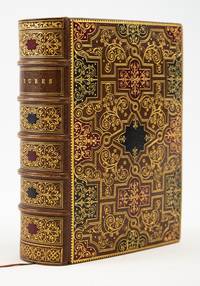
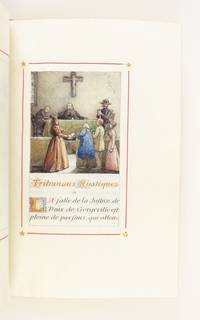
1896ST17129-026Paris 1896. 200 x 135 mm. 7 7/8 x 5 3/8". 11 leaves. Single column 16 lines plus headline in a thin graceful italic script. <br/> Attractive red crushed morocco by Marcellin Lortic stamp-signed on front doublure covers framed by multiple-rule gilt strapwork raised bands spine compartments with gilt French fillet gilt titling vellum doublures with gilt frame in the Romantic style leather hinges vellum endleaves all edges gilt. In matching morocco-trimmed slipcase. Title in burnished gold embellished with red and blue penwork text with red-ruled border and burnished gold stars at corners numerous one-line burnished gold initials with red or blue penwork two-line opening initial in burnished gold on a blue white and pink background and A HALF-PAGE MINIATURE measuring 71 x 64 mm. SHOWING A COURTROOM SCENE. Front free endleaf with morocco bookplate of Robert Hoe. ◆Just the slightest hint of rubbing to joints but A VERY FINE SPECIMEN entirely fresh bright and clean inside and out.<br/> <br/> This elegant little manuscript in French recounts Guy de Maupassant's satirical tale of a trial in the provinces; it was created by a man who knew the inside of a courtroom all too well. Bouton 1819-1901 was a young rebel during the 1848 Revolution who spent five years in jail for his participation in a bombing in Paris. Oddly enough the dedicated republican was also an expert on heraldry and paleography publishing pamphlets on those subjects as well as on politics and producing manuscripts like the present one. De Maupassant 1850-1893 is generally acknowledged as one of the great masters of the short story. In the present tale a wealthy older woman who had tried to buy a young peasant's love by giving him land sues unsuccessfully for the return of her property when the object of her affection forsakes her for a younger woman. According to Beverly Chew the library of Robert Hoe 1839-1911 founding member and first president of the Grolier Club was "the finest America has ever contained." Hoe acquired illuminated manuscripts early printing he owned a Gutenberg Bible on paper and one on vellum fine bindings French and English literature and Americana and when his library was sold in 1911-12 it fetched nearly $2 million a record that held until the Streeter sale more than 50 years later. Hoe owned several Bouton manuscripts of de Maupassant stories and the Morgan Library also has Bouton creations. The Lortic name was made famous in the history of French binding by Pierre Marcellin Lortic 1822-92 a leading Parisian binder for 40 years; the binder here was Lortic's son Marcellin or "Lortic Fils" 1852-1928. unknown
2001SONG1646961293M & M Limitless Online Inc 2020-01-20. hardcover. Used: Good. 6.00x0.50x9.00. Buy with confidence. Excellent Customer Service & Return policy. M & M Limitless Online Inc hardcover
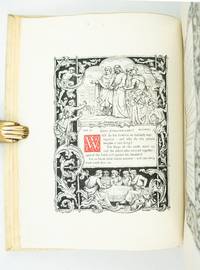
1862ST20857London: Edmund Evans for Sampson Low Son and Co 1862. ONE OF PERHAPS 10 COPIES PRINTED ON VELLUM. 260 x 195 mm. 10 1/4 x 7 3/4". vii 1 235 1 pp. <br/> Publisher's stiff vellum smooth spine with gilt lettering edges untrimmed. In a modern felt-lined blue buckram drop-back box. Decorative initials in red or blue title page and text leaves with full criblé border of vined foliation occasionally inhabited eight or 10 leaves with more extensive illustrations at head or foot all engraved by W. J. Linton after illustrations by John Franklin. Front pastedown with ex-libris of Marion Hope Rattey. A Large Paper Copy. McLean "Victorian Book Design" p. 184. Short thin cracks to head and tail of front joint spine vaguely soiled upper cover with two very small brown spots and one trivial red mark occasional mild rumpling or naturally occurring variations in the grain or thickness of the vellum as usual a couple of minor smudges but still a very agreeable copy the binding solid and without the splaying common in vellum books the interior clean fresh and bright and the margins extraordinarily wide.<br/> <br/> This is an infrequently encountered copy of a beautiful Victorian book on vellum issued by one of the era's top printers. The volume was printed by Edmund Evans 1826-1905 who is now best remembered for his illustrations and advances in color wood engravings. Relatively little is known about this book's production: Ruari McLean tells us that it was "entirely printed" by Evans but it is unknown whether he was responsible for the design as well McLean remarks that "if Evans was responsible for its design it shows his superiority in book-making". We also are unsure how many copies were printed on vellum although the general consensus is 10. Regardless as McLean tells us "it is one of the prettiest books of the 'sixties" with sharp deep impressions of the type on the rich creamy vellum jewel-like colored initials and elegant wood-engraved illustrations. These illustrations are the work of John Franklin ca.1800-68 a painter and draftsman who was highly respected in his own time. The precisely realized borders feature idealized human forms posed within a robust botanical largely acanthus context the figures posing with balletic grace their expressive faces often turned gently away from the reader. The size of the leaf here is significant: the untrimmed edges retain their tiny printing pinholes which would normally have been trimmed away with regrettable loss. And not surprisingly our vellum printing is almost never seen: we could trace just two copies at auction since 1924. Former owner Marion Hope Rattey 1922-97 was likely the daughter of bibliographer Clifford C. Rattey 1886-1970 whose impressive library featured incunabula and block prints. [Edmund Evans for] Sampson Low, Son, and Co unknown
1882ST16453Glasgow: Printed by Robert Anderson for Private Circulation 1882. ONE OF ONLY 50 COPIES. 195 x 122 mm. 7 3/4 x 4 7/8". 1 p.l. x 103 1 pp.From George Bannatyne's manuscript compiled A.D. 1568. <br/> BEAUTIFUL CITRON CRUSHED MOROCCO ELABORATELY TOOLED IN GILT BY RAMAGE stamp-signed on front turn-in covers with six concentric frames--intricate filigree roll pointillé-tooled floral vine and alternating small ornaments--enclosing a central panel with cornerpieces semé with rows of fleurs-de-lys large oval medallion at center radiating ornate fleurons raised bands spine compartments with large central medallion containing a vase of flowers delicate tooling in corners gilt titling turn-ins framed by filigree roll and alternating small ornaments brown and tan silk jacquard endleaves patterned in a Medieval motif top edge gilt. Printer's device on title page decorative woodcut initials and headpieces. Spines evenly sunned to a warm honey brown corners lightly rubbed short faint scratch to lower board but the binding virtually unworn and happily free of the splaying that plagues vellum books. Leaves lightly rumpled but A VERY FINE COPY the vellum leaves creamy clean and bright and the binding glittering with gold.<br/> <br/> Printed on luxurious vellum and limited to just 50 copies presumably for private circulation among friends of the printer this is a lovely edition of 16th century poems by a mysterious author believed to have been a poet and musician associated with the court of Mary Queen of Scots. This work contains all 36 extant poems attributed to Scott ca. 1520-82/3 including what is considered to be his most historically important work "Ane New Yeir Gift to Quene Mary" 1562 written in support of the young Scottish queen caught between Catholic and Protestant agendas. His other poems consist largely of lyric verses on love and sexuality which DNB describes as possessing "exceptional metrical variety and vernacular directness" with "a musician's ear for rhythm and melody." Scott's poems are known to us via the Bannatyne manuscript now held in the National Library of Scotland which ranks among the most important documents of Scottish Medieval literature. Written by George Bannatyne in 1568 during a period of confinement due to an outbreak of plague it contains a mixture of both secular and religious material including the sole extant copies of several texts. In the preface to the present work the publisher notes that Scott's poetry has been faithfully reproduced from that manuscript and thus "for the first time accurately printed." Very little is known regarding the life of Alexander Scott but he seems to have been attached to the court of Mary Stuart through John Erskine a guardian and counselor to the queen. Given the very limited number of copies made it is not surprising that this work is extremely rare on the market. Printed [by Robert Anderson] for Private Circulation unknown
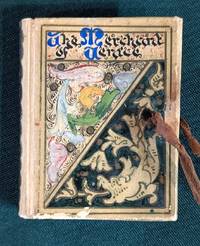
50727Venice: S. Rosen - Publisher Piazza S. Marc MDCCCCVI. 1906 . Scarce miniature book with hand-painted decoration. 2.75" x 2.25" x 0.5" 7.2cm x 5.8cm x 1.4cm. pp.256. Soiled vellum binding in very good condition. Both boards and spine with hand-painted decoration. Original leather tie still attached. Patterned endpapers. Gift inscription in red to front free-endpapers: "Of great value. Hand painted cover. From Father brought from Venice July 1909. A.D. To Ailen Mary Danby." Portrait frontis. Clean English text throughout plus a further 3 full-page illustrations. VG . Venice: S. Rosen - Publisher Piazza S. Marc, MDCCCCVI. [ 1906 ] . hardcover
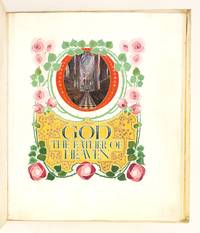
1907ST16456Birmingham 1907. 312 x 275 mm. 12 3/8 x 10 3/4". 16 leaves illuminated on rectos only. <br/> Pleasing original full vellum over bevelled boards covers ruled in gilt and with gilt crosses in each corner gilt lettering on upper cover smooth spine gilt rules dividing compartments with central gilt cross thick vellum turn-ins ruled in gilt bright purple silk endpapers front joint very expertly repaired. Calligraphic lettering mostly in black green and red a few one-line initials and many three-line initials in blue or purple with red penwork several slightly larger purple or blue initials infilled with ivy of various colors and dotted with gold EACH PAGE WITH A DIFFERENT ARTS & CRAFTS-INSPIRED FLORAL BORDER consisting of multi-colored blossoms and acanthus as well as meandering vine-stems and highlighted with gold bezants or stippled gold ONE LEAF WITH A 90 MM. INITIAL INHABITED BY A REALISTIC CATHEDRAL INTERIOR the large lettering below it on a gold ground with etched patterns and painted purple ivy leaves the text and the initial surrounded by pink roses green leaves and thorny vines. ◆Corners a bit bumped vellum with a few shallow scratches slightly soiled in a few places other minor signs of use but the binding still quite clean and attractive; perhaps a hint of thumb-soiling to margins of a couple leaves but the contents in nearly perfect condition.<br/> <br/> This is a beautiful and engaging manuscript with imaginative illuminations by the little-known but extremely talented illuminator calligrapher and cartographer Ernest Costain Clegg 1876-1954. The text here reproduces the Great Litany of the Church of England derived from the Book of Common Prayer and composed of short divine petitions. Each leaf contains a different and unique border featuring stylized floral motifs often with curving vines encircling the text and a cheerful color palette consisting of clear pastels that beautifully offset the darker inks used in the text. The generous use of gold on the first leaf of text and gilt details throughout the borders provide a dimension of luxury without overshadowing the prayers themselves. Clegg draws on the Medieval tradition of manuscript illumination but this work also shows the influence of the Arts & Crafts movement of the 19th century especially in the beautiful initial inhabited by a realistic Cathedral interior pierced with light--a feature that invites comparison with the superlative work of Alberto Sangorski. But Clegg's reliance on a variety of floral decoration in his borders makes this manuscript more feminine than the typical work of Sangorski. Ernest Clegg entered the military in his early twenties serving in the Boer War 1899-1902 then returned to England to train at the Birmingham School of Art. In 1909 he went to work for Tiffany's of New York as a jewelry designer. Clegg also served in the English forces during the First World War; afterwards in America his popularity in the veteran community led to more commissions and a thriving artistic career. Clegg is perhaps best known for illustrating the poem "In Flanders Fields" written by John McCrae but he also found success as a cartographer producing among other works a well-known map of Charles Lindbergh's flight across the Atlantic in 1927. unknown
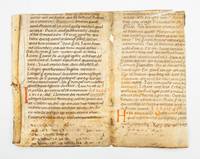
ST20509a-bGermany Late 11th or early 12th century. Largest bifolium measures 221 x 275 mm. 8 7/8 x 10 3/4". Single column 25-27 lines in a late Caroline hand. <br/> Rubrics in orange each bifolium with one or more one one-line initial in orange and one or more large four- to five-line initials in orange. With marginal notations in a later hand. Recovered from a binding and thus with some soiling abrasions glue residue and other small problems; the pages nearly complete but with a couple of letters and/or lines cut away from one side of each bifolia with more extensive abrasions on one side affecting legibility but very good specimens overall the better side in each case quite clear and readable.<br/> <br/> Once part of a Lectionary a collection of scriptural readings appropriate for Masses through the year and other ceremonial occasions these attractive mostly legible binding fragments display an excellent transitional script with both Caroline minuscule and proto-gothic characteristics. The present examples include short lessons or "lectiones" taken from the Old and New Testaments including among other passages excerpts from John in which Christ casts the sellers out of the temple and Daniel relating the prayers of the three men who refused to bow to Nebuchadnezzar's golden idol. The lovely script here shares much in common with the pure Caroline miniscule of earlier centuries--particularly in the overall legibility of the text the space between individual letters and the limited use of ligatures and abbreviations; also of note is the exclusive use of the long "s" unless at the beginning of a sentence and the ampersand as a general abbreviation for the letters "et" occurring anywhere in a word e.g. "propheta" written "proph&a" here. Evidence of a progression toward proto-gothic script can also be observed here in the appearance of certain letter forms such as the closed "g" a more oval "o" and the use of two forms of "d" both upright and Uncial the latter with a sloping shaft. There is added interest here in the form of marginal notations in a later hand--probably dating from the time these bifolia were in situ as binding waste. unknown
ST20509c-dGermany Late 11th or early 12th century. Larger bifolium measures 221 x 275 mm. 8 7/8 x 10 3/4".; smaller bifolium measures 207 x 275 mm. 8 1/8 x 10 3/4". Single column 25-27 lines in a late Caroline hand. <br/> Rubrics in orange each bifolium with one or more one-line initial in orange and one or more large four- to five-line initials in orange. With marginal notations in a later hand. Recovered from a binding and thus with some soiling abrasions glue residue and other small problems as well as limited loss of legibility in a few places; the pages nearly complete but with a couple of letters and/or lines cut away from one side of each bifolium; even with the problems very good specimens overall the letters on the better side quite clear and readable in each case.<br/> <br/> Once part of a Lectionary a collection of scriptural readings appropriate for Masses and other ceremonial occasions through the year these attractive mostly legible binding fragments display an excellent transitional script with both Caroline minuscule and proto-gothic characteristics. The present examples include short lessons or "lectiones" taken from the Old and New Testaments including among other passages excerpts from John in which Christ casts the sellers out of the temple and Daniel relating the prayers of the three men who refused to bow to Nebuchadnezzar's golden idol. The lovely script here shares much in common with the pure Caroline miniscule of earlier centuries--particularly in the overall legibility of the text the space between individual letters and the limited use of ligatures and abbreviations; also of note is the exclusive use of the long "s" unless at the beginning of a sentence and the ampersand as a general abbreviation for the letters "et" occurring anywhere in a word e.g. "propheta" written "proph&a" here. Evidence of a progression toward proto-gothic script can be observed here in the appearance of certain letter forms such as the closed "g" a more oval "o" and the use of two forms of "d" both upright and Uncial the latter with a sloping shaft. There is added interest here in the form of marginal notations in a later hand--probably dating from the time these bifolia were in situ as binding waste. The price given here is for one bifolium. unknown
1891ST15049London: Seeley and Co 1891. No. 85 OF 160 COPIES ON LARGE PAPER. 382 x 275 mm. 15 x 10 3/4". 4 p.l. 111 1 pp. <br/> Publisher's gilt-stamped vellum upper cover with titling and the Tennyson coat of arms BOTH COVERS WITH LOVELY HAND-PAINTED DESIGN BY JOHN T. BEER upper cover with urn at foot and blooming rose branches emanating from a medallion bearing the date 1902 and curving around the title and escutcheon lower cover with branches of apple blossoms dividing the board into quadrants each inhabited by a bird in flight smooth spine with gilt titling edges untrimmed. With frontispiece photographic portrait of Tennyson 31 vignettes in the text and 14 copper-plate engravings after drawings by Edward Hull. Verso of title page and limitations page with ink stamp of Gloucester County Library. Weber "The Fore-Edge Paintings of John T. Beer" 195. Small scratch near head of front joint minor soiling and rubbing to edges of boards mild foxing mostly marginal and not affecting copper engravings otherwise an excellent copy clean and fresh internally with wide margins the binding especially bright the pretty decoration perfectly preserved. AN EXTREMELY ATTRACTIVE COPY.<br/> <br/> This very large format deluxe illustrated work describing the places associated with England's beloved Poet Laureate Alfred Lord Tennyson is enhanced by former owner John T. Beer's Arts & Crafts-style embellishments to the vellum binding. After retiring from a successful career as a clothier Merseyside book collector Beer ca. 1826-1903 occupied himself decorating books from his library mostly with fore-edge paintings but in a score of instances with painted bindings. Jeff Weber considers Beer "one of the most highly skilled artists of fore-edge paintings" noting that he was the first artist to put his signature to such works. Weber's catalogue raisonnée of Beer's works lists 189 fore-edge paintings 22 painted bindings including this one #195 and three bindings designed by Beer and executed by Fazakerley of Liverpool. The design here is clearly influenced by the Arts & Crafts movement and Beer owned several works by William Morris including a Kelmscott Press "Godefrey of Bologne" on the vellum covers of which he had painted a design of tulips and lilies. Among the locations discussed and pictured in the "The Laureate's Country" are Tennyson's childhood homes in Somersby and Bag Enderby Trinity College Cambridge where he matriculated and his estates Farringford on the Isle of Wight and Aldworth in West Sussex. Seeley and Co unknown