48 résultats
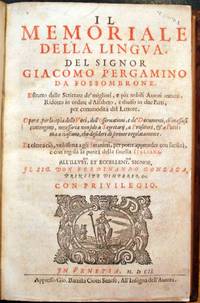
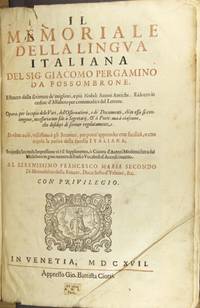
16024955Venice: Giovanni Battista Ciotti 1602. First edition. Leather. Very Good/The first methodical Italian dictionary based on literary examples il Memoriale della lingua appeared ten years before the Accademia della Crusca issued its famous dictionary. Gamba points out that Pergamino who was a friend of Tasso utilized examples that the Crusca missed such as Tasso's dialogues Guido Cavalcanti Ludovico Dolce and Gian Giorgio Trissino. The first edition is quite scarce absent from recent auction records with copies scattered in a few important libraries. Gamba himself saw only the second edition of 1617. A third edition appeared in 1656. Folio 31 cm; 12 524 395 i.e. 375 lacks two unnumbered leaves errata at end. Title page in red and black. Printer's device on title page and colophon. Text printed in two columns. Woodcut head pieces; initials. Rebacked in period style retaining eighteenth-century boards in flecked calf gilt with double fillets. Title page and colophon a little worn but contents generally clean and bright. Few marginal worm trails. Discrete 19th-century library blindstamp on title page colophon and few other leaves. Reference: Bruni & Evans 4042; Michel VI 97; Fontanini I80 "il primo Vocabolario pieno e metodico"; Gamba 2757 1617 ed.; Vinciana 3839 1656 ed. "uno dei migliori vocabolari italiani pubblicati prima della Crusca." Giovanni Battista Ciotti hardcover books
163314597Lugdunum Batavorum (Leyde), Elzevier, 1633 ; in-12 ; plein vélin ivoire à recouvrement rigide de l'époque, titre manuscrit au dos ; (12) dont titre illustré gravé et portrait d'Alexandre le Grand, carte dépliante, 338, (21) pp., (1 bl.), 1 gravure sur bois hors-texte (p.75).
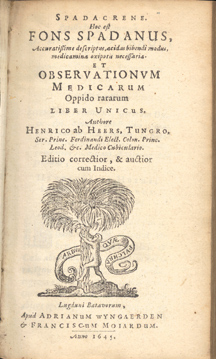
16456365Leyde, Adrianus Wyngaerden et Franciscus Moiardus, 1645 ; in-12 ; plein vélin ivoire rigide, titre manuscrit au dos (reliure de l'époque) ; (1) f. blanc, (22), 159, (15) pp. (index) ; (8), 254, (23) pp., (1 bl.), (2) ff. blancs.
162711183Lyon, Simon Rigaud, 1627 ; très fort in-8 ; plein vélin ivoire, titre manuscrit au dos (reliure de l'époque) ; (32) (titre en rouge et noir, Epistre du traducteur, l'Imprimeur au Lecteur, portrait gravé par Charles Audran, Tables), 1451, (3), (90) pp. (table des matières).
161771548Venetia: appresso Gio. Battista Ciotti 1617. pergamino. Folio. appresso Gio. Battista Ciotti unknown
164496370Frankfurt, Johann Beyer, gedruckt bei Caspar Röttel, 1644. Gestoch., illustr. "Titel Traiani Boccalini Relationes Auß Parnasso", [22] Bl., 702 S. 20 cm. Pgt d. Zeit mit umgebogenen langen Kanten.
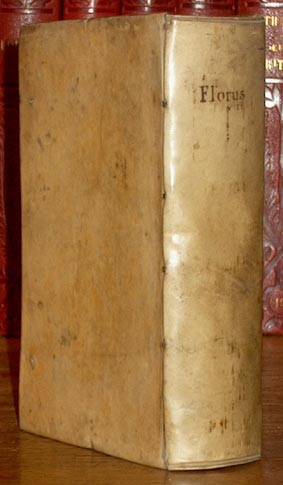
161743152Venetia: Apresso Gio. Battista Ciotti 1617. Seconda impressione two parts in one folio pp. 12 609 1 8 236; a6 A-2N8 2O-2p6 †4 A-O8 P6; V4 of the first section missigned R4 with manuscript cancellation; woodcut printer's device initials and head- and tail-pieces; title page printed in red and black; text in double columns; full contemporary vellum soiling calf bands manuscript spine title and ornamentation; vertical hatch marks to upper cover edges quite rubbed and worn; endpapers supplied title page edges rather ragged minor worming to preliminaries else textblock mostly very good. Small period manuscript paper label "Ad usum A.M.L. Parm." mounted to bottom of title page. Zaunmüller p. 209. OCLC does not locate any copies in the United States. <br/><br/> Apresso Gio. Battista Ciotti hardcover books
161743152Venetia: Apresso Gio. Battista Ciotti 1617. Seconda impressione two parts in one folio pp. 12 609 1 8 236; a6 A-2N8 2O-2p6 †4 A-O8 P6; V4 of the first section missigned R4 with manuscript cancellation; woodcut printer's device initials and head- and tail-pieces; title page printed in red and black; text in double columns; full contemporary vellum soiling calf bands manuscript spine title and ornamentation; vertical hatch marks to upper cover edges quite rubbed and worn; endpapers supplied title page edges rather ragged minor worming to preliminaries else textblock mostly very good. Small period manuscript paper label "Ad usum A.M.L. Parm." mounted to bottom of title page. Zaunmüller p. 209. OCLC does not locate any copies in the United States. Apresso Gio. Battista Ciotti unknown
1692000920Amstelaedami Wetstenium 1692
16782763Paris, André Pralard, 1678-1679 ; trois tomes in-12 reliés en deux volumes, plein vélin ivoire, titre manuscrit, armes dorées, au centre des deux plats, du comte de Nédonchel (reliure de l'époque) ; (14) ff., 416 pp., (5) ff. ; 497 pp., (5) pp., (1) f. blanc ; (8) ff., 238 pp., (5) ff. dont 2 blancs ; 8 planches hors-texte.
163419923In Firenza, Gio : Batista Landini, 1634 ; in 4°, vélin de l’époque, titre manuscrit au dos ; [16], 284, [4] pp. ; (signatures : †, ††, A-Z, Aa-Nn4).
16642940Amsterdam, ex officina Elzeviriana, 1664 ; in-16 ; plein vélin à recouvrements, titre manuscrit au dos, tranches mouchetées (reliure de l’époque) ; (20) ff. (titre gravé, lettre dédicatoire, index des chapitres et propositions), 748 pp., 4 tableaux dépliants et 1 planche dépliante.
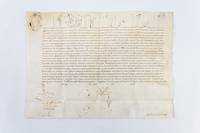
1622ST12778-0281Rome 1622. 295 x 410 mm. 11 5/8 x 16 1/8". Single column 23 lines in a papal chancery hand. <br/> Elaborate lettering across top line of text. Lower margin with several signatures in ink; verso with brief notes in ink; lacking the original hemp tie and lead seal. Two tears at bottom of the document where ties were removed not affecting text vellum lightly soiled but in excellent condition overall.<br/> <br/> Addressed to the Archbishop of Naples this Papal Bull grants a marriage dispensation between Fabritio Virgopia and Judith Cuono. An online search finds nothing about the couple named here but the document reveals that they were petitioning for a dispensation because they fell into the second and third degrees of consanguinity meaning that they shared at least one common ancestor. Although marrying within four degrees of consanguinity was prohibited by the church it was not uncommon for the Holy See to issue dispensations as here allowing such marriages to take place—particularly for the privileged classes. The Papal Bull takes its name from the lead seals called "bullae" lacking in the present example that were issued with official documents of the papacy as a way of ensuring their authenticity. Apart from the very rare Solemn Privilege like Innocent III's famous granting of England in 1214 to his involuntary vassal King John there are three categories of Papal Bulls: Simple Privileges also called Solemn Letters Letters of Grace which confirm privileges and rights but are somewhat smaller and Mandates which are differentiated by their use of hemp ties as opposed to silk as would have been the case here. Pope Gregory XV born Alessandro Ludovisi 1554-1623 ruled for just over two years from 1621-23. His brief papacy was marked by efforts to support the Catholic Counter-Reformation including the establishment of the Congregation for the Propagation of the Faith to oversee missionary work. He also played a key role in the election of Holy Roman Emperor Ferdinand II canonized notable saints such as Ignatius of Loyola and Francis Xavier and issued the last papal mandate concerning witchcraft. Documents issued by Gregory XV are unsurprisingly rare given the shortness of his rein: we could trace just one sold at auction since 1995. unknown
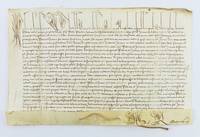
1614ST12778-0352Rome 1614. 203 x 319 mm. 8 x 12 5/8". Single column 25 lines in a papal chancery hand. <br/> With braided cloth tie for appended seal now gone. Elaborate lettering all across top line of text especially the first 8-line initial and at lower right corner. Lower margin with several signatures in ink behind the fold; verso with brief notes in ink; remains of hemp tie for appended seal which has been cut away. Three vertical and one horizontal fold creases faint overall yellowing to verso possible erasure correction in second line of text otherwise the page bright and the hand clear.<br/> <br/> Addressed to the Archbishop of Naples this Papal Bull grants a marriage dispensation between Pietro Palladino and Giovanna Cabalone. An online search finds nothing about the couple named in the present document but they were apparently high-ranking Neapolitan citizens who had the means to procure a Papal intercession. Likewise the particular impediment prohibiting the marriage is not apparent here. This type of document takes its name from the lead seals called "bullae" that were issued with official documents of the papacy as a way of ensuring their authenticity. Apart from the very rare Solemn Privilege like Innocent III's famous granting of England in 1214 to his involuntary vassal King John there are three categories of Papal Bulls: Simple Privileges also called Solemn Letters Letters of Grace which confirm privileges and rights but are somewhat smaller and Mandates which are differentiated by their use of hemp ties as opposed to silk as here. A member of the influential Borghese family Pope Paul V born Camillo Borghese 1550-1621 reigned as head of the Catholic Church for 16 years from 1605 until his death. As a staunch defender of the rights and privileges of the church he often came into conflict with secular leaders. He is perhaps best remembered for financing the completion of St. Peter's Basilica and for his involvement in the Galileo controversy in which he warned the scientist against advocating heliocentrism. unknown
1678(LCPCLIT-0027)(Une très rare comédie d'un suiveur de Molière, en édition originale, conservée dans son vélin de l'époque) HAUTEROCHE Noël LE BRETON (Sieur DE). (Paris, 1617-1707) "LES NOBLES DE PROVINCE, COMEDIE...". 1678, Lyon, T. Almaury. 1 volume in-16° (143x89 mm) (dimensions pages 141x86 mm) 126 pp. (y compris titre et avis), (1) f. (permission). (A8, B4, C8, D4, E8, F4, G8, H4, I8, K-L4) Reliure de l'époque en vélin souple. Edition Originale, rarissime. Petites brunissures éparses, mais bel exemplaire conservé dans son vélin strictement du temps. "Ceux qui liront cette Comedie, y verront une image de ces Gentils-hommes de campagne qui Souvent Se piquent plus de l'Antiquité de leur NobleSSe, que d'avoir de la raiSon. On y verra auSSi des caracteres qui leur Sont tout à fait oppoSez, & qu'on peut dire raiSonnables. Ie ne taScherai point icy, à prevenir le Lecteur, en faveur de cette Pièce, j'advoeray Seulement...". "Fils d'un huissier au Parlement, Hauteroche s'enfuit en Espagne pour échapper à un mariage qu'on voulait lui faire contracter malgré lui et se fit comédien à Valence (Espagne). Il joua en Allemagne et fonda sa propre troupe à Paris en 1654, puis entra au Théâtre du Marais la même année et passa à l'Hôtel de Bourgogne en 1660. En 1671, il succéda à Floridon comme directeur de la troupe". Il obtint de grands succès comme auteur dramatique et en même temps, émule de Molière, il composa des comédies. "Sans s'élever à la création des caractères ou à la peinture des moeurs, son talent consistait à nouer habilement une intrigue et à semer le dialogue de traits plaisants". (Wikipedia) Seuls 4 exemplaires dans les collections publiques françaises. Provenance : Ex libris manuscrit Blondeau sur la page de titre. (LCPCLIT-0027) (1.500,00 €)
16260044501626 Lyon, Barthelemy Vincent, 1626. Deux ouvrages reliés en un volume petit in-8 (115 X 179 mm) vélin souple à coutures apparentes, titre calligraphié au dos à l'encre noire (Reliure de l'époque); (4) ff. dont feuillet de titre, 342 pages (dont une planche à pleine page p. 338), (1) f. de planche et privilège au verso, (7) planches dépliantes - 313 pages, (4) pages de table. Petites restaurations à la reliure et au feuillet de titre.
162219912Paris, Jean Houzé, 1622 ; in 4°, vélin moucheté de l’époque ; [8], 514, [22] pp.
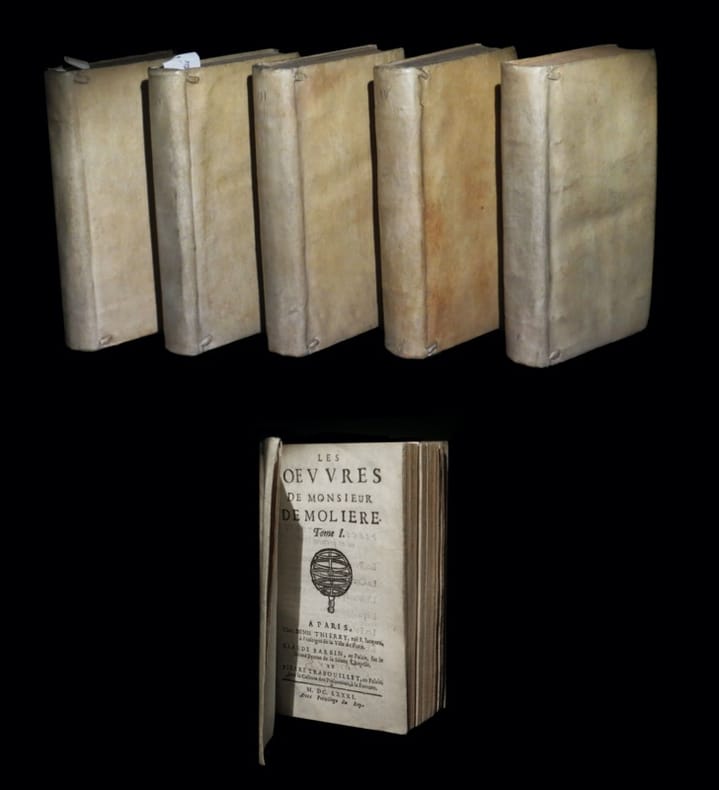
168127543A Paris, chez Denis Thierry / Claude Barbin et Pierre Trabouillet, 1681. 5 vol. au format pt in-12 (148 x 92 mm) de 428 pp. et 1 f. bl. ; 400 pp. ; 436 pp. ; 466 pp. ; 402 pp. et 2 ff. de Privilège n.fol. Reliures ''à la hollandaise'' uniformes de l'époque de plein vélin ivoire à rabats rempliés et coutures apparentes, plats jansénistes, dos lisses, indication de tomaison à l'encre anciennement calligraphié en tête, tranches mouchetées.
1617LCPCLIT-0044(Les Essais de Montaigne en reliure strictement de l'époque. L'exemplaire d'un membre de la famille De Calonne) MONTAIGNE MICHEL EYQUEM DE. (Bordeaux, 1533 - Saint-Michel-de-Montaigne, 1592) "LES ESSAIS DE MICHEL SEIGNEUR DE MONTAIGNE. EDITION NOUVELLE ENRICHIE DANOTATIONS EN MARGE : CORRIGEE ET AUGMENTEE D'UN TIERS...". 1617, Rouen, I. Osmont (N. L'Oyselet sur la dernière page). 1 fort volume in-8° (173x115 mm) (dimensions pages 166x107 mm) (1) titre frontispice gravé par E. Charpy, (2) pp. (avis), (3) pp. (table des chapitres), (7) pp. (biographie), (1) f. avec le portrait de Montaigne, non signé, gravé par Thomas de Leu, 1129 (i.e. 1087 pp.), (1) pp. (fautes et sauts de numération aux pp. 698-609 et 739-740), (17) ff. (table). (a8, A-Z8, Aa-Zz8, Aaa-Yyy8, Aaaa-Bbbb8, Cccc2) Reliure strictement de l'époque en vélin rigide à rabats. Rare et jolie édition, réimpréssion des éditions de Paris de 1608 et 1611. Tout petit manque de papier à l'angle inférieur du f. M1 sans atteinte. Cahier Aa très très légèrement et partiellement dérelié. Traces de lacets en soie sur les plats. Très bel exemplaire, frais et en reliure du temps. "Cette édition a été partagée entre plusieurs libraires rouennais" (Tvili, 421). Provenance : Un ex libris manuscrit "De Calonne" sur le premier f. de garde. Très probablement l'exemplaire d'un membre de la famille du célèbre ministre des finances de Louis XVI. (Tchémerzine, IV, 889)
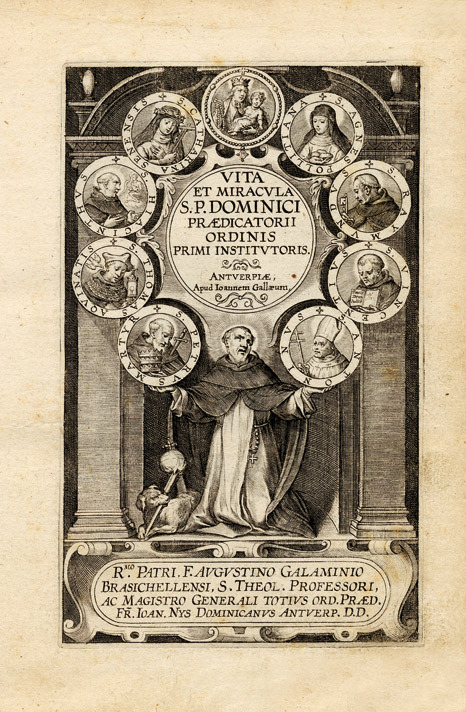
163011321Antverpiae, Joan Galle, (circa 1630) ; F. Ioannes Nys invenit, Peter de Jode figuravit, Theodor Galle sculpsit et excudit ; titre gravé, portrait et 32 planches légendées. SUIVI de 4 planches gravées par JOAN GALLE : I- Prudentia, II- Justitia, III- Fortitudo, IV- Temperantia (les 4 vertus cardinales). SUIVI de 14 planches de sujets religieux, gravées par CORNELIUS GALLE le Vieux : Silva sacra, Fugit familia sacra, S. Barbara, S. Ianvarius Neapolis patronis, S. Lucia, S. Leontius martyr miraculis gloriossus in Muris Helvetiorum, S. Iacobus Maior, Benedicite omnes bestiae et pecora domino, S. Hieromymus, Vierge à l'Enfant, etc. Soit en tout 52 planches, reliées en 1 volume petit in-4 ; plein vélin ivoire, titre au dos, tranches rouges (reliure du XIXe).
164219929Lyon, Jean Caffin et F. Plaignard, 1642 ; in 8, vélin rigide de l’époque ; [8], 299 pp, [5] pp. bl., (signatures : â4, A-T8) le dernier f. blanc est collé au contreplat de la reliure.
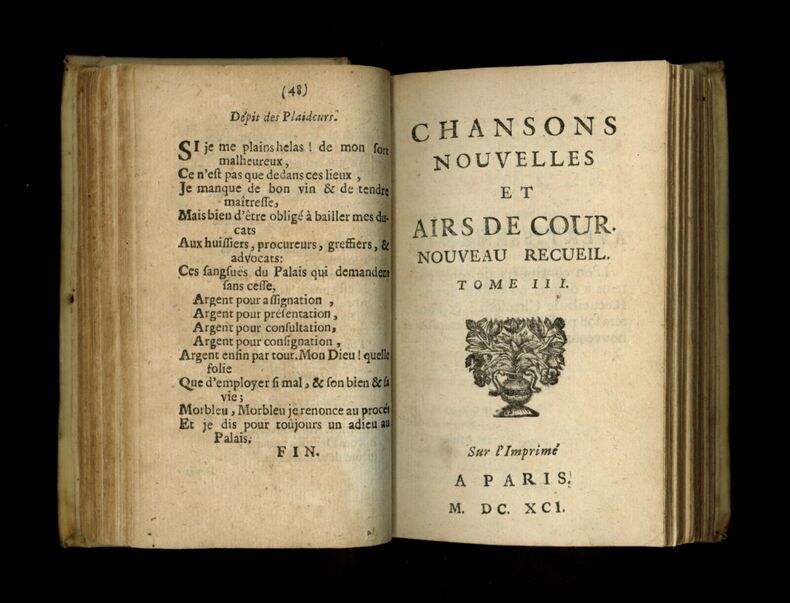
1690AMO-4534Reliure plein vélin ivoire de l'époque à coutures apparentes (vélin hollandais). Reste de titre à l'encre au dos (presque effacé). Légers frottements. Exemplaire frais, non restauré. Papier de qualité plus ou moins médiocre selon les tomes, parfois uniformément teinté. Collationné complet. Ce recueil est extrêment rare selon les différentes sources consultées. Sa mise en oeuvre semble hératique (nom d'éditeurn, dates et mention d'édition assez fantaisistes). Il semble pourtant que ce soit tout ce qui a paru de cet ensemble composé de chansons bacchiques, lestes et gaillardes. On lit dans le catalogue de livres provenant de la bibliotheque de monsieur Leroux de Lincy, n°225 (vélin, même collation) : "Recueil extrêmement rare, dans lequel on trouve un certain nombre de chansons relatives au règne de Louis XIV (vendu 58 francs à la vente Silvestre en 1845, ex. relié vélin comme le nôtre). "Il s'y trouve un grand nombre de couplets hostiles à Louis XIV". On trouve un autre recueil quasi identique à la date de 1688, est-le même ? Et un autre en 12 parties datées de 1696, qui ne semble pas être le même que notre exemplaire. On lit par ailleurs dans le catalogue de la bibliothèque de monsieur Cigongne à propros d'un exemplaire identique au nôtre : "Tome I. 3è édition (6 parties intitulées t. I à VI, et 1ère partie d'un 2ème volume, datée de 1690). Sur l'imprimé à Paris (Hollande), 1691. Petit in-12. maroquin olive par Trautz-Bauzonnet (n°1228 du catalogue Cigongne), avec ce commentaire : "On croit que c'est tout ce qui a paru de ce recueil.".
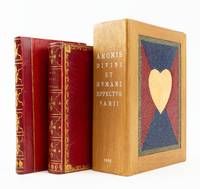
1626ST19298Antwerp: M. Snyders 1626. FIRST EDITION. 135 x 82 mm. 5 1/4 x 3 1/4". 39 of 40 leaves lacking C4. Two volumes one as issued the other a companion volume containing related plates without any title page. <br/> Very pretty late 18th or early 19th century red morocco covers bordered by delicate cresting roll with leaf cornerpieces smooth spine gilt in compartments with leafy centerpieces gilt lettering turn-in with gilt floral roll pale blue watered silk endleaves all edges gilt. Supplemental volume in late 19th century red half morocco over red paper boards similarly tooled spine. Housed together in a custom-made modern wooden box with sliding panel closure a heart mosaic in multi-colored hard-grain leather on its sides. Amoris Divini WITH engraved title page and 38 of 39; lacking plate XXXIV ENGRAVED PLATES 35 OF THEM ON VELLUM ALL DELICATELY COLORED AND HEIGHTENED IN GOLD plates 19 29 30 31 and 36 bound after text pages for plates 31 36 29 30 and 34 respectively; second volume with 45 plates on paper though without any text including many of these same emblems apparently from a later edition of this work ALL DAINTILY HIGHLIGHTED WITH GILT. Front pastedown of first volume with monogram book label in colors and gilt verso of front free endpaper with oval armorial bookplate "Ex Museo Van Der Helle" see below. De Vries "De Nederlandsche Emblemata" 121; Landwehr "Low Countries" 33; Praz p. 254; Brunet I 240 this copy; Delbergue-Cormont "Bibliothèque de M. Van der Helle" Paris 10 Février 1868 lot 69 this copy. Amoris spine very slightly dulled occasional hints of marginal thumbing but A LOVELY COPY clean and fresh internally with rich colors and glistening gold in a well-preserved binding; supplemental plates with faint marginal browning but excellent internally the engravings gently shimmering with gold and the binding with few signs of wear.<br/> <br/> The main volume here comprises a collection of emblems illustrating concepts of human and divine love; it is made all the more special by being printed on vellum beautifully hand colored and then delicately highlighted with gold. The emblems depict Divine Love as a beardless young man with nimbus who always represents love in its purest form. Human love or worldly love is variously embodied in a winged Cupid sometimes blindfolded who represents erotic love and who is accompanied by symbols of treasure or power that represent worldly desires. Landwehr Praz and De Vries make no mention of a vellum edition but Brunet describes one copy on vellum painted in colors and gold which he says sold at the Duriez auction. That book appeared as lot 3216 in "Catalogue des livres imprimés et manuscrits composant la bibliothèque de feu M. L.-M.-J. Duriez de Lille membre de la Société des Bibliophiles français" Paris J.-S. Merlin 1827 where its binding description matches our copy. Having uncovered no other hand-colored copies on vellum in auction records or in OCLC we think it quite likely that the present volume is in fact the Duriez copy. Louis Duriez 1753-1825 was a Lille lawyer of sufficient skill and cleverness to move without incident from serving as lieutenant provost for his district under King Louis XVI to becoming receiver of the district of Lille after the revolution 1791 and purchasing the estate of an aristocrat which had been seized by the state. He rose to successively more important and remunerative governmental positions and was named Knight of the Royal Order of the Legion of Honor in 1814. In 1820 he was one of the founding members of the Société des Bibliophiles français an elite group limited to 24 scholarly collectors. After his death his collection of more than 5000 carefully chosen works was dispersed at 59 auctions held between 22 January and 1 April 1828 at Maison Silvestre in Paris. A perusal of the lots on offer finds a strong emphasis on fine bindings works on vellum and illustrated books many noting hand coloring. The emblems in the second thinner book here on paper without coloring--but with gold highlighting allow the reader to experience the pleasure to be found in comparing the degrees of decoration and opulence of the two volumes. These illustrations likely come from one of the later printings of this title each of which added new emblems to the original 39 called for in Landwehr and Praz. It is not clear when or by whom this second volume was wedded to the first. After its presumed residence in the Duriez collection our copy of the 1626 edition and perhaps its sidecar volume moved to another distinguished library--that formed by the scholarly and erudite French collector M. Van Der Helle of Lille who amassed a collection particularly rich in illustrated books and works on vellum. In the catalogue for the sale of his library in 1868 Paris auction house Delbergue-Cormont described him as a bibliophile "of the school of Renouard . . . who only liked irreproachable copies." We bought this item without being warned that it is slightly defective but given its distinguished provenance and the many other features it has going for it we did not ask the seller to take it back. M. Snyders unknown





_2.jpg)