1 374 résultats
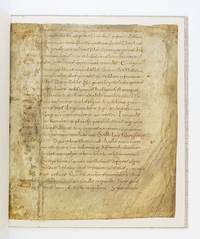
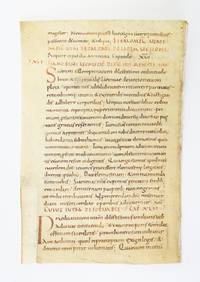
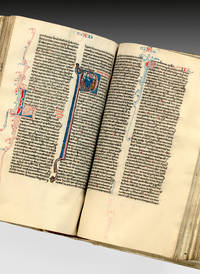
ABAA25-1<p>Northern France probably Paris 1230-1250.</p><p>12mo 140 x 93 mm of 1 658 ll.: 1-1524 1620 17-2224 2310 24-2524 2617 without the bl. l. xviii 2726 2828 295 without the bl. l. vi. <strong>Thus complete</strong>.</p><p>Double column of 47 lines written in brown ink in a very fine Gothic writing.</p><p>Justification: 92 x 60 mm.</p><p><strong>78 historiated initials</strong>. Quires numbered in Roman numerals at the foot of the back of the last ll. and signatures at the bottom corner of the text on each recto of the first half of a quire headings in red initials in red letters of running titles and chapters numbers alternately in red or blue initials of chapters on 2 lines alternately in red or blue with a decor of the opposite color initials of 5 to 7 lines at the beginning of the prologues of the same type but with decoration in two colors opening the prologues 78 historiated initials most decorated with foliage and dragons the extension of 29 of them forming borders decorating the margin painted in blue pink orange-red and yellow a few wormholes in the first l. a few running titles cropped last l. restored in the outer margin.</p><p>Stiff vellum gilt Greek roll-stamp around the covers flat spine decorated green morocco lettering piece gilt edges from the 19th century.</p><p>Superb Capetian manuscript from the School of Paris complete and of perfect freshness handwritten on vellum skin and illuminated with exquisite finesse between 1230 and 1250.</p><p><u>Text</u>: List of Books of the Bible: recto and verso of the first endpaper; the Vulgate with the preamble: ll. 1-599v; Interpretation of the Hebrew names: ll. 600-658.</p><p>Superb example of the small vulgate bibles produced in Paris in the 13th century.</p><p>It was in the 13th century in Paris that the masters of theology of the University established what was to become the standard form of the Latin Bible: the selection of the books their order and their division into chapters established by Stéphane Laugton still universally employed the insertion of the forewords of St Jerome and the interpretation of the Hebrew names.</p><p>All these characteristics are present in this very elegant Bible on very thin vellum skin.</p><p><u>Illuminations</u>: A masterpiece from Pierre de Bar's workshop active in Paris between 1230 and 1250 distinguishes itself by the particularly colored and bright shades of its illuminations; the usual whites pinks and blues are enriched with red orange and even more surprisingly by large areas of yellow.</p><p>This Bible contains 78 illuminations of great beauty and of amazing freshness.</p><p>The repertoire of decorative details is peculiar compared to other French illuminations of the time and the foliage contains small clover leaves.</p><p>Branner attributed the illustration of the manuscript to the Parisian workshop that illustrated the most outstanding illuminated manuscripts of the first half of the 13th century Bar's workshop with reference to Cardinal Pierre de Bar 1252 who gave to the Abbey of Clairvaux a Bible in four volumes issued from this workshop and preserved today under the reference Troyes Bibliothèque municipale ms. 106 108 110 and 111.</p><p>This manuscript can be dated from 1230-1250. Remarkable for its large and well-formed heads; the bodies are robust and covered with clothes with deep and dark folds R. Branner <em>Manuscript Painting in Paris during the Reign of Saint Louis</em> 1977 pp. 70-71. He dates the activity of Pierre de Bar's workshop between 1230-1250 and explains its specificities by suggesting the development of its style outside Paris.</p><p>The decoration of the manuscript consists of 78 historiated illuminated initials and a great number of capital letters rubricated in red or blue.</p><p>This very attractive bible seems to have been made in Paris; it represents an interesting addition to the production of a workshop producing according to Branner some of the most beautiful and refined Parisian illuminations of the first half of the 13th century.</p><p>We witness from the years 1220-1230 under the reign of Queen Blanche of Castile a concentration of illuminators in Paris at the expense of abbeys and provincial capitular schools. We can indeed attribute several manuscripts to Blanche of Castile who inaugurated the tradition of female patronage in the royal family. But the peak of these famous small Capetian bibles happened during the reign of Saint Louis.</p><p>The subjects of the historiated initials are the following:</p><p>l. l St Jerome Prologue; l. 4 The 7 days of Creation Genesis; l. 27 Moses leading his people across the Red Sea Exodus; l. 43 the Jews offering a sacrifice; l. 54 Moses preaching; l. 72 Moses receiving the Tablets of Stone; l. 89 God talking to Joshua; l. 99 Gideon holding his sword; l. 110 Elimelech and Naomi migrating to Moab Ruth; l. 112v Beheading of Eli; l. 128 Beheading of Amalekite before David; l. 141 David's servant bringing Abishag to him; l. 155v Ahaziah falling from a tower; l. 170v the Patriarchs; l. 185 Solomon enthroned; l. 202 The Construction of the Temple; l. 207 Nehemiah presenting the golden cup to Artaxerxes; l. 213v Spraying of the Temple; l. 220v Tobias; l. 225v Judith beheading Holofernes; l. 232 Ahasuerus being merciful to Esther; l. 238v Job on the manure heap; l. 251 David playing the harp; l. 256 anointing of David by Samuel; l. 258v David showing his mouth; l. 261 madman holding the stick and the bread Psalm 52; l. 264 God above David below in the water Psalm 68; l. 268 David ringing the bells Psalm 80; l. 271v Two Singers Psalm 97; l. 275 The Trinity Psalm 109; l. 283v Solomon whipping a young man; l. 294v Solomon teaching to a young man; l. 298 Madonna and Child Enthroned; l. 299v Solomon and a young man carrying a sword; l. 307v Ecclesia; l. 328 Isaiah being sawn in half; l. 353 Stoning; l. 381 Baruch writing; l. 384v Ezekiel in bed with the Tetramorph; l. 412 Daniel in the lions' den; l. 423v Hosea and Gomer; l. 427v Joel preaching to a group of Jews; l. 429v Amos offering the sheep; l. 432v God appearing to Obadiah; l. 433v Jonah in the mouth of the whale; l. 434v the teaching Prophet; l. 437 Nahum lamenting about the fall of Nineveh; l. 438v Habakkuk and the stones; l. 440 the Prophet with his scroll; l. 441v Two Prophets; l. 442v Prophet; l. 447 Two men talking; l. 449 Beheading of the idolatrous Jew; l. 466 the Messenger delivering the letter; l. 478v the Tree of Jesse; l. 494v Saint Mark with the lion; l. 505 Saint Luke with the angel; l. 521v Saint John; l. 535 Saint Paul carrying the cross; l. 541 Saint Paul carrying a sword; l. 546v Saint Paul carrying a sword and a scroll; l. 551 Saint Paul carrying a sword and a book; l. 555 Saint Paul carrying a sword; l. 556v Saint Paul carrying a sword and a book; l. 558 Saint Paul carrying a sword; l. 559 Saint Paul carrying a sword; l. 560 Saint Paul carrying a sword; l. 561v Saint Paul carrying a sword; l. 562v Saint Paul carrying a sword; l. 561v Saint Paul carrying a sword; l. 562v Saint Paul carrying a sword; l. 563v Saint Paul carrying a sword; l. 564 Two men talking; l. 568v. Ascension; l. 585 Jacob holding a book; l. 586v Saint Peter seated holding a book; l. 588 Saint Peter holding a key; l. 589 Saint John writing; l. 590v Saint John; l. 591 Saint John; f. 591 Saint Jude; l. 592 Saint John writing.</p><p>This complete bible dated from 1230-1250 is a masterpiece of Capetian illumination produced under the reign of Saint Louis.</p><p>Provenance:</p><p>- <em>Jean Tornone</em>: doctor from Burgundy: inscription on the verso of the endpaper mentioning his gifting of the book to <em>Stroyff</em>.</p><p>- <em>Assuerus Stroyff</em>: inscription mentioning his reception of the book by Tornone then his gift to <em>Johan Baron de Bronckhorst.</em></p><ul><li><em>Johan Baron de Bronckhorst</em> and <em>Batenburg de Guelders</em>: inscription dated from 1574 mentioning his receipt of the book.</li></ul><p><strong>FR</strong></p><p>Nord de la France probablement Paris 1230-1250.</p><p>In-12 de 1 658 ff. : 1-1524 1620 17-2224 2310 24-2524 2617 sans le f. blanc xviii 2726 2828 295 sans le f. blanc vi. <strong>Ainsi complet</strong>.</p><p>Double colonne de 47 lignes écrites à l'encre brune dans une très fine écriture gothique.</p><p>Justification : 92 x 60 mm.</p><p><strong>78 initiales historiées</strong>. Cahiers numérotés en chiffres romains au pied des versos des derniers ff. et signatures au pied du coin inférieur du texte sur chaque recto de la première moitié d'un cahier rubriques en rouge initiales en rouge lettres des titres courants et numéros des chapitres alternativement en rouge ou bleu initiales des chapitres sur 2 lignes alternativement en rouge ou bleu avec un décor de la couleur opposée initiales de 5 à 7 lignes au début des prologues du même type mais avec des décors des deux couleurs ouvrant les prologues 78 initiales historiées la plupart ornées de feuillage et de dragons le prolongement de 29 d'entre elles formant des bordures décorant la marge peintes en bleu rose orange-rouge et jaune qq. trous de vers ds. le premier f. atteinte à qq. titres courants dernier f. restauré ds. la marge extérieure.</p><p>Vélin rigide du XIXe siècle encadrement d'une roulette grecque dorée autour des plats dos lisse orné pièce de titre de maroquin vert tranches dorées.</p><p>140 x 93 mm.</p><p><strong>Superbe manuscrit capétien de l'école de Paris complet et de parfaite fraicheur calligraphié sur peau de vélin et enluminé avec une exquise finesse entre 1230 et 1250.</strong></p><p><u>Texte</u> : Liste des Livres de la Bible : recto et verso de la première garde ; la Vulgate avec le préambule : ff. 1-599v ; Interprétation des noms hébreux : ff. 600-658.</p><p><strong>Superbe exemple des petites bibles vulgates produites à Paris au XIIIe siècle.</strong></p><p>C'est au XIIIe siècle à Paris que les maîtres de théologie de l'Université établirent ce qui devait devenir la forme standard de la Bible latine : la sélection des livres et de l'ordre de ceux-ci et leur division en chapitres établies par Stéphane Laugton et encore universellement employée l'insertion des prologues de St Jérôme et l'interprétation des noms hébreux.</p><p>Toutes ces caractéristiques sont bien présentes dans cette très élégante Bible sur peau de vélin très fine.</p><p><u>Enluminures</u> : Chef-d'œuvre de l'atelier de Pierre de Bar actif à Paris entre 1230 et 1250 il se distingue par les teintes de ses enluminures particulièrement colorées et vives ; les habituels blancs roses et bleus sont enrichis de rouge orange et de manière plus surprenante encore par de larges zones de jaune.</p><p><strong>Cette Bible possède 78 enluminures d'une grande beauté et d'une étonnante fraicheur.</strong></p><p>Le répertoire de détails décoratifs est particulier en comparaison des autres enluminures françaises de cette époque et le feuillage comporte des petites feuilles de trèfle.</p><p><strong>Branner a attribué l'illustration du manuscrit à l'atelier parisien qui a illustré les plus remarquables manuscrits enluminés de la première moitié du XIIIe siècle l'atelier de Bar</strong> par référence au cardinal Pierre de Bar 1252 qui donna à l'abbaye de Clairvaux une Bible en quatre volumes provenant de cet atelier et conservés aujourd'hui sous les cotes Troyes Bibliothèque municipale ms. 106 108 110 et 111.</p><p>On peut dater le présent manuscrit de 1230-1250. Remarquable par ses têtes larges et bien formées ; les corps sont robustes et recouverts de draperies aux plis profonds et sombres. R. Branner <em>Manuscript Painting in Paris during the Reign of Saint Louis</em> 1977 pp. 70-71. Il date l'activité de l'atelier de Pierre de Bar entre 1230-1250 et explique ses spécificités en suggérant la formation se son style en dehors de Paris.</p><p><strong>La décoration du manuscrit comprend 78 initiales historiées enluminées et d'innombrables capitales rubriquées en rouge ou bleu.</strong></p><p>Cette bible très séduisante semble avoir été réalisée à Paris ; elle représente un ajout intéressant à la production d'un atelier considéré par Branner comme produisant certaines des enluminures parisiennes les plus belles et les plus raffinées de la première moitié du XIIIe siècle.</p><p>On assiste à partir des années 1220-1230 sous le règne de la reine Blanche de Castille à une concentration des artistes enlumineurs à Paris au détriment des abbayes et des écoles capitulaires de province. On peut en effet imputer plusieurs manuscrits à Blanche de Castille qui inaugura la tradition du mécénat féminin dans la famille royale. Mais l'apogée de ces célèbres petites bibles capétiennes se situe sous le règne de Saint Louis.</p><p>Les sujets des initiales historiées sont les suivants :</p><p>f. l St Jerome Prologue ; f. 4 Les 7 jours de la Création Genèse ; f. 27 Moïse conduit son peuple à travers la Mer Rouge Exode ; f. 43 les Juifs offrent un sacrifice ; f. 54 Moïse preche ; f. 72 Moise reçoit les tables de la Loi ; f. 89 Dieu s'adresse à Joshua ; f. 99 Gédéon tient son épée ; f. 110 Elimelech et Naomi migrent à Moab Ruth ; f. 112v Décapitation d'Eli ; f. 128 Décapitation d'Amalekite devant David ; f. 141 le serviteur de David lui amène Abishag ; f. 155v Ahaziah tombe d'une tour ; f. 170v Les trois juifs patriarches ; f. 185 Salomon intronisé ; f. 202 La Construction du Temple ; f. 207 Néhémie présentant la coupe d'or à Artaxerxès ; f. 213v Aspersion du Temple ; f. 220v Tobias ; f. 225v Judith décapitant Holopherne ; f. 232 Assuérus se montre clément envers Esther ; f. 238v Job sur le tas de fumier ; f. f. 251 David joue de la harpe ; f. 256 onction de David par Samuel ; f. 258v David montre sa bouche ; f. f. 261 fou tenant le bâton et le pain psaume 52 ; f. 264 Dieu au-dessus David dans l'eau dessous Psaume 68 ; f. 268 David sonnant les cloches Psaume 80 ; f. 271v Deux chanteurs Psaume 97 ; f. 275 La Trinité Psaume 109 ; f. 283v Salomon fouette un jeune ; f. 294v Salomon enseigne à un jeune ; f. 298 La Vierge et l'Enfant intronisé ; f. 299v Salomon et un jeune portant une épée ; f. 307v Ecclésia ; f. 328 Isaïe est scié en deux ; f. 353 Lapidation ; f. 381 Baruch écrivant ; f. 384v Ezéchiel au lit avec le Tétramorphe ; f. 412 Daniel dans la fosse aux lions ; f. 423v Osée et Gomer ; f. 427v Joel prechant à un groupe de juifs ; f. 429v Amos offre le mouton ; f. 432v Dieu apparait à Obadiah ; f. 433v Jonas dans la bouche de la baleine ; f. 434v le Prophète enseignant ; f. 437 Nahum se lamente sur la chute de Nineveh ; f. 438v Habakuk et les pierres ; f. 440 le Prophète avec son rouleau ; f. 441v Deux Prophètes ; f. 442v Prophète ; f. 447 Deux hommes en discussion ; f. 449 Décapitation du juif idolâtre ; f. 466 le Messager livre la lettre ; f. 478v l'Arbre de Jessé ; f. 494v Saint Marc avec le lion ; f. 505 Saint Luc avec l'ange ; f. 521v Saint Jean ; f. 535 Saint Paul portant la croix ; f. 541 Saint Paul portant une épée ; f. 546v Saint Paul portant une épée et un rouleau ; f. 551 Saint Paul portant une épée et un livre ; f. 555 Saint Paul portant une épée ; f. 556v Saint Paul portant une épée et un livre ; f. 555 Saint Paul portant une épée ; f. 556v Saint Paul portant une apée et un livre ; f. 558 Saint Paul portant une épée ; f. 559 Saint Paul portant une épée ; f. 560 Saint Paul portant une épée ; f. 561v Saint Paul portant une épée ; f. f. 562v Saint Paul portant une épée ; f. 561v Saint Paul portant une épée ; f. 562v Saint Paul portant une épée ; f. 563v Saint Paul portant une épée ; f. 564 Deux hommes en discussion ; f. 568v. Ascension ; f. 585 Jacob tenant un livre ; f. 586v Saint Pierre assis tenant un livre ; f. 588 Saint Pierre tenant une clef ; f. 589 Saint Jean écrivant ; f. 590v Saint Jean ; f. 591 Saint Jean ; f. 591 Saint Jude ; f. 592 Saint Jean écrivant.</p><p><strong>Cette bible complète datée de 1230-1250 est un chef-d'œuvre de l'enluminure capétienne réalisée sous le règne de Saint Louis.</strong></p><p>Provenance :</p><p>- <em>Jean Tornone</em> : docteur bouguignon : inscription au verso de la garde mentionnant son présent du livre à Stroyff.</p><p>- <em>Assuerus Stroyff</em> : inscription mentionnant sa réception du livre par Tornone puis son présent à Johan Baron de Bronckhorst.</p><p>- <em>Johan Baron de Bronckhorst</em> et <em>Batenburg de Guelders</em> : inscription datée de 1574 mentionnant sa réception du livre.</p> hardcover
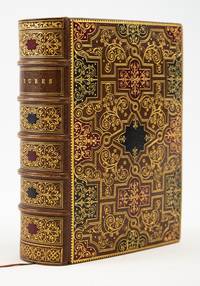
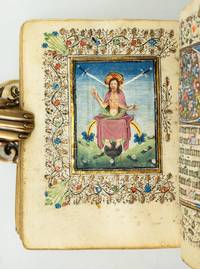
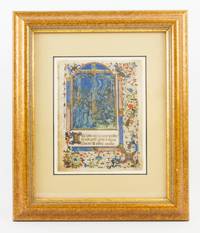
ST20295Northern France probably Paris third quarter of 15th century. 130 x 100 mm. 5 1/8 x 3 7/8". Single column 15 lines in an elegant gothic book hand. 280 leaves. First four leaves misbound lacking at least seven leaves five of which probably contained miniatures. Contents: Devotion to the Passion f. 1r; blank f. 4; Calendar f. 5r; Gospel Lessons f. 17r; "Obsecro te" and "O intemerata" f. 23r; blank f. 23; Hours of the Virgin lacking opening leaves for Terce Nones and Vespers f. 33r; Penitential Psalms and Litany f. 100r; Hours of the Cross lacking preliminary leaf f. 120r; Hours of the Holy Spirit p. 123r; Office of the Dead lacking preliminary leaf f. 127r; "Sept Vers de Saint Bernard" and Suffrages f. 176v; series of devotional prayers in Latin and French including the Hours of the Conception an indulgence devotional poems in French prayers for specific occasions such as when facing tribulations going to confession protection against storms and for friends abroad the Stabat Mater the Seven Joys of the Virgin Gospel sequences "Le chemin de paradis" and many others f. 199r; blank f. 280. <br/> ESPECIALLY BEAUTIFUL MID-19TH CENTURY LIGHT BROWN MOROCCO LAVISHLY GILT IN THE "FANFARE" STYLE BY CAPÉ stamp-signed in gilt on front turn-in covers with large green and red morocco inlaid panels gilt strapwork scrolling and small star tools raised bands spine compartments with red or green morocco inlay surrounded by gilt scrolling embellishments gilt lettering RED MOROCCO DOUBLURES gilt in the style of Duodo with repeating pattern of flowers encircled by vines marbled endleaves modern paper and vellum flyleaves all edges gilt. Housed in a fine suede-lined pebble-grained leather pull-off case with gilt lettering on spine. Light red ruling and rubrics numerous line-fillers in blue and pink with gilt embellishments many one- and two-line initials in burnished gold on pink and blue ground three four-line initials in pink or blue filled with ivy leaves on a burnished gold ground two of these with a gilt and painted baguette along the outer edge of text and all with a three-quarter border of hairline vines flowers acanthus and gold leaves the majority of the leaves with a panel border of hairline vines and flowers on one side one historiated initial painted blue on a burnished gold ground depicting the Virgin accompanied by a gilt and painted baguette and three-quarter border FOUR SMALL MINIATURES DEPICTING THE APOSTLES each with a gilt and painted baguette and surrounded by a three-quarter border and EIGHT LARGE ARCH-TOPPED MINIATURES above a three-line initial painted blue or pink on gold ground a gilt "L" shaped bar border incorporating colorful flowers and a full border of border of hairline vines flowers acanthus and gold leaves and A HALF-PAGE RECTANGULAR MINIATURE with a border along the lower half. The subjects of the large miniatures include: the Mass of St. Gregory f. 1r; Annunciation f. 33r; Visitation f. 57r; Nativity f. 70r; Adoration of the Magi f. 80v; Crowning of the Virgin f. 94v; David in Prayer f. 100r; Pentecost f. 123r; and a rectangular miniature of the Holy Wound or perhaps the Bleeding Host of Dijon f. 241v. Isolated light rubbing and negligible chips to miniatures the dark blue paint appearing slightly worn in places as is often the case occasional faint smudges to borders and other imperfections but all of these trivial. IN THOROUGHLY FINE CONDITION INTERNALLY--the paint fresh the vellum clean and the margins quite comfortable--AND THE EXTRAORDINARILY FINE BINDING FLAWLESS.<br/> <br/> In a spectacular 19th century binding this lovely thick little Book of Hours was executed by a talented follower of Maître François and the Master of Jean Rolin and contains a large number of prayers and devotional texts many of them in French. The manuscript includes a fine array of large and small miniatures executed with a colorful palette and careful attention to detail. Particularly noteworthy is the excellent molding of faces. Each figure--no matter their station or importance to the scene--displays unique characteristics that give us a sense of their age sentiments and demeanor. This is an impressive feat given the small scale of the compositions and this individualization adds a great deal of value to the miniatures as well as the viewer's emotional experience connecting to the images. Our artist owes much to the work of the so-called Maître François and slightly before him the Master of Jean Rolin the latter an eponym attached to the illuminator of missals done for Rolin cardinal-bishop of Autun d. 1483. Perhaps of Burgundian origin the Master of Jean Rolin completed his artistic education in Paris probably in the workshop of the Bedford Master and afterward established his own atelier in Burgundy. There he played a key role in the transition from the Bedford Master's slightly more gothic style to the more thoroughly Renaissance style of Maître François who ran the most successful Parisian workshop during the years between 1460 and 1480 producing illuminated manuscripts small and large sacred and secular. Characteristic of Maître François's style are richly colored scenes interiors depicted with considerable detail women and children with pale porcelain complexions and male figures with darker weathered flesh tones--all of which can be seen in the present work. The final miniature present in this work however seems to have been executed by a different artist altogether being rather more flat in appearance and without the detailed facial molding noted earlier. About two-thirds of the manuscript follows fairly regular arrangement of texts with the exception of the Mass of St. Gregory which is misbound at the beginning of the volume. Then following the Suffrages are approximately 80 leaves of devotional texts in Latin and French including popular verses such as the "Seven Joys of the Virgin" and the "Stabat Mater" as well as more unusual texts such as the Hours of the Conception prayers for specific occasions or protections--for example against storms "Contre tempeste" and when one passes over water "Quant on passe par eaue"--indulgences and other related texts. Two of the more interesting passages are "Le chemin de paradis" a French prayer beginning "Qui en paradis veult aller" and a series of Latin poems that claim to be copied from originals found at the church of St. Paul in Rome. These copious additional prayers suggest a high degree of customization for a client who may have been particularly religious or at least very concerned with self-preservation! and they present intriguing possibilities for further study. The manuscript was rebound sometime in the middle years of the 19th century by Capé d. 1867 one of the most distinguished binders in France in his day. He was especially well known for the delicacy of his work which can be observed to great effect in the present example. He was the binder to the Empress Eugenie and Béraldi calls him "the Bozérian of the second Empire." His work has always been highly sought after and it resides in all of the great collections where bindings are considered important. This volume seems to have been sold to bookseller Francis Edwards as lot no. 95 at Sotheby's sale on 3 April 1957 and has been in private hands ever since. The manuscript is a little jewel inside and out and has obviously been a treasured vessel of prayer and art for generations of owners. unknown
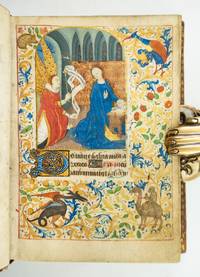
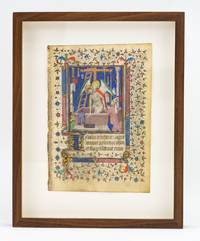
1470ST20836Western France Angers ca. 1470. 122 x 88 mm. 4 3/4 x 3 1/2". Single column 15 lines in a neat bâtarde hand. 152 leaves first and last three are ruled blank leaves; leaf count does not include the first blank endleaf erroneously included in the modern pencil foliation. COMPLETE. Contents: early ownership inscriptions f. 2v Calendar f. 5r Hours of the Virgin f. 17r Extract from the Gospel of John f. 55v Obsecro Te f. 57r Penitential Psalms and Litany f. 61r Office of the Dead f. 78r series of devotional prayers in Latin to the Virgin Mary Christ and the Archangel Michael f. 115r O Intemerata f. 134v series of devotional prayers in Latin f. 138r ruled blank leaves with family records of Jacques Bille f. 150v. <br/> Pleasing early 19th century caramel colored straight-grain morocco covers bordered with a double gilt rule smooth spine gilt in compartments divided with a double gilt rule and dotted roll and cross centerpieces neat early repair to head of spine turn-ins gilt marbled endpapers all edges gilt. Housed in a 20th century felt-lined slipcase with a gilt monogram on front. Ruled in red rubricated in red and blue two one-line burnished gold initials on a blue or pink ground one three-line blue and red penwork initial eight three- to four-line initials in pink and blue filled with ivy leaves on a burnished gold ground these pages with three-quarter borders of acanthus leaves dense rinceaux colorful fruit and flowers gold ivy leaves and bezants and WITH FOUR ARCH-TOPPED MINIATURES above a three- or four-line initial painted blue or pink on gold ground each surrounded by a full border of painted gold and brightly colored acanthus leaves vines and flowers studded with burnished gold bezants three borders inhabited with fantastical creatures the subjects of the miniatures including the Annunciation f. 17r; King David in Prayer f. 61r; a funeral procession f. 78r; and the Pietà f. 115r. Verso of first leaf with signature of Jacques Bille or Billes and the following page with a note in a different contemporary hand with the day and year erased and written over: "Ces presentes heures sont a iaques bille qui les trouvera si les luy Rende et il paiera voluntriers le VIII le jour de la sainct martin. Tesmoion son seign manuel cy mis le huytiesme jour de Avril L'an mil cinqcens et seze" "These present hours belong to Jaques Bille; whoever finds them should return them to him and he will gladly pay on the eighth the day of Saint Martin. Witness his manual signature placed here on the eighth day of April in the year one thousand five hundred and sixteen" followed by Bille's signature; third blank leaf with the ownership inscription "Tussanus Philippus Adeline Presbyter anno 1763"; verso of final text leaf and next three blanks with family records see below. Superficial crease to spine other insignificant signs of use to the leather but the binding sound and attractive. A hint of thumbing at lower corners of first half of the manuscript miniatures with a few isolated minor spots of rubbing not affecting faces otherwise in very fine condition internally the paint bright and fresh and the vellum clean.<br/> <br/> Almost certainly made in western France and with early ownership inscriptions tying it to that area this Book of Hours contains four extraordinarily high-quality miniatures by an accomplished artist very likely related to one of the greatest French manuscript illuminators of the period. Stylistic markers here include drapery with crisp folds figures with pale skin and high foreheads simple but perfectly executed scenery and a flair for detail. The latter talent is particularly evident on the various textiles and garments which include almost impossibly fine gold trimmings and sophisticated draping. It was in fact on the basis of the extraordinary drapery that the manuscript had previously been associated with the circle of Jean Fouquet called by Avril and Reynaud "the greatest French painter and illuminator of the 15th century." In a case of twin summits recent scholarship suggests an alternative attribution to the similarly illustrious circle of Maître de Jouvenel des Ursins a contemporary of Fouquet who according to Avril and Reynaud was "the most important illuminator of the mid 15th century in western France." Around him sprung up a group of artists collectively referred to as the "Jouvenel group" who were based primarily in the area between Tours Nantes and Angers. The illuminations in the present work are so skillful that with additional research it may be possible to pin down an attribution with more certainty; whatever the identity of the artists the level of finishing in these illuminations--from the careful molding of the faces and bodies to the expertly balanced compositions and elegant brushwork--are the hallmarks of a superior hand. When this item was sold at Sotheby's on 13 July 1977 the auction catalogue said that the miniatures "are painted with fine clear colours with great delicacy in the modelling of faces and costumes. The finest miniature is that of the Pietà set against a deep green hill with a fiery sun setting behind dark mountains and buildings and lighting up the evening sky." Indeed this image is a quiet masterpiece of illumination and an excellent example of this artist's work. The naked figure of Christ exhibits a real command of anatomy and proportion while subtle details such as the foreshortening to Christ's face and the whisper-thin cloth clinging to the lower body are done with an exquisite touch. The miniature of the funeral procession also stands out for its superior quality. The composition is quite different from the Pietà being a large group of people rather than an intimate portrait of two figures but it is approached with equal rigor and devotion to detail. The faces turning toward the viewer all show impressive individualization with the figure dressed in blue being particularly well formed and highly differentiated from the crowd--so much so that this could possibly be considered a patron portrait. Three of the miniatures in this work contain borders with delightful examples of marginalia including a court jester a hedgehog a male and female centaur wielding weapons a monkey riding a camel another monkey rubbing his posterior and other whimsical hybrid creatures. These stand out because they are rendered with the characteristic skill and attention to detail found in the larger miniatures so it is possible that they could also be the work of the miniature artist. Although the Calendar in this manuscript is fairly sparse at least two unusual entries in red point toward western France: St. Julian Bishop of Le Mans 27 January; and St. Maurilius patron saint of Angers 13 September. Significantly the Translation of St. Maurilius also appears on both 16 August and 19 of October in black. Strengthening this association with the west are the early ownership inscriptions tying to the Bille family from at least the early 16th century and possibly before. The final three leaves contain family records that include the date of Jacques Bille's wedding 8 April 1516 and the births of 15 children written in two or three hands between approximately 1520 and 1549. The name of our former owner was difficult to trace with certainty but we find mention of a Jacques Bille in the French National Archives where he is listed as a notary in Bourg in southwestern France. This would make sense given Bille's complex signatures found on the first two leaves--the extra flourishes may well reflect notarial signatures that he used in his work. In modern times our manuscript was sold at Sotheby's on 25 February 1946 lot 57 to Maggs who may well have sold it to Sven Ericcson who is listed as the owner of this and four other 15th century illuminated Books of Hours when it was sold at Sotheby's in 1977 for £3200. According to RBH it was purchased at that auction by "Malle" almost certainly Bernard Malle 1929-2008 brother of filmmaker Louis Malle and an eminent collector and bibliographer. In an elegant tribute to his late friend and mentor Bernard Clavreuil calls Malle "one of the most discerning . . . collectors of the postwar era" someone who "never ceased to refine and improve in order to achieve an impossible perfection." Malle also acted as a private advisor to more than one major collection and it is possible that he purchased the present manuscript on behalf of an unknown collector rather than his own library. These former owners clearly looked after this Book of Hours carefully over the years and for good reason: it is a work of considerable craftsmanship and beauty with illuminations distinguished by very substantial artistic skill. unknown
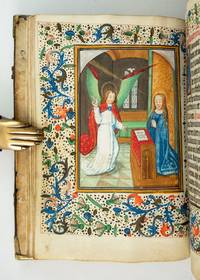
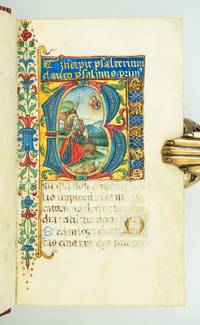
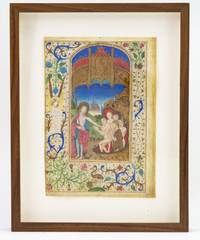
1470CLe2501Low Countries probably Bruges ca. 1470-80. 186 x 135 mm. 7 3/8 x 5 1/4". Single column 20 lines in a gothic book hand. i blank 108 i blank leaves bound too tightly for a close collation but APPARENTLY COMPLETE. Contents: Calendar f. 1r; Gospel Lessons f. 7r; Hours of the Holy Cross f. 11r; Hours of the Holy Spirit f. 15r; Mass of the Virgin 18r; "Obsecro te" f. 21r; "O Intemerata" f. 23r; Suffrages f. 24r; Hours of the Virgin f. 33r; Office of the Virgin as said throughout Advent f. 71r; Penitential Psalms f. 76r; Litany and petitions f. 81v; Office of the Dead f. 87r. <br/> HANDSOME RENAISSANCE ENTRELAC BINDING upper joint and parts of spine very skillfully repaired covers with a gilt floral border surrounding a central panel of gilt strapwork design with traces of original polychrome painting raised bands spine gilt in compartments original bosses and catchplates clasps renewed all edges gilt. Rubrics in red numerous one-line initials in blue with red penwork or gold with dark purple penwork many two-line initials in burnished gold on pink and blue ground with white highlights most of these with floral sprays extending into the margins 22 SMALL MINIATURES measuring approximately 45 x 37 mm. each with panel borders of colorful acanthus and flowers at the top and bottom of the page connected by a strand of gilt bezants and 14 FULL-PAGE MINIATURES each surrounded by a full border of acanthus flowers and bezants the facing pages also with full borders and a large six-line initial painted pink or blue filled with swirling vines and flowers on gilt and painted ground. Subjects of the large miniatures being: Crucifixion f. 10v; Pentecost f. 14v; Virgin and Child f. 17v; Annunciation f. 32v; Visitation f. 42v; Nativity f. 49v; Annunciation to the Shepherds f. 52v; Adoration of the Magi f. 55v; Presentation in the Temple f. 58v; Massacre of the Innocents f. 61v; Flight into Egypt f. 66v; Coronation of the Virgin f. 70v; David in Prayer f. 75v; Raising of Lazarus f. 86v. Front pastedown with a 16th century inscription see below; rear pastedown with a 17th century ownership inscription in ink signed François le Paige. Lower joint a bit rubbed margins with a little soiling and occasional wrinkle fore-edge border rule just grazed by binder in a few places the other borders quite ample miniatures with tiny chips light fading or rubbing in a couple places etc. but IN EXCELLENT CONDITION the attractive period binding very well preserved with boards showing virtually no signs of wear the vellum generally clean and bright and the miniatures fresh and richly colored.<br/> <br/> This is an extensively illustrated Book of Hours preserved in an especially attractive early binding with richly colored miniatures attributed to the Master of Philip of Cleves' "Book of the Hunt." Active in the Low Countries from approximately 1470-90 this artist was patronized by some of the area's wealthiest elite and is known to have collaborated with another important illuminator called the Bruges Master of 1482. Some trademarks of our painter include faces with subtle blue shading; high arched eyebrows; thin golden halos; and women with very straight shoulder-length hair highlighted with strands of gold. Outdoor scenes often contain narrative elements in the distance such as the figures of a young David and Goliath in the miniature of King David at Prayer or pagan idols dropping from a column in the Flight into Egypt recalling a popular apocryphal tale of pagan relics miraculously falling to pieces as the Holy Family passes by. Some miniatures of note in addition to these two are the Raising of Lazarus for the Office of the Dead--a popular alternative to funeral images particularly among Flemish illuminators--and the Massacre of the Innocents for the hour of Vespers a particularly violent episode in which King Herod commands his soldiers to slaughter the male infants of Bethlehem. Like other miniatures in this work the action in these scenes is spread out between the fore middle and background creating a multi-layered narrative that invites the eye to explore and meditate. The artist's color palette in this manuscript is quite memorable and includes a bright mustard yellow pale green and cherry blossom pink. The Coronation of the Virgin makes particularly strong use of color with a sunset-like gradient giving way to billowy blue clouds. The Annunciation miniature also demonstrates the Master's facility with color; here the Angel Gabriel's red and green wings are fully extended while the Virgin is radiant against a golden yellow wall covering. In addition to the large compositions we are treated to 22 smaller miniatures depicting the Evangelists and saints each of which is charming in its more confined presentation. Although the saints found in the Suffrages are quite typical for a Book of Hours the Calendar is another story. Despite being rather sparsely filled out the calendar here includes several feast days some of them unusual enough to provide additional insight into the manuscript's localization and use. For example there is St. Landoaldi 19 March a missionary to Northern France and Belgium and St. Winnoc 6 November the son of a Breton king with a former abbey in the far north of France. The calendar is idiosyncratic in other ways as well with saints' names that are repeated and others that are either extremely obscure or whose dates seem to be wrong. Whatever the case additional research into the calendar would undoubtedly prove revealing. We are fortunate to have some early provenance information written into this Book of Hours. The inscription on the front pastedown reads: "This last day of September 1590 we name erased but Claude le Paige lieutenant of the guards of his highness of Bar le Duc on the one hand and Alix de la Taxe on the other hand have married in front of the holy Catholic church at the place of Mirecourt." Below this inscription are notes indicating the ages of the bride and groom 17 and 36 respectively as well as the dates of their deaths: he died on 9 May 1610 and she on 14 September 1622. Located in the strategically important Meuse region in northeastern France the Duchy of Bar-le-Duc unified with Lorraine in 1480 and became extremely wealthy during the 16th century. Although we do not know for whom the manuscript was originally made it seems quite possible that it was commissioned for a forebear of the named Bar-le-Duc spouses and was perhaps passed down through later generations of the family. The signature on the pastedown indicates that François le Paige son of Claude and Alix inherited the book from his parents. This manuscript was lavishly and tastefully bound early in the 16th century and has survived in excellent condition to the present day. This binding would originally have been painted but even without its original colors it is still quite attractive perhaps even splendid. In excellent condition inside and out the manuscript is a fortunate survival and a testament to generations of careful stewardship. unknown
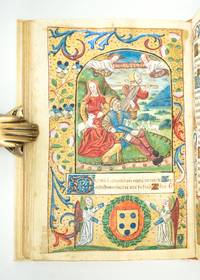
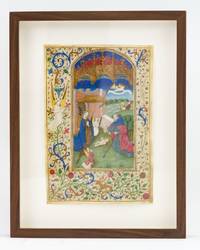
1516ST20620Northern France late 15th or early 16th century. 176 x 128 mm. 7 x 5". Single column 23 lines in a neat batârde hand. i blank 101 ii blank leaves. Lacking one leaf after f. 87 possibly containing a miniature otherwise complete. Contents: Calendar f. 1r; Gospel Lessons f. 7r; Passion according to John f. 10v; Hours of the Virgin f. 15v; Penitential Psalms and Litany f. 45r; Office of the Dead f. 54v; Hours of the Cross f. 68v; Hours of the Holy Spirit f. 70v; Prayers to the Trinity St. Veronica "Obsecro Te" "O Intemerata" and "Stabat Mater" f. 72v; Suffrages f. 79r; Prayers in French to be said on various occasions f. 86v; verse prayer in French beginning "Royne des cieulx glorieuse" f. 90r; additional prayers in French and Latin f. 93v. <br/> Attractive 19th century vellum with lacy gilt border raised bands ruled in gilt gilt lettering tan silk endleaves all edges gilt. Housed in a felt-lined reddish-brown pebbled morocco clamshell box with gilt lettering on spine. Rubrics in red numerous one- and two-line initials in painted gold on burgundy or blue ground WITH 27 SMALL MINIATURES one miniature of Christ Carrying the Cross measuring 60 x 68 mm. the rest depicting saints and measuring between eight and nine lines each surrounded by a full border of acanthus flowers and small dots on bare or painted vellum and 14 LARGE MINIATURES EACH OPENING WITH A FULL BORDER either with acanthus and flowers as before or architectural some borders embellished with figures animals or hybrids two with a small scene in the lower margin and about a dozen with the added coats of arms and/or mottos of Jean Boutin. The subjects of the large miniatures include the following: St. John of Patmos f. 7r; Annunciation f. 15v; Visitation f. 23r; Nativity f. 27v; Annunciation to the Shepherds f. 29v; Adoration of the Magi f. 31v; Presentation in the Temple f. 33v; Flight into Egypt f. 35v; Death of the Virgin f. 38v; Bathsheba bathing f. 45r; Funeral Mass f. 54v; Crucifixion f. 68v; Pentecost f .70v; Trinity f. 72v. See: Fairfax-Murray "French" p. 265-266. Vellum binding soiled but perfectly sound. Small portions of some border figures and perhaps three or four miniatures touched up in the 16th century see below occasional chipping to white paint small hole in the border of ff. 11 & 29 light scattered spotting fading thumb soiling and other minor issues but an attractive and substantially complete manuscript the illumination extensive and mostly well preserved.<br/> <br/> This heavily illustrated Book of Hours is a lovely example of provincial illumination; it calls attention in an interesting way to the influence of printed books on manuscript art; and it contains intriguing traces of an early prominent owner. Our manuscript contains a total of 41 large and small miniatures by a skilled artist who clearly had some training and familiarity with the prevailing styles of the time. The overall appearance of the work suggests the artist or workshop was located in Northern France and although the figures and backgrounds are indicative of a provincial hand the rich colors profuse use of liquid gold and sumptuous borders are unmistakable marks of luxury. The image of the Trinity is particularly lovely demanding the viewer's attention with God the Father's piercing gaze and conveying the majesty of the subject with a patterned throne set against a starry sky. Of special interest here are the compositions of the large miniatures many of which seem to have been copied from printed Books of Hours of the period. When we talk about the transition from manuscripts to print culture in the late-15th and 16th centuries the discussion often focuses on how the art of manuscripts influenced the appearance of printed works. There is no better example than Books of Hours which in printed editions often mimic the look of their manuscript predecessors in appearance and the way many were finished by hand. However as the present example demonstrates the opposite was also true as printed works inevitably made their way into the hands of manuscript artists. Some even worked simultaneously both as illustrators for publishers working with metal- and woodcuts and as manuscript painters. As a reflection of this point in the present work we find distinct similarities between our miniatures and a series of metalcuts used by Philippe Pigouchet for the publisher Simon Vostre beginning in 1496 Fairfax-Murray's set 2. According to Fairfax-Murray "These cuts . . . were evidently very favourably received by Pigouchet's rivals and imitators for one finds several close copies and adaptations in the various productions of other presses" including a very close imitation of woodcut images commissioned by the publisher Antoine Vérard. Evidently the popularity of these plates extended to manuscript artists and it is fascinating to see the adaptation of each composition to suit the painter's own style and the patron's needs. Most of the compositions in our manuscript are essentially simplified versions of the printed miniatures retaining the central figures their gestures garments and props but with complex backgrounds eschewed as are extra figures deemed unnecessary to fulfill the narrative. The resulting miniatures are far less busy than their printed counterparts allowing the viewer to focus on the central story. In a few instances the artist has added small scenes beneath the large miniatures. An example on f. 35 depicts the so-called "Miracle of the Wheat" featuring harvesters misleading Herod's soldiers by truthfully saying that the fleeing Holy Family passed by when their now miraculously matured crop was just being sown. This kind of inclusion may have been influenced by the copious small metalcut scenes that decorate the borders of numerous printed Books of Hours of this period. The text here follows a fairly typical structure but includes prayers in French to be said for each day of the week and on various occasions such as when one awakens or when one leaves a house. Also in French are additional verses to the Virgin--one of which is credited to the Franciscan preacher Jean Tisserand d. 1497 who founded an order for repentant women. Another accessory prayer included here f. 98 appeared in both prayer books and conjuring manuals of the period straddling the line between religion and popular magic. Based on an apocryphal encounter between Pope Leo III and Charlemagne during the Battle of Roncevaux this prayer was often used as a protective amulet against all manner of evil; here it is said to "conquer demons and one's enemies." Although we do not know for whom this manuscript was originally made the book shows a number of marginal customizations in the form of different coats of arms the motto "Soit avenu" "Let it come to pass" and the name of Jean Boutin written on ff. 23 and 35. This owner could have been Jean Boutin Sieur de la Court et de Chamballan and Mayor of Nantes from 1575-76. In addition to the marginal customizations the manuscript may possibly have some very neat replenishing of white facial paint in a handful of marginal figures and perhaps in a very small number of the miniatures. Using magnification and strong light we are unable to find convincing evidence that this retouching took place at least in the miniatures and if it was we think it was done quite early perhaps in the 16th century. Worst case it would necessarily be termed subtle and skillful enough to cause uncertainty now and whatever the verdict is in this respect the manuscript remains very fresh and attractive features attractively executed paintings is complete but for one leaf and would provide ample room for additional research. unknown
1450ST20835Flanders ca. 1450. 109 x 81 mm. 4 1/4 x 3 1/8". Single column 14 lines in a gothic book hand. 161 leaves. COMPLETE. Contents: Calendar f. 1r; Mass of the Holy Spirit f. 14r; Mass of the Holy Cross f. 23r; Requiem Mass f. 30r; Prayer on the Seven Last Words of Christ by the Venerable Bede f. 36v; Passion according to John f. 40v; blank f. 53; Hours of the Holy Cross f. 55r; Mass of the Virgin Mary f. 60r; Gospel Lessons f. 66v; Hours of the Virgin f. 73r; Penitential Psalms f. 126r; Litany f. 138r; Office of the Dead f. 144r. <br/> PLEASING NEAR-CONTEMPORARY BLIND-ROLLED CALF apparently with some old skilled restoration to joints spine and corners covers with rolled vine border surrounding a panel of three columns bearing a roll with parts of the inscription "AVE MARIA GRACIA PLENA" each word separated by one of four small motifs a flower a human profile the lamb of god and a sitting animal--perhaps a lion raised bands compartments with part of the same inscription roll. Lacking the original ties. Housed in a very attractive custom-made brown calf folding case with blind-stamped lettering on the spine interior lined in suede the whole within a calf-lipped suede-lined matching slipcase. Rubrics in red numerous one-line initials in blue with red penwork or gold with dark blue penwork many two-line initials in burnished gold on pink and blue ground with white embellishments several larger "I" initials between four and 11 lines in burnished gold on pink and blue ground with white embellishments 12 six- to seven-line initials some painted pink or blue with white embellishments and filled with flowers and tendrils on a gold ground or the initial in burnished gold on pink and blue ground with white embellishments EIGHT LARGE MINIATURES each inside a thin gold frame and with a three-quarter border of gilt leaves hairline vines and floral spays each facing page with a similar three-quarter border the subjects of the miniatures being: the Holy Spirit in the form of a dove f. 13v; St. Helena and the True Cross f. 22v; Raising of Lazarus f. 29v; Crucifixion f. 54v; Virgin and Child Enthroned f. 59v; Annunciation f. 72v; Last Judgment f. 125v; Funeral Mass f. 143v. Prickings visible in fore margins. See: Defoer et. al "The Golden Age of Dutch Manuscript Illumination" pp. 75-86. Just minor wear to the solid very pleasing early binding. A little chipping almost always mild to four of the miniatures with square frames the fifth the Annunciation somewhat rubbed and faded the three domed miniatures perfectly intact vellum with minor soiling and thumbing in places especially in lower corners of leaves in second half other trivial imperfections but overall a very well-preserved manuscript with no major issues.<br/> <br/> This enchanting little prayer book features eight attractive miniatures large gleaming burnished gold initials and a pleasing period binding--all in an excellent state of preservation. The miniature program here can be attributed to the so-called Masters of Otto van Moerdrecht the name given to a variety of Dutch artists active in the 1430s and '40s all working in a similar mode rather than to a specific master or workshop. According to Defoer et al. the work of these miniaturists "exhibit varied compositional formulas and bright highly contrasting colors . . . . The small somewhat doll-like figures appear rather wooden but their expressive gestures give the scenes a varied and vivid character." Two artistic hands are responsible for the present miniatures. The artist behind the first three miniatures all set within domed gilt frames the Holy Spirit St. Helena and Raising of Lazarus shows particular skill with a very smooth application of color figures with long eloquent hands and faces with subtle white highlighting. A second artist was responsible for the remaining five miniatures set within square golden frames Crucifixion Virgin and Child Enthroned Annunciation Last Judgment and Funeral Mass. Though this hand is less polished and the miniatures slightly smaller in size the scenes are all quite charming and attractively colored with vivid splashes of bright orange bubblegum pink sky blue and pale green. It is worth noting that the miniatures differ not only because of the artists' degree of success but also because of their condition: whereas the five are generally well preserved the other three are in a virtually perfect state. In addition to the central text of the Hours of the Virgin this manuscript contains several Masses each of which is preceded by a miniature. Perhaps the most interesting of these is the Mass of the Holy Cross which is paired with a miniature of St. Helena mother of Constantine the Great. According to Christian tradition Helena found the wooden cross used in the Crucifixion while she was travelling in Jerusalem in the fourth century. Constantine built the Basilica of the Holy Sepulchre in its honor and installed the relic there to be venerated. Britannica says that the adoration of the True Cross led to wide-spread sale of its fragments sought after as objects of devotion. It is unusual to find St. Helena depicted in a Book of Hours and this image is especially appealing with Helena in a beautiful red robe crown and halo embracing a large wooden cross in the center of the composition. The background is reminiscent of the work of the Gold Scrolls group with small swirls of liquid gold swimming in a scarlet sky the same scrolling motif graces the Holy Dove miniature. There is no indication of former ownership in this manuscript although the Calendar presents a few unusual saints that confirm a Flanders connection. These include St. Amandus in red known as the "Apostle of Flanders" on 2 February; St. Guido known as the "Poor Man of Anderlecht" on 9 September; St. Bavo in red patron saint of Ghent where a Cathedral is named in his honor on 10 October; and St. Eligius patron saint of goldsmiths and metalworkers on 1 December. The binding here is very close to contemporary and probably dates to the late 15th century. Neither the floral roll nor the "Ave Maria" roll seems to appear in EBDB. Similar rolls include r001954 r000623 and r000670 but ours is the only one with four different and charming tools one of each used between every "Ave" and "Maria." For a manuscript only slightly bigger than the palm of one’s hand this Book of Hours has a great deal to offer. In addition to its early binding and lovely illumination by an influential group of artists great care has been put into its preservation so that it resolutely endures for our pleasure and for owners in the centuries to come. unknown
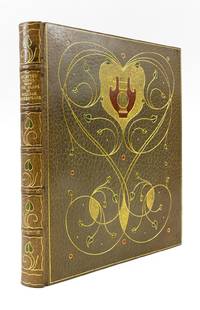
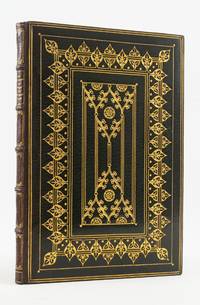
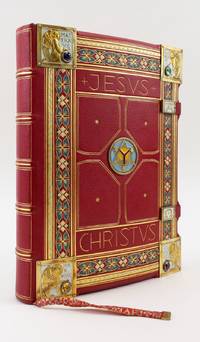
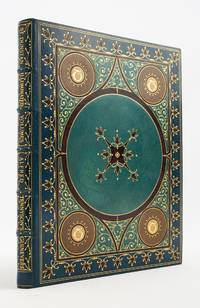
1920ST16608<p>London: Designed written out and illuminated by Alberto Sangorski Colophon 1920. 255 x 212 mm. 10 1/8 x 8 1/2". 25 3 pp.</p><p>ELEGANT LIGHT OLIVE GREEN CRUSHED MOROCCO GILT AND INLAID by Riviere for London bookseller Charles J. Sawyer stamp-signed "Chas. J. Sawyer Ltd. London" on front turn-in upper cover with inlaid mahogany-brown morocco lyre at head "strung" with gilt fillets and surrounded by dense gilt stippling six gilt fillets emanating from the top of this ornament and curling extravagantly below it with inlaid green morocco leaves at the tips of its extensions and inlaid red dots accenting the perimeter raised bands spine compartments with gilt and inlaid leaf sprig gilt titling turn-ins framed with five gilt fillets stippled and inlaid cornerpieces ivory moiré silk doublures and endleaves. In a fine full morocco plush-lined box with raised bands and gilt titling. ILLUSTRATED THROUGHOUT WITH EIGHT LARGE MINIATURES within extraordinarily elaborate illuminated borders FIVE FINE ROUNDELS FOUR LARGE HISTORIATED INITIALS a portrait of a young woman a leaping stag a skull and a landscape with a castle tower AND 25 ILLUMINATED INITIALS all with burnished gold. New expertly matched silk guards. SIGNED by Sangorski in the colophon following the statement: "This manuscript will not be duplicated." With an early typescript list of the contents laid in at front. Ratcliffe "Alberto Sangorski" SJR 338 attributing the binding to Riviere. ◆Spine slightly sunned to olive brown just a hint of sunning to head and fore edges of boards spine with half a dozen barely perceptible tiny dark spots but A VERY FINE COPY OF AN EXTRAORDINARILY BEAUTIFUL MANUSCRIPT the binding unworn and lustrous and the interior pristine with vellum clean and bright and the paintings perfectly preserved.<br /><br />Written out decorated and painted by one of the most accomplished illuminators of the modern era this attractively bound work celebrates some of Shakespeare's best-known plays with sumptuous miniatures that are in a perfect state of preservation. Songs from "The Tempest" "As You Like It" "Hamlet" "A Midsummer Night's Dream" and other works provide the inspiration for the many delightful miniatures seen here which display an impressive variety of portraits outdoor views and figural scenes--everything from reclining nudes to a particularly lush scene in which a group of spirited hunters return from the woods. The illustrations are all painted with exquisite attention to detail and demonstrate the artist's innate understanding of color rendering each composition delicate yet vigorous and vibrantly hued. All Sangorski manuscripts with miniatures are painted with great skill but this one is particularly arresting. Alberto Sangorski 1862-1932 started his professional life as secretary to a goldsmith's firm became attracted to the book arts at the age of 43 and began doing illuminated manuscripts that were then bound by his brother Francis' firm Sangorski & Sutcliffe. Sometime around 1910 Alberto and Francis had a falling out and the artist went to work for Riviere the chief competitor to his brother's firm. <br /><br />The gracefully tooled binding here was commissioned by London bookseller Charles J. Sawyer 1876-1931 who opened his shop in 1894. According to Brown and Brett's "The London Bookshop" Sawyer provided "anything suitable for a gentleman's library" with specialties in "rare items early English literature fine bindings and sporting and colour-plate books." While the binder fulfilling the commission did not sign this work Sangorski bibliographer Stephen Ratcliffe attributes it to Riviere & Son and there are examples of Riviere bindings decorated in this Art Nouveau style. But the design here with its delicate curving lines creating uncommon shapes also resembles the work done by members of the Guild of Women Binders. Whoever the artisans involved the binding is attractively designed and executed using premium materials and it provides a pleasing cover for the glorious illuminations within.</p> [D]esigned, written out, and illuminated by Alberto Sangorski [Colophon]
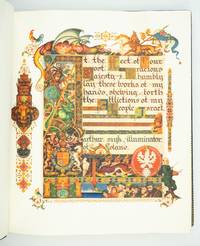
1939ST20331London: Beaconsfield Press 1939. No. 72 OF 125 COPIES SIGNED BY THE ARTIST AND THE EDITOR for sale in the British Empire. 292 x 248 mm. 11 1/2 x 9 3/4". xxvi pp. 46 leaves all leaves French fold. Edited by Cecil Roth. <br/> Elegant original blue crushed morocco by Sangorski & Sutcliffe signed on front turn-in covers with gilt French fillet border and large intricate central figure designed by Szyk of a patriarch holding a goblet and book raised bands spine gilt in double ruled compartments with ornate crown centerpiece gilt titling turn-ins with double gilt-ruled and scalloped border surrounding an illustrated silk doublure featuring a Szyk portrait of Moses with the Ten Commandments done in shades of gray within a frame of elaborate design. In an excellent velvet-lined box of blue half morocco over lighter blue cloth upper cover with central lion's head in gilt on blue morocco spine like that of the book. WITH 14 FULL-PAGE AND 32 SMALLER COLOR REPRODUCTIONS OF DESIGNS BY SZYK. English translation printed in black commentary printed in red. Front flyleaf inscribed in ink: "To Mr. and Mrs. Solomon Brachman / very cordially / Arthur Szyk / New York. April 1945." Very faint naturally occurring variations in the grain of the vellum otherwise a pristine copy.<br/> <br/> With an important Holocaust-related authorial inscription this is a very fine copy of what the London Times described as "a book worthy to be placed among the most beautiful of books that the hand of man has produced." Arthur Szyk 1894-1951 a Polish Jew is considered by scholars to be the greatest 20th century illuminator. Using the style of the Medieval illuminated manuscript artists he has here created a Haggadah for Passover that is at once a beautiful book of devotion a political protest against the rise of Nazism and a plea for England's help for the Jews of Europe. By 1939 Szyk's anti-Nazi cartoons had caused Hitler to put a price on his head forcing him to flee to England. His original illustrations for his "Haggadah" featuring the villains of the Exodus with the heads of Hitler Goebbels and other leading Nazis had to be toned down before publication. All 46 pages of the Hebrew text are illustrated with scenes from the Passover story as well as vignettes of Jewish life in modern Europe—sometimes Szyk mixes the two to great effect. Perhaps the most moving illustration in the book is the elaborately illustrated dedication to King George VI of England appealing for his mercy to European Jews. The great symbols of the British Empire—the lion and unicorn St. George defeating the dragon—surround Szyk's plea to the king: "At the feet of your most gracious majesty I humbly lay these works of my hands shewing forth the affliction of my people Israel." In the lower right corner of the painting we see Jewish refugees beside one of the ships which were usually turned away from British shores while Szyk depicts himself leaning against the painting his brush and easel in hand. The text here is enriched by the historical introduction and the commentary contributed by Cecil Roth 1899-1970 the preeminent British expert on Jewish history. This crowning achievement of Szyk's life was four years in the making and has proved to be an enduring treasure. Szyk presented this copy to Texas oilfield supply magnate Solomon "Sol" Brachman 1896-1974 and his wife Etta. The son of a Latvian Jew Brachman was the founding president of the Jewish Federation of Fort Worth in 1936 and helped arrange an emergency $100000 bank loan for Israel on the eve of statehood in 1948. His wife who served as president of the National Council of Jewish Women was known as "the mother of Hadassah." Szyk's 1945 inscription was no doubt especially meaningful to this devout family whose Latvian relatives were among the 90 percent of that country's Jews who perished in the Holocaust. Beaconsfield Press unknown
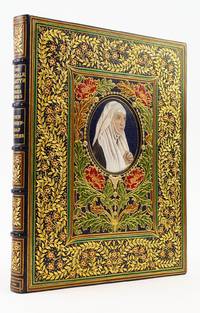
1914ST18714London 1914. 265 x 207 mm. 10 1/2 x 8 1/4". 41 3 blank pp. 1 leaf colophon. <br/> RESPLENDENT IN DARK BLUE MOROCCO RICHLY GILT AND ONLAID BY RIVIERE & SON stamp-signed on front doublure covers with wide frame of swirling gilt vines bearing red morocco blossoms and blue and green berries bordered by strips of green and tan morocco central panel of upper cover with recessed oval containing a portrait of a young nun sculpted in leather with painted details this encircled by an onlaid ivory morocco rosary and surrounded by an exuberant spray of red morocco poppies with green and tan leaves central panel of lower cover with an arch-backed black morocco cat beneath the arch of a gray morocco horseshoe at center a black and red witch's hat above the horseshoe and the whole on a very densely stippled gilt ground incised with calligraphic curls and set with nine silver stars around the cat this centerpiece surrounded by curling gilt vines bearing red morocco and gilt posies raised bands spine compartments framed with tan morocco and containing a gilt and onlaid floral sprig TAN MOROCCO DOUBLURES bordered by a strip of purple morocco this with onlaid green morocco frame adorned with gilt latticework densely stippled gilt cornerpieces set with purple morocco passionflowers all accented with inlaid circles of purple navy and green in varying sizes leather hinges apricot watered silk endleaves all edges gilt. In the original silk- and velvet-lined green morocco box. Numerous two- to three-line initials in red blue or burnished gold three three-line illuminated initials 11 five- to six-line initials in shades of purple blue and green with highlights of pink and burnished gold two of these with extensions running the length of the text and two incorporated into full borders four very large initials 12 lines or more in colors and gold five full borders that on title page incorporating a small oval miniature of Whittier and TWO FULL-PAGE MINIATURES one of a young nun at prayer the other of two lovers walking in a forest. Calligraphed colophon SIGNED by Sangorski stating: "This manuscript . . . was designed written out and illuminated by Alberto Sangorski for Messrs. R. Rivière & Son Bookbinders & Booksellers to his Majesty King George V. London. This manuscript will not be duplicated. This manuscript was executed by me." From the collection of Phoebe A. D. Boyle her sale at Anderson Galleries 19-20 November 1923 lot 368. Front flyleaf with engraved bookplate of comic book pioneer M. C. Gaines 1894-1947; typed description from "Kolb Collection" Louis Kolb laid in. Ratcliffe "Albert Sangorski Bibliography" SJR 245. Vellum a bit wavy as is typical but A BEAUTIFUL COPY the leaves creamy and bright being painted with rich colors and glittering gold and IN A FLAWLESS BINDING.<br/> <br/> This is an outstanding example of the artistry of Alberto Sangorski and that of the binders gilders and finishers of Riviere & Son the volume being executed at the zenith of their creative powers and formerly owned by the most important collector of Sangorski's manuscripts. Sangorski has written out and illuminated three poems by American author John Greenleaf Whittier: "The Female Martyr" inspired by an 18-year-old nun from the Sisters of Charity who died nursing cholera victims; "The Witch's Daughter" set in Puritan New England; and "Memories" a lover's touching reminiscences of youthful romance. In addition to elaborate initials and borders in his preferred palette of blues purples and greens brightened with burnished gold Sangorski has created two full-page paintings one of the beautiful young nun at prayer the other of youthful sweethearts strolling arm-in-arm through a wood. <br /> <br /> Alberto Sangorski 1862-1932 started his professional life as secretary to a goldsmith's firm became attracted to the book arts at the age of 43 and began doing illuminated manuscripts that were then bound by his brother Francis' firm Sangorski & Sutcliffe. Sometime around 1910 Alberto and Francis had a falling out and the artist went to work for Riviere the chief competitor to his brother's firm. Like the manuscript here our binding by Riviere is the work of many months with hundreds of individual inlays onlays and applications of gilt. Robert Riviere began as a bookseller and binder in Bath in 1829 then set up shop as a binder in London in 1840; in 1881 he took his grandson Percival Calkin into partnership at which time the firm became known as Riviere & Son and the bindery continued to do business until 1939. New York collector Phoebe A. D. Boyle was the widow of a canvas manufacturer who had made a fortune providing tents to the U.S. Army in the Civil War. George Sutcliffe described this important client as "rivalling the Medici in her patronage of the production of beautiful books." Stephen Ratcliffe deems the Boyle collection as "unrivalled" for its jewelled bindings and modern illuminated manuscripts; 33 of Alberto Sangorski's creations appeared in her sale at Anderson Galleries in 1923 and during World War I she was one of the only customers for extravagant productions like the present item. Any book from the Boyle collection which was put together with the greatest taste and discrimination is recognized as desirable beyond its intrinsic literary merit. unknown
1915ST20770London: Especially written out and illuminated by Alberto Sangorski ca. 1915. 249 x 165 mm. 9 3/4 x 6 1/2". 18 2 pp. 2 leaves blank colophon. <br/> Attractive dark green crushed morocco gilt by Riviere & Son stamp-signed on front turn-in covers with wide frame and central panel tooled in gothic architectural motifs raised bands spine compartments with double gilt rules gilt lettering turn-ins framed by gilt fillets and dots scarlet watered silk pastedowns and endleaves all edges gilt old repair to head of spine. With one burnished gold initial "A" with intricate penwork embellishment in red and blue THE WORD "FOR" WRITTEN IN LARGE BURNISHED GOLD LETTERS SIX TIMES all with delicate penwork embellishment in blue or green TWO WITH A FAIRY-WINGED PUTTO perched on the crossbar of the "F" another "FOR" written in blue THE "F" IN BURNISHED GOLD ON A BACKGROUND OF BRUSHED GOLD WITH A PINK ROSE SPRIG a tailpiece of white jasmine blossoms entwined with a spray of lilac blooms FOUR ESPECIALLY FINE BRIGHT OVAL VIGNETTES approximately 90 mm. across SHOWING LOVELY GARDENS one of these accompanied by A HALF BORDER OF HUCKLEBERRY VINE another at the front as part of A SUPERB DOUBLE-PAGE OPENING FEATURING A PROFUSION OF PINK ROSES forming a frame around a gilt-edged cartouche bearing the title in blue surrounded by delicately blue and brown tendrils on the left AND A FRAME OF GRAPEVINES BEARING SUCCULENT PURPLE FRUIT ON A BRUSHED GOLD BACKGROUND on the right an oval view of a lake and mountains at its foot this frame enclosing text beginning with the words "GOD ALMIGHTY" in thickly burnished gold accented with curling blue and brown acanthus leaves and blue penwork. One page with trivial thumb smudge faint variations in shade of the vellum but A SUPERB SPECIMEN the vellum smooth and creamy the paint and gold bright and the virtually unworn binding with shining gilt.<br/> <br/> Featuring several gorgeous moments this is a luxurious and appropriately luxuriant illuminated manuscript of Bacon's prescription for the ideal princely garden. The most prominent modern creator of illuminated manuscripts our artist Alberto Sangorski 1862-1932 started his professional life as secretary to a goldsmith's firm before being attracted to the book arts at the age of 43. He began doing illuminated manuscripts that were then bound by his brother Francis' firm Sangorski & Sutcliffe with the colophon crediting the manuscript to the firm rather than acknowledging Alberto's contribution. Partly because of this failure to recognize his work Alberto had a falling out with Francis sometime around 1910 at which time he took his talents to Riviere the chief competitor to his brother's bindery. Robert Riviere began as a bookseller and binder in Bath in 1829 then set up shop as a binder in London in 1840; in 1881 he took his grandson Percival Calkin into partnership at which time the firm became known as Riviere & Son and the bindery continued to do business until 1939. Riviere was happy to allow Albert to add a colophon proclaiming as here that "This manuscript . . . was designed written out and illuminated by Alberto Sangorski." The decoration in the present work has an airy light-hearted aura with the bright gold lettering the delicate intricate penwork and the whimsical fairies conveying considerable joy and playfulness. And the beauty of the manuscript is heightened by the extremely fine condition here. Especially written out and illuminated by Alberto Sangorski unknown
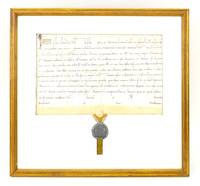
ST16379-036Rome 2 December 1210. 206 x 293 mm. 8 1/8 x 11 1/2". 12 lines in a papal documentary script. <br/> Attractively framed. Lead bulla suspended on silk threads. Very light rubbing to ink in places one horizontal and three vertical creases each with a tiny hole where the folds meet lead seal showing a bit of wear around edges and to protuberances of the faces but these faults all quite minor and on the whole an excellent specimen.<br/> <br/> Beautifully preserved and with the original lead bulla still attached this document issued by one of the most powerful popes of the Middle Ages resolves a dispute between the monastery attached to the Lateran Palace and the priory of Santi Quattro Coronati Four Holy Martyrs. The two groups seem to have been in conflict over their respective parish boundaries and the inclusion or exclusion of certain churches and therefore the tithes and legal dues stemming from those churches within their particular networks of influence. According to this bull the cardinal priest of Sts. Peter and Paul was charged with hearing their petitions; based on his report Pope Innocent III decrees that the boundaries of the priory's parish will extend to the church of St. Nicholas "de formis" on one side and the arch of John the Baptist "intra formis" on the other side with "de formis" and "intra formis" possibly referring to their relative position to certain aqueducts in the city. The document also notes that it does not alter parish boundaries as formerly defined by Pope Calixtus II r. 1119-24. The present item falls into a category of papal documents known as "litterae solemnes" comprising solemn letters and simple privileges. Though somewhat shorter and less formal than the so-called "Great Bulls" which were very large and included many marks and signatures for authentication "litterae solemnes" still followed strict rules in terms of format and appearance and included a lead seal displaying the pope's name on one side and the visages of Sts. Peter and Paul on the other as here. For a full overview of papal bulls and their various formats see Clemens & Graham "Introduction to Manuscript Studies" pp. 230-36. Innocent III born Lotario dei Conti di Segni 1160 or 1161-1216 was considered the most powerful person in Europe during his reign 1198-1216 having done much to consolidate the power of the Holy See and exert influence over the affairs of nations near and far. Notably he proclaimed the supremacy of the church over secular authority launched the Fourth Crusade which ended in the sacking of Constantinople presided over the Fourth Lateran Council excommunicated King John of England and nullified the Magna Carta and vigorously suppressed heretical sects such as the Cathars. Papal bulls issued by Innocent III seem to be of the utmost rarity on the market; we could find just one other example recorded by ABPC and RBH as sold in the past 100 years going for a hammer price of €9000 $10999 in 2013. unknown
1536ST20557Italy Florence completed in 1536. 155 x 96 mm. 6 1/8 x 3 3/4". Single column 17 lines in a rounded gothic hand. 225 leaves first leaf and last three leaves blank. One signature bound upside-down the calendar bound at end but COMPLETE. With modern foliation in pencil i 225 leaves f. 222 omitted in numbering. <br/> Attractive 19th century red straight-grain morocco covers with lacy gilt border raised bands compartments with floral a scrolling tools with small stars and bezants green morocco label with gilt lettering gilt floral turn-ins all edges gilt and gauffered. In a fine modern pebble-grained red morocco folding box by A. Lobstein gilt lettering on spine lined with velvet. Rubrics in red numerous one-line initials and paragraph marks in red or blue many two-line gilt initials on ground of two colors red blue green or purple with small gold embellishments three-line "KL" initials for each calendar month in gilt TWO LARGE HISTORIATED INITIALS the first measuring approximately 11 lines 65 mm. and featuring King David in prayer the initial painted blue and embellished with green and pink acanthus on gold ground surrounded on two sides by bars of gilt lettering on blue and pink ground inner margin decorated with colorful floral motifs decorated with gilt bezants the second initial measuring six lines 35 mm. and featuring the Holy Trinity the initial painted pink with colorful acanthus on gilt ground and with a similar floral border in the outer margin and extending over the initial along the top. See: Alexander "The Painted Page" nos. 1 3 & 4; and Salmi "Italian Miniatures" frontispiece and pp. 52-53. Text rather faded in places though sense always recoverable isolated insignificant rubbing or chipping to the gilt a handful of trivial stains and instances of soiling or foxing but a nevertheless lovely manuscript--very clean and fresh with wide margins and the historiated initials especially well preserved. Just the slightest signs of use to the lustrous binding.<br/> <br/> This is a fine example of Florentine manuscript production from the early 16th century with a beautiful rounded gothic script sparkling initials and historiation that suggests a link to some of the most important miniaturists of the period. The decoration is composed of rich jewel tones and includes a half-page initial opening "Beatus vir" depicting King David in prayer and a smaller "D" opening Psalm 109 "Dixit Dominus Domino meo: a sede adextris meis" depicting the Holy Trinity. Each initial is embellished by a lovely partial border of floral motifs and many gilt bezants in a typical Florentine style. The large "Beatus vir" initial is particularly well done with excellent molding and shading and careful attention to even the smallest hair on David's beard. Into a relatively small space the artist manages to fit an entire outdoor scene complete with foreground middle ground and background including rolling hills a river and a distinctive rock formation that adds dimension scale and a sense of realism to the painting. Although whoever had the box made for this work attributed the manuscript to Giovanni Boccardi known as Boccardino il Vecchio 1460-1529 the figures and border decoration are stylistically closer to the work of two other contemporary workshops: that of Attavante degli Attavanti 1452-1525 and brothers Gherardo 1445-97 and Monte 1448-1532 di Giovanni del Fora. Of Attavante Salmi notes that he was "At one time the most celebrated miniaturist of the Renaissance" and Alexander says that he "was one of the most successful entrepreneurs in the Florentine book trade in obtaining commissions from patrons outside Florence." He counted European royalty among his patrons and executed celebrated manuscripts for Mattias Corvinus King of Hungary and Manuel I King of Portugal as well as high ranking members of the church including Pope Leo X. Among the many hands employed by Attavante were those of Gherardo and Monte di Giovanni del Fora which explains the closely related styles of the two workshops. Salmi notes that "As expert miniaturists Gherardo and Monte composed magnificent interiors evoking historical events and landscapes of great depth and drama abounding in descriptive details and precious minutiae worthy of the Books of Hours of Flemish and French Masters." In addition to stylistic similarities we have been able to find two other examples of miniatures with compositions that are very close to the "Beatus vir" initial in the present work both of which are attributed to Gherardo and Monte Giovanni del Fora or their workshop. These are: an "S" initial in a Choirbook at the Museo dell'Opera di S. Maria del Fiore we found a black & white reproduction only; and a full-page miniature in the Biblioteca Medicea Laurenziana MS Plut. 15.17. Like our opening initial these miniatures both depict King David kneeling in prayer dressed in similarly draped and shaped garments in the miniature with color reproductions available the garments are identically colored red and blue with an unusual lobed harp on the ground and a rocky outcropping in the background. Most notably in the latter miniature as well as our initial this rock formation includes a natural archway that has formed over a river. If we are to believe the final rubricated lines indicating that the manuscript was completed on 25 October 1536 then the historiated initials were probably painted by an artist who was at the very least quite familiar with the work of the aforementioned miniaturists if not directly employed by one of their workshops. The most likely workshop would be that of Monte Giovanni del Fora who died in 1532--four years before this work was supposedly completed. It is perhaps even conceivable that the production of the Psalter took long enough that the initials might have been executed during Monte's lifetime. It is unfortunate that three lines in the colophon have been erased as they may have provided additional information about the making of this manuscript. Whatever the case may be this is a lovely object with tasteful decoration that clearly echoes the work of some of Florence's finest workshops. Italian prayer books such as this are increasingly difficult to come by and the present item being complete and in excellent condition would be a fine addition to any private or institutional collection. unknown
ST17766Probably Germany third quarter of ninth century. 285 x 245 mm. 11 1/4 x 9 3/4". Single column 25 lines in a Caroline minuscule book hand. <br/> Tipped into a paper folder and presented in a tan cloth binding with ink notation on spine and a small sticker on upper cover. Rubrics in red. Front pastedown of folder with the bookplate of the Schøyen collection. With several pages of typed and handwritten notes including Bernard Rosenthal's cataloguing and a copy of a letter from Bernhard Bischoff to Rosenthal concerning the dating of the leaf. ◆Recovered from a binding and thus with some expected browning staining and wrinkling a long vertical fold through the text touching a couple letters of each line recto with the first few words of each line roughened and somewhat obscured a couple of other words a bit hard to make out but the vast majority of text very legible with fore and tail margins very ample and in all quite a good specimen representing a remarkable survival.<br/> <br/> Featuring a lovely Caroline miniscule hand this very early leaf from a Lectionary may have been made for the use of a particular church or individual and comes with recent distinguished scholarship and provenance. Although the text here contains familiar passages from the Old and New Testaments their juxtaposition in this context presents a bit of a conundrum: as the enclosed cataloguing explains the story of the wicked husbandmen from Matthew followed by the story of Esau surrendering his birthright to Jacob from Genesis "is an irregular and indeed unrecorded liturgical sequence of texts and suggests that this particular collection of lections was compiled for a particular church or private chapel." It is also possible that the Lectionary was made for the use of an individual rather than an institution with certain needs or preferences—perhaps a scholar or theologian or even a Carolingian nobleman many of whom were literate and educated. The hand here is an excellent example of the legible and elegant Caroline minuscule that dominated Western Europe in this period; distinctive letter forms include clubbed ascenders such as on the letters "b" "d" and "l" a long "s" with the shaft on the line and the use of the ampersand as a general abbreviation for the letters "et" occurring anywhere in a word for example "conter&" for "conteret". Termed the "integrated ampersand" this usage is especially characteristic of Caroline minuscule manuscripts of the late eighth and ninth centuries. Our leaf comes with bookseller Bernard M. Rosenthal's catalogue description noting that it was "Purchased from Schab New York Feb. 1969." William H. Schab was a book and art dealer in the firm of Gilhofer and & Ranschburg in Vienna before fleeing Austria in 1938 and settling in New York where he founded his own business. Also included here is a copy of a handwritten note regarding the date of the present leaf from renowned paleographer Bernard Bischoff. The leaf was also featured in Quaritch's 1991 catalogue 1147 Bookhands of the Middle Ages V no. 25.5 and was until recently part of the Schøyen Collection their MS 623. Four additional pages of cataloguing are also included here. Despite having been used as binding scrap at some point in its life this leaf is very well preserved with no words lost from trimming with distinctly visible ink and in a clear and very pleasing hand. unknown
ST17767BEGermany second quarter of ninth century. Each leaf approximately 305 x 205 mm 12 x 8". Single column 29-30 lines in a large and extremely legible Caroline minuscule. <br/> Rubrics in red each leaf with one or more large initials in red. Text with a few contemporary corrections and erasures. Accompanied by a copy of a letter from Bernhard Bischoff dating the manuscript leaves. ◆Vellum a little toned and soiled one leaf with an old repair to the bottom third of the outer margin minor folds small stains and other trivial imperfections but IN EXTREMELY FINE CONDITION the lettering clear and legible the vellum in excellent shape and the margins surprisingly comfortable.<br/> <br/> These are nothing short of magnificent specimens and remarkable survivals with wide borders all around with entirely clear and distinct script with only minimal overall dust soiling and with strength and freshness to the vellum; the leaves present a powerful redolence of a time as far in the past as one could optimistically hope to encounter among Western manuscript artifacts in the marketplace. The script here is an outstanding example of the highly legible Caroline minuscule that dominated Europe in the ninth century characterized by clear letter forms ample spacing between letters and between lines and very few abbreviations the most common occurrence being "&" for "et" occurring anywhere in a word. The parent manuscript was almost certainly a Homiliary containing sermons by various Christian authors to be said throughout the year with the present leaves containing passages from part of Leo I Sermo XCV and parts of a tractatus on Luke by Ambrose as well as other lections readings for the Vigil of the Feast of St Peter and the Feast of the Octave of Pentecost and the opening of a sermon of Leo I for Feria IV mensis IV; four other sister leaves are known and contain additional passages from Leo I and Ambrose as well as Pope Gregory I and readings for various feast days. The presence of these texts suggest that the leaves might have come from a Homiliary originally composed by Paul the Deacon at the behest of Charlemagne a version that was widely circulated throughout the Carolingian Empire in the eighth and ninth centuries. Although the scriptorium in which these leaves were produced has yet to be determined we can say with confidence that they date to the second quarter of the ninth century due to the style of the script as stated in the accompanying letter by esteemed paleographer Bernard Bischoff. Much of their history over the last 12 centuries remains a mystery but we do know that three of the extant leaves were in the possession of dealer Bruce Ferrini by 1989 with his stock number beginning "VM" and two bear the stock numbers and price codes of Quaritch. All were acquired by Martin Schøyen and became part of the renowned Schøyen collection MS 587. Very early leaves such as these often survive only because they come from manuscripts that were dismembered with the leaves then being reused as binding scrap; when later recovered they are typically in lamentable condition. The present leaves by contrast met no such fate--they have always been intact and untouched by the binder and so show none of the staining and trimming that are almost always present with repurposed leaves from demolished manuscripts. This notably fine state of preservation is rarely seen on the market. As a consequence these specimens are not only among the earliest leaves we have ever offered for sale but also some of the most extraordinary survivals we have ever acquired. We have bought and sold only a handful of ninth century leaves in our 45 years in business; in the present case because we were extremely lucky to acquire a small collection of six leaves from a single source we are able to offer them here at an advantageous price point. unknown
THE ONLY COPY PRINTED ON VELLUM OF ANY BOOK ISSUED BY POULET-MALASSIS. In this monograph, Langlois (1829-1869), a leading Orientalist of his time (despite his short life), ingeniously uses archeological, historical, and scriptural evidence to prove the true location of Jesus' tomb. 48 pp. PRINTED ENTIRELY ON FINE VELLUM BY JOUAUST, ONE OF THE GREAT PRINTERS OF THE SECOND HALF OF THE 19TH CENTURY. to. Attractively bound in contemporary quarter morocco and decorated boards. Spine in five compartments with fleurons and raised bands. Tiny traces of wear to binding, else FINE AND BRIGHT. Launay 152; Contades, p. 39; OberlÈ 594 (this copy: "PrÈcieux exemplaire imprimÈ sur peau de vÈlin. Il est probablement unique. C'est le seul volume publiÈ par notre Èditeur qui ait ÈtÈ tirÈ sur peau de vÈlin.") Copies of this book on paper are very rare; this unique copy on vellum is A PIECE OF PUBLISHING HISTORY. Provenance: Jean-Jacques Launay, the comprehensive bibliographer of Poulet-Malassis, acquired this book after compiling his bibliography, and thus while he cites the book in his bibliography, he does not describe it (obviously because he was unable to locate any copy at all.) From him it passed to Gerard OberlÈ.
1925ST16974Flensburg ca. 1925. 325 x 240 mm. 12 7/8 x 9 1/2". 4 p.l. first two blank 4 leaves 144 pp. 4 leaves last blank. Single column 31 lines in a fine calligraphic hand. <br/> FLAMBOYANT DEEP RED MOROCCO ELABORATELY INLAID AND GILT BY W. A. PETERSEN stamp-signed on rear turn-in covers framed by inlaid white morocco strip tooled with gilt triangles enclosing sides in a bead-and-lozenge pattern of gilt-outlined mandorlas containing a red cross on a blue background alternating with an inlaid white lozenge upper cover with brass and enamel cornerpieces featuring the symbols of the four Evangelists each of these set with a colored glass gem central panel divided into four compartments each containing a small star tool central brass and enamel medallion with a six-pointed star emblazoned with a sun and a red enamel "Y" two straps with brass and enamel clasps marked with Alpha and Omega lower cover with brass cornerpieces raised bands spine with gilt-ruled compartments turn-ins tooled with plain and dotted gilt rules and gilt stars deep pink moiré silk doublures shot with gold thread all edges gilt. In a box with a velvet-lined maroon buckram base and green marbled paper lid. With many initials of various sizes painted blue red green purple maroon or gilt three three-line initials in gold on a colored ground with the shape of a cross one two-line initial and 13 four- to six-line initials in gold on a multi-colored ground in a geometric design SEVEN HISTORIATED INITIALS each measuring seven to 11 lines in length FIVE MINIATURES MEASURING A THIRD TO THREE-QUARTERS OF THE PAGE each featuring a scene from the life of the Virgin or the life of Christ SIX FULL-PAGE ILLUMINATIONS incorporating text of different sizes and fonts many colors and patterns five of which contain a large central gilt circle the first of these completely filled with gold the others with a religious symbol in pen on bare vellum every page with a unique border composed of a thin frame with different geometric designs in gold and color some pages with an additional column of floral and foliate designs running down the left side of the text within the border plus additional flourishes elsewhere. Text in multiple sizes and fonts occasional words or phrases penned in color or gold. Boards somewhat bowed as often with bindings on vellum works occasional naturally occurring variations in the grain of the vellum a few instances of faint thumb smudging in corners but A BEAUTIFUL MANUSCRIPT IN ESPECIALLY FINE CONDITION the vellum smooth and fresh the illuminations shimmering and the binding unworn.<br/> <br/> Replete with gold illumination and bright colors evoking the appearance of Medieval manuscripts and stained glass this is an exquisitely produced work relating the life and words of Christ divided into five thematic parts: Light Word Spirit Death and Resurrection. Each part opens with a sumptuous full-page illumination reminiscent of the "carpet page" painting found in early Insular manuscripts; in the present work our artist fills the frame with a dazzling mixture of text and decorative patterns around a lustrous gilt medallion calling to mind the sun a resplendent halo or the Host. Although much of the decoration both on these full-page illuminations and elsewhere in this work remind one of Medieval manuscripts and are often composed of geometric designs and colors suggestive of stained glass the overall style here is decidedly modern. The palette is fresh and bold while the emphasis on strong lines and patterns shows the influence of the reigning Art Deco movement with echoes of the Art Nouveau movement that preceded it. Traditional biblical narratives in the form of historiated initials and miniatures are also presented here in refreshing ways: the image of the Sermon on the Mount for example places the viewer directly among the masses; we experience the event as a member of the audience would looking over the shoulders of the people in front of us to see Christ orating from a small hill silhouetted against a bright pink sky. Another memorable image--and the largest figural composition in this manuscript--is the Crucifixion. Though he has used a fairly standard composition the artist plays with our perception of space by setting the scene on a dark blue ground that envelopes the figures in a shadowy void; the only light source seems to come from the gold lettering immediately above the cross radiating off the face of Christ and to a lesser degree off the grief-stricken faces of John the Evangelist and the Virgin. All are pictured without haloes thus emphasizing the humanity of Christ over his divinity. As a whole this manuscript is extremely impressive in terms of artistry and technical execution and the prolific decoration and calligraphic variety hold the viewer's interest page after page. The equally impressive binding--modelled after the look of a Medieval Gospel book complete with enamel-like bosses and jewels--is fitting for a work that pays homage to the past while celebrating contemporary art and style. The life and work of calligrapher and illuminator Johann Holtz 1875-1944 is poorly documented but he seems to have been active in Flensberg Germany; he also worked as a graphic artist. Binder W. A. Petersen has proven equally illusive but we know that his workshop was also located in Flensburg. Given the town's close proximity to Denmark we might speculate whether Petersen was somehow related to the Copenhagen-based binder Immanuel Petersen who took over from master binder D. L. Clément in 1877. Despite the lack of biographical information on our artist and binder the work here needs no provenance information to be pleasing in every way from the gleaming binding to the beautifully preserved and magnificently illuminated contents. unknown
1440ST19540aMetz ca. 1440. Leaf: 162 x 124 mm. 6 3/8 x 4 7/8". Frame: 308 x 258 mm. 12 1/8 x 10 1/8". Single column three lines of text under the miniature obverse with 18 ruled lines five of which contain text in a gothic book hand. <br/> Attractively matted and framed. Recto with one three-line initial in gold on pink and blue ground WITH A LARGE MINIATURE OF THE CRUCIFIXION WASHED IN BLUE Christ on a painted gold cross flanked by two thieves on painted gold crosses surrounded by throngs of people including the Virgin St. John Mary Magdalene and numerous soldiers all in an arched gold frame inside a three-sided painted and gilt baguette and a FULL BORDER of colorful vine sprays and flowers inhabited by a peacock. See: "The Jeanne Miles Blacburn Collection of Manuscript Illuminations" nos. 29-38; Avril & Reynaud pp. 182 & 190. Minor soiling/browning right at inner edge away from border and image otherwise IN VERY FINE CONDITION THE MINIATURE REMARKABLY WELL PRESERVED WITHOUT ANY LOSS OF PAINT.<br/> <br/> This stunning miniature with its memorable nocturnal scene comes from a very fine Book of Hours probably executed by Henri d'Orquevaulz or d'Orquevaulx or a member of his workshop. D'Oquevaulz was active during the second quarter of the 15th century in Metz the cultural and commercial capital of Lorraine during the period and the center of a growing book trade. According to the catalogue of the Jeanne Miles Blackburn Collection in the Cleveland Museum of Art which owns 10 leaves from the original manuscript the parent Book of Hours can be localized based on the Lorraine dialect found in the French text on some of the leaves including the present example and because the calendar singled out two bishop-saints of Metz Clement and Arnoul. Although little is known about d'Orquevaulz his dated signature in the colophon of a Livy manuscript that he illuminated for an alderman of Metz indicates that he was active in that city in 1440. Artistic affinities with northern European styles make it possible that d'Orquevaulz had emigrated from the Netherlands or Germany to Lorraine; another possibility one that Avril and Renaud suggest is that the master himself was from Metz but that he had German associates perhaps from the Rhineland area. According to these two scholars the painter's use of large flat areas of colors is more typical of the Rhineland the Netherlands or Bohemia than of France; in any case they praise his "exquisite color harmonies." The artist has outdone himself in the present miniature rising to the height of pathos and making it one of the most extraordinary leaves we have ever offered for sale. In contrast to the bright colors used in Books of Hours even to depict the most serious scenes the present leaf presents a remarkable visual nocturne with the figures and buildings painted in the same shades of blue as the sky suggesting that heaven itself is darkening at the death of Christ. Mary Magdalen kneels at the foot of the cross while St. John supports the devastated Virgin as a soldier pierces the Savior's side with a lance. The miniature is crowded with figures we see well-defined faces of no fewer than 18 persons and two horses but the artist has not lost his dramatic focus as Christ on his cross of brushed gold dominates the scene. In choosing to make this a darkened composition the artist has risked obscuring detail but his skill has been equal to his concept here as he has used a diluted blue paint that allows for a very successful delineation in various shades almost like grisaille this technique not incidentally has prevented the cracking and erosion so commonly seen with the normal thick applications of typical cobalt blue. The result of the decision to show the world in eclipse at Christ's death is to heighten and universalize the drama here to such an extent that the scene leaves a powerful and lasting impression. The text on this leaf is entirely in French in rhyming verse. Roughly it translates as: "Jesus on the cross did hang / And took upon himself our sins / Gave to humankind redemption / Rendered up his soul to God. / The sunshine lost its glowing light / The earth did tremble and did crack / Grieving for the bitter death / Suffered by the son of God." Although the original Book of Hours was dismembered some time in the 20th century extant leaves suggest that its visual program was much bigger than usual and probably the result of an important commission by a wealthy patron--something likely to be painted by one of the chief artists in the workshop. Illuminated manuscripts from Metz--let alone examples of this quality--are uncommonly seen on the market. unknown
1982ST16482Bayreuth: Printed by Chr. Scheufele Offizin Stuttgart for Bear Press 1982. No. 1 OF 10 COPIES ON VELLUM plus a "special" edition of 25 copies and 185 copies on Kochi Japanese paper. 223 x 148 mm. 8 7/8 x 5 3/4". 50 pp. 2 leaves.Translated and with an afterword by Wolfram Benda. <br/> Publisher's fine burgundy morocco by Erwin Lehr upper cover with gilt rose in recessed square flat spine with gilt titling turn-ins with gilt fillet frame pale yellow silk pastedowns. In the original burgundy suede slipcase. With three large initials in burnished gold and four signed and numbered original etchings by Peter Klitsch. Printed in red and black. Signed in the colophon by the artist the binder and the publisher/translator. In mint condition.<br/> <br/> This is the splendid deluxe version of a finely crafted private press edition of Wilde's fairy tales "The Nightingale and the Rose" "The Happy Prince" and "The Selfish Giant." It is the third work issued by the Bear Press founded in 1979 by literary scholar Wolfram Benda and still in operation. According to the firm's website "at a time when the craftsmanship and ethos of the artisan in bookmaking have been damaged by ever-increasing industrialization and neglect . . . The Bear Press . . . tries to achieve the highest possible degree of technical and artistic perfection in its printed works." The font used to print the text and the artist chosen to illustrate each work are carefully selected to express "the individual author's personality and intention." Even the discriminating aesthete Wilde 1854-1900 would be pleased with the choices here especially for the luxurious vellum printing: the type is set in refined Walbaum Antiqua and shown off with special effect by the creamy leaves; the etchings by Austrian artist Peter Klitsch b. 1934 are meticulous detailed and reminiscent of the work of Wilde's friend Aubrey Beardsley; and the binding is the epitome of tasteful restraint flawlessly executed with premium materials. <br /> <br /> The three tales here first appeared in 1888 and are bittersweet in their themes of love and self-sacrifice. His stories for children were one of Wilde's early successes and DNB notes "Their permanent place in child affections refutes the vulgarism that Wilde's literary reputation arose from his legal notoriety. In all cases the fairy tales are on the child's side celebrating the courage and generosity of the poor and vulnerable while their satire mocks the kind of pomposity and hypocrisy children can recognize." We have been able to trace just two other copies of the vellum printing at auction in ABPC and RBH. [Printed by Chr. Scheufele Offizin, Stuttgart, for] Bear Press unknown
1902ST20771New Rochelle: Printed by the University Press for George D. Sproul 1902. No. 23 OF 30 COPIES 18 for America 12 for Europe; this copy illuminated for Herman A. Metz of the "St. Dunstan Edition" all of them PRINTED ON VELLUM. 270 x 210 mm. 10 5/8 x 8 3/8". 50 leaves last blank. <br/> SUMPTUOUS COBALT BLUE MOROCCO GILT AND INLAID TO AN ARABESQUE DESIGN BY TRAUTZ-BAUZONNET stamp-signed on front doublure covers framed in gilt and inlaid brown morocco blossoms central panel of azure blue morocco outlined in brown morocco large central medallion enclosed in brown morocco and inlaid with an eight-pointed inlaid and gilt fleuron each corner with tan and ivory morocco medallion with gilt "T" at center outlined in brown morocco the spaces between the medallions with curling gilt flourishes raised bands spine compartments with gilt lettering framed by sprays of gilt berries SKY BLUE MOROCCO DOUBLURES inlaid with darker blue squares containing an ivory morocco polygon these forming a frame around a central taupe morocco panel with inlaid blue morocco flowers at corners vellum free endleaves painted with a simple blue frame small flowers at each corner all edges gilt. BEAUTIFULLY ILLUMINATED BY ROSS TURNER the title page and final page with heraldic emblems and WITH 51 LOVELY INITIALS in a range of hues 22 with delicate extensions. Printed entirely in majuscules on rectos only. A couple of small faint water spots to upper board with slight dulling where someone tried to fix these naturally occurring variations in the grain and color of the vellum otherwise A FINE COPY--the vellum creamy and smooth the colors and gilt bright and the binding lustrous.<br/> <br/> A bookmaking tour-de-force this item is part of the remarkable St. Dunstan series of famous works of literature produced at the turn of the century in very strictly limited and particularly luxurious editions by publisher George Sproul. Named for the English bishop Dunstan 909-88 who was known for his skills as an illuminator the St. Dunstan volumes were printed on vellum illuminated by different artists and then put into bindings of striking design executed by Trautz-Bauzonnet one of the premier French binders of the period. While the physical properties of this volume announce themselves more emphatically than the text the narrative here is from Tennyson's "Idylls of the King" a work Day tells us in which the legend of King Arthur is used "to establish the Victorian virtues of marital faithfulness fair play gentlemanly conduct and useful action for self and society." "Guinevere" sets forth the consequences of marital infidelity presenting a penitent queen now withdrawn to a convent groveling for Arthur to pardon her affair with Lancelot. Although the injured king grants her forgiveness he does so with little grace appearing to modern readers as "insufferably self-righteous." Day Reminiscent of the designs used in 15th century illuminated books the painted initials in our volume are well executed and attractive combining fluid shapes and consonant combinations of colors and the binding is a singularly elaborate achievement. German-born binder Georges Trautz 1807-79 apprenticed in Heidelberg Stuttgart and Witemberg before arriving in Paris in 1803. There he trained in “dorure†with the skilled gilder Debès learning to create intricate gilt designs on bindings. In 1833 he was hired as a doreur by Bauzonnet the successor to the celebrated Purgold and soon achieved acclaim for his beautifully gilded bindings. According to Michon he was "the uncontested master of the luxury binding" in 19th century France celebrated for his "sumptuous moroccos" and "dazzling gilt." His bindings were so sought after that the term "Trautzolâtrie" was coined to describe the craze for his work. In 1869 he became the first bookbinder to be named a chevalier of the Legion of Honor. The culmination and termination of the St. Dunstan books was a planned edition of 15 sets of the complete works of Dickens projected to contain 130 large folio volumes—surely the most ambitious undertaking in the history of modern American fine printing. Five volumes only comprising most of "Pickwick" were produced before the grandeur of the project overwhelmed its sponsors. Potter says that in addition to the Dickens edition the St. Dunstan series comprised a dozen volumes of the works of various authors one of them the present Tennyson issued to subscribers at the spectacular amount of $12000 per set. One of the subscribers was our original owner New York chemical manufacturer and U.S. Congressman Herman A. Metz 1867-1934. Not surprisingly this strictly limited "Guinevere" is quite rare: We could trace just two copies at auction since 1975 one of them ours sold in 1998.  . [Printed by the University Press for] George D. Sproul unknown
1470ST17764Delft ca. 1470. Leaf: 175 x 122 mm. 6 7/8 x 4 3/4"; Frame: 250 x 195 mm. 9 3/4 x 7 3/4". No text on recto or verso. <br/> In an attractive wooden frame. A FINELY PAINTED MINIATURE OF THE HARROWING OF HELL within an arch-topped compartment the mouth of hell depicted on the left with a fiery red interior and five people emerging from it the figure of Christ on the left holding a cross on a long staff and half-clothed in a pink and blue robe the background with a castle in the distance ALL OF THIS BENEATH A VERY DETAILED ARCHITECTURAL CANOPY suspended in the sky AND THE WHOLE WITHIN A FULL BORDER of acanthus leaves and other foliage and flowers in reds blues greens yellows and brushed gold along with very many small burnished gold ivy leaves and buds on hairline stems a small stork in the bottom border and a large delicately shaded angel in the left border. ◆Left margin trimmed very close to decoration just escaping loss and the other three margins ample mild darkening right at fore and tail edge but not reaching into borders otherwise IN FINE CONDITION the colors rich and true and the burnished gold still shimmering.<br/> <br/> This extraordinary miniature notable for its uncommon subject matter memorable imagery and fine workmanship was produced by a talented artist belonging to the stylistic group known as the Masters of the Delft Half-Length Figures. The subject here is infrequently depicted in Books of Hours: the Harrowing of Hell appears as a full-page miniature in only three of the 119 prayer books described by Roger Wieck in his "Time Sanctified" and three others contain a Harrowing depiction inside an initial. Christian theological tradition tells us that after his crucifixion Christ went to liberate souls from Limbo--a location inhabited by those barred from entry into Heaven because they died before the Redemption. In our scene Christ wrapped in a regal cloak and carrying a long staff his hands and feet still bleeding from the wounds he received on the Cross reaches into an absolutely wonderful Hellmouth to extricate Adam and Eve and other naked souls while the recently deceased and original saint John the Baptist still clad in an animal skin garment waits patiently for his turn to emerge. The great maw of Hell as depicted here has bulging eyes a distended snout thickly matted hair and a bad complexion; his gaping mouth punctuated by sharp gray teeth glows red hot and one can tell from the creature's expression that he is loath to comply with this rescue of souls. In addition to its compelling subject matter there is a high level of artistic achievement here including delicately molded figures impressively detailed architectural elements and a lovely color palette. The elegance and quiet sophistication observed in this miniature distinguishes the artist responsible for this work as a particularly talented member of his circle. Active from about 1450-80 the Masters of the Delft Half-Length Figures were named by James Marrow after the angels and other figures whose upper bodies are typically found emerging from a cloud within the borders. Although the present leaf uncharacteristically contains a full-length angel in the border it shares other stylistic similarities such as the elaborate architectural canopy hovering over the main composition; and it particularly resembles the work of the artist of Keble College MS 77 an illuminator described in "The Golden Age of Dutch Manuscript Illumination" as "one of the more articulate of the group" whose "figures are more fully modelled and his palette . . . deeper and brighter" than that of his contemporaries. Because the subject of the present miniature goes beyond the standard image program seen in routine productions and because of the high level of artistic accomplishment seen here this leaf was almost certainly part of an elaborate Book of Hours produced in response to an important commission. unknown
1415ST17763Paris ca. 1415-20. Leaf: 160 x 110 mm. 6 1/4 x 3/8"; Frame: 232 x 185 mm. 9 1/8 x 7 1/4". Recto with three lines single column in a gothic book hand verso not inspected due to frame. <br/> Mounted in a wooden frame. Recto with a three-line initial in blue on gold ground embellished with ivy leaves A HALF-PAGE MINIATURE DEPICTING THE MASS OF ST. GREGORY the recently crucified Christ depicted emerging from a tomb supported by an angel and surrounded by the Arma Christi St. Gregory kneeling at the corner of the image the text and miniature framed by thick bar borders of pink blue and gold on three sides all SURROUNDED BY A FULL BORDER of hairline vines gilt ivy leaves and bezants and a few colorful flowers and acanthus. A little faint smudging in top and bottom borders very small scarcely noticeable area of blue background retouched not affecting the figures but A BEAUTIFUL LEAF the colors bright and the detail in the miniature very well preserved.<br/> <br/> Featuring carefully realized detail intriguing iconography and artistry that shows a very high degree of skill this is an important and early example of the work of the Master of the Harvard Hannibal. The subject of the present work is a well-known story about the sixth century Pope Gregory ca. 540-604 commonly known as St. Gregory the Great. According to legend Gregory was saying Mass when one of his deacons expressed a doubt in the doctrine of Transubstantiation whereby the communion bread actually becomes the body of Christ. Gregory prayed to God for a verifying sign whereupon Christ appeared in the guise of the Man of Sorrows clad in a loincloth and displaying the bloody wounds he incurred during the Crucifixion. Most Medieval miniatures depict Gregory kneeling before an altar as he says Mass accompanied by one or more deacons or assistants who bear witness to the miraculous event. In a notable departure from this norm the present miniature depicts the saint alone at the edge of the picture plane; in place of the chalice host and altar that would normally occupy the center of the scene is a considerable open tomb from which a larger-than-life-size Christ emerges. With blood still rushing from his wounds he places one hand on the edge of the tomb to steady himself while an angel supports him from behind. Christ's expression conveys both physical and mental pain as he struggles to support his own bodyweight; the angel who assists him spreads his wings protectively around the body of Christ while looking down at Gregory with a sorrowful expression knitted into his brow. The fine detail work seen in the figures' faces the angel's wings and the careful delineation of each slender finger is also carried over into more than a dozen objects crammed into the spaces in and around the tomb the rope is especially remarkable in the representation of its detail. Known as the "Arma Christi" or "Instruments of the Passion" these objects are meant to symbolize Christ's suffering. Seen here are: the cross nails and hammer that were used to crucify Christ the ladder used in the Deposition the disembodied hand symbolizing the one which slapped Christ's face the dice used by soldiers to see who would claim his seamless robe a lantern used by the soldiers who arrested Christ the 30 pieces of silver from Judas' betrayal a purple robe used in the mockery of Christ and other items that appear as part of the Passion narrative. It is also interesting to note that although a St. Gregory miniature usually appears at the beginning of the Hours of the Cross the Penitential Psalms or before the Seven Prayers of St. Gregory here rather unusually it opens a reading from John chapter 19 beginning "In illo tempore adprehendit Pilatus Iesum et flagellavit" describing the events of the Passion. This miniature can be attributed to an artist known as the Master of the Harvard Hannibal so-named for a splendid miniature painting of the "Coronation of Hannibal" prefacing a Livy in the Harvard College Library. Active from about 1415-30 in Paris and later possibly Rouen it is believed that our illuminator was a pupil of the Boucicaut Master with whom he is thought to have collaborated on several manuscripts both secular and religious. The present miniature would probably have been executed early in his career and while it certainly shows the influence of his teacher it also reveals certain stylistic tendencies that would become staples of the Master of the Harvard Hannibal's more mature work such as his preference for rich colors heavy molding of the faces and interest in decorative details. With its clever composition meticulous detail work and emotive figures that engage the viewer the present miniature is not only a beautiful work of art it also documents the precocious talent of an emerging master early in his professional career. unknown
1470ST17765Delft ca. 1470. Leaf: 172 x 115 mm. 6 3/4 x 4 1/2". Frame: 242 x 190 mm. 9 1/2 x 7 1/2". <br/> In an attractive wooden frame. A FINELY PAINTED MINIATURE OF THE NATIVITY within an arch-topped compartment the parents of the Christ Child kneeling before him as he lies on the ground outside the stable Joseph uncharacteristically supporting himself with a cane in his left hand and holding a long burning candle in his right two diminutive angels in attendance the head of an ass sticking out of the stable window in the background to the left AND IN THE RIGHT BACKGROUND A CHARMING DEPICTION OF THE ANNUNCIATION TO THE SHEPHERDS ALL OF THIS BENEATH A VERY DETAILED ARCHITECTURAL CANOPY suspended in the sky AND THE WHOLE WITHIN A FULL BORDER of acanthus leaves and other foliage and flowers in reds blues greens yellows and brushed gold along with very many small burnished gold ivy leaves and buds on hairline stems a small stag in the bottom border and a large delicately shaded angel who mirrors the Virgin's pose in the left border verso blank. ◆A hint of soiling to edges of vellum but IN VERY FINE CONDITION without any paint erosion with the colors rich and true and with the burnished gold still shimmering.<br/> <br/> Notable for its attractive color scheme fine craftsmanship and unusual composition this vibrant leaf was produced by a talented artist belonging to the stylistic group known as the Masters of the Delft Half-Length Figures. The lack of text and blank back of this leaf clearly suggest that it was produced as a singleton intended for insertion in a Book of Hours and its subject matter indicates that it would have faced the opening for the third hour of the day Prime. The present depiction of the Nativity is out of the ordinary in that it is combined with another scene the Annunciation to the Shepherds a subject that usually begins Terce in the Hours of the Virgin. It is a testament to the artist's ingenuity and compositional skills that he has managed to incorporate these two scenes so seamlessly; in fact rather than pulling focus from the main subject celebrating the birth of Christ this secondary scene adds additional interest to the picture and amplifies the storyline. Though the Annunciation to the Shepherds takes place at a distance from the Nativity we immediately grasp their connection and can see how arrival of humanity's savior was felt far beyond the manger. It is also interesting to note how much the artist has emphasized the figure of Joseph. Not only does he take up as much space as the Virgin but the candle and cane he holds frame the Christ child and communicate a strong suggestion of a protective parent the Virgin is doing her part by praying hard but she is more passive. In addition to its engaging subject matter there is a high level of artistic achievement here including delicately molded figures impressively detailed architectural elements and a lovely color palette. The elegant hand seen in this miniature manifests a quiet sophistication that distinguishes this artist as a particularly talented member of his circle. Active from about 1450-80 the Masters of the Delft Half-Length Figures were named by James Marrow after the angels and other figures whose upper bodies are typically found emerging from a cloud within the borders. Although the present leaf uncharacteristically contains a full-length angel in the border it shares other stylistic similarities such as the elaborate architectural canopy hovering over the main composition; and it particularly resembles the work of the artist of Keble College MS 77 an illuminator described in "The Golden Age of Dutch Manuscript Illumination" as "one of the more articulate of the group" whose "figures are more fully modelled and his palette . . . deeper and brighter" than that of his contemporaries. Because of the complexity of the subject matter and the high level of artistic accomplishment seen here this leaf was probably part of an elaborate Book of Hours produced in response to an important commission. unknown
181110857Paris, Didot l'aîné, 1811. In-folio de 48 feuillets et 35 planches hors-texte, demi-veau chamois à coins, dos à nerfs, coiffes, mors et coins frottés. Reliure moderne. Exemplaire non rogné. Quelques rousseurs aux feuillets initiaux et finaux. Voici la collation des 96 pages de texte: [8] pages soit 1ff. blanc, faux-titre, titre, 1 ff. de table des planches, 6p. pour le Tableau général du lac de Genève (dernière bl.), [8]p. pour la description des planches, 10p. pour le Tableau général du Valais (dernière bl.), [8]p. pour la description des planches, 4p. pour le Tableau général du Simplon, [34]p. pour la description des planches, 2p. pour le Tableau général du lac Majeur, [12]p. pour la description des planches, [2]p. pour 1 ff. blanc.
122866Naples: late 15th century. A cutting 173 mm x 182 mm with historiated initial 'E' doubtless the introit 'Ecce advenit. for Mass at Epiphany 147 mm x 152 mm. Slight spots of rubbing. In an elaborate gold frame. § The Virgin and Child seated on the right with Joseph behind set among green and yellow hills painted in full colors and liquid gold the initial itself in elaborate leafy design in dark red with pink and white heightening entwined with green leaves at the top and bottom set on a burnished gold ground with colored trefoils in each corner flecked blue surround traces of text and music to the right of the initial verso with parts of 2 lines each of text and of music on a 4-line red stave. Large miniature in the style of the Neapolitan illuminator Cristoforo Majorana documented in Naples from 1480 until 1492 cf. F. Avril Dix siecles d'enluminure italienne 1984 pp. 176-7 no. 156. The standing kinds are painted with splendid robes fringed with pearls. The blue flecked border giving the effect of the whole initial hovering above the vellum derived from the classicising illumination of Mantua and Padua and became a feature of Neapolitan manuscripts of the late fifteenth century. late 15th century. A cutting hardcover books
THE ONLY COPY PRINTED ON VELLUM OF THIS IMPORTANT AND BEAUTIFUL PUBLICATION. Two volumes, complete. FIRST AND ONLY COMPLETE EDITION, and first and only critical edition of the works of Pierre de Brach, an important 16th-century poet from Bordeaux, a close friend of Montaigne and many other key French Renaissance literary figures. ABOUT HALF THE WORKS ARE PUBLISHED HERE FOR THE FIRST TIME: Dezeimeris had discovered an important manuscript which included many texts thought lost forever, including the "Tombeau et regrets funebres sur la mort d'Aymee" and the second book of the "Amours". Extensive scholarly apparatus, notes, and index. Edition limited to 260 copies, of which this is THE UNIQUE COPY beautifully printed (by Gounouilhou of Bordeaux) on FINE VELLUM, with numerous woodcut ornaments, headpieces, and tailpieces. Title-pages printed in red and black, with large woodcut printer's device. Text in Italic type, notes in Roman type. Two engraved portraits on chine applique and two wood-engraved plates. 4to. Attractively bound in contemporary half red morocco. Top edge gilt, other edges uncut. Minimal traces of wear to bindings, else a fine set. Vicaire I, 919 (citing this copy); Brunet supp. I, 167 (citing this copy): "Belle publication." Viollet le Duc (I, 333): "C'etait un ecrivain correct, un versificateur elegant et harmonieux, bien superieur sous ce rapport a tous les poetes ses contemporains. On peut lui reprocher de manquer de la verve et de l'entrainement de Ronsard, par exemple; mais comme forme de langage, c'est un auteur des plus remarquables et assurement digne d'Ítre etudiÈ." 19th century French books printed on vellum are rare, and in such a large format they are extremely rare.