1 337 résultats
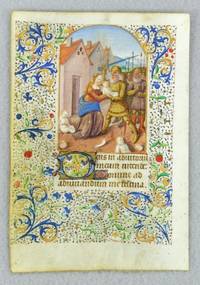
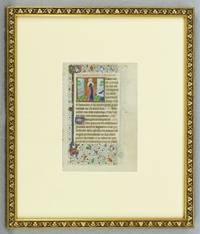
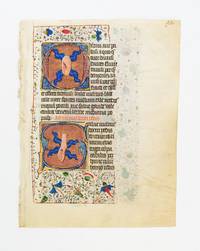
1465ST17243bBruges ca. 1465. 193 x 145 mm. 7 5/8 x 5 3/4". Single column 21 lines in a gothic book hand. <br/> Rubrics in red one two-line initial in gold filled with blue on pink ground WITH THREE LARGE HISTORIATED INITIALS: ONE FEATURING AN OVAL-SHAPED PIECE OF FLESH WITH A GASH IN THE CENTER AND TWO WITH CHRIST'S DISEMBODIED FOOT SHOWING THE PUNCTURE WOUND FROM THE CRUCIFIXION each initial in pink or blue with white tracery filled with dark pink and thin gilt lines and dots four wavy blue rays radiating from behind each appendage all within a thin gilt frame both sides with a three-quarter border consisting of hairline vines gold bezants and a few colorful flowers. ◆Vellum a shade less than bright faint marginal rumpling trivial paint transfer on one initial BUT IN FINE CONDITION the initials richly painted and extremely well preserved.<br/> <br/> From a manuscript probably produced in Bruges for the English market this leaf contains arresting initials that direct the viewer's attention to the wounds endured by Christ during the Passion. According to Roger Wieck Passion Cycle images enjoyed a particular vogue in 15th century Dutch Flemish and English Books of Hours including those that were exported to England. In the present example the strikingly unusual imagery includes the wounds of the left and right foot as well as the spear injury to Christ's side depicted as an oval piece of flesh with a laceration across the center. A sister leaf to the present item features three additional initials showing a portrait of Christ wearing the Crown of Thorns his gaze fixed directly at the viewer and in separate initials his left and right hands appear disembodied and displaying the stigmata. The parent manuscript containing the present leaf sold at Christie's on 15 November 2006 lot 16 the description for which gives us additional information about the book's contents and provenance: it was made for the Use of Sarum included a calendar with the English saint Thomas Becket and Popes Gregory and Silvester with their names crossed out indicating that it was in England through at least the time of the Reformation and contained an early ownership inscription of a woman named Bridget Lowe with a Middle English inscription on the pastedown. Christie's also attributed the parent manuscript to the workshop of William Vrelant with miniatures possibly by his chief assistant the Master of the "Vraie Cronique Descoce." They note that this work is "of higher quality than many of the works that satisfied the English demand for Netherlandish illumination" and that it "demonstrates why Vrelant appealed to the great bibliophiles of the Burgundian Netherlands." Vrelant was the leading purveyor of books of private devotion in Bruges during the third quarter of the 15th century and his prominent position among Flemish illuminators of the time is indicated by the considerable number of manuscripts illustrated in his manner by other miniaturists both in Bruges and in nearby cities in Flanders. Similar examples to the present leaf can be found in intact Books of Hours at the Philadelphia Free Library MS Widener 3 and the Huntington HM 1086--both of which were produced in Flanders or the Netherlands around the same time as the present work. The present leaf surpasses both of these examples in terms of excellence of the artistic hand and attention to detail. unknown
105904Rhineland or possibly Flanders or England: c. 1260-1280. Single leaf 177 x 131mm. 20 lines of text in gothic script. 4-line historiated initial of a knight in armor 4 initials in gold gold highlighting in text. Small drawing of a dragon in red ink drawing of a bird in left margin partly trimmed away. In very good condition. § A very fine and early leaf of interest in that other leaves from this manuscript are known which variously originate from either the Rhineland or England. Elaborate description on back probably English dealer provenance. Private collection California. c. 1260-1280. Single leaf unknown books
1704(LCPCECO-0004)(Un précieux manuscrit calligraphié sur vélin, sans doute destiné à un membre très éminent de la Chancellerie Royale de Louis XIV) "TARIF DES DROITS DU SCEAU, TANT DE 1672, 1674, 1691, QUE DE L'AUGMENTATION DE 1704, QUE LE ROY DE L'ADVIS DE MONSIEUR LE CHANCELIER VEUT ESTRE LEVEZ A L'AVENIR SUR LES LETTRES ET EXPEDITIONS QUI SERONT SCELLEES EN LA GRANDE CHANCELLERIE...". s.d. (vers 1704) 4 parties en 1 volume in-12° (175x125 mm) (dimensions pages 169x114 mm) (7) ff. b. de papier, (1) f. b. de vélin, (48) ff. de vélin, (1) f. b. de vélin, (7) ff. b. de papier. Reliure de l'époque en maroquin noir. Encadrement de triple filet doré sur les plats avec fleurons dorés aux angles et fleurs de lys dorés en écoinçons. Dos à cinq nerfs avec compartiments décorés avec fleurs de lys et titre en lettres dorées. Roulette intérieure dorée. Tranches dorées. Précieux et rarissime manuscrit sur vélin, parfaitement calligraphié, dans sa reliure du temps en maroquin noir aux fleurs de lys, sans doute destiné à un des membres les plus éminents de la haute administration royale. A l'époque le Chancelier en charge (de 1699 à 1714) était le M.is Louis Phélypeaux, C.te de Maurepas et de Pontchartrain (1643-1727), qui "redonna à la chancellerie une importance et un éclat oubliés depuis la vieillesse de Pierre Séguier". Manques aux coiffes et partie inférieure du mors du premier plat fendu sur 3 cm, mais très bel exemplaire avec intérieur frais et magnifiquement conservé. Le texte est divisé en quatre parties. La première présente les tarifs par actes et par offices ; vient ensuite la liste des archevêchés et des évêchés ; suit un état de ce que doivent payer les chancelleries supérieures ; et, enfin, un "Tarif des droits de la Chancellerie de Paris et des chancelleries près de nos cours présidiaux...". Cette dernière partie semble ne pas être reprise dans l'édition de 1704. Ce rarissime manuscrit sur les droits de la Chancellerie royale et leur augmentation de 1704 est le précieux témoignage de la période fort troublée des dernières années du règne de Louis XIV. Nous sommes en pleine guerre pour la succession au trône d'Espagne, déclenchée en 1701 à la suite du décès de Charles II (le 1er novembre 1700), mort sans descendance. C'est le grand conflit qui oppose la France des Bourbons, qui soutient le Duc d'Anjou (futur Philippe V d'Espagne), deuxième fils du Grand Dauphin et petit-fils de Louis XIV, à l'Autriche des Habsbourg, qui soutient Charles, second fils de l'Empereur Léopold Ier. En 1702 l'Angleterre, le Saint-Empire romain germanique et les Provinces-Unies déclarent la guerre à la France, une guerre qui durera douze ans et qui épuisera toute l'Europe jusqu'à 1713 et aux signatures des Traités d'Utrech et de Rastatt (1714). Le coût des armées françaises est faramineux et l'augmentation des droits de chancellerie est un des premiers moyens employés pour remplir les caisses de l'Etat. Mais cela ne suffira pas. La France sera particulièrement frappée par la crise financière de 1709, étroitement liée à l'inflation causée par les colossales dépenses de guerre et aggravée par la plus terrible famine de son histoire, celle de l'hiver de la même année (avec 600.000 décès, le prix du blé multiplié de six à dix fois dans de nombreuses villes du royaume et le Roi obligé à mettre ses pierreries en gage de la monnaie royale). Les conséquences de cette crise enorme tourneront la France de la Régence (après la mort de Louis XIV en 1715), toujours en très grave déficit, au système de Law. Le présent manuscrit fut sans doute rédigé par un copiste professionnel ou maître en écriture. Nous avons pu localiser seulement 4 autres exemplaires en reliure identique ou similaire : Institut de France (1 vol. in-fol., 1ère partie réalisée en 1691, les deux suivantes en 1704, provenant de la collection Godefroy : dans les collections publiques parisiennes depuis 1760 (170x110 mm et 175x120 mm), BNF (acquis dans les années 1960 (170x120 mm)), Ranbervillers (168x112 mm) et Nevers (don à la bibliothèque en 1851 (170x110 mm)). Le texte fut imprimé à Paris chez la V.ve Laurent Raudet au format in-4°. (LCPCECO-0004) (5.500,00 €)
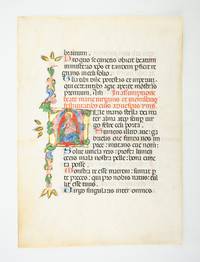
1059101350. Tuscany: c. 1350. <br /> <br /> Folio 430 x 308 mm. Single leaf. With four-line staves of music on both sides with five recto and six verso lines of text beneath. With a very fine initial 'A' in Tuscan colors. The top edge has been repaired perhaps at the time with a strip of vellum for unknown reasons perhaps a mark of ownership removed. Otherwise in very good condition generally clean and fresh and with ample margins.<br /> <br /> § A fine early Tuscan leaf being the responses and versicles for the first reading at Matins. The leaf opens: "Absterget Deus omnem lacrimam ab oculis." Provenance: Bernard M. Rosenthal 1995 with his notes; private collection San Francisco. unknown
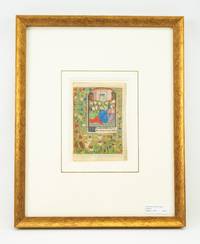
1490ST20853France ca. 1490. 144 x 99 mm. 5 5/8 x 3 3/4". Single column recto with 14 lines in a gothic book hand. <br/> Attractively matted and framed. Rubrics in red two two-line initials one painted pink on blue ground with flowers the other painted blue and inhabited by a rampant lion on pink and gold ground recto with a panel border featuring long-stemmed flowers and owls on a pink ground verso WITH A HALF-PAGE ARCH-TOPPED MINIATURE DEPICTING PENTECOST WITH A FULL BORDER featuring a plethora of different flowers berries greenery songbirds an owl and a butterfly all ON A RICHLY PAINTED GOLD GROUND. Trimmed close on one side and just grazing a border on the opposite side very minor chipping to faces trivial signs of rubbing or wear otherwise a fine leaf--colorful bright and very pleasing to the eye.<br/> <br/> This leaf contains the customary Pentecost miniature associated with the Hours of the Holy Spirit but with several attributes that set it apart from other examples we have encountered. The miniature here depicts a densely crowded scene with the Virgin at the center surrounded by the apostles each of whom wears a burnished gold halo. Packed tightly together they gaze up at a white dove who emanates small red tongues of fire above their heads. According to biblical tradition this visitation by the Holy Ghost in the form of a dove enabled Christ's disciples to start preaching marking the beginning of the Christian Church. The artist favors an unusual pastel palette choosing pale pink for the walls and eggshell blue for some of the floor tiles as well as bright yellow muted lilac rose and lime green for the robes of the apostles. Looking more closely at the figures we see that each face is carefully individualized each with its own features and expressions. Although most crane their necks to get a view of the miracle unfolding one of the apostles looks directly out at the viewer as if surprised by our presence. Moving outside the miniature we note that the leaf features a particularly exuberant border with tangles of flowers fruit acanthus leaves and several birds including an owl in one corner. There is additional interest on the verso with another bright border painted an intense pink and filled with more flowers and owls. unknown
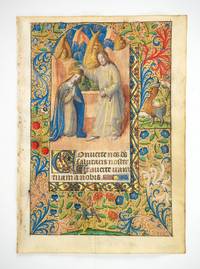
1500ST20810RParis ca. 1500. 163 x 115 mm. 6 1/2 x 4 1/2". Single column 18 lines in a gothic book hand. <br/> Rubrics in red line fillers in blue and pink with gold bezant six one-line initials in burnished gold on pink and blue ground two two-line initials in blue on gold ground with a flower in the center one three-line initial in blue filled with ivy on gold ground verso with panel border of colorful flowers and acanthus recto with A LARGE ARCH-TOPPED MINIATURE OF THE CORONATION OF THE VIRGIN with an "L" shaped frame of burnished gold and painted flowers and A FULL BORDER of acanthus flowers a man playing a bagpipe and a hybrid creature wearing a hat all on a painted gold ground. Very minor wrinkling to vellum but the leaf IN LOVELY CONDITION with the gold everywhere gleaming brightly.<br/> <br/> From a luxuriously appointed Book of Hours this leaf features a handsome miniature of the Coronation of the Virgin attributed to the workshop of Jean Pichore fl. ca. 1502-20 a major figure among illuminators of the period and one of the most sought-after artists in France at the turn of the 16th century. Executed with imagination and delicacy the miniature features the traditional subject associated with the hour of Compline showing the Virgin being crowned Queen of Heaven following her Death and Assumption. The composition here is quite intimate with the Virgin kneeling before her son as she accepts with humility the crown he lays upon her head. Christ is depicted barefoot and slightly bowed toward his mother in a gentle display of respect. The artist creates a wonderful backdrop for this scene composed entirely of seraphim painted gold blue light pink and green closely packed together. Two of the seraphim hold up light pink draperies behind the central figures as if to shield this tender moment from prying eyes. The borders here are a source of delight featuring a figure wearing a jester-like cap and playing the bagpipe as well as a creature with the body of a bird and the face of a human donning a rather fashionable bycocket cap. The illumination here is of high quality features a liberal use of gold and contains unique marginal details suggesting that the original manuscript must have been a costly commission for a wealthy patron. unknown
THE UNIQUE COPY PRINTED ON REAL VELLUM ("peau de vÈlin") OF THE FIRST AND ONLY EDITION OF THIS EXTREMELY IMPORTANT AND RARE BOOK ABOUT THE TOURAINE. XVI, 208 pp. Beautifully printed on fine vellum, with huge margins, for Jules Taschereau, an important Touraine intellectual, politician, and bibliophile who was also the editor of this volume. 8vo (the remainder of the edition, 180 copies on paper for the SociÈtÈ des Bibliophiles de Touraine, was printed 12mo.) BEAUTIFULLY BOUND BY CAP… IN FULL MOROCCO, spine elegantly gilt in six compartments, triple gilt fillet on covers, turn-ins elegantly gilt. Tiny traces of wear to lower extremties of joints, else FINE AND BRIGHT, COMPLETELY UNCUT, WITH NO DEFECTS. Taschereau I, p. XIX; Taschereau auction catalogue (1875) n∫ 30. UNIQUE AND IMPORTANT.
THE ONLY COPY PRINTED ON VELLUM OF THE POET'S FIRST BOOK, ILLUSTRATED WITH THREE ORIGINAL HORS-TEXTE DRYPOINTS BY FRANTISEK PAVELKA. 71 pp. Edition limited to 500 numbered copies, of which this is COPY NUMBER 1, THE ONLY COPY PRINTED ON VELLUM. Inscribed and signed below the justification by the author (to himself, apparently) in Czech: "The first copy of the first edition of my first book." Also inscribed and signed by the publisher on the rear pastedown. Both inscriptions dated December 21, 1926. 8vo. Beautifully bound in full hand-painted pigskin. Top edge gilt, other edges uncut. FINE AND BRIGHT. Czech books printed on vellum are of the utmost rarity.
1910ST14374England ca. 1910. 392 x 287 mm. 15 3/8 x 11 1/4". 32 leaves with text in an attractive italic hand all separated by tissue guards. <br/> SUMPTUOUS OLIVE GREEN STRAIGHT-GRAIN MOROCCO ELABORATELY GILT BY ZAEHNSDORF stamp-signed on front doublure and with their exhibition stamp on rear turn-in covers with densely stippled floral roll border enclosing a large frame formed by drawer handle tools and floral tools on a stippled ground; central panel with large cornerpieces rampant with flower tools circlets volutes and much stippling; raised bands spine compartments heavily gilt in a similar style gilt titling RED MOROCCO DOUBLURES with opulent dentelle frame surrounded by gilt-tooled green morocco turn-ins red watered silk endleaves with gilt edging all edges gilt.ma WITH 76 BLACK & WHITE PHOTOGRAPHIC REPRODUCTIONS OF PORTRAIT MINIATURES BY RICHARD COSWAY ANDREW PLIMER AND OTHERS mounted and enclosed by hand-painted burnished gold frames EACH PORTRAIT WITH HAND-ILLUMINATED TITLE in red blue green and burnished gold. Verso of front endleaf with book label of Thomas Agnew & Sons Old Bond Street Library. A bit of wear to front joint a little rubbing to extremities occasional mild rumpling to head or tail of vellum leaves isolated small marginal smudges otherwise a fine specimen the vellum creamy and bright the illuminations shining and the binding quite sound and lustrous with gold.<br/> <br/> Composed of vellum leaves this is a unique luxurious catalogue of a miniatures collection with delicate script lovely illumination and a stately binding by one of London's foremost workshops. State-of-the-art photographic reproductions of mostly 18th century miniatures are juxtaposed here with calligraphy and illuminations harking back to Medieval bookmaking. Each portrait is surrounded by a gold frame and accompanied by a hand-written description with an illuminated title giving biographical details of known subjects and a physical description of the miniatures whenever they are labelled simply "Portrait of a Lady" or "Portrait of a Gentleman." The scale of this production--which is nearly twice the size of most illuminated manuscripts of the early 20th century--and the splendor of the binding point to a patron of considerable means likely either the proprietors of or a client of the Agnew art dealers. The Agnew firm began as printsellers in Manchester in 1817 but over the course of the 19th century became one of the principal British galleries under the leadership of the founder's son William. A London branch opened in 1860 and the Bond Street flagship in 1875. William Agnew 1825-1910 did much to foster the careers of British artists Holman Hunt Frederick Leighton and Edward Burne-Jones and his clients included Henry Tate whom he encouraged to found the celebrated Tate Gallery. The binding here is a superb example of the work of the Zaehnsdorf firm long a top-ranked English bindery. Born in Pest Hungary Joseph Zaehnsdorf 1816-86 served his apprenticeship in Stuttgart worked at a number of European locations as a journeyman and then settled in London where he was hired first by Westley and then by Mackenzie before opening his own workshop in 1842. His son and namesake took over the business at age 33 when the senior Joseph died and the firm flourished under the son's leadership becoming a leading West End bindery. Over the years Zaehnsdorf employed a considerable number of distinguished binders including the Frenchman Louis Genth who was chief finisher from 1859-84 and trained a number of others including Roger de Coverly and Sarah Prideaux. A family-run business until 1947 the Zaehnsdorf bindery continued to produce consistently attractive and innovative designs executed with unfailing skill. It is generally understood that the firm reserved the use of its oval stamp showing a binder at work seen here for their finest bindings including those entered in exhibitions. unknown
1882ST12705Paris: A. Quantin 1882. UNIQUE COPY ON VELLUM printed for M. A. Werlé. 206 x 140 mm. 8 1/8 x 5 1/2". xxxii 247 pp. 1 leaf colophon.With a bio-bibliographical notice by Fernand Drujon. <br/> Pleasing burgundy Jansenist crushed morocco by Canape et Corriez stamp-signed in gilt on front turn-in dated 1930 on rear turn-in raised bands turn-ins richly gilt marbled endpapers all edges gilt on the rough. Decorative head- and tail-pieces throughout and eight engraved plates comprised of a frontispiece portrait in four states one on vellum three on paper and an allegorical vignette also in four states. Verso of front free endpaper with ex-libris of Jean Furstenberg. ◆Two small dark spots to upper cover a couple of leaves with naturally occurring minor discoloration to vellum but A FINE COPY--especially clean fresh and bright internally and in a lustrous unworn binding.<br/> <br/> Given its illustrious provenance and its singular status as the only copy printed on vellum this is a quintessentially bibliophilic copy of the poems of French cleric and diplomat Cardinal François-Joachim de Pierre de Bernis 1715-94. Admired as a witty epigrammist at the court of Louis XV where Madame de Pompadour presided Bernis composed poems on such conventional themes as love and the natural world but also verses contemplating manners and mores fashion independence and love of country. Since none of his poems was published before his death he was not widely known as a poet during his lifetime but in another sphere he performed important service to his country as France's ambassador to Rome. He provided shelter and succour there for refugees from the French Revolution earning the papal epithet "Protector of the Church of France." The present work was printed for Count Alfred Werlé whose father had inherited the Veuve Clicquot Champagne house from the Widow Clicquot. Alfred took over the operation in 1884 and greatly expanded the Veuve Clicquot-Ponsardin vineyards. The volume subsequently passed into the library of the great collector Jean or Hans Furstenberg 1890-1982 who put together one of the finest collections of 18th century books ever assembled. In 1974 the Furstenberg collection was sold en bloc to Dr. Otto Schäfer whose marvelous library had already become distinguished for its fine and historic bindings. A. Quantin unknown
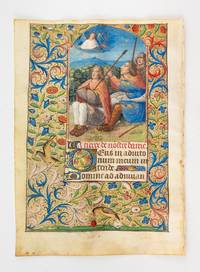
1500ST20810PParis ca. 1500. 165 x 117 mm. 6 1/2 x 4 5/8". Single column 18 lines in a gothic book hand. <br/> Rubrics in red line fillers in blue and pink with gold bezant five one-line initials in burnished gold on pink and blue ground one two-line initial in blue on gold ground with a flower in the center one three-line initial in blue filled with ivy on gold ground recto with panel border of colorful flowers vase and acanthus verso with A LARGE ARCH-TOPPED MINIATURE OF THE ANNUNCIATION TO THE SHEPHERDS surrounded by A FULL BORDER of acanthus flowers and two birds all on a painted gold ground. Slight soiling to vellum but a very well-preserved leaf in fine condition.<br/> <br/> From what was surely a costly Book of Hours this leaf features a charming and skillfully painted miniature of the Annunciation to the Shepherds attributable to the workshop of Jean Pichore fl. ca. 1502-20 a major figure among illuminators of the period and one of the most sought-after artists in France at the turn of the 16th century. Depicting the traditional subject associated with the hour of Terce our miniature portrays as usual an angel appearing to shepherds tending their flock bringing news of the birth of Christ. Although the biblical narrative suggests that the shepherds were startled by the angel's appearance the three figures in this miniature appear remarkably unmoved--in fact only one of them seems to take any notice at all. The first shepherd sits on the ground looking straight ahead; the second holds his hands in prayer but looks little more than well prayerful at the angel in the sky; and a third figure maintains a slightly aloof expression taking no particular interest in the unfolding miraculous event. What may seem to be indifference can be explained easily enough by the artist's successful portrayal of nighttime cold! All three shepherds are thickly dressed one with his arms pressed tightly against his chest another with a hood partly covering his face and the sheep are tightly huddled together into one woolly white cluster. Another manifestation of the artist's success here is seen in the particularly well done molding of the faces with subtle shading attractively rendered features and clear individuation. Moreover although the shepherds seem essentially unmoved their garments are dusted with a glistening gold radiance from above a further subtle touch revealing a high level of achievement on the part of the painter. Finally the borders are one last source of delight with a small bird shown in mid-flight and a second one investigating a single strawberry that seems to have been placed there just for him. All of these indications of sophistication suggest that the original manuscript must have been commissioned by a patron able to pay a premium for the work of a highly skilled atelier. unknown
ST20973Italy 15th century. 364 x 260 mm. 14 3/8 x 10 1/4". Single column 22 lines in a rounded gothic book hand. <br/> Rubrics in red versal initials alternating red and blue with purple penwork one three-line initial in blue with purple penwork A SIX-LINE "A" DEPICTING THE ASSUMPTION OF THE VIRGIN the initial painted pink with red green and blue nodes and acanthus on a burnished gold ground with extensions running the length of the text column incorporating more acanthus and small gold embellishments with sprays of the gold leaves at the top bottom and center. A little rubbing to the paint negligible soiling and small spots to margins but in excellent condition overall.<br/> <br/> This very large handsomely preserved leaf features a strikingly attractive initial of the Virgin opening the beloved hymn "Ave Maris Stella" "Hail Star of the Sea". Dating back to at least the ninth century and traditionally associated with the hour of Vespers on Marian feast days as here the hymn praises the Virgin's purity meekness and mercy calling upon her as the "Nurturing Mother of God" to dispel evil and free us from our sins. Inside the gilt and painted initial is a lovely portrait of the Virgin who is depicted seated against a red mandorla dressed in pink and wrapped in a green and blue mantle--perhaps a reference to the colors of the ocean. Her hands are raised in prayer fingers lightly touching above her heart and her well-defined features appear both strong and serene. Judging from the size of the initial liberal use of gold and the wide margins of this leaf the original manuscript must have been a costly item produced for a wealthy church or monastery. unknown
1450ST11774-85Paris ca. 1450. 159 x 108 mm. 6 1/4 x 4 1/4". Single column four lines of text on the verso 15 on the recto in a very pleasing gothic book hand. <br/> Attractively matted. Recto with a line filler in colors and gold verso with a one-line initial in burnished gold on a maroon and blue background with white tracery and a three-line "D" in blue and white enclosing a spray of violets in the same colors the capital on a burnished gold ground the same side WITH A FULL SWIRLING BORDER of acanthus leaves flowers and berries and many burnished gold ivy leaves ENCLOSING A BLOODY ILLUMINATED MINIATURE OF THE MASSACRE OF THE INNOCENTS measuring approximately 78 x 54 mm. Fore and lower margins on the side with the miniature a bit rubbed and with a faint patina reflecting frequent use also minor fading and loss of paint and gold in the same place otherwise in fine condition THE MINIATURE itself REMARKABLY WELL PRESERVED WITHOUT ANY EROSION OF PIGMENT.<br/> <br/> This leaf comes from a Book of Hours decorated by extremely skilled members of what must have been a first-class workshop. The Massacre of the Innocents cannot help but be a moving subject and the composition here as well as the painter's considerable ability add to the emotional impact in the present miniature. The center of the scene is dominated by the gold-armored gray-bearded soldier whose sword is raised over the head of a woman clinging to her son. The blood-spattered foreground is littered with the dismembered bodies of infants looking like so many broken dolls. On the left we see a row of modest cottages providing considerable depth as they recede toward distant hills. On the right stands a crowd of grim-faced soldiers all as elderly as their commander and seemingly following orders that are unwelcomed; it is perhaps the acute sadness in their faces that makes this scene especially memorable. The clear sky green fields and serene blue mountains in the distance contrast markedly with the horrific events unfolding. unknown
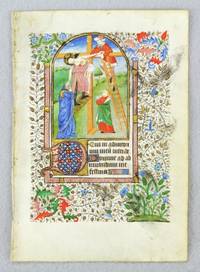
1420ST12005fFrance probably Paris ca. 1420. 210 x 146 mm. 8 1/4 x 5 3/4". Single column recto with five lines of text verso with 16 lines all in a very pleasing very regular gothic book hand. <br/> Attractively matted. Rubrics in red verso with a one-line and two two-line initials as well as a line filler in colors and burnished gold recto with a one-line initial and a line filler in the same style and with a quite large five-line "D" in pink and white with enclosed floral diapering all on a burnished gold ground the same side WITH A LOVELY FULL BORDER of swirling hairline stems bearing numerous leaves and berries of burnished gold and with sprays of acanthus leaves and flowers in multiple colors spilling from the corners this ENCLOSING A POIGNANT ARCH-TOPPED MINIATURE OF THE REMOVAL OF CHRIST FROM THE CROSS measuring approximately 85 x 60 mm. the miniature within a thin gold frame and enclosed in turn on three sides by bars in colors and gold the scene showing two men on ladders unfastening Christ's lifeless body from the cross while Joseph of Arimathea waits below clutching cloth to be used for a burial shroud as the Madonna at the lower left of the picture reaches up to clasp her son's bloody arm. With a small cross stitched in white thread in each upper corner. ◆A little soiling right along hinge edge a few smudges in the border a couple of tiny flakes of paint missing from the cross and the sky otherwise fine the vellum clean and fresh the colors rich and the gold lustrous.<br/> <br/> This is an especially sorrowful scene depicted with power grace and sensitivity by an artist demonstrating very considerable skill in composition and execution. The scene is well designed with the cross providing a device for focus at the center of the miniature. Nicodemus identified by his expensive attire is atop a ladder behind the cross lowering Christ's limp body onto the shoulder of another man probably a servant whose ladder is set against the front. Despite the fact that the corpse is more bones than flesh the artist has made it seem a heavy burden draped over the shoulder of the man as he walks backward down his ladder. Fully stretched out Christ's left arm is held for balance by Nicodemus at the top right while the other arm hangs down toward the Virgin. While we can only see her back her image evokes great pathos as she reaches up with both hands to grasp the mangled arm of her son his blood running from his hand onto hers. Joseph of Arimathea whose position anchors the right side of the picture looks on with concern tightly holding linen to shroud the body. St. John and Mary Magdalen conventional participants in the Deposition are not present in this miniature. While it is possible and even likely that the same artist produced this scene and the miniature of Christ Carrying the Cross this one is better as the faces are more deftly painted and the folds in the various garments are more clearly defined. unknown
18287462Paris, Baudouin frères, 1828. 4 volumes in-8 en demi-maroquin vert à grains longs, avec coins, dos lisse orné de fers romantiques, doubles filets dorés sur les plats, non rogné, avec les couvertures conservées des 10 livraisons de l'édition de Baudouin, mais également les couvertures - verte et jaune de 6 de livraisons de l'édition des vignettes chez Perrotin, avec un envoi autographe de ce dernier. Belles reliures Pastiches dues au maître du genre, Bernasconi. La reliure est signée par Bernasconi.
1898110521898 P., Bibliothèque-Charpentier, 1898, 1 fort vol. in-12° (195 x 130) relié plein cartonnage moderne à la Bradel recouvert de papier anthracite à motifs noir, dos lisse orné d'une pièce de titre en maroquin noir souligné d'un filet doré, gardes de papier noir, de (2) ff. (faux-titre et titre) - 608 pp. Très bel exemplaire non rogné à grands témoins conservés.
1955008624Paris Tériade 1955 in folio En feuilles, couverture rempliée, chemise et étui éditeur
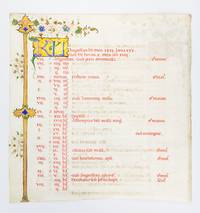
1441ST19882Italy Ferrara 1441-48. 205 x 200 mm. 8 x 7 7/8". 35 lines in a very fine rounded gothic hand. <br/> Text in dark brown and red capitals touched with yellow two four-line "KL" initials in blue pink and green on burnished gold ground with leafy marginal extensions the initials on the recto crowned with an exuberant spray of green blue and gold acanthus hairline tendrils pink flowers and gilt bezants and leaves the verso initials with a long bar border on outer margin painted pink on gilt ground with pink green and blue motifs at middle and top the border traced with black the top of the border accompanied by a spray of hairline tendrils colorful flowers gold bezants and leaves. ◆Lower margin of the verso trimmed away with loss of the end of bar border though not the text some of the other margins trimmed close crowding but not affecting the decoration some fading to brown ink less faded on recto legible on both sides in any case negligible dampstain in upper margin short closed tear just entering gold bar at top left of verso; not without imperfections but still an exquisite and very desirable leaf with richly colored and gilt embellishment.<br/> <br/> This item presents a very special perhaps singular opportunity to own the only known calendar leaf from the renowned Llangattock Breviary to emerge since the manuscript was taken apart in the 20th century. Executed with great skill and delicacy in sensitive Italianate colors highlighted by spring green and pink our leaf is unsurprisingly from a manuscript intended for a powerful aristocrat. It comes from the celebrated Breviary illuminated for the chapel of the Marquises of Este rulers of Ferrara and Mantua a manuscript commissioned by Leonello d'Este duke of Ferrara from 1441-50. According to the d'Este family records this manuscript seems to be the Breviary done for Leonello by Giorgio d'Alemagna Bartolomeo de Beninc Guglielmo Giraldi and Matteo de' Pasti see Toniolo "La Miniatura a Ferrara dal Tempo di Cosm Tura all'eredit di Ercole de' Roberti" 1998 pp. 19-20 and 76-77. Leaves from this manuscript show subtle variations in the style of the illuminations a result of work performed individually by a team of artists doing variations on a theme. At one time in a Spanish library the manuscript was brought to Britain during the Peninsular War and came to be owned by the Rolls family later Lords Llangattock of Monmouth in Wales from whom it takes its name. By the time the work reached Britain most of the miniatures had already been cut out. The Breviary sold at Christie's on 8 December 1958 lot #190 after which it was acquired and subsequently dismembered by Goodspeed's of Boston. The attribution of this leaf to the Llangattock Breviary is based its script ruling and style of decoration as well as physical attributes such as width of the leaf and the appearance of the vellum which all correlate to other known leaves from this manuscript. Furthermore according to the 1958 auction description of the complete manuscript the entire calendar section had its lower margins trimmed away as here. The present leaf appeared in a 1979 catalogue of bookseller Kenneth Rendell and it remains the only known calendar leaf from this manuscript that has ever been advertised. unknown
1465ST11151bBruges ca. 1465. 181 x 127 mm. 7 1/8 x 5". Single column 19 lines in a careful pleasing gothic book hand. <br/> In a very attractive new gilt wooden frame. Rubrics in pink or faded red one two-line initial in blue magenta and burnished gold two lines with undulating line fillers in blue and gold both sides of the leaf with a three-quarter panel border incorporating foliage blossoms and ivy leaves on hairline stems the vertical part of this frame with a bar border composed of colors and burnished gold terminating at top and bottom in colorful acanthus leaves and WITH TWO SMALL BUT VERY PLEASING MINIATURE PAINTINGS SAINT ELIZABETH ON THE RECTO AND SAINT GERTRUDE ON THE VERSO. ◆Tiny wormhole in fore edge where it has done negligible damage small portions of the blue paint in the Elizabeth miniature eroded gray paint slightly smeared as well but apparently at the time of painting otherwise in fine clean fresh condition.<br/> <br/> This leaf is characteristic work from the circle of Willem Vrelant the leading purveyor of books of private devotion in Bruges during the third quarter of the 15th century. His leading position among Flemish illuminators of the time is indicated by the considerable number of manuscripts illustrated in his manner by other miniaturists both in Bruges and in nearby cities in Flanders. The illuminator of our Book of Hours shows a number of distinctive stylistic traits. Among these are a preference for boldly patterned cloth backdrops tessellated flooring landscapes filled with stylized bushes and trees and persisting prominent architectural constructions that frame the subject frequently in a corner in these leaves it is a waist-high outdoor wall or an indoor feature resembling wainscoting. The inclination for strong geometrical patterning is manifested in the artist's angular treatment of human figures and their garments. Dressed in pink and blue Elizabeth is depicted with a sweet round face. She is saluted here as the woman worthy to be the mother of John the Baptist the forerunner of the Redeemer. Gertrude is dressed in monastic black although a pink undergarment is visible and her inky habit is trimmed in gold. This shimmering feature is a reminder that Gertrude 626-59 was the daughter of Pepin I of Landen Mayor of the Palace for the Frankish realm of Austrasia and the forebear of Charlemagne. Gertrude is a natural choice for illustration by an artist of Bruges since she was the patron of nearby Nivelles. The saint was routinely invoked for aid in coping with mice and is here shown surrounded by four animated rodents as black as her habit. No legend survives to explain why she had such power over the creatures who seem here to be more her pets one climbs her staff of office than her victims. unknown
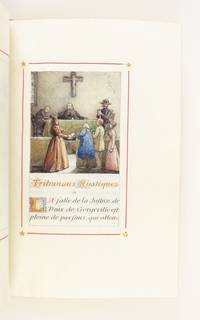
1896ST17129-026Paris 1896. 200 x 135 mm. 7 7/8 x 5 3/8". 11 leaves. Single column 16 lines plus headline in a thin graceful italic script. <br/> Attractive red crushed morocco by Marcellin Lortic stamp-signed on front doublure covers framed by multiple-rule gilt strapwork raised bands spine compartments with gilt French fillet gilt titling vellum doublures with gilt frame in the Romantic style leather hinges vellum endleaves all edges gilt. In matching morocco-trimmed slipcase. Title in burnished gold embellished with red and blue penwork text with red-ruled border and burnished gold stars at corners numerous one-line burnished gold initials with red or blue penwork two-line opening initial in burnished gold on a blue white and pink background and A HALF-PAGE MINIATURE measuring 71 x 64 mm. SHOWING A COURTROOM SCENE. Front free endleaf with morocco bookplate of Robert Hoe. ◆Just the slightest hint of rubbing to joints but A VERY FINE SPECIMEN entirely fresh bright and clean inside and out.<br/> <br/> This elegant little manuscript in French recounts Guy de Maupassant's satirical tale of a trial in the provinces; it was created by a man who knew the inside of a courtroom all too well. Bouton 1819-1901 was a young rebel during the 1848 Revolution who spent five years in jail for his participation in a bombing in Paris. Oddly enough the dedicated republican was also an expert on heraldry and paleography publishing pamphlets on those subjects as well as on politics and producing manuscripts like the present one. De Maupassant 1850-1893 is generally acknowledged as one of the great masters of the short story. In the present tale a wealthy older woman who had tried to buy a young peasant's love by giving him land sues unsuccessfully for the return of her property when the object of her affection forsakes her for a younger woman. According to Beverly Chew the library of Robert Hoe 1839-1911 founding member and first president of the Grolier Club was "the finest America has ever contained." Hoe acquired illuminated manuscripts early printing he owned a Gutenberg Bible on paper and one on vellum fine bindings French and English literature and Americana and when his library was sold in 1911-12 it fetched nearly $2 million a record that held until the Streeter sale more than 50 years later. Hoe owned several Bouton manuscripts of de Maupassant stories and the Morgan Library also has Bouton creations. The Lortic name was made famous in the history of French binding by Pierre Marcellin Lortic 1822-92 a leading Parisian binder for 40 years; the binder here was Lortic's son Marcellin or "Lortic Fils" 1852-1928. unknown
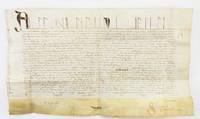
1502ST17895Rome 10 August 1502. 305 x 513 mm. 12 x 20 1/4". Single column 29 lines in a papal documentary script plus signatures at bottom. <br/> First line of text much larger and with elongated letters and calligraphic flourishes. WITH THE ORIGINAL LEAD SEAL AND HEMP TIES ATTACHED. Verso with several ink notations in different contemporary and later hands recto with a long ink line in one margin and the letter "A" in the other both by a later hand. Several folds to vellum as usual one-inch tear near where the hemp tie is attached a couple of small holes in the large "A" at the top of the document seal a little worn around edges and to the contours of the faces but overall in excellent condition with no major issues the vellum especially clean and bright.<br/> <br/> Issued to the overseer of a church in Frilingen probably modern Freilingen in Germany this bull orders the return of the vacated ecclesiastical seat and benefices of the church of St. James in Hergelzhausen in the diocese of Frilingen to two people. The church's rector Andrew Kuefuelz is to receive the position and things that once belonged to Leonard Walter the procurator while George Maltzel of Erding a priest of the same church is to receive the provisions and annual rents pertaining to the church. A member of the powerful Borgia family Rodrigo Borgia 1431-1503 served as vice-chancellor to five successive popes before being elected to the papacy in 1492 taking the name Alexander VI. One of two Borgias to ascend to the papacy the other was Callixtus III who died after just three years as pope Alexander held his own among a notorious family known for scandal. He led a sordid personal life--he was accused of participating in an orgy when he was a cardinal and openly admitted to fathering several children by his mistresses--and his reign was characterized by acts of nepotism and promoting his own family's interests above all else--especially with matters related to foreign policy. However he was also known as a patron of the arts having commissioned work by Raphael Michelangelo and Pinturicchio adopted a rather tolerant attitude toward Jews during this period and succeeded in cracking down on crime in Rome. The Papal Bull takes its name from the lead seals called "bullae" that were issued with official documents of the papacy as a way of ensuring their authenticity. Apart from the rare Solemn Privilege like Innocent III's famous granting of England in 1214 to his involuntary vassal King John there are three other categories of Papal Bulls: Simple Privileges also called Solemn Letters Letters of Grace which confirm privileges and rights and Mandates. The present item is of this final type differentiated by its use of hemp ties as opposed to silk. unknown
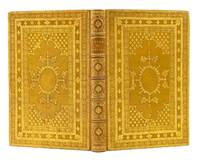
1882ST16453Glasgow: Printed by Robert Anderson for Private Circulation 1882. ONE OF ONLY 50 COPIES. 195 x 122 mm. 7 3/4 x 4 7/8". 1 p.l. x 103 1 pp.From George Bannatyne's manuscript compiled A.D. 1568. <br/> BEAUTIFUL CITRON CRUSHED MOROCCO ELABORATELY TOOLED IN GILT BY RAMAGE stamp-signed on front turn-in covers with six concentric frames--intricate filigree roll pointillé-tooled floral vine and alternating small ornaments--enclosing a central panel with cornerpieces semé with rows of fleurs-de-lys large oval medallion at center radiating ornate fleurons raised bands spine compartments with large central medallion containing a vase of flowers delicate tooling in corners gilt titling turn-ins framed by filigree roll and alternating small ornaments brown and tan silk jacquard endleaves patterned in a Medieval motif top edge gilt. Printer's device on title page decorative woodcut initials and headpieces. Spines evenly sunned to a warm honey brown corners lightly rubbed short faint scratch to lower board but the binding virtually unworn and happily free of the splaying that plagues vellum books. Leaves lightly rumpled but A VERY FINE COPY the vellum leaves creamy clean and bright and the binding glittering with gold.<br/> <br/> Printed on luxurious vellum and limited to just 50 copies presumably for private circulation among friends of the printer this is a lovely edition of 16th century poems by a mysterious author believed to have been a poet and musician associated with the court of Mary Queen of Scots. This work contains all 36 extant poems attributed to Scott ca. 1520-82/3 including what is considered to be his most historically important work "Ane New Yeir Gift to Quene Mary" 1562 written in support of the young Scottish queen caught between Catholic and Protestant agendas. His other poems consist largely of lyric verses on love and sexuality which DNB describes as possessing "exceptional metrical variety and vernacular directness" with "a musician's ear for rhythm and melody." Scott's poems are known to us via the Bannatyne manuscript now held in the National Library of Scotland which ranks among the most important documents of Scottish Medieval literature. Written by George Bannatyne in 1568 during a period of confinement due to an outbreak of plague it contains a mixture of both secular and religious material including the sole extant copies of several texts. In the preface to the present work the publisher notes that Scott's poetry has been faithfully reproduced from that manuscript and thus "for the first time accurately printed." Very little is known regarding the life of Alexander Scott but he seems to have been attached to the court of Mary Stuart through John Erskine a guardian and counselor to the queen. Given the very limited number of copies made it is not surprising that this work is extremely rare on the market. Printed [by Robert Anderson] for Private Circulation unknown
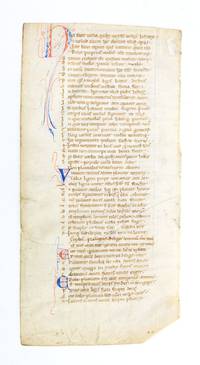
ST18250bEngland first half of 13th century. 235 x 117 mm. 9 1/4 x 4 1/2". Single column 49-50 lines in a gothic hand. <br/> Rubrics in dark brown ink three two-line initials in red or blue with contrasting penwork one four-line puzzle initial in red and blue with red and blue penwork decorations and long marginal extenders. With a few contemporary corrections in a different hand verso with scant remnants of mounting tape. Gwara Handlist no. 7. ◆Top edge trimmed cutting into the large initial's ascender one corner cut away not affecting text a couple of wrinkles and a bit of soiling to vellum but in excellent condition overall quite clean and entirely legible.<br/> <br/> Noticeably different in appearance from the Medieval leaves more commonly encountered on the market such as Books of Hours Bibles liturgical books etc. this leaf features a tall thin "ledger" format and offset initials spaced slightly apart from the rest of the line. The text here comes from the "Aurora" a commentary on the Bible in verse form written in the late 12th century by French poet Petrus Riga 1140-1209 a canon of Rheims cathedral. Although little is known about the author's life Riga's text became immensely popular throughout Europe and was routinely studied in Medieval universities. In fact it is likely that the present leaf came from a manuscript intended for a student or academic as its dimensions suggest it was made for easy transport and could even have been slipped into a pocket. In the 20th century the parent manuscript was owned and dismembered by biblioclast Otto Ege and leaves appeared as specimen no. 7 in his "Fifty Original Leaves from Medieval Manuscripts Western Europe XII to XVI Century." Single leaves from this manuscript appear at auction very rarely. The last example we were able to track on RBH and ABPC sold at Bloomsbury in 2016 for an all-in price of £3100. unknown
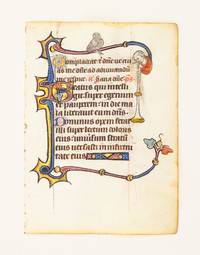
ST16985QFrance first half of 14th century. 110 x 82 mm. 4 3/8 x 3 1/4". Single column 12 lines in a gothic book hand. <br/> Line enders in pink and blue with gold accents each leaf with one or more one-line initials in blue with red penwork or gold with blue penwork each leaf with one two line initial painted pink or blue ONE INHABITED BY HUMAN FACE others filled with painted floral motifs all on a gold ground one side of each leaf with A FULL BORDER composed of pink and blue tendrils accompanied by spikey gold decoration and gold accents often terminating in ivy leaves and incorporating EXTRAORDINARILY CHARMING EXAMPLES OF MARGINALIA INCLUDING ANIMALS HUMAN HEADS AND HUMAN-BEAST HYBRIDS. ◆Vellum with a little soiling and a few small stains slightly more noticeable on one leaf where it is touching the text though not obscuring meaning a few instances of rubbing to gold and decoration including one bird with its detailing rubbed away other minor imperfections but none of these flaws egregious and the most desirable imagery here still very well preserved.<br/> <br/> Though diminutive in size these leaves contain enormously appealing marginal decoration in the form of humans animals and hybrid creatures inventively incorporated into the lively borders in manners that range from adorable to bizarre. Especially popular in Flanders Northern France and England during the 13th and 14th centuries marginalia such as these comprise some of the most memorable and entertaining images to be found in any Medieval manuscripts. Despite being found largely in religious books such as Psalters and Books of Hours the images are often strange humorous or even outrageous and they provide us with consistent delight. Being by definition outside of the central text or miniature the margins seem to have been a place where illuminators felt more at ease to experiment resulting in highly imaginative and unique artistic expressions. The present specimens come from a fragmentary manuscript with many leaves either missing or rendered defective where portions of the vellum were cut away. Fortunately this group of leaves is intact and retains much marvelous imagery including an owl and two other birds one apparently holding a worm in its mouth human heads and torsos capping off the ends of border tendrils including a trumpeter blowing into a particularly long instrument and a man reaching both arms straight into the air as if trying to grab the head attached to the tendril above him and a hybrid with the head of a human in a gold hood and the body of a hare perched gingerly on an ivy branch. For additional leaves from this same manuscript at different price points please check our website. unknown
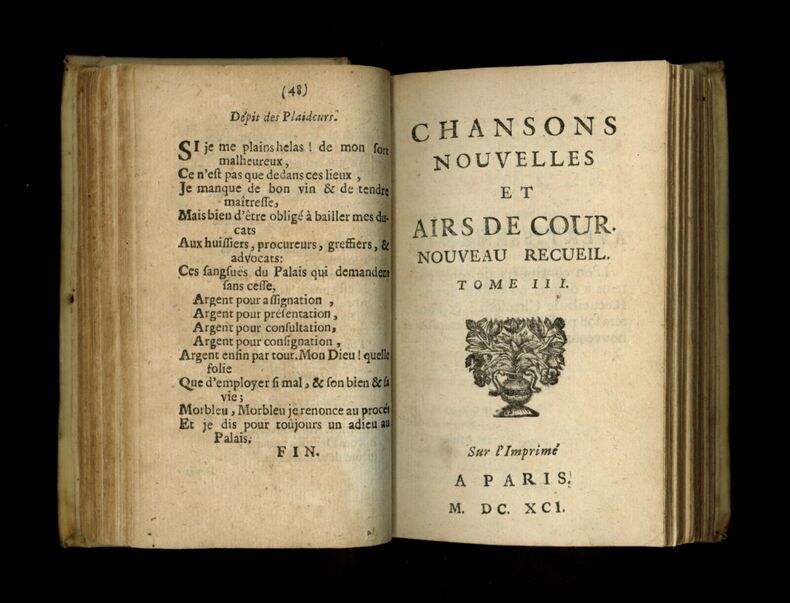
1690AMO-4534Reliure plein vélin ivoire de l'époque à coutures apparentes (vélin hollandais). Reste de titre à l'encre au dos (presque effacé). Légers frottements. Exemplaire frais, non restauré. Papier de qualité plus ou moins médiocre selon les tomes, parfois uniformément teinté. Collationné complet. Ce recueil est extrêment rare selon les différentes sources consultées. Sa mise en oeuvre semble hératique (nom d'éditeurn, dates et mention d'édition assez fantaisistes). Il semble pourtant que ce soit tout ce qui a paru de cet ensemble composé de chansons bacchiques, lestes et gaillardes. On lit dans le catalogue de livres provenant de la bibliotheque de monsieur Leroux de Lincy, n°225 (vélin, même collation) : "Recueil extrêmement rare, dans lequel on trouve un certain nombre de chansons relatives au règne de Louis XIV (vendu 58 francs à la vente Silvestre en 1845, ex. relié vélin comme le nôtre). "Il s'y trouve un grand nombre de couplets hostiles à Louis XIV". On trouve un autre recueil quasi identique à la date de 1688, est-le même ? Et un autre en 12 parties datées de 1696, qui ne semble pas être le même que notre exemplaire. On lit par ailleurs dans le catalogue de la bibliothèque de monsieur Cigongne à propros d'un exemplaire identique au nôtre : "Tome I. 3è édition (6 parties intitulées t. I à VI, et 1ère partie d'un 2ème volume, datée de 1690). Sur l'imprimé à Paris (Hollande), 1691. Petit in-12. maroquin olive par Trautz-Bauzonnet (n°1228 du catalogue Cigongne), avec ce commentaire : "On croit que c'est tout ce qui a paru de ce recueil.".

_1.jpg)