ERNST (Max).Livre Rare Book

1 374 résultats
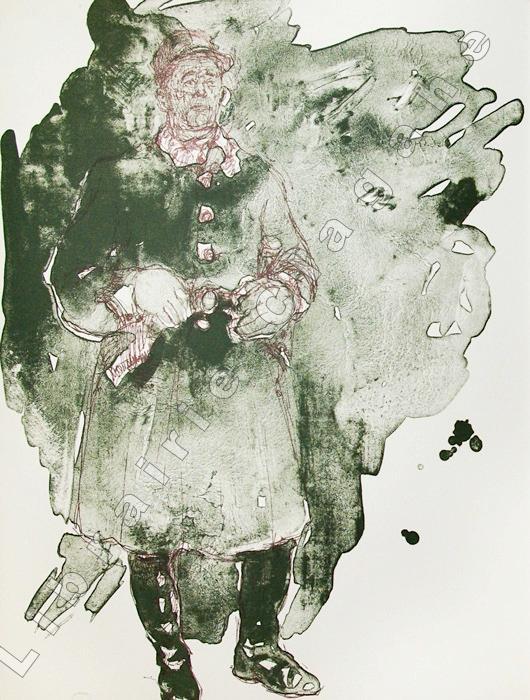
awd-1117Lithographie originale en couleurs sur vélin, titrée essai et signée au crayon en marge (38,2/27,5 cm). Élégant encadrement (53,3/42,4 cm).
1834250991834 Planche 391 de La Caricature N° 186.La Caricature, 29 mai 1834. Lithographie originale sur Velin blanc. . Delteil 79. épreuve en noir ; lithographie en noir sur velin blanc pli vertical,bon tirage bien noir,petite tache brune en marge - Delteil 79 ,
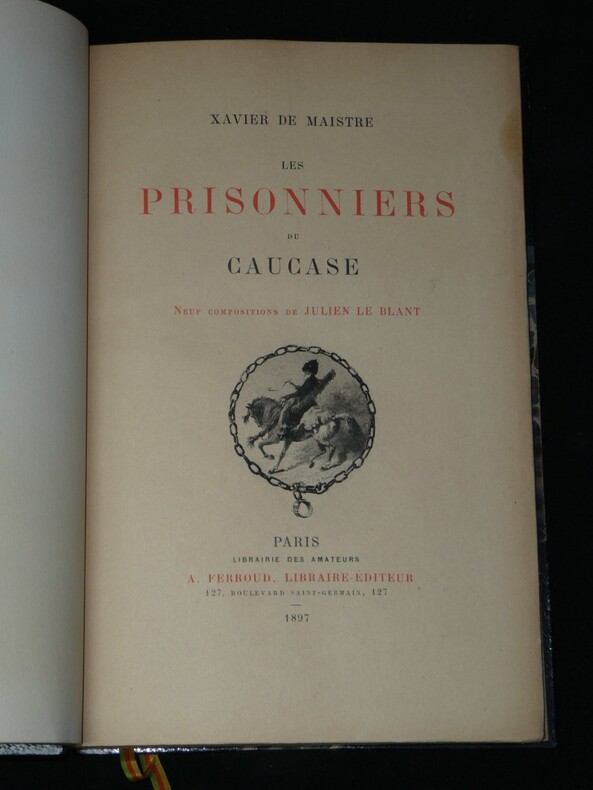
1897boz_006490Xavier de Maistre - 9 compositions de Julien Le Blant - Reliure signée V. Champs - Les Prisonniers du Caucase - Préface par Léo Claretie - 1/350 sur vélin d'Arches - 1897 Auteur : Xavier de Maistre Titre : Les Prisonniers du Caucase. Préface par Léo Claretie. Édition : Librairie des Amateurs A. Ferroud, Paris, 1897. Imprimé par Charles Hérissey (Évreux). Tirage : Édition originale. Exemplaire n 251, l'un des 350 exemplaires sur papier vélin d'Arches (après 150 Japon ou grand vélin). Exemplaire non coupé. Gravures : Julien Le Blant, 9 compositions gravées à l'eau-forte en noir et blanc par Louis Muller. Reliure : Demi-maroquin noir à coins, dos à 5 nerfs richement orné de caissons dorés, couvertures et dos conservés. Reliure signée V. CHAMPS. Tête dorée. Présence d'un ex-libris. Dimensions : 16,4 x 24 cm État : Bel exemplaire dans une élégante reliure signée. L'intérieur présente quelques rousseurs claires éparses. De belles marges non coupées. Voir les photos pour plus de détails. Nombre de pages : XIII 73 pages
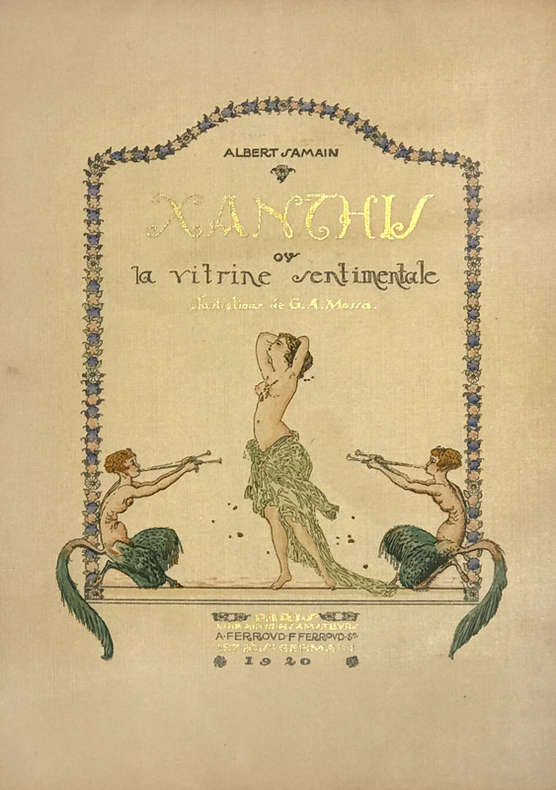
192015216Paris, Librairie des Amateurs, Ferroud, 1920 ; petit in-4, broché ; (8), 44, (2), (1) f. blanc ; 38 illustrations mises en couleurs au pochoir par Eugène Charpentier, dont la couverture, le titre illustré, 5 hors-texte dont le frontispice, 4 bandeaux et 27 vignettes.
1988CCC50065. Petit in-4 (16.5 cm X 24.5 cm), broché, couverture à rabats, non coupé, 22 pages, Librairie Croulebarbe, 1988. Comme neuf, l'êdition originale avec trois gravures en couleurs signé BRILLANT, plus l'illustration de la couverture, par Gilou BRILLANT. Tirage 21/100. Numérotés sur vélin d'Arches et signé au stylo par Cartano et Brillant. Photos possibles.
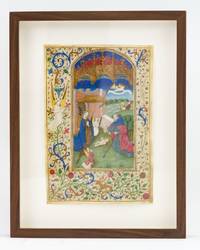
1470ST17765Delft ca. 1470. Leaf: 172 x 115 mm. 6 3/4 x 4 1/2". Frame: 242 x 190 mm. 9 1/2 x 7 1/2". <br/> In an attractive wooden frame. A FINELY PAINTED MINIATURE OF THE NATIVITY within an arch-topped compartment the parents of the Christ Child kneeling before him as he lies on the ground outside the stable Joseph uncharacteristically supporting himself with a cane in his left hand and holding a long burning candle in his right two diminutive angels in attendance the head of an ass sticking out of the stable window in the background to the left AND IN THE RIGHT BACKGROUND A CHARMING DEPICTION OF THE ANNUNCIATION TO THE SHEPHERDS ALL OF THIS BENEATH A VERY DETAILED ARCHITECTURAL CANOPY suspended in the sky AND THE WHOLE WITHIN A FULL BORDER of acanthus leaves and other foliage and flowers in reds blues greens yellows and brushed gold along with very many small burnished gold ivy leaves and buds on hairline stems a small stag in the bottom border and a large delicately shaded angel who mirrors the Virgin's pose in the left border verso blank. ◆A hint of soiling to edges of vellum but IN VERY FINE CONDITION without any paint erosion with the colors rich and true and with the burnished gold still shimmering.<br/> <br/> Notable for its attractive color scheme fine craftsmanship and unusual composition this vibrant leaf was produced by a talented artist belonging to the stylistic group known as the Masters of the Delft Half-Length Figures. The lack of text and blank back of this leaf clearly suggest that it was produced as a singleton intended for insertion in a Book of Hours and its subject matter indicates that it would have faced the opening for the third hour of the day Prime. The present depiction of the Nativity is out of the ordinary in that it is combined with another scene the Annunciation to the Shepherds a subject that usually begins Terce in the Hours of the Virgin. It is a testament to the artist's ingenuity and compositional skills that he has managed to incorporate these two scenes so seamlessly; in fact rather than pulling focus from the main subject celebrating the birth of Christ this secondary scene adds additional interest to the picture and amplifies the storyline. Though the Annunciation to the Shepherds takes place at a distance from the Nativity we immediately grasp their connection and can see how arrival of humanity's savior was felt far beyond the manger. It is also interesting to note how much the artist has emphasized the figure of Joseph. Not only does he take up as much space as the Virgin but the candle and cane he holds frame the Christ child and communicate a strong suggestion of a protective parent the Virgin is doing her part by praying hard but she is more passive. In addition to its engaging subject matter there is a high level of artistic achievement here including delicately molded figures impressively detailed architectural elements and a lovely color palette. The elegant hand seen in this miniature manifests a quiet sophistication that distinguishes this artist as a particularly talented member of his circle. Active from about 1450-80 the Masters of the Delft Half-Length Figures were named by James Marrow after the angels and other figures whose upper bodies are typically found emerging from a cloud within the borders. Although the present leaf uncharacteristically contains a full-length angel in the border it shares other stylistic similarities such as the elaborate architectural canopy hovering over the main composition; and it particularly resembles the work of the artist of Keble College MS 77 an illuminator described in "The Golden Age of Dutch Manuscript Illumination" as "one of the more articulate of the group" whose "figures are more fully modelled and his palette . . . deeper and brighter" than that of his contemporaries. Because of the complexity of the subject matter and the high level of artistic accomplishment seen here this leaf was probably part of an elaborate Book of Hours produced in response to an important commission. unknown
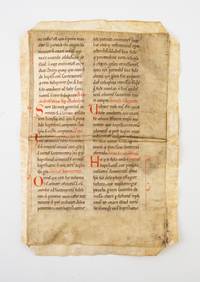
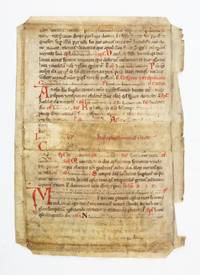
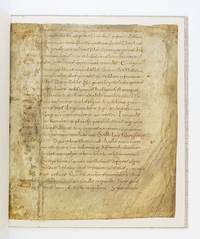
ST20837bGermany late 12th or early 13th century. 335 x 224 mm. 13 1/4 x 8 7/8". Double column 29 lines in an elegant proto-gothic book hand. <br/> Rubrics in red several two-line initials in red. Recovered from a binding and so the vellum a bit soiled creased and wavy recto with a lighter patch where a title label was once situated light stains and glue and paper residue on the verso but overall the leaf remarkably clean entirely legible and surprisingly well preserved.<br/> <br/> Once serving as a cover for a later book this leaf comes from a nearly contemporaneous copy of Peter Lombard's "Sentences" considered the most important theological book of the 12th century. Written between 1155 and 1158 and arranged topically Lombard's "Sententiae" summarize past learning about Christian doctrine by quoting authorities in an attempt to resolve textual disagreement by dialectical analysis. As a source collection that continued to spark discussion Lombard's great work enjoyed sustained success as a theological textbook until the 17th century and inspired numerous commentaries including those of Aquinas and Luther. This leaf comes from Book IV "On the Doctrine of Signs" which is primarily concerned with the seven sacraments: Baptism Confirmation the Eucharist Penance Extreme Unction Sacred Orders and Matrimony. The script is an upright and very legible proto-gothic book hand with a few distinctive letter forms and abbreviations that may help determine a more definitive point of origin these include a "g" with a downward cross on its tail and a conjoined "qe" for "que". It is unusual and very lucky that this leaf survives completely intact as Medieval manuscripts used in later bindings were often cut down in size to make smaller covers or used as waste paper for pastedowns or other binding elements. unknown
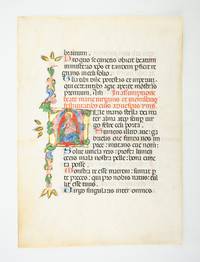
ST20973Italy 15th century. 364 x 260 mm. 14 3/8 x 10 1/4". Single column 22 lines in a rounded gothic book hand. <br/> Rubrics in red versal initials alternating red and blue with purple penwork one three-line initial in blue with purple penwork A SIX-LINE "A" DEPICTING THE ASSUMPTION OF THE VIRGIN the initial painted pink with red green and blue nodes and acanthus on a burnished gold ground with extensions running the length of the text column incorporating more acanthus and small gold embellishments with sprays of the gold leaves at the top bottom and center. A little rubbing to the paint negligible soiling and small spots to margins but in excellent condition overall.<br/> <br/> This very large handsomely preserved leaf features a strikingly attractive initial of the Virgin opening the beloved hymn "Ave Maris Stella" "Hail Star of the Sea". Dating back to at least the ninth century and traditionally associated with the hour of Vespers on Marian feast days as here the hymn praises the Virgin's purity meekness and mercy calling upon her as the "Nurturing Mother of God" to dispel evil and free us from our sins. Inside the gilt and painted initial is a lovely portrait of the Virgin who is depicted seated against a red mandorla dressed in pink and wrapped in a green and blue mantle--perhaps a reference to the colors of the ocean. Her hands are raised in prayer fingers lightly touching above her heart and her well-defined features appear both strong and serene. Judging from the size of the initial liberal use of gold and the wide margins of this leaf the original manuscript must have been a costly item produced for a wealthy church or monastery. unknown
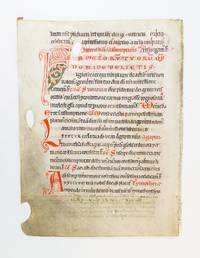
ST19350-013Germany early 13th century. 273 x 193 mm. 10 3/4 x 7 1/2". Single column 31 lines text in two sizes in a gothic hand. <br/> Rubrics in red several one- and two-line initials in red and two larger initials in red. A few lines with neumes later notations in the margins now quite faded. ◆Vellum a bit soiled and creased as expected fading to four or five lines where the spine was placed several notches along one edge other imperfections due to its reuse as binding scrap but still an excellent specimen that is almost entirely legible.<br/> <br/> Written in a neat and attractive hand this sizable leaf from a Missal remains mostly quite legible with all its rubrication intact despite having been used as part of a binding. A few lines also show musical notation from the earliest generation of neumes. They are described as "in campo aperto" which means literally "in an open field" because they and they alone occupy the space or "field" above the text. They are also described as adiastematic because they appear in a straight line whereas later diastematic neumes reflect changes in pitch by being placed in a higher or lower vertical position above the text. At the time the present leaf was written out the neumes here simply served as an "aide memoire" to the singer who had already learned the melody orally. unknown
ST17236Germany mid- to late 12th century. 290 x 217 mm. 11 3/8 x 8 1/2". Single column 21 lines in an attractive proto-gothic book hand. <br/> Rubrics in red several one-line initials in red five red initials measuring two to four lines long and with penwork embellishment A LOVELY SEVEN-LINE WHITE-VINE INITIAL outlined in red and with a pale yellow wash along the edge the lower half of the ground filled with green wash. Lower margins with notations in later Medieval hands. ◆A handful of original holes in the vellum no doubt from stretching the skin during processing with the scribe writing around the flaws where necessary a little soiling to lower outside corner one or two negligible spots otherwise IN FINE CONDITION the ink unusually rich and the paint very bright.<br/> <br/> From a Sacramentary a service book that contained the prayers said during Mass subsumed by the Missal in the 13th century this early leaf was once part of an attractive manuscript of very high quality. The very large and superb "F" opens the Mass for the Feast of the Assumption and the other readings here include Masses for Sts. Hippolytus and Cassian celebrated on 13 August; St. Eusabius 14 August; Vigil of the Assumption of the Virgin 14 August; Assumption of the Virgin 15 August; St. Agapitus 18 August; and the beginning of the Mass for Sts. Timothy Hippolytus and Symphorian 22 August. Sister leaves from this same manuscript have previously appeared in Sam Fogg Cat. 16 "Text Manuscripts and Documents 2200BC to 1600AD" 1995 nos. 30 and 31; Maggs Bros. European Bulletin 20 1995 no. 37; Quaritch Cat. 1270 "Bookhands of the Middle Ages VI" 2000 nos. 69 and 70; Sotheby's 6 December 2001 lot 8; and Bloomsbury 6 December 2017 lot 16. The Fogg description notes that similar initials can be seen in French German and Flemish manuscripts of the period "but very few manuscripts have the special characteristics of this one." For example the initials on the sister leaves described by Fogg contain atypically mauve and green as well as an "unusual . . . exterior contoured ground which is not confined by any geometric form." This means there is no line or shape to box in or define the capital's form; rather it appears as if surrounded by an aura or gentle shadow. Our initial contains a green ground only no mauve but the same unusual and attractive yellow aura. It is rare to find Romanesque leaves of this size and caliber in such fine condition and the present leaf with its beautiful regular proto-gothic hand exceptional white-vine initial and several large decorative initials in red is especially desirable. unknown
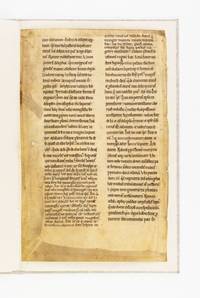
ST17768<p>England second half of 12th century but before 1180. 313 x 198 mm. 12 1/4 x 7 3/4. Double column 32 lines in a lovely late Caroline hand verso with some lines erased and corrected in a smaller hand. <br />Mounted in a fine tan cloth folder between sheets of textured acid-free paper. Front pastedown with book label of the Schøyen Collection with their shelf mark MS 237 written in ink. ◆Recovered from a binding and thus with overall toning and soiling recto somewhat browned from binder's glue but almost entirely confined to three margins and the verso virtually unaffected other trivial imperfections but in surprisingly good condition given its history the very rich ink especially dark and well preserved.<br /><br />This is an exceptionally lovely example of an early English book hand standing at the crossroads of the Caroline and proto-gothic calligraphic traditions. According to Thompson "In the twelfth century the scribes seem to have vied with each other in producing the best types of book-writing of which they were capable with the result that remarkable precision in the formation of the letters was attained and that the century may be named as excelling all others for the beauty of its MSS." "Greek and Latin Paleography" p. 436 The present leaf certainly lives up to this description being notable for its exceptionally neat and legible script written with uncommonly pretty and regular letter forms by a practiced and confident hand. The Caroline tradition is apparent in certain tendencies such as the use of "&" for "et" and the lack of biting curves between letters while a shift toward the proto-gothic can be seen in the vertical and compressed letter forms as well as the increased use of abbreviations and ligatures. Although the present work has often been credited to Haymo of Halberstadt due to a longstanding error in attribution reaching back to the 15th century modern scholarship now recognizes Haimo of Auxerre a monk at the Abbey of Saint-Germain in Auxerre d. ca. 875 as its true author. A prominent theologist and writer during the Caroline Renaissance Haimo produced a number of influential commentaries on various books of the Bible. The provenance on this leaf can be traced back as far as the mid-19th century when it was auctioned at Sotheby's on 21 August 1858 lot 119.2 sold as part of an album containing various leaves and fragments put together by Philip Bliss 1787-1857 registrar of the University of Oxford. It then went into the celebrated collection of Sir Thomas Phillipps 1792-1872 and was eventually sold by the Robinson Brothers on 24 April 1911 lot 390.3. This leaf has previously appeared in Quartich's catalogue 1036 "Bookhands of the Middle Ages" no. 79.5 and was most recently in the collection of Martin Schøyen his MS 237.</p>
ST17766Probably Germany third quarter of ninth century. 285 x 245 mm. 11 1/4 x 9 3/4". Single column 25 lines in a Caroline minuscule book hand. <br/> Tipped into a paper folder and presented in a tan cloth binding with ink notation on spine and a small sticker on upper cover. Rubrics in red. Front pastedown of folder with the bookplate of the Schøyen collection. With several pages of typed and handwritten notes including Bernard Rosenthal's cataloguing and a copy of a letter from Bernhard Bischoff to Rosenthal concerning the dating of the leaf. ◆Recovered from a binding and thus with some expected browning staining and wrinkling a long vertical fold through the text touching a couple letters of each line recto with the first few words of each line roughened and somewhat obscured a couple of other words a bit hard to make out but the vast majority of text very legible with fore and tail margins very ample and in all quite a good specimen representing a remarkable survival.<br/> <br/> Featuring a lovely Caroline miniscule hand this very early leaf from a Lectionary may have been made for the use of a particular church or individual and comes with recent distinguished scholarship and provenance. Although the text here contains familiar passages from the Old and New Testaments their juxtaposition in this context presents a bit of a conundrum: as the enclosed cataloguing explains the story of the wicked husbandmen from Matthew followed by the story of Esau surrendering his birthright to Jacob from Genesis "is an irregular and indeed unrecorded liturgical sequence of texts and suggests that this particular collection of lections was compiled for a particular church or private chapel." It is also possible that the Lectionary was made for the use of an individual rather than an institution with certain needs or preferences—perhaps a scholar or theologian or even a Carolingian nobleman many of whom were literate and educated. The hand here is an excellent example of the legible and elegant Caroline minuscule that dominated Western Europe in this period; distinctive letter forms include clubbed ascenders such as on the letters "b" "d" and "l" a long "s" with the shaft on the line and the use of the ampersand as a general abbreviation for the letters "et" occurring anywhere in a word for example "conter&" for "conteret". Termed the "integrated ampersand" this usage is especially characteristic of Caroline minuscule manuscripts of the late eighth and ninth centuries. Our leaf comes with bookseller Bernard M. Rosenthal's catalogue description noting that it was "Purchased from Schab New York Feb. 1969." William H. Schab was a book and art dealer in the firm of Gilhofer and & Ranschburg in Vienna before fleeing Austria in 1938 and settling in New York where he founded his own business. Also included here is a copy of a handwritten note regarding the date of the present leaf from renowned paleographer Bernard Bischoff. The leaf was also featured in Quaritch's 1991 catalogue 1147 Bookhands of the Middle Ages V no. 25.5 and was until recently part of the Schøyen Collection their MS 623. Four additional pages of cataloguing are also included here. Despite having been used as binding scrap at some point in its life this leaf is very well preserved with no words lost from trimming with distinctly visible ink and in a clear and very pleasing hand. unknown
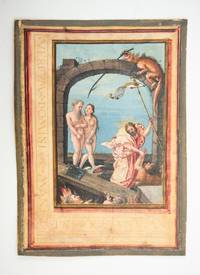
1540ST20622Germany ca. 1540. 183 x 133 mm. 7 1/8 x 5 1/4". <br/> WITH A FULL-PAGE MINIATURE DEPICTING THE HARROWING OF HELL featuring a naked Adam and Eve on the left and on the right Christ bending down to rescue John the Baptist the figures framed by a stone archway supporting a hairy creature who aims the point of a spear directly at Adam and Eve the miniature in a thin brown frame with gilt lines surrounded on two sides by the words "VERBUM DOMINI MANET IN ETERNUM" in gilt all framed in gray and red washes with double rules of black and gilt. Light soiling to frame a little flaking to the gray border and a couple of small scuffs and smudges elsewhere verso with spotting but the miniature vibrant and well preserved with only very trivial imperfections.<br/> <br/> A close copy of an early 16th century engraving by Albrecht Dürer this powerful miniature depicting the Harrowing of Hell is an intriguing artifact that ties together manuscript art print culture and the Reformation. The image depicts an apocryphal tale in the Gospel of Nicodemus in which Christ following his death but before his Resurrection descends into Limbo in order to save righteous souls who had passed away before him particularly figures from the Old Testament. Christ appears here in pale pink robes carrying a long staff with a cross and banner adorning the top. Having just brought down the gates of Hell he stoops to rescue John the Baptist here dressed in furs from its depths. A naked Adam and Eve covering their loins stand at the left of the composition--Adam now a gray-bearded old man as a reflection of sin and mortality but Eve still as she was at the Expulsion in keeping with the period's inclination to retain the classically idealized youthful feminine form. Above them is a stone arch upon which a dog-like demon perches stealthily aiming a spear directly at the oblivious couple. Another demon snaps its jaws at the feet of Christ and we can see a lick of flames below the broken gate as more captive souls clamor to escape. The painting is skillfully done showing the artist's facility with anatomy proportion and foreshortening. The bodies of Adam and Eve are particularly excellent with lovely skin tones and convincing molding. The composition is clearly based on an engraving by Dürer published in 1513 as part of a major series of 16 images known as the "Engraved Passion." In translating a black & white print into a full-color painting the artist here dispensed with a few details seen in Dürer's work such as the shadowy figure behind Adam and Eve and the stigmata on Christ's hand; however the overall composition deviates little from the original suggesting that the artist may have been working from an actual engraving. Although this leaf contains just a few words in the form of a border inscription--"Verbum Domini manet eternum" "the Word of the Lord endures forever"--they are monumentally important. This line from Isaiah 40:8 and 1 Peter 1:25 became the motto of the Lutheran Reformation appearing on art clothing coins and even armor of the 16th century. The Schmalkaldic League an influential group of allied Lutheran principalities in the Holy Roman Empire at the time also adopted it as their motto. Given the dominance of print materials during the Reformation period our hand-painted miniature--possibly produced as a frontispiece--must have been a very special commission. It is also an object that is prime for further study touching on aspects of book production religious art and the transmission of images and ideas in the early modern period. unknown
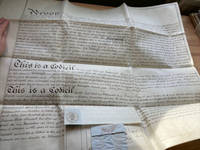
49886Great Waldingfield Sudbury Suffolk: Reverend Francis Cresswell 22nd December 1841 Probate. 22" x 27". 2 vellum sheets written on one side. Two vertical folds and three horizontal folds. Plus the probate certificate is attached including the paper/wax seal. Family history records show Francis Cresswell was born in 1762. He married Jane Okes on October 12 1807 in Cambridge Cambridgeshire England. He died on November 17 1841 in Suffolk England having lived a long life of 79 years and was buried in Great Waldingfield Suffolk. "1807 - Francis Cresswell S.T.B. Clare College Cambridge; B.A. 1785; M.A. 1788; B.D. 1796; Fellow and Tutor; was instituted March 24 1807 enjoying the benefice thirty-five years.He died Nov. 17. and was burried here November 24 1841 aged 78 years. There is a tablet in the church. In the churchyard West of the church is a stone with the initials: "F.C." 1841 J.C. 1870. The Parish register gives Francis Cresswell buried 24 Nov. 1841 aged 78. Jane Cresswell of Melford late of Great Waldingfield buried Feb 5 1870 aged 91." - See Rectors of Great Waldingfield By Rev. Francis Haslewood . Great Waldingfield, Sudbury, Suffolk: Reverend Francis Cresswell 22nd December 1841 (Probate) hardcover
192869614Wien, F. G. Speidel, [1928]. 84 S. Mit 9 s/w. Taf. 4to (28 x 20,5 cm). OHPgt. mit Goldpräg.
191325630Hans von Weber, München, S. Fischer, Berlin, 1913. Rodenberg 414. Originalpergamentband mit Deckelvignette (Doppelsignet beider Verleger) und Kopfgoldschnitt. [8[, 278, [4] Seiten. 28 : 20 cm.
3752897015.Gpaperback. Good. Access codes and supplements are not guaranteed with used items. May be an ex-library book. paperback
196612447Paris - Bièvres, Pierre de Tartas, 1966 ; in-folio en feuilles sous couverture beige muette, coffret d'éditeur de tissu marron, titre lavande, intérieur de suédine grise ; (106) pp., (2) ff. blancs, 18 lithographies originales en couleurs, dont 7 à doubles pages et 3 en marge du livre par Jean Commère.
1974024244Bruxelles 1974 Bibliotheque Royale Albert Ier Soft cover Inscribed by Author(s)
184020303Paris, Ernest Bourdin et Cie éditeur, 1840. In-8 de 4-VII-[1]-VIII-621-[3] pages, demi-veau beige à petits coins, dos à nerfs orné de filets et fleurons dorés, roulette à froid.
181110857Paris, Didot l'aîné, 1811. In-folio de 48 feuillets et 35 planches hors-texte, demi-veau chamois à coins, dos à nerfs, coiffes, mors et coins frottés. Reliure moderne. Exemplaire non rogné. Quelques rousseurs aux feuillets initiaux et finaux. Voici la collation des 96 pages de texte: [8] pages soit 1ff. blanc, faux-titre, titre, 1 ff. de table des planches, 6p. pour le Tableau général du lac de Genève (dernière bl.), [8]p. pour la description des planches, 10p. pour le Tableau général du Valais (dernière bl.), [8]p. pour la description des planches, 4p. pour le Tableau général du Simplon, [34]p. pour la description des planches, 2p. pour le Tableau général du lac Majeur, [12]p. pour la description des planches, [2]p. pour 1 ff. blanc.
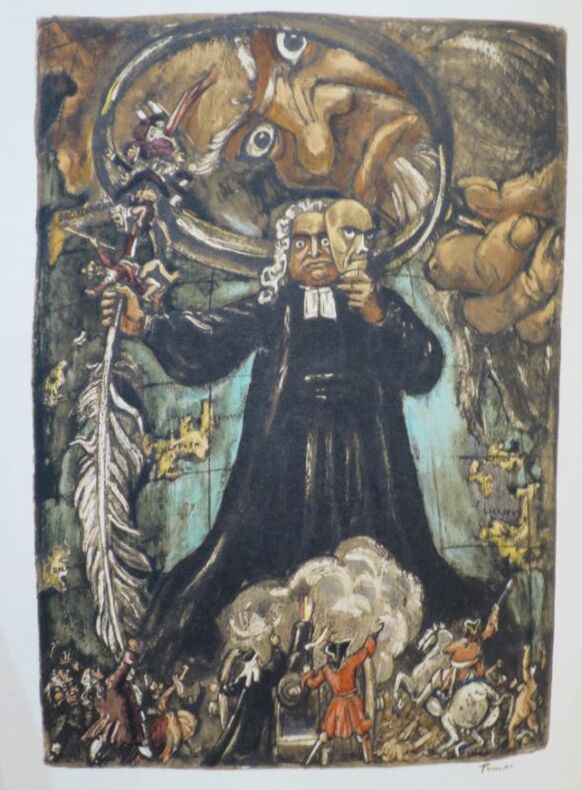
110747Paris, A l'Emblème du Secrétaire, 13, rue Daguerre, 1940, 2 volumes in-8 de 235x185 mm environ, Tome I : 252 pages, Tome II : 240 pages, reliure demi chagrin bordeaux, dos lisses portant titres filets dorés. Exemplaire numéroté n° 536, un des 920 exemplaires sur Vélin ivoirine des Papeteries Boucher, orné de 2 frontispices et de 80 illustrations en couleurs dans le texte, (certaines en double-page, ou pleine page), de Timar, toutes comprises dans la pagination. Petits frottements sur les coupes inférieures, petit défaut restauré sur la bordure inférieure du premier plat (tome I), sinon bon état.
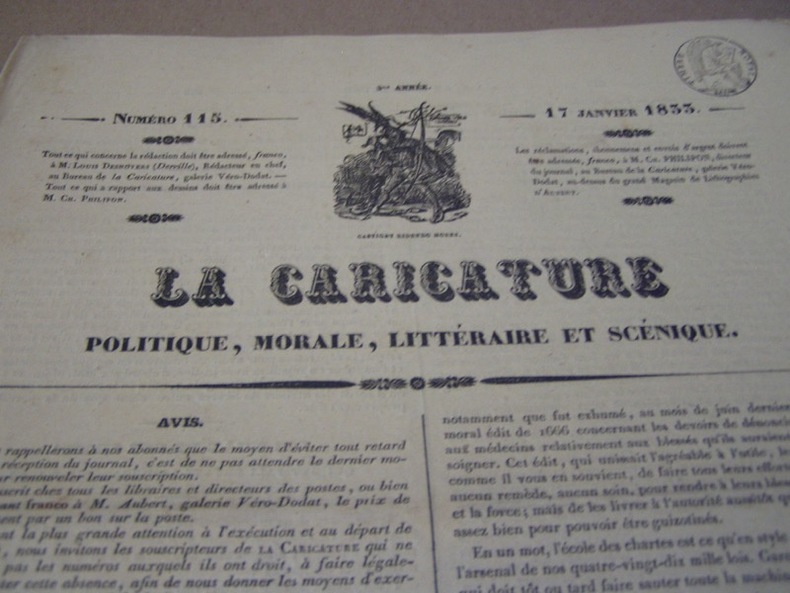
25220Planche HT parue dans La Caricature politique, morale, littéraire et scénique, volume 5, 17 janvier 1833 (Planche n°238) - Hauteur: 27cmx Largeur: 35.8cm - Image : Hauteur: 20cmx Largeur: 25.5cm - Titre en bas au centre : « Voulez vous aller faire vos ordures plus loin, polissons ! » ; indications : en ht à gauche : « La Caricature (Journal) N°115. », en ht à droite : « Pl. 238 »- Dans la lettre : « Lith. de Becquet, rue childebert N°9. » [imprimeur], « On s’abonne chez Aubert, Galerie véro dodat. » [éditeur] ; dans l’image, en bas à gche : « AB. » [Auguste Bouquet, dessinateur]Inscription - A côté du rebord de la fenêtre, un graffiti rouge représente le long nez de « d’argout ». D’autres inscriptions sont présentes sur ce mur : « Thierrat » ( ?) et « Crédeville // Voleur » (nom d’un usurier qui avait été contraint de quitter Paris ? ; graffiti rencontré fréquemment sur les murs de Paris à l’époque, sous la forme « Crédeville voleur » ou simplement « Crédeville »)
191488680Berlin, Julius Bard, 1914. 222 S. Mit 30 s/w Abb. a. Taf. 21,5 cm. Orig. GANZPERGAMENT mit RSchild und Kopfgoldschnitt.
192171918Dresden, Carl Reißner, (1921). 79 S., 1 Bl. Mit 5 Illustrationen auf Tafeln. 22 cm. OHPgt m. goldgeprägtem Rückenschild u. Kopfgoldschnitt.