Velin, FrançoisLivre Rare Book
Velin KoychevBiblio.com
Orthodontic Treatment Protocols
A9786199164006Paperback / softback. New. paperback

The Saint Bookstore · Royaume-Uni126,11 £GB≈ 143,99 €
1 337 résultats
SLIVCN-9782258211308Presses de la Cité (5/2025)
A9786199164006Paperback / softback. New. paperback
1822mon0003529457Chez de Bure Freres 1822. Paperback. Good. . Extremely scarce in any condition. 5 volumes in 4 physical books II and III in one. Fragile but fully intact. Some chipping at edges. Pages clean. Chez de Bure Freres paperback
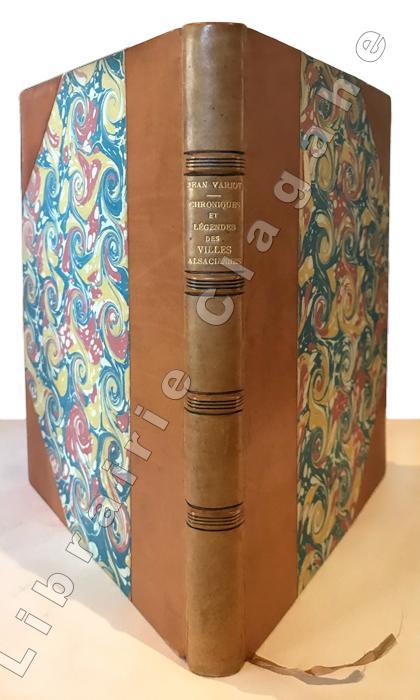
192721568Strasbourg, Collection de la vie en Alsace, 1927 ; in-8 (242 mm), demi-veau fauve à coins, dos à larges nerfs soulignés de filets à froid, titre diré, couverture illustrée et dos conservés, non rogné (Madelain) ; XII, 166, [2] pp., nombreuses gravures en noir et blanc.
16642940Amsterdam, ex officina Elzeviriana, 1664 ; in-16 ; plein vélin à recouvrements, titre manuscrit au dos, tranches mouchetées (reliure de l’époque) ; (20) ff. (titre gravé, lettre dédicatoire, index des chapitres et propositions), 748 pp., 4 tableaux dépliants et 1 planche dépliante.
In 4°; 10 tomi in 9 volumi, completo. Riedizione, anastatica, della prima edizione parigina delle due opere uscite nel 1822-8 e nel 1824-8. Legatura editoriale in piena tela nera con titolo impresso in oro al dorso. Ottime condizioni di conservazione di questa importante opera bibliografica dedicata alle opere stampate su pergamena conservati nella Biblioteca Reale, nella Biblioteca Nazionale di Francia e nelle altre biblioteche francesi. Completo ed in ottime condizioni di conservazione.
1930013338Paris Henry Babou - Collection "La technique du livre et des arts graphiques" 1930 En feuilles sous portfolio
956Paris, A l'Etoile, 1946 16 x 25, 179 pp., non coupé, bon état
1952CCC0019954. Gallimard NRF, 1952. Couverture rigide. État : Très bon. In-8 cartonnage d'édition d'après la maquette de Paul Bonet. Lettres à quelques-uns. Gallimard, NRF, 1952, EDITION ORIGINALE. Exemplaire numéroté sur vélin labeur des papeteries Navarre de Voiron N°1199 Haut du dos legerement corné
1971005640Colombes , Collection Génération n°5 (Gervais Jassaud) 1971 In-8 Broché Edition originale
1949001068Paris K Editeur 1949 In-8 Broché, couv. illustrée Ed. numérotée
1931013821Paris Editions Surréalistes 1931 Broché, couverture rempliée> Dédicacé par l'auteur
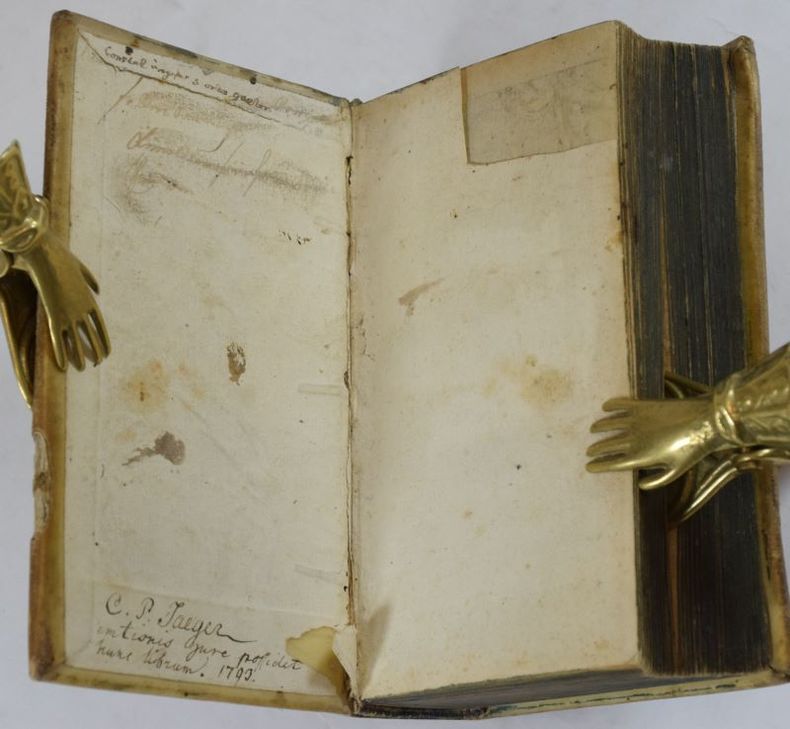
17025728Lipsiae (Leipzig), Sumpt. Jo. Lud. Gleditschi, 1702. In-12 (135 x 81 mm), frontispice gravé, (3) ff. : titre, Lectori Benevolo S.P.D., 554 pp., (66) feuillets : "Index Terentianus". Reliure vélin, dos lisse, inscription manuscrite en tête du dos, tranches bleutées, ex-libris manuscrit ancien sur contreplat, traces d'un ex-libris manuscrit ancien effacé sur contreplat, rectangle de 25 x 40 mm découpé à l'angle sup. de la page de garde, inscription ancienne à l'encre raturée sur titre, manque de cuir et fente sur les coupes de 30 x 5 et 20 mm. Bon exemplaire.
1935002866Paris Denoel et Steele 1935 In-8 Broché Edition originale
1946009238Paris Glm 1946 In-4 Broché
1947014999Paris Bordas 1947 En feuilles
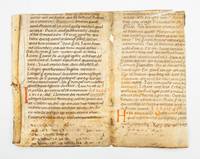
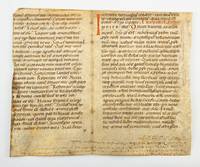
ST15769aPerhaps France mid-12th century. Each leaf measures approximately 370 x 240 mm. 14 1/2 x 9 1/2". Double column 32 lines in a fine proto-gothic hand. <br/> See: Thompson "An Introduction to Greek and Latin Paleography" p. 436. ◆Recovered from a binding and thus with one side of each leaf somewhat browned soiled and with a few creases one leaf with several small blotches of red paint in the text not affecting overall legibility one corner of each leaf torn away affecting running title and one to two lines of text other trivial defects but still very nice specimens with clear and legible script and one side of each leaf quite clean and well preserved.<br/> <br/> Once part of a large and elegant Romanesque Bible these leaves are excellent examples of a high quality proto-gothic book hand. Sometimes referred to as "praegothica" or "late Caroline" the proto-gothic script is characterized by letterforms that are more or less unchanged from Caroline minuscule but with a number of traits starting to show elements of gothic script--most notably the addition of feet appearing here as an upward flick of the pen on the bottom of minims but also including the use of more abbreviations the fusion of certain letter combinations a more elongated "o" and a straight-backed "a." Whatever the level of its evolution the script here has very pleasing rounded letterforms that are highly legible and generously spaced. Though the vellum is not unmarred by its former life as binding material the script here has not lost any of its beauty revealing a hand that is practiced regular and distinctly pleasing to the eye. As Thompson notes "In the twelfth century the scribes seem to have vied with each other in producing the best types of book-writing of which they were capable with the result that remarkable precision in the formation of the letter was attained and that the century may be named as excelling all others for the beauty of its MSS." Our leaves come from Deuteronomy the Old Testament book consisting primarily of three sermons made by Moses just before entering the Promised Land. One leaf contains brief summaries of chapters 2-18 with some chapters numbered in the margins while the other leaf contains part of the first of Moses' speeches in which he recalls the Israelites' 40-year journey through the wilderness. unknown
ST19578Northern Italy last quarter of 15th century. Each leaf measuring 250 x 164 mm. 9 7/8 x 6 3/8". Single column 24 lines in a handsome humanist hand. <br/> Each leaf with three to four large initials one measuring two lines all others three lines in burnished gold in-filled with pink and green paint with white embellishment on blue ground with white embellishments. See: Baldwin "Medieval Rhetoric and Poetic" pp. 216-23. ◆Insignificant wrinkling and a couple faint creases to vellum tiny snag along top edge of each leaf but IN VERY FINE CONDITION the vellum especially clean and bright the paint and ink fresh and the margins generous.<br/> <br/> Written in a beautiful humanistic script enclosed by wide margins and adorned with tasteful gilt initials these leaves come from what must have been a particularly fine manuscript made for a person of means. The text comes from the "Candelabrum" of Bene of Florence an early 13th century treatise on rhetoric and the art of elegant writing. The work consisted of eight parts instructing readers on word choice composition rhythm style and other important considerations in the construction of effective letters and prose. Apart from their enormous aesthetic appeal the present leaves are of great interest because few manuscripts of the text have survived. The style of the initials--elegant burnished gold on a ground of pale pink green and sapphire blue with whisps of white embellishments--suggest that the manuscript was executed in Northern Italy perhaps Milan Bologna or Florence by a craftsman of great technical skill. Fine examples of humanistic script are becoming increasingly difficult to find on the market and the present examples are among the loveliest we have ever acquired. unknown
ST20509c-dGermany Late 11th or early 12th century. Larger bifolium measures 221 x 275 mm. 8 7/8 x 10 3/4".; smaller bifolium measures 207 x 275 mm. 8 1/8 x 10 3/4". Single column 25-27 lines in a late Caroline hand. <br/> Rubrics in orange each bifolium with one or more one-line initial in orange and one or more large four- to five-line initials in orange. With marginal notations in a later hand. Recovered from a binding and thus with some soiling abrasions glue residue and other small problems as well as limited loss of legibility in a few places; the pages nearly complete but with a couple of letters and/or lines cut away from one side of each bifolium; even with the problems very good specimens overall the letters on the better side quite clear and readable in each case.<br/> <br/> Once part of a Lectionary a collection of scriptural readings appropriate for Masses and other ceremonial occasions through the year these attractive mostly legible binding fragments display an excellent transitional script with both Caroline minuscule and proto-gothic characteristics. The present examples include short lessons or "lectiones" taken from the Old and New Testaments including among other passages excerpts from John in which Christ casts the sellers out of the temple and Daniel relating the prayers of the three men who refused to bow to Nebuchadnezzar's golden idol. The lovely script here shares much in common with the pure Caroline miniscule of earlier centuries--particularly in the overall legibility of the text the space between individual letters and the limited use of ligatures and abbreviations; also of note is the exclusive use of the long "s" unless at the beginning of a sentence and the ampersand as a general abbreviation for the letters "et" occurring anywhere in a word e.g. "propheta" written "proph&a" here. Evidence of a progression toward proto-gothic script can be observed here in the appearance of certain letter forms such as the closed "g" a more oval "o" and the use of two forms of "d" both upright and Uncial the latter with a sloping shaft. There is added interest here in the form of marginal notations in a later hand--probably dating from the time these bifolia were in situ as binding waste. The price given here is for one bifolium. unknown
ST20509a-bGermany Late 11th or early 12th century. Largest bifolium measures 221 x 275 mm. 8 7/8 x 10 3/4". Single column 25-27 lines in a late Caroline hand. <br/> Rubrics in orange each bifolium with one or more one one-line initial in orange and one or more large four- to five-line initials in orange. With marginal notations in a later hand. Recovered from a binding and thus with some soiling abrasions glue residue and other small problems; the pages nearly complete but with a couple of letters and/or lines cut away from one side of each bifolia with more extensive abrasions on one side affecting legibility but very good specimens overall the better side in each case quite clear and readable.<br/> <br/> Once part of a Lectionary a collection of scriptural readings appropriate for Masses through the year and other ceremonial occasions these attractive mostly legible binding fragments display an excellent transitional script with both Caroline minuscule and proto-gothic characteristics. The present examples include short lessons or "lectiones" taken from the Old and New Testaments including among other passages excerpts from John in which Christ casts the sellers out of the temple and Daniel relating the prayers of the three men who refused to bow to Nebuchadnezzar's golden idol. The lovely script here shares much in common with the pure Caroline miniscule of earlier centuries--particularly in the overall legibility of the text the space between individual letters and the limited use of ligatures and abbreviations; also of note is the exclusive use of the long "s" unless at the beginning of a sentence and the ampersand as a general abbreviation for the letters "et" occurring anywhere in a word e.g. "propheta" written "proph&a" here. Evidence of a progression toward proto-gothic script can also be observed here in the appearance of certain letter forms such as the closed "g" a more oval "o" and the use of two forms of "d" both upright and Uncial the latter with a sloping shaft. There is added interest here in the form of marginal notations in a later hand--probably dating from the time these bifolia were in situ as binding waste. unknown
166023685A Paris, chez Charles Angot, 1660. 4 parties reliées en fort vol. au format in-4 (238 x 183 mm) de 4 ff. n.fol., 348, 431 pp. et 26 ff. n.fol. Reliure ''à la hollandaise de l'époque de plein vélin ivoire à coutures apparentes et recouvrements, dos lisse, titre anciennement calligraphié en tête.
1999015392Grasset 1999 In-8 Broché
1945005937Paris Seghers "collection des 150" 1945 In-16 Broché
014261Piazza 0 In-4 En feuilles, couverture illustrée rempliée, chemise et étui éditeur
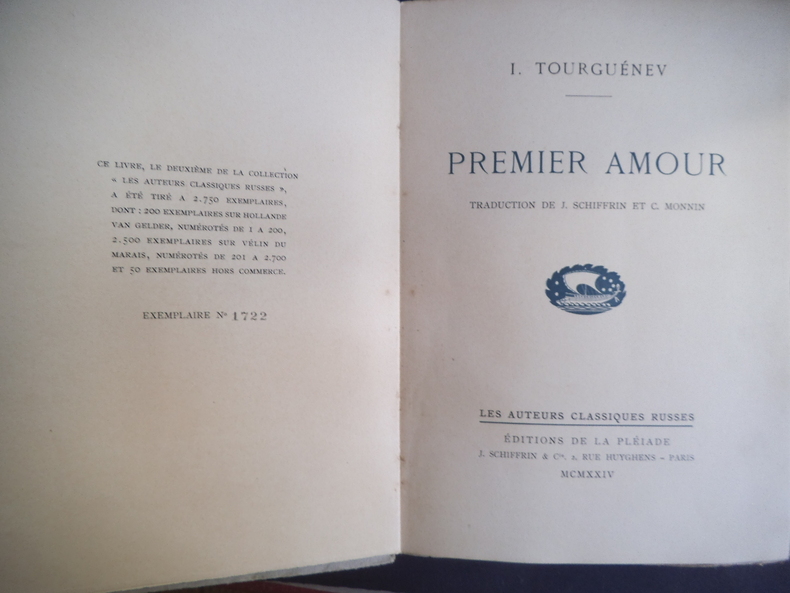
14116In 8 broché, 150x220mm, couverture rempliée, faux-titre, titre, 149 pages, Presses du maître imprimeur P COULOUMA 10 septembre 1924. Exemplaire numéroté sur vélin du Marais. Les auteurs classiques Russes. Editions de la pléiade 1924. Traduction de J SCHIFFRIN et COMONNIN. Très bon état