1 336 résultats
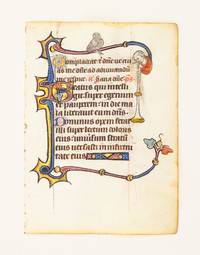
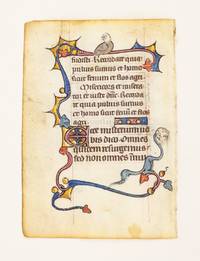
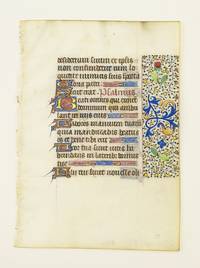
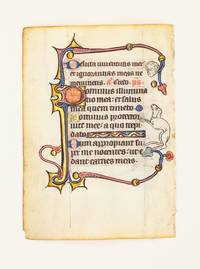
ST16985NFrance first half of 14th century. 110 x 82 mm. 4 3/8 x 3 1/4". Single column 12 lines in a gothic book hand. <br/> Line enders in pink and blue with gold accents each leaf with one or more one-line initials in blue with red penwork or gold with blue penwork each leaf with one two line initial painted pink or blue filled with painted floral motifs and TWO INHABITED BY HUMAN FACES and on a gold ground one side of each leaf with A FULL BORDER composed of pink and blue tendrils accompanied by spikey gold decoration and gold accents often terminating in ivy leaves and incorporating EXTRAORDINARILY CHARMING EXAMPLES OF MARGINALIA INCLUDING ANIMALS HUMAN HEADS AND HUMAN-BEAST HYBRIDS. ◆Vellum a little soiled and with a few small stains one leaf with more obvious soiling varying degrees of smudging two leaves with more noticeable smudging affecting some of the text and decoration another leaf with two of the human heads slightly rubbed but all other examples of marginalia very well preserved and paint quite fresh and the gold sparkling.<br/> <br/> Though diminutive in size these leaves contain enormously appealing marginal decoration in the form of humans animals and hybrid creatures inventively incorporated into the lively borders in manners that range from adorable to bizarre. Especially popular in Flanders Northern France and England during the 13th and 14th centuries marginalia such as these comprise some of the most memorable and entertaining images to be found in any Medieval manuscripts. Despite being found largely in religious books such as Psalters and Books of Hours the images are often strange humorous or even outrageous and they provide us with consistent delight. Being by definition outside of the central text or miniature the margins seem to have been a place where illuminators felt more at ease to experiment resulting in highly imaginative and unique artistic expressions. The present specimens come from a fragmentary manuscript with many leaves either missing or rendered defective where portions of the vellum were cut away. Fortunately this group of leaves is intact and retains much marvelous imagery including several animals a dog a bird a squirrel and a large hare human and bestial heads capping the ends of border tendrils many with a memorable detail such as a bushy beard a massive gold horn or wearing a tall pointy hat including the torso of a person holding a long antler-like club and colorful human-beast hybrids. A couple of these leaves also have initials inhabited by charming little human faces. For additional leaves from this same manuscript at different price points please check our website. unknown
ST16985QFrance first half of 14th century. 110 x 82 mm. 4 3/8 x 3 1/4". Single column 12 lines in a gothic book hand. <br/> Line enders in pink and blue with gold accents each leaf with one or more one-line initials in blue with red penwork or gold with blue penwork each leaf with one two line initial painted pink or blue ONE INHABITED BY HUMAN FACE others filled with painted floral motifs all on a gold ground one side of each leaf with A FULL BORDER composed of pink and blue tendrils accompanied by spikey gold decoration and gold accents often terminating in ivy leaves and incorporating EXTRAORDINARILY CHARMING EXAMPLES OF MARGINALIA INCLUDING ANIMALS HUMAN HEADS AND HUMAN-BEAST HYBRIDS. ◆Vellum with a little soiling and a few small stains slightly more noticeable on one leaf where it is touching the text though not obscuring meaning a few instances of rubbing to gold and decoration including one bird with its detailing rubbed away other minor imperfections but none of these flaws egregious and the most desirable imagery here still very well preserved.<br/> <br/> Though diminutive in size these leaves contain enormously appealing marginal decoration in the form of humans animals and hybrid creatures inventively incorporated into the lively borders in manners that range from adorable to bizarre. Especially popular in Flanders Northern France and England during the 13th and 14th centuries marginalia such as these comprise some of the most memorable and entertaining images to be found in any Medieval manuscripts. Despite being found largely in religious books such as Psalters and Books of Hours the images are often strange humorous or even outrageous and they provide us with consistent delight. Being by definition outside of the central text or miniature the margins seem to have been a place where illuminators felt more at ease to experiment resulting in highly imaginative and unique artistic expressions. The present specimens come from a fragmentary manuscript with many leaves either missing or rendered defective where portions of the vellum were cut away. Fortunately this group of leaves is intact and retains much marvelous imagery including an owl and two other birds one apparently holding a worm in its mouth human heads and torsos capping off the ends of border tendrils including a trumpeter blowing into a particularly long instrument and a man reaching both arms straight into the air as if trying to grab the head attached to the tendril above him and a hybrid with the head of a human in a gold hood and the body of a hare perched gingerly on an ivy branch. For additional leaves from this same manuscript at different price points please check our website. unknown
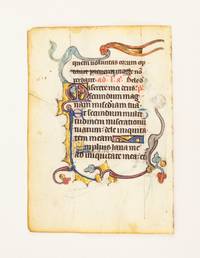
ST16985LFrance first half of 14th century. 110 x 82 mm. 4 3/8 x 3 1/4". Single column 12 lines in a gothic book hand. <br/> Line enders in pink and blue with gold accents each leaf with one or more one-line initials in blue with red penwork or gold with blue penwork each leaf with one two line initial painted pink or blue filled with painted floral motifs and on a gold or blue ground one side of each leaf with A NEAR-FULL BORDER composed of pink and blue tendrils accompanied by spikey gold decoration and gold accents often terminating in ivy leaves and incorporating EXTRAORDINARILY CHARMING EXAMPLES OF MARGINALIA INCLUDING ANIMALS HUMANS AND HYBRIDS. ◆Vellum a little soiled and lightly stained and wrinkled in places some of the gold a bit rubbed one leaf with some noticeable smudging affecting some of the text and decoration including the head of one of the hybrids but the other examples of marginalia quite well preserved and still retaining much of their original charm.<br/> <br/> Though diminutive in size these leaves contain enormously appealing marginal decoration in the form of humans animals and hybrid creatures inventively incorporated into the lively borders in manners that range from adorable to bizarre. Especially popular in Flanders Northern France and England during the 13th and 14th centuries marginalia such as these comprise some of the most memorable and entertaining images to be found in any Medieval manuscripts. Despite being found largely in religious books such as Psalters and Books of Hours the images are often strange humorous or even outrageous and they provide us with consistent delight. Being by definition outside of the central text or miniature the margins seem to have been a place where illuminators felt more at ease to experiment resulting in highly imaginative and unique artistic expressions. The present specimens come from a fragmentary manuscript with many leaves either missing or rendered defective where portions of the vellum were cut away. Fortunately this group of leaves is intact and retains much marvelous imagery including a particularly annoyed-looking bird two human-beast hybrids with long necks and bushy tails and a trumpeter emerging from the border decoration blowing into a long instrument decorated with gold accents. For additional leaves from this same manuscript at different price points please check our website. unknown
ST16985MFrance First half of 14th century. 110 x 82 mm. 4 3/8 x 3 1/4". Single column 12 lines in a gothic book hand. <br/> Line enders in pink and blue with gold accents each leaf with one or more one-line initials in blue with red penwork or gold with blue penwork each leaf with one two line initial painted pink or blue filled with painted floral motifs and on a gold ground one side of each leaf with A NEAR-FULL BORDER composed of pink and blue tendrils accompanied by spikey gold decoration and gold accents often terminating in ivy leaves and incorporating EXTRAORDINARILY CHARMING EXAMPLES OF MARGINALIA INCLUDING HUMAN-BEAST HYBRIDS. ◆Vellum a little soiled and with a few small stains one leaf with more noticeable smudging affecting some of the text and decoration another leaf with one of the heads a little rubbed but all other examples of marginalia very well preserved.<br/> <br/> Though diminutive in size these leaves contain enormously appealing marginal decoration in the form of humans animals and hybrid creatures inventively incorporated into the lively borders in manners that range from adorable to bizarre. Especially popular in Flanders Northern France and England during the 13th and 14th centuries marginalia such as these comprise some of the most memorable and entertaining images to be found in any Medieval manuscripts. Despite being found largely in religious books such as Psalters and Books of Hours the images are often strange humorous or even outrageous and they provide us with consistent delight. Being by definition outside of the central text or miniature the margins seem to have been a place where illuminators felt more at ease to experiment resulting in highly imaginative and unique artistic expressions. The present specimens come from a fragmentary manuscript with many leaves either missing or rendered defective where portions of the vellum were cut away. Fortunately this group of leaves is intact and retains much marvelous imagery including a beast with an exaggeratedly long body and horns and long-necked beasts with human heads--one who appears to be blowing smoke into the air one with a bearded face as its bottom and another with the body of a stork sporting a hat with a long pointy tendril. For additional leaves from this same manuscript at different price points please check our website. unknown
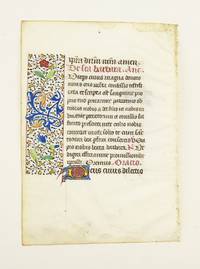
1440ST12158bAParis ca. 1440. 222 x 162 mm. 8 3/4 x 6 3/8". Single column 16 lines of text in a beautiful gothic book hand. <br/> Rubrics in red leaves with varying numbers of line fillers and one- and two-line initials in burnished gold blue and magenta highlighted with white tracery and WITH LOVELY RINCEAU BORDERS on one or both sides these composed of delicately twining hairline stems bearing red and blue blossoms and FEATURING A PROFUSION OF BURNISHED GOLD IVY LEAVES. IN OUTSTANDING CONDITION the vellum extraordinarily bright fresh and clean and WITH MARGINS AS VAST AS ONE COULD EVER HOPE FOR.<br/> <br/> Commissioned for use by a woman as indicated by the feminine form in the "Obsecro te" the Book of Hours from which these leaves come could only have been a manuscript of great beauty prepared for a household of very substantial wealth and importance. The level of achievement manifested here in both the scribal hand and the execution of the illuminated decoration clearly indicates that some of the best artisans money could buy were at work on this book and only a powerful family could afford to pay their price. Further corroboration of this fact is seen in the leaves' noticeable size and immense margins which are at least as wide as on any Book of Hours leaves we have ever owned. Such a conspicuous display of purchasing power those extra millimeters meant the slaughtering of extra animals and that meant greater cost announces an owner's self-congratulatory consequence that is uncommon except in the grandest of prayer books of the period. Happily the condition here matches the importance of the manuscript which was obviously considered from the beginning--and ever after--an object to be carefully preserved. For additional leaves from this Book of Hours at different price points please check our website. unknown
1450ST11774DParis ca. 1450. 159 x 108 mm. 6 1/4 x 4 1/4". Single column 15 lines per page in an excellent gothic book hand. <br/> Rubrics in red each leaf with two or more two-line initials in burnished gold on red and blue ground with white tracery some also with one-line initials and line fillers similarly decorated one or both sides with a swirling panel border featuring flowers leaves strawberries and many burnished gold ivy leaves on hairline stems. Isolated trivial stains or imperfections but VERY BRIGHT CLEAN AND FRESH.<br/> <br/> In fine condition beautifully decorated and sparkling with gold these leaves are marvelous examples of a high-quality Parisian Book of Hours made for a person of means. The borders here are especially pleasing with skeins of hairline vines accented by burnished bezants and ivy bright blue and gold acanthus pale green leaves and cheerful red blossoms. For leaves at other price points please check our website. unknown
1450ST11774EParis ca. 1450. 159 x 108 mm. 6 1/4 x 4 1/4". Single column 15 lines per page in an excellent gothic book hand. <br/> Rubrics in red each leaf with line fillers and multiple one- and two-line initials in burinshed gold on red and blue ground with white tracery one or both sides with swirling panel border featuring flowers leaves strawberries and many burnished gold ivy leaves on hairline stems. Isolated trivial stains or imperfections but VERY BRIGHT CLEAN AND FRESH.<br/> <br/> In fine condition beautifully decorated and sparkling with gold these leaves are marvelous examples of a high-quality Parisian Book of Hours made for a person of means. The borders here are especially pleasing with skeins of hairline vines accented by burnished bezants and ivy bright blue and gold acanthus pale green leaves and cheerful red blossoms. For leaves at other price points please check our website. unknown
1470in 8 broché carré,faux-titre,titre,26 pages,GLM 1948.édition originale Exemplaire numéroté sur vélin de Rénage.Très bon état
1920003755Paris Albert Messein 1920 In-8 Broché
175196354Berlin, Christian Friedrich Voss, 1751. Gestoch. Titel (als Frontispiz), XXXII, 513 S., [23] Bl. Titel in Schwarz- u. Rotdruck. Mit 12 (röm. num.) gefalt. Kupferstichtafeln. 18 cm. Pgt. d. Zt. mit 3 durchgestoch. Heft- u. 2 Fitzbünden, hs. Rückentitel u. Vollfarbschnitt (dieser mit Wasserrand oben).
192277705München, Piper, 1922. VII, 314 S., 1 Bl. Mit 6 Orig.-Graphiken und zahlr. teils farb. Lichtdrucktafeln. 4to. 28 cm. OHPgt.
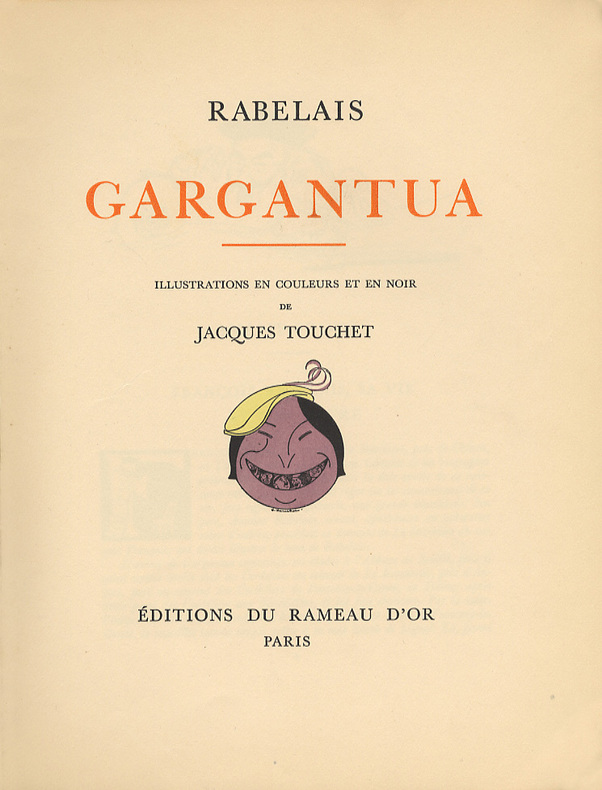
19352300Paris, Editions du Rameau d'or, 1935 ; 5 volumes in-4, brochés ; vol. I : (3) ff. (bl., faux-titre, titre), 207 pp., (3) ff. (achevé d'imprimer, 2 bl.), 10 planches hors-texte en couleurs ; vol. II : (3) ff. (bl., faux-titre, titre), 172 pp., (1) f. (achevé d'imprimer), 10 planches hors-texte en couleurs ; vol. III : (3) ff. (bl., faux-titre, titre), 233 pp., (2) ff. (achevé d'imprimer, bl.), 10 planches hors-texte en couleurs ; vol. IV : (3) ff. (bl., faux-titre, titre), 258 pp., (2) ff. (achevé d'imprimer, bl.), 10 planches hors-texte en couleurs ; vol. V : (3) ff. (bl., faux-titre, titre), 191 pp., (3) ff. (achevé d'imprimer, 2 bl.), 10 planches hors-texte en couleurs ; couverture blanche à rabats illustrée en couleurs.
25979Paris, G. Cres, 1922 20x27.6 cm., 813 pp., relie demi-maroquin havane a coins, signee par Laurent Peeters - Anvers. Filet dore cernant les plats de pap., dos orne, dos a 5 nerfs et finnement fleuronnes dores (decor floral), tete doree, couverture imprimee d'editeur. edition transcrite et annotee par Henri Clouzot, conservateur du Musee Galliera et illustree de 525 vignettes en n/b par Joseph Hemard, Tirage limite. Tirage de 400 exemplaires sur velin a la forme des papeteries de rives.
1927015537Paris Librairie Gallimard - Editions de la Nouvelle Revue Française 1927 In-12 Broché
182177915Wien, J.B. Wallishausser / Hamburg, Perthes und Besser, 1821. XII, 444; XII, 360 S. (20 x 12). HPgt. m. schwarzgeprägt. RTitel.
5580Paris, Gallimard, 1928 12 x 19, 266 pp., broché, non coupé, très bon état
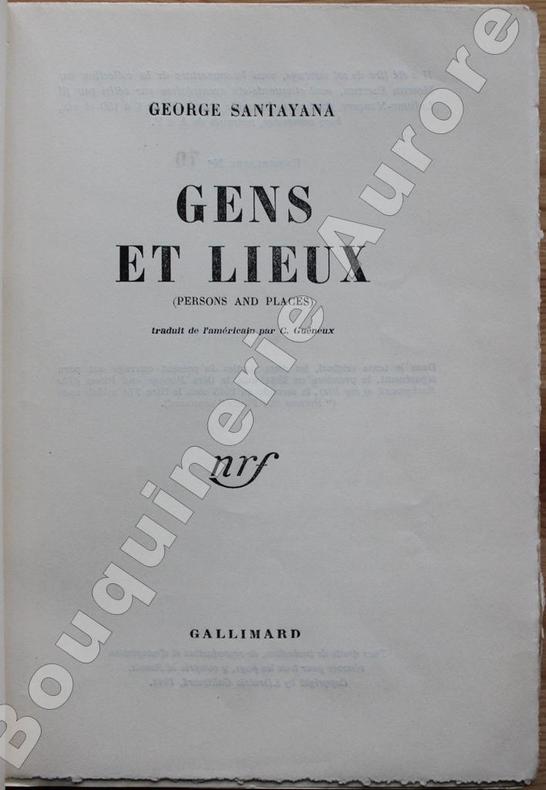
9669P., NRF Gallimard, 1948, 1 vol. in-8 (207 x 147) broché sous couverture bleutée imprimée en noir et rouge, de 397 pp. + table et achevé d'imprimer. Tranche supérieure poussiéreuse, très bel exemplaire.
173398340Venetiis [Venedig], Typographia Balleoniana, 1733. 347 S. 16 cm. Pgt. d. Zeit m. Rückenvergoldg.
16642940Amsterdam, ex officina Elzeviriana, 1664 ; in-16 ; plein vélin à recouvrements, titre manuscrit au dos, tranches mouchetées (reliure de l’époque) ; (20) ff. (titre gravé, lettre dédicatoire, index des chapitres et propositions), 748 pp., 4 tableaux dépliants et 1 planche dépliante.
191092171Berlin, S. Fischer, 1910. 21 cm. Flexibles OGanzPgt. m. Kopfgoldschnitt.
174788452Berlin, Haude und Spener, 1747. [4] von 6 Bl., 643 S. u. [4] Bl., 620 S. 17,5 cm. Pgt. d. Zeit m. goldgepr. Rückenschild.
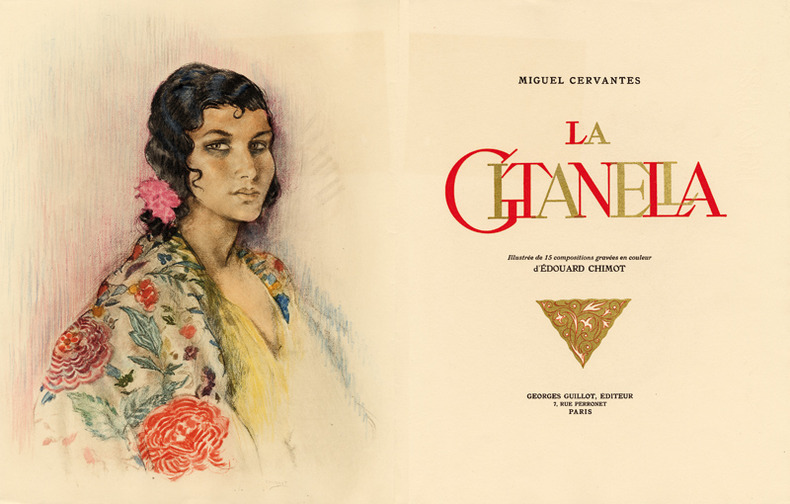
194816381Paris, Guillot, 1948 ; in-folio, en feuilles sous couverture gaufrée blanc-cassé rempliée, chemise-étui orange d’éditeur, titre en rouge ; (4), 123, [124], (4) pp., 15 eaux-fortes à pleine page, en couleurs, dont le frontispice, titre sang et or avec un fleuron d’arabesques, lettrine, rosace et cartouche de l’achevé d’imprimer de style hispano-mauresque sang et or.
8818Paris, Imprimerie de J. Haumont, 1944 13 x 20, 225 pp., broché, bon état
170977182Hamburg, Christian Liebezeit (Drucker: Spiering), 1709. Titel in Rot-Schwarz-Druck, 26 Bll., 527 S. Mit 1 Kpfr.-Frontispiz u. 1 gefalt. Kpfr.-Taf. (18 x 11,5 cm). Pgt. d. Zt.
239Paris, H. Piazza, 1926 17 x 24, 175 pp., non coupé, broché, très bon état