Wildgans, AntonAntiquariat.de

120 résultats
192869614Wien, F. G. Speidel, [1928]. 84 S. Mit 9 s/w. Taf. 4to (28 x 20,5 cm). OHPgt. mit Goldpräg.
191325630Hans von Weber, München, S. Fischer, Berlin, 1913. Rodenberg 414. Originalpergamentband mit Deckelvignette (Doppelsignet beider Verleger) und Kopfgoldschnitt. [8[, 278, [4] Seiten. 28 : 20 cm.
191488680Berlin, Julius Bard, 1914. 222 S. Mit 30 s/w Abb. a. Taf. 21,5 cm. Orig. GANZPERGAMENT mit RSchild und Kopfgoldschnitt.
192171918Dresden, Carl Reißner, (1921). 79 S., 1 Bl. Mit 5 Illustrationen auf Tafeln. 22 cm. OHPgt m. goldgeprägtem Rückenschild u. Kopfgoldschnitt.
192098613Leipzig, Insel, 1920. [8], 753 S. (= Die menschliche Komödie). 22 cm. OHPgt.
196081170Zürich, Verlag Die Waage, (1960). 16 TextS. Mit 27 Zeichn. von Otto Bachmann. Groß-4to (36 x 28 cm). Lose in OKart. mit SU, dieser in OHPgt.-Umschlag in schlichtem OPp.-Schuber.
192865759Darmstadt, Darmstädter Verlag zu Darmstadt, 1928. 1 Bl., 29 S. Mit rot-schwarz gedrucktem Titel, 3 rotgedruckten Zier-Initialen u. 10 Original-Radierungen als Textillustr. 4to. Illustr. OHPgt in Blockbuchbindung m. orangefarb. Deckelbezügen.
1904260651904. Librairie de la Collection des Dix, A. Romagnol, Paris. Illustriert von Frabcois Courboin. Dekorativer Ledereinband mit reicher Vergoldung und Ganzgoldschnitt sowie Innenkantenvergoldung und mit Seide bezogenen Vorsätzen. [10], 192, [8] Seiten. 26,5 x 19 cm.
196299589Zürich, Artemis, ( 1962). 581 S. (= Die Bibliothek der alten Welt. Reihe Antike und Christentum. Werke, Bd. 5). Kl.-8vo. 17,5 cm. Orig.-PERGAMENT mit Kopfgoldchnitt.
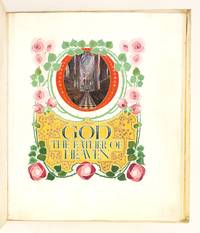
1907ST16456Birmingham 1907. 312 x 275 mm. 12 3/8 x 10 3/4". 16 leaves illuminated on rectos only. <br/> Pleasing original full vellum over bevelled boards covers ruled in gilt and with gilt crosses in each corner gilt lettering on upper cover smooth spine gilt rules dividing compartments with central gilt cross thick vellum turn-ins ruled in gilt bright purple silk endpapers front joint very expertly repaired. Calligraphic lettering mostly in black green and red a few one-line initials and many three-line initials in blue or purple with red penwork several slightly larger purple or blue initials infilled with ivy of various colors and dotted with gold EACH PAGE WITH A DIFFERENT ARTS & CRAFTS-INSPIRED FLORAL BORDER consisting of multi-colored blossoms and acanthus as well as meandering vine-stems and highlighted with gold bezants or stippled gold ONE LEAF WITH A 90 MM. INITIAL INHABITED BY A REALISTIC CATHEDRAL INTERIOR the large lettering below it on a gold ground with etched patterns and painted purple ivy leaves the text and the initial surrounded by pink roses green leaves and thorny vines. ◆Corners a bit bumped vellum with a few shallow scratches slightly soiled in a few places other minor signs of use but the binding still quite clean and attractive; perhaps a hint of thumb-soiling to margins of a couple leaves but the contents in nearly perfect condition.<br/> <br/> This is a beautiful and engaging manuscript with imaginative illuminations by the little-known but extremely talented illuminator calligrapher and cartographer Ernest Costain Clegg 1876-1954. The text here reproduces the Great Litany of the Church of England derived from the Book of Common Prayer and composed of short divine petitions. Each leaf contains a different and unique border featuring stylized floral motifs often with curving vines encircling the text and a cheerful color palette consisting of clear pastels that beautifully offset the darker inks used in the text. The generous use of gold on the first leaf of text and gilt details throughout the borders provide a dimension of luxury without overshadowing the prayers themselves. Clegg draws on the Medieval tradition of manuscript illumination but this work also shows the influence of the Arts & Crafts movement of the 19th century especially in the beautiful initial inhabited by a realistic Cathedral interior pierced with light--a feature that invites comparison with the superlative work of Alberto Sangorski. But Clegg's reliance on a variety of floral decoration in his borders makes this manuscript more feminine than the typical work of Sangorski. Ernest Clegg entered the military in his early twenties serving in the Boer War 1899-1902 then returned to England to train at the Birmingham School of Art. In 1909 he went to work for Tiffany's of New York as a jewelry designer. Clegg also served in the English forces during the First World War; afterwards in America his popularity in the veteran community led to more commissions and a thriving artistic career. Clegg is perhaps best known for illustrating the poem "In Flanders Fields" written by John McCrae but he also found success as a cartographer producing among other works a well-known map of Charles Lindbergh's flight across the Atlantic in 1927. unknown
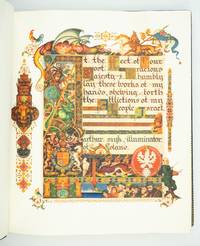
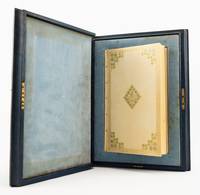
1939ST20331London: Beaconsfield Press 1939. No. 72 OF 125 COPIES SIGNED BY THE ARTIST AND THE EDITOR for sale in the British Empire. 292 x 248 mm. 11 1/2 x 9 3/4". xxvi pp. 46 leaves all leaves French fold. Edited by Cecil Roth. <br/> Elegant original blue crushed morocco by Sangorski & Sutcliffe signed on front turn-in covers with gilt French fillet border and large intricate central figure designed by Szyk of a patriarch holding a goblet and book raised bands spine gilt in double ruled compartments with ornate crown centerpiece gilt titling turn-ins with double gilt-ruled and scalloped border surrounding an illustrated silk doublure featuring a Szyk portrait of Moses with the Ten Commandments done in shades of gray within a frame of elaborate design. In an excellent velvet-lined box of blue half morocco over lighter blue cloth upper cover with central lion's head in gilt on blue morocco spine like that of the book. WITH 14 FULL-PAGE AND 32 SMALLER COLOR REPRODUCTIONS OF DESIGNS BY SZYK. English translation printed in black commentary printed in red. Front flyleaf inscribed in ink: "To Mr. and Mrs. Solomon Brachman / very cordially / Arthur Szyk / New York. April 1945." Very faint naturally occurring variations in the grain of the vellum otherwise a pristine copy.<br/> <br/> With an important Holocaust-related authorial inscription this is a very fine copy of what the London Times described as "a book worthy to be placed among the most beautiful of books that the hand of man has produced." Arthur Szyk 1894-1951 a Polish Jew is considered by scholars to be the greatest 20th century illuminator. Using the style of the Medieval illuminated manuscript artists he has here created a Haggadah for Passover that is at once a beautiful book of devotion a political protest against the rise of Nazism and a plea for England's help for the Jews of Europe. By 1939 Szyk's anti-Nazi cartoons had caused Hitler to put a price on his head forcing him to flee to England. His original illustrations for his "Haggadah" featuring the villains of the Exodus with the heads of Hitler Goebbels and other leading Nazis had to be toned down before publication. All 46 pages of the Hebrew text are illustrated with scenes from the Passover story as well as vignettes of Jewish life in modern Europe—sometimes Szyk mixes the two to great effect. Perhaps the most moving illustration in the book is the elaborately illustrated dedication to King George VI of England appealing for his mercy to European Jews. The great symbols of the British Empire—the lion and unicorn St. George defeating the dragon—surround Szyk's plea to the king: "At the feet of your most gracious majesty I humbly lay these works of my hands shewing forth the affliction of my people Israel." In the lower right corner of the painting we see Jewish refugees beside one of the ships which were usually turned away from British shores while Szyk depicts himself leaning against the painting his brush and easel in hand. The text here is enriched by the historical introduction and the commentary contributed by Cecil Roth 1899-1970 the preeminent British expert on Jewish history. This crowning achievement of Szyk's life was four years in the making and has proved to be an enduring treasure. Szyk presented this copy to Texas oilfield supply magnate Solomon "Sol" Brachman 1896-1974 and his wife Etta. The son of a Latvian Jew Brachman was the founding president of the Jewish Federation of Fort Worth in 1936 and helped arrange an emergency $100000 bank loan for Israel on the eve of statehood in 1948. His wife who served as president of the National Council of Jewish Women was known as "the mother of Hadassah." Szyk's 1945 inscription was no doubt especially meaningful to this devout family whose Latvian relatives were among the 90 percent of that country's Jews who perished in the Holocaust. Beaconsfield Press unknown
190273377London: Edwin Arnold 1902. Limited to 165 numbered copies on vellum at the Essex House Press under C. R. Ashbee. Small octavo. 45 1 pp. Hand-colored frontispiece and two full-page hand-colored illustrations and eighty-five hand-colored ornamental letters by Edith Harwood. Tail-piece. Caslon type. Publisher's vellum with rose and gilt lettering to front cover. Bit of natural mottling to vellum. Custom folding cloth chemise and slipcase. A very good copy.Great Poems Series No. 6. "In 1886 C.R. Ashbee established the Guild of Handicraft at Essex House London. Around the same time Ashbee created the Essex House Press. The Essex House Press published its first book in 1898. The work of the press was very much a part of the Arts and Crafts Movement. Ashbee continually linked the aims of the press with those of John Ruskin and William Morris and described the object of the movement as “making useful things…making them well and…making them beautiful.†The critics however were not so sure about the work of Essex House Press calling it “articraftiness.†Later booklovers came to admire much of its work. Some of the presses and some of the workmen for Essex House Press came from the Kelmscott Press after its demise in 1897 following the death of William Morris. Ashbee designed his own typeface called “Endeavor†for the press. In 1902 the press moved to Glouscestershire. The Essex House Press closed in 1910 having produced more than seventy titles." Univ. of Utah Edwin Arnold hardcover
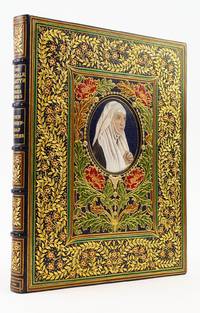
1914ST18714London 1914. 265 x 207 mm. 10 1/2 x 8 1/4". 41 3 blank pp. 1 leaf colophon. <br/> RESPLENDENT IN DARK BLUE MOROCCO RICHLY GILT AND ONLAID BY RIVIERE & SON stamp-signed on front doublure covers with wide frame of swirling gilt vines bearing red morocco blossoms and blue and green berries bordered by strips of green and tan morocco central panel of upper cover with recessed oval containing a portrait of a young nun sculpted in leather with painted details this encircled by an onlaid ivory morocco rosary and surrounded by an exuberant spray of red morocco poppies with green and tan leaves central panel of lower cover with an arch-backed black morocco cat beneath the arch of a gray morocco horseshoe at center a black and red witch's hat above the horseshoe and the whole on a very densely stippled gilt ground incised with calligraphic curls and set with nine silver stars around the cat this centerpiece surrounded by curling gilt vines bearing red morocco and gilt posies raised bands spine compartments framed with tan morocco and containing a gilt and onlaid floral sprig TAN MOROCCO DOUBLURES bordered by a strip of purple morocco this with onlaid green morocco frame adorned with gilt latticework densely stippled gilt cornerpieces set with purple morocco passionflowers all accented with inlaid circles of purple navy and green in varying sizes leather hinges apricot watered silk endleaves all edges gilt. In the original silk- and velvet-lined green morocco box. Numerous two- to three-line initials in red blue or burnished gold three three-line illuminated initials 11 five- to six-line initials in shades of purple blue and green with highlights of pink and burnished gold two of these with extensions running the length of the text and two incorporated into full borders four very large initials 12 lines or more in colors and gold five full borders that on title page incorporating a small oval miniature of Whittier and TWO FULL-PAGE MINIATURES one of a young nun at prayer the other of two lovers walking in a forest. Calligraphed colophon SIGNED by Sangorski stating: "This manuscript . . . was designed written out and illuminated by Alberto Sangorski for Messrs. R. Rivière & Son Bookbinders & Booksellers to his Majesty King George V. London. This manuscript will not be duplicated. This manuscript was executed by me." From the collection of Phoebe A. D. Boyle her sale at Anderson Galleries 19-20 November 1923 lot 368. Front flyleaf with engraved bookplate of comic book pioneer M. C. Gaines 1894-1947; typed description from "Kolb Collection" Louis Kolb laid in. Ratcliffe "Albert Sangorski Bibliography" SJR 245. Vellum a bit wavy as is typical but A BEAUTIFUL COPY the leaves creamy and bright being painted with rich colors and glittering gold and IN A FLAWLESS BINDING.<br/> <br/> This is an outstanding example of the artistry of Alberto Sangorski and that of the binders gilders and finishers of Riviere & Son the volume being executed at the zenith of their creative powers and formerly owned by the most important collector of Sangorski's manuscripts. Sangorski has written out and illuminated three poems by American author John Greenleaf Whittier: "The Female Martyr" inspired by an 18-year-old nun from the Sisters of Charity who died nursing cholera victims; "The Witch's Daughter" set in Puritan New England; and "Memories" a lover's touching reminiscences of youthful romance. In addition to elaborate initials and borders in his preferred palette of blues purples and greens brightened with burnished gold Sangorski has created two full-page paintings one of the beautiful young nun at prayer the other of youthful sweethearts strolling arm-in-arm through a wood. <br /> <br /> Alberto Sangorski 1862-1932 started his professional life as secretary to a goldsmith's firm became attracted to the book arts at the age of 43 and began doing illuminated manuscripts that were then bound by his brother Francis' firm Sangorski & Sutcliffe. Sometime around 1910 Alberto and Francis had a falling out and the artist went to work for Riviere the chief competitor to his brother's firm. Like the manuscript here our binding by Riviere is the work of many months with hundreds of individual inlays onlays and applications of gilt. Robert Riviere began as a bookseller and binder in Bath in 1829 then set up shop as a binder in London in 1840; in 1881 he took his grandson Percival Calkin into partnership at which time the firm became known as Riviere & Son and the bindery continued to do business until 1939. New York collector Phoebe A. D. Boyle was the widow of a canvas manufacturer who had made a fortune providing tents to the U.S. Army in the Civil War. George Sutcliffe described this important client as "rivalling the Medici in her patronage of the production of beautiful books." Stephen Ratcliffe deems the Boyle collection as "unrivalled" for its jewelled bindings and modern illuminated manuscripts; 33 of Alberto Sangorski's creations appeared in her sale at Anderson Galleries in 1923 and during World War I she was one of the only customers for extravagant productions like the present item. Any book from the Boyle collection which was put together with the greatest taste and discrimination is recognized as desirable beyond its intrinsic literary merit. unknown
1937ST21066London: William Heinemann Limited 1937. FIRST EDITION. Book: 245 x 152 mm. 9 3/4 x 6"; Case: 330 x 235 mm. 13 x 9 1/4". 3 p.l. 34 pp. <br/> LOVELY CONTEMPORARY STIFF VELLUM GILT AND PAINTED covers with delicate gilt frame sprays of flower and leaves at each corner outlined in gilt and painted blue and green central lozenge outlined in gilt dots and framed by painted flowers and leaves a large initial "A" in gilt at center smooth spine divided into compartments with gilt and painted floral ornament turn-ins with gilt floral roll sky blue silk endleaves all edges gilt. Housed in a fine oversized blue morocco case designed to look like a book with gilt lettering on the upper cover raised bands gilt ruled compartments and lettering to spine the interior constructed and padded to hold the smaller book and lined with blue velvet spine of case a bit sunned corners a little rubbed clasp no longer functional. A FINE COPY clean and fresh internally in a pristine binding.<br/> <br/> With very considerable visual and tactile appeal this is a gracefully bound copy of the the final book of verse issued by Richard Aldington published before he turned exclusively to writing prose. A leading poet of the early 20th-century Imagist school Aldington né Edward Godfree Aldington 1892-1962 was a prolific writer whose 50-year career produced novels biographies translations and literary criticism as well as sharp minimalist free verse. He was part of the contemporary London avant-garde crowd being close friends with Ezra Pound T. S. Eliot Amy Lowell and D. H. Lawrence; and he was especially close to the poet H. D. Hilda Doolittle his first wife from 1913-38. As literary editor of the leading Modernist periodical "The Egoist" he was an integral part of the pre-World War I literary scene and his first largely autobiographical work "Death of a Hero" 1929 was considered by George Orwell and Lawrence Durrell to be the best of the English Great War novels. The poems here were written in the mid-1930s when Aldington had decamped to the United States after the woman he loved Netta Patmore rejected his proposal of marriage. While tracing his grief and longing the verses also build the image of a "crystal world" created by the love of an ardent couple concluding that "Only from the purity of extreme passion / And alas the purity of extreme pain / Can you build the crystal world." Happily Aldington's beloved Netta to whom the work is dedicated reversed her decision and agreed in 1938 to help him build their crystal world together. The present lovely binding is unsigned but the delicate precise tooling and elegant design indicate the work of very talented hands. The romantic contents and the rather feminine aspect of the binding suggest that this was a gift from one lover to another perhaps a recipient sharing the initial "A" with our author. And the oversized and extravagant custom case indicates how much this object was treasured. William Heinemann Limited unknown
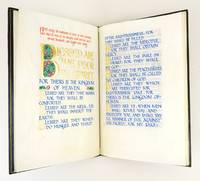
1939ST17129-020Wimbledon Surrey September 1939. 373 x 255 mm. 14 3/4 x 10". 12 vellum leaves seven with text and illuminations. Single column approximately 30 lines in a fine calligraphic hand. <br/> Attractive contemporary dark blue crushed morocco covers with gilt and blind rules raised bands with gilt rules gilt-ruled turn-ins vellum pastedowns. Text in blue black green and red a few lines with larger lettering in gilt several two-line initials in colored ink five two-line initials in red or blue with floral decorations opening pages with eight two-line initials in gold the lines here of a larger size than rest of text six three-line initials in gold filled and surrounded by floral decoration three four- to six-line gilt initials with more intricate floral decorations one of these with gilt stippling and two surrounded by a gilt frame and ONE VERY LARGE 80 x 45 mm GILT "B" decorated with stippling filled with two-tone green leaves pink flowers and large gold bezants. First leaf with ink inscription "Presented by Dr. W J Pearson / in appreciation of the work of / Ashridge Hospital 1939-1946"; two silk guards. Boards with a hint of soiling but A BEAUTIFUL MANUSCRIPT IN OUTSTANDING CONDITION the paint lovely and bright and the gold sparkling.<br/> <br/> This beautifully executed manuscript by a notable female calligrapher and illuminator features the oft-quoted and much-loved biblical text known as the "Sermon on the Mount" in which Matthew relates various moral teachings attributed to Christ. The text is written in an extremely pleasing and regular upright script throughout but the first opening listing the nine Beatitudes in capital letters is especially striking. Opening with the largest and most attractive initial in the manuscript it begins with "Blessed are the poor in spirit" in prominent gilt lettering; this is followed by the other blessings each beginning with a smaller gilt "B" initial written entirely in blue capital letters. The rest of the text penned primarily in black ink but accented with cheerful gilt initials and occasional colored lettering exudes a sense of order and simple elegance befitting the contents. Illuminator and calligrapher Violet Wilson was born in Wimbledon in 1902. She studied calligraphy under Claire G. M. Evans who had been a pupil of Graily Hewitt known for his work with the Ashendene Press and one of the principal British calligraphers and teachers of lettering in the first half of the 20th century. Wilson became a member of the Society of Scribes and Illuminators in the U.K. in the 1930s. The San Francisco Public Library has examples of her work in its Harrison Collection of Calligraphy and another illuminated copy of the "Sermon on the Mount" made in 1957 was included in the Baltimore Art Museum's 1965 exhibition and catalogue titled "Two Thousand Years of Calligraphy." The catalogue entry no. 213 notes that Wilson preferred to work on books and decorative maps and exhibited her work in many countries. According to the presentation inscription in the present work this manuscript was given to Ashridge Hospital--formerly a monastery and royal residence--by the distinguished physician Dr. Wilfred John Pearson 1884-1957 who had headed one of the London sectors of the Emergency Medical Service during World War II. His obituary in the "British Medical Journal" declared him "one of the striking figures of his time.". unknown
190997708Leipzig, Insel-Verlag, 1909. 134 S. 20,5 cm. OHPgt. mit ornamentalem Deckelschmuck.
192296125Berlin, Propyläen, 1922. CLXVII, 342 S., XV, 490 S, XV, 510 S. u. XVIII, 666 S. Mit 4 montierten Tiefdrucktafeln. 22 cm. OHPgt m. dekorativer Rückenvergoldung u. goldgepragt. Rückenschildern.
190497764Leipzig, 1904. 79, [5] S. Mit mont. illustr. Titel u. 8 Tafeln (4 montiert), Notenbeispiel im Text sowie Schlußvignette. 19,5 cm. OHPgt m. goldgeprägter VDeckelillustr. u. Kopfgoldschnitt.
191396908Leipzig, Xenien-Verlag, 1913. 82 S. 25 cm. OHPgt.
190996334München, Hyperion, 1909. 3 Bll. Vakat, 33 Bll., 2 Bll Vakat. Mit 32 tls. farb. Lithpographien a. Taf. Folio. 49,5 cm. OHPgt. m. Ganzgoldschnitt.
193067582Berlin, Atlantis-Verlag, [1930]. XLVI, 280 S. Mit zahlr. Abb. in Kupfertiefdruck (= Orbis terrarum, Reihe 1,4). OHPgt. Mit Kopfgoldschnitt.
19158494Portland Maine: Thomas Bird Mosher 1915. First edition thus number 22 of 25 copies printed on Japan Vellum. 8vo 19x14cm v xvi 3 142 1pp. Two initials printed in red text printed within borders few leaves unopened. Bound in gilt stamped parchment boards and in near fine condition with bumped corners. In original plain paper jacket which shows toning and a few tears and housed in toned paper slipcase with two ownership signatures one being Primrose Rupp Hinton. <br /> <br /> Very scarce and beautiful Mosher printing on Japanese vellum. Sirenica is a 1913 novel by Leith which explores the myth of the Siren Song and the struggle by man for the unobtainable. <br /> <br /> <br /> This copy with an interesting ownership provenance from journalist Primrose Rupp Hinton who was longtime society editor for the Aberdeen Daily World in Aberdeen WA. . Thomas Bird Mosher unknown
19023402<p>F. Lumachi publisher. 1902. Florence. Full vellum limp with leather ties. This is a nice example of one of the Florence gift bindings done around the turn of the century. The front cover is hand painted titling and decoration in a fine hand. A slight bit of discoloration to the vellum otherwise a clean unmarked copy. Yapp edges all ties present.</p> F. Lumachi hardcover
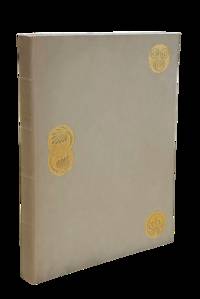
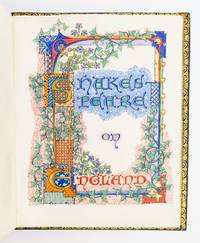
1944ST19310Sheffield England December 1944. 265 x 215 mm. 10 1/2 x 8 1/2". 6 leaves illuminated on rectos final leaf also illuminated on verso with colophon. <br/> VERY ATTRACTIVE DARK BLUE MOROCCO GILT stamped-signed "Bound by Slinn" on front pastedown upper cover with monogram of Edwin Goddard Stokes framed by gilt-ruled compartments containing gilt lettering elaborate gilt foliage and a gilt crown tool at top the panel surrounded by a double gilt rule frame and dogtooth roll border with additional foliate tools rear cover with quatrefoil design in floral tools and pointillé dogtooth roll border smooth spine with gilt-ruled compartments. In a rather worn felt-lined brown paper wallet case with handwritten titling on spine. Each recto with one or two large two- to three-line initials either painted or gilt TITLE PAGE WITH A FULL BORDER and others with a large complex border all of them elaborately painted with a variety of patterns styles motifs and with gilt embellishments one border incorporating three coats of arms AND ANOTHER PAGE WITH A QUARTER-PAGE MINIATURE OF A KNIGHT ON HORSEBACK. Trivial wear at top of front joint otherwise in pristine condition.<br/> <br/> This is a charming modern illuminated manuscript penned during WWII that contains two excerpts from Shakespeare in praise of "this other Eden demi-paradise" called England--specifically passages from John of Gaunt's dying speech in "King Richard II" and lines from "King John." As stated in the colophon the manuscript "was Designed Written out and Illuminated by John Wilfred Clarke of Ecclesall Sheffield for his great friend Edwin Goddard Stokes of Ringinglow Sheffield." Clarke d. 1954 was a municipal engineer and town planner by trade professions for which skill in the visual arts particularly draftsmanship is not only preferred but required. He was clearly a talented amateur with a flair for pattern and design. Though he incorporates elements found in Medieval manuscripts--trailing ivy leaves penwork decoration tessellation and line enders--the style is at the same time modern utilizing bold color combinations and layered shapes and patterns. Given the artist's location it is quite possible that he was involved with the Sheffield School of Art which was founded in 1843 and offered classes in fine arts and crafts. We know that the binder Walter Slinn d. 1964 was a staff member at the school as well as a prominent local bookbinder. Nationalistic sentiments are made clear in the choice of material celebrating England in Shakespeare's voice and this manuscript is all the more poignant when seen in the context of its time and place. Sheffield an industrial city was a major producer of steel and armaments during WWII --and thus a high-value target for German air raids. The so-called "Sheffield Blitz" of 1940 resulted in hundreds of deaths and nearly 80000 damaged homes. In December of 1944 when this manuscript was completed the end of the war was not yet in sight. Despite the bleak circumstances the manuscript radiates color light and hope. The recipient of Clarke's attractive manuscript was Edwin Goddard Stokes 1902 - ca. 1957 one of the sons of the prominent Sheffield businessman Robert James Stokes founder of R. J. Stokes & Co. a tile company that still flourishes in the city now. It is clear that this item was carefully looked after by this "great friend" of the artist. So far as we have been able to determine Clarke is an unrecorded artist except for the present Shakespeare work and one other similar manuscript featuring excerpts from Chaucer now in Stanford University Library. unknown