120 résultats
1924WRCLIT75177Paris: L'Edition d'Art 1924. Octavo. Full stiff vellum the upper board hand painted with an elaborate frame of intertwined devices in red and black separating small circular vignettes of birds and heart devices repeated in a modified fashion on the spine devices with highlights in gold and a central vignette of a sailing ship on the rear board t.e.g. wallet fore- edges. A bit of slight rubbing but moderately well preserved internally fine. Later edition. The binding was attributed by a previous owner to art nouveau exponent Charles Septier although it is not signed by him. However a small ink signature and date appears on the front top vellum turn-in - "Henry de Bertier June 1926" - and may be either an ownership marking or just as likely the identification of the artist. L'Edition d'Art hardcover books
192265900Berlin, Bruno Cassirer, 1922. 16 S. Mit 9 Federlithographien. Folio. OHPgt mit Bezügen in floral gemustertem Kleister-Monotypiepapier.
191872853Berlin, Bruno Cassirer, 1917/1918. [6], 494 S. 4to (32 cm). OHPgt mit goldgeprägt. Vorderdeckel.
190672851Berlin, Bruno Cassirer, 1905/1906. [6], 532 S. Mit zahlr. s/w Abb. im Text u. auf Tafeln sowie einigen farb. montierten Tafeln. 4to (32 cm). OHPgt mit goldgeprägt. Vorderdeckel.
190372850Berlin, Bruno Cassirer, 1902/1903. [6], 492 S. Mit zahlr. s/w u. einigen farb. Abb. im Text u. auf Tafeln. 4to (32 cm). OHPgt. (Rücken mit Leinen unterfüttert).
192096512Berlin, Gustav Kiepenheuer, 1920. VIII, 335; 323; 362 S. Orig.-Halbpergament m. goldgeprägt. RTitel.
190975230Leipzig, Insel-Verlag, 1909. 137 S. (21 x 14,5 cm). OHPgt.
190998251Leipzig, Insel-Verlag, 1909. 128; 137 S. 21 cm. OHPgt. m. Lesebändchen.
192169745Berlin, Egon Fleischel, 1921. XIII S., 1 Bl.,86 S., 1 w. Bl., 102 S.; 2 Bll., 111, 110 S., 1 w. Bl., 107 S. Mit 1 farb. Frontispiz in Bd. 1. (19,5 x 14 cm). Privates HPgt. mit handschriftl. RTitel. Mit farb. Kopfschnitt, sonst unbeschnitten.
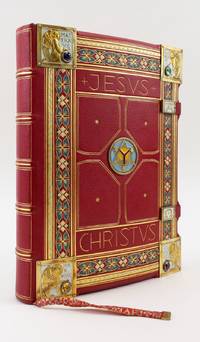
1925ST16974Flensburg ca. 1925. 325 x 240 mm. 12 7/8 x 9 1/2". 4 p.l. first two blank 4 leaves 144 pp. 4 leaves last blank. Single column 31 lines in a fine calligraphic hand. <br/> FLAMBOYANT DEEP RED MOROCCO ELABORATELY INLAID AND GILT BY W. A. PETERSEN stamp-signed on rear turn-in covers framed by inlaid white morocco strip tooled with gilt triangles enclosing sides in a bead-and-lozenge pattern of gilt-outlined mandorlas containing a red cross on a blue background alternating with an inlaid white lozenge upper cover with brass and enamel cornerpieces featuring the symbols of the four Evangelists each of these set with a colored glass gem central panel divided into four compartments each containing a small star tool central brass and enamel medallion with a six-pointed star emblazoned with a sun and a red enamel "Y" two straps with brass and enamel clasps marked with Alpha and Omega lower cover with brass cornerpieces raised bands spine with gilt-ruled compartments turn-ins tooled with plain and dotted gilt rules and gilt stars deep pink moiré silk doublures shot with gold thread all edges gilt. In a box with a velvet-lined maroon buckram base and green marbled paper lid. With many initials of various sizes painted blue red green purple maroon or gilt three three-line initials in gold on a colored ground with the shape of a cross one two-line initial and 13 four- to six-line initials in gold on a multi-colored ground in a geometric design SEVEN HISTORIATED INITIALS each measuring seven to 11 lines in length FIVE MINIATURES MEASURING A THIRD TO THREE-QUARTERS OF THE PAGE each featuring a scene from the life of the Virgin or the life of Christ SIX FULL-PAGE ILLUMINATIONS incorporating text of different sizes and fonts many colors and patterns five of which contain a large central gilt circle the first of these completely filled with gold the others with a religious symbol in pen on bare vellum every page with a unique border composed of a thin frame with different geometric designs in gold and color some pages with an additional column of floral and foliate designs running down the left side of the text within the border plus additional flourishes elsewhere. Text in multiple sizes and fonts occasional words or phrases penned in color or gold. Boards somewhat bowed as often with bindings on vellum works occasional naturally occurring variations in the grain of the vellum a few instances of faint thumb smudging in corners but A BEAUTIFUL MANUSCRIPT IN ESPECIALLY FINE CONDITION the vellum smooth and fresh the illuminations shimmering and the binding unworn.<br/> <br/> Replete with gold illumination and bright colors evoking the appearance of Medieval manuscripts and stained glass this is an exquisitely produced work relating the life and words of Christ divided into five thematic parts: Light Word Spirit Death and Resurrection. Each part opens with a sumptuous full-page illumination reminiscent of the "carpet page" painting found in early Insular manuscripts; in the present work our artist fills the frame with a dazzling mixture of text and decorative patterns around a lustrous gilt medallion calling to mind the sun a resplendent halo or the Host. Although much of the decoration both on these full-page illuminations and elsewhere in this work remind one of Medieval manuscripts and are often composed of geometric designs and colors suggestive of stained glass the overall style here is decidedly modern. The palette is fresh and bold while the emphasis on strong lines and patterns shows the influence of the reigning Art Deco movement with echoes of the Art Nouveau movement that preceded it. Traditional biblical narratives in the form of historiated initials and miniatures are also presented here in refreshing ways: the image of the Sermon on the Mount for example places the viewer directly among the masses; we experience the event as a member of the audience would looking over the shoulders of the people in front of us to see Christ orating from a small hill silhouetted against a bright pink sky. Another memorable image--and the largest figural composition in this manuscript--is the Crucifixion. Though he has used a fairly standard composition the artist plays with our perception of space by setting the scene on a dark blue ground that envelopes the figures in a shadowy void; the only light source seems to come from the gold lettering immediately above the cross radiating off the face of Christ and to a lesser degree off the grief-stricken faces of John the Evangelist and the Virgin. All are pictured without haloes thus emphasizing the humanity of Christ over his divinity. As a whole this manuscript is extremely impressive in terms of artistry and technical execution and the prolific decoration and calligraphic variety hold the viewer's interest page after page. The equally impressive binding--modelled after the look of a Medieval Gospel book complete with enamel-like bosses and jewels--is fitting for a work that pays homage to the past while celebrating contemporary art and style. The life and work of calligrapher and illuminator Johann Holtz 1875-1944 is poorly documented but he seems to have been active in Flensberg Germany; he also worked as a graphic artist. Binder W. A. Petersen has proven equally illusive but we know that his workshop was also located in Flensburg. Given the town's close proximity to Denmark we might speculate whether Petersen was somehow related to the Copenhagen-based binder Immanuel Petersen who took over from master binder D. L. Clément in 1877. Despite the lack of biographical information on our artist and binder the work here needs no provenance information to be pleasing in every way from the gleaming binding to the beautifully preserved and magnificently illuminated contents. unknown
191397424Leipzig, Insel, 1913. 310 S. Mit 118 s/w Taf. 22 cm. Goldgeprägtes OHalbPergament.
190596059Leipzig, Insel-Verlag, 1905. [4] Bl., 124, (3) S. 20 cm. Flex. OPgt.
193060793Bergisch Gladbach, J. W. Zanders, o. J. (um 1930). Qu.-4°. Titelblatt u. 6 Zeichenpapiere, geheftet in illustr. OUmschlag.
198694830Hanau, Müller und Kiepenheuer, ( 1986). XLVIII, 450 S. 26 cm. Goldgeprägt. Halbpergament im bedruckten OSchuber (dieser oben angestoßen).
1928120551928. Original illuminated large manuscript page on vellum comprising a central panel of calligraphic text in red and black ink with a miniature of a young herald surrounded by a decorative border of larger armorial shields set within a stylised foliate background in blue red green and gilt with a fine miniature of a knight’s tournament at the foot. 41 x 25.5cm. Mounted on card with ink title to the head: “Illuminated page on vellum. / Testimony of study for Board of Education Exam in industrial design 1928.†In very good condition.WITH: Two further pencil drawings by the same artist the first of an elderly gentleman the second of a classical sculpture measuring 57.5 x 38cm and 56 x 39cm respectively each signed “Bate†and dated 1927. The pencil drawings have a few short tears to the edges otherwise they are in very good condition. A fine example of 1920s illumination hardcover
191196434Jena, Eugen Diederichs, 1911. LII, 171 S. Mit 14, teils ganzseit. Holzschnitten; 217 S. Mit 1 Holzschnitt. u. 4 s/s Tafeln. 20 cm. Privates GANZPERGAMENT m. goldgeprägtem RTitel u. Kopfgoldschnitt.
194917903(Hamburg, gedr. bei Hans Christians, 1949). 140 S. Mit Tab. u. Diagr. Privat. GANZPERGAMENT mit durchgezogenen Bünden.
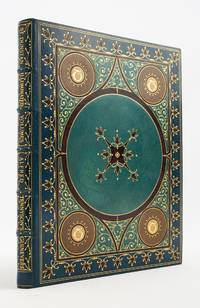
1902ST20771New Rochelle: Printed by the University Press for George D. Sproul 1902. No. 23 OF 30 COPIES 18 for America 12 for Europe; this copy illuminated for Herman A. Metz of the "St. Dunstan Edition" all of them PRINTED ON VELLUM. 270 x 210 mm. 10 5/8 x 8 3/8". 50 leaves last blank. <br/> SUMPTUOUS COBALT BLUE MOROCCO GILT AND INLAID TO AN ARABESQUE DESIGN BY TRAUTZ-BAUZONNET stamp-signed on front doublure covers framed in gilt and inlaid brown morocco blossoms central panel of azure blue morocco outlined in brown morocco large central medallion enclosed in brown morocco and inlaid with an eight-pointed inlaid and gilt fleuron each corner with tan and ivory morocco medallion with gilt "T" at center outlined in brown morocco the spaces between the medallions with curling gilt flourishes raised bands spine compartments with gilt lettering framed by sprays of gilt berries SKY BLUE MOROCCO DOUBLURES inlaid with darker blue squares containing an ivory morocco polygon these forming a frame around a central taupe morocco panel with inlaid blue morocco flowers at corners vellum free endleaves painted with a simple blue frame small flowers at each corner all edges gilt. BEAUTIFULLY ILLUMINATED BY ROSS TURNER the title page and final page with heraldic emblems and WITH 51 LOVELY INITIALS in a range of hues 22 with delicate extensions. Printed entirely in majuscules on rectos only. A couple of small faint water spots to upper board with slight dulling where someone tried to fix these naturally occurring variations in the grain and color of the vellum otherwise A FINE COPY--the vellum creamy and smooth the colors and gilt bright and the binding lustrous.<br/> <br/> A bookmaking tour-de-force this item is part of the remarkable St. Dunstan series of famous works of literature produced at the turn of the century in very strictly limited and particularly luxurious editions by publisher George Sproul. Named for the English bishop Dunstan 909-88 who was known for his skills as an illuminator the St. Dunstan volumes were printed on vellum illuminated by different artists and then put into bindings of striking design executed by Trautz-Bauzonnet one of the premier French binders of the period. While the physical properties of this volume announce themselves more emphatically than the text the narrative here is from Tennyson's "Idylls of the King" a work Day tells us in which the legend of King Arthur is used "to establish the Victorian virtues of marital faithfulness fair play gentlemanly conduct and useful action for self and society." "Guinevere" sets forth the consequences of marital infidelity presenting a penitent queen now withdrawn to a convent groveling for Arthur to pardon her affair with Lancelot. Although the injured king grants her forgiveness he does so with little grace appearing to modern readers as "insufferably self-righteous." Day Reminiscent of the designs used in 15th century illuminated books the painted initials in our volume are well executed and attractive combining fluid shapes and consonant combinations of colors and the binding is a singularly elaborate achievement. German-born binder Georges Trautz 1807-79 apprenticed in Heidelberg Stuttgart and Witemberg before arriving in Paris in 1803. There he trained in “dorure†with the skilled gilder Debès learning to create intricate gilt designs on bindings. In 1833 he was hired as a doreur by Bauzonnet the successor to the celebrated Purgold and soon achieved acclaim for his beautifully gilded bindings. According to Michon he was "the uncontested master of the luxury binding" in 19th century France celebrated for his "sumptuous moroccos" and "dazzling gilt." His bindings were so sought after that the term "Trautzolâtrie" was coined to describe the craze for his work. In 1869 he became the first bookbinder to be named a chevalier of the Legion of Honor. The culmination and termination of the St. Dunstan books was a planned edition of 15 sets of the complete works of Dickens projected to contain 130 large folio volumes—surely the most ambitious undertaking in the history of modern American fine printing. Five volumes only comprising most of "Pickwick" were produced before the grandeur of the project overwhelmed its sponsors. Potter says that in addition to the Dickens edition the St. Dunstan series comprised a dozen volumes of the works of various authors one of them the present Tennyson issued to subscribers at the spectacular amount of $12000 per set. One of the subscribers was our original owner New York chemical manufacturer and U.S. Congressman Herman A. Metz 1867-1934. Not surprisingly this strictly limited "Guinevere" is quite rare: We could trace just two copies at auction since 1975 one of them ours sold in 1998.  . [Printed by the University Press for] George D. Sproul unknown
191092171Berlin, S. Fischer, 1910. 21 cm. Flexibles OGanzPgt. m. Kopfgoldschnitt.
192277705München, Piper, 1922. VII, 314 S., 1 Bl. Mit 6 Orig.-Graphiken und zahlr. teils farb. Lichtdrucktafeln. 4to. 28 cm. OHPgt.
1915ST17129-042Chicago: Written and Illuminated for The Renaissance Society ca. 1915. 216 x 153 mm. 8 1/2 x 6". ii 28 pp. 1 leaf colophon. Single column 18 lines in an attractive calligraphic hand. <br/> VERY PRETTY VIOLET CRUSHED MOROCCO GILT AND INLAID for The Renaissance Society stamp-signed in gilt on front doublure smooth spine with gilt titling FULL MOROCCO DOUBLURES consisting of a green morocco panel framed by purple morocco with gilt dots and scrolling floral motifs at each corner each with an inlaid white morocco flower cream-colored watered silk endleaves. In a lavender buckram chemise and matching purple morocco-backed slipcase with raised bands and gilt lettering. With many one-line initials in pink each leaf with a different two- to four-line initial in a different style with both painted and gilt elements and exuberantly decorated most leaves with a panel or "L"-shaped border ranging from simple lines to elaborate decorative bars a few borders with small landscapes and a total of FOUR FIGURAL SCENES decorative title page with colorful initials lettering and decorative flourishes text beginning with A HALF-PAGE MINIATURE OF ST. JEROME AT HIS DESK surrounded by A FULL BORDER of flowers gilt detailing and stylized heads of putti all by Louis Bauhan. Front free endpaper with bookplate of Phoebe Boyle. Leather with a slight chalky appearance silk endleaves starting to fray at fore edge a few leaves with a hint of waviness but THE MANUSCRIPT IN BEAUTIFUL CONDITION the vellum entirely clean and the paint especially bright and fresh.<br/> <br/> Exuberantly decorated by a major illustrator of the period this manuscript was commissioned and bound for The Renaissance Society of Chicago before making its way into the superb collection of American bibliophile Phoebe Boyle. The text here comes from a poem by "Atlantic Monthly" writer and editor Thomas Bailey Aldrich 1836-1907 imagining the agony and the ecstasy of St. Jerome as he sat down to write his translation of the Bible. The illumination though certainly inspired by the decorative programs of Medieval manuscripts is decidedly modern in appearance drawing on the Art Nouveau movement and utilizing bold color combinations and whimsical design motifs. It is not clear why the illustrator here Louis Bauhan 1855-1941 has used the ananym "Siuol Na-Huab" because there is no reason to hide responsibility for producing the clean elegant script the imaginative marginal decoration and the finished human and animal images that enliven the manuscript. Bauhan was a very successful painter and illustrator perhaps best known to the public as art editor of "Cosmopolitan Magazine" under John Brisben Walker who edited and published the magazine from 1889 to 1905. In 1881 Bauhan helped to found the Kit-Kat Club of New York a bohemian artists' and cultural association; he was persistently in demand as a book illustrator; and among other things he painted landscapes and portraits in oil. The colophon here states that the manuscript was written and illuminated for The Renaissance Society--an artistic group associated with the University of Chicago whose mission was to cultivate and promote modern art--and it was given an appropriately luxurious binding by the same organization. The manuscript was obviously valued highly enough to join the collection of Phoebe A. D. Boyle a client George Sutcliffe described as "rivalling the Medici in her patronage of the production of beautiful books." Shepherd "The Cinderella of the Arts" p. 63 Stephen Ratcliffe describes the Boyle collection as "unrivalled" for its jewelled bindings and modern illuminated manuscripts and any book from the Boyle collection which was put together with the greatest taste and discrimination is recognized as desirable beyond its intrinsic literary merit. Written and Illuminated for The Renaissance Society unknown
192196148Tübingen, A. Fischer, 1921. 132 S. Druck in Rot und Schwarz. 19 cm. OHPgt mit goldgeprägtem Rückentitel.
191388686Berlin, J.G.Cotta, 1913. 348 S. 18,5 cm. Privat. HALBPERGAMENT mit Pergamentecken, gebatikter Deckelbezug.
192496454Frauenfeld (Schweiz) & Leipzig, Huber, 1924. VIII, 240 S. 19,5 cm. OHPgt. mit Goldprägung u. Farbkopfschnitt.
1929260431929. L'Edition d'Art H. Piazza, Paris. Mit 12 Farbtafeln und Abbildungen von Kay Nielsen. Originalbroschur im Originalschuber. 117, [3] Seiten.