153 résultats
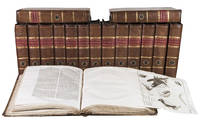
1778L72A782E8WD9Leiden Johannes Le Mair; 1778. 4to. Leeuwarden Jacques Alexandre de Chalmot Contemporary uniform half calf and sprinkled paper sides gold-tooled spines in compartments with a red morocco title label lettered in gold and a black oval with gold lettering detailing the parts letters included in each volume. With an allegorical frontispiece in volume 1 and a total of 153 folding copper engravings in the 16 volumes and a woodcut vignette at the end of volumes 1 8-11 13 and 15. 16 volumes. XXXVII 1 blank 565 1 blank; 566-1194; 2 1195-1902; 2 1903-2502; 2 2503-3170; 2 3173-3761 3; 2 3763-4370; VIII 1-749; 3 750-1495 1; 3 1498-2284 4; 3 2290-3031 1; 3 3034-3823 1; 3 3826-4540; 3 4542-528 A rare untrimmed and complete set of the most popular domestic encyclopaedia of the 18th century uniformly bound. This second edition is considerably enlarged and expanded: it is more than twice the size of the first edition has 9000 more pages and 73 more plates. Furthermore a continuation was written called Vervolg op M. Noël Chomel which added a further 9 volumes to the already hefty work.The encyclopaedia was originally published in French by Noël Chomel 1632-1712 as Dictionnaire oeconomique 1709. Chomel was an agronomist entrusted with the domestic management of the possessions of the abbey at Vincennes where he acquired all the knowledge necessary to write his encyclopaedia. The first Dutch version of the encyclopaedia translated and edited by Jacques Alexandre de Chalmot -1801 was published in 1743. The second edition appeared between 1768-1777 and was published a second time in 1778. Chalmot who was also the author of the Vervolg lists the sources he has used to complement Chomel's text in the introduction: for instance the works of Linnaeus Houttuyn Merian Van Leeuwenhoek Swammerdam Bufon Lobel Dodonaeus en Knoop. He also mentions the cooperation of Prof. Petrus Camper who has contributed many articles.Interestingly the Dutch edition also became popular in Japan. In the 18th century the Japanese came into contact with Western-European science via a Dutch trading post on the island of Deshima. Parts of the encyclopaedia were translated into Japanese between 1811 and 1845 under the title Koshei Shimpen. A small portion of the sprinkled paper on the front board of volume 11 has scraped off. Volume 15 has a small stain on the front. Volume 5 and 7 are missing the "bericht aan den boekbinder". Overall the set is in very good condition with only slight traces of use.l Sijs N. van der Verantwoording van de digitale uitgave van huishoudelyk woordenboek door Noël Chomel; STCN 21514368X ad 1 and 156926164 ad 2; cf. Brunet 6287; Goodman The Dutch impact on Japan 1640-1853 p. 129-130; Thiébaud Bibl. des ouvr. fr. sur la chasse pp. 202-4. ABE CAT Agriculture unknown
179943266Lampsaque, , 1799. 2 vol. in-4 manuscrits de (241) et (269) ff., becquets dans le texte et sur un contreplat, demi-basane blonde à petits coins de vélin, dos lisse orné, pièces de titre en maroquin rouge et noir (reliure de l'époque).
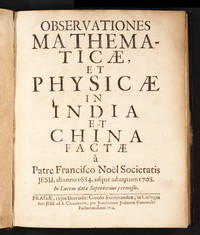
1710B5718<p>FROM PEKING TO PRAGUE</p><p>THE CHINESE ASTRONOMY OF FRANÇOIS NOËL</p><p>WITH A LARGE FOLDING STAR CHART OF THE SOUTHERN HEMISPHERE</p><p>4to 19.1 x 15.2 cm 133 pp. 1 pp. including full-page engraved Chinese Calendar p. 59 numerous woodcut diagrams and tables with woodcut Chinese letters a full-page engraved plate of astronomical observations verso of p. 133 and with 1 large folding engraved star chart for the epoch 1687 signed Balthasar van Westerhaut woodcut headpiece and initials. Bound in contemporary calf gold-tooled spine red sprinkled edges. Some rubbing and edge wear to spine and boards minor warning to covers. Contemporary annotations moderate browning in a few quires occasional minor toning small 3 mm. hole in chart not affecting images.</p><p>Rare first and sole edition of one of the few works published in Europe to record detailed first-person observations made at Jesuit astronomical observatories in China in the 17th century and one of the first works to convey information on Chinese observational data and astronomical traditions to a Western audience. Compiled by the Belgian-born polymath François Noël 1651-1729 the <em>Observationes Mathematicae et Physicae in India et in China</em> represents a full account of this Jesuit's astronomical career. The volume is illustrated with a large folding celestial chart of the southern skies incorporating observations Noël made at the Jesuit Colleges at Rachol in Goa Macao and Bahia in Brazil. Other illustrations include a full-page plate engraving the 1690 transit of Mercury Noël's observations of Jupiter and his method for recording magnetic inclinations for use in navigating by compass at sea as well as a full-page plate illustrating the Chinese Sexagenary calendar.</p><p>Noël's discussion of Chinese astronomy Chapter V not only serves as an introductory primer but also is a fastidious record of Chinese observational data collected by Noël from Chinese star catalogues and charts and he even retains information which was at odds with European observations. Noël produces a chart of the relevant Chinese calendrical characters the Ten Heavenly Stems and the Twelve Earthly Branches an engraving of the Sexagenary calendar a table of the 28 Chinese constellations a list of Chinese zodiacal signs with a chart comparing them to European signs. His extensive <em>Catalogus Latino-Sinicus</em> pp. 65-103 compares Chinese and European stellar nomenclatures. Here Noël lauds the "extreme antiquity of Chinese astronomy which began some 4000 years ago" but puzzles over the fact that the Chinese tradition records "many small stars which are no longer visible"; he dutifully records these numerous stars in the <em>Catalogus</em> but notes that "they are either very faint or perhaps made up" "<em>minimae aut fictae</em>" "<em>vel minimae vel fictae</em>" etc. Noël apologizes for not printing the Chinese characters for star names "because of the difficulty of having them cut in Europe" p. 67. Chinese weights and measures are also discussed.</p><p>In other chapters Noël offers his observations of Jupiter's satellites made while in Huai'an in 1689-90 including tables comparing his data to observations made by others in Nanjing and Paris as well as a description of 16 observations both telescopic and made with naked-eye instruments of lunar and solar eclipses he made in Goa Macau Siam Peking Shanghai Nanjing Huai'an Tshusima Island Trincomalee Sri Lanka etc. between 1684 and 1707. He provides an extensive list of his longitude and latitude observations for numerous locations in China and India which he made between 1687-1708 as well as readings from Bahia in Brazil including a table summarizing the longitude and latitude of more than 80 cities and towns in China. In his 13-page catalogue of some 350 southern stars ascensions declinations magnitudes for the epoch 1687 Noël cites the recent work of Riccoli Hevelius and Halley taking issue with several of their measurements; the folding <em>Mappa Stellarum Australium</em> engraved by Balthasar van Westerhaut illustrates the placement of southern stars as observed by Noël.</p><p>The work's final chapter includes Noël's extensive notes on the Comets of 1695 1701 and 1702 which he observed from Peking and Java meteorological curiosities he saw in Asia twilight unusual rainbows and planetary observations including an unusual visual aberration that occurred when he viewed Jupiter through a 13.5-foot telescope in Nanchang in 1694 this observation is illustrated aberrations he encountered in viewing Venus through a 40-foot telescope in 1697 and data from Jean de Fontenay's 1643-1710 observation in Canton of the 1690 transit of Mercury also illustrated here.</p><p>Interestingly the present example preserves contemporary annotations to Noël's catalogue of magnetic declinations and inclinations he made Chapter VIII using a magnetic needle during his 1706 journey from Portugal to India and his 1708 voyage from the Sunda Strait between Java and Sumatra westward to Brazil. The annotator has carefully underlined and enumerated Noël's 201 location readings apparently for incorporation into a larger table or chart he hoped would be useful in resolving the ongoing problem of pinpointing longitude in sea navigation. Halley had only recently published his groundbreaking map of magnetic variation in Atlantic waters 1701 and his world chart was still decades away from publication.</p><p>Noël joined the Society of Jesus at age 19 in 1670 and studied theology mathematics and astronomy at the University of Douai. He departed on his first Asia journey in 1684 hoping to join the Japan mission but the longstanding ban on Western missionaries by the Tokugawa shogunate foreclosed on this possibility. Noël instead spent two years learning Chinese at Macao before traveling to the Chinese mainland in 1687 where we traveled widely doing missionary work primarily related to the lower classes and abandoned women and children. He was a major figure in the Chinese Rites controversy and his role in this and other Jesuit Roman Embassies was the impetus for the various journeys recorded in the <em>Observationes Mathematicae et Physicae</em>. Known in Chinese as Wei Fangji Noël published widely on Chinese Confucian classics. He returned to Europe for good in about 1709 settling in Prague to teach mathematics at the Jesuit-staffed Charles-Ferdinand University under whose auspices he quickly published the <em>Observationes Mathematicae et Physicae</em>.</p><p>OCLC locates U.S. copies at the Library of Congress Adler Planetarium Boston College Michigan Princeton and Wisconsin.</p><p> De Backer Sommervogel V.1791.6; NBG xxxviii.174; Warner <em>Sky Explored</em> p. 194 incorrectly giving his nationality as Czech with star chart illustrated; Pfister I.414-19; J. Needham <em>Science and Civilization in China</em> III.454.</p> Joachim Joannes Kamenicky hardcover