Byron, [George Gordon Noel], LordBiblio.com
331 résultats
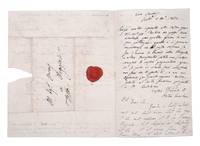
1823352339Cephalonia 1823. 3 pp. on a single sheet bifolium with address To Msgr Stevens Argostoli. 8vo. Small tear above signature from opening wax seal still present. Old docketing in French. 3 pp. on a single sheet bifolium with address To Msgr Stevens Argostoli. 8vo. A notable Byron letter showing his commitment to join the armed struggle in Greece just before he left Cephalonia for the Greek mainland. As is frequently the case Byron writes beneath a letter from Count Gamba whose sister was Byron's mistress Countess Guiccioli addressed "Caro Stevens". The correspondent George Stevens was a customs official at Argostoli on Cephalonia and a recipient of several letters from Byron in 1823.<br /> <br /> "P.S. Dear sir Gamba is half asleep and and sic don't know what he says. I do not suppose it to be Parry's Brigade - but whoever or whatever it be - if it came from the committee I will attend to it with all diligence. The boats had better be engaged because if this intelligence is not confirmed I must sail at any rate and even if it be I shall sail as soon as possible after communicating with the vessels on their voyage which if my instructions do not err or I for them are committed to my direction. I do not perceive however how a ship directed to Greece Continental from London can touch at Ancona in its propoer course unless it has continued to pass the Alps by Steam or a special wind of Providence added to a new Deluge. But whether correct or otherwise the repeat of our friend Count Delladecima believe that I am ever and truly ."<br /> <br /> Byron had been staying on Cephalonia since August. Edward Trelawny his opportunistic and self-aggrandizing sometime travelling companion had gone to Greece in September and was soon converted to another faction in the Greek struggle for independence. In November Byron was besieged by requests for money and a week after this letter would pledge large sums to the cause. Here he demonstrates a considerable flash of wit and knowledge of current technology as he reminds his correspondent of the realities of Italian geography and suggests Steam power or a new Deluge as the only possible explanation for a proposed itinerary Ancona is on the Adriatic far to the north of Cephalonia.<br /> <br /> As the representative of the London Greek Committee "Byron remained in Cephalonia with Pietro Gamba multiplying his Greek contacts and assessing information he was gathering as a prelude to action. When Prince Alexander Mavrocordatos who eventually became first president of independent Greece moved to Missolonghi in December he invited Byron to join him and his forces" ODNB. Byron and Gamba departed from Argostoli on 29 December 1823. Gamba's vessel was captured and briefly held by the Turks; Byron reached Missolonghion 4 January 1824.<br /> <br /> This letter was previously known only in an excerpt from the description in catalogue 44 of F. Naylor July 1878 incorrectly dated to May and lacking the name of the correspondent published in A Heart for Every Fate: Byron's Letters and Journals Vol. 10 1980 pp. 161-162.<br /> <br /> A CHOICE BYRON LETTER FROM JUST BEFORE HIS FATEFUL EXPEDITION TO MISSOLONGHI. Marchand 10:161-2 a partial transcription misdated to May 1823 unknown
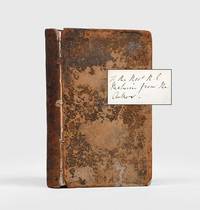
1816174164London: John Murray 1816. Inscribed by Byron to inspire his fellow writer and later by Maturin in memory of his friend Presentation copy of Childe Harold's Pilgrimage inscribed by Byron on the half-title "To the Revd R. C. Maturin from the Author". Following Byron's death in 1824 Maturin inscribed a quatrain from a contemporary poem by James Montgomery on the rear free endpaper in memoriam: "Friend after friend departs; / Who hath not lost a friend / There is no union here of hearts / That hath not here an end". Byron and Maturin enjoyed a warm literary friendship beginning in December 1815 when they were introduced by Walter Scott. That month Maturin sent Byron the manuscript for his Gothic tragedy Bertram. Byron adored the play writing to John Murray that he received the manuscript "late in the evening and read it through without being able to stop" Murray letter to Scott 25 December 1815. In a letter to Maturin he praised the work as "a very extraordinary production - of great & singular merit as a composition" 22 December 1815. Byron helped Maturin bring his work to the stage sending the manuscript to George Lamb with whom he managed the Drury Lane Theatre Lamb like Byron read the play by candlelight and "could not go to bed without finishing it". Despite his enthusiasm for Maturin's tragedy Byron found himself exiled from England from April 1816 and never saw the play performed. His Childe Harold was nonetheless an important influence on its success: "Bertram undoubtedly benefitted from the great popularity of Byron's Childe Harold's Pilgrimage the first two cantos of which had been published in 1812 for the hero of Maturin's play was spoken of by a number of contemporary critics as a 'Byronic figure'" Lougy p. 45. The play became Maturin's first critical and commercial success and his touching inscription at the rear of the volume reveals the gratitude and affection he felt for the poet. This copy of Childe Harold is from the 1816 edition of Byron's collected works. Vol. I of IV only duodecimo 165 x 106 mm. Engraved plate by Thomas Stothard with tissue facing p. 10. Contemporary unlettered calf. Housed in a custom brown quarter morocco folding box by the Chelsea Bindery. Book label of J. O. Edwards to front pastedown. Binding worn front joint cracked but cords firm contents clean. A good copy in unrestored condition. Robert E. Lougy Charles Robert Maturin 1975. unknown
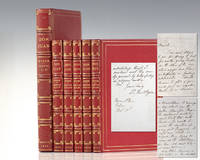
1819142573London: Thomas Davison i.e. John Murray 1819-1821 Cantos I-V Volumes I-II/John Hunt 1823-24 Cantos VI-XVI Volumes III-VI. Scarce complete first edition set of Byron's great work which was widely criticized as immoral upon publication and is now considered one of the greatest poems of the Romantics; from the library of American writer Erica Jong. Volume one was produced in quarto format and the subsequent 5 volumes in octavo Davison abandoned the quarto format after disappointing sales of the first volume six volumes uniformly bound in full morocco with gilt titles and tooling to the spine double gilt ruling to the front and rear panels gilt inner dentelles marbled endpapers all edges gilt. With an autograph letter signed by Lady Byron bound into the first volume. Written from Moore Place Esher the letter reads in part "Dear Sir I am much obliged to you for offering to look for another young Teacher in place of the one who is engaged but I have no difficulty in finding a Substitute. I should however be glad if you could find me an older master for a situation in Warwickshire - to manage a day-school on the Garden plan for Bogs - the emolument would not exceed 20 to 24 pounds with Board - He would be under the direction of a very good Clergyman - A single man would be preferred there being no room at the Schoolhouse for him - she must lodge at some distance. Lady Olivia Sparrow is still active in her charitable undertakings though I sometimes wish they were less governed by hasty feelings in religious matters. Yours truly A.I. Noel Byron Moore Place Esher Nov 19th." From the library of Erica Jong. Jong remains best known for her 1973 novel Fear of Flying which became famously controversial for its portrayal of female sexuality and figured prominently in the development of second-wave feminism. Written in the first person and narrated by its protagonist 29-year-old American poet Isadora Wing Fear of Flying was written in the throes of the Sexual Revolution of the 1970s and encapsulated the movement’s redefinition of female sexuality. In interviews Jong stated: “At the time I wrote Fear of Flying there was not a book that said women are romantic women are intellectual women are sexual—and brought all those things together… What Isadora is looking for is how to be a whole human being a body and a mind and that is what women were newly aware they needed in 1973.†The novel remains a feminist classic and has sold more than 20 million copies worldwide. Jong notable used a quotation from Don Juan as the epigraph in Fear of Flying "Alas! the love of women! it is known To be a lovely and a fearful thing; For all of theirs upon that die is thrown And if 'tis lost life hath no more to bring To them but mockeries of the past alone And their revenge is as the tiger's spring Deadly and quick and crushing; yet as real Torture is theirs -- what they inflict they feel. They are right; for man to man so oft unjust Is always so to women; one sole bond Awaits them -- treachery is all their trust; Taught to conceal their bursting hearts despond Over their idol till some wealthier lust Buys them in marriage -- and what rests beyond A thankless husband -- next a faithless lover -- Then dressing nursing praying -- and all's over. Some take a lover some take drams or prayers Some mind their household others dissipation Some run away and but exchange their cares Losing the advantage of a virtuous station; Few changes e'er can better their affairs Theirs being an unnatural situation From the dull palace to the dirty hovel: Some play the devil and then write a novel" Lord Byron Don Juan 1824. In fine condition. Scarce and with fine provenance. "The War and Peace of English poetry Don Juan contains an epic sweep that moves from Spain to the East and to Russia before ending in England… At the same time that Byron's broad canvas foretells the scope of the great 19th-century novels the poet's own sensibilities echo the picaresque 18th-century novels of his early reading Smollett and Fielding with their bawdy humor and sly inversions of vice and virtue. Unlike these prose narratives however Don Juan has no beginning middle or end. It draws us in not to learn 'what happens next' but to hear what this seductive confidential teasing voice is going to tell us" Eisler 610. When Cantos I through V appeared they did so without the name of either author or publisher on the title page. Publisher John Murray refused to print Byron's dedicatory poem which ridiculed English poet laureate Robert Southey and Byron refused to put his name on a censored publication. Because of Byron's change from his long-standing publisher Murray to John Hunt brother of writer Leigh Hunt midway through Don Juan complete first-edition copies with all cantos are scarce. Thomas Davison [i.e., John Murray] unknown
184821535London: WIlliam Smith 1848. Hardcover. Near fine. Two volumes in four extra-illustrated with the insertion of the illuminated plates from Humpheys' "Illuminated Illustrations of Froissart" in addition to the hand-colored plates of this edition. <br /> <p><br /> Dark green levant morocco spines in five compartments intricately gilt board tooled in gilt and blind inner dentelles gilt linen endpaper all edges gilt. Bindings signed The Knickerbocker Press and G. P. Putnam's Sons. <br /> <p><br /> The handcolored plates are heightened with gold and silver in imitation of the manuscript originals.<br /> <p><br /> A fine set handsomely bound with bright plates the spines showing only a pleasant lightening toward brown.<br /> <p>. WIlliam Smith hardcover
1888g5899London: Vizetelly & Co. G: in Good condition without dust jacket. Boards lightly rubbed and bumped with slight lean to spine. Tissue guard missing from frontispiece. Rear endpaper missing. 1888. Reprint unexpergated edition. Brown decorated hardback cloth cover with gilt titles. 190mm x 130mm 7" x 5". 392pp. This seemingly insignificant book is from the Mermaid Series of Best Plays of the Old Dramatists belonged to Aubrey Beardsley. On the ffep a hand drawn bookplate by Aubrey Beardsley is pasted dated Xmas 1888. On the half title page there is the signature A V Beardsley Xmas 1888. On the reverse of the frontispiece in the top corner is an ink stamp BEARDSLEY. . Vizetelly & Co hardcover
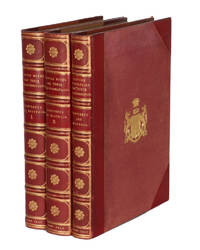
18494505034London: Wm. S. Orr & Co and William Smith 1849. Three volumes quarto profusely illustrated with full-page plates exquisitely hand-coloured; uniformly bound in half morocco richly gilt all edges gilt with the gilt arms of the Barons Sherborne. <p><p>A very fine copy in a grand binding with excellent provenance of this remarkable collaboration an exquisite work of Victorian natural history. As one of the pre-eminent entomologists of the Victorian period John Obadiah Westwood 1805-1893 served as collaborator editor and consultant on many entomological publications. He was a prodigious author and researcher publishing some four hundred scientific papers and some twenty books as well as making numerous contributions to works by other authors. In 1833 he was one of the founding members of the Entomological Society and he became honorary life president in 1883 and a fellow of the Linnaean Society. It was for his study of Australian species that Anthony Musgrave author of the Bibliography of Australian Entomology 1775-1930 named the period 1831-1861 "The Westwoodian Period" in recognition of his great service during these years to Australian entomology Musgrave p. 345. </p> <p>Henry Noel Humphreys 1810-1879 was an accomplished illustrator and scholar in numerous subjects. In addition to his entomological texts Humphreys wrote works on ancient Greek and Roman coins archaeology and the art of writing and printing enriching even these simplest texts with exquisite chromolithographs printed by Owen Jones. He was inspired to embark on this ambitious planned survey of British insects following a trip to Italy. In the Preface he likened the person in the fields unacquainted with natural history to one placed in a library and unable to read. "He cannot read in the beautiful book of nature when in the summer it opens its brightest leaves". </p> <p>A contemporary review in The Lancet noted: The plates exquisitely drawn by Mr. Humphreys represent the insect in its three great stages-as the caterpillar the chrysalis and the butterfly or moth -all hanging side by side on the plants which furnish their ordinary food. The transformation thus seems to take place under the eye; and the metamorphoses are associated in the mind without any effort." In response to Humphreys' claim that "Entomology is a branch of knowledge more easily acquired than many imagine. The individual beauty of the insects in every stage the ease with which they are preserved and the comparative facility with which a complete collection of British species may be formed particularly of butterflies of which we number scarcely more than eighty distinct species render it a task of easy attainment" the same reviewer wryly noted "Mr. Humphreys throws out a suggestion which has perhaps a touch of the butterfly Utopia in it but which is ingenious and deserves trial."</p> </p> . Provenance: Each volume with the gilt arms of the Barons Sherborne with links to Australia through the Duttons of Anlaby South Australia; and the bookplate of Princess Despina Mary Karadja 1868-1943 poet writer on spiritualism founder of the White Cross Union and wife of the envoy to the Ottoman empire Jean-Constantin Karadja a distinguished diplomat and noted book collector. Wm. S. Orr & Co and William Smith unknown
18151717131815. GOUFFE Armand. Les jeux des jeunes garcons representes par un grand nombre d'estampes accompagnees de l'explication des regles de fables inedites et d'anecdotes. 24 engraved and coloured plates. Small oblong 4to 205 x 233 mm. red half-cloth with corners and marbled paper boards. Paris: Nepveu Libraire 1815. A delightful and complete set of twenty-four plates in exquisite contemporary hand colouring depicting young boys playing a variety of games. The plates are described in the Bibliotheque Nationale catalogue as being the work of Noel Jeune which he made to accompany the work by Armand Gouffé. In immaculate condition. Extremely rare. OCLC lists copies at NYPL and UCLA both with text. Provenance: Félicie Meunié d'Hostel 1843-1935 with her engraved bookplate. hardcover
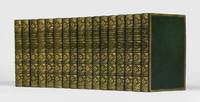
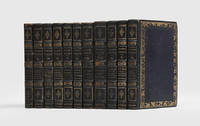
1832145545London: John Murray 1832-33. A handsome set A very handsome set of Byron's collected works including his letters and journals and Moore's biography of the poet. 17 vols octavo 163 x 100 mm. With engraved frontispieces and vignette title pages. Contemporary green morocco spines lettered in gilt gilt in compartments gilt borders and turn-ins marbled endpapers gilt edges. Spines lightly sunned minor browning to plates and sporadic very light foxing; a superb set. unknown
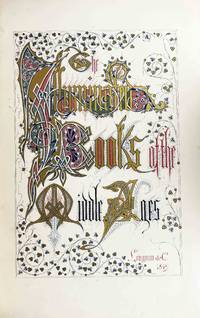
18471267London: Longman & Company 1847. First edition. First edition. 12mo. Superbly bound in full black impressed morocco binding over beveled boards by Hayday. 31 chromolithographed full-page illustrations chromo title-page text borders and initials all by Noel Humphreys. A monumental production of this most notable and sought-after early Victorian landmark in book binding and color production. A fine copy with almost no signs of wear seldom seen in this condition. Longman & Company unknown
181638597John Murray 1816. 8vo. First Edition EXTRA-ILLUSTRATED with engraved frontispiece and 18 engraved plates; most attractively bound in full red calf sides with gilt frame border expertly rebacked to style with old backstrip gilt laid down gilt top gilt dentelles marbled endpapers uncut a remarkably well-preserved fresh crisp copy. With the publisher's 4pp catalogue dated February 1816 at end. THIS COPY WAS BOUND BY ZAEHNSDORF IN THE LATTER HALF OF THE NINETEENTH CENTURY FOR CHICAGO PUBLISHER AND WHOLESALER A.C. McCLURG; the binding is signed on front free endpaper verso. It was possibly compiled on behalf of a dedicated collector for the plates and portraits are numerous and relevant. The frontispiece 'Leila' engraved by Mote after Corbaux and 11 plates relate to the first work; the remaining 7 plates to the second. Of particular interest are the fine portraits of John Hobhouse to whom the work is dedicated by Hopwood after Wivell and John Sobieski engraved by Thomson from a picture in the Louvre. A MOST UNUSUAL AND EXCEEDINGLY SCARCE COPY IN sympathetically restored period binding. Randolph p. 55; Wise I p.106. John Murray, unknown
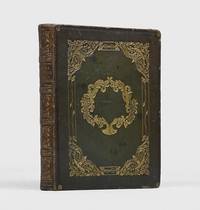
1841190305London: William Smith 1841. A gem of 19th-century entomological illustration First edition of this splendidly illustrated book one of Humphreys's most accomplished works as a naturalist illustrator. It is a collaboration with the leading entomologist John Westwood who contributed the letterpress. A skilled artist trained in Brussels Humphreys became interested in natural history after a tour of Italy. Upon his return he settled in London as a neighbour of a relative the landscape architect and prolific author J. C. Loudon. Humphreys is "deservedly remembered for his extensive and significant contribution to the commercially produced book" ODNB. He wrote for a series of garden periodicals including Loudon's Gardener's Magazine and published two entomological works with Westwood: the present work on butterflies and subsequently British Moths and Their Transformations 1843-45. Both proved extremely popular. Westwood 1805-1893 was one of the first entomologists to obtain an academic position at Oxford University and he founded with Frederick William Hope the Entomological Society of London. In 1846 the name Westwoodia was given in his honour to a genus of Hymenoptera. He was himself a skilled insect illustrator contributing drawings to several publications between the 1820s and the the 1840s. Large quarto 266 x 206 mm. Original green roan spine with gilt raised bands lettering and floral decoration in compartments covers with blind frame enclosing elaborate floral border and centrepiece board edges and turn-ins richly gilt yellow coated endpapers edges gilt. Hand-coloured lithographic title page and 42 similar plates. Old bookseller's slips loosely inserted; ownership inscription on front free endpaper of the London dentist Ashley William Barrett 1848-1939 and his brother Henry John dated 1901 inscription of one David S. Smith below. Spine and board edges faded to brown corners worn a few marks to covers extremities skilfully refurbished and front inner hinge repaired occasional faint spot of foxing or small mark to contents else clean. A very good copy. hardcover
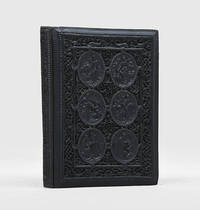
1848182652London: Longman & Co. 1848. One of the "supreme examples of Victorian Gothic" First edition of this icon of 19th-century book design. It is one of a handful of titles that showcase Humphrey's black so-called papier-mâché binding and displays a fantastic suite of his chromolithographs. Such bindings which imitate carved ebony were cast in plaster over a papier mâché mould. "The result was splendidly gothic and impressive" and they represent "perhaps the biggest triumph among all the ingenuities of Victorian commercial book-binding" McLean pp. 72 & 151. This design was inspired by a binding of carved ivory on a psalter in the British Museum. Humphreys 1810-1879 was also heavily influenced by Italian and Flemish manuscripts of the Middle Ages. The skill of the chromolithography demonstrated here is masterly and improves upon that of his previous titles. Octavo. Chromolithograph title page heightened in gilt 31 chromolithograph leaves with text and borders in medieval style 4 pp. letterpress at end. Original black plaster boards with elaborate gothic relievo design by Humphreys incorporating six medallion vignettes depicting miracles black embossed morocco spine spine and both boards lettered in relief gilt inner dentelles Fountain pattern marbled endpapers gilt edges. Housed in a custom blue cloth box. Relievo crisp and unrubbed boards superficially cracked at edges lower corners bumped letterpress pages foxed plates bright. A near-fine copy. Ruari McLean Victorian Book Design & Colour Printing 1963. hardcover
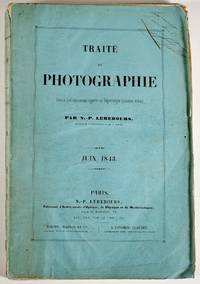
184354394Paris: N.-P. Lerebours 1843. Fourth edition. 8vo. vi 203 pp. folding engraved plate plus 14 pp. catalogue possibly lacking a terminal leaf. Publisher's original printed blue wrappers which are chipped at the spine ends and have a 3-inch separation along the front joint. There is scattered foxing to the text and engraved plate with one leaf of the catalogue crudely opened. On the upper tip of the front wrapper the author has signed and inscribed "Hommage l'auteur N P Lereboures." A very good moderately worn presentation copy. N.P. Lerebours is most noted for his publications EXCURSIONS DAGUERRIENNES 1841-1844 the first large-scaled publication illustrated from photographs as well as for his manufacture of apparatuses of which he was among the first. <br /> <br /> In this work he discusses the underlying theory of the photographic process and the numerous practical methodologies of the day. Largely concerned with the daguerreotype with a compilation of writings by the inventors or practitioners themselves - the list of reads as a European directory of the most famous of the period. There are sections on the galvanographic process to make prints from daguerreotypes and the gravure process of Fizeau. Although stated as the fourth edition it should be referred to as the fourth enlarged and revised edition; his earlier publications had various other titles and were less than half the length of this work. The appended priced catalog lists all manner of photographic apparatus. There are several pages concerned with his publication EXCURSIONS DAGUERRIENNES and the various contents that could be ordered. <br /> <br /> In Catalogue 52 Commemorating the Centenary of Fox Talbot and Daguerre 1839 - 1939 E. P. Goldschmidt called this "the first standard hand-book of photography." WorldCat locates eight copies in European libraries with a single North American copy held by the University of Ottawa. Roosens and Salu No. 2842. Bellier de la Chavignerie Manuel Bibliographie du Photographe Francais 1863 No. 18. N.-P. Lerebours unknown
184351857Paris: N.-P. Lerebours 1843. Fourth ed. 8vo. iv 203 pp. folding plate plus 16 pp. catalogue. Cloth backed marbled paper over boards with a morocco spine label. The half-title shows modest soiling; occasional scattered foxing with a small stain to the top blank corner of the last few leaves; the original owner has signed his name on the blank reverse of the title page with bleed-through; else very good. N.P. Lerebours is most noted for his publications EXCURSIONS DAGUERRIENNES 1841-1844 the first large-scaled publication illustrated from photographs as well as for his manufacture of apparatuses of which he was among the first. <br /> <br /> In this work he discusses the underlying theory of the photographic process and the numerous practical methodologies of the day. Largely concerned with the daguerreotype with a compilation of writings by the inventors or practitioners themselves - the list of reads as a European directory of the most famous of the period. There are sections on the galvanographic process to make prints from daguerreotypes and the gravure process of Fizeau. Although stated as the fourth edition it should be referred to as the fourth enlarged and revised edition; his earlier publications had various other titles and were less than half the length of this work. The appended priced catalog lists all manner of photographic apparatus. There are several pages concerned with his publication EXCURSIONS DAGUERRIENNES and the various contents that could be ordered. <br /> <br /> In Catalogue 52 Commemorating the Centenary of Fox Talbot and Daguerre 1839 - 1939 E. P. Goldschmidt called this "the first standard hand-book of photography." WorldCat locates eight copies in European libraries with a single North American copy held by the University of Ottawa. Roosens and Salu No. 2842. Bellier de la Chavignerie Manuel Bibliographie du Photographe Francais 1863 No. 18.<br /> <br /> <br /> WorldCat locates eight copies in European libraries witha single North American copy the University of Ottawa. Roosens and Salu No. 2842. Bellier de la Chavignerie Manuel Bibliographie du Photographe Francais 1863 No. 18. In Catalogue 52 Commemorating the Centenary of Fox Talbot and Daguerre 1839 - 1939 E. P. Goldschmidt called this "the first standard hand-book of photography. N.-P. Lerebours unknown
1879B6441London: John Murray. 1879. A fine copy in publisher’s decorative half red calf. Binding: contemporary half red calf over marbled boards title in gilt on two spine with five raised bands spine with decorative gilt ruling and central devices marbled upper and lower endpapers top edges in gilt. Notes: The books Bedouin Tribes of the Euphrates and A Pilgrimage to Nejd are attributed to her and were based on her journals but were extensively edited by her husband. Illustrated with a folding map and hand-coloured woodcuts by the author. <br><br>Anne Isabella Noel Blunt 1837 – 1917 known for most of her life as Lady Anne Blunt was co-founder with her husband the poet Wilfrid Blunt of the Crabbet Arabian Stud in England and the Sheykh Obeyd estate near Cairo. The two married on 8 June 1869. From the late 1870s Wilfrid and Lady Anne travelled extensively in Arabia and the Middle East buying Arabian horses from Bedouin tribesmen and the Egyptian Ali Pasha Sherif. Among the great and influential horses they took to England were Azrek Dajania Queen of Sheba Rodania and the famous Ali Pasha Sherif stallion Mesaoud. To this day the vast majority of purebred Arabian horses trace their lineage to at least one Crabbet ancestor.<br><br> Size: 8vo. Illustration: Illustrated with a folding map and hand-coloured woodcuts by the author. Volume: 2 volumes. Category: Book Asia Middle East General; Book Plate Books Colour; John Murray. hardcover
1861009786Washington D. C: Superintendent of Documents 1861. 5 parts in one volume. 2 large folding lithographic maps clean/no tears 8 fine folding lithographic views 8 chromolithographic beautiful color plates showing dress of various Indian tribes along river and 16 lithographic plates of views and fossils from sketches by Baldwin Mollhausen all clean and in excellent condition. Original decorated black cloth gilt with spine cloth missing. Overall tight and clean. Minimal foxing. Frst edition This is the Senate and preferred issue. Probably best known as the engineer and architect of the Washington Monument 1859-1860 in 1857 Ives was "promoted to first lieutenant and was named to lead an expedition up the Colorado River in order to develop potential routes of supply in the event of a war between the national government and the Mormon settlements in Deseret Utah. Ives's expedition included John Strong Newberry as naturalist the Prussian Heinrich Balduin Möllhausen as artist and unofficial diarist and F. W. Egloffstein as topographer. Ives purchased a steamboat in Philadelphia. The vessel was taken apart and shipped via the Isthmus of Panama to California and thence to the mouth of the Colorado River where Ives and the members of his expedition rendezvoused late in 1857. Ives and his men reassembled the steamboat and christened it the Explorer. They launched the ship on 31 December 1857 and set out on their journey of reconnaissance. Overall with exception of spine covering missing an exceptional copy. Clean. 1st Edition. Decorative Cloth. Very Good/No Jacket - Issued. Illus. by Möllhausen Heinrich Baldwin. 4to - over 9¾" - 12" tall. Superintendent of Documents Hardcover
1824186939London: John Murray vols I-VI; Knight and Lacey IX; John & Henry L. Hunt X-XI 1824-27. Fine contemporary morocco A very attractive mixed-imprint set in well-preserved bindings. 11 vols octavo 160 x 103 mm. Contemporary blue straight-grain morocco spines lettered in gilt gilt lozenge tool to upper and lower compartments gilt ivy-leaf frame to boards enclosing blind roll and corner rosettes green coated endpapers edges gilt blue bookmarkers. Unobtrusive scratches to boards corners bumped intermittent foxing heavy in vol. XI. A very good set presenting well in the bindings. hardcover
1832139270London: John Murray 1832-33. An attractive set An attractive library set of Byron's works complete with the three Don Juan volumes added to the edition including all his poems and plays letters and journals and the Life by his friend Thomas Moore. 17 vols octavo 166 x 104 mm. Engraved frontispieces and vignette title pages. Contemporary red half morocco spines lettered in gilt marbled sides and endpapers. Bindings with sporadic rubbing but generally in nice shape slight discoloration to some endpapers contents lightly toned else clean and unmarked. An excellent set. unknown
1849009747London: Longman Brown Green and Longmans 1849 Folio 56 cm 2 15 pp. letterpress title printed in red and black additional chromolithographic title 39 chromolithographic plates and one uncoloured plate. Contemporary half leather over red cloth spine with raised bands gilt-lettered title all edges gilt binding worn but sound with rubbing to extremities and some skinning of the leather mainly on the back board; spotting and toning throughout occasionally heavy; indistinct bookbinder's stamp on front pastedown. An important and lavishly produced survey of the art of illumination from the fourth to the seventeenth century by Henry Noel Humphreys 1810-1879 one of the leading Victorian interpreters of medieval art with plates executed by Owen Jones the foremost designer and chromolithographer of the period. The text provides a concise but learned overview of Roman Byzantine Insular Carolingian Gothic and Renaissance illumination reflecting contemporary scholarship and the nineteenth-century revival of interest in medieval ornament. The magnificent full-page chromolithographic plates printed from stone in rich colours and often at the scale of the originals reproduce some of the finest examples of manuscript illumination including leaves from the Lindisfarne Gospels Italian Renaissance manuscripts Franco-Flemish court productions and Gothic devotional books. The plates remain vivid and striking. A good copy of one of the most significant Victorian publications on medieval art. Longman, Brown, Green, and Longmans hardcover
185320949London: Ingram Cooke and Co. 1853 A connected narative of the development of the art its primeval phases in Egypt China Mexico etc; its middle state in the Cuneatic systems of Nineveh and Persepolis to its introduction to Europe through the medium of the Hebrew Phoenician and Greek systems and its subsequent progress to the present day. viii 176pp gilt all edges. 28 plates all present and correct. All colour plates are signed H.N.Humphreys. Lith.Day & Son. Lith.rs to the Queen. All black and white plates are signed 'Printed by Paul Jerrard 111 Fleet St'. Marbled end papers and pastedowns. Black papie mache with red backing paper. The design is the same on both covers comprising a leaf and flower border with three fillets inside. The centre is occupied by a large foliage stem which surrounds the title. The lower pastedown bears the binders label of Leighton Son & Hodge Shoe Lane London Ball 53A The binding has been meticulously rebacked with the original gold blocked design relaid. There is no loss or damage to the papier mache. Internally there is light random foxing throughout. This is a rare survivor of a spectacular binding fully deserving of the new Solander box in which it is now housed. Ingram, Cooke and Co. hardcover
181055228London John Murray/Thomas Davison 1810-21. 8vo. Bound in 6 uniform near contemp. hcalf. Richly gilt spines. Wear to spine-ends. Gilt lettering. Upper part of spine on the first volume loosening. Light wear to edges. All but one are Murray imprint. In general clean and fine on good paper. <br/><br/><em>An interesting collection of nearly all of Byron's works and here with many first editions. </em> unknown
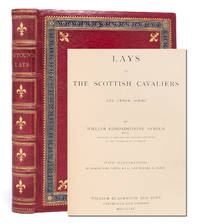
18656502Edinburgh and London: William Blackwood and Sons 1865. Later printing. Fine. Bound in a 20th-century full straight grain red morocco with gilt crest on front panel gilt fluer-de-lis and decorative gilt foliate and blue inlaid borders on front and back boards with raised six-compartment spine with gilt fleur-de-lis and title. Red marble endpapers with decorative gilt inner dentelles with a floral and vine pattern. Binding by J. Ramage & co. with binding stamp on version of free endpaper. All edges of the text block gilt interior bright and clean with in-text illustrations headpieces and tailpieces throughout. A Fine copy overall.<br /> <br /> A delightful collection that mixes prose and poetry inspired by the 19th century interest in revival texts and Scottish history. Aytoun's Lays first published 1849 were modelled on the works of Macaulay and Scott ODNB. The Paton Edition is prized for its expressive illustrations which embrace a medieval-revival style to emphasize historic costume and create a sense of drama. <br /> <br /> The London-based bindery John Ramage and Company helped "restore the fine hand-craft of bookbinding in an era when that process was increasingly mechanized" Morgan Library. John Ramage 1836-1911 apprenticed with both English and French binders before buying his first binder business in Edinburgh 1860. He opened a London bindery three years later Gertz. "Though the range of their designs is broad Ramage bindings are celebrated for their remarkably delicate careful and elaborate gilt work" Gertz. Fine. William Blackwood and Sons unknown
184760420London:: Longman & Co. 1847. First edition. original lettered leather-backed relief boards simulating a gothic carved wooden binding incorporating "Scripture / Parables" on front and rear panels; a.e.g. There is some inoffensive marginal foxing to a few of the leaves some leaves starting as is nearly always the case; tiny losses to two of the corners; but otherwise an extremely attractive example of a landmark binding rarely found intact. 12mo. Chromolithographed title leaf and 32 chromolithographed pages. This copy has 3 additional chromolithographed prayers in similar style affixed to blank leaves at front. See: Ray The Illustrator and the Book in England 231. Longman & Co., hardcover
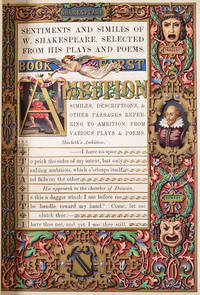
185146518London: Longmans & Green 1851. <p>Humphreys Henry Noel 1810-79. Shakespeare William 1564-1616. Sentiments and similes of William Shakespeare. Edited by Henry Noel Humphreys 1810-79. 6 100pp. Elaborate chromolithographed border by Humphreys on the first page remaining text pages printed in black and gold with 2-color initials. London: Longman Brown Green Longmans and Roberts 1851. 194 x 147 mm. Pierced high-relief papier-mâché covers over gold foil featuring a cameo bust of Shakespeare on the front cover and the initials "WS" on the back gilt dentelles all edges gilt. Skillfully recased and rebacked; boxed. Minor soiling and fore-edge wear on first few leaves but very good. 19th-century gift inscription on the title. Bookplate.</p> <p> First Edition. "According to his preface Shakespeare was the first author Henry Noel Humphreys thought of honoring with a modern printed illuminated book . . . Humphreys's enshrinement of Shakespeare's words is completed by the black papier-mâché binding with a terracotta cameo portrait of Shakespeare on the front cover and Shakespeare's initials in a similar oval on the back cover. In the first edition the pieced strapwork is placed over a striated gold foil while the second edition 1857 has a red background and an indented bevel at the outer edge. This cover the illuminated first page and Humphreys's remarks about selecting ornament that Shakespeare might have requested himself reflects the emergence of an understanding that there was a difference between the style of the Middle Ages and that of the 16th and 17th centuries" Beckwith p. 43. A. Beckwith Victorian Bibliomania: The Illuminated Book in 19th-Century Britain no. 30. </p> . Longmans & Green unknown
184817405London: Longman & Co 1848. First edition. Hardcover. Very good. 8vo. iv1312pp. Thirty-two pages are chromolithographed by Humphreys in addition there is a leaf of the illuminator' s remarks and one comprising an index of the miracles. Bound in the original black papier-mache covers designed to look like carved ebony. The binding was based on one carved in ivory in the 12th Century and has medallions of the principal miracles intertwined with ornate decorations and the title. The front and rear covers are identical. The book is exuberantly illustrated using chromolithography on 32 pages alternating between hot bright colors and cool pages subtly tinted with various shades the whole combining to make both a magnificent tribute to Medieval illustration and to the then new and novel technique of chromolithography. Marbled endpapers all edges gilt. Nicely rebacked in plain black leather;; a few small cracks in the binding edges and corners neatly mended but a very good copy. The Art of Publishers' Bookbindings 160-162. Housed in a custom slipcase. Longman & Co hardcover