Diderot Denis.ABAA

158 résultats
122581Paris 1765. Folio 253 x 393mm. 1 page of descriptive text & 8 loose plates with their accompanying text sheet from the volume of plates. Slight browning to margins a little spotting otherwise very good. § The 8 plates and descriptive text for the entry of Fleuriste Artificiel from volume IV of plates. Plates are numbered 1-8. Plate 8 is a double plate.1 page 780 from volume XVII of the Encyclopédie 1765 including information on Les ouvrages : description des opérations de son art.With some browning to a few leaves.An important home industry in the eighteenth-century France was for some time at the forefront of the manufacture of artificial flowers. The first plate's charming studio scene depicts a small yet busy and lively workshop. Further plates show the patterns used and the tools employed the aim of the plates volumes being the provision of useful guides for learning and improving the craft. The final plate larger than the rest is an illustration of a marvellous table display a depiction of a formal garden. The suite and the accompanying article on Fleuriste are the work of Jacques-Raymond Lucotte whose contribution to the plates volumes is far more extensive than his work in the text volumes. He designed over 650 himself and wrote around forty-five of their commentaries. He was heavily influenced by the Descriptions des arts et métiers of the Paris Académie royale des sciences. Although his speciality was masonry and architecture his contribution on artificial flowers is characteristic of his attention to detail. description des opérations de son art.With some browning to a few leaves.An important home industry in the eighteenth-century unknown books
1931002209Paris 1931 1932. Limited First Edition. Half Morocco over Marbled Paper. Very Good. No. 351 of 600 with total issuance in various forms of 3416 copies. This set was issued with papier pur fil Lafuma. With 24 color plates and 40 black and white illustrated plates in the two volumes. Bound attractively with decorated morocco with various curly-cue gilt ornamentation. The set epitomizes the inter-war French vogue for soft core erotica here with literary pretensions or pedigree from the eighteenth century that hotbed of erotic gamboling before squelched by the Revolution. Some spotting on the fore-edges. Rubbing on the spine extremities and the edges. Overall a handsome set. <br/><br/> unknown books
122561Paris 1767. 11 pages of descriptive text & 25 loose plates with their accompanying 17 text sheets from the volume of plates. Slight browning to margins a little spotting otherwise very good. § The 25 plates and descriptive text for the entry of Fonderie des canons from volume V of plates. Plates are numbered 1-25. Plates 3 6 7 8 24 and 25 are all double plates. The editors miscounted the number of double plates as five when there are in fact six. 11 pages 606-616 from volume II of the Encyclopédie 1751 with information on the foundry.This impressive suite of plates on the casting of canons includes many attractive double plates of different canons and the machines used to make them. The Arms of France appear on many of these as do those of Louis Auguste de Bourbon Louis XIV’s son. The creation of the canon mould and the casting of the weapon are also explained with fascinating details on the drills used to produce the correct bore.Several detailed plates also depict the casting of various weights of canon ball. Furthermore two plates examine a recent Spanishinvention an improvement on the design of the gun carriage. Theplates are supported by a number of entries under Canon dans l’art militaire. unknown books
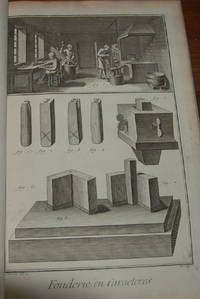
177233947Paris 1772. Folio 3 pages of letter press and 8 engraved plates. Bound in plain paper wraps. Printing and the Mind of Man 200: "a momument in the history of European thought; the acme of the age of reason; a prime motive force in undermining the ancien regime and in heralding the French Revolution; a permanent source for all aspects of eighteenth-century civilization. Light foxing to the letterpress near fine copy. Illustrations and text about the type foundry. unknown books
122525Paris 1767. 1 page of descriptive text & 8 loose plates with their accompanying 4 text sheets from the volume of plates. Slight browning to margins a little spotting otherwise very good. § The 8 plates and descriptive text forthe entry of Fonte des Cloches from volume V of plates. Plates are numbered 1-8. Plate 1 is a double plate. unknown books
122570Paris 1769. Folio 253 x 393mm. 12 pages of descriptive text & 8 loose plates with their accompanying 16 text sheets from the volume of plates. Slight browning to margins a little spotting otherwise very good. § The 8 plates and descriptive text for the entry of Forge des Ancres from volume VII of plates. Plates are numbered 1-8.6 pages 162 & 442-446 from volume I of the Encyclopédie 1751 including Ancre d'affourche and Les ancres en général3 pages 339 355 & 418 from volume II of the Encyclopédie 1751 including information on Boussoirs soutenir l'ancre and Lorsque le cable s'est rompu and Brider l'ancre1 page 689 from volume V of the Encyclopédie 1755 including Enjabler une ancre1 page 860 from volume VII of the Encyclopédie 1757 including Les grappins1 page 463 from volume VIII of the Encyclopédie 1765 including Jas d'ancre2 pages 187 & 188 from volume XII of the Encyclopédie 1765 including Patte d'une ancre1 page 806 from volume XVI of the Encyclopédie 1765 including Ancre des Chinois1 page 188 from volume I of the Supplément à l'Encyclopédie 1776 which includes further information on Ancre d'affourcheWith some browning to a few leaves.This impressive suite of plates depicts the construction of enormous anchors and the gigantic forges in which they are created. Massive levers and pulleys are used to move the components and the finished anchors which would be used on the battleships of their day. Also included are many relevant text entries most of which were contributed by Jacques-Nicolas Bellin a French philosophe and hydrographer. These include the main entry for Ancre Grappin Jas D'Ancre and those on other processes and parts. Other articles include those by Chevalier Louis de Jaucourt and Chevalier de la Coudraye a naval officer and politician. unknown books
122524Paris 1765. 41 pages of descriptive text & 52 loose plates with their accompanying 23 textsheets from the volume of plates. Slight browning to margins a little spotting otherwise very good. § The 52 plates and descriptive text for the entry of Forges ou Art du Fer from volume IV of plates. The first section contains ten platesnumbered 1-10. The second section also contains ten platesnumbered 1-10 although plates 1 and 2 are double plates. The third sections contains twelve plates numbered 1-12 with plates 1 and 2 being double plates. The fourth section is made up of 7 plates numbered 1-7 with plates 1 2 and 3 being double plates. There is a small about of damage to plate 5 of the fourth section.This mammoth suite of plates tackles the casting of iron beginning with images of various mines and the collecting of ore. Small and giant furnaces are examined and the casting and finishing of the iron are shown. All aspects of forging are covered in this incredible suite of plates. No guide to eighteenth-century forging is so complete and comprehensive. Also included to help explain the art are many text entries on the subject carefully selected from the Encyclopédie text volumes.These include articles by Diderot and Étienne-Jean Bouchu a pioneering French steelmaker. Furthermore an article on the casting of horseshoes was contributed by Claude Bourgelat a renowned veterinary surgeon. unknown books
122492Paris 1765. Folio 253 x 393mm. 11 pages of descriptive text & 6 loose plates with their accompanying text sheets from the volume of plates. Slight browning to margins a little spotting otherwise very good. § The 51 plates and descriptive text for the entry of Fourreur from volume IV of plates. Plates are numbered 1-6.1 page 556 from volume I of the Encyclopédie 1751 including La maniere de les passer en huile.8 pages 254-262 from volume VII of the Encyclopédie 1757 including Fourreurs.1 page 751 from volume IX of the Encyclopédie 1765 including Préparation qui fert à lustrer les fourrures.This suite of plates examines the craft of the furrier and the tools and skills used in the manufacture of fine furs. A charming scene of the furrier's shop depicts a woman selecting a roll of fur and a furrier at work. The main entry for Fourreur is also included with the suite and this helps explain the subject further. unknown books
195340464London: Cassell 1953. First Edition. 8vo pp. xxiii 428. Index. Blue cloth. Cover worn at edges o/w a VG copy. Cassell unknown books
122559Paris 1772. Folio 253 x 393mm. 4 loose plates with their accompanying text sheet from the volume of plates. Slight browning to margins a little spotting otherwise very good. § The 4 plates and descriptive text for the entry of Gazier from volume XI of plates. Plates are numbered 1-4. With some browning to a few leaves.These four plates display several looms used for the manufacture of gauze from silk and also show how they are constructed making these a useful guide for the eighteenth-century gauze-maker. unknown books
1802291825Milan 1802. hardcover. very good. 111 pages. Slim 12mo 1/2 contemporary mottled calf marbled boards. Milan: 1802. Light foxing throughout still a very good copy.<br/><br/> unknown books
122481Paris 1767 Folio 253 x 393mm. 4 pages of descriptive text & 3 loose plates with their accompanying text sheets. Slight browning to margins a little spotting otherwise very good. § The 3 plates and descriptive text for the entry of Gravure sur Pierres Fines from volume V of plates. Plates are numbered 1-3. Also with the relevant entries listed under Pierres Fines in the Table Analytique et Raisonnée du Dictionnaire des Sciences Arts et Métiers. Vol 2 1780.4 pages 595-598 from volume XII of the Encyclopédie 1765 with information on Gravures.Illustrating the art of engraving semi-precious stones these plates give a fine overview of the engraver at work. Beginning with a studio scene demonstrating the use of his lathe the next two plates show his key tools. Included also with the text are relevant entries by Chevalier Louis de Jaucourt on stonework with particular reference to semi-precious artifacts. unknown books
122529Paris 1771. 62 pages of descriptive text & 105 loose plates with theiraccompanying 50 text sheets from the volume of plates. Slightbrowning to margins a little spotting otherwise very good. § The 47 plates and descriptive text for the entry of Histoire Naturelle Minéralogie and Métallurgiefrom volume VI of plates.There are a total of thirty sets of plates in this suite each covering a different aspect of this topic. All plates are numbered with their position in their set unless the set contains only one plate. There are a total of 26 double plates with one triple plate. In the penultimate set entitled Ardoiserie de la Anjou Plate 1 is spread over five sheets and Plate 2 is spread over two sheets. The largest suites are titled Travail de cuivre and Fabrique des Poudres à Canon.The following is a list of all the various titles for all the suite’s setswith the number of plates in brackets: Géometrie Souterraine 1 Sonde de Terre 3 Instrumens des Mines 2 Coupe d’une Mine 3 Lavoir et Bocard 1 Calcination des Mines 2 Mercure 1 Minéralogie et Métallurgie 3 Travail deCuivre 10Calamine 6 Etain 1 Travail du Fer-Blanc 3 Machines de Pontpéan 5 Plomb 1 Fonte de Bismuth 1 Travail de Zinc 1 Fourneaux pour le Colbalt & de l’Arsenic 1 Travail de Soufre 3 Extraction du Salpêtre 4 Raffinage du Salpêtre 5 plates numbered 5-9 Fabrique de la Poudre à Canon 19 Extraction du Vitriol ou Couperose 1 Travail de l’Alun 1 Minéralogie Salines 11 Maraie Salans 5 Travail des Sels 1 Charbon Minéral ou de Terre 2 Ardoiserie dela Meuse 5 Ardoiserie de la Anjou 2 and finally Travail du Noir de Fumé 1.In total there are 51 accompanying text sheets extracted from Plates Volume VI for these sets of plates.Under Métallurgy and Métal:1 page 644 from volume II of the Encylcopédie 1751 including Composition de métal fort estimé des Caraïbes1 page 812 from volume IV of the Encyclopédie 1754 including Différence entre les métaux & les demi-métaux2 pages 189 & 984 from volume V of the Encyclopédie 1755 including Tous les métaux triturés avec l'eau passent pour fournir un certain sel and Les essais qui doivent précéder les travaux de métallurgie 2 pages 325 & 870 from volume VI of the Encyclopédie 1756 including information on Preuve sensible de l'extension des métaux par la chaleur and Fleuves qui roulent des grains de différens métaux 1 page 400 from volume VII of the Encyclopédie 1757 including Métaux qui s'unissent: métaux qui ne peuvent s'unir22 pages 273 379 428-435 & 521-532 from volume X of the Encyclopédie 1765 including information on Le mercur Métal Histoire Naturelle Chymie & Métallurgie en général Les métaux dans leurs mines and La formation des métaux1 page 859 from volume XII of the Encyclopédie 1765 including Poids dont se servent les métallurgistes 1 page 922 from volume XIV of the Encyclopédie 1765 including information on Rapport de l'acide marin avec les métaux blancs2 pages 596 & 866 from volume XV of the Encyclopédie 1765 describing Affinité des sucs arsénicaux avec les métaux and L'origine de l'influence attribuée aux plantes sur divers métaux1 page 172 from volume XVI of the Encyclopédie 1765 including further information on Le mercure3 pages 286 581 & 737 from volume I of the Supplément à l'Encyclopédie 1776 which includes L'alkali De leur mêlange avec l'arsenic and more information on Le mercure1 page 630 from volume II of the Supplément à l'Encyclopédie 1776 which includes Les métaux principes de couleurs dans les minéraux végétaux & animaux1 page 188 from volume III of the Supplément à l'Encyclopédie 1777 which includes Connoissance des anciens gaulois dans cet art1 page 322 from volume iV of the Supplément à l'Encyclopédie 1777 which includes Effet du mêlange de plussiers métauxUnder Minéralogie and Minéral:1 page 192 from volume III of the Encyclopédie 1753 including Exhalaisons empoisonnées des minéraux1 page 245 from volume IV of the Encyclopédie 1754 including L'ouvrage de minéralogie de Wallerius 1 page 803 from volume VI of the Encyclopédie 1756 including Une même montagne des minéraux de différentes especes2 pages 133 & 708 from volume VIII of the Encyclopédie 1765 including Moyen de découvrir si une substance minérale contient de soufre and information on Substances minérales13 pages 533-544 & 778 from volume X of the Encyclopédie 1765 including Regne Minéral Minéalisation Minérologie Minéraux and further information on Exhalaisons empoisonnées des minéraux 1 page 580 from volume XVI of the Encyclopédie 1765 including more information on Exhalaisons empoisonnées des minéraux1 page 362 from volume XVII of the Encyclopédie 1765 including Division des substances de regne minéral en calcaires vitrifiables & réfractaires ou apyresThis vast suite of plates shows mines and earth works of an enormous size. Impressive cross-sections of shafts and images men at work in the processing halls and foundries make this one of the most visually compelling suites from Diderot’s Encyclopédie. However these are not only attractive depictions of eighteenth-century mining and Earth Sciences they are a comprehensive guide to the operation and construction of the machines and tools employed. Diderot and Goussier ‘the third Encyclopédist’ who together visited many factories and workshops around France and Europe meant the Encyclopédie as a textbook and as a way of propagating new ideas and methods. For instance one of the largest sections in this suite is devoted to the famous Pont-Péan lead mines in Brittany where innovative hydraulic machines had recently been installed. Further plates demonstrate the arts of underground surveying and geometry the renowned slate quarries of Anjoun and the refining of mercury copper gold tin zinc and cobalt. No other publication had devoted this amount of attention to the mechanical arts before and none did again until the mid-nineteenth-century. These images are of considerable significance now as one of few records of mining practices and the mining machines of the eighteenth-century particularly interesting because of their attention to detail and their useful cross-sections and disassemblies.To accompany the plates are many relevant text entries including the main articles for Mine Minéral Minéralogie Minéraux Métal and Métallurgie by Paul-Henri Thiry Baron d’Holbach a French-German philosophe and encyclopédist author of the renowned Système de la Nature ou Des Loix du Monde Physique et du Monde Moral 1780.D’Holbach contributed around four hundred articles to theEncyclopédie a number of which were translations of Germanphilosophical works.Another important paper is on Regne Minéral and is an abrigedversion of a work by Charles Le Roy a French physician and professor of medicine at Montpellier University. Géometrie Souterraine (1) unknown books
122515Paris 1768. Folio 253 x 393mm. 39 pages of descriptive text & 21 loose plates with their accompanying 6 text sheets from the volume of plates. Slight browning to margins a little spotting otherwise very good. § The 21 plates and descriptive text for the entry of Histoire Naturelle Oiseaux from volume VI of plates. The twenty-one plates are numbered 30-50. Plate 50 is continued on a second sheet.Also with the relevant entries listed under Ornitholite Ornithologie and Ornithologue in the Table Analytique et Raisonnée du Dictionnaire des Sciences Arts et Métiers. Vol II 17801 page 690 from volume II of the Encyclopédie 1751 including La différence entre les oiseaux de proie & les granivores1 page 1007 from volume V of the Encyclopédie 1755 including further information on La différence entre les oiseaux de proie & les granivores2 pages 200 & 201 from volume VIII of the Encyclopédie 1765 including Observations sur le mouvement de leurs paupieres and Oiseaux de nuit13 pages 433-445 from volume XI of the Encyclopédie 1765 including Oiseau Ornithologie observations générales3 pages 555 557 & 560 from volume XII of the Encyclopédie 1765 including Oiseaux des paradis observations sur les pieds de cet oiseau and Leur pieds & leurs jambes2 pages 708 & 709 from volume XIII of the Encyclopédie 1765 including Leur queue11 pages 32-3 432 433 440 441 447-449 733 & 735 from volume XVII of the Encyclopédie 1765 including Gésier des oiseaux Du chant & de la voix des oiseaux Chasses avec les oiseaux de proie Vol des oiseaux and Chant des oiseaux au printems2 pages 299 & 300 from volume II of the Supplément à l'Encyclopédie 1776 which includes information on Observations sur leur cerveau & sur leur cervelet2 pages 123 & 124 from volume II of the Supplément à l'Encyclopédie 1776 which includes information on Blason La maniere de représenter différentes especes d'oiseaux and Les pays éloignés2 pages 186 & 187 from volume IV of the Supplément à l'Encyclopédie 1777 which includes information on Ornithologie en général under OrnithologieWith some browning to a few leaves.These plates were the work of François-Nicolas Martinet 1731-1800 a French engraver and illustrator of note. One of the most influential ornithologists of his day his popularity was the result of his ability to depict the birds realistically. Perhaps his most famous illustrations were those for Mathurin Jacques Brisson's Ornithologia sive Synopsis Methodica 1760-63. His twenty-one plates here show many birds now scarce or endangered and are an essential document of eighteenth-century French ornithology. Also included is Goussier's chart of various bird bills and feet.The text entries accompanying these plates help to explain the anatomy of birds as understood at the time. These include the entries for Carnacier Estomac and Ventricule. Other articles are on owls birdsong and ornithology in general. The contributors to these sections include Pierre Tarin a French writer and doctor and Chevalier Louis de Jaucourt an aristocrat who wrote around one quarter of the completed Encyclopédie. unknown books
122513Paris 1768 and the Supplementary Plates Volume 1777. Folio 253 x 393mm. 42 pages of descriptive text & 35 loose plates with their accompanying 7 text sheets from the volume of plates. Slight browning to margins a little spotting otherwise very good. § The 29 plates and descriptive text for the entry of Histoire Naturelle Regne Animal from volume VI of plates with an additional 6 plates from the Supplementary Plates Volume. The twenty-nine plates from volume VI are numbered 1-29 with seven accompanying text sheets. This suite includes plates on land quadrupeds and sea mammals in particular.The six supplementary plates come in two sets. The first set contains four plates numbered 1-4 and these cover frogs and zoophytes in particular. The second set contains 2 plates numbered 2 & 3 and these cover hermaphrodites. Unfortunately the first plate is this set is missing.Also with the relevant entries listed under Animalité in the Table Analytique et Raisonnée du Dictionnaire des Sciences Arts et Métiers. Vol I 178012 pages 88 89 98 99 122 & 468-476 from volume I of the Encyclopédie 1751 including Plus il approche de l'adolescence plus il croît lentement La durée de sa vie peut se mesurer par celle de tems de l'accroissement Sels animaux Sels qui se trouvent dans le corps de l'animal Action animale and Animal Histoire Naturelle.3 pages 214 318 & 813 from volume II of the Encyclopédie 1751 including Animal Bête Brute Bonté animale and Cendres animales4 pages 31-33 & 596 from volume III of the Encyclopédie 1753 including Chaleur de l'animal; principaux phénomenes qu'elle présente and La dilatation & la contraction des dimensions extérieures du corps sont essentielles à la vie de l'animal1 page 363 from volume VI of the Encyclopédie 1756 including Facultés animales4 pages 35 36 51 & 110 from volume VII of the Encyclopédie 1757 including Plus les autres visceres sont petits dans un animal à proportion du sujet plus le foie est grand Fonctions animales and Accroissement & décroissement de la force de l'animal1 page 236 from volume VIII of the Encyclopédie 1765 including De l'animal selon la philosophie de Hobbes1 page 841 from volume X of the Encyclopédie 1765 including Mouvement animal7 pages 360-366 from volume XI of the Encyclopédie 1765 including Economie animale3 pages 39 585 & 586 from volume XV of the Encyclopédie 1765 including La premiere notion dans l'animal Substances animales and De l'acide animal 1 page 175 from volume XVI of the Encyclopédie 1765 including information on Les corps terreux naturels tirés de regne animal: leur usage en médecine2 pages 435 & 436 from volume I of the Supplément à l'Encyclopédie 1776 which includes information on Les animals en général 1 page 490 from volume II of the Supplément à l'Encyclopédie 1776 which includes information on Caractere distinctif de l'animalWith some browning to a few leaves.Contributed by François-Nicolas Martinet 1731-1800 famous for his ornithological engravings these plates display many noted mammals reptiles and amphibians. Martinet was well regarded because of his ability to depict the creatures realistically and many of his subjects are now scarce or endangered. Perhaps his most famous illustrations were those for Mathurin Jacques Brisson's Ornithologia sive Synopsis Methodica 1760-63. These visually compelling plates show creatures of all sorts from elephants to capybara and apes sloths and monkeys to cabasssou armadillos surinam toads and chameleons. Martinet's illustrations are detailed and informative although in places are charmingly naïve. Several relevant text entries follow and these include Animal by Diderot and Louis-Jean-Marie Daubenton a French naturalist of note. Futher articles were contributed by Pierre Tarin Paul Jacques Malouin and Baron de Haller. leur usage en médecine2 pages (435 & 436) from volume I of the Supplément à l'Encyclopédie (1776) which includes information unknown books
122951Paris: 1768. Folio 253 x 393mm. 59 pages of descriptive text & 11 loose plates with their accompanying 2 text sheets from the volume of plates. Slight browning to margins a little spotting otherwise very good. § The 11 plates and descriptive text for the entry of Histoire Naturelle Regne Végétal from volume VI of plates. The eleven plates are numbered 94-101 with 2 accompanying text sheets. 2 pages 489 & 491 from volume II of the Encyclopédie 1751 including Collection du cabinet du roi dans le regne végétal and Soin que demande dans un cabinet l'entretien des végétaux.1 page 228 from volume VIII of the Encyclopédie 1765 including further information on Les rapports & différences des végétaux.2 pages 182 & 871 from volume XVI of the Encyclopédie 1765 including Observations sur la nature de la terre matrice des végétaux and Son usage dans les mets1 page 744 from volume XVII of the Encyclopédie 1765 including Les animaux qui forment la nuance entre le regne végétal et le regne animal.1 page 532 from volume IV of the Supplément à l'Encyclopédie 1777 which includes further information on Les animaux qui forment la nuance entre le regne végétal et le regne animal.3 pages 233 583 610 from volume I of the Encyclopédie 1751 which includes Causes de la végétation La nutrition des plantes and Principe qui selon quelques anciens détermine chaque végétation en son espece under Végétation2 pages 516 & 653 from volume VI of the Encyclopédie 1756 which includes information on Les anciens and Usage de feuilles dans la végétation.1 page 646 from volume VII of the Encyclopédie 1757 which includes La description de celle d'une graine under Végétation1 page 290 from volume XI of the Encyclopédie 1765 which includes information on La nutrition des plantes under Végétation17 pages 710-726 from volume XII of the Encyclopédie 1765 which includes L'explication de l'économie végétale under Végétation.1 page 746 from volume XIII of the Encyclopedie 1765 which includes information on La nutrition des plantes under Végétation.10 pages 953-962 from volume XVI of the Encyclopédie 1765 includes information on Végétation Histoire Naturelle Botanique under Végétation.1 page 45 from volume II of the Supplément à l'Encyclopédie 1776 which includes Etat d'imperfection où cette partie de la botanique se trouve encore and Mammelons intercutanés d'où se forment selon les circonstances des branches ou des racines under Végétarian. 16 pages 207-222 from volume III of the Supplément à l'Encyclopédie 1777 which includes Germination under Végetation. (1768). Folio unknown books
1774BL4658The Hague:: Chez Gosse Fils 1774. 1774. <br /><br /> 7 volumes. 8vo. xii 4 604; viii 434; xii 612; viii 417 1; xii 416; viii 406; viii 448 pp. Half-titles vols. 1 3 5 7 7 engraved plates 7=4 meaning 7 large folding engraved maps are present as issued of which 4 are unique and 3 are duplicates again as issued vols. 1 & 2 and 3 & 4 have the same two maps each marked "Tome 1&2" - or – "Tome 3&4" V: Gulf of Mexico; VI & VII: 2 copies large folding eng. map of North America errata. <br /><br /> Original full mottled calf ornate gilt spines dual leather gilt-stamped spine labels; some wear to extremities. Unidentified rubber-stamps on half-title or titles purple: feathered crown over two crossing feather pens a ribbon draped over a rod with the word: ----bekholes. Very good set lacking the engraved portrait of the author but complete with all the text and 7 plates and 7 maps. "Man will never be free until the last king is strangled with the entrails of the last priest" – Denis Diderot. EARLY EDITION first issued in 1770 of this classic that opens with the discovery of North America then thought of as the New World while looking for passage to India. This edition was edited and improved over previous editions. The work is embellished with 7 historiated "frontispiece" elaborately engraved plates located at the beginning of the narrative show indigenous peoples in natural settings. The 4 folding engraved maps depict the entire world North America including Hudson Bay and Greenland to the north and reaching as far south as the Gulf of Mexico and east to the western part of Africa and the Gulf of Mexico region reaching to the northern part of S. America. 3 additional maps repeat three of the original maps. <br /><br /> "The book examines the East Indies South America the West Indies and North America. The final chapter comprises theory around the future of Europe as a whole. Raynal also examines commerce religion slavery and other popular subjects all with a perspective from the French Enlightenment." – Wikip. <br /><br /> Born April 12 1713 at Saint-Geniez in Rouergue Raynal received a Jesuit education at Pezenas. "Collaboration was crucial to Raynal's greatest achievement as an editor and author. It was Raynal after all who shepherded into print one of the eighteenth century's most influential collective efforts the massive Histoire philosophique et politique des etablissements et du commerce des Europeens dans les deux Indes a philosophical and political history . . . Printed in three "authorized" versions edited by Raynal 1770 1774 and 1780 the Histoire des deux Indes was the work of a score of authors among them Denis Diderot Jean le Rond d'Alembert Charles Pinot-Duclos and Paul-Henri Thiry The Baron d'Holbach 1723-1789. Diderot and d'Holbach denounced the tyranny of despotism which touched a nerve from the French monarchy resulting in the book being condemned by the French parliament in 1781. Raynal was exiled from France and in fact an order was issued for his arrest even though his name did not appear on the first edition of the work. <br /><br /> The Histoire des deux Indes attempted a comprehensive history of the contemporary European colonial enterprise in the Far East and the Atlantic world. Beginning with the fifteenth-century Portuguese explorations and culminating with a sweeping analysis of all colonial powers in the eighteenth century the Histoire laid bare the progress of conquest for each European nation and its trading companies. Often the 'progress' translated into the abuses made possible by the disproportionate use of force and state-sponsored trading monopolies. No colonial power was spared. . ." – Bill Marshall Cristina Johnston France and The Americas: Culture Politics And History ABC-CLIO 2005 p. 978. <br /><br /> "Diderot was one of the most forceful critics of European colonization. In his contributions to Raynal's Histoire des deux Indes he challenges the view that indigenous people benefit from European civilization and argues that the European colonists are the uncivilized ones. He claims that culture "national character" helps to inculcate morality and reinforces norms of respect but these norms tend to dissipate when the individual is far from his country of origin. According to Diderot colonial empires frequently become the sites of extreme brutality because the colonists are far away from legal institutions and informal sanctions and this weakens the habits of restraint exposing natural man's full instinct for violence Muthu 2003." – Margaret Kohn "Colonialism" Stanford Encyclopedia of Philosophy. <br /><br /> Feugere Anatole Bibliographie critique de l'abbe Raynal. Angouleme: Impr. ouvriere 1922. See: Censure de la faculte de theologie de Paris. 1774; Morley John Diderot and the Encyclopedists London: Macmillan 1886. Chez Gosse, Fils, 1774. hardcover books
18141296344London: Henry Colburn 1814. Hardcover. Octavos 2 volumes; Poor; 3/4 bound in brown leather marbled boards; paneled spines one compartment with burgundy label one with an ex-library sticker label on volume 1 has been lost; severe wear and rubbing to boards and binding; gutter visible on ffep of volume 1 with front board and spine detached from text block but attached to rear board at hinge volume 2 nearly detached in a similar manner but still held together; ex-library with usual stamps bookplates and stickers; volume 2 lacking front endpapers all pages after 486;. 1296344. Rockville Non-Retail Listings. Henry Colburn hardcover books
192226505Paris: Lapina 1922. Hémard Joseph. 4° XXIV 407 p. Illustrated with 19 hors-texte color plates and 120 illustrations in the text colored by the pochoir stencil process. Copy number 126 signed by Hemard from a total edition of 521. Parchment covers top edge gilt others uncut in fine condition in lightly worn slipcase original wrappers and prospectus bound in. <br/><br/> Lapina unknown books
122571Paris 1771. Folio 253 x 393mm. 1 page of descriptive text & 8 loose plates with their accompanying text sheet from the volume of plates. Slight browning to margins a little spotting otherwise very good. § The 8 plates and descriptive text for the entry of L'Art de Faire des Tapis de Pié Façon de Turquie from volume IX of plates. Plates are numbered 1-8. Plates 1 & 2 are double plates.1 page 896 from volume XV of the Encyclopédie 1765 including Description de la façon de travaillerWith some browning to a few leaves.The plates in this suite come with their accompanying text sheets which describe the looms and processes shown in the great depth characteristic of the Encyclopédie. The plates show a number of different looms being used and several floral patterns being created. Together they make an excellent guide to the craft at that time unknown books
19652290882Henri Veyrier 1965. Large Softcover. Very Good. Single faint spine crease wrappers lightly soiled. 1965 Large Softcover. 15 x 10. This particular volume featuring hundreds of detailed technical drawings deals with various forms of industry from tanneries to textiles. It details specifics of setup equipment uses etc. of looms mills and other industrial subjects. Includes many fold-out illustrations. "Encyclop Henri Veyrier paperback books
176730191Paris 1767. The following plates come from a defective copy of Volume 5 and are generally in excellent condition with full margins: This suite of 71 plates comes in divided sections and each section is devoted to the explanation of a different branch of science thus each one of these 17 sections is numbered individually followed by 16 text pages. GÉOMÉTRIE 5 plates numbered 1-5 are an extensive work showing all the figures and instruments used in the practice of science of geometry. TRIGONOMÉTRIE 2 plates numbered 1-2 demonstrate the relationship involving lengths and angles of triangles and shows how this science emerged from applications of geometry to astronomical studies. ARPENTAGE 3 plates numbered 1-3 illustrate the science of surveying it's tools and the way are used in land and sea mapping . These science is known since human built the first large structures. ALGEBRE ET ARITHMÉTIQUE 2 plates numbered 1-2 demonstrat figures practiced in this science and on plate two we have the Machine of Arithmétique de Pascal figures in three dimensions. SECTIONS CONIQUES 3 plates numbered 1-3 contains figures practiced in conic section . ANALYSE 2 plates numbered 1-2 display figures used in this branch of science. MECHANIQUE 5 plates numbered 1 to 5 illustrate simple machines levers balances screws pulleys etc. and diagram their functions. HYDROSTATIQUE HYDRODYNAMIQUE et HYDRAULIQUE 3 plates numbered 1-3 display fountains instruments such as the Archimedan Screw MACHINES HYDRAULIQUES 2 plates numbered 1-2 show detail Marli's impressive machine. 1 plate unnumbered contains different views of sewer reservoir pump. 1 plate unnumbered describes the fire pump and arm pump. This plate has 2 inches nicely repaired tear at top. 2 plates numbered 1-2 are drawings detailing the machine of scientist Dupuis. 1 plate unnumbered displays the windmill of Meudon. This mill is located in the park of the castle of Meudon near the farm of Vibon. We see all the internal mechanism in this plate and it is to show it the cage which contains it all around has to destroyed. 2 plates numbered 1-2 these plates show six figures detailing the harmonious work of the implements in the Machine of Nymphembourg. This machine is the invention of the Count de Whal. It is empowered to raise the water at sixty feet in height. 5 plates numbered 1-5 describe and display all the parts internal and external of the Water Mill. 4 plates numbered 1-4 are impressive views of the Noria water wheel. This is an ancient invention 1 plate unnumbered contains a scene of Canal et Écluses Canal and Locks. 6 plates numbered 1-6 are figures and plans of fire pompe. Thaïs machine has been employed in the Bois de Boffu near Saint-Guilain in the Province of Hainault. Plates 4 5 are internal views of the steam pompe while is it on pate 6 is profile of the Giant cylinder and other tools. 1 plate unnumbered showing four aspects of the filtering fountain. OPTIQUE 6 plates numbered 1-6 show attractive images of optics such relative to glasses lenses colors magnitude lanterns virtual focus and more. PERSPECTIVE 2 plates numbered 1-2 represent drawings of perspective distortion visual graphical aerial and geometry and the effect of visual perspective in graphic arts. ASTRONOMIE 26 plates numbered 1-26 are beautifully representing the instruction and the making of instruments used in this science and the way are used GEOGRAPHIE 3 plates numbered 1 1 2 represent construction and usage of maps and world map measurement of inaccessible distances. Plate tow is construction des globes. GNOMONIQUE 2 plates numbered 1-2 showing projections and equipment NAVIGATION 1 plate showing an astrolabe maps and other instuments. . INSTRUMENS DE MATHEMATIQUES 3 plates numbered 1-3. First plate opens with an attractive atelier displaying two craftsmen involved in the making of the instruments described on the rest of the plates. PHYSIQUE 5 plates numbered 1-5. Aurora borealis water spouts snowflakes scientific instruments PNEUMATIQUE 3 plates barometers thermometers an air-gun wind mills anenometer. <br/><br/> unknown books
176730190Paris 1767. The following plates come from a defective copy of Volume 5 and are generally in excellent condition with full margins: 14 plates including one double-page plus 1 page of descriptive text. 253 x 393mm. The folio represents all the buildings of all the royal manufacture of Langlee close to Montargis seen from the channel of Montargis and shows details of the giant mills. The drawings illustrate beautiful giant mills each one in it's own atelier & details of their mechanism plus the tools needed in the making of this art. <br/><br/> unknown books
176730184Paris 1767. The following plates come from a defective copy of Volume 5 and are generally in excellent condition with full margins: 3 plates displaying an attractive atelier and engravers on wood and tools plate numbered 3 in this section is a display of the principles and 1 descriptive text sheet. Plates are numbered 1-3. <br/><br/> unknown books
176730182Paris 1767. The following plates come from a defective copy of Volume 5 and are generally in excellent condition with full margins: 2 plates displaying engraving of letters maps and music and the tools used to engrave letters sheet music maps. And two descriptive text sheets. Plates are numbered 1-2. <br/><br/> unknown books