Diderot Denis.ABAA

158 résultats
122492Paris 1765. Folio 253 x 393mm. 11 pages of descriptive text & 6 loose plates with their accompanying text sheets from the volume of plates. Slight browning to margins a little spotting otherwise very good. § The 51 plates and descriptive text for the entry of Fourreur from volume IV of plates. Plates are numbered 1-6.1 page 556 from volume I of the Encyclopédie 1751 including La maniere de les passer en huile.8 pages 254-262 from volume VII of the Encyclopédie 1757 including Fourreurs.1 page 751 from volume IX of the Encyclopédie 1765 including Préparation qui fert à lustrer les fourrures.This suite of plates examines the craft of the furrier and the tools and skills used in the manufacture of fine furs. A charming scene of the furrier's shop depicts a woman selecting a roll of fur and a furrier at work. The main entry for Fourreur is also included with the suite and this helps explain the subject further. unknown books
122524Paris 1765. 41 pages of descriptive text & 52 loose plates with their accompanying 23 textsheets from the volume of plates. Slight browning to margins a little spotting otherwise very good. § The 52 plates and descriptive text for the entry of Forges ou Art du Fer from volume IV of plates. The first section contains ten platesnumbered 1-10. The second section also contains ten platesnumbered 1-10 although plates 1 and 2 are double plates. The third sections contains twelve plates numbered 1-12 with plates 1 and 2 being double plates. The fourth section is made up of 7 plates numbered 1-7 with plates 1 2 and 3 being double plates. There is a small about of damage to plate 5 of the fourth section.This mammoth suite of plates tackles the casting of iron beginning with images of various mines and the collecting of ore. Small and giant furnaces are examined and the casting and finishing of the iron are shown. All aspects of forging are covered in this incredible suite of plates. No guide to eighteenth-century forging is so complete and comprehensive. Also included to help explain the art are many text entries on the subject carefully selected from the Encyclopédie text volumes.These include articles by Diderot and Étienne-Jean Bouchu a pioneering French steelmaker. Furthermore an article on the casting of horseshoes was contributed by Claude Bourgelat a renowned veterinary surgeon. unknown books
122570Paris 1769. Folio 253 x 393mm. 12 pages of descriptive text & 8 loose plates with their accompanying 16 text sheets from the volume of plates. Slight browning to margins a little spotting otherwise very good. § The 8 plates and descriptive text for the entry of Forge des Ancres from volume VII of plates. Plates are numbered 1-8.6 pages 162 & 442-446 from volume I of the Encyclopédie 1751 including Ancre d'affourche and Les ancres en général3 pages 339 355 & 418 from volume II of the Encyclopédie 1751 including information on Boussoirs soutenir l'ancre and Lorsque le cable s'est rompu and Brider l'ancre1 page 689 from volume V of the Encyclopédie 1755 including Enjabler une ancre1 page 860 from volume VII of the Encyclopédie 1757 including Les grappins1 page 463 from volume VIII of the Encyclopédie 1765 including Jas d'ancre2 pages 187 & 188 from volume XII of the Encyclopédie 1765 including Patte d'une ancre1 page 806 from volume XVI of the Encyclopédie 1765 including Ancre des Chinois1 page 188 from volume I of the Supplément à l'Encyclopédie 1776 which includes further information on Ancre d'affourcheWith some browning to a few leaves.This impressive suite of plates depicts the construction of enormous anchors and the gigantic forges in which they are created. Massive levers and pulleys are used to move the components and the finished anchors which would be used on the battleships of their day. Also included are many relevant text entries most of which were contributed by Jacques-Nicolas Bellin a French philosophe and hydrographer. These include the main entry for Ancre Grappin Jas D'Ancre and those on other processes and parts. Other articles include those by Chevalier Louis de Jaucourt and Chevalier de la Coudraye a naval officer and politician. unknown books
122525Paris 1767. 1 page of descriptive text & 8 loose plates with their accompanying 4 text sheets from the volume of plates. Slight browning to margins a little spotting otherwise very good. § The 8 plates and descriptive text forthe entry of Fonte des Cloches from volume V of plates. Plates are numbered 1-8. Plate 1 is a double plate. unknown books
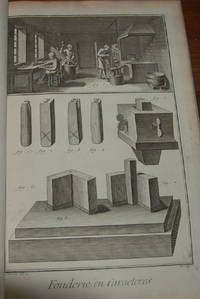
177233947Paris 1772. Folio 3 pages of letter press and 8 engraved plates. Bound in plain paper wraps. Printing and the Mind of Man 200: "a momument in the history of European thought; the acme of the age of reason; a prime motive force in undermining the ancien regime and in heralding the French Revolution; a permanent source for all aspects of eighteenth-century civilization. Light foxing to the letterpress near fine copy. Illustrations and text about the type foundry. unknown books
122561Paris 1767. 11 pages of descriptive text & 25 loose plates with their accompanying 17 text sheets from the volume of plates. Slight browning to margins a little spotting otherwise very good. § The 25 plates and descriptive text for the entry of Fonderie des canons from volume V of plates. Plates are numbered 1-25. Plates 3 6 7 8 24 and 25 are all double plates. The editors miscounted the number of double plates as five when there are in fact six. 11 pages 606-616 from volume II of the Encyclopédie 1751 with information on the foundry.This impressive suite of plates on the casting of canons includes many attractive double plates of different canons and the machines used to make them. The Arms of France appear on many of these as do those of Louis Auguste de Bourbon Louis XIV’s son. The creation of the canon mould and the casting of the weapon are also explained with fascinating details on the drills used to produce the correct bore.Several detailed plates also depict the casting of various weights of canon ball. Furthermore two plates examine a recent Spanishinvention an improvement on the design of the gun carriage. Theplates are supported by a number of entries under Canon dans l’art militaire. unknown books
1931002209Paris 1931 1932. Limited First Edition. Half Morocco over Marbled Paper. Very Good. No. 351 of 600 with total issuance in various forms of 3416 copies. This set was issued with papier pur fil Lafuma. With 24 color plates and 40 black and white illustrated plates in the two volumes. Bound attractively with decorated morocco with various curly-cue gilt ornamentation. The set epitomizes the inter-war French vogue for soft core erotica here with literary pretensions or pedigree from the eighteenth century that hotbed of erotic gamboling before squelched by the Revolution. Some spotting on the fore-edges. Rubbing on the spine extremities and the edges. Overall a handsome set. <br/><br/> unknown books
122581Paris 1765. Folio 253 x 393mm. 1 page of descriptive text & 8 loose plates with their accompanying text sheet from the volume of plates. Slight browning to margins a little spotting otherwise very good. § The 8 plates and descriptive text for the entry of Fleuriste Artificiel from volume IV of plates. Plates are numbered 1-8. Plate 8 is a double plate.1 page 780 from volume XVII of the Encyclopédie 1765 including information on Les ouvrages : description des opérations de son art.With some browning to a few leaves.An important home industry in the eighteenth-century France was for some time at the forefront of the manufacture of artificial flowers. The first plate's charming studio scene depicts a small yet busy and lively workshop. Further plates show the patterns used and the tools employed the aim of the plates volumes being the provision of useful guides for learning and improving the craft. The final plate larger than the rest is an illustration of a marvellous table display a depiction of a formal garden. The suite and the accompanying article on Fleuriste are the work of Jacques-Raymond Lucotte whose contribution to the plates volumes is far more extensive than his work in the text volumes. He designed over 650 himself and wrote around forty-five of their commentaries. He was heavily influenced by the Descriptions des arts et métiers of the Paris Académie royale des sciences. Although his speciality was masonry and architecture his contribution on artificial flowers is characteristic of his attention to detail. description des opérations de son art.With some browning to a few leaves.An important home industry in the eighteenth-century unknown books
122564Paris 1765. Folio 253 x 393mm. 55 pages of descriptive text & 12 loose plates with their accompanying 3 text sheets from the volume of plates. Slight browning to margins a little spotting otherwise very good. § The 12 plates and descriptive text for the entry of Fayencerie from volume IV of plates. Plates are numbered 1-12.Also with the relevant entries listed under Fayence in the Table Analytique et Raisonnée du Dictionnaire des Sciences Arts et Métiers. Vol 1 17805 pages 371 & 455-460 from volume VI of the Encyclopédie 1756 including La ville de Faenza en Italie and Fayence en général1 page 609 from volume XVI of the Encyclopédie 1765 including information on Fayence trezalée2 pages 33 & 518 from volume IV of the Supplément à l'Encyclopédie 1777 which includes Manufacture de fayence and Poterie de fayenceWith some browning to a few leaves.All aspects of pottery and crockery have been examined in these plates originally designed by Lucotte. Opening with a scene of the earthworks the plates display both simple and ornate crockery a variety of tools and pieces of equipment and most notably different types of pottery wheels with accurate representations of kilns and a pottery mill. Lucotte's contribution to the plates volumes is far more extensive than to the text volumes designing over 650 himself and writing around forty-five commentaries. He was heavily influenced by the Descriptions des arts et métiers of the Paris Académie royale des sciences as seen here. Although not working on one of his specialities he approaches his work on pottery and crockery with his characteristic enthusiasm and attention to detail. unknown books
122473Paris 1763. Folio 253 x 393mm. 3 pages of descriptive text & 11 loose plates with their accompanying text sheet. Slight browning to margins a little spotting otherwise very good. § The 11 plates and descriptive text for the entry of Faiseur de Metier à Bas from volume II of plates. Plates are split into two sets with 7 numbered plates in the first set and 4 numbered plates in the second. The set titles are Métier à faire des bas and Travail du bas au metier. There are 6 double plates in the first set Plates 2-7 and two in the second set Plates 1 & 2. Plate 4 from the first set has a 1.5 inch tear down crease.The plates in this suite are as much a guide to the use of the loom as they are to its construction. Indeed a great variety of 18th century looms are depicted each helpfully annotated in the accompanying text sheets. Diderot visited most of the small ateliers and larger factories which were written on often accompanied by Goussier the 'third encyclopédist' and the motivating force behind the plates volumes. No publication before this or for many years after devoted this amount of attention to the mechanical arts. The Encyclopédistes were devoted to the propagation of new ideas and improved methods and this suite is a fine example also accompanied by the text entry for Metier by Chevalier Louis de Jaucourt. unknown books
122576Paris 1777. Folio 253 x 393mm. 45 pages of descriptive text & 7 loose plates. Slight browning to margins a little spotting otherwise very good. § The 7 plates and descriptive text for the entry of Fabrique des Armes from the supplementary volume of plates. Plates are numbered 1-7.Also with the relevant entries listed under Armes in the Table Analytique et Raisonnée du Dictionnaire des Sciences Arts et Métiers. Vol I 17803 pages 401 461 & 743 from volume IV of the Encyclopédie 1754 including information on Les armes courtoises Cri d'armes and Défi d'armes1 page 383 from volume VI of the Encyclopédie 1756 including Le maniement des armes16 pages 286 300 397 & 985-998 from volume VII of the Encyclopédie 1757 including Anciennes armes des François Sergent d'armes Le calibre de ces armes Réflexions sur ce sujer and Premieres armes qui ont été employées à la guerre3 pages 8 279 & 521 from volume VIII of the Encyclopédie 1765 including Les armes des cavaliers des hussards des dragons & des fantassins Homme d'armes and Les armes de jet2 pages 172 & 177 from volume XI of the Encyclopédie 1765 including Noblesse par les armes and Noblesse de nom & d'armes3 pages 109 671 & 672 from volume XII of the Encyclopédie 1765 including Pas d''armes and Places d'armes2 pages 249 & 316 from volume XIII of the Encyclopédie 1765 including Poursuivant d'armes and L'honneur rendu en préfentant les armes4 pages 322-324 & 574 from volume XIV of the Encyclopédie 1765 including Roi d'armes and Salle d'armes10 pages 86-93 120 & 121 from volume XV of the Encyclopédie 1765 including Servent d'armes Service d'armes and further information on Sergent d'armes1 page 874 from volume XVI of the Encyclopédie 1765 including Veille des armesWith some browning to a few leaves.This suite of seven plates depicts the manufacture of guns the tools and machines used and the mechanisms inside the weapons. There are many articles supporting the plates and these range over a variety of military topics. With entries by Diderot D'Alembert Edme Mallet Chevalier Louis de Jaucourt Blondel and Boucher D'Argis among many more these plates are a fine example of the work of some of the key Encyclopédistes. Also included are entries by Louis-Élisabeth de La Vergne de Tressan a French medievalist writer and soldier. unknown books
122574Paris 1763. Folio 253 x 393mm. 1 page of descriptive text & 2 loose plates with their accompanying text sheet from the volume of plates. Slight browning to margins a little spotting otherwise very good. § The 2 plates and descriptive text for the entry of Fabrique de la Cire D'Espagne ou a Cacheter from volume III of plates. Plates are numbered 1-2.1 page 436 from volume II of the Supplément à l'Encyclopédie 1776 which includes Les diverses opérations de la fabrique de cette cireWith some browning to a few leaves.With two scenes of the craftsmen's workshop these plates show the manufacture of sealing wax an essential commodity. Text sheets help explain the tools and equipment depicted. unknown books
122563Paris 1765. Folio 253 x 393mm. 4 pages of descriptive text & 4 loose plates with their accompanying text sheet from the volume of plates. Slight browning to margins a little spotting otherwise very good. § The 4 plates and descriptive text for the entry of Eventailliste from volume IV of plates. Plates are numbered 1-4.Also with the relevant entries listed under Eventail in the Table Analytique et Raisonnée du Dictionnaire des Sciences Arts et Métiers. Vol 1 17801 page 509 from volume II of the Encyclopédie 1751 including L'article Bois3 pages 138 139 & 850 from volume VI of the Encyclopédie 1756 including information on Eventails en général and Fleches d'éventailsWith some browning to a few leaves.This suite of plates charts the processes involved in the creation of a fan a key eighteenth-century fashion accessory following from the preparation of the paper and its painting to the fixing of the sticks and ribs. The text includes the entries for Eventail Eventailliste and Fleches. unknown books
17492305752Amsterdam: Au Pays Libre pour Le Bien Public 1749. Full-Leather. Very Good/No Jacket. Paper label on spine base corners a bit rubbed minor loss of gilt bookplate of philosopher Paul Desjardins on front endpaper. 1749 Full-Leather. viii 124; iv 99 5 pp. 16mo. Original full leather gilt titles decorations and triple rule marbled endpapers all edges gilt. Two works in one volume: Essai sur la Liberte de Produire ses Sentimens attributed to either Elie Luzac or Julian Offroy de la Mettrie 1749 with Pensees sur l'Interpretation de la Nature by Denis Diderot 1754 first edition. French text. "Elie Luzac wishing to justify his publication of the book L'Homme machine had in 1749 brought out anonymously the Essai sur la liberte de produire ses sentimens. It was a crisp and well-reasoned work which contended Au Pays Libre pour Le Bien Public hardcover books
122491Paris 1765. Folio 253 x 393mm. 6 pages of descriptive text & 3 loose plates with their accompanying 4 text sheets from the volume of plates. Slight browning to margins a little spotting otherwise very good. § The 3 plates and descriptive text for the entry of Epinglier from volume IV of plates. Plates are numbered 1-3 and plates 2 and 3 are double.1 page 210 from volume I of the Encyclopédie 1751 including Réunion de leur communauté à celle des aiguilliers.5 pages 804-808 from volume V of the Encyclopédie 1755 including Observations sur le corps des épingliers à Paris.With detailed text from both the plates and letterpress volumes of the Encyclopédie this suite on the manufacture of pins is a useful guide to the methods used in the 18th-century when creating hatpins hairpins and anumber of other forms of pin. The main text entry was contributed by Delaire an expert of the manufacture of needles pins etc. Further more specific pin-related entries were contributed by Antoine-Gaspard Boucher d'Argis a French lawyer. unknown books
122565Paris 1765. Folio 253 x 393mm. 6 pages of descriptive text & 16 loose plates with their accompanying 2 text sheets from the volume of plates. Slight browning to margins a little spotting otherwise very good. § The 16 plates and descriptive text for the entry of Eperonnier from volume IV of plates. Plates are numbered 1-16.6 pages 559 765-769 from volume V of the Encyclopédie 1755 including Réglemens Les chevaux and Pourquoi cette communauté a quitté S. Eloi pour invoquer S. Gilles.With some browning to a few leaves.With the main text entries for Eperon and Eperonnier this suite of plates is a comprehensive guide to the many different types of eighteenth-century spur both English and French and how they are created. The fabrication of the horse's bits and spurs are shown being made with two visually-delightful busy workshop views. unknown books
1979309452Milan: Franco Maria Ricci 1979. Illustrated. 12 Volumes of plates; 5 of text and one final volumes of Essays etc. Folio. Original cloth spines sunned else fine. Illustrated. 12 Volumes of plates; 5 of text and one final volumes of Essays etc. Folio. Complete. Franco Maria Ricci unknown books
234933hardcover. near fine. 36 full-page plates in very clean condition. Includes the list of plates in French and the lovely allegorical frontispiece for "Chirurgie" section but no actual title page. Folio rebound in recent cloth-backed marbled boards. N.P. N.D. circa 1760. Ownership information inside front cover still in near fine condition -- an uncommon collection of these medical plates.<br/><br/> 36 plates from Diderot's 18th century Encyclopedia depicting interesting medical instruments and various operations from Lithotomy and a rather horrible looking Mastectomy to Craniotomy and Amputation.<br/><br/> unknown books
122489Paris 1763. Folio 253 x 393mm. 1 page of descriptive text & 3 loose plates with their accompanying text sheet from the volume of plates. Slight browning to margins a little spotting otherwise very good. § The 3 plates and descriptive text for the entry of Découper et Gaufreur d'etoffes from volume III of plates. Plates are numbered 1-3.1 page 704 from volume IV of the Encyclopédie 1751 including Communauté des découpers à Paris.With the text entry for Découpeur these plates are a useful guide to 18th-century fabric cutting and embossing. The first plate shows a woman at work on a strip of fabric and the tools she uses to cut the various patterns and shapes are displayed below. The following two plates are a close examination of the presses and rollers used in the embossing of fabrics. unknown books
19522916New York: Curt Valentin Gallery 1952. Softcover. VG-; pencil marks on cover. Wraps. 16 pp. 27 bw repros. Lists 79 works by American and European artists and sculptors including R. Butler A. Calder Chagall Ensor Feininger Grosz Kirchner Flannagan Klee and others. Curt Valentin Gallery unknown books
178041047Paris 1780. First edition. 1 p. of text & 13 plates 2 double-page. 1 vols. Folio. Disbound. Fine. First edition. 1 p. of text & 13 plates 2 double-page. 1 vols. Folio. From Diderot-d'Alembert's Encyclopédie which was published in Paris Neuchatel and Amsterday from 1751-1780. The plates Recueil de Planches were published in 11 volumes from 1762-1777 and are among the glories of book illustration of the 18th century. unknown books
122474Paris 1763. Folio 253 x 393mm. 6 pages of descriptive text & 11 loose plates with their accompanying text sheet. Slight browning to margins a little spotting otherwise very good. § The 11 plates and descriptive text for the entry of Draperie from volume III of plates. Plates are numbered 1-11. Plates 4 and 10 are double plates.3 pages 107-109 from volume V of the Encyclopédie 1755 including information on Draperie en général.1 page 529 from volume VIII of the Encyclopédie 1765 including information on L'art avec lequel les draperies doivent être jettées.1 page 906 from volume I of the Supplément à l'Encyclopédie 1776 which includes La maniere de blanchir les étoffes de laine.1 page 701 form volume III of the Supplément à l'Encyclopédie 1777 which includes La maniere de laner ou garnir les draps.This suite of plates beings with a charming scene of two men washing textiles one in a nearby stream and another in his vat. The following plates describe further the complex art of spinning cloth and the many different pieces of equipment used. The double plates for instance display the larger machinery of the drapery. The text includes Draperie by Claude-Henri Watelet best known for his writings on gardens and the arts and several more specific papers on tools and processes for instance Foulonier by Diderot. hardcover books
1960179858Oxford: The Clarendon Press 1960. First. Hardcover. VG/G-. DJ has shelfwear and tears. Covers a re slightly bumped but clean. Pages are clean and binding tight. Reddish hardcover with gilt lettering on spine and light blue endpapers. Tan dj. xviii; 250 pp. plates with 97 BW illustrations. Text in French. Showcases the works of various artists of the eighteenth century as noted by Denis Diderot French art critic and philosopher. The Clarendon Press hardcover books
1975179853Oxford: The Clarendon Press 1975. 2nd edition. Hardcover. G/G- Cover has general signs of wear. Text is good and bind is tight. DJ has tears and tape repairs shows wear. Cherry-colored hardcover with gilt lettering on spine; illustrated dj. t. xvii; 259 pp. 117 glossy BW illustrations. Text in French. Showcases the works of various artists of the eighteenth century as noted by Denis Diderot French art critic and philosopher. Includes an index of artists and their subjects. The Clarendon Press hardcover books
122584Paris 1763. Folio 253 x 393mm. 21 pages of descriptive text & 2 loose plates with their accompanying text sheet from the volume of plates. Slight browning to margins a little spotting otherwise very good. § The 2 plates and descriptive text for the entry of Diamantaire from volume III of plates. Plates are numbered 1-2. Plate 1 is continued on a second sheet.Also with the relevant entries listed under Diamant in the Table Analytique et Raisonnée du Dictionnaire des Sciences Arts et Métiers. Vol 1 17801 page 145 from volume II of the Encyclopédie 1751 which includes information on Bâton à égrifer1 page 193 from volume IV of the Encyclopédie 1754 which includes information on L'outil appellé coquille1 page 764 from volume V of the Encyclopédie 1755 which includes information on Lien de fer1 page 124 from volume XVI of the Encyclopédie 1765 which includes Tenailles4 pages 938-941 from volume IV of the Encyclopédie 1754 including information on Les diamants en général under Diamant1 page 877 from volume VI of the Encyclopédie 1756 including information on Le palais ducal à Florence under Diamant1 page 687 from volume VII of the Encyclopédie 1757 including information on Le défaut appellé glace under Diamant1 page 849 from volume VIII of the Encyclopédie 1765 including information on Progrés under Diamant1 page 282 from volume IX of the Encyclopédie 1765 including information on La maniere under Diamant2 pages 588 & 594from volume XII of the Encyclopédie 1765 describing La gravure sur les diamants under Diamant1 page 634 from volume XIV of the Encyclopédie 1765 which includes Procédé par lequel on change le saphir en diamant under Diamant1 page 802 from volume XV of the Encyclopédie 1765 on Table du diamant under Diamant2 pages 417 & 876 from volume XVI of the Encyclopédie 1765 on Les topases & les saphirs and L'ouvrage de Tavernier under Diamant3 pages 710-712 from volume II of the Supplément à l'Encyclopédie 1776 which includes Les experiences qui prouvent la singuliere volatilité du diamant under DiamantWith some browning to a few leaves.These plates thoroughly examine the systems of pulleys and wheels involved in the precise art of cutting diamonds. Artisans are shown at work and different blades and grinders are displayed. The main and supplementary articles on Diamant are also included to help explain the art as it was in the eighteenth-century as are entries on Lapidaire Saphir Baton à Égriser Coquille Epée and Tenailles. unknown books