DICKENS, CharlesBiblio.com
17 545 résultats
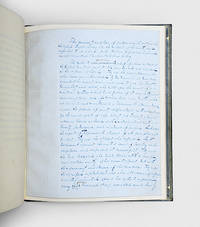
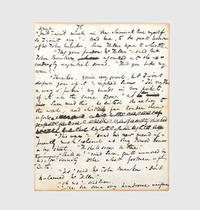
1837124911London: before April 1837. One of only five pages of the Pickwick manuscript remaining in private hands Original autograph manuscript leaf with authorial emendations from the Pickwick Papers the novel that transformed an obscure 25-year-old journalist into England's most famous author in a matter of months. One of only five such leaves remaining in private hands this leaf is from the setting manuscript used by the printers. Fewer than 50 of the estimated 1500 pages that constituted it are known to survive. In keeping with the convention of the time Dickens's authorial manuscripts were discarded after being set in type. However on this occasion Charles Hicks c.1799-1870 the foreman-printer for Bradbury and Evans who printed the book for Chapman and Hall salvaged some of the original. Hicks's salvage comprising 33 leaves from Chapters 36 and 37 makes up "the largest number of contiguous Pickwick manuscript leaves known to survive" Long p. 32. As Dickens's fame grew he "became increasingly aware of the value of his manuscripts. and he sought with limited success to retain what he could of his early work" Long p. 32. Dickens wrote to Hicks around September 1838 requesting that "'when you have time be good enough to look me up all the old copy you have of mine as I am very anxious to have it complete'. Dickens's instruction is said to be the 'first recorded instance of CD's collection of his own MSS'" Long p. 31. In May 1840 when Dickens donated five slips from Chapter 39 of Pickwick to a charitable cause in Halifax he enclosed a note: "I have never given away any old published MS. considering that it will have a greater interest one of these days for my own family than it can ever possess for others; but your request in behalf of the Halifax Institution set me looking over a box of fragments and from its contents I have selected the enclosed original and only draught of a portion of a chapter of Pickwick to which the Association is heartily welcome" Long p. 24. The Posthumous Papers of the Pickwick Club issued monthly between April 1836 and November 1837 became a publishing phenomenon only after the introduction of Sam Weller who features in the portion of text preserved here. The comic scene occurs during a visit to Bath by Pickwick and his friends. The text begins halfway through a discussion of the chalybeate taste of the famous waters. Dickens's deletions include three full lines of text and four words blotted out; his insertions consist of three words added interlineally at the top left. The leaf is numbered "75" at the head of the page in his hand: Sadleir notes that "it is clear that Dickens numbered separately each successive instalment of manuscript delivered monthly to the printer". Although the text here is part of Chapter 37 it was published as part of Chapter 36 due to the previous misnumbering of two consecutive chapters as "XXVIII" - an error that was rectified in subsequent editions. This is one of only five leaves from the Pickwick manuscript remaining in private hands. The leaves were originally part of the 33 slips held by Hicks's family and were dispersed in their sale in 1882. They re-appeared as part of a group of 12 consecutively numbered leaves in the Suzannet sale in 1971 - the last occasion on which significant manuscripts of Dickens's works were offered at auction. Of those 12 leaves numbering from 69 to 80 the majority are now held institutionally: number 69 by the Morgan Library; number 70 by the Princeton University Library; and numbers 76 to 80 by the Free Library of Philadelphia. Leaves numbered 71 to 75 are held privately and two further slips from this sequence of leaves are also recorded: Suzannet donated number 81 to the Charles Dickens Museum in 1937 and the final slip number 82 is held by the British Library. The other leaves preserved by Hicks consisting of slips 50 to 68 from chapter 36 are today in the Rosenbach Museum and Library. All other surviving portions of the Pickwick Papers manuscript are held institutionally and comprise: five slips from chapter 19 British Library; a slip from chapter 25 and fragment of four lines from chapter 37 New York Public Library; and five consecutive slips from chapter 39 Rosenbach Museum and Library. Single leaf 230 x 185 mm. Manuscript text in brown ink on recto only. Housed in a custom pinkish-orange morocco gilt-stamped folder with cream moiré silk lining and a pinkish-orange quarter morocco clamshell case. Unobtrusive compositor's inky fingerprint at lower centre browning to very edges faint traces of mount to verso along one edge. In excellent condition. Provenance: Comte Alain de Suzannet his sale Sotheby's 22 November 1971; the William E. Self-Kenyon Starling copy. A full transcription of the text is available on request. Sadleir Catalogue of the Suzannet sale p. 277; Long William F. Dickens Donates a Piece of Pickwick Dickens Quarterly Vol. 33 No. 1 March 2016 pp. 23-37. unknown
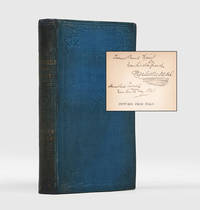
1846130416London: published for the author by Bradbury & Evans 1846. Presentation to one of his oldest friends First edition presentation copy inscribed by the author at the head of the half-title "Thomas Beard Esquire From his old friend Charles Dickens Devonshire Terrace Nineteenth May 1846". The inscription is dated the day after publication. Thomas Beard 1807-1891 was almost the oldest of Dickens's friends and their friendship was uninterrupted until the novelist's death in 1870. Dickens joined Beard as a reporter on the Morning Chronicle in August 1834 through Beard's recommendation; Beard was best man at his wedding and godfather to his eldest son Letters of Charles Dickens eds. Madeleine House & Graham Story p. 3 vol. 1 1965. Small octavo. Title vignette and 3 wood-engraved vignettes in the text. Original moderate blue fine-diaper cloth spine lettered in gilt spine and covers stamped in blind pale yellow coated endpapers. Recent custom blue morocco-backed folding case. The Suzannet copy with the engraved bookplate of Alain de Suzannet Sotheby's 22 Nov. 1971 lot 87 to J. E. Teale; subsequently resold at Sotheby's 1984. Rebacked with original spine laid down light toning to margins a very good copy. Smith II 7. hardcover
184290110Philadelphia: Lea and Blanchard 1842. Presentation copy Presentation copy inscribed by Dickens to William Cullen Bryant 1794-1878 editor of the New York Evening Post and a leading poet of his generation: "William Cullen Bryant From his friend and admirer Charles Dickens" signed with his characteristic lavish underscores. Dickens met Bryant for their first private audience on his American tour on Tuesday 22 February 1842 and presented him with a gift of six books all American editions of his own works. Bryant reciprocated by presenting Dickens a copy of his own The Fountain and other Poems his inscription using the same form of words that copy later in the Stephen H. Wakeman collection sold American Art Association April 1924 lot 26 $400. Bryant was well-disposed to Dickens at that time the most famous living author in the world but he like many other Americans was dismayed by the criticisms Dickens expressed in his American Notes 1842 and in the American chapters of Martin Chuzzlewit 1844. However he recovered sufficiently to visit Dickens as an old friend on his return to America in 1867. The fact that this is an American edition of Dickens's first publishing success is evocative: Dickens had strong feelings on the contentious issue of international copyright and the subject hung over the whole trip. He mentioned it himself several times during his public engagements eventually drawing on himself the wrath of the American press. Lea and Blanchard successors to Cary and Lea were Dickens's "official" American publishers and had prepared for his visit by reprinting his works to date but the American economy was in the middle of a depression general fiction could only be sold in the cheapest possible formats and the cash-strapped publishers were not eager to further erode their profits by paying royalties to foreign authors. Large octavo. Provenance: by descent from the recipient. Original brown vertical grain cloth covers blind-stamped spine with figure and title in gilt stained worn inscribed to Bryant "from his friend and admirer Charles Dickens". Housed in a brown quarter morocco solander box by the Chelsea Bindery. Substantial dampstaining to top edges of boards also affecting contents but to a lesser extent head and tail of spine chipped wormholes to joints boards rubbed and scuffed ring stain to front board some spotting and oxidisation of plates sporadic foxing and tanning to text. hardcover
18491665901849. They seek a refuge here in England almost the only free land where they may set foot The original manuscript of an appeal on behalf of Italian refugees by a committee of Victorian notables which by its handwriting confirms Dickens as its principal author. The appeal was published in the English newspapers reprinted by Forster in the Examiner of 8 September 1849 and was also translated into Italian for Mazzini's Italia del Popolo. "But for the discovery of this manuscript the fact that Dickens wrote it might never have been revealed" The Dickensian. Despite its re-discovery in 1914 the manuscript has since been lost to modern scholarship. The immediate cause of the influx of Italian refugees was the defeat of the Republic army defending Rome from the French army in July 1849. Garibaldi withdrew from the city with 4000 troops and took temporary refuge in San Marino before he and his revolutionaries were forced into temporary exile. In England an Italian Appeal Committee was formed comprising several Members of Parliament together with Charles Dickens John Forster Douglas Jerrold Walter Savage Landor Frank Stone and W. M. Thackeray. Dickens already a friend of the Italian patriot Giuseppe Mazzini and a frequent visitor to Italy was the natural choice to write the appeal. Dickens wrote to Frank Stone on 22 August 1849 assuring him he would "do my best with the Refugee Statement" and that Stone should "rely on its being at least earnest and having a drop of heart's blood in it". On 26 August he wrote to James Stansfeld one of the two honorary secretaries of the appeal committee mentioning some "alterations" to the text. Besides making minor corrections during composition Dickens subsequently made additions in black ink distinct from his compositional blue ink. He sent the manuscript to William Greening 1799-1869 a founder of Bradbury and Evans. The original envelope signed by Dickens is bound at the back of the volume addressed "For Greening Messrs Bradbury and Evans". It is headed: "Please to make the additional corrections enclosed CD". There are differences between the manuscript and the published version. In the second paragraph for example Dickens originally appealed for "a compassionate relief" published as "a generous relief". He also reduces the size of the French army from "fifty thousand strong" to "forty thousand strong" the attack on More O'Ferrall was originally shorter and "The Exiles appeal through the Committee named above to Englishmen" becomes a slightly more distanced "The committee named above appeals in their behalf to Englishmen". These textual emendations were not reproduced in either the original published article or The Dickensian and are hitherto unknown. When the editors of the Pilgrim Edition of the Letters referred to the manuscript they relied on the published transcription in the absence of the original. The manuscript lacks the conclusion of the penultimate sentence and the last sentence mostly comprising names of the committee or banking details but is otherwise complete. When publicized in The Dickensian in 1914 the manuscript was in the possession of Walter T. Spencer 1863-1936 a London bookdealer with premises at 27 New Oxford Street specializing in Dickensiana. The location was next recorded in the same journal in 1917 by William Miller and T. W. Hill in an article on "Charles Dickens's Manuscripts" as remaining with "W. T. Spencer". The manuscript was acquired by a private collector in Lincolnshire probably in the 1950s and was bought by us from his family. We cannot currently trace any appearance of it within the book trade or at auction. 2 leaves 222 x 186 mm manuscript in blue and black ink with several corrections together with envelope including embossed "CD" design to flap and 5 leaves of calligraphic transcription in red black and blue ink bound in early 20th-century green morocco by Sangorski & Sutcliffe spine with raised bands spine and front cover lettered in gilt with additional gilt borders front cover with author's facsimile signature in gilt rear cover with author's lion couchant crest and "CD" in gilt ruled dentelles in gilt all edges gilt. Housed in a green cloth folding box. Original folds two minor marks browning to free endpapers folding box worn: near-fine. "Charles Dickens and the Italian Refugees of 1849" The Dickensian 1 December 1914 pp. 319-322; Miller and Hill "Charles Dickens's Manuscripts" The Dickensian 1 July 1917 pp. 181-185 & 1 August 1917 pp. 217-219; M. Gabriell Caponi-Doherty "Charles Dickens and the Italian Risorgimento" Dickens Quarterly September 1996 pp. 151-163. hardcover
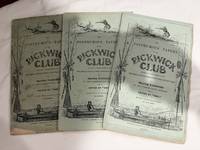
10002London April 1836 - November 1837: Chapman & Hall. First Edition. Charles Parkhurst Books presents a Prime Pickwick The Parkhurst-Goranitis-Costas copy exhibiting ALL eleven points enumerated in "Prime Pickwicks In Parts" by John C. Eckel 1928 as enumerated below. Remarkably it contains the rare ad "Pigot's Coloured Views" in part XIII known only in 5 copies now 6. The present set is a publisher's presentation copy signed "With The Publishers Compliments" on the inside front wrap of part III in the same hand and on the same inside wrapper as the McCutcheon- Young-Suzannet prime copy. Octavo 20 parts in 19; original blue-green printed wrappers. First edition having been collated with Hatton & Cleaver and containing the correct wrappers advertisments addresses first state of the plates and text with the following exceptions: WRAPPERS - the rear wrap of part I is early; parts IV and V with early wraps; all other wrappers are first issue; all front wrappers have the date 1836. It is important to note that parts I and II have "With Four Illustrations By Seymour" and part III has "With Illustrations by R. W. Buss" on front wraps. PLATES - part IV plates are 2nd state of original first plate; part VI plates are in 2nd state of original first plate 1st state plates are rare and "may be considered the rarest items in the whole realm of Pickwick" - Hatton & Cleaver p.47; part I plates are all signed by Seymour #1 is 1st state of 1st plate - #2 is 2nd state of 1st plate - #3 is 1st state of 2nd plate - #4 is 1st state of 2nd plate; all other plates are 1st state. TEXT - the text of all parts is first issue with the following exceptions: part I is later text; part IV is first issue text with 2 exceptions; part VI is later issue text; part VIII text is in mixed state; part IX text is first issue but without the signature "N2"; part X text is mixed state; all other parts are 1st issue text. PICKWICK ADVERTISER - the Pickwick Advertiser is lacking in parts IV V VI and IX no Advertiser is called for in parts I II and III; all other Advertisers are present and correct. It should be noted that part X Advertiser is UNOPENED. ADVERTISMENTS - part I lacks the front slip; part III lacks the front slip and rear ad "The Toilet;" part V lacks "Grattan's Publications" and "Rowland's Kalydor" ad; part VII lacks the rear slip "Phrenology Made Easy;" part IX lacks rear ads "Chapman & Hall" - "Effingham Wilson" - "Works by W. S. Orr" - "Jennings Landscape" and "George Henekey & Co." ads; part X lacks "Literary Announcements" - all others are present. ADDRESSES by the Author - all are present in parts II III X and XV; part III Address has edges extended 2nd issue in parts II and X. ADDRESSES by the Publishers - all are present in parts XVII XVIII and XIX/XX. In summation the parts which are complete are parts II VIII XI XII XIII XIV XV XVI XVII XVIII and XIX/XX. Most parts have spines expertly renewed. A few wrappers show light soiling; part III wrappers have edges extended; plates are very good to fine. Note that part II is complete and has first issue of the text indicating that it is one of the first 500 copies printed in the first issue as in the Dexter copy. Also noteworthy is that the Advertiser in part XIX/XX is the first issue with the date on page 7 misprinted "1388" rather than "1838." Now let me enumerate the eleven "points" which are necessary for a Pickwick to qualify as a prime copy; as Eckel states: #1 All covers of the parts must bear the date 1836 in Roman numbers. #2 Parts I and II must have the words "With four illustrations by Seymour." #3 Part III the words "With illustrations by R. W. Buss." #4 Part I must have three plates by Seymour signed and not re-etched by "Phiz." #5 Part II must have three plates by Seymour signed. #6 Part III must have two plates signed "Drawn and etched by R. W. Buss" and the pages numbered thereon. #7 Part IV two plates faintly signed "Nemo" and not "Phiz." #8 Parts II III X and XV must have the addresses by the author. #9 Parts XVII XVIII and XX the addresses by the publishers. #10 Plates in Parts I to XII must have no captions only numerical references to the pages where they go parts XIII to XX have neither titles nor numerical references. #11 On the vignette title-page the name "Weller" on the signboard over the door is spelled with a "V." On the frontispiece the artist's name on the center shield on the bottom must run around the shield. The present copy conforms to all the above points. Bookplate of Charles Parkhurst affixed to chemise. Housed in a handsome turn-of-the-century green full morocco pull-off-top slipcase with chemise. Chapman & Hall unknown
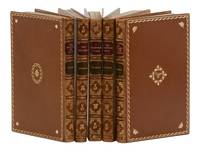
1843ST18706London: Chapman and Hall first three; Bradbury & Evans last two 1843; 1845 but 1844; 1846 but 1845; 1846; 1848. FIRST EDITIONS. "Carol" in FIRST STATE bound-in original front cover with closest interval between blind-stamped left border and left extremity of gilt wreath being 15 mm. "D" in Dickens on front cover in perfect condition; "Chimes" and "Cricket" in Second State; "Battle" with Fourth Issue of the engraved title as usual "Haunted" with no issue points. 167 x 102 mm. 6 5/8 x 4 1/8". Five separately published works in five volumes. <br/> SUPERB OLIVE GREEN CRUSHED MOROCCO COSWAY BINDINGS BY RIVIERE & SON FROM DESIGNS BY J. H. STONEHOUSE stamp-signed on front turn-ins upper covers all with two inlaid red morocco banners that at head with title in gilt that at foot lettered "Lord keep my Memory Green" and each binding FEATURING AT CENTER AN OVAL MINIATURE PORTRAIT BY MISS C. B. CURRIE signed in gilt on rear turn-ins the five showing Dickens at different ages painted on ivory under glass and surrounded by a gilt wreath of holly and mistletoe; raised bands spines gilt in compartments with holly sprig gilt lettering gilt-ruled turn-ins with mistletoe sprig at corners moss green watered silk endleaves all edges gilt. Original cloth covers bound in at rear of each volume. An aggregate total of 53 woodcut illustrations in the texts four engraved vignette title pages the one in "Haunted" tinted and eight engraved plates the four in "Carol" nicely hand-colored the illustrations by John Tenniel John Leech Daniel Maclise Richard Doyle and others. Carol with bound-in ALS FROM DICKENS dated 3 August 1842 and with two original green endpapers one inscribed with a passage from Foster's "Life of Dickens" bound in at rear; "Chimes" with ALS from artist Richard Doyle dated 21 September no year bound in at front; "Cricket" with ALS from artist John Leech dated 17 July 1846; "Battle" with undated ALS from artist Daniel Maclise bound in; "Haunted Man" with ALS from artist John Tenniel to Dickens collector and bibliographer F. G. Kitton dated 15 July 1896 bound in. Eckel 110-25; Smith II 4-6 8-9. Spines slightly faded to a uniform medium brown and front cover of "Haunted Man" just subtly sunned to olive brown "Chimes" with faint foxing to engraved title opening "Haunted Man" with light offsetting to printed title as usual other trivial imperfections but A SPLENDID SET--clean and fresh internally "Carol" being virtually pristine and THE REMARKABLY CHARMING BINDINGS WITH NO SIGNS OF USE.<br/> <br/> This is the ultimate bibliophile's set of Dickens' five Christmas books: first editions in especially fine condition in authentic Cosway bindings by the creators of that style and with an autograph letter signed by Dickens or one of the artists who illustrated these works bound into each volume. "A Christmas Carol" the immortal story of how ghostly visitations finally inject the miserly Scrooge with the Christmas spirit is called by Eckels "the greatest Christmas book from the pen of any man . . . . Artistically it was a pronounced success and from a literary aspect it has delighted millions of readers." The work is not only finely written but its sentiments had great appeal for Victorian taste.<br /> <br /> Our copy has all of the text first issue points listed in Smith and Eckel but those bibliographers disagree as to whether yellow Smith or green Eckel endpapers have priority. William Todd distrusted all internal issue points beyond uncorrected text including color of the endpapers. He believed the most reliable way to determine priority of issue was by studying the location of the gilt wreath on the cover which was stamped by a single machine. He says "This desideratum is a single point one encompassing all the others and if it is to be a sign of issue the one last appearing in the course of manufacture." The brass stamp with the cover design shifted to the left and developed imperfections as time went on so Todd assigned priority to volumes with the most distance 14-15 mm. between the right edge of the blind-stamped border on the left side of the cover and the left-most extremity of the gilt wreath and with a perfect "D" in the author's name within that wreath. By these criteria our copy is a first issue. As an added bonus our volume contains a letter written and flamboyantly signed by Dickens to Messrs. Curry and Co. concerning newspaper piracy of his works by "wholesale robbers."<br /> <br /> The warm reception of "A Christmas Carol" prompted Dickens to launch a series of four further Christmas books. "The Chimes" was described by the author to his friend and biographer John Foster as striking "a blow for the poor" while "The Cricket on the Hearth" presented domestic life in the ideal Victorian home. "The Battle of Life" is a love story with a happy ending a Victorian rom-com for the holidays and "The Haunted Man and the Ghost's Bargain" finds another grumpy old man learning about the spirit of Christmas from a ghost. The illustrations for these works were done by some of the most popular artists of the day including those whose letters are bound into volumes here: Richard Doyle 1824-83 who created the first cover and the masthead for "Punch"; John Leech 1817-54 well known for his political cartoons and humorous illustrations for "Punch"; Daniel Maclise 1806-70 whose professional life was devoted primarily to painting especially portraits and historical scenes; and Sir John Tenniel 1820-1914 illustrator of "Alice in Wonderland" and "Through the Looking Glass."<br /> <br /> This set was splendidly bound by the masters of the Cosway binding: Riviere Stonehouse and Currie. The "Cosway" style of binding with painted miniatures inlaid in handsome morocco apparently originated with the London bookselling firm of Henry Sotheran about 1909 the year G. C. Williamson's book entitled "Richard Cosway" was remaindered by Sotheran and presumably given this special decorative treatment. The name "Cosway" then was used to describe any book so treated whatever its subject. Admirable miniatures on Cosway bindings were executed by Caroline Billin Currie 1849-1940 from 1910 until her death creating such paintings for Sotheran's usually as here from designs by J. H. Stonehouse for bindings executed by Riviere. The portraits created by Miss Currie for this work show a maturing Dickens from youthful idealism to successful middle age to gray eminence and the festive decoration of the bindings virtually shouts "Merry Christmas" from the bookshelf. The portraits gracing Cosway-style bindings vary greatly in their level of achievement; Miss Currie's paintings are universally acknowledged as the very best. Finally the condition of our set is so fine not even Scrooge himself could find fault with it. Chapman and Hall (first three); Bradbury & Evans (last two) unknown
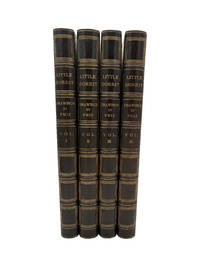
001611London: No Publisher Four volumes of original artwork with a copy of Little Dorrit five volumes in total. The art is attractively bound in later straight grain morocco by Riviere and Son raised bands spine in seven panels title to second panel running title to third panel and volume number to fourth those three panels with a single fillet frame remaining panels blank with a triple fillet frame covers with a triple fillet border a double line to edges inner edges with a floral roll a double fillet and an inner small floral roll a.e.g. A few minor scrapes to covers small abrasion to inner joint of first volume but generally bright clean and attractively presented. The original drawings for the illustrations used in Little Dorrit including thirty-six preliminary studies and an alternative of one which was not used being a total of forty-two drawings with five signed by Phiz to make up the whole set with the majority in pencil and wash or ink and wash. A full list of contents is available upon request. Also included is a short letter from Browne dated May 15 1878 to an unidentified collector noting that the "sketches which you have are the originals from which I executed my etchings for Little Dorritt" sic. With the armorial bookplate of Alain de Suzannet to front pastedowns. Previously sold at Sotheby's in 1971 for £4400 Sotheby's in 1976 for £7000 and Sotheby's again in 1988 for £28600. The copy of Little Dorrit is the first edition bound from the parts in contemporary dark blue polished calf with the original wrappers bound in at the end and recently rebacked. First Edition. Hardback. Very Good. Illus. by Phiz Browne Hablot K. Folio. Original Artwork. No Publisher Hardcover
1900187098London: The Caxton Society c. 1900. One of the most exquisite Dickens library limited editions Extra-illustrated édition de luxe lettered "A" of 15 lettered sets in fine uniform bindings and adding over 200 original watercolours to enhance the "superb memorial" of Chapman and Hall's 1881-2 édition de Luxe. Printed on Japanese vellum this set was originally published by Chapman and Hall with more than 700 illustrations including all those from the first editions. The watercolour artists include H. C. Green and Joseph Clayton Clark 1857-1937 who worked under the name "Kyd" and dedicated almost his entire career to illustrating Dickensian characters to great success. Kyd's first Dickens illustrations appeared in 1887 in Fleet Street Magazine and as early as 1890 major Dickens collectors such as Thomas Wilson and Frederick Cosens sought his sketches. The British Museum acquired a collection of 598 Kyd illustrations of Dickens in 1910 and the V&A the Charles Dickens Museum and the University of Texas each have a significant collection. Even today Dickens's larger-than-life characters are in part imagined through Kyd's depictions and in 2012 six of his illustrations were issued as stamps by the Royal Mail to mark the 200th anniversary of Dickens's birth. 60 volumes large octavo 259 x 173 mm. Prolific mounted illustrations both full-page and in-text and well over 200 original watercolours captioned in ink with character names. Title pages printed in red and black. Original green crushed morocco spines lettered and decorated in gilt with floral frames incorporating red onlays gilt foliate tooling bordering covers and enclosing gilt centrepiece both with red onlays wide turn-ins decorated with gilt rules and rolls alongside red onlaid corners purple doublures incorporating scrolling gilt foliage and central green onlay stamped with gilt floral device green moiré silk free endpapers edges gilt. Spines evenly sunned bindings presenting well occasional minor mottling of covers front inner hinges of vols 17 and 40 cracked but firm scattered wormholes and mostly superficial depredations to a few gutters a few plates loose or cracked at gutter one plate mount split plate not affected sporadic light foxing. A near-fine set. Spencer pp. 26-9 for the original Chapman and Hall edition. hardcover
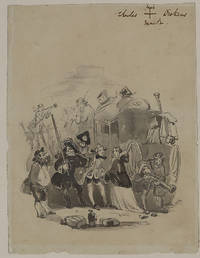
28075Original artwork. c.1836. An original drawing by Halbot K. Browne "Phiz" illustrating Charles Dickens' first novel. Ink and wash heightened in white on paper. Signed and humorously inscribed by the author in black ink "Charles Dickens his X mark" upper right. The image measures 17.8 x 13.2cm. In very good condition with some toning and a few light foxing spots. Laid down and mounted. The mount measures 28 x 22.8cm and is inscribed in a later hand in black ink 'The Ghostly Passengers in the Ghost of a Mail by "Phiz". Housed in a quarter red calf slipcase and silk cloth chemise with titles in gilt to the spine. A remarkable Dickens artifact bringing together the author and his preferred illustrator at the very beginning of their career-long partnership. First issued in 20 weekly parts between March 1836 to November 1837 'The Pickwick Papers' skyrocketed the young Dickens from obscurity to the position of the best-selling novelist of his time. This is the original drawing from which the engraving was made. The printed illustration appears in reverse in part 17 of the parts issue and as plate 37 opposite page 523 of the first state of the published work in book form. The author's inscription is a wonderfully humorous reference to an episode in the novel when Pickwick discovers an old stone seemingly engraved with the words 'X / BILST / UM / PHSI / S.M. / ARK'. Believing it to be of Roman origin he buys it from the owner a farmer for 10 shillings and later takes it back to London where his lectures and findings on the subject are accepted by dozens of experts in British and foreign historical societies. Hoping to expose Pickwick Mr Blotton a rival in an upcoming election visits the farmer a Mr. Stumps and discovers that the illiterate old man had indeed carved the stone himself intending that it should read 'X BILL STUMPS HIS MARK'. Despite Blotton's best efforts Pickwick has the last laugh as all the learned societies eventually pronounce in favour of their much-lauded hero resulting in Blotton's expulsion from the club. Hablot Knight Browne "Phiz" illustrated 10 of Dickens's 15 novels contributing over 500 plates title vignettes frontispieces and cover illustrations each of which was approved by the critical eye of Dickens himself: 'By whatever means Dickens relayed his instructions he was unvarying in his insistence that he approve the artist's preliminary sketches' Cohen. Provenance: Stuart M. Samuel M.P. 1856-1926 politician manuscript collector owner of the autograph manuscript of A Christmas Carol between 1882-1890 his library sold in 1907; Anderson Galleries 8 December 1925 lot 274 one of 15 Pickwick drawings offered for sale; Edward Lowell Dean rare-book and autograph dealer 347 Madison Avenue typed copy of note recording purchase from him on 21 December 1925; William Randolph Hearst stated provenance in 1953 PBG catalogue; Lewis A. Hird bookplate on inside cover of cloth folder; his sale First Editions Autographs Manuscripts Original Drawings by and Relating to Charles Dickens. Collection of Lewis A. Hird Englewood New Jersey Parke-Bernet Galleries New York 17 November 1953 lot 113 illustrated on facing page; private collection. Further details and images for any of the items listed are available on request. Lucius Books welcomes direct contact with our customers. Original artwork. c.1836 hardcover
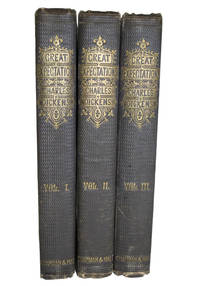
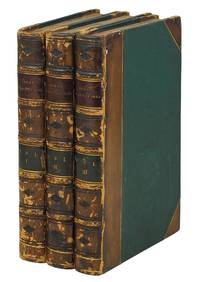
186168722London: Chapman and Hall 1861. PAILTHORPE F.W. First edition in book form first issue according to Smith. Three octavo volumes. 4 344; 2 351 1 printer's imprint; 2 344 pp. plus 32 pp. advertisements dated May 1861. With the first issue title-pages and with all the internal flaws for the first issue called for by Smith except page 173 in volume III has an apostrophe in "there's." There are a four more points however that Smith notes which do not occur in every copy. Our set does not have the two points in Volume III that Smith notes only appeared in Sadleir's copy "3" missing in page number on p. 103 and first "i" missing in "inflexible" on p. 193 four lines up. However our set does have the two other points which are that there is a period after the headline on page 236 in volume III and also a dot over the 'i" on page 278 volume II. However according to Clarendon we have some points of the first issue but most are second.<br> <br> Original moderate violet wavy-grain cloth with covers decoratively stamped in blind and spines ruled in blind and decoratively stamped and lettered in gilt. Spines a bit sunned and extremities of boards and spines lightly rubbed. Occasional signature slightly sprung. Front inner hinge of volume III professionally restored others with hairline cracks. Overall an almost fine set in every way. Housed together in a blue morocco pull-off case by Riviere & Son.<br> <br> One of only two Dickens novels never issued in monthly parts- the typical method since Pickwick- Great Expectations is also one of only two of his novels whose first editions weren't illustrated in both cases Hard Times is the other. Great Expectations first appeared in England in the pages of Dickens's popular magazine All the Year Round beginning on December 1 1860 though two American magazines Harper's Weekly and the American All the Year Round began serializing it slightly earlier technically jeopardizing Dickens's British copyright.<br> <br> "The rarity of the first issue of Great Expectations has been attributed to the probable small binding-up of copies with the first title-page coupled with the fact according to C.P. Johnson Hints to Collectors p. 33 and others later that 'the first edition was almost entirely taken up by the libraries.' Patten pp. 290-92 states that 1000 copies of the first issue and 750 of the second were printed and that probably most of the first and more than half of the second 1400 copies in all were purchased by Mudie's Select Library" Smith I p. 104 note 5.<br> <br> Smith I 14. Eckel pp. 91-93. Gimbel A146.<br> <br> HBS 68722.<br> <br> $45000. Chapman and Hall unknown
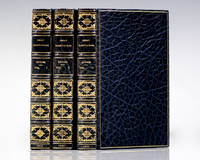
1861142357London: Chapman and Hall 1861. First edition first impression of Dickens' rarest novel. Octavo three volumes bound in full royal blue crushed levant morocco by Bayntun Bindery with gilt titles and tooling to the spine in six compartments within raised gilt bands gilt ruling to the front and rear panels gilt turn-ins and wide gilt inner dentelles stamp-signed by Bayntun all edges gilt. The earliest impression of Dickens' rarest novel. This copy agrees in all points with Margaret Caldwell's extensive analysis of the differing impressions in the Clarendon edition of Great Expectations. As in the Lawrence Drizen copy sold in 2019 at Sotheby’s and in the Clarendon edition the third volume here contains the numeral “3†in the pagination on p. 103 and the initial “i†in “inflexible†on p. 193 which are sometimes missing in copies of the first impression of the third volume indicating that the present copy is among the earlier printings of the first impression. Smith comments that “the rarity of the first issue of Great Expectations has been attributed to the probable small binding-up of copies with the first title-page coupled with the fact according to C.P. Johnson “Hints to Collectors†that “the first edition was almost entirely taken up by the libraries.†Only 1000 copies of the first issue and 750 copies of the second were printed and that probably most of the first and more than half of the second 1400 copies in all were purchased by Mudie’s Select Library. Eckel pp. 91-93; Sadleir 688; Smith I:14. In fine condition. An exceptional example of one of Dickens' great masterpieces. Dickens' penultimate novel Great Expectations was written in "the afternoon of his life and fame" G.K. Chesterton. The novel contains some of Dickens' most memorable scenes including its opening set in a graveyard when the young orphan Pip is accosted by escaped convict Abel Magwitch. Upon its release the novel received near universal acclaim. Although Dickens' contemporary Thomas Carlyle referred to it disparagingly as "that Pip nonsense" he nevertheless reacted to each fresh instalment with "roars of laughter." Later George Bernard Shaw praised the novel as "all of one piece and consistently truthful." During the serial publication Dickens was pleased with public response to Great Expectations and its sales; when the plot first formed in his mind he called it "a very fine new and grotesque idea." Chapman and Hall unknown
183768684London: Chapman and Hall 1837. BROWNE Hablot Knight; BUSS R.W.SEYMOUR Robert. London: Chapman and Hall 1836 i.e. April 1836-November 1837.<br> <br> Full description available upon request<br> <br> First edition in the original monthly parts twenty numbers bound in nineteen parts. Octavo. i-vviviiviii-ixx-xixii-xivxv-xvi 12-609610. Forty-three inserted engraved plates including frontispiece and vignette title-page with the original plates by Seymour and Buss. And all parts are dated 1836. Parts are generally very clean and in very good condition. Some occasional toning to plates. Some spines repairs to parts V VI VIII X XIV XVI XVII XVIII and XIX/XX. Small repairs to edges of front wrapper of parts XII and XIV. Previous owner's signatures to front wrapper of parts III V VII IX XI XV and XVI. With additional typed notated sheets by Hatton included with the parts. All notes and parts housed in a quarter green morocco clamshell.<br> <br> All front and back wrappers are first issue inside and out except back wrapper of Part 1 Part II front wrapper of Part V.<br> <br> All seven "Addresses" are present as called for including the rare Seymour suicide address in Part II. There are two Part X present and included with the additional Part X including the first issue address without the "dash".<br> <br> Text is true first issue in all parts besides parts I II VIII and IX. In part IX Text with pg 260 and pg 267 points in first issue but pg 261 text is second issue with X2 not N2. The first issue is extremely rare and H&C claims "This point is an extremely rare one and has not been previously recorded. Only twice has it come under the writer's notice."<br> <br> Of the forty-three plates most are in first state with the exception of part I part VI and part IXX/XX. Present part I has included with it an additional set of plates as well. In this final part the frontispiece and Vignette title are in first state but the two other plates are second state. With Part VI it has the the rare first state mispaginated plate number 14 "Mrs. Leo" numbered 169 rather than 154. But with the second state of plate 15 "Seminary" correctly numbered 169. According the Hatton and Cleaver "These mispaginated plates may be considered the rarest items in the whole realm of Pickwick."<br> <br> Part III contains the extremely rare first paid ad in Pickwick and possibly first paid ad in a book the "Toilet" ad present in the preferred Hatton and Cleaver Variant No. 1. Part IV Has the very rare "Pickwick Advertiser" at front. Part V with Grattans ad similar to H&C but slightly different variant. Matches exactly the Bruton copy variant. Part X with the early rare "Lions of London" a definitive point of priority. And with Part XIII with rare "Pigot" ad slip which Hatton states only three copies known.<br> <br> Full Parts Breakdown:<br> <br> Part 1: Front wrapper is good Back wrapper is the H&C variant 4 Same as wrapper for part 3<br> <br> Plates- 1- Additional plate: First or second state of First Seymour. 2- First state 2nd Seymour- Extra plate maybe 2nd state first Seymour<br> <br> 3- 2nd State 1st Seymour. Extra plate same. 4- 2nd State 1st Seymour. Extra plate same. Missing all ads bound with no ads at all Pg 25/26 with Signature E and both page numbers but incorrect headline so 3rd issue. Text mostly not 1st issue points<br> <br> Part 2: Front and back wrapper are H& C variant 5 Same as part 4<br> <br> Plates- 1-1st 2- 1st 3- 1st Has the extremely rare "Address" on the death of Seymour authentic example.<br> <br> Text: No 1st issue points<br> <br> Part 3: Front wrapper correct the rarest of the series with illustration credit to Buss. Back wrapper correct. Lacks front ad slip. But inserted instead is H&C's ad No. 1b "The Auto-Biography of an Oil Bottle" With all plates in first state. Has the "Address" authentic example With the extremely rare back ad "The Toilet" the first paid ad in Pickwick in the preferred Hatton and Cleaver Variant 1 but without pagination on 2-4. Text in earliest state. Previous owner's signature on top of front wrapper.<br> <br> Part 4: Wrappers all correct Has the very rare "Pickwick Advertiser" at front. All text 1st issue With all plates in first state but no visual "NEMO" on "Breakdown" plate.<br> <br> Part 5: Front wrapper is an unknown variant. Can't find exact version in H&C. Back wrapper correct Front ad correct Back ad- with Grattans ad similar to H&C but slightly different variant. Matches exactly the Bruton copy variant. Without the folded sheet advertiser for Rowland Kalydor but the famous Bruton- Pattersen-Newton copy was also missing the folded sheet advertiser. First issue of both plates All first issue points for text Previous owner's sig on front wrapper<br> <br> Part 6: Wrappers all correct No ads present Text in earliest state. With the rare first state mispaginated plate number 14 "Mrs. Leo" numbered 169 rather than 154. But with the second state of plate 15 "Seminary" correctly numbered 169. Plates are a bit toned.<br> <br> Part 7: Wrappers all correct With front advertiser. Without very rare rear advertiser "Phrenology" Previous owner's sig on front wrapper dated 1836 With both plates in first state but "Phiz del" sig on first plate almost invisible<br> <br> Text in earliest state<br> <br> Part 8: Wrappers correct With front advertiser. With back advertiser. With all plates in first state Text seems to be state 2 neither imperfection in HC noted are there.<br> <br> Part 9: Wrappers all correct With all ads correct With front advertiser With back Chapman & Hall advertiser. With Effingham slip laid in With Orr and Co. advertiser With Jennings's slip on yellow paper. With Pink Geo Henley slip. Both plates in first issue Previous owner's sig on front wrapper Text with pg 260 and pg 267 points in first issue but pg 261 text is second issue with X2 not N2. The first issue is extremely rare and H&C claims "This point is an extremely rare one and has not been previously recorded. Only twice has it come under the writer's notice."<br> <br> Part 10: Wrappers correct With front advertiser with early rare "Lions of London" a definitive point of priority With back ads all correct. First state of both plates With both issues of "Address." First copy with later issue of "Address" with dash but additional part X included has the first issue of "Address" without dash.<br> <br> Part 11: Wrappers all correct With front advertiser. With all plates in first state.<br> <br> Part 12: Wrappers correct With front advertiser. With back "Mechi's" slip in red and green Plates in earliest state with no page numbers Both first plates first state.<br> <br> Text in earliest state.<br> <br> Part 13: Wrappers correct With rare "Pigot" ad slip With front advertiser With both back advertisers. The Argyll Room ad with J. Bradley with "y" spaced out considered an alternative version. Both plates in first state Text in earliest state<br> <br> Part 14: Wrappers all correct With front advertiser. With back advertiser. With all plates in first state.<br> <br> Text in earliest state.<br> <br> Part 15: Wrappers all correct With front advertiser. With all back ads. "Royal Behlah" on blue paper.<br> <br> With both plates in first state. With "Address"<br> <br> Part 16: Wrappers all correct Previous owner"s faint signature on front wrapper<br> <br> Front advertiser missing pages 3-6 With both plates in first state<br> <br> Part 17: Wrapper all correct With front advertiser. With all back ads "Mansion House" in solid type version no priority.<br> <br> Both plates in first state With "Address."<br> <br> Part 18: Wrapper all correct With front advertiser. With all back ads "Simpson" ad is bound backwards and is H&C 3rd variant.<br> <br> Both plates in first state With "Address."<br> <br> Part 19/20: Wrappers all correct With front advertiser without the early "1388" misprint. With all back ads: "Tea" ad in back is second issue. "Simpson" ad is H&C first variant. "Eye" ad is one of two versions this one with open letters. "Mechi's" ad laid in is in blue and green. Frontispiece and vignette title are First State but 2 other plates are second issue<br> <br> With "Address"<br> <br> Gimbel A15. Hatton and Cleaver pp. 3-88.<br> <br> HBS 68684.<br> <br> $45000. Chapman and Hall unknown
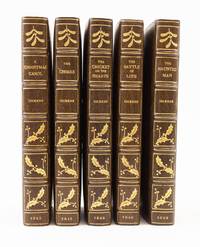
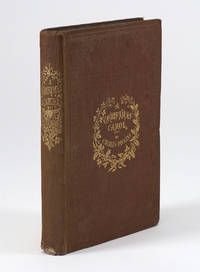
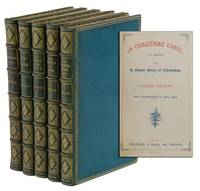
184342820874<p><strong>FIRST EDITIONS of all five Dickens Christmas books including the first issue of <em>A Christmas Carol</em>.</strong></p><p>Dickens wrote <em>A Christmas Carol</em> in little more than six weeks in October and November 1843. Wanting to make the book memorable for its appearance as well as its story Dickens arranged for Chapman and Hall to publish the book on commission so that he could exercise close control over production. Dickens called for a deluxe production with a gilt-stamped binding gilt edges a title-page printed in red and blue and four hand-colored etchings by John Leech. But at the same time Dickens wanted the book to reach a wide audience and set the price at only five shillings. The book was extremely well received and sold quickly but Dickens found that on the first 6000 copies he had cleared only £230 not the £1000 he had hoped for.</p><p><strong><em>A Christmas Carol</em> is the first issue</strong> with uncorrected text "Stave I" as the first chapter heading the red and blue title page dated 1843 the half title printed in blue and light green endpapers. <strong>The binding is Todd's first impression first issue</strong> with the smallest interval between blind-stamped border and gilt wreath measuring 14-15 mm and with the "D" in "Dickens" unbroken.</p><p>Dickens followed <em>A Christmas Carol</em> with four more Christmas books echoing the first book's themes of charity love and redemption. This handsome set also features: first edition of <em>The Chimes</em> with the first state of the engraved title page publisher's imprint is engraved within the title vignette; first edition of <em>The Cricket on the Hearth</em> with second state of advertising leaf at rear headed "New Edition of Oliver Twist"; first edition of <em>The Battle of Life</em> with vignette title page in the second state of four; and first edition of <em>The Haunted Man</em> <em>and</em> <em>The</em> <em>Ghost's Bargain</em>.</p><p><strong>A lovely entirely unrestored set of these beloved classics.</strong></p><p>Five volumes. Original rose and red cloth gilt. Foot of spine of <em>A Christmas Carol </em>a little chipped else a near fine set. Red morocco case.</p> Chapman and Hall [and Bradbury and Evans] hardcover
186858251868. Signed "Charles Dickens with a large flourish Washington D.C. Seventh February 1868." Large oval portrait photograph measures 13 inches by 13 inches. Matted in a walnut frame which measures 24 inches by 27 inches. On his Washington tour Dickens met President Andrew Johnson and signed this photograph on the date of that meeting February 7 which also happened to be Dickens' birthday. He discussed in a letter to his friend and agent John Foster regarding that day "This scrambling scribblement is resumed this morning because I have just seen the President: who had sent to me very courteously asking me to make my own appointment. He is a man with a remarkable face." From the Library of The Cosmos Club in Washington D.C. Portrait photographs of this size signed by Dickens are exceptionally rare especially with such noted provenance. Charles Dickens was an English writer and social critic. He created some of the world's best-known fictional characters and is regarded by many as the greatest novelist of the Victorian era. His works enjoyed unprecedented popularity during his lifetime and by the twentieth century critics and scholars had recognized him as a literary genius. unknown
18611260181861. London: Chapman & Hall 1861. <br /> <br /> 3 vols. 8vo iv 344; ii 351 1; ii 344 pp. Three quarter morocco green cloth sides marbled edges and endpapers backstrips with raised bands ruled in gilt with red and green title labels. Backstrips and board edges a little worn and scuffed contents near fine with only very occasional spotting. A unusually bright set internally with the armorial bookplates of Jonathan Latimer Collens and small ticket of the renowned Chaucer's Head bookshop in each volume.<br /> <br /> § First edition first issue in book form with no edition statements on the title page. An unusually fine copy with all the necessary points in Clarendon Appendix D and all points noted by Smith save for the two which he noted appeared only in Sadleir's copy. Bound without terminal adverts to vol. III; Smith states that not all copies were issued with adverts. Smith I 14. unknown
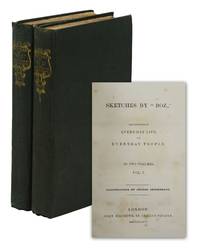
1836140944727London: John Macrone 1836. First edition. First edition. viii 348; iv 342 pp. with all 16 illustrated plates by Cruikshank. Two volumes bound in publisher's green leaf-patterned morocco cloth spine lettered in gilt pale yellow coated endpapers. Near Fine unsophisticated copies with contemporary gift inscriptions on paste downs alongside armorial bookplates and tiny bookplates discrete number stamps to copyright pages with withdrawal stamps from G.M.A. Library. Some foxing to contents darkening to plates and occasional corner creasing. Slight lean to first volume. Lovely grain of cloth with hardly any rubbing truly superior in this respect and gilt lettering still quite distinct despite the years. Housed in a custom slipcase.<br /> <p>The famous Victorian novelist's very first book largely comprised of humorous short pieces that had been printed in magazines the past three years. "A Visit to Newgate" "The Black Veil" and "The Great Winglebury Duel" are published here first. Rare in the original cloth in such excellent condition. John Macrone unknown
1843140945735London: Chapman & Hall / Bradbury & Evans 1843. First Edition. Near Fine. 1843 1845 1846 1846 1848. First editions of all five of Charles Dickens' Christmas Books all in their most desirable states. A Christmas Carol is the first issue with title page printed in red and blue dated 1843 in Roman numerals; half title and verso of title page printed in blue; "Stave I" on page 1. The Chimes first edition first issue with the publisher's name part of the vignette title page. The Cricket on the Hearth first edition second issue with 2pp. ads. The Battle of Life first edition second of four states of the engraved title page with "A Love Story" in a scroll sans cupid; terminal ads announce the publication in parts of Dombey and Son and the bound volume of Oliver Twist. The Haunted Man first edition first and only issue.<p>All five volumes uniformly bound in full teal morocco ribbed gilt decorated spines covers triple ruled in gilt gilt dentelles all edges gilt original cloth covers and spines bound in the rear of each volume housed in a blue cloth open ended slipcase which is rubbed. Near Fine expert hinge repairs to "A Christmas Carol" and "The Battle Of Life". Contents tanned with the light sporadic age-related spot. A lovely set. Chapman & Hall / Bradbury & Evans unknown
1868740301868. Large oval portrait photograph measures 20 inches by 16 inches. Matted in a contemporary frame which measures 25.5 inches by 29.5 inches. Signed "Charles Dickens with a large flourish Boston Sixth March 1868."Â In 1867 Charles Dickens began his second American reading tour at Boston's Tremont Temple where an enthusiastic audience delighted in some of his most notable works members of the audience included legendary literary stars such as Henry Wadsworth Longfellow and Ralph Waldo Emerson. Although Dickens was in declining health he embarked on an ambitious travel schedule across the United States. Dickens returned to Boston once more before concluding his U.S. tour in New York City. When Charles Dickens arrived in Boston on November 19 1867 the celebrated English author spent several days at the Parker House hotel recuperating from the voyage. As conscientious a performer as he was a writer Dickens had prepared diligently for his performances redrafting and memorizing key passages from his books especially for these engagements. He used a book only as a prop; he was so familiar with the material that he could improvise with ease. However during his 1867-1868 tour he was plagued with Flu-like symptoms insomnia and an inflammation of his foot which forced him to walk with a cane. During his last tours in 1868 Dickens confined much of his performances to the New England area. Dickens was grateful for the income he desperately needed from his readings which generated $140000 close to $2000000 today; but he longed for home. On April 8 1868 Dickens gave the last performance of the tour. Prolonged applause followed the reading. He closed by telling the audience "In this brief life of ours it is sad to do almost anything for the last time. Ladies and gentlemen I beg most earnestly most gratefully and most affectionately to bid you each and all farewell." He died two years later having written 14 novels several of which are considered classics of English literature. A desirable piece of Victorian literary history. Charles Dickens was an English writer and social critic. He created some of the world's best-known fictional characters and is regarded by many as the greatest novelist of the Victorian era. His works enjoyed unprecedented popularity during his lifetime and by the twentieth century critics and scholars had recognized him as a literary genius. unknown
1843140947309London: Chapman & Hall / Bradbury & Evans 1843. First Edition. Near Fine. 1843 1845 1846 1846 1848. First editions of all five of Charles Dickens' Christmas Books Smith II.4-6 II.8-9. A Christmas Carol is the first issue with title page printed in red and blue dated 1843 in Roman numerals; half title and verso of title page printed in blue; "Stave I" on page 1. The Chimes first edition second issue with the publisher's name below the plate on the vignette title page. The Cricket on the Hearth first edition second issue with 2pp. ads. The Battle of Life first edition Todd's fifth state of the engraved title page with "A Love Story" in a scroll held by a cupid; terminal ads announce the publication in parts of Dombey and Son and the bound volume of Oliver Twist. The Haunted Man first edition first and only issue.<p>All five volumes bound in full polished calf with elaborate gilt seasonal stamping unique to each book. Morocco title labels to ribbed spines gilt dentelles all edges gilt. Sangorski & Sutcliffe stamp in gilt to front turn-in of each volume. Original cloth covers and spines bound in rear of all volumes but the last. Housed in an open-ended slipcase moderately rubbed and toned covered in the same floral gilt-embellished paper used for endpapers. Near Fine with slightly rubbed spines. Light edge toning to interiors occasional thumbing and staining and spots of foxing. <p>No writer is more closely associated with Christmas than Charles Dickens who began with the immortal A Christmas Carol in November 1843. It was published on December 19 and sold so well there were seven editions by the following May. The Chimes followed in December 1844 and three more books appeared in 1845 1846 and 1848 two of the title page dates follow the then-common practice of dating a book published in November or December with the coming year.<br /> <p>The enduring appeal of Dickens’ Christmas stories lies in his unmatched ability to combine sentimentality with melancholy or righteous fury a balancing act of light and dark. A Christmas Carol composed as Dickens walked weeping through the dark London streets was intended to draw attention to the plight of the working poor in London. The Chimes attacks the cruelty and hypocrisy of the rich and the protagonist of The Cricket on the Hearth contemplates murder. The Haunted Man the last novella emphasizes the need to remember past sorrows and hardships.<br /> <br /> <p>Dickens wanted his Christmas books to be pretty – his specifications for the first cut severely into his profits – and it is appropriate that these copies have been given jewel-like bindings by Sangorski & Sutcliffe one of the most famous fine binderies in the English-speaking world. A beautiful set of beautiful stories illustrated by the leading artists of the day. Chapman & Hall / Bradbury & Evans unknown
190621430London.: Chapman & Hall Ltd. 1906 - 1908. Full contemporary blue crushed morocco banded spines with gilt titles in six compartments turn-ins with decorative gilt borders marbled endpapers blue silk placemarkers t.e.g. 80 vols. 8vo. 235 x 168 mm. Each vol. with leaf with limitation verso half-title and printed title in red and black with publisher's vignette and Arguably the best edition of Dickens' works with the definitive text large type and facsimiles of title pages and original covers etc. Limited to 750 copies.This a deluxe extra-illustrated set with before-letters proof states of most of the wood-engraved plates together with additional hors-texte illustrations many hand-coloured.This set also includes an original ALS from Dickens to George Dolby his manager dated the first of July 1866 in which Dickens tries to fix a date for the two to meet. A truly fine set. Chapman & Hall Ltd. unknown
18509951850. First Edition. Uniformly bound by Bayntun Riviere in full crushed Morocco. Near Fine. Cruikshank. Twain Mark.<br /> WHAT IS MAN And Other Essays.<br /> Harper & Bros: NY 1917. Item #99-1211<br /> Illustr 7.75 x 5.25 376 pp vg. FINELY BOUND BY BAYNTUN-RIVIERE IN FULL CRUSHED BROWN MOROCCO GILT STAMPED SPINE ALL EDGES GILT MARBLED END PAPERS FIRST ED. A beautiful copy.<br /> Twain Mark.<br /> TOM SAWYER ABROAD/TOM SAWYER DETECTIVE And Other Stories.<br /> Harper & Bros.: NY 1896. Item #99-1183<br /> Illustr; 7.75 x 5.25 410 ads vg. FINELY BOUND BY BAYNTUN-RIVIERE IN FULL CRUSHED BROWN MOROCCO GILT STAMPED SPINE ALL EDGES GILT MARBLED END PAPERS. FIRST EDITION. A beautiful copy.<br /> Twain Mark.<br /> THE AMERICAN CLAIMANT.<br /> Charles L. Webster: NY 1892. Item #99-1198<br /> Illustr 8 x 5.5 277 ads vg. FINELY BOUND BY BAYNTUN-RIVIERE IN FULL CRUSHED BROWN MOROCCO GILT STAMPED SPINE ALL EDGES GILT MARBLED END PAPERS FIRST ED. A beautiful copy.<br /> Twain Mark.<br /> CHRISTIAN SCIENCE with Notes Containing Corrections to Date.<br /> Harper & Bros: NY and London 1907. Item #99-1200<br /> Illustr 7.75 x 5.25 362 pp vg. FINELY BOUND BY BAYNTUN-RIVIERE IN FULL CRUSHED BROWN MOROCCO GILT STAMPED SPINE ALL EDGES GILT MARBLED END PAPERS FIRST ED. FIRST STATE. A beautiful copy.<br /> Twain Mark.<br /> MARK TWAIN'S SKETCHES. New and Old.<br /> American Publishing Co: 1875. Item #99-1203<br /> Illustr 8.5 x6.5 320 pp vg. FINELY BOUND BY BAYNTUN-RIVIERE IN FULL CRUSHED BROWN MOROCCO GILT STAMPED SPINE ALL EDGES GILT MARBLED END PAPERS FIRST ED FIRST STATE. A beautiful copy.<br /> Twain Mark.<br /> TOM SAWYER ABROAD BY HUCK FINN.<br /> Charles L. Webster: NY 1894. Item #99-1186<br /> Illustr; 8 x 5.75 219 ads vg. FINELY BOUND BY BAYNTUN-RIVIERE IN FULL CRUSHED BROWN MOROCCO GILT STAMPED SPINE ALL EDGES GILT MARBLED END PAPERS. FIRST EDITION. A beautiful copy.<br /> Dickens Charles.<br /> THE LIFE AND ADVENTURES OF MARTIN CHUZZLEWIT.<br /> Chapman & Hall: London 1844. Item #99-2460<br /> "With illustrations by Phiz." 8.25 x 5.25 finely bound in full gilt-ruled golden crushed morocco; aeg 624 pp covers lightly rubbed hinges a little loose pp toned but still a very nice handsomely bound copy of the FIRST EDITION FIRST ISSUE with all the points listed in Smith: Heritage Bookshop; with one of the "L100" plates as engraved extra title. Binding by Bayntun-Riviere though not noted as such.<br /> Twain Mark.<br /> EVE'S DIARY.<br /> Harper & Bros.: NY and London 1906. Item #99-1189<br /> Illustr by Lester Ralph; 8 x 5. 109 pp vg. FINELY BOUND BY BAYNTUN-RIVIERE IN FULL CRUSHED BROWN MOROCCO GILT STAMPED SPINE ALL EDGES GILT MARBLED END PAPERS FIRST EDITION. A beautiful copy.<br /> Twain Mark and Charles Dudley Warner.<br /> THE GILDED AGE.<br /> American Publishing Co: Hartford. 1873. Item #99-1201<br /> Illustr 8.75 x 5.5 574 appendix vg. FINELY BOUND BY BAYNTUN-RIVIERE IN FULL CRUSHED BROWN MOROCCO GILT STAMPED SPINE ALL EDGES GILT MARBLED END PAPERS FIRST ED. EARLY ISSUE no ads. A beautiful copy.<br /> Twain Mark.<br /> MERRY TALES.<br /> Charles L. Webster: NY 1892. Item #99-1193<br /> 7 x 4.75 209 ads blind stamped name and address on title page else vg. FINELY BOUND BY BAYNTUN-RIVIERE IN FULL CRUSHED BROWN MOROCCO GILT STAMPED SPINE ALL EDGES GILT MARBLED END PAPERS FIRST ED state unknown but no portrait. "Fiction Fact And Fancy Series." A beautiful copy.<br /> Twain Mark.<br /> THE MAN THAT CORRUPTED HADLEYBURG And Other Stories and Essays.<br /> Harper & Bros.: NY and London 1900. Item #99-1187<br /> Illustr; 7.75 x 5.25 398 ads vg. FINELY BOUND BY BAYNTUN-RIVIERE IN FULL CRUSHED BROWN MOROCCO GILT STAMPED SPINE ALL EDGES GILT MARBLED END PAPERS. FIRST EDITION. Third State 1.25" bulk A beautiful copy.<br /> Twain Mark.<br /> EXTRACT FROM CAPTAIN STORMFIELD'S VISIT TO HEAVEN.<br /> Harper & Bros NY and London 1909. Item #99-1181<br /> Frontis 7.5 x 5. 121 pp vg. FINELY BOUND BY BAYNTUN-RIVIERE IN FULL CRUSHED BROWN MOROCCO GILT STAMPED SPINE ALL EDGES GILT MARBLED END PAPERS. FIRST EDITION. A beautiful copy.<br /> Dickens Charles. LITTLE DORRIT.<br /> Bradbury and Evans: London 1857. Item #99-2458<br /> "With illustrations by HK Browne" 8.5 x 5.25 finely bound in gilt-ruled gold crushed morocco with raised bands; aeg 625 pp covers with minor rubbing hinges a little loose pp toned illustr with some spotting else a beautifully bound copy of the FIRST EDITION EARLY ISSUE with "po litical" on p 50 "figetty" on p265 "chimnies" on p342 "diceing" on p 360. "B2" at bottom of p 371; but with proper quotes before "Because" on p377 "Rigaud" for "Blandois" with printed errata on p xiv Smith: Heritage Bookshop. Binding by Bayntun-Riviere though not noted as such.<br /> Dickens Charles.<br /> THE MYSTERY OF EDWIN DROOD.<br /> Chapman & Hall: London 1870. Item #99-2455<br /> "With twelve illustrations by S.L. Fildes and a portrait" 8.5 x 5.25 finely bound in gilt-ruled gold crushed morocco with raised bands; aeg 190 pp ads covers with very minor rubbing hinges a bit loose pp toned illustr toned and spotted as usual else nice clean fresh copy of the FIRST EDITION FIRST ISSUE with "Tower" on pl "sentiment" on p131 "years" on p149 no "very" on p168 and "reflection" on p 169 Smith: Heritage Bookshop.<br /> Dickens Charles.<br /> OUR MUTUAL FRIEND two volumes in one.<br /> Chapman and Hall: London 1865. Item #99-2456<br /> two volumes in one. "With illustrations by Marcus Stone" 8.5 x 5.25 finely bound in full gilt-ruled gold crushed morocco with raised bands; aeg 320 pp. 309 pp minor rubbing to covers hinges a little loose pp toned small tear to foredge of frontis margin else a nice finely bound copy of the FIRST EDITION FIRST ISSUE with all the points listed in Smith: Heritage Bookshop.<br /> Dickens Charles.<br /> DOMBEY AND SON.<br /> Bradbury and Evans: London 1848. Item #99-2453<br /> "With illustrations by HK Browne" 8.5 x 5.25 finely bound in gilt ruled gold crushed morocco with raised bands aeg 624 pp very minor cover rubbing hinges a little loose pp toned illustr toned and spotted as usual else a beautifully bound copy of the FIRST EDITION FIRST ISSUE with errata leaf and such points as "figetty" on p26 "amiliar" on p70 "Capatin" on p324 no period at the end of the last line on p582 and hook on left arm in title page vignette Smith: Heritage Bookshop. Binding by Bayntun-Riviere though not noted as such.<br /> Dickens Charles.<br /> THE UNCOMMERCIAL TRAVELLER.<br /> Chapman & Hall: London 1859. Item #99-2619<br /> 7.25 x 4.75 finely bound in full gilt ruled full crushed golden morocco with raised bands; aeg binding by Bayntun-Riviere though not identified as such 264 pp with original cloth spine affixed to rear blank minor cover rubbing hingesa little loose pp a little edge toned but still a nice beautiful copy of the FIRST ED but with no ads in rear.<br /> Dickens Charles.<br /> MASTER HUMPHREY'S CLOCK.<br /> Chapman and Hall: London 1840-1841. Item #99-2566<br /> 3 Vols in 1. Illustr by George Cattermole and Hablot Browne 10 x 6.5 gilt ruled crushed gold morocco with raised bands; aeg binding by Bayntun-Riviere but not designated as such but with a printed slip from Bayntun Riviere 306 pp 306 pp. 426 pp covers with minor wear hinges a little loose pp browned with some finger soiling and spotting old ink name of former owner at start of third part else a nice elegant finely bound copy of FIRST ED with most of the flaws listed in Smith: Heritage Bookshop bibliography including p 128 1 "deessed" and p 133 III "THIRTY-FIFTH.". unknown
1837195825London: Chapman & Hall / Cosway 1837. First Edition; First Printing. Fine Binding. First edition. One octavo volume bound in two. Title-page bound in the second volume with the rest of the preliminaries bound in the first volume. Very tastefully extra-illustrated with portraits of Dickens Seymour Talfourd the dedicatee and Phiz; engraved woodcut and a few hand-colored views of places mentioned in the text; plates a few colorea by A. B. Frost and other artists from later sets of illustrations to Pickwick; additional plain and hand-colored plates by George Cruikshank another Dickensian illustrator; and two different states of the original illustrations to Pickwick by Seymour Buss and Phiz. Handsomely bound in full green morocco gilt for Charles J. Sawyer almost certainly by Sangorski & Sutcliffe. Covers panelled in blind and gilt with central gilt facsimile signature of Dickens on front covers spines lettered and decoratively tooled in gilt in compartments. Gilt-ruled board edges and gilt-tooled turn-ins. Red morocco doublures and red watered silk end-leaves front end-leaf in Volume I with gilt facsimile signature. With a portrait of Charles Dickens set under glass in the front inner cover of Volume I above the gilt-lettering "Charles Dickens at: 27 after the painting by Maclise." Some very minor browning to text and plates but overall a fine copy of this book in a very attractive binding. Hatton and Cleaver pp. 1-88. Johannsen PP. 1-75. Smith I 3. Both Volumes Very Good in decorative boards. One octavo volume bound as two. Bound in full green morocco gilt. Covers panelled in blind and gilt with central gilt facsimile signature of Dickens on front covers. Red Morocco doublures and red watered silk end-leaves. Very minor browning to text and plates overall a fantastic copy in a very attractive binding. Chapman & Hall / Cosway unknown
1859131460London: Chapman and Hall June-December 1859. First edition first issue of one of Dickens’ most enduring works with p.213 in part 7/8 mispaginated "113" and signature mark 'b' present on List of Plates at end etched frontispiece additional title and 14 plates by "Phiz" Hablot K. Browne. Octavo original blue-green wrappers. Complete with all the advertisements called for by Hatton & Cleaver and the two rare slips in parts 1 and 5. Includes three variant issues of part 1 one with Morison's 'premises' advert the second with Morison's 'lion' advert and the third with the rare French version of the Morison's 'lion' advert. In near fine condition. A scarce and desirable complete set in original parts. Housed in a custom folding clamshell box. The most famous and possibly the most popular of Dickens's novels A Tale of Two Cities shows a master of dramatic narrative extracting gold from the ore of history. If the bloody tableau of the French Revolution were not in itself sufficient for a dozen novels Dickens added to it a professional resurrectionist an authentic ogress and an antihero as convincingly flawed as any in modern literature. “Dickens had always admired Carlyle’s History of the French Revolution and asked him to recommend suitable books from which he could research the period; in reply Carlyle sent him a ‘cartload’ of volumes… So great was Dickens’ enthusiasm for the story that it had indeed ‘taken in possession’ of him… The force of the novel springs from its exploration of darkness and death but its beauty derives from Dickens’ real sense of transcendence from his ability to see the sweep of destiny†Ackroyd 858. The last of Dickens’ books to be illustrated by H.K. Browne “Phiz†with 16 engraved plates by him. “Browne for 23 years responsible for all the etchings which had so successfully embellished these Dickens’ books produced his last drawings for the present work… Bradbury and Evans the printers of all and publishers of five of Dickens’ works as issued in monthly parts had ceased to act in this dual capacity after completion of Little Dorrit… resulting in the return of Chapman and Hall as publishers of this and all succeeding works†Hatton & Cleaver 333. Chapman and Hall unknown
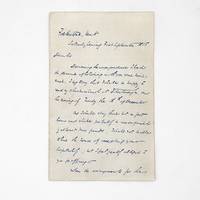
1855374851Folkestone 1855. 2 pp. 1 vols. 8vo. Written on the first and last pages of a folded sheet in blue ink. Chemise and half green morocco slipcase with spine lettered in gilt. 2 pp. 1 vols. 8vo. In late summer of 1855 Dickens agrees to a public reading of A Christmas Carol already a much-loved work at Peterborough in December. He first read his ghost story of Christmas at Birmingham in 1853 and had reprised the performances the following year. "The public readings of Charles Dickens which were to play so large and in some respects so fatal a part in his life were from the start specifically associated with his philanthropic activities" Ackroyd Dickens p. 666.<br /> <br /> "Resuming the correspondence I had the pleasure of holding with you some time since I beg to say that I shall be happy to read my Christmas Carol at Peterborough on the morning of Tuesday the 18th of December. As I shall stay there but a few hours and shall probably be accompanied by at least two friends I shall not be able to have the honor of accepting your hospitality; but I feel greatly obliged to you for offering it. When the arrangements for the occasion shall begin to be in progress may I beg you to contact my friend Mr W. H. Wills of the Household Words office London. Mr. Wills will give him any information he may desire as to the time the reading will occupy and as to my own little requirements with a view to position &c."<br /> <br /> Dickens' readings were well attended and he gave memorable moving performances. In December in the midst of work on Little Dorrit which had just begun serial publication Dickens went to Peterborough and gave his reading at the Mechanics' Institute returned to London "where the people I met on their way to offices were actually sobbing and crying with cold"; up North to Sheffield for another performance then back to London like "an enormous top in full spin" and off to Paris to resume work on the novel in progress Ackroyd pp. 751-2. Letters from Dickens discussing the public readings of A Christmas Carol are uncommon.<br /> <br /> A CHOICE LETTER FROM DICKENS. Provenance: Swann November 26 2013 sale 2333 lot 270 unknown
18611602012Chapman and Hall London 1861. 5th or later Edition. Hardcover. Near Fine. First Edition fifth issue. Three volumes including the publisher's catalog dated August 1861 at the rear of Volume III. Bound in the publisher's original ribbed purple cloth binding with ruling and decorations in blind to boards lettering and decorations in gilt to spine. This copy has the majority of the first issue points with only a few of the corrections that were made after the first issue. Overall a clean and attractive set extremely rare in the unsophisticated publisher's cloth. The first issue of the first edition book published on July 6 1861 was followed by four subsequent issues of the same edition published on August 5 August 17 September 21 and October 30 of the same year. Smith notes that "These first five issues were probably printed at a single impression and published with altered title pages to imply and encourage a rapid sale In all five issues the same misprints persist." The first issue which included a print run of 1000 copies was "almost entirely taken up by the libraries" leaving only a few hundred copies for private ownership. Overall a beautiful unrestored uniform set. Housed in a custom-made collector's slipcase. Chapman and Hall, London hardcover