Charles Louis Fleury Panckoucke,Biblio.com
3 731 résultats
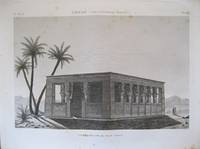
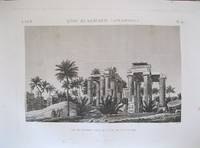
1982Middle East: Paris Impremerie de C.L.F.Pancoucke 1820-1829. Copper engraved view of the temple of Qau el-Kebir from the fourth volume of the "Antiquities "of the "Description de l'Egypte" 2nd Edition; black & white; verso blank. Blind stamp of the publisher Panckoucke to margin. The view shows the ruins of the temple Qau or Qau el-Kebir surrounded by palm trees Qau is located by the site of ancient Tjebu known in ancient Greek records as Antaeopolis 'city of Antaeus' on the east bank of the Nile midway between the towns of Akhmim and Asyut The temple was built by Ptolemy IV. substantial parts of which were still standing at the beginning of the 19th century sadly it was swept away by the Nile flood of 1821 Good dark impression; some light foxing to sky and spotting to margins. "Description de l'Egypte ou Recueil des observations et des recherches qui ont été faites en Egypte pendant l'expédition de l'armée française." When Napoleon Bonaparte invaded Egypt in 1798 he brought with him an entourage of more than 160 scholars and scientists. Known as the French Commission on the Sciences and Arts of Egypt these experts undertook an extensive survey of the country's archeology topography and natural history. . For four years more than 150 artists engineers linguists and scientists traveled throughout the country examining almost every aspect of ancient and contemporary Egypt. They recorded and measured in meticulous detail Egypt's topography flora and fauna and its ancient and contemporary architecture. A soldier who was part of the expedition found the famous Rosetta Stone which the French linguist and scholar Jean-François Champollion 1790-1832 later used to unlock many of the mysteries that long had surrounded the language of ancient Egypt. The Egyptian expedition ended with a total military failure. The French left Egypt in 1801 with the honors of war but defeated; yet military failure remains a significant event in the history of knowledge because it is the first time a military expedition was accompanied by a scientific expedition. In 1802 Napoleon authorized the publication of the commission's findings in a monumental multi-volume work that included plates maps scholarly essays and a detailed index. Publication of the original Imperial edition began in 1809 and continued to 1822 sold by subscription. It proved so popular that a second edition was published under the post-Napoleonic Bourbon Restoration. The "Royal edition" published in Paris by C.L.F. Panckoucke from 1820-1830. The Second edition consists of 11 or 12 volumes of plates in folio and 24 of text bound as 26 8vo. Brunet:II 617; Blackmer/Navari: 476 1st edition Middle East Egypt Qau el-Kebir Qâou El Kebyreh Antæopolis. Paris Impremerie de C.L.F.Pancoucke 1820-1829 unknown
1979Middle East: Paris Impremerie de C.L.F.Pancoucke 1820-1829. Copper engraved view of the small temple or Birth House at Edfu from the first volume of the "Antiquities "of the "Description de l'Egypte" 2nd Edition; black & white; verso blank. Blind stamp of the publisher Panckoucke to margin. The view shows a reconstrucion of the small temple or Birth house described in the Antiquites. Opposite the large temple of Horus is another much smaller temple in a rather poorer state of preservation - the mammisi Birth House. The floral columns are crowned with sculptures of the god Bes a disfigured domestic god considered the guardian of expectant mothers and newborn infants. Since the scenes on the outside had been destroyed the French artists executed an imaginary reconstruction of the temple with all the decoration typical of similar monuments. Good dark impression; some spotting mainly to margins a few to image. "Description de l'Egypte ou Recueil des observations et des recherches qui ont été faites en Egypte pendant l'expédition de l'armée française." When Napoleon Bonaparte invaded Egypt in 1798 he brought with him an entourage of more than 160 scholars and scientists. Known as the French Commission on the Sciences and Arts of Egypt these experts undertook an extensive survey of the country's archeology topography and natural history. . For four years more than 150 artists engineers linguists and scientists traveled throughout the country examining almost every aspect of ancient and contemporary Egypt. They recorded and measured in meticulous detail Egypt's topography flora and fauna and its ancient and contemporary architecture. A soldier who was part of the expedition found the famous Rosetta Stone which the French linguist and scholar Jean-François Champollion 1790-1832 later used to unlock many of the mysteries that long had surrounded the language of ancient Egypt. The Egyptian expedition ended with a total military failure. The French left Egypt in 1801 with the honors of war but defeated; yet military failure remains a significant event in the history of knowledge because it is the first time a military expedition was accompanied by a scientific expedition. In 1802 Napoleon authorized the publication of the commission's findings in a monumental multi-volume work that included plates maps scholarly essays and a detailed index. Publication of the original Imperial edition began in 1809 and continued to 1822 sold by subscription. It proved so popular that a second edition was published under the post-Napoleonic Bourbon Restoration. The "Royal edition" published in Paris by C.L.F. Panckoucke from 1820-1830. The Second edition consists of 11 or 12 volumes of plates in folio and 24 of text bound as 26 8vo. Brunet:II 617; Blackmer/Navari: 476 1st edition Middle East Egypt Edfu Paris Impremerie de C.L.F.Pancoucke 1820-1829 unknown
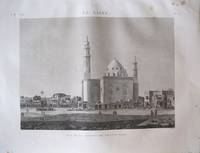
1966Middle East: Paris Impremerie de C.L.F.Pancoucke 1820-1829. Copper engraved view of the mosque of Sultan Hasan Cairo from the first volume of the "Etat Modene "of the "Description de l'Egypte" 2nd Edition; 1822; black & white; verso blank. Blind stamp of the publisher Panckoucke to margin. The view shows the mosque towering over the nearby buildings with small shops and workshops in and around the Square. Good dark impression; some foxing to platemainly to blank margins. "Description de l'Egypte ou Recueil des observations et des recherches qui ont été faites en Egypte pendant l'expédition de l'armée française." When Napoleon Bonaparte invaded Egypt in 1798 he brought with him an entourage of more than 160 scholars and scientists. Known as the French Commission on the Sciences and Arts of Egypt these experts undertook an extensive survey of the country's archeology topography and natural history. . For four years more than 150 artists engineers linguists and scientists traveled throughout the country examining almost every aspect of ancient and contemporary Egypt. They recorded and measured in meticulous detail Egypt's topography flora and fauna and its ancient and contemporary architecture. A soldier who was part of the expedition found the famous Rosetta Stone which the French linguist and scholar Jean-François Champollion 1790-1832 later used to unlock many of the mysteries that long had surrounded the language of ancient Egypt. The Egyptian expedition ended with a total military failure. The French left Egypt in 1801 with the honors of war but defeated; yet military failure remains a significant event in the history of knowledge because it is the first time a military expedition was accompanied by a scientific expedition. In 1802 Napoleon authorized the publication of the commission's findings in a monumental multi-volume work that included plates maps scholarly essays and a detailed index. Publication of the original Imperial edition began in 1809 and continued to 1822 sold by subscription. It proved so popular that a second edition was published under the post-Napoleonic Bourbon Restoration. The "Royal edition" published in Paris by C.L.F. Panckoucke from 1820-1830. The Second edition consists of 11 or 12 volumes of plates in folio and 24 of text bound as 26 8vo. Brunet:II 617; Blackmer/Navari: 476 1st edition Middle East Egypt Cairo Sultan Hasan Mosque Paris Impremerie de C.L.F.Pancoucke 1820-1829 unknown
0364829605.Gpaperback. Good. Access codes and supplements are not guaranteed with used items. May be an ex-library book. paperback
0364794070.Ghardcover. Good. Access codes and supplements are not guaranteed with used items. May be an ex-library book. hardcover
0364829729.Ghardcover. Good. Access codes and supplements are not guaranteed with used items. May be an ex-library book. hardcover
0259803014.Gpaperback. Good. Access codes and supplements are not guaranteed with used items. May be an ex-library book. paperback
0484153358.Ghardcover. Good. Access codes and supplements are not guaranteed with used items. May be an ex-library book. hardcover
1385961090.Ghardcover. Good. Access codes and supplements are not guaranteed with used items. May be an ex-library book. hardcover
2012980171.Gpaperback. Good. Access codes and supplements are not guaranteed with used items. May be an ex-library book. paperback
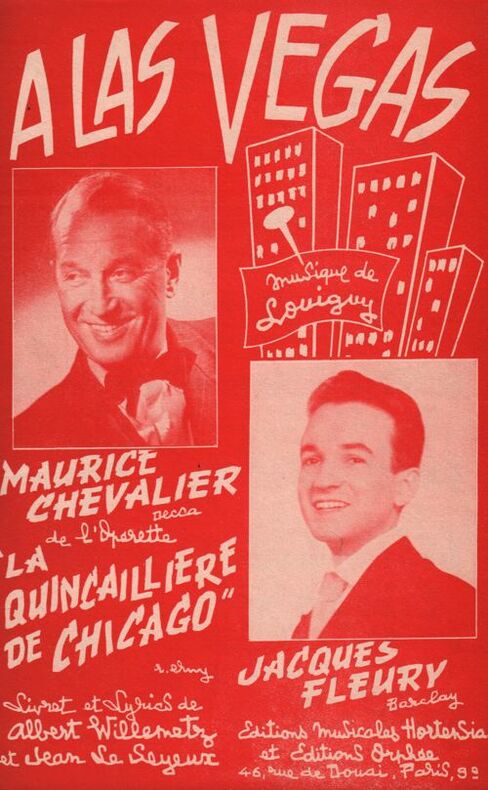
195676261Partitions sur les États-Unis Hortensia 1956
201328191Casterman 2013 168 pages 24x17x2cm. 2013. Album. 168 pages.
201330742Casterman 2013 168 pages 24x17x2cm. 2013. Album. 168 pages.
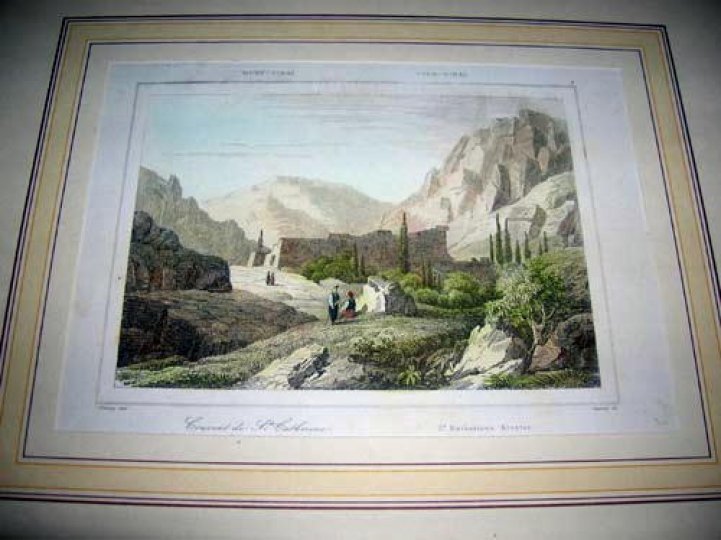
18509091Gravure en couleurs. Mont-Sinaï - Couvent de Ste. Catherine. Vers 1850.Très bon état. Format in-8°(20x13) pour la gravure. Format in-4°(30x24) pour le passe-partout. Livré sans le passe-partout pour des raisons techniques.
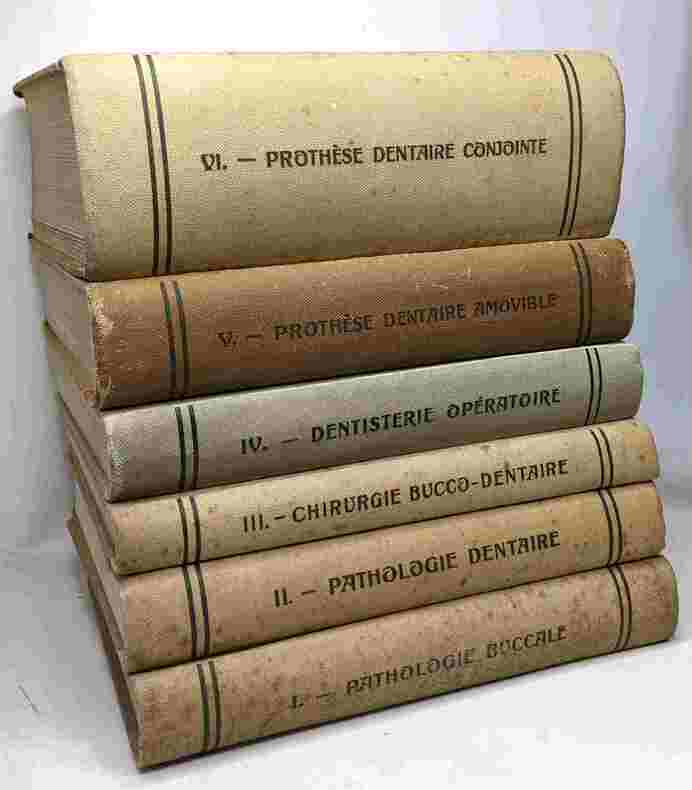
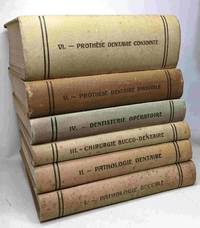
100073662Masson et cie in8. Sans date. Cartonné. 7 volume(s). La pratique stomatologique - TOME 1 à 6 (de 1939 à 1941) : Pathologie buccale + Pathologie dentaire + Technique chirurgicale bucco-dentaire + Dentisterie opératoire + Prothèse dentaire amovible + Prothèse dentaire conjointe abondante iconographie
193214918In Annales de Géographie n°234 du 15 novembre 1932 ; in-8, broché ; pp. 561 à 582 et 3 planches hors-texte soit 6 photographies aériennes du capitaine Seive (Fleury).
100073662Masson et cie. couvertures défraîchies ternissures frottements rousseurs intérieurs propres. in8. Sans date. Cartonné. 7 volumes. La pratique stomatologique - TOME 1 à 6 de 1939 à 1941 : Pathologie buccale Pathologie dentaire Technique chirurgicale bucco-dentaire Dentisterie opératoire Prothèse dentaire amovible Prothèse dentaire conjointe abondante iconographie Masson et cie unknown
1999038473Arléa broché Bristol 1999 117 pages en format 13 - 19 cm Exemplaire de bibliothèque 2-86959-441-0
2003039783Arléa broché Bristol 2003 104 pages en format 13 - 19 cm 2-86959-635-9
193014905en noir et blanc (14,5 x 19 cm) datant des années 1930 (capitaine Fleury Seive, photographe) ; vue générale à haute altitude du viaduc de Cize-Bolozon construit en 1875 (il sera dynamité par la Résistance et reconstruit en 1950) ; le barrage qui se situe un peu en amont n'était pas encore construit ; ce cliché montre admirablement la boucle de l'Ain.
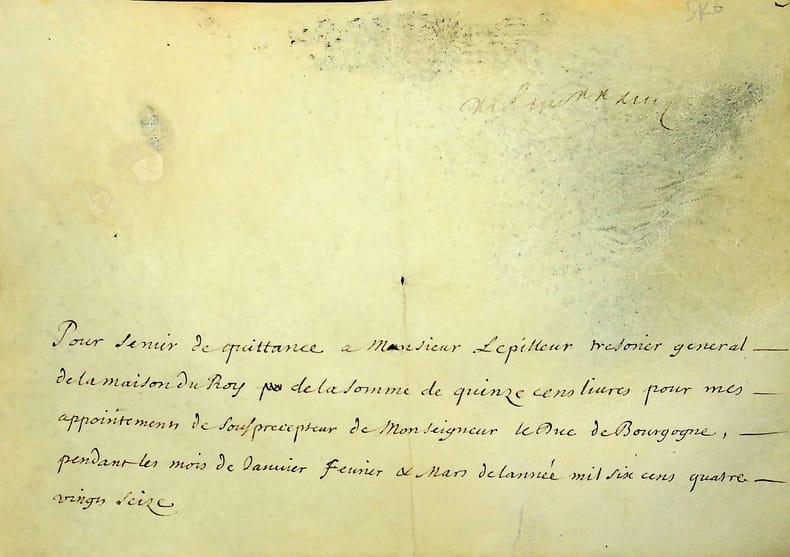
014222Claude Fleury (1640-1723), prêtre, historien, précepteur de princes dont les petits-fils de Louis XIV, confesseur de Louis XV, membre de l'Académie française. P.A.S., [1696], 1p in-4. Très belle quittance, sur parchemin, pour sa place de sous-précepteur du duc de Bourgogne, i.e. Louis de France (1682-1712), père de Louis XV : « Pour servir de quittance à Monsieur Lepilleur trésorier général de la maison du Roy de la somme de quinze cens livres pour mes appointemens de sous-précepteur de Monseigneur le Duc de Bourgogne, pendant les mois de Janvier Février & Mars mil six cens quatre vingt seize ». Au dos « Claude » et « Fleury ». Très beau document. [231-2]
0259571822.Gpaperback. Good. Access codes and supplements are not guaranteed with used items. May be an ex-library book. paperback
0666720053.Ghardcover. Good. Access codes and supplements are not guaranteed with used items. May be an ex-library book. hardcover
0666663432.Ghardcover. Good. Access codes and supplements are not guaranteed with used items. May be an ex-library book. hardcover