Bry Jean Théodore de, Bry Jean Israël deLivre Rare Book
970 résultats
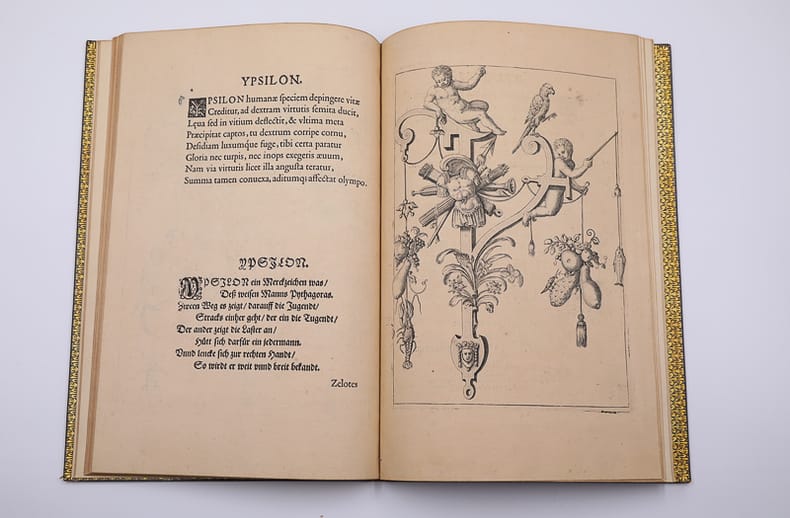
1595bf5572Fr. ad Moe Relié 1595 EDITION ORIGINALE DES PLUS RECHERCHEES. Nova alphati effictio historiis ad singulas literas correspondentibus, et toreumate Bryanæo artificiose in æs incisis illustrata : Versibus insuper Latinis et Rithmis Germanicis non omnino inconditis. Nejw kunstliches Alphabet, gezirt mit schonen Figurn deren jede sich auff seinen Buchstaben acconmodirt ; artlich in kupffergestochen, durch die Bryen, Auch mit Lateineschen Versen und teutschen Reimen lustig beschrieben. Fr. ad Moe. [Francfort-sur-le-Main]. 1595. In-4 (28 x 19 cm). Titre-frontispice, (2) ff. [Dédicace et préface], (24) planches gravées avec le texte latin et allemand imprimé sur la page en regard : plein maroquin havane janséniste, dos à six nerfs, dentelle intérieure et tranches dorées. (Trautz-Bauzonnet). Édition originale, des plus recherchées, du somptueux alphabet des frères de Bry. Jean Théodore (Strasbourg 1561-1623 Francfort), graveur, dessinateur et éditeur, travailla, en association avec son frère, Jean Israël (1565-1609), dans l’imprimerie familiale de Strasbourg fondée par leur père, Théodore de Bry (Liège 1528-1598 Francfort), dessinateur, graveur et éditeur protestant. Remarquable suite de vingt-quatre planches, finement gravées sur cuivre, figurant vingt-quatre lettres richement ornées inspirées de la Bible : Adam, Caïn, David, Goliath, Holopherne, Judith, Luc, Moïse, Noé, Pierre, Roboam, Salomon, Thomas, Vrias, Xhristus, etc. Les personnages représentant l’occurrence sont agrémentés de fruits, animaux, objets et angelots. En regard, le texte en latin et allemand avec lettrines ornées. Seconde émission avec le texte en allemand. Merveilleux recueil et bel exemplaire dans une élégante reliure en plein maroquin de Trautz-Bauzonnet, conçue vers 1860, avec quelques très minimes frottements d’usage. Provenances : Bibliothèque d’Edmond Foulc (1826-1916), avec son ex-libris, remarquable collectionneur d’art et de recueils d’estampes d’architecture et d’ornements. Un second ex-libris, sous forme de carré magique, révèle le nom de Jules Riollot, ingénieur spécialiste de l’étude de ces carrés. Livraison a domicile (La Poste) ou en Mondial Relay sur simple demande.
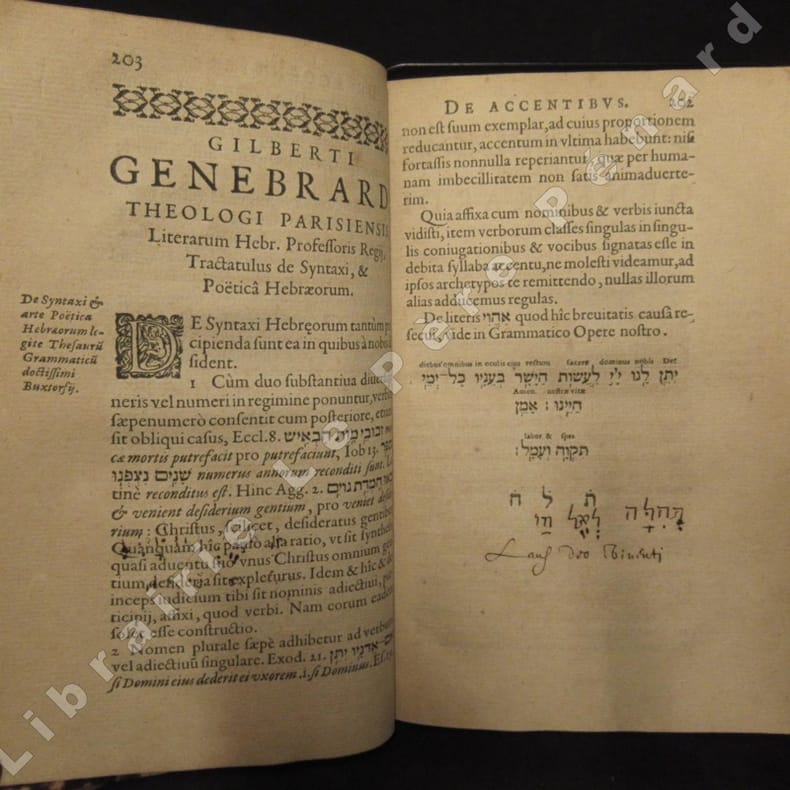
Due volumi legati insieme. In-8°, (15x10.5), (3), 104; (3), (16), legatura in piena pelle coeva, con decorazione a filetti in nero su entrambi i piatti, con decorazioni in oro agli angoli e al centro, e iniziali (BB) su entrambi i piatti. Dorso restaurato con nervature e due decorazioni floreali. Capilettera incisi, marca tipografica in fine. Due rarissime grammatiche ebraiche del Cinquecento, appartenute ad un mercante lucchese in Francia di quel periodo, Bartolomeo Balbani, le cui iniziali (BB) sono impresse sui piatti della legatura, con la sua firma sul frontespizio. Two books in one. In-8 °, (15x10.5), (3), 104; (3), (16), coeval full calf binding, with black filet decoration on both plates, gilt decoration at the corners and center of both sides, initials (BB) on both plates. Back restored with bands and two floral decorations. Engraved initial letters, printer’s mark at the end. Two very rare Hebraic grammars of the sixteenth century, belonging to a merchant from Lucca, in France in that period, Bartolomeo Balbani, whose initials (BB) are imprinted on both plates of the binding with his signature on the title page.
[scaffale Q] In-4° oblungo; 20 tavole. Rara ed elegante suite completa con le venti lettere dell’alfabeto incise da I. Paulini. In pieno stile manierista, le maiuscole formate da figure di uomini, donne e satiri, campeggiano in ameni paesaggi finemente dettagliati, in cui si aprono scene tratte dalla mitologia classica, riassunte da un titolo che ha per iniziale la lettera rappresentata. Cornici architettoniche animate da grottesche, personaggi, animali e eclettici motivi ornamentali inquadrano le lettere. Unica edizione, esemplare completo a quanto risulta dalle fonti da noi consultate.
Very Good Turkish, Ottoman (1500-1928) Contemporary quarter leather bdg. Handsomely bound. Six raised bands to spine, the second compartment has the title, the fifth has "issue 1-104", and the sixth has ex-owner's name of the volume, "Semseddin" lettered gilt. Original end-papers of the period. Slightly age-toned on the lower pages, fading on extremities of boards, overall a very good volume. Folio. (41 x 29 cm). In Ottoman script (Old Turkish with Arabic letters) and Turkish with Latin letters. This folio volume consists of 104 issues of the periodical, each issue has 4 pages, which has mostly color illustrated covers as well as several b/w ones. A rare togetherness of the first 104 issues of this Turkish satirical magazine, richly illustrated with thousands of attractive illustrations and caricatures, was published in Istanbul twice a week every Wednesday and Saturday with at least four, at most eight pages, during the Letter Revolution 1928, when the transition from the Arabic alphabet to new Latin letters was ensured. The collection provides an invaluable resource, reflecting the changes in society during and after the Letter Revolution in New Turkey, 1928, placing the new Latin alphabet instead of old Arabic letters and contributing to the development of reading and writing skills of the new Turkish society, as well as "creating the basis for the rapid social evolution in the young Turkish Republic Revolution" soon after the proclamation of the Republic in 1923. The newspaper had a printing house with the same name headquartered in Bab-i Ali (The Sublime Porte of Constantinople), the place where the heart of the Ottoman press was. Burhan Cahid Morkaya left Karagöz Newspaper and founded Köroglu Newspaper in 1928 and wanted the people living in Istanbul and Anatolia to be able to read and write new letters. Indeed, during the period of its publication, Köroglu Newspaper reached the most remote corners of the New Turkish Republic with its attractive cartoons covering local and mostly international subjects. In addition to this news and cartoons, Morkaya also published Turkish reading passages with Arabic letters that were transcripted into Latin letters. Therefore, he created a great positive effect that facilitated the transition to new letters during the Turkish Alphabet Revolution. Duman 1155.
1986EXE-718Easthampton, Cheloniidae Press, 1986. In-8°, reliure de plein vélin, emboîtage de toile (Gray Parrot). Illustré de 26 gravures sur bois par Robinson et de 26 lettrines par Suzanne Moore. Tiré à 231 exemplaires, l’un des 26 de tête sur papier de Rives, signé par Alan James Robinson, contenant les lettres et noms des oiseaux à l’encre par Suzanne Moore. Cet exemplaire est bien complet de la suite de toute les gravures signées par Robinson, ainsi que d’une encre originale d'un Jacanidae, pour la lettre J. Par ailleurs, il contient aussi la suite des lettres embossées.
18501716331850. ALPHABET. ALPHABET OF EXERCISES. Alphabet gymnastique. 72 pp. including 4 b&w plates of engravings in intaglio. 158 x 102 mm. red morocco boards. Paris: Locard-Davi 1850. A delightful alphabet with charming plates showing children participating in various passtimes noy all of them seeming to require physical energy.A few marginal paper repairs but overall a pleasing copy of a very rare book. OCLC lists Southern Mississippi and 3 in Europe hardcover
1999BB078<p>ABC</p><p><b>ERNI</b> Hans 1909–2015:</p><p><b><i>Alphabet Anthropomorph</i></b> <i>Anthropomorphic Alphabet</i>. </p><p>Luzern Michael Duplain and Nicolas Chabloz Printers 1998-1999. </p><p>With 26 engravings in black and 24 printed in color illustrating letters of the alphabet formed by entwined nudes. Pages bound in leporello-style pages with printed letterpress by Roland Meuter Ascona. </p><p>Two volumes bound in complimentary two-color inlay leather packaged with the actual copperplate for printing Letter "C" engraved at the Atelier de Talle-Douce Pietro Sarto St-Prex the whole encased in protective leather and cloth clamshell box Numbered and Signed by the artist in limited edition # 3/26 C</p><p>Additional tirage: 5 copies A-E plus 3 artist copies.</p> Michael Duplain and Nicolas Chabloz, Printers hardcover books
BB078<p>ABC</p><p><b>ERNI</b> Hans 1909–2015:</p><p><b><i>Alphabet Anthropomorph</i></b> <i>Anthropomorphic Alphabet</i>. </p><p>Luzern Michael Duplain and Nicolas Chabloz Printers 1998-1999. </p><p>With 26 engravings in black and 24 printed in color illustrating letters of the alphabet formed by entwined nudes. Pages bound in leporello-style pages with printed letterpress by Roland Meuter Ascona. </p><p>Two volumes bound in complimentary two-color inlay leather packaged with the actual copperplate for printing Letter "C" engraved at the Atelier de Talle-Douce Pietro Sarto St-Prex the whole encased in protective leather and cloth clamshell box Numbered and Signed by the artist in limited edition # 3/26 C</p><p>Additional tirage: 5 copies A-E plus 3 artist copies.</p> Michael Duplain and Nicolas Chabloz, Printers hardcover
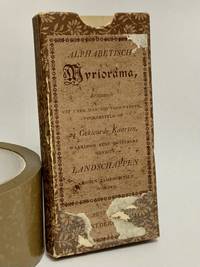
32228Amsterdam: Gebrodeders van Arum n.d. c.1825 . 16mo. hand-coloured engraved myriorama alphabet comprising 24 pictorial cards with numbers beneath the pictures 1-24 and A-Z in upper and lower case to each card. The cards are housed in a card slipcase with decorative floral paper covering and printed paper label; occasional light foxing to some cards light wear to extremities of the slipcase with loss to lower portion and upper corner of the printed title label light loss to marbled paper covering of case in a couple of places a very good example of this rare set. “An exceptional early Picture Alphabet that completely focused on both extramural reading and fun for the child.” Buijnsters :Lust En Leering. History of the Dutch children's book in the nineteenth century. Myriorama or ‘Many Thousand Views’ consist of numerous cards depicting fragments or segments of landscapes people and buildings that can be arranged in a multitude of different combinations allowing a child to create a variety of imaginary landscapes. This ‘entertainment’ for ‘young ladies and gentlemen’ originated in France but was quickly adopted in other European countries. From wikipedia: Myriorama originally meant a set of illustrated cards which 19th century children could arrange and re-arrange forming different pictures. Later in the century the name was also applied to shows using a sequence of impressive visual effects to entertain and inform an audience. The word myriorama was invented to mean myriad pictures following the model of panorama diorama cosmorama and other novelties. These were all part of a wider interest in viewing landscape as panorama and in new ways of presenting "spectacular" scenes. The early myrioramas were cards with people buildings and other images on compatible backgrounds and could be laid out in any order allowing a child to create a variety of imaginary landscapes. Jean-Pierre Brès a French children's writer published an early version which he described as a polyoptic picture tableau polyoptique in the early 19th century and John Clark of London took up the idea and designed a set of cards he called a myriorama. Clark's "second series" myriorama an "Italian landscape" was produced in 1824 the same year as a similar set of English cards called a panoramacopia created by drawing teacher T.T.Dales. Amsterdam: Gebrodeders van Arum, n.d. (c.1825) unknown
Very Good Serbo-Croatian Paperback. Roy. 8vo. (23 x 15 cm). In Aljamiado (Serbo-Croatian in Arabic letters), Arabic, and Persian with an introduction in Arabic. The third revised edition of the Waqf Directorate in Sarajevo. 104 p., 4 unnumbered b/w plates. "Ilmihal" [i.e. Catechism] recommended to all who want to know and learn Islamic ceremonies and practice. Learn how to pray, what are basic principles of the Islamic faith, what are the Islamic duties, what are the Islamic holidays, what constitutes proper Islamic behavior, and lots more. This extremely rare catechism book printed in Sarajevo in Croatian with Arabic letters (Aljamiado). This book is one of the late examples of Aljamiado literature beginning in early Andalusia and constitutes one of the rarest examples of the Ottoman book tradition. Aljamiado or Aljamía texts are manuscripts that use the Arabic script for transcribing European languages, especially Romance languages such as Mozarabic, Portuguese, Spanish or Ladino, and Bosnian with its Arebica script. According to Anwar G. Chejne, Aljamiado or Aljamía is "a corruption of the Arabic word ?ajamiyah (in this case it means foreign language) and, generally, the Arabic expression ?ajam and its derivative 'Ajamiyah are applicable to peoples whose ancestry is not of Arabian origin". During the Arab conquest of Persia, the term became a racial pejorative. In linguistic terms, the Aljamía is the use of the Arabic alphabet to transcribe a Romance language. It was used by some people in some areas of Al-Andalus as an everyday communication vehicle, while Arabic was reserved as the language of science, high culture, and religion. The systematic writing of Romance-language texts in Arabic scripts appears to have begun in the fifteenth century, and the overwhelming majority of such texts that can be dated belong to the sixteenth century. A key aljamiado text was the mufti of Segovia's compilation Suma de los principales mandamientos y devediamentos de nuestra santa ley y sunna, of 1462. In later times, Moriscos were banned from using Arabic as a religious language and wrote in Spanish on Islamic subjects. Examples are the Coplas del alhichante de Puey Monzón, narrating a Hajj, or the Poema de Yuçuf on the Biblical Joseph (written in Aragonese). Aljamiado played a very important role in preserving Islam and the Arabic language in the life of the Moriscos. After the fall of the last Muslim kingdom on the Iberian peninsula, the Moriscos (Andalusian Muslims in Granada and other parts of what was once Al-Andalus) were forced to convert to Christianity or leave the peninsula. They were forced to adopt Christian customs and traditions and to attend church services on Sundays. Nevertheless, some of the Moriscos kept their Islamic belief and traditions secretly through the usage of Aljamiado. In 1567, Philip II of Spain issued a royal decree in Spain, which forced Moriscos to abandon using Arabic on all occasions, formal and informal, speaking and writing. Using Arabic in any sense of the word would be regarded as a crime. They were given three years to learn the language of the Christian Spanish, after which they would have to get rid of all Arabic written material. Moriscos translated all prayers and the sayings of their prophet Mohammed into Aljamiado transcriptions of the Spanish language while keeping all Qur'anic verses in the original Arabic. Aljamiado scrolls were circulated amongst the Moriscos. Historians came to know about Aljamiado literature only in the early nineteenth century. Some of the Aljamiado scrolls are kept in the Spanish National Library in Madrid. The word aljamiado is sometimes used for other non-Semitic languages written in Arabic letters. For example, Bosnian and Albanian texts written in Arabic script during the Ottoman period have been referred to as aljamiado. However, many linguists prefer to limit the term to Romance languages, instead of using Arebica to refer to the use of Arabic script for Slavic languages... Not in OCLC.
Very Good French Original wrappers. Demy 8vo. (22 x 14 cm). In French. 33, [1] p., tables, and plates. First and only edition of this extremely rare treatise on How Kufic script is applied to print, a brief history of Kufic script, its use in ancient and modern times, examples of writing accompanied by illustrations, typesetting on the keyboard for linotype printing, its use on typewriters, its use in telegraphy (with Arab and international typesettings), etc. Ali Kenan (?-1962), married Emine Nemika Sultan (1888-1969) in 191 and became a groom to the Ottoman palace and the royal family. Only one copy can be traced in OCLC 1065045158, in The British Library, St. Pancras.
Very Good Bulgarian Original blue cloth bdg. with embossing. Slightly stains on boards and toned on pages. Otherwise a very good copy. 12mo. (16,5 x 12 cm). In Bulgarian. 1230, [2] p. [HOLY BOOK IN BULGARIAN PRINTED IN TSARIGRAD (CONSTANTINOPLE)] Bibliia sirech sveshtenoto pisanie na Vetkhiia i Noviia zavet: Viarno i tochno prevedena ot pûrvoobraznoto. [.] In 1840 5,000 copies of the first complete translation of the New Testament were printed in Smyrna by the British and Foreign Bible Society. A second edition which was printed in Smyrna in 1850 was an almost exact reprint of the 1840 edition. A third edition followed in 1853 with 15,000 copies. The fourth edition was published in 1857 in Bucharest, and for the first time civil characters type was used. In 1859, two more editions were published. In 1866, a new "pocket" edition with text revised by Elias Riggs and Dr. Albert Long was printed in Constantinople. The New Testament was revised and reprinted a total of nine times. In the period from 1840 to 1860 the Eastern (Tarnovo) dialect was adopted as literary Bulgarian language and the Macedonian dialect, in which the New Testament had been translated, was widely rejected. By 1858 Neofit Rilski had finished large portion of the Old Testament. Riggs met with Neofit Rilski and discussed a possible revision of the Bulgarian New Testament to remove the Macedonian dialect elements. Neofit objected the revision, so Riggs took the translation and returned to Constantinople. In January 1859 Riggs invited the Bulgarian teacher Hristodul Kostovich to help him with the revision. In 1862 Long and Riggs visited the noted Bulgarian writer and poet Petko Rachov Slaveykov in Tryavna. Slaveykov agreed to help with the translation and began the work on the revising of Neofit's New Testament at once. Long joined the revision of the New Testament into the Eastern dialect in 1863 and later assisted with the translation of the Old Testament. In June 1871, after more than 12 years of revision and translation, 36,000 copies of the complete Bible translation in Bulgarian were published in Constantinople. The translation came to be known as the "Tsarigrad (Constantinople) Edition". Tsarigrad [or; Tsargrad, Tzargrad, Czargrad] Tsargrad is a Slavic name for the city or land of Constantinople, the capital of the Eastern Roman (Byzantine) Empire, and present-day Istanbul in Turkey. A physical copy of this edition is not located in OCLC. For digital register: OCLC 181122059.
In 4°, pp. (16), al frontespizio marca tipografica e fregi incisi su legno, grande capolettera inciso su legno. Legatura in cartonato moderno. Prima edizione. Camozzi (1515-1581) fu maestro di retorica a professore di filosofia a Bologna. Sembra che per la sua conoscenza di lingue orientali venne in fine incaricato a Roma di tradurre i testi dei Padri greci; tradusse anche Aristotele. In questa orazione ripercorre una storia dell’uso delle lettere dalle origini. Ascarelli p. 44.
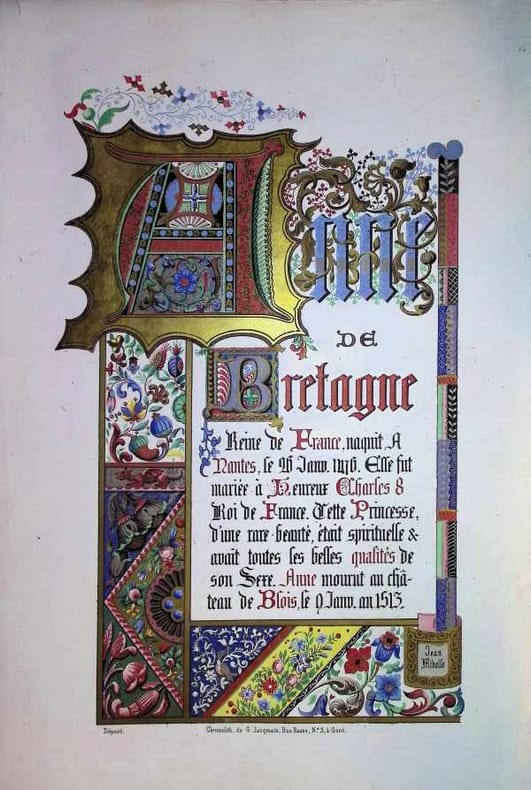
1846029497Gand 1846 G. Jacqmain, No Binding 1st Edition
1932vd1298Editions Antoine Roche Coups de coeur de Bernard Cartonnage d'éditeur 1932 Un des plus célèbres abécédaires photographiques, réalisé par Emmanuel Sougez (1889-1972) en 1932. Formé aux Beaux-arts de Bordeaux, il fut le directeur des services photographiques de L’Illustration, dès leur création en 1926, et une figure majeure de la photographie des années trente, refusant truquages et photomontages, seul l’art du photographe comptait. Vingt-six clichés noir et blanc reproduits en héliogravure par Aulard & Cie et tirés sur papier fort. Une double page par lettre, à droite, un cliché d’art simple et réaliste et, à gauche, l’initiale en rouge sous deux formes typographiques et la légende de la photo en trois langues : français, anglais, allemand. Petit in-8 (17 x 18,3 cm). (54) pp. : couvertures cartonnées souples, dos rouge, clichés noir et blanc de cubes avec leurs ombres sur les deux plats ; Frottements sur les couvertures et petit manque en pied du dos. Exemplaire de la collection Bernard Farkas. Livraison a domicile (La Poste) ou en Mondial Relay sur simple demande.
In -folio, 2 voll., pp. (4), VIII, 1-224, (2), 223-244, 70 tavv. a colori; (4), XLIX, 464, tela con tassello e titolo al dorso. Sontuosa edizione completa di 70 litografie che riproducono, a colori, il cosiddetto “Codice Troano”, uno dei pochi manoscritti superstiti della lingua maya. Si tratta di uno dei primi cospicui tentativi di decodificare la scrittura della civiltà precolombiana: Brasseur (1814-1874) vi si dedicò per oltre cinque anni con passione, diligenza e competenza ma, purtroppo, partendo dallo sbagliato presupposto che i codici riproducessero un alfabeto fonetico, convinzione che derivava da un metodo cinquecentesco messo a punto da Diego de Landa, monaco spagnolo che sarebbe diventato vescovo dello Yucatàn. La tavola comparativa tra alfabeto latino e caratteri maya era inaffidabile. In base alla decrittazione di questo codice, fra l’altro, si ipotizzò la suggestiva descrizione del continente perduto di Mu, mitica terra collocata nel Pacifico. Il lavoro di Brasseur avrebbe avuto un corso scientifico molto limitato, e la sua teoria fu smentita entro la fine del secolo, ma una serie di miti costruiti sulle sue presunte scoperte, fra tutti proprio quello della terra di Mu, hanno avuto corso fino a oggi in ambito parascientifico e in numerose suggestioni letterarie. La pubblicazione fa parte di una serie di opere commissionate da Napoleone III (“Mission scientifique au Méxique”) intese allo studio del Sud America. A luxury edition, complete of 70 lythographies reproducing, in colors, the so said “Troano codex”, one of the few manuscripts survived to Maya civilization’s destruction. This is one of the first attempts to decipher their writing: Brasseur (1814-1874) studied the matter for five years but he was wrongly convinced that the codex was reproducing a phonetic alphabet. The myth of “Mu” land results from this erroneus interpretation. The publication is part of a collection of works about South America commissioned by Napoleon the III.
192524660Paris La Cit des Livres 1925 26 volumes in-8 carr, bradel demi-maroquin havane, plats de papier marbr ocre; doublures et gardes de papier ocre, ttes dores, non rogns, couvertures imprimes. Etui (M.P. Trmois).Edition originale de cet ensemble de 26 textes classs selon l'ordre alphabtique des auteurs. Tirage limit 495 exemplaires numrots. Exemplaire non numrot sur verg d'Arches.
In-8 p., legatura edit. in marocchino oasis marrone, sigla in oro al piatto anter., astuccio con cuffia in pelle, pp. 128,(4), disegno nello stile di Feliciano nel frontespizio in rosso e giallo, con figure nel t. e 5 tavv. di iscrizioni f.t., riprodotte in calcografia. Trattato sulla costruzione geometrica dell’alfabeto maiuscolo romano (ca. 1460) di Felice Feliciano veronese, dal Codice Vat. Lat. 6852, con le 25 maiuscole in facsimile colorate a mano a due colori da Ameglio Trivella e a fronte la loro costruzione. Cfr. Mardersteig,122: “L’"Alphabetum Romanum" del Feliciano venne pubblicato in lingua italiana, inglese e tedesca: l’introduzione e le note bibliografiche di Giovanni Mardersteig sono state tradotte in italiano da Oreste Ferrari”. Tiratura di 160 esempl. numerati, su carta a mano Magnani. Solo i primi 50 sono rilegati in p. marocchino. Il ns., 8, è in ottimo stato.
1901wq668Édition du Conservatoire de la tradition populaire. Anvers Broché 1901 Rare tirage de tête dont les gravures sur bois, mises en couleurs, sont réalisées sur une face des feuillets de papier Hollande. In-4 (26,8 x 21,2 cm). 58 feuillets. Abécédaire entièrement orné, dessiné et gravé par le poète symboliste belge Max Elskamp (1862-1931). Tirage limité à 215 exemplaires : 5 sur Japon, 10 sur Chine, 100 sur Hollande et 100 sur vélin. Un des rares exemplaires sur Hollande n° 58. Est jointe, une lettre de l’éditeur G. Van Oest de Bruxelles, datée du 6 juin 1921, adressée à un ambassadeur et relative au livre dont Elskamp vient de retrouver deux exemplaires ; dos jauni, couverture légèrement salie, intérieur très frais, bon exemplaire. Livraison a domicile (La Poste) ou en Mondial Relay sur simple demande.
1679PHO-1772Paris, Dezallier, 1679, 2 volumes in-4 ,28ff.-686pp., 22ff-648pp , relié plein cuir époque, dos à nerfs orné avec pièce de titre et tomaison, tranches mouchetées rouge, réparations aux dos, pièces de titre et tomaison récentes au tome, illustré de 6 cartes dépliantes (7), ex-libris manuscrit en page de garde et au titre, traces de réparation aux cartes.
16211162551621 Lutetiae. Ex officina & Typis Gulielmi Lebe - CI . I C. XXI (1621) - In-12, demi-basane brune (reliure postérieure), faux-nerfs, filets et titre en doré au dos - 247 pp. - Ouvrage en latin
19431699691943. ALPHABET. ABÉCÉDAIRE du Marechal Petain. 28 ff. illustrated throughout. Square 8vo 140 x 140 mm. original illustrated wrappers in a new linen box with black label. n.p.: Bureau de Documentation du Chef de l'Etat 1943. One of the strange alphabets but a perfect insight into the creation of Petain as saviour of France. A rare little book. OCLC lists just 3 copies all in France. unknown
1925EXE-57Paris, La Cité des Livres, Imp. Ducros et Colas, Paris, 1925-1927. 26 volumes in-12 carré. Édition originale.
183612306Paris, Se vend à la fabrique de jeux Instructifs et Amusants, [Amonier], [Circa 1836]. 22,5 x 16 x 2,8 cm. Boite compartimentée en carton aux bords recouverts de papier jaune et noir décoré de petits motifs en rouge et blanc, couvercle ajouré avec une plaque de verre, frise gaufrée et dorée en encadrement (avec manques).
1685T77109[Paris], [1685] [ii] + 16pp. + 153 [154] engraved pages with 15 emblems per page engraved by N.Verien + 24pp. de tables, 1st edition, titlepage is missing, 20cm., cart.cover (marbled plates, spine in leather with gilt title and decorations), marbled endpapers, occassional small stains at pages, Good copy, scarce, T77109, [Detailed content: 2 pages of author's dedication to "Monsiegneur le Dauphin", 16 pages of text: "Explication alphabetique des médailles ou figures hieroglyfiques du Livre second", 154 pages of engravings and 24 pages of tables], This book concerns only the second section of the work [the first section is: "Emblemes et devises latines, espagnoles et italiennes livre premier", the third one is: "Supports et cimiers pour les ornemens des armes. livre troisième". The work has been reprinted in 1696 and 1724 under the title "recueil d'emblemes"]