SYLVESTRE DE SACYLivre Rare Book
5 131 résultats
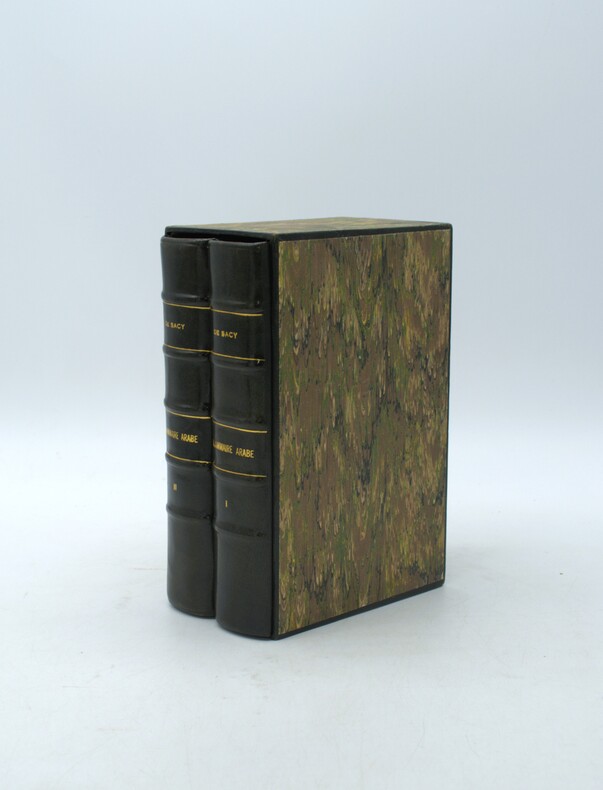
1810PHO-2229Paris, Imprimerie impériale, 1810, 2 volumes in-8 (22,5x15,5cm), xxvi-434pp.-1f (catalogue), x-473pp.-1f (catalogue suite). Demi chagrin et coins moderne dans un coffret, dos à nerfs avec auteur, titre et tomaison, brunissures sur les premières et dernières pages, travail de vers sur les 3 premiers feuillets de chaque tome renforcé, petit travail de ver en pied. Complet de ses 10 tableaux dont 9 dépliants, manque les 8 gravures de lettres arabes
1775JC11027France c. 1775. Hardcover. Very Good. Manuscript on paper in French. Written in brown ink in a neat script with a calligraphic title and headings in clear majuscules. Title page inscribed: Catalogue alphabétique dun grand nombre de mot homonyme de la Langue française; cest-à-dire des mots qui se prononcent ou sécriven de la meme manière ou à-pereprès mais don la signification est differente. Extrait de Dictionnaire de mots homonymes. France: c. 1775. 4to 205 x 170mm. 230pp. recto and verso. Original mottled sheep spine gilt with red morocco label marbled endpapers edges stained red; cover slightly warped spine lightly rubbed with small hole near head otherwise good. Once part of the dictionary collection of Thomas Malin Rodgers Jr. <br/><br/>Descriptions of homonyms were published in books on French grammar since the 17th-century. The issue of disambiguation in the field of semantics or the so-called qualified ambivalences were appointed within this body of knowledge and refined over several years of lexicology study. The first dictionary of homonyms of the French language was the Dictionnaire des mots homonymes de la langue françoise 1775 by Pierre Thomas Nicolas Hurtaut and published in Paris. By the title of this manuscript we can surmise that this manuscript quotes a number of key examples from his publication. This handwritten exercise and the resulting grammar book would have been destined for students in secondary education who at the time were learning the semantics of speech in their native tongue and learning how to write them correctly as homonyms can be quite confusing. Some common French homonyms with the largest variance of meaning are and eau au aux haut os ô pp. 65-67 and ver verre vers vert vair pp. 224-225. The ambiguity of such words was tackled by classifying them into word collections and alphabetical lists all echoed in this careful undertaking. This manuscript dates to a time when there was a distinct emergence of European linguistic terminology and great interest in collecting such recorded knowledge. hardcover
1775JC11027France c. 1775. Hardcover. Very Good. Manuscript on paper in French. Written in brown ink in a neat script with a calligraphic title and headings in clear majuscules. Title page inscribed: Catalogue alphabétique dun grand nombre de mot homonyme de la Langue française; cest-à-dire des mots qui se prononcent ou sécriven de la meme manière ou à-pereprès mais don la signification est differente. Extrait de Dictionnaire de mots homonymes. France: c. 1775. 4to 205 x 170mm. 230pp. recto and verso. Original mottled sheep spine gilt with red morocco label marbled endpapers edges stained red; cover slightly warped spine lightly rubbed with small hole near head otherwise good. Once part of the dictionary collection of Thomas Malin Rodgers Jr. <br/><br/>Descriptions of homonyms were published in books on French grammar since the 17th-century. The issue of disambiguation in the field of semantics or the so-called qualified ambivalences were appointed within this body of knowledge and refined over several years of lexicology study. The first dictionary of homonyms of the French language was the Dictionnaire des mots homonymes de la langue françoise 1775 by Pierre Thomas Nicolas Hurtaut and published in Paris. By the title of this manuscript we can surmise that this manuscript quotes a number of key examples from his publication. This handwritten exercise and the resulting grammar book would have been destined for students in secondary education who at the time were learning the semantics of speech in their native tongue and learning how to write them correctly as homonyms can be quite confusing. Some common French homonyms with the largest variance of meaning are and eau au aux haut os ô pp. 65-67 and ver verre vers vert vair pp. 224-225. The ambiguity of such words was tackled by classifying them into word collections and alphabetical lists all echoed in this careful undertaking. This manuscript dates to a time when there was a distinct emergence of European linguistic terminology and great interest in collecting such recorded knowledge. hardcover books
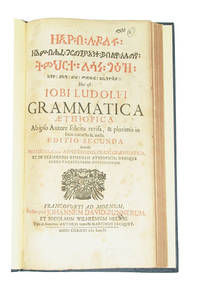
170231267Frankfurt am Main Apud Johannem David. Zunnerum et Nicolaum Wilhelmum Helwig1702. Small folio. Very nice recent blue hcalf w. gilt lettering on spine. Title-page printed in red and black w. woodcut vignette and stamp: "Jews college London". Some brownspotting but all in all a very nice copy. 12 184 8 Index pp. <br/><br/><em>Second edition of Ludolfus' groundbreaking Ethiopian Grammar. The German Job Ludolf was the first to bring the study of Etiopian subjects into a system and his present work is the first of its kind to see the light of day. It was unusal for the time to take up the study of something like the Ethiopian laguage and after Ludolfus' important philological works followed a long period of neglect which did not end till the second half of the nineteenth century when these studies were finally resumed causing them to flourish. Brunet III pp. 1223. </em> unknown
170231267Frankfurt am Main, Apud Johannem David. Zunnerum et Nicolaum Wilhelmum Helwig,1702. Small folio. Very nice recent blue hcalf w. gilt lettering on spine. Title-page printed in red and black, w. woodcut vignette and stamp: ""Jews college, London"". Some brownspotting, but all in all a very nice copy. (12), 184, (8) (Index) pp.
15741124921574 Genevae (Genève), Apud Eustathium Vignon (Eustache Vignon), 1574, 1 volume in-4 de 180 x 250 mm environ, (12) ff. (page de titre, Epistola, Praefatio), 440 pages, écrit en latin avec un sens de lecture de la gauche vers la droite mais texte imprimé et paginé de la droite vers la gauche. Plein vélin souple d'époque au dos muet, traces de lien. Reliure en état d'usage (quelques taches sur les plats et une étiquette papier collée sur le plat supérieur, un coin plié), tampon de bibliothèque répété, annotations à l'encre pages 40-41-57-59, légères traces de mouillures aux coins d'une dizaine de feuillets, plus importantes sur 7 feuillets (p.195 à 208), discrets trous de vers, déchirure marginale sans atteinte au texte p. 304. Bel état pour cet ouvrage d'érudition rare.
1861PHO-564
In-8°, (6), 447, (22), legatura in pergamena coeva, tracce di titolo manoscritto al dorso, buone condizioni. Si tratta della prima ed unica edizione del glossario latino-arabo-siriaco di mons. Tommaso Obicini da Novara basata su quello dello studioso Elias Barsinaeus (Elias bar Shinaya) metropolita di Nisibi. Obicini, già abate del convento francescano di Aleppo venne eletto Custode di Terra Santa e Commissario Apostolico per tutto l’Oriente nel 1620. BM-STC 624. Smitskamp 223. Schnurrer 63. Fück 77. Zaunmüller 372. Vater/Jülg 24. Graesse V, 1. Ebert 14920. In-8 °, (6), 447, (22), contemporary vellum binding, traces of a handwritten title on the spine, good condition. This is the first and only edition of the Latin-Arabic-Syriac glossary of Msgr. Tommaso Obicini da Novara based on that of the scholar Elias Barsinaeus (Elias bar Shinaya) metropolitan of Nisibi. Obicini, former abbot of the Franciscan convent of Aleppo, was elected Custodian of the Holy Land and Apostolic Commissioner for the whole East in 1620. BM-STC 624. Smitskamp 223. Schnurrer 63. Fück 77. Zaunmüller 372. Vater / Jülg 24. Graesse V , 1. Ebert 14920.
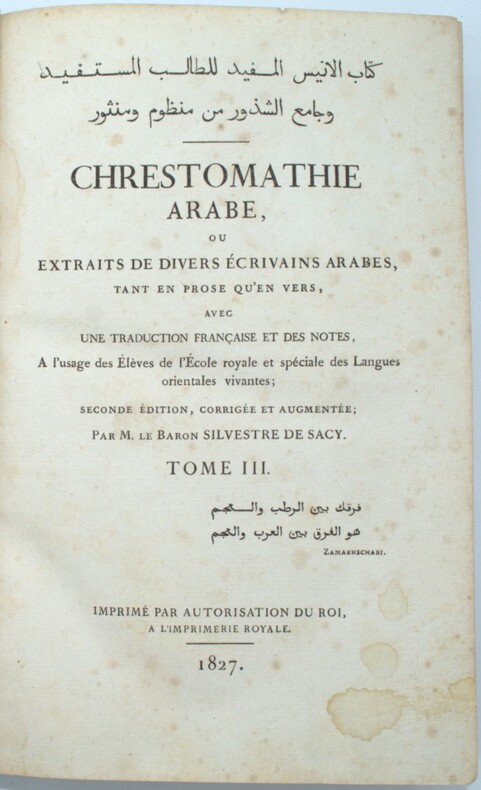
1826PHO-1339Paris, Imprimerie Royale, 1826-1827. 2 volumes grand In-8°(sur 3 , manque tome 1), de VII, 577pp. ; VIII, 596 pp. , demi-chagrin , dos ornés avec auteur ,titre et tomaison , initiale en pied , plat frottés , coins usés , pages de garde brunies , tache au titre (tome 2).
First edition, 8vo (230 x 145 mm), vii, [2], vi-xxviii, 427, [1]pp., some light spotting, rebound in half calf, marbled boards, spine gilt, morocco title label. William Yates (15 November 1792 - 3 July 1845) was an English Baptist missionary and orientalist. After joining the Baptist Missionary Society he sailed for India and arrived in Calcutta in 1815. From there "He continued to Serampore to join William Carey (1761?1834), who had been sent out by the same society in 1792, and under his direction began to study Sanskrit and Bengali. Almost immediately he began to help with the mission's publications."?(Oxford DNB.)
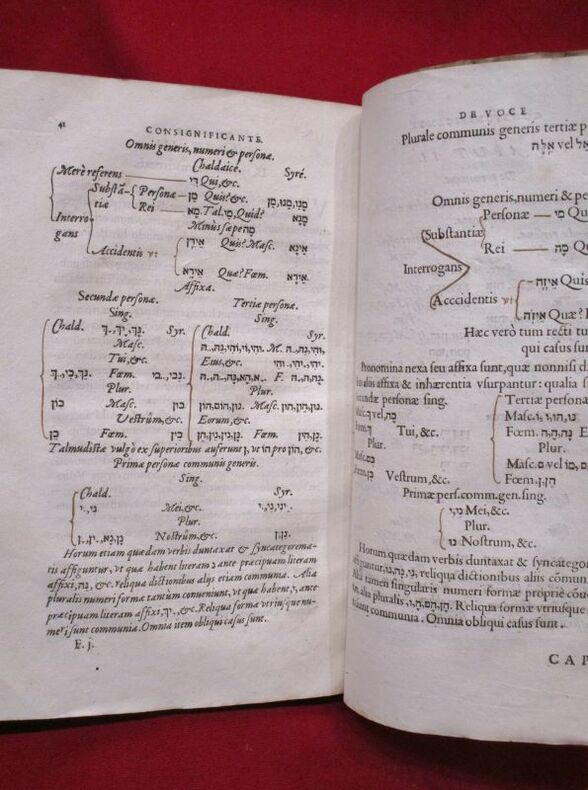
In-4°; Edizione originale rara; frontespizio entro cornice incisa su legno e marca tipograica; l’opera è preceduta da un capitolo sull’alfabeto greco e sulla pronuncia, e si chiude con “De dialectis ex Corintho”, “Diferentiae dictionumob accentum”, “De verbis anomalis” e altre note di grammatica. legatura XVII sec. in piena pelle con fregi e tassello con titolo in oro al dorso, tagli in rosso. Alle ultime carte lieve gora di umidità al margine interno.
FOUR VOLUMES BOUND TOGETHER. RARE Italian translation of the Hebrew Bible, mostly executed in 1858-1860 by Samuel David Luzzatto (1800-1865), the preeminent Italian Jewish scholar and poet, and finished by Abram Mainster, Eude Lolli, Filosseno Luzzatto; Moses Levi Ehrenreich, Jacob Vita Pardo, David Graziadio Viterbi, Marco Mortara, and Foà. 225x145mm. [VIÌ+323] + [264] + [306] + [387] pages. Black cloth Hardcover with sticker on spine. Cover slightly rubbed. Cover corners and edge rubbed. Spine wrinkled. Title-sticker wrinkled and slightly peeling/worn. Spine edges slightly peeling. Two stamps (Comunita Israelita Trieste) on front endpaper. Ink writing and stamp on front whitepage (pre-title page). Pages slightly yellowing and age-stained. [SUMMARY]: This extremely rare copy of the unique translation of the Old Testament from the original Hebrew into Italian by one of the most influential members of the "Wissenschaft des Judentums" movement is in good condition. PLEASE NOTE: This item is overweight. We may ask for extra shipping costs.
168556729Kiøbenhaffn Bockenhoffer 1685. Lille 8vo. Samtidigt helpergament. Lille stempel på titelbladet. 1411682 pp. Enkelte gl. tilskrifter og understregninger. Et par ark svagt bruntonede men et velbevaret eksemplar. <br/><br/><em>Originaludgaven af den første danske grammatik skrevet på modersmålet.Thesaurus II675. - Bibl. Danica IV62. </em> unknown
168556729Kiøbenhaffn, Bockenhoffer, 1685. Lille 8vo. Samtidigt helpergament. Lille stempel på titelbladet. (14),116,82) pp. Enkelte gl. tilskrifter og understregninger. Et par ark svagt bruntonede, men et velbevaret eksemplar.
14395Genève, chez Jean de Tournes,1627, 1 plein velin d'époque, manque sur 1 coin. in-12 de 318 pp. + 40 feuillets d'index, ex-libris manuscrit, quelques rousseurs dans les marges ;
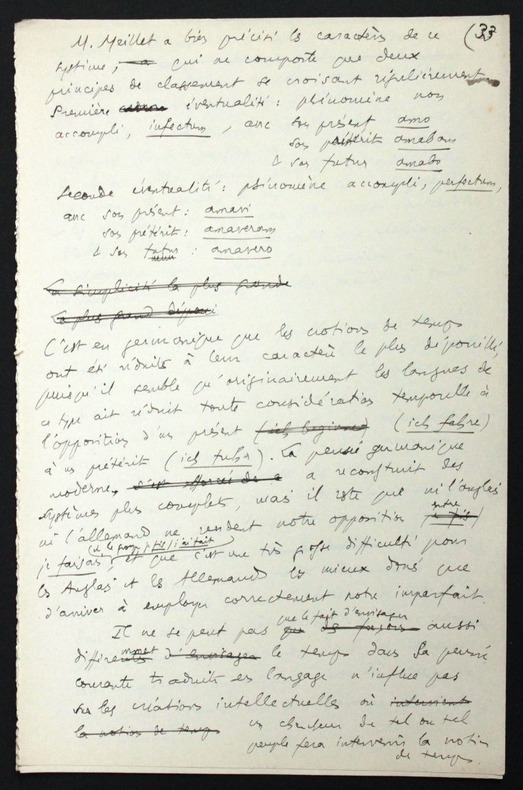
193242591932 in-4 en feuilles 38 pp. in-4, entièrement autographes, ratures et corrections.
1581X119612Witebergae [Wittenberg], Excudebant haeredes Ioannis Cratonis [Johann Krafft] 1581 [2bl.] + [16] + 447 + [1] + [4bl.] pp. [i.e. 437pp. ; page 209 jumping to p.220], engraved coat of arms at verso of title page, 2nd edition "Editio secunda diligenter recognita & aucta" (1st ed. = 1575), 17x11cm., contemporary blind-tooled vellum (intact, somewaht soiled), text is clean and bright except for few old underlinings, endpapers partly made of old manuscript excerpts, good condition, cfr. USTC 661234, X119612
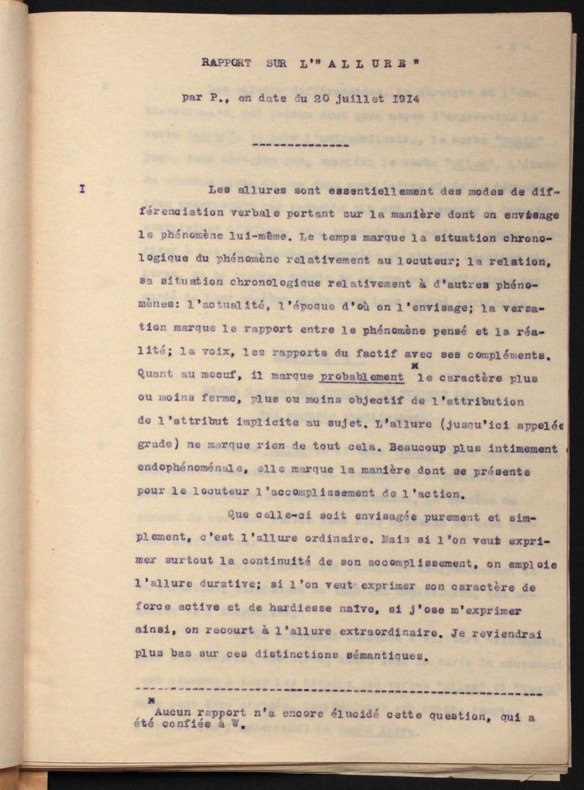
4283en feuilles A) Manuscrit : "Anecdotes vraies", 20 pp. in-4, en feuilles sous chemise (17 historiettes, non signées) ; B) Manuscrit : "De plus en plus vrai", 97 pp. in-4, en feuilles sous chemise (15 contes, certains signés "Jacques Normandin") ; C) Tapuscrit (en copie carbone) : "Tout aussi vrai qu'autre chose", 236 pp. in-4 précédées de 2 pp. in-4 manuscrites (titre et pseudonyme de l'auteur puis table des contes) en feuilles sous chemise (18 contes, certains en double, avec corrections autographes - répétées sur les doubles, la chemise porte, entre autres : "Jacques Normandin, chez M. Damourette" puis son adresse à Sarcelles) ; D) 2 pp. in-4 autographes listant les 33 contes présentés en (B) et (C) ainsi que 4 longs poèmes dont nous n'avons pas trouvé trace ; E) Manuscrit (et palimpseste) : un conte autographe à l'écriture rapide et difficilement déchiffrable, 14 pp. in-4 au verso du tapuscrit (de 25 pp.) d'un rapport sur "l'allure" (en grammaire) par son neuveu Edouard Pichon daté du 20 juillet 1914 ; F) Manuscrit : "Histoire d'un avocat...", 8 pp. autographes in-4 signées "Bindin" ; G) 4 poèmes ou chansons autographes (dont deux signés) sur 5 pp. in-4, 1 p. in-8 et 1 p. in-12.
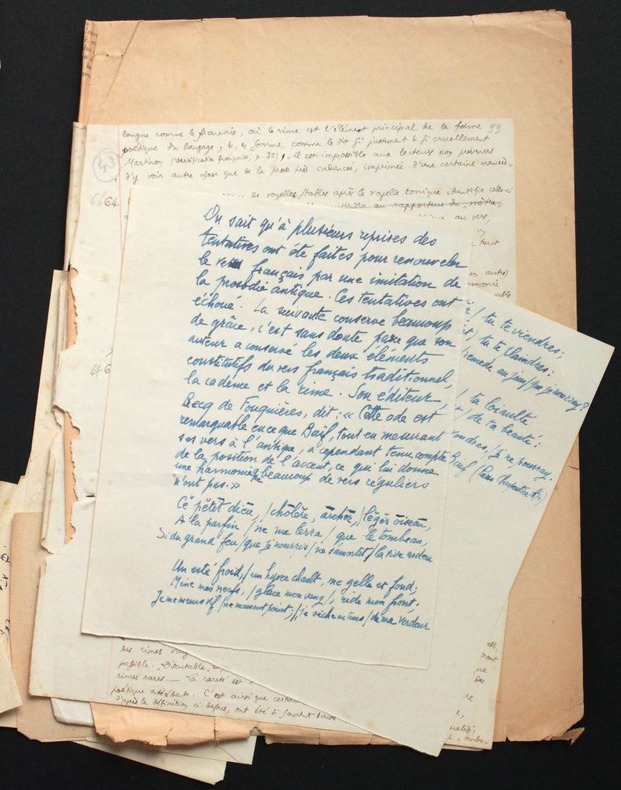
4272en feuilles 44 pp. in-4 ou in-8, souvent découpées, montées sur papier et annotées.
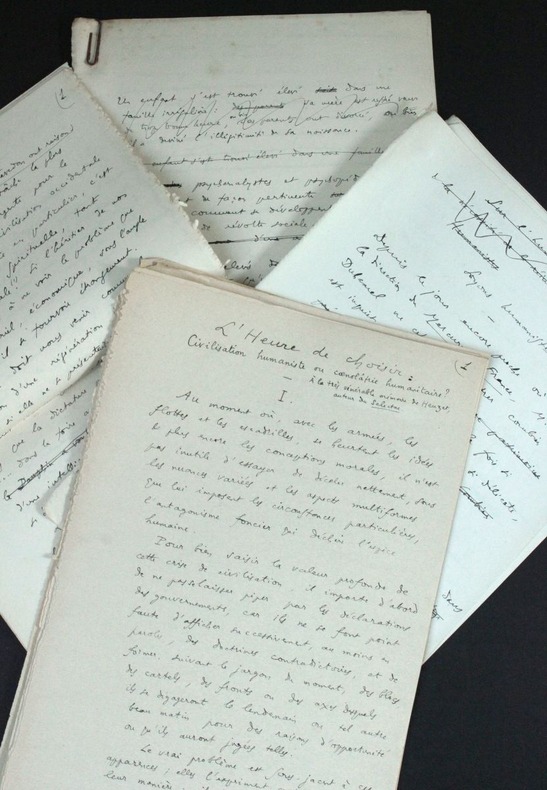
194042631940 A) "L'heure de choisir" : 15 pp. in-4, manuscrit signé, situé (Marlotte) et daté (4 janvier 1940) ; B) "Sur l'humanisme", 4 pp. 1/3 in-4 ; C) "Soyons humanistes", 2 1/2 pp. in-4 ; D) texte sans titre de 12 pp. in-4.
Very Good Hebrew Contemporary 1/4 leather bdg. Demy 8vo. (21 x 14 cm). In Hebrew with interspersed with Arabic; a preface in French. [xvi], 144 p. Goldenthal was an Austrian Orientalist; born at Brody, Galicia, April 16, 1815; died at Vienna Dec. 28, 1868; educated at the University of Leipsic. In June, 1843, he became principal of the Jewish school at Kishinef, Bessarabia, and held the office for some years. He was appointed professor of rabbinical and Oriental languages at the University of Vienna in Sept. 1849, and held the chair until his death. Upon the nomination of Hammer-Purgstall, he was elected a corresponding member of the Vienna Academy of Sciences, and member of the Asiatic Societies of Germany, of Paris, and of London. His chief literary activity consisted in editing the following manuscripts: "Mozene ?ede?," a treatise on philosóphical ethics by Al-Ghazali, translated into Hebrew by Abraham ibn ?asdai, with an introduction on the lives and works of Al-Ghazali and Ibn ?asdai, 1838. "Bi'ur ibn Roshd," Todrosi's Hebrew translation of Averroes' commentary on Aristotle's "Rhetorica," with a historical and philosophical introduction, 1842. "Mesharet Mosheh," commentary by Kalonymus on Maimonides' system of Divine Providence, with his explanation of Ps. xix. and xxxvii., 1845. "Maftea?," methodology of the Talmud by Nissim ben Jacob of Kairwan, with an introduction, notes, and references, 1847. "Mi?dash Me'a?," Moses Rieti's didactic poem on ancient philosophy and the history of Jewish literature, with an Italian and Hebrew preface, 1851 (see "Allg. Zeit. des Jud." 1859, p. 124). Goldenthal further published a catalog of Hebrew manuscripts in the Imperial Library of Vienna, 1854, and an Arabic grammar in Hebrew for the use of the Oriental Jews, with a French preface, 1857. Volume i. of the "Denkschriften" of the Vienna Academy of Sciences contains his "Beiträge zu einem Sprachvergleichenden Rabbinisch-Philosophischen Wörterbuche." He issued "Das Neue Zion," a monthly periodical, Leipsic, Nisan, 1845, of which only one number appeared. Another periodical which he edited, "Das Morgenland," was also short-lived. (Jewish Encyclopedia). In his Hebrew preface, Goldenthal notes that knowledge of Arabic is particularly important for Talmudists, illustrating his point by a passage from Rabbenu Nissim's commentary to Tractate Shabbat found in a manuscript in the Palatine Library of Vienna. (Source: K&C). First Edition. OCLC 40972030.; Friedberg M-2669.
SHL-12A Paris, Chez l'auteur, Boudet, Valleyre, Vve Duchesne, Saugrain, Ruault, 1776, in-8, demi-basane brune et papier à la colle, dos lisse à faux-nerfs filetés dorés, titre doré. Faux-titre, frontispice gravé par A. L. Romanet d’après C. P. Marillier « Mercure conduit par l'Amour, ou Invention du Langage et de l'Ecriture. », Page de titre, 400 pp, 1 tableau dépliant « Alphabet Primitif, fig. 1& 2 » et 1 Planche dépliante colorée « relative aux organes de la voix, en cinq figures…dessinées d’après nature et gravées en couleurs par M. GAUTHIER DAGOTY Père», signature gravée dans la planche. Reliure avec défauts d’usage, frottements, dos légèrement passé, en partie recollé en tête, mors supérieur fendu, coiffes et coins en bon état. Corps de l’ouvrage en très bel état : belles marges, peu ou pas de rousseurs, petites salissures dans la marge sup. du frontispice, les deux planches dépliantes en parfait état & notamment la planche colorée de M. Gautier-Dagoty aux teintes éclatantes. Edition séparée, du troisième volume « Du Monde Primitif (1773- 82, 9 vol. in-4) », augmentée de la planche colorée de Gautier-Dagoty, dont l’Explication des figures fut rédigée par M. Dessault, chirurgien à Paris. Elle est considérée comme originale car elle reparue en 1816, à Paris chez Plancher, sous le nouveau titre « Histoire naturelle de la parole, ou grammaire universelle, à l'usage des jeunes gens. Nouv. édit., avec un Discours préliminaire et des Notes par M. le comte Lanjuinais.» BRUNET II-1516 ; QUERARD II-316
21937ST-BRIEUC, L. Prud'homme -1847 & 1850 - Complet en 2 volumes In-4 carré - Reliure 1/2 chagrin - Dos à nerfs à pointillés dorés - LLXVIII-836 pages & XI-594 pages - rousseurs d'usage - Bons exemplaires
18033220563<p><em>16mo 93 x 60mm pp. 64; with engraved frontispiece; original yellow paper boards later paper reback with printed paper label to upper board.</em></p><p>Scarce work for children providing them with 'short and easy rules for attaining a knowledge of English grammar'. Although issued separately the work was also designed to be included as part of Wallis's 'Bookcase of Knowledge' which comprised ten works on a variety of subjects such as Arithmetic Astronomy Botany Geography History Mythology and Natural History all housed in a custom made miniature wooden bookcase to form a juvenile library.</p><p>'During the 1790s Ellenor Fenn was a force to be reckoned with in the promotion of what might be called home-reading-without-tears. A number of her books from this period mention or advertise boxes of letters and other equipment which were designed to help children learn through play. These experiments culminated in a series of brilliantly conceived "miniature libraries" initiated by her publisher John Marshall. They were sets of tiny books planned around themes and housed in wooden boxes whose lids were made to resemble the front of a bookcase. The first of these was actually the largest gThe Juvenile or Child's Libraryg 1799-1800 but it was quickly followed by the smaller gInfant's Libraryg 1800-1 - sixteen little books in a box - which proved to be the most popular of a whole succession of imitations . Once John Marshall had shown the way other publishers were quick to market alternatives to his Juvenile and Infant's libraries. As might be expected John Wallis with his involvement in maps games puzzles and so on was one of the foremost competitors.' Anderson & Oyens gBe Merry and Wise: Origins of Children's Book Publishing in England 1650-1850g 2006 p. 128.</p><p>In 1800 London publisher John Marshall decided that parents were not the only ones who deserved the pleasure of a book-filled library. Small children should have their own and henceforth gThe Infant's Libraryg was conceived designed and produced: John Wallis immediately copied his idea although he chose to issue the books in 1801 apparently without a wooden cabinet at first which was only supplied modelled on Marshall's in 1803.</p> London: Printed for J. Wallis, Ludgate Street, by T. Gillet, Salisbury-Square.
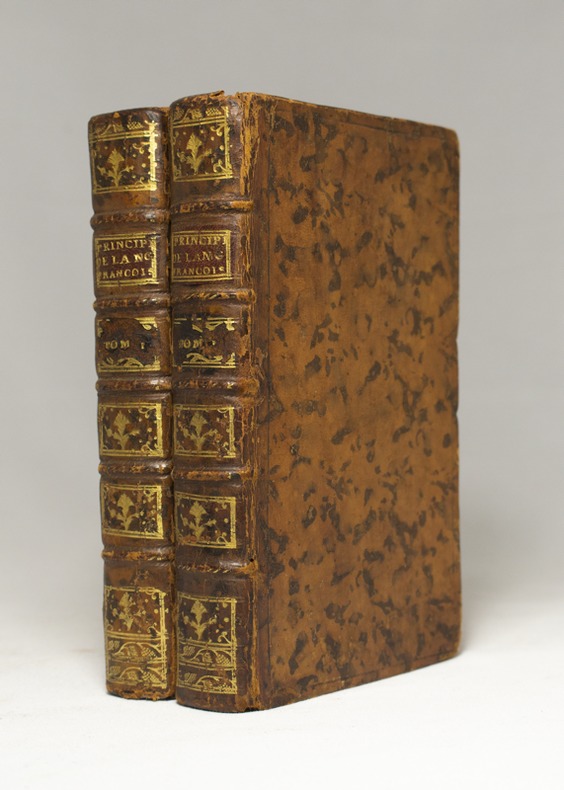
174716041A Paris, chez Le Breton, 1747. 2 volumes in-12 de X-432; [4]-468-[4] pages, plein veau raciné brun, dos à nerfs ornés de filets et fleurons dorés, pièces de titre bordeaux, tranches rouges.