5 134 résultats
1989R160110685HACHETTE. 1989. In-12. Broché. Bon état, Couv. convenable, Dos satisfaisant, Intérieur frais. 145 pages.. . . . Classification Dewey : 445-Grammaire française
IN HEBREW, ENGLISH, RUSSIAN AND YIDDISH. 23X15.5 cm. 55+353 pages. Softcover. in good condition.
in-12, 139 pp., cartonnage imprime de l"editeur, dos toile Tres bon etat. [MI-8]
RO40056663LIRBAIRE ARMAND COLIN. non daté. In-8. Broché. Bon état, Couv. convenable, Agrafes rouillées, Quelques rousseurs. 20 pages environ.. . . . Classification Dewey : 445-Grammaire française
1964ROD0137992MANUEL GENERAL JOURNAL DES PROFESSEURS. 1964. In-12. Broché. Etat passable, Couv. légèrement passée, Dos abîmé, Papier jauni. 63 pages - annotations à l'encre sur la page de titre - mors fendus -. . . . Classification Dewey : 445-Grammaire française
1987159971Paris: Hachette 1987. 191; 62 Seiten / Pages. Gr. 8° (22,5-25 cm). Orig.-Broschuren. [Softcover / Paperback].
89783Paris, Duculot, 1979. 13 x 19, 101 pp., broché, bon état.
Exhibition catalogue. VG pbk. Previous owner's inscription on the inside front cover. 15703. eng
27893Tamines (Belgique), Duculot-Roulin, Imprimeur éditeur, 1926. 13 x 20, 90 pp., cartonnage d'édition, dos toilé, bon état.
1967R320018163LAROUSSE. 1967. In-8. Broché. Etat d'usage, Couv. convenable, Dos satisfaisant, Intérieur frais. 223 pages - quelques rousseurs sur les tranches.. . . . Classification Dewey : 445-Grammaire française
1977R320018164LAROUSSE. 1977. In-8. Broché. Etat d'usage, Couv. convenable, Dos satisfaisant, Intérieur frais. 189 pages.. . . . Classification Dewey : 445-Grammaire française
LIBRAIRIE LAROUSSE. 1965. In-8 Carré. Broché. Bon état. Couv. convenable. Dos satisfaisant. Intérieur frais. 191 pages.
Very Good Armenian In contemporary black cloth bdg. No gilt on cloth. [4], 275, [1] p. Ownership signature in Ottoman script as 'Doctor Cemil, Bayburd'. [A COMPARATIVE ARMENIAN DICTIONARY from ARMENIAN to OTTOMAN TURKISH] Yndarzak barraran Hayeree tatskeren. Abikean was an Armenian prolific lexicographer and linguist. Editions in OCLC has 160 p. This Edition not in OCLC.
Very Good Turkish, Ottoman (1500-1928) In contemporary cloth bdg. Cr. 8vo. (19 x 13 cm). In Ottoman script. 88, [1] p. Usûl-i tedris-i Arabî. Mösyö Ahn'in usûlünden muktebesdir. Translated by Ismail Hemeti b. Osman. Ismail Hâmeti is one of the teachers of Beirut Idadî School. First Edition is published in 1898 in Beyrut. The Ministry of Education of the period made some changes in the program regarding the method of teaching Arabic translation and speaking. Additionally, he wanted the change to include the program of the sixth and seventh classes of "Idadîs". In accordance with this change made by the Ministry of Education, this book was started immediately since there were no books to be taught in Arabic teaching, and it was also published after the education by the Ministry of Education, with its 422 numbered permission on August 11, 1914. The method followed in the book is in accordance with the change made by the Ministry of Education in the program. The author states that on the cover of his book he prepared his work based on the "Monsieur Ahn" [i.e. Jean Françoise Ahn] procedure. This statement shows that the authors investigate the methods that arise about language teaching and closely follow the methods which are followed in the teaching of Western languages in order to prepare books suitable for these methods. Because the author adapted the rules of the method put forward by a Western linguist to the teaching of the Arabic language and tried to prepare his book. The topics in the work are covered at a level that the reader can understand easily. The first part of the book begins with exercises on translations from Arabic to Turkish and from Turkish to Arabic. Arabic words and Turkish meanings are given across each word. As the topics progress, both the number of sample sentences and level increases gradually. In the second chapter, grammar topics are handled in the same way under the title of "Kavâid-i Esasiye". In the third part, 45 prepositions are listed first with the title "edevât". he meanings of the prepositions are given, and then each is given as an example. After prepositions, there is a section under the title of "lugat" [i.e. dictionary]. (Source: Ikinci Mesrutiyet'ten günümüze Türkiye'de Arapça ögretimi, by Hasan Soyupek). A rare book on Arabic grammar and linguistics. Second Edition. Hegira-Hijri: 1325 = Gregorian: 1909. Özege 22297 (For 1904 Edition). Çögenli 173.
Very Good Arabic In modern full leather bdg. Roy. 8vo. (24 x 17 cm). In Arabic and Modern Turkish. [xv], [1], 186, [2], 158 p. Abû ?ayyân Athîr ad-Dîn al-Gharnâtî, whose full name is Mu?ammad ibn Yûsuf bin 'Alî ibn Yûsuf ibn Hayyân, sometimes called Ibn Hayyan, was a celebrated commentator on the Quran and foremost Arabic grammarian of his era. His magnum opus Tafsir al-Bahr al-Muhit (Explanation of the Ocean) is the most important reference on Qur'anic expressions and the issues of grammar, vocabulary, etymology and the transcriber-copyists of the Holy Qur'an. Quite exceptionally for a linguist of Arabic of his day was his strong interest in non-Arabic languages. He wrote several works of comparative linguistics for Arabic speakers, and gives extensive comparative grammatical analysis and explanation. He was born in Spain in November of 1256 to a family of Berber origins, from the Berber tribe of Nifza. Historians variously cite Gharnati's place of birth as both Jaén and Granada; his appellation "Gharnati" derives from this latter. At the time Jaén was a dependency of Granada, and the appellation conflict may only be apparent. Abu Hayyan adhered to the Zahiri madhhab of Sunni Islam. When asked toward the end of his life about a claim he had switched to the Shafi'i madhhab, or some other school, he responded that, anyone who had known the ?ahiri school could never leave it. He regarded Sufism as heresy, and the metaphysicsts ibn Arabi, Mansur Al-Hallaj, Ibn al-Farid, Ibn Sab'in and Abu al-Hasan al-Shushtari, as especially impious heretics.[5] Abu Hayyan, along with most Muslim scholars of Andalus of the time, saw the appeal of Sufism as a particular threat to secular Muslims. On the Arabic language, Abu Hayyan shared the views of his fellow ?âhirî Andalusian, Ibn Ma?â'. Absolute belief in the divine mover led them to reject the concept of linguistic causality. For them the 'cause' of all things, including language, is attributable solely to God. Thus on theological grounds, he was suspicious of the so-called "eastern grammarian" supporters of 'linguistic causality'. When Abu Hayyan arrived in Egypt the Mamluk Sultan was ruler. Although Abu Hayyan held the Turkic languages of Mamluk Egypt superior to the Kipchak and Turkmen languages with which he was familiar, he also wrote grammars of Amharic, Middle Mongol, the Berber languages and the Turkic. Other Arabic-language linguists of his day had little regard for foreign languages. Abu Hayyan often illuminated Arabic grammatical concepts with quotes from various language. (Wikipedia). Ahmet Caferoglu was a Turkish filologist. He has worked on basic works of Turkish, etymology, Turkish dialects and Anatolian dialects. He was the first language dialect researcher and historian of science with sturdy title in Turkey. OCLC: 150018789 / 977434024 / 906866886 / 917024141 / 576836072 / 924028884.
Very Good Turkish, Ottoman (1500-1928) Original 1/3 leather bdg. Decorative cloth boards with crescent and star and tughra. Roy. 8vo. (23 x 16 ccm). In Ottoman script. 271 p. AH 1286 = AD 1870. Karakaszâde was born in Bursa and died in Edirne. One sheikhsof the Jalvatiyya order. His works are "Nûru'l-Hüdâ li men Ihtidâ" and "Serh-i Risâle-i Hâce Cihan" and "Mürettebât Divan", which talk about mysticism and morality and are written on the old Ottoman inscription, but were written with some humble and extreme views. This book includes history of the mystic orders and tradition of Islamic and Turkish sufism. According to some claims this work by him is a plagiarist from 'Menâkibnâme-i Hâce Cihan ve Netice-i Can' by Vahidî. One copy in OCLC with mistake of author's name: 39817913.; Özege 15570. First Edition. Rare.
[English and Yiddish] [4 volume set].21.5X28 cm.XLII+128+62+238+XII+265+11+XIIIÌÌ+285Ì+45 Pages. Gilt Hardcover. In good condition. PLEASE NOTE: This item is overweight. We may ask for extra shipping costs.
170231267Frankfurt am Main, Apud Johannem David. Zunnerum et Nicolaum Wilhelmum Helwig,1702. Small folio. Very nice recent blue hcalf w. gilt lettering on spine. Title-page printed in red and black, w. woodcut vignette and stamp: ""Jews college, London"". Some brownspotting, but all in all a very nice copy. (12), 184, (8) (Index) pp.
Very Good Hebrew Contemporary 1/4 leather bdg. Demy 8vo. (21 x 14 cm). In Hebrew with interspersed with Arabic; a preface in French. [xvi], 144 p. Goldenthal was an Austrian Orientalist; born at Brody, Galicia, April 16, 1815; died at Vienna Dec. 28, 1868; educated at the University of Leipsic. In June, 1843, he became principal of the Jewish school at Kishinef, Bessarabia, and held the office for some years. He was appointed professor of rabbinical and Oriental languages at the University of Vienna in Sept. 1849, and held the chair until his death. Upon the nomination of Hammer-Purgstall, he was elected a corresponding member of the Vienna Academy of Sciences, and member of the Asiatic Societies of Germany, of Paris, and of London. His chief literary activity consisted in editing the following manuscripts: "Mozene ?ede?," a treatise on philosóphical ethics by Al-Ghazali, translated into Hebrew by Abraham ibn ?asdai, with an introduction on the lives and works of Al-Ghazali and Ibn ?asdai, 1838. "Bi'ur ibn Roshd," Todrosi's Hebrew translation of Averroes' commentary on Aristotle's "Rhetorica," with a historical and philosophical introduction, 1842. "Mesharet Mosheh," commentary by Kalonymus on Maimonides' system of Divine Providence, with his explanation of Ps. xix. and xxxvii., 1845. "Maftea?," methodology of the Talmud by Nissim ben Jacob of Kairwan, with an introduction, notes, and references, 1847. "Mi?dash Me'a?," Moses Rieti's didactic poem on ancient philosophy and the history of Jewish literature, with an Italian and Hebrew preface, 1851 (see "Allg. Zeit. des Jud." 1859, p. 124). Goldenthal further published a catalog of Hebrew manuscripts in the Imperial Library of Vienna, 1854, and an Arabic grammar in Hebrew for the use of the Oriental Jews, with a French preface, 1857. Volume i. of the "Denkschriften" of the Vienna Academy of Sciences contains his "Beiträge zu einem Sprachvergleichenden Rabbinisch-Philosophischen Wörterbuche." He issued "Das Neue Zion," a monthly periodical, Leipsic, Nisan, 1845, of which only one number appeared. Another periodical which he edited, "Das Morgenland," was also short-lived. (Jewish Encyclopedia). In his Hebrew preface, Goldenthal notes that knowledge of Arabic is particularly important for Talmudists, illustrating his point by a passage from Rabbenu Nissim's commentary to Tractate Shabbat found in a manuscript in the Palatine Library of Vienna. (Source: K&C). First Edition. OCLC 40972030.; Friedberg M-2669.
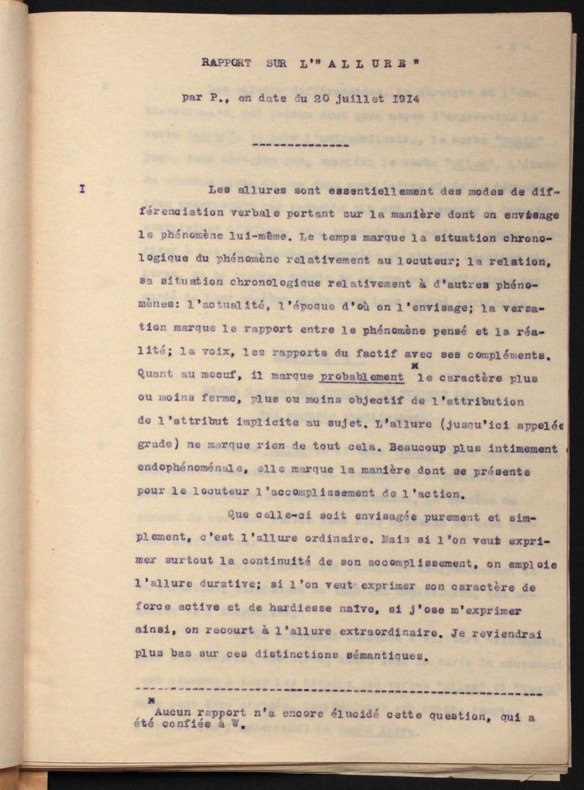
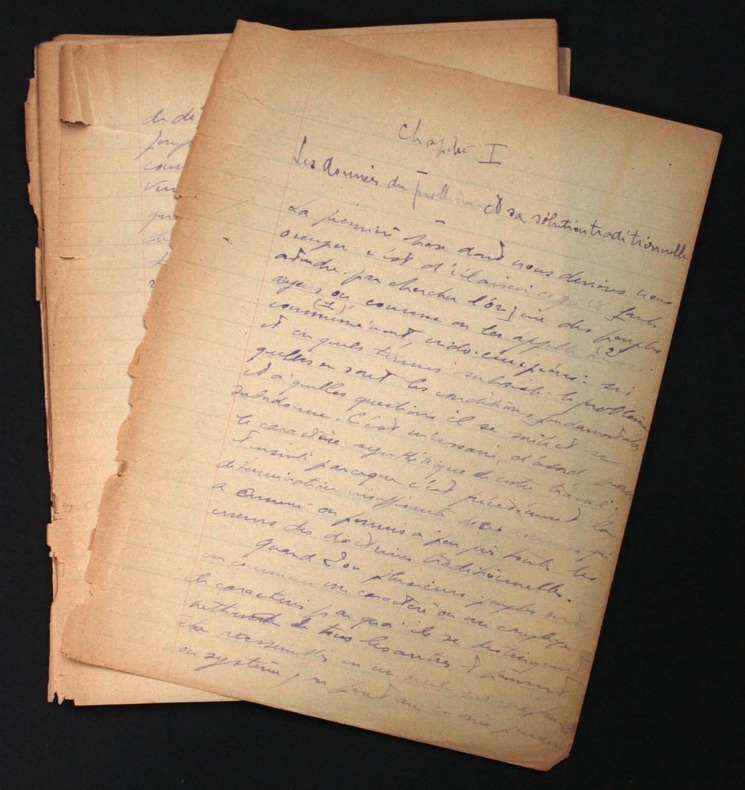
4283en feuilles A) Manuscrit : "Anecdotes vraies", 20 pp. in-4, en feuilles sous chemise (17 historiettes, non signées) ; B) Manuscrit : "De plus en plus vrai", 97 pp. in-4, en feuilles sous chemise (15 contes, certains signés "Jacques Normandin") ; C) Tapuscrit (en copie carbone) : "Tout aussi vrai qu'autre chose", 236 pp. in-4 précédées de 2 pp. in-4 manuscrites (titre et pseudonyme de l'auteur puis table des contes) en feuilles sous chemise (18 contes, certains en double, avec corrections autographes - répétées sur les doubles, la chemise porte, entre autres : "Jacques Normandin, chez M. Damourette" puis son adresse à Sarcelles) ; D) 2 pp. in-4 autographes listant les 33 contes présentés en (B) et (C) ainsi que 4 longs poèmes dont nous n'avons pas trouvé trace ; E) Manuscrit (et palimpseste) : un conte autographe à l'écriture rapide et difficilement déchiffrable, 14 pp. in-4 au verso du tapuscrit (de 25 pp.) d'un rapport sur "l'allure" (en grammaire) par son neuveu Edouard Pichon daté du 20 juillet 1914 ; F) Manuscrit : "Histoire d'un avocat...", 8 pp. autographes in-4 signées "Bindin" ; G) 4 poèmes ou chansons autographes (dont deux signés) sur 5 pp. in-4, 1 p. in-8 et 1 p. in-12.
4285in-8 en feuilles 90 pp. in-8 dans un cahier (couvertures et premiers et dernier feuillets détachés).
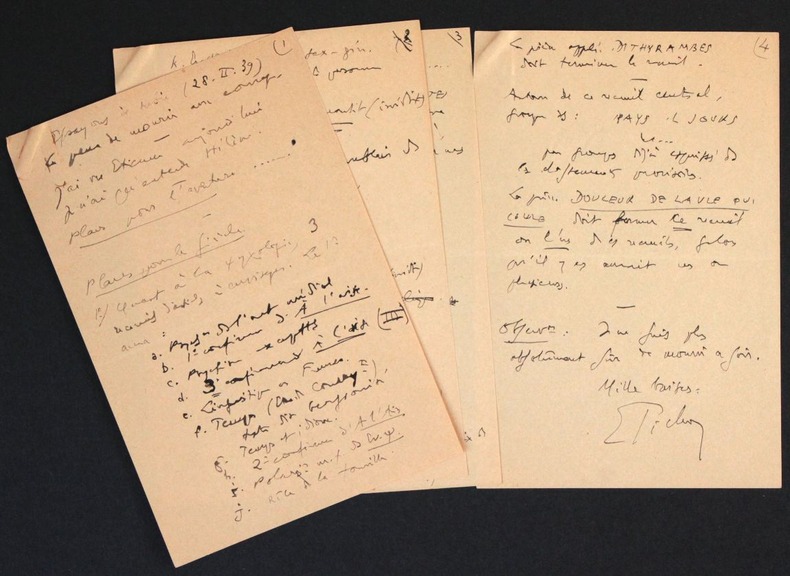
193942571939 in-16 en feuilles 4 pp. in-16 datées du 28 février 1939 et signées.
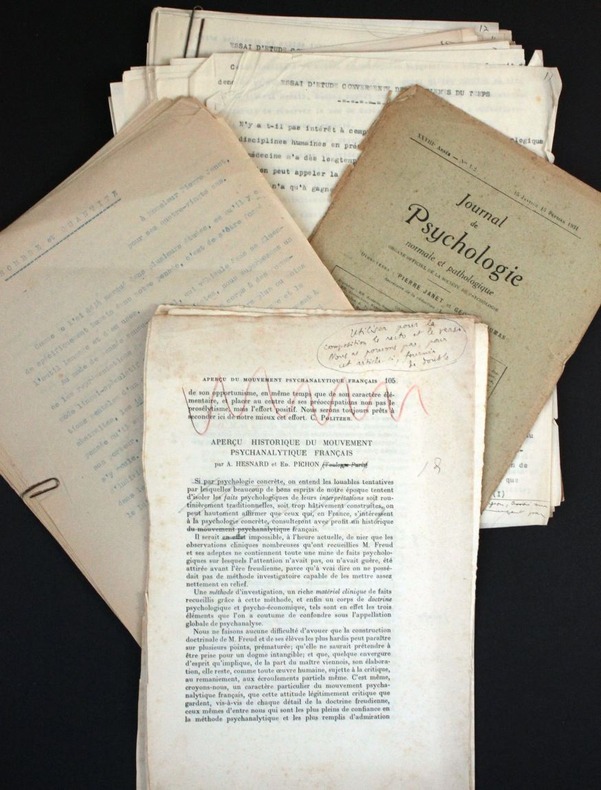
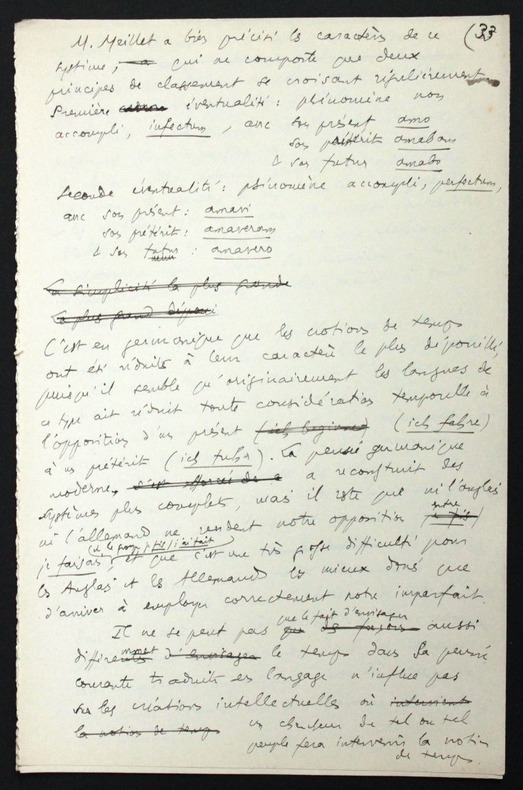
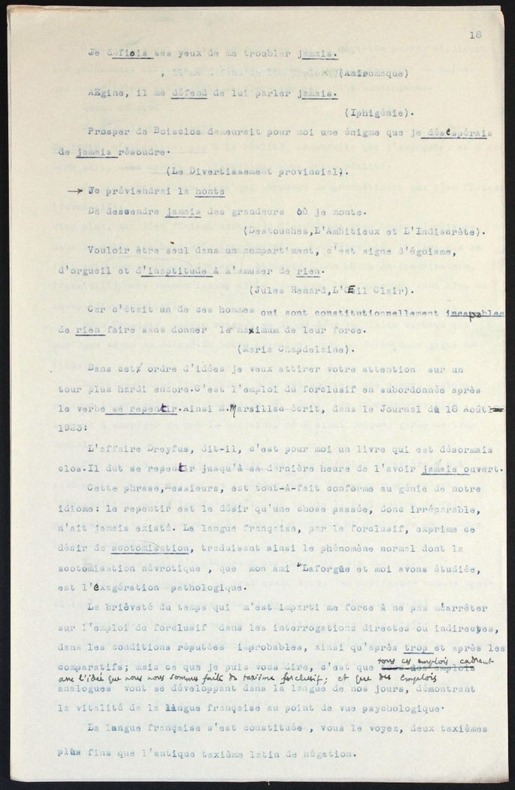
194042581940 in-4 en feuilles A) PLANS pour la publication de l'ouvrage ou des ouvrages : 1) un lettre autographe signée datée du 6 juin 1932 (4 pp. in-4) présentant son projet de recueil, qui "ne sera pas strictement psychanalytique" et listant les 16 articles qu'il prévoit d'y faire figurer, avec les références de la première publication (sauf pour l'un d'entre eux, écrit avec René Laforgue, une communication au Congrès de psychologie, inédite - cf. D) infra); 2) brouillon du plan de l'ouvrage pour la version de 1932 (1 p. in-4); 3) liste autographe des travaux de Pichon dans la "Revue Française de Psychanalyse" jusqu'à "A l'aise dans la civilisation" (1 p. in-4) ; 4) liste manuscrite des Conférences des Psychanalystes de langue française, de 1926 à 1936, avec pour chacune le nom du président et les titres et auteurs des conférences (1 p. in-4) ; 5) plan pour un ouvrage en deux parties ou volumes : "Chez Psyché" ou "Psyché dans son parc" (18 articles) et "L'Envol de Psyché" (20 articles dont 2 inédits) (1p. in-8 et 1 p. in-12) ; 6) "livres ultérieurs", avec projets de titre, etc ; 7) de la main de Hélène Pichon-Janet, liste des documents, éventuellement corrigés, dont elle dispose (2 pp. in-8).B) PROJET de MAQUETTE pour "Les Jardins de Psyché, douze études revues et mises à jour et une étude inédite", comportant faux-titre, liste des livres publiés, titre, dédicace "à cinq maîtres, Henri Bergson, Sigismond Freud, Pierre Janet, Charles Maurras, Antoine Meillet, de chacun desquels je suis le disciple plus ardent que servile"), avertissement, puis 1) "La psychanalyse dans l'art médical", feuillets découpés de "L'Evolution psychiatrique" (t. 3, f. 1, 1932) et assemblés, avec quelques corrections autographes et de nombreuses notes autographes ajoutées (18 ff. in-4 foliotés 6 à 23) [à la suite : la copie carbone du tapuscrit de la première version de l'article, 32 ff. in-4] ; 2) "Le rôle du complexe d'OEdipe dans le développement psychique de l'être humain", feuillets découpés de la Revue Française de Psychanalyse (2e année, n° 1, 1928), avec quelques corrections et de nombreuses notes ajoutées (21 ff. in-8 ou in-4 foliotés 24 à 44) ; 3) "Position du problème de l'adaptation réciproque entre la société et les psychismes exceptionnels" (ib.), feuillets découpés, pour certains assemblés, avec quelques correctionset de nombreuses notes ajoutées (45 ff. in-8 ou in-4 foliotés 45 à 89) ; 4) "Comment la pensée prend corps", extrait de "A l'aise dans la civilisation" (Denoël, 1938) avec quelques corrections autographes et notes ajoutées (16 ff. in-8 ou in-4 foliotés 90 à 105) ; 5) "La linguistique en France : problèmes et méthodes", feuillets découpés du "Journal de psychologie normale et pathologique" (15 janvier - 15 février 1937) avec quelques corrections autographes et notes ajoutées (15 ff. in-8 ou in-4 foliotés 106 à 130)[ici s'arrête la maquette proprement dite et l'on trouve à la suite divers articles manuscrits ou tapuscrits devant probablement faire partie du recueil tel qu'envisagé en 1932 ou des recueils esquissés en 1939-1940 :]C) "A propos d'un rêve funèbre, pour la Société psychanalytique, 17 novembre 1931", MANUSCRIT autographe INÉDIT, une étude de cas (12 pp. in-4) ;D) "Sur quelques réactions sociales d'ordre para-névrotique", TAPUSCRIT d'un article de Laforgue et Pichon datant de 1929 et INÉDIT (10 pp. in-4, avec quelques corrections autographes) ;E) "Essai d'étude convergente des problèmes du temps", TAPUSCRIT (42 pp. in-4) en double exemplaire d'un article paru dans le "Journal de psychologie normale et pathologique" (15 janvier - 15 février 1931, couvertures de la revue découpées) ;F) "Temps et idiome, la voie linguistique d'exploration du problème psychologique du temps", TAPUSCRIT (46 pp. in-4) d'un article paru dans la revue "Recherches philosophiques" (t. V, 1935-1936) ;G) "Nombre et quantité", TAPUSCRIT (15 pp. in-4) d'un article de 1938 publié dans les "Mélanges" Pierre Janet (1939) ;H) "Aperçu historique du mouvement psychanalytique français" (avec A. Hesnard), 16 pp. grand in-8 découpées de la "Revue de psychologie concrète" (t. I, n° 1, février 1929), avec quelques corrections autographes et la mention autographe "utiliser pour la composition le recto et le verso, nous ne pouvons pas, pour cet article-ci, fournir de double" ;I) un exemplaire de la revue "Paris médical" (9 janvier 1932) contenant un article de Pichon : "Aperçu sur le développement moteur et psychique de l'enfant" ;J) un important ensemble d'articles découpés de la Revue Française de Psychanalyse, en double et assemblés en vue de la composition, mais que Pichon n'a pas eu le temps de corriger (certains sont incomplets) : 1) compte-rendu du livre de Charles Odier, "Curiosité morbide" ; 2) présentation du cas de Georgette Sansonnet ; 3) "Sur la prétendue différence entre l'organique et le psychogène" ; 4) "Court document d'Onirocritique" ; 5) compte-rendu du livre G. Dwelshauvers, "Traîté de psychologie" ; 6) "Sur les traitements psychotérapiques courts d'inspiration freudienne chez les enfants" (avec Parcheminey) ; 7) compte-rendu du livre de E. Minkowski, "La Schizophrénie".Soit un ensemble de 19 articles manuscrits, tapuscrits et/ou imprimés, certains en double (1), augmentés (5), inédits (2) ou corrigés (1).
193242591932 in-4 en feuilles 38 pp. in-4, entièrement autographes, ratures et corrections.
192642611926 in-4 en feuilles Manuscrit autographe (parafé deux fois en tête) de 40 pp. in-4 (nombreuses ratures et corrections) et tapuscrit avec corrections autographes de 20 pp. in-4. Le tapuscrit est la mise au propre du manuscrit. L'ensemble est à notre connaissance inédit.