76 résultats
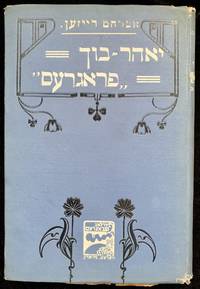
190443110Varsha Warsaw: Ferlag "Progress 1904. First edition. Original illustrated printed boards 8vo 162 32 pages plus 7 unnumbered leaves of plates with illustrations. 22 cm. In Yiddish. Title translates as “Yearbook ‘Progress’: A Journal for Literature Science and Criticism.â€<br> “Abraham Reisen was a Yiddish poet short-story writer playwright and editor…While he was still a teenager his talent was recognized by Shalom Aleichem and I.L. Peretz who arranged for the publication of his earliest poems. After some years in Minsk Warsaw Krakow and Berlin he settled permanently in New York in 1914. Influenced by Heinrich Heine whom he translated into Yiddish he was one of the first Yiddish poets to make use of folksong material. His poetry though mostly written in conventional quatrains is suffused by a refined sensibility that adumbrates the writing of Di Yunge.†Jewish Virtual Library<br> â€In 1900 Yakov Lidski founded "Progress" publishing house. Its name clearly communicated its goal. This publishing company considered to be the first to deal with modern Yiddish literature published a series of original and translated popular science books along with translated European literature and original Yiddish literature. The first editor of the publishing house was poet Avrom Reyzen.†Wikipedia. <br> SUBJECTS: Yiddish literature. Jews -- Poland -- Periodicals. OCLC: 21651882<br> Wear to spine some page separation toning and markings. About Good Condition. YID-46-28-GGLEX-’cc. Varsha [Warsaw]: Ferlag "Progress unknown
19461116373New York: Jewish Encyclopedic Handbooks Central Yiddish Culture Organization CYCO. Fine maroon leatherbound 2 volume set gilt all edges Volume 1 has 430 pp with B/W illustrations; Volume 2 has 430 pp with B/W illustrations. . Fine. Leather Bound. 1946. Jewish Encyclopedic Handbooks Central Yiddish Culture Organization (CYCO hardcover
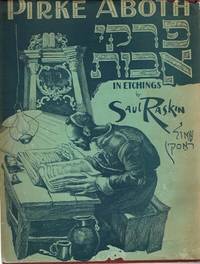
19387471NY: Academy Photo Offset Inc. Very Good in Good dust jacket. 1938. First Edition Thus. 1. Hard Cover. Publisher's full burgundy cloth Hebrew lettering gilt on cover. title page in color. Illustrated with fine etchings by Saul Raskin Text in English and Hebrew. Covers very lightly soiled Hebrew inscriptions on ffep very mildly shelf-worn else fine. The dust jacket now in Mylar is moderately chipped with some loss at the head of the spine. All of the etchings are in bright clean condition. VERY GOOD/VERY GOOD. . Etchings. 4to 11" - 13" tall. 124 2 pp . Academy Photo Offset, Inc. hardcover
192936164Vilne: Vilner Farlag B. Kletskin 1929. Hardcover. g. Quarto. Vol. 2: 8 516 XXVII. Black buckram with gold lettering on front. Blind stamp borders on spine with red text boxes. Blind stamp symbol and lettering on back boards. Brown decorative endpapers b/w photographic facsimile plates and cuts throughout. Includes articles about the history of Yiddish theater Slavic influences on Yiddish burial customs early German thief jargon and Yiddish surnames in Ukraine. Additional title pages and summaries in English. Slight wearing on edges and ends. Top of spine torn. Slight age toning. Binding and interior in good condition. Text in Yiddish. Vilner Farlag B. Kletskin hardcover
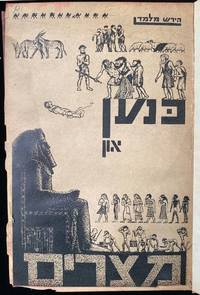
193042782Rige Riga: Yungbukh 1930. 1st edition. Period boards with original covers bound in. 8vo. 157 pages 21 cm. In Yiddish with Latvian "front" cover and title page at rear. Title translates as "Canaan and Egypt: A Novel." <br> Wonderfully illustrated cover bound in featuring cartoonish drawings of Canaanites and Egyptians. Two volumes in one: 1. Yoysef in Mitsroyim and 2. Yosef der reter fun Mitsroyim. <br> <br> SUBJECTS: Yiddish fiction. OCLC: 503648109. OCLC lists 8 copies worldwide including copies of an undated edition which we assume to be a later reprint. <br> <br> Ex-library with usual marks. Paper brown and somewhat fragile old dampstain to lower edge of boards extending into margins of first and last leaves. Original bound-in covers have come loose. Good condition thus. B YID-33-27-L-'ccex. Rige [Riga]: Yungbukh unknown
194613981Lodzsh: Tsentraler Yidisher Historisher Komisye baym Tsentral-Komitet fun Poylishe Yidn 1946. 1st edition. Later cloth with original dramatic photgraphic cover mounted on front 8vo 70 1 pages 1 l. includes facsimiles. 21 cm. Poems. "Oysgabes fun Der Tsentraler Yidisher Historisher Komisye baym Tsentral-Komitet fun Poylishe Yidn. Serye yidishe literatur 1." <br> A committee dedicated to recording the fate of Polish Jews published this book length poem by Simkhah Szajewics. Written in the Lodz Ghetto it appeared immediately after the war in 1946; Szajewicz perished in a concentration camp in 1944" from the permanent exhibit at the National Yiddish Book Center which houses their copy in their Rare Book Collection. <br> The book actually includes two long poems: "Lekh-lekha" and "Friling 702 " as well as letters and other related material. <br> See David Roskies interesting reflection on this work and it's stunning photographic cover at jtsa.edu/torah/go-forth-the-grammar-of-remembrance. <br> For more about the author-poet see Chava rosenfarb's essay on Shayevitch in Tablet Magazine at tabletmag.com/sections/arts-letters/articles/the-last-poet-of-lodz. SUBJECTS: Jews -- Persecutions -- Poland -- Lódz. Holocaust Jewish 1939-1945 -- Poetry. Jews -- Correspondence. Expertly rebound in attractive black cloth with the original photographic front cover mounted on the front. Very Good Condition. B HOLO2-110-36-CCALX-'emm H-40-10. Lodzsh: Tsentraler Yidisher Historisher Komisye baym Tsentral-Komitet fun Poylishe Yidn unknown
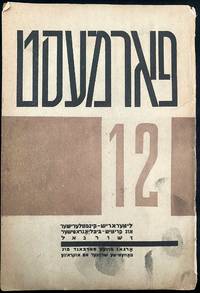
193543308Kharkov: Ukrmelukhenatsmindfarlag 1935. First edition. Original illustrated paper wrappers 8vo 156 pages.Includes illustrations. 21-23 cm. In Yiddish. Title translates roughly as “Challenge: A Literary Artistic and Critical Bibliographical Journal.â€<br> At the time the only Yiddish literary periodical in Ukraine.<br> Farmest 1933–1937 was a monthly Yiddish literary magazine published in Kharkhiv Ukraine by the Ukrainian Committee for Soviet Writers.<br> “Edited by the poet Itsik Fefer 1900–1952 it was continued in Sovetishe literatur: Literarish-kinstlerisher un kritish-bibliografisher zhurnal Soviet Literature: Literary-Artistic and Critical-Bibliographical Journal; 1938–1941.<br> In 1927 Fefer was a founding member of the Jewish Section of the All-Ukrainian Union of Proletarian Writers and from 1928 one of the editors of its Kharkov-based journal Prolit Proletarian Literature. He also coedited the nonproletarian Kharkov journal Di royte velt The Red World from 1929. From 1933 to 1937 he edited the Kiev periodical Farmest Challenge; known as Sovetishe literatur Soviet Literature between 1938 and 1941 which replaced Prolit and Di royte velt and was thereafter the only Yiddish literary periodical in Ukraine.†YIVO. Avrom Gontar was also involved in the collective and editorial committee. <br> The editor Itsik Fefer 1900–1952 “began writing poems in 1918 and in 1922 joined Vidervuks New Growth in Kiev a group of young Yiddish literati whose mentor was Dovid Hofshteyn. That same year the appearance of Fefer’s small collection Shpener Splinters established him as a rising literary star. His poetry amalgamated the Kultur-lige poets’ revolutionary romanticism with the propagandist objectives of the workers’ movement.<br> Fefer was known for his literary credo of proste reyd simple speech a concept he formulated in 1922. In the early 1920s poetry particularly avant-garde poetry swamped the literary pages of Soviet Yiddish periodicals. This phenomenon worried editors and critics who were wary of the fact that Yiddish readers usually could not identify with this style of literature. All Yiddish readers by contrast could understand Fefer’s proste reyd.<br> In 1927 Fefer was a founding member of the Jewish Section of the All-Ukrainian Union of Proletarian Writers and from 1928 one of the editors of its Kharkov-based journal Prolit Proletarian Literature. He also coedited the nonproletarian Kharkov journal Di royte velt The Red World from 1929†Gennady Estraikh.<br> For more see: Gennady Estraikh “The Kharkiv Yiddish Literary World 1920s–Mid-1930s†East European Jewish Affairs 32.2 2002: 70–88; Chone Shmeruk “Yiddish Literature in the U.S.S.R.†in The Jews in Soviet Russia since 1917 ed. Lionel Kochan pp. 242–280 London and New York 1970.<br> SUBJECTS: Yiddish literature -- Ukraine -- Periodicals. Yiddish literature. OCLC: 35051038.<br> Pages toning as expected some sunning and stains to cover Good Condition. BYID-46-2A-LGG-’excc. Kharkov: Ukrmelukhenatsmindfarlag unknown
195932876New York: Celia Adler Foundation / Shulsinger Bros. Linotyping & Publishing Co 1959. Very Good/Very Good. New York: Celia Adler Foundation / Shulsinger Bros. Linotyping & Publishing Co. 1959. First Edition. Two octavo volumes 23.5cm; 688pp. Black and white photographs. Photo-illustrated dust jackets; blue cloth boards. Yiddish-language text throughout. Dust jackets show mild chipping with a few short tears along edges; general rubbing and sun-fading. Old damp-marks to board edges of both volumes causing discoloration to cloth but no structural damage. Bindings sound. Glue residue to endpapers of volume II else unmarked and still a Very Good set of this uncommon autobiography of "The First Lady of Yiddish Theater." Adler was known for creating leading roles in Yiddish versions of many classic plays and was the first actor to portray a Holocaust survivor in her brother Luther's 1946 Broadway production A Flag is Born. Scarce. Celia Adler Foundation / Shulsinger Bros. Linotyping & Publishing Co unknown
195949878New York: Celia Adler Fondeyshon un bukh-komitet Celia Adler Foundation 1959. First Edition. Two octavo volumes 24cm. Blue cloth boards; dustjackets; viii688pp; illus. Old damp-marks to board edges of both volumes causing discoloration to cloth but no structural damage. Text clean tight and unmarked; jackets lightly worn and sun-faded; complete sound and Good. Text entirely in Yiddish save verso of title page which provides both a transcription and an English-language translation of the title and publisher. Exceedingly uncommon autobiography of Celia Adler 1899-1979 daughter of Jacob Adler and half-sister to Stella Adler known as the "First Lady of the Yiddish Theatre." Adler was associated with the Yiddish Art Theater movement of the 1920s and gave one of the first theatrical portrayals of a Holocaust survivor in her brother Luther's 1946 Broadway production A Flag is Born. Unaccountably scarce even for an American work written entirely in Yiddish: OCLC notes a single location only in the U.S. Northwestern; five more copies are in European and Israeli institutions. Celia Adler Fondeyshon un bukh-komitet [Celia Adler Foundation] unknown books
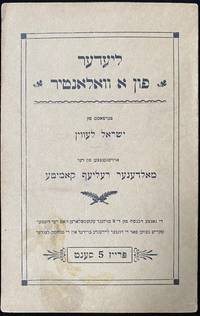
191942896No Place Malden MA: Maldener Relief Komite 1919. No Date 1919. 1st Edition. Original printed paper wrappers 8vo 14 pages. 21 cm. In Yiddish. Title translates as “Verses of a Volunteer.†No city or date listed but clearly published during or immediately after WW I with the Leksikon suggesting Malden MA 1919 OCLC suggests Boston the location of the printer and a clearly incorrect date of 1900 perhaps intending "1900s". Malden the poet’s home town just outside of Boston and clearly the home of the "Maldener Relief Komite" makes much more sense making this is the first documented yiddish publication in Malden MA north of Boston.<br> "The poet dedicated the entire income of 5 thousand copies to the brothers suffering from hunger in the countries at war†Translated from the front cover. Includes 4 poems: Der Volontir; Ikh Zukh a Vort; Nach der Milhome; Hazkharot Neshimot. The final poem is “in memory of the fallen Jewish heroes in all the war-torn lands.â€<br> Israel Levine 1878-1970 “was born in a village in Minsk district Byelorussia. In 1895 he arrived in the United States lived in various cities worked as a teacher in Talmud Torahs and was secretary for Mizrachi in the town in which he lived Malden Massachusetts. <br> He debuted in print in 1904 in Fraye arbeter-shtime Free voice of labor in New York with a poem entitled ‘Funken shpritsn’ Sparks fly and from that point he went on to contribute poetry and translations from Tanakh and from ethical books to: Yidishes tageblat Jewish daily newspaper Forverts Forward Dos yudishe folk The Jewish people Di varheyt The truth and Idisher kemfer Jewish fighter—in New York; Idishe shtime Jewish voice in Boston; and more. He published in book form: Lider fun a volontir Poems of a volunteer Malden 1919 16 pp.; Sefer naim zemirot tehilim Naim Zemirot on Psalms translated into a poetic form with short prefaces by Dr. Meir Vaksman and Aharon Kaminska Jerusalem 1934 19 pp†Khayim Leyb Fuks in Leksikon Fun Der Nayer Yidisher Literatur<br> OCLC: 19307496. OCLC lists 4 copies worldwide YIVO Brandeis Harvard NYBC none outside the northeast. A few stains & discoloring Very Good Condition an excellent copy. Scarce. B YID-45-9XX-LE-’. No Place [Malden, MA]: Maldener Relief Komite unknown
1912224381912. Schwartz Isidor Publisher. Vi Azoy Tsu Veren a Sitizen. / The Citizen: A Guide to Naturalization. All Important Questions and Answers Printed in Hebrew and Yiddish Also Translations in Plain English Which You are to Know When Applying for Your Final Citizen Papers. Brooklyn: Aroysgegeben fun Isidor Schwartz / Published by Isidor Schwartz n.d. after 1912. Only edition. 31 page. Text in English and Yiddish both transliterated and Hebrew script. 6" x 4.5. Stapled pamphlet in printe wrappers.<br /> <br /> An immigrant-era Yiddish-English naturalization guide for Jewish immigrants preparing to become U.S. citizens published by Isidor Schwartz in Brooklyn. This vernacular instructional manual contains sample questions and answers in three formats: English Yiddish in Hebrew script and transliterated English in Latin script referred to on the cover as "Jewish-English". Designed for oral preparation it walks new arrivals through both general and localized questions commonly asked at the naturalization interview particularly for applicants in New York. Questions range from general American civics-"How does a bill become a law"-to specific regional knowledge-"What is the capital of New York State" and "How many stars has the American flag" The answer is noted as "Forty-eight stars" dating the publication to after Arizona and New Mexico's 1912 admission but before Alaska and Hawaii. The phrasing used-"We vote for the candidate who is in our opinion best fitted to occupy the office he wishes to be elected to"-illustrates the pamphlet's focus on simplified phonetic civic literacy.<br /> <br /> A vital artifact of Jewish immigrant life and Americanization in the early 20th century this pamphlet exemplifies how Jewish community publishers mediated state bureaucracies for recent arrivals. Yiddish language guides like this one offered more than instruction-they were part of the infrastructure of mutual aid and cultural transition particularly within New York's dense immigrant communities.<br /> <br /> Fragile condition with moderate chipping and edgewear to front and rear wrappers including some closed tears and loss at corners; interior pages clean and legible. Overall good condition. A scarce and historically significant publication supporting Jewish American integration during a peak period of Yiddish-speaking immigration; OCLC locates only 8 institutional holdings worldwide. unknown
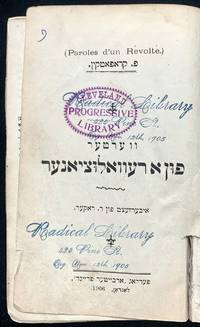
190643217London: "Arbayter fraynd 1906. First Yiddish edition. Period boards 8vo xiii 426 pages 19 cm. In Yiddish. Title translates as “Words from a Revolutionary.â€<br> Translation of “Paroles d'un re´volte´.†Includes translation of the forewords by the author and Elise´e Reclus. Includes bibliographical references.<br> “During his long exile Kropotkin wrote a series of influential works the most important being ‘Paroles d’un révolté’ 1885; “Words of a Rebelâ€.Kropotkin’s aim as he often remarked was to provide anarchism with a scientific basis. In Mutual Aid which is widely regarded as his masterpiece he argued that despite the Darwinian concept of the survival of the fittest cooperation rather than conflict is the chief factor in the evolution of species. Providing abundant examples he showed that sociability is a dominant feature at every level of the animal world. <br> Among humans too he found that mutual aid has been the rule rather than the exception. He traced the evolution of voluntary cooperation from the primitive tribe peasant village and medieval commune to a variety of modern associations—trade unions learned societies the Red Cross—that have continued to practice mutual support despite the rise of the coercive bureaucratic state. The trend of modern history he believed was pointing back toward decentralized nonpolitical cooperative societies in which people could develop their creative faculties without interference from rulers clerics or soldiers.â€<br> SUBJECTS: Anarchism. OCLC: 19303211.<br> Ex-library with early 19th Century left-wing library markings see photos. Good- Condition YID-48-41-LXCCGG-’e. London: "Arbayter fraynd unknown
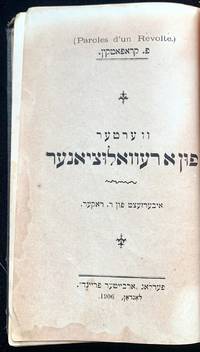
190643219London: "Arbayter fraynd 1906. First Yiddish edition. Period boards 8vo xiii 426 pages 19 cm. In Yiddish. Title translates as “Words from a Revolutionary.â€<br> Translation of “Paroles d'un re´volte´.†Includes translation of the forewords by the author and Elise´e Reclus. Includes bibliographical references.<br> “During his long exile Kropotkin wrote a series of influential works the most important being ‘Paroles d’un révolté’ 1885; “Words of a Rebelâ€.Kropotkin’s aim as he often remarked was to provide anarchism with a scientific basis. In Mutual Aid which is widely regarded as his masterpiece he argued that despite the Darwinian concept of the survival of the fittest cooperation rather than conflict is the chief factor in the evolution of species. Providing abundant examples he showed that sociability is a dominant feature at every level of the animal world. <br> Among humans too he found that mutual aid has been the rule rather than the exception. He traced the evolution of voluntary cooperation from the primitive tribe peasant village and medieval commune to a variety of modern associations—trade unions learned societies the Red Cross—that have continued to practice mutual support despite the rise of the coercive bureaucratic state. The trend of modern history he believed was pointing back toward decentralized nonpolitical cooperative societies in which people could develop their creative faculties without interference from rulers clerics or soldiers.â€<br> SUBJECTS: Anarchism. OCLC: 19303211.<br> Spine is taped.Tight binding but text block is clean and intact. Good Condition YID-48-40-LXCCGG-’e. London: "Arbayter fraynd unknown
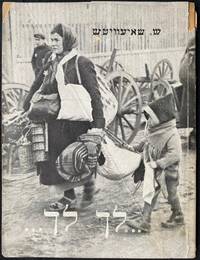
194643433Lodzsh: Tsentraler Yidisher Historisher Komisye baym Tsentral-Komitet fun Poylishe Yidn 1946. 1st edition. Original dramatic photgraphic covers 8vo 70 1 page 1 leaf. Includes facsimiles. 21 cm. In Yiddish. Poems. "Oysgabes fun Der Tsentraler Yidisher Historisher Komisye baym Tsentral-Komitet fun Poylishe Yidn. Serye yidishe literatur 1." <br> "Published by a commission The Central Jewish Historical Commission dedicated to recording the fate of Polish Jews published this book length poem by Simkhah Szajewics. Written in the Lodz Ghetto it appeared immediately after the war in 1946; Szajewicz perished in a concentration camp in 1944" from an exhibit at the National Yiddish Book Center which houses their copy in their Rare Book Collection. <br> The book includes two long poems: "Lekh-lekha" and "Friling 702 " as well as letters and other related material. <br> See David Roskies' interesting reflection on this work and it's stunning photographic cover at <br> jtsa.edu/torah/go-forth-the-grammar-of-remembrance. <br> For more about the author-poet see Chava rosenfarb's essay on Shayevitch in Tablet Magazine at <br> tabletmag.com/sections/arts-letters/articles/the-last-poet-of-lodz. <br> SUBJECTS: Jews -- Persecutions -- Poland -- Lódz. Holocaust Jewish 1939-1945 -- Poetry. Jews -- Correspondence. Crease and wear to wrapper and foot and crown of spine see photo better condition than usually found attractive. Good Condition. B HOLO2-110-36A-CCALX-'emm H-40-10. Lodzsh: Tsentraler Yidisher Historisher Komisye baym Tsentral-Komitet fun Poylishe Yidn unknown
1934STLE0064a?ernovits : Seminar far Jid. Literatur- un ?prachkenteni?, 1934. kl.-8°. 96 S., OKart. mit mont. Deckel- u. Rückenschildchen. Errata-Zettel beiliegend. In romanisiertem Jiddisch. Das Romanisierungsystem ist im Anhang erläutert.
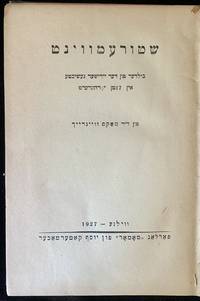
192743261Vilne: Tamar 1927. First edition. Original boards. 8vo 220 pages 21 cm. In Yiddish. Title translates as “Storm Winds: Images from Yiddish History in the 17th Century.â€<br> Max Weinreich’s historical work on Jews in Europe in the 17th Century focusing on the Chmelnitski pogroms.<br> “While Weinreich was first and foremost a linguist other topics he wrote about included psychology he translated Freud into Yiddish sociology economics theater studies literary history education ethnography and philosophy. He had a second career as a writer of popular articles in the Yiddish Forward frequently under the unlikely pseudonym Sore Brener. His linguistic interests included the history of linguistics orthography grammar he coauthored an early Yiddish grammar etymology and the etymological components of Yiddish dialectology stylistics and the influence of traditional Jewish culture in all its facets on the development of the Yiddish language.<br> In 1925 on the initiative of the linguist Nokhem Shtif the Yidisher Visnshaftlekher Institut Yiddish Research Institute; YIVO was founded in Berlin and began its work in Vilna; its first headquarters was located in a room in Weinreich’s apartment. Weinreich quickly became the driving force behind the new institute which was originally to have been known as an academy but Weinreich insisted on institute. Although YIVO may not have been Weinreich’s brainchild it was his child in every other way even after it acquired its own building on Wiwulski Street in Vilna.†<br> SUBJECTS: Jews -- Poland -- History -- Persecutions. Chmelnicki massacres. Blood accusation -- Lithuania -- Vilnius. Blood accusation. Jews -- Persecutions. History. OCLC: 649090568. OCLC lists 8 copies worldwide AJHS SUNY- Albany YIVO AJU Stanford Harvard NYBC Penn<br> Spine separation and some markings but text block is in good condition. Good Condition. Important and somewhat scarce. YID-48-62-BX'L-’emccgg. Vilne: Tamar unknown
19262310310184xbvkBerlin, 1926 [Druck: Leipzig, Offizin W. Drugulin, 1925/1926]. XVI, 97 Seiten / (58) Blätter, alles auf kräftigem tlw. unbeschnittenem Papier. - Dunkelblauer kräftiger Original-Pappeinband mit goldgeprägtem Deckelsignet; 4to.(ca. 26 x 20 x 2 cm; ca. 1 kg.).
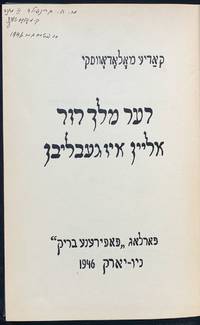
194643238New York: Papirene Brik 1946. First edition. Original boards. 8vo 156 pages 24 cm. In Yiddish. Title appears in English as “Only King David Remained.â€<br> <br> Inscribed by Molodowsky on title page in year of publication<br> <br> Early post-war book of poems by Kadya Mololdowsky that is composed of poems about the Holocaust and that “draw upon traditional Jewish literary responses to catastrophe.†Contains some of Molodowsky’s most well regarded poems.<br> <br> Kadya Molodowsky was a major figure in the Yiddish literary scene in Warsaw from the 1920s through 1935 and in New York from 1935 until her death in 1975. A teacher in the Yiddish schools in Warsaw as a young woman she was best known for her children's poems.<br> <br> In the United States she wrote for the Yiddish press and founded and edited a journal Sviva Surroundings which she published for three decades. Living in Israel 1948-52 she founded and edited a journal Heym. She published six major books of poems 1927-1965 novels short stories plays and essays. Recurrent themes in her work include the lives of Jewish women and girls Jewish tradition in the face of modernity Israel and the Holocaust.<br> <br> SUBJECTS: Yiddish poetry. David King of Israel -- Poetry. David King of Israel. Poetry. OCLC: 19314664.<br> <br> Clean copy with book stamp from “Emil Gorovets’s Library.†Very Good Condition. An attractive inscribed work by a leading female Yiddish writer. YID-48-47-LEXCCM!-’gg. New York: Papirene Brik unknown
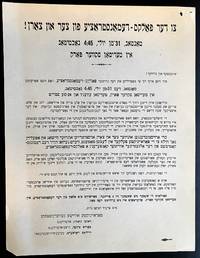
194443416No Place New York Fereynigte Yidishe Geverkshaftn United Hebrew Trades 1944. 1st edition broadside single-sided flyer 4to. In Yiddish. <br> <br> Translation: "ALL OUT TO THE PUBLIC DEMONSTRATION OF GRIEF AND RAGE!<br> Monday July 31st 4:45 PM<br> in Madison Square Park<br> <br> Sisters and brothers!<br> We invite you to participate in the great public demonstration that will take place<br> Monday July 31 4:45 p.m.<br> in Madison Square Park Madison Avenue and 24th Street<br> <br> Millions of Jews were murdered by the Nazis in all parts of Europe. Young and old women and men were driven into gas and death chambers and destroyed. In the current hour the greatest danger for those still alive in the Nazi countries.<br> The Hitlerian beast which conquered and humiliated countries and murdered millions of people is ready to strangle and murder the surviving remnants of the Jewish people. Hundreds of thousands of Jews from Hungary are now in danger of death the tens of thousands of Jews left alive in Poland in France in Belgium in the Czech Republic where they are under Hitler's rule.<br> <br> In order to express our grief and anger to cry out our grief and appeal for help to the United Nations at the last moment a public demonstration is called by the Rescue Committee of the General Jewish Conference.<br> <br> We cannot and must not remain silent. People must help save the survivors. Come express your feelings desires and demands! It is demanding that the United Nations do everything possible to stop the death march! It is demanded that all those who are guilty of the murders will be brought to justice!<br> The Nazi victims who are now struggling between death and life must know that we are with them.<br> At a conference of representatives of the trade union organizations called by the Jewish Labor Committee it was decided to actively participate in the great national demonstration. We must do everything we can so that the demonstration will be imposing and effective.<br> <br> Leave the store no later than 4 o'clock. Marched to the site of the demonstration in Madison Square Park. Overtime is not allowed on this day.<br> With Trade Union Regards<br> United Hebrew Trades<br> Reuven Guskin President<br> Maurice Tigel Vice-President<br> William Wolpert Executive Secretary"<br> <br> <br> The rally was covered by the Jewish Telegraphic Agency JTA the next day:<br> <br> "Tens of thousands of Jews and non-Jews crowded Madison Square Park today at an open-air mass-demonstration in behalf of the Jews of Hungary and other parts of Nazi Europe sponsored by the 64 affiliated agencies of the American Jewish Conference with the cooperation of the American Jewish Committee and other national organizations.<br> Speakers at the demonstration included Assistant U. S. Attorney General Norman M. Littell who is secretary of the National Committee Against Persecution of Jews; Dr. Stephen S.Wise president of the American Jewish Congress and co-chairman of the American Jewish Conference; Judge Joseph M. Proskauer president of the American Jewish Committee; Henry Monsky president of B'nai B'rith and co-chairman of the American Jewish Conference; Adolph Held president of the Jewish Labor Committee and many other noted Jewish and Christian leaders.<br> The huge mass-meeting in which Jews from all walks of life participated adopted a declaration stating that it is not yet too late 'to save thousands upon thousands' of Jews for the day of liberation. The meeting appealed in the first instance to President Roosevelt and the Government of the United States and through them to the United Nations and to the neutral states." <br> <br> The original JTA covers including a full list of the demands from the rally and other details can be viewed at www.jta.org/archive/huge-open-air-demonstration-in-new-york-demands-rescue-of-jews-from-europe<br> <br> Leading national Jewish organizations organized this July 31 1944 Madison Square Park mass rally to demand Allied action against the Nazi slaughter of European Jews. <br> New York had at the time the world's biggest Jewish population with a Jewish community of around 2 million. The city had hosted numerous similar rallies over the previous decade all focused on building opposition to Hitler and support for the struggling Jews of Europe. <br> <br> Beginning on March 4 1934 "One year after Hitler's ascension to power in Germany tens of thousands of New Yorkers gathered at Madison Square Garden to hear the words of Rabbi Stephen Wise. 'Despite the oceanic tragedy which has befallen us' Wise pronounced 'we Jews tonight joining in the chorus of civilization indict Hitlerism as humans as members of civilized society before the high court of human judgment.' <br> Wise's words resonated for audience members attending the rally that March night. Over the course of the evening they heard from a chorus of voices representing the American public self-identifying across different racial religious and ideological lines. Framed as a 'court' the speakers at the rally gathered to indict Hitler for his crimes against civilization an intentionally pointed term that would offend Nazi ideologues claiming to protect civilization through Aryan supremacy. This mock trial was part of a larger trend of American Jewish protest performances staged during the Third Reich that intended to garner support for the rescue of European Jews.<br> On March 27 the AJCongress American Jewish Congress successfully staged a rally titled Stop Hitler Now to an audience of twenty thousand Jews in Madison Square Garden. Outside of the Garden thirty-five thousand people stood protesting and ten thousand more marched through Brooklyn in solidarity. Simultaneous protests also occurred in major cities across the country. The United Press estimated that one million protesters participated in the nationwide demonstration that day. <br> In retaliation to the American uproar Hitler threatened a one-day boycott against German Jewish businesses to be resumed three days later if 'international protests' did not cease. Wise after speaking with Undersecretary William Phillips at the State Department agreed to a brief silence on the matter" Gonzalez Maya. Imagining the "Day of Reckoning": AmericanJewish Performance Activism during the Holocaust. Masters Thesis UMass-Amherst 2023. https://hdl.handle.net/20.500.14394/33069 <br> We could locate no recorded examples of this flyer anywhere using OCLC ArchiveGrid or a google search. <br> <br> Staple hole in upper right corner margin slight corner loss to lower left margin no text affected in either case light toning about Very Good Condition. Rare and displayable Holo2-163-30. No Place [New York], Fereynigte Yidishe Geverkshaftn [United Hebrew Trades] unknown
191026282Jerusalem: Druck vermutlich bei Gebr. Monsohn. um 1910). Quer-Oktav, 10,5 x 16,5 cm. (etwas beschabt, eine kleine Ecke des hinteren Deckels fehlt, innen etwas gebräunt, Stempel auf Titel verso, insgesamt abr recht gut erhalten und farbfrisch) 12 Blatt. Original-Halbleder mit Orig.-Zedernholz-Deckeln,
195743419New York: Shalom-Alekhem folks shuln 1957. ; First edition. Original illustrated paper wrappers bound by year into later paper outer wrappers for each yearly volume 4to each issue contains 18 pages includes illustrations. 26 cm. In Yiddish. Title translates as "Children's Journal."<br> All published copies of the famous Yiddish children's magazine Kinder Zhurnal from 1956 and 1957 during the Cold War. Six issues per year. <br> "Kinder zhurnal a children's magazine was in existence from 1920 to 1981. Its first editor Shmuel Niger served from 1922 to 1948. The magazine published works by writers such as Mani Leib Aleph Katz Jacob Glatstein Kadia Molodowsky. Farlag Matones was established in 1925 as a publisher of children's books but became a leading publisher of Yiddish literature and of well-known authors such as Menahem Boraisha Jacob Glatstein Chaim Grade Moses Moyshe Leib Halpern Leibush Lehrer Isaac Bashevis Singer Hillel Zeitlin Aaron Zeitlin. Lippa Lehrer was the manager and leading figure of both organizations and was editor of Kinder zhurnal for a number of years." YIVO<br> SUBJECTS: Children's literature Yiddish -- Periodicals. Children's literature Yiddish. OCLC: 10158059<br> Outer blank paper wrappers faded with light rusting to staples but issues themselves remain in Very Good Condition. YID-48-104-GGLEX-'cc. New York: Shalom-Alekhem folks shuln unknown
1922N442Berlin: Rimon Publ. House 1922. First Edition . Hardcover. Near Fine. Folio. 1922-1924. Issues 1 - 6 all published. Some 250pp. for the 6 parts bound together in the ORIGINAL PUBLISHER'S HALF CLOTH. Each issue HAS A FINE DECORATIVE COVER PRESERVED HERE. PROFUSELY ILLUSTRATED. MANY IN COLOR. Contributors included Bialik Lissitzky Chagall Tchernichovsky Nathan Altman and others many of the Jewish-Russian Avantgarde. This YIDDISH language journal published in BERLIN between 1922-1924 was dedicated to Jewish arts and literature and unique in its paper and printing quality. It served as a parallel publication to the Hebrew edition "Rimon" but varied in the literary content which was edited by the famous Yiddish writers Dovid Bergelson and Der Nister. The initiators of this exquisite production were Dr. Mark Wischnitzer and his wife famous art historian RACHEL BERNSTEIN-WISCHNITZER who had joined a group of Russian-Jewish intellectuals immigrants in Berlin with multi-lingual literary needs. Text in yiddish except for the additional content page in each issue which is in German for the first issue and in English for all the others issues. Condition of binding: Head and tail of spine with small expert repair hard to notice Cover with a few minimal markings. A VERY GOOD CLEAN AND FRESH COPY .RARE in this complete and fine state! ---ERSTE ORIGINAL -AUSGABE 1- 6 alles erschienen. Ca. 250 S. für die 6 Teile zusammengebunden in dem Original-Halbleinen des Herausgebers. Jede einzelne der 6 Ausgaben hat ein eindrucksvolles dekoratives Umschlagsblatt alle sind erhalten. Reich illustriert teils farbig. Mit Beiträgen von Ch.N. Bialik Marc Chagall Eli Lissitzky Nathan Altman u.a. viele Vertreter der JÜDISCH- RUSSISCHEN AVANTGARDE. Dieses jiddische Journal wurde in Berlin zwischen 1922 -und 1924 veröffentlicht und war der jüdischen Kunst und Literatur gewidmet. Es erschien parallel zu der hebräischen Edition genannt "Rimon" hatte aber einen anderen literarischen Inhalt. Text in jiddisch mit Ausnahme der zusätzlichen Inhaltsgabe der jeweiligen der 6 Ausgaben beim ersten Heft in deutsch bei Heft 2- 6 in englisch.Die Initiatoren dieser herausragenden Produktion in herausragender Druckqualität waren Dr. Mark Wischnitzer und seine Frau die berühmte Kunsthistorikerin Rachel Bernstein-Wischitzer.Beide hatten sich einer Gruppe von russisch-jüdischen Intellektuellen in Berlin angeschlossen.: Einband am Kopf des Rückens und unten mit einer kleinen kaum sichtbaren professionellen Restauration. Einband mit einigen wenigen minimalen Gebrauchsspuren. Ein sehr sauberes und frisches Exemplar. SELTEN! <br/> <br/> Rimon Publ. House hardcover
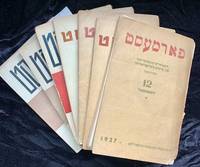
193743101Kharkov: Ukrmelukhenatsmindfarlag 1937. First edition. Original illustrated paper wrappers 8vo issues range from 129-196 pages each. Includes illustrations. 21-23 cm. In Yiddish. Title translates roughly as “Challenge: A Literary Artistic and Critical Bibliographical Journal.â€<br> At the time the only Yiddish literary periodical in Ukraine.<br> Farmest 1933–1937 was a monthly Yiddish literary magazine published in Kharkhiv Ukraine by the Ukrainian Committee for Soviet Writers. “Edited by the poet Itsik Fefer 1900–1952 it was continued in Sovetishe literatur: Literarish-kinstlerisher un kritish-bibliografisher zhurnal Soviet Literature: Literary-Artistic and Critical-Bibliographical Journal; 1938–1941.<br> In 1927 Fefer was a founding member of the Jewish Section of the All-Ukrainian Union of Proletarian Writers and from 1928 one of the editors of its Kharkov-based journal Prolit Proletarian Literature. He also coedited the nonproletarian Kharkov journal Di royte velt The Red World from 1929. From 1933 to 1937 he edited the Kiev periodical Farmest Challenge; known as Sovetishe literatur Soviet Literature between 1938 and 1941 which replaced Prolit and Di royte velt and was thereafter the only Yiddish literary periodical in Ukraine.†YIVO. Avrom Gontar was also involved in the collective and editorial committee. <br> The editor Itsik Fefer 1900–1952 “began writing poems in 1918 and in 1922 joined Vidervuks New Growth in Kiev a group of young Yiddish literati whose mentor was Dovid Hofshteyn. That same year the appearance of Fefer’s small collection Shpener Splinters established him as a rising literary star. His poetry amalgamated the Kultur-lige poets’ revolutionary romanticism with the propagandist objectives of the workers’ movement.<br> Fefer was known for his literary credo of proste reyd simple speech a concept he formulated in 1922. In the early 1920s poetry particularly avant-garde poetry swamped the literary pages of Soviet Yiddish periodicals. This phenomenon worried editors and critics who were wary of the fact that Yiddish readers usually could not identify with this style of literature. All Yiddish readers by contrast could understand Fefer’s proste reyd.<br> In 1927 Fefer was a founding member of the Jewish Section of the All-Ukrainian Union of Proletarian Writers and from 1928 one of the editors of its Kharkov-based journal Prolit Proletarian Literature. He also coedited the nonproletarian Kharkov journal Di royte velt The Red World from 1929†Gennady Estraikh.<br> For more see: Gennady Estraikh “The Kharkiv Yiddish Literary World 1920s–Mid-1930s†East European Jewish Affairs 32.2 2002: 70–88; Chone Shmeruk “Yiddish Literature in the U.S.S.R.†in The Jews in Soviet Russia since 1917 ed. Lionel Kochan pp. 242–280 London and New York 1970.<br> SUBJECTS: Yiddish literature -- Ukraine -- Periodicals. Yiddish literature. OCLC: 35051038.<br> Some pages brittle some wear to spines. Overall Good Condition. Rare. YID-46-2-LGG-’excc. Kharkov: Ukrmelukhenatsmindfarlag unknown
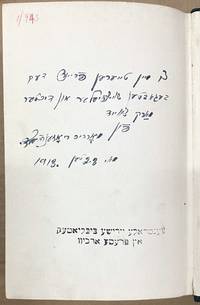
191243120Nyu York New York: Forverts 1912. First edition. Original boards 8vo 266 266 268 pages. 20 cm. In Yiddish. Title translates as “Collected Writings.â€<br> Full set of Morris Rosenfeld’s collected works. Volume 1 contains poetry Volume 2 and 3 contain stories. Warmly inscribed by Rosenfeld in 1913 to Yiddish actor and director Mark Schweid 1891-1969: “To my dearest friend actor and poet Mark Shvayd. From Morris Rosenfeld 3. 2nd i.e. 3 of Feb 1913.†<br> “Rosenfeld known as the ‘Poet Laureate of Labor’ was a pioneer of Yiddish poetry in the US. Born in Russian Poland he came to New York by way of London in 1889 and worked as a presser in a sweatshop. His sweatshop songs were often sung by Jewish workers in factories and at mass meetings. Moshe Starkman notes in the EJ that when his Lider-Bukh ‘The Book of Songs’ 1897 was translated in 1898 by Leo Wiener under the title Songs from the Ghetto his fame spread to non-Yiddish circles. Starkman also notes that ‘his proletarian poems and national songs stirred the Jewish masses during their early struggles in the New World and at the beginning of the Jewish national renascence’ sic. Aaron Kramer notes as well that ‘Of all Yiddish poets Morris Rosenfeld alone.was acknowledged by the non-Jewish literary world as a notable singer;’ Wiener's translation of Songs from the Ghetto ‘immediately established Rosenfeld's reputation among America's literati.†EJ 1971 14: 285-286; Kramer trans: The Teardrop Millionaire and Other Poems 1955.<br> Mark Shveyd Schweid 1891-1969 to whom Rosenfeld inscribed this copy was a “playwright poet translator and artist born in Warsaw. His original Jewish given name was Volf-Mortkhe.…in 1911 he graduated from a Polish drama school in Warsaw and went on to act in Yiddish theaters and on the Polish stage as well. In 1911 he emigrated to the United States performed in New York’s Yiddish theaters and from 1921 was one of the principal artists in Maurice Schwartz’s Yiddish Art Theater. From 1926 he was also acting on the English-language stage.<br> He wrote poetry drama studies one-act plays plays and longer articles on theater. He debuted in print in 1907 with poems in Roman-tsaytung….From 1946 he was an internal contributor to Forverts Forward in New York.<br> Shveyd wrote adapted or translated roughly fifty plays†as well as 9 books. <br> “Shveyd also translated novels from Polish Russian German and English some of which were published such as: Israel Zangwill Troymers fun’m geto Dreamers of the ghetto vol. 1 New York: M. Yankovitsh 1929 341 pp.; Stanislaw Przybyszewski Fun’m obgrund Out of the depths original: De Profundis New York n.d. 79 pp.; Fyodor Dostoevsky Erniderigte un baleytigte Humiliated and insulted original: Unizhennye i oskorblennye New York: Max Jankovitz 1920s 2 vols. Two novels he adapted were published in Warsaw’s Moment†Yekhezkl Lifshits in Leksikon Fun Der Nayer Yidisher Literatur.<br> Schweid was director of the Bronx Art Theatre in 1930-1931; a partial collection of his papers is at the Center for Jewish History in New York. SUBJECTS: Yiddish language. Yiddish poetry. Short stories Yiddish. OCLC: 3758034<br> Vol I with inscription has unobtrusive number on spine and old Yiddish institutional stamp at bottom of inscribed endpaper with gutter taped at contents page. Otherwise a Very Good Condition set with important inscription. YID-46-36--’cc. Nyu York [New York]: Forverts unknown
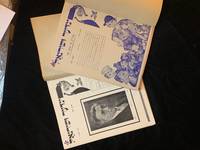
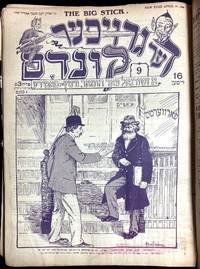
190942930New York: Ferlag "Kibets 1909. 1st Edition. Original publisher’s binding Folio newspaper. Complete first volume Starting with Vol I Nr 1 of “Der Kibitser†Dec. 15 1908 renamed and renumbered first as Vol I Nr 1 Jan 22 1909 of “Der Groyser Kibetser The big kibetzer†with the following issue of Feb 5 numbered as "3" to correctly follow from the first issue and then with Vol I Nr 6 March 19 1909 onward as “Der Groyser Kundes The Big Stick†or “The Big Prankster.†Incidentally the other set of this volume we examined also did not have a Nr 2 so we are confident this is complete as issued. <br> One centerfold cartoon by Zuni Maud see image features "Der Kaptialistisher Tayfel"--the Capitalist Devil–holding back a "mother" by the hair to stop her from interfering as "baby's milk-bottle" is drained off by the "milk-trust" cat. <br> The caption reads "The Capitalist Devil: - to the mother: Never mind madam all in English in Hebrew letters you go to the factory the milk-trust will take good care of your baby."<br> This cartoon-laden periodical was a New York City Yiddish language satirical bi- weekly which ran from 1908 until 1927.<br> The humor paper was issued biweekly this volume for its first 20 months and then weekly after that. OCLC also references another Vol I Nr 1 from April 15 1908 a special S´imhes` Toyreh Simchas Torah issue but this may have been a one-off. <br> Founded by the humorist Yosef Tunkel or Der Tunkeler his pen name meaning 'The Dark One' the paper was taken on by Jacob Marinoff when Tunkel left to work for an established paper in Warsaw. The paper consciously set itself up in opposition to the serious Yiddish-language press of the time such as the socialist Forverts.Naturally more traditional religious Judaism did not escape its satire: The later 1915 "Christmas" edition included a parodic conversation between Jesus and the prophet Elijah. <br> Despite its irreverent attitude to everything it also published poetry by Di Yunge "The Young Ones" poets such as Moyshe-Leyb Halpern and Zuni Maud. At its height it had a circulation of 35000 but folded in 1927 due to flagging sales. Der Groyer Kunds is highlighted in this recent talk by Yiddish comics scholar Eddie Portnoy on the reactions in the Yiddish press to restrictions on Jewish immigration to the US: https://www.yiddishbookcenter.org/collections/archival-recordings/recorded- programs/ybcr-nybc-ybcr-1048/door-slams-shut-reactions-yiddish-press-immigr ation .<br> SUBJECTS: Yiddish wit and humor -- Periodicals. OCLC: 28297536. Most holdings appear to be fragmentary and do not include these issues. Issue 18 with torn cover. In final issue the bottom margin suffers some loss to the final leaves none to the dramatic front cover though. Damaged boards are loose and most issues are coming loose though the quality paper used has remaind strong and bright much better than standard newsprint would have. Important graphic Yiddish humor from the great migration period. Dramatic and displayable! BK5 YID-43-9A-LEX. [New York]: Ferlag "Kibets unknown