Oppenheim, IsraelMareMagnum

658 résultats
Hardback. 8vo. 671 pages. 23 cm. First edition. In Hebrew. Added title page: The "He-Halutz" movement in Poland, 1917-1929. The He-Haluts was a Zionist pioneering movement in Poland. The founders of He-? Aluts believed that no political or propaganda accomplishment would benefit Zionism in the long run unless it were complemented by deeds of personal fulfillment, which became a primary objective in the organizations overall ideology. In other words, to actually implement the principles of He-? Aluts, the individual was expected both to identify with the Histadrut (Labor Federation) and to live on a cooperative kibbutz in Palestine. On an ideological level, the basic foundations of the He-? Aluts movement were consolidated in 1917. Based on a combination of universal socialist and nationalist concepts, they drew ideological influence from the Tseire Tsiyon party. He-? Aluts continued to evolve in Russia even after the change of regime. The fundamentals of agricultural training farms and links with the budding kibbutz movement in Palestine were laid down. The Fourth Aliyah (19241929) marked the first test of the populist concept, since at the time of the Third Aliyah (19191923) the previous immigration waveHe-? Aluts had still been in an amorphous ideological phase and had been a marginal factor in Diaspora public affairs. When He-? Aluts held its world conference in 1923, the movement numbered only 7, 000 registered members, but membership increased to tens of thousands within a year and a half. This massive growth led to a change in the organizations social structure. High-school students and middle-class youth were now replaced with thousands of working-class youngsters and unemployed individuals, including members of Zionist Socialist parties. (YIVO Encyclopedia; He-Haluts; article written by Israel Oppenheim) . Israel Oppenheim is Professor Emeritus of the History of the Jewish People, Ben-Gurion University of the Negev, Beersheba. Subjects: Labor Zionism - Poland - History. Jews - Poland - History - 20th century. Histadrut he-H? Aluts be-Polin. Poland - Ethnic relations. Light soiling to outer edges, previous owners name in pen on inside endpage; otherwise very clean and fresh. Very good condition. (EE-5-32)
Milano, Feltrinelli, 2002, 8vo brossura con copertina illustrata, pp. 230.
In 8°, br. edit. ill., pp. 238,(2); copia molto buona (Coll. "Faretra", 26). (ban 03)
Softbound. 8vo. 112 pages. 22 cm. Second edition. Reprint, originally published: Riga, 1932. In German. The Emergence of the Jewish Labor Movement in Russia. Subjects: Jews - Soviet Union. Working class - Soviet Union. Joden. Arbeidersbeweging. OCLC lists 23 copies. Light shelf wear to edges, otherwise clean and fresh. Very good condition. (EE-5-46)
16', 229pp. hardcover. worn cover and edges, spine on edges slightly damaged. stamp and previous owners name on title page, yellowing pages, else in fair+ condition.
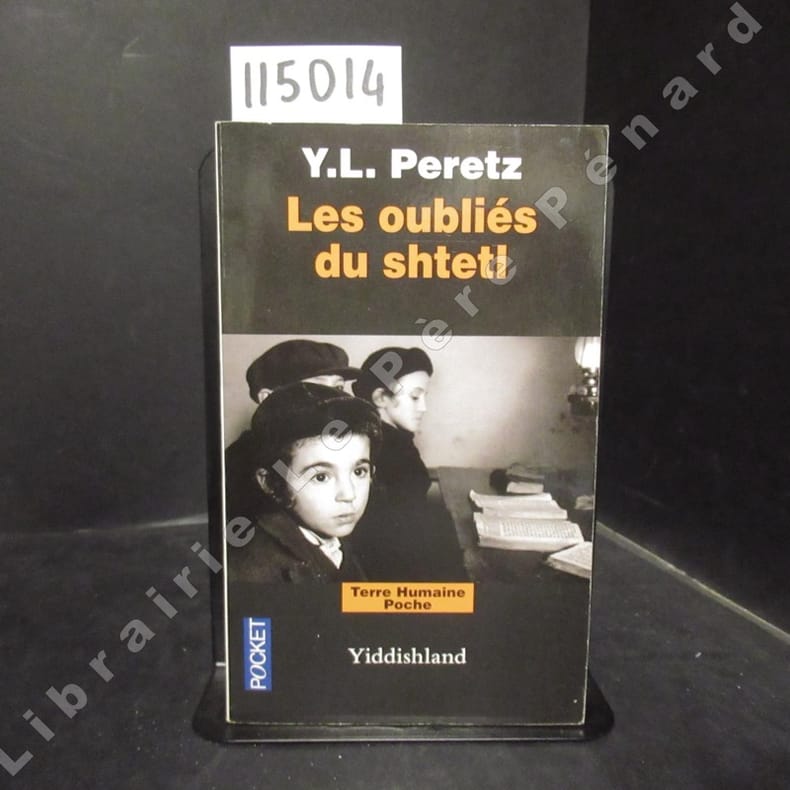
20101150142010 Editions Pocket, Collection "Terre Humaine Poche" dirigée par Jean Malaurie - 2010 - In-12, broché, couverture illustrée en N&B - 537 p. - Petit cahier de reproductions photographiques en N&B en milieu d'ouvrage
Original Cloth. 8vo. VI, 133 pages. 24 cm. First edition. In German. 'Bousset's Religion of Judaism: critically examined from the New Testament Period. ' A critique of the Protestant theologian Wilhelm Bousset's 'Religion des Judentums', also published in 1903. Felix Perles (18741933) , rabbi and scholar. Felix was drawn into the Zionist movement in Vienna and in 1899 he became rabbi at Koenigsberg. Felix Perles had wide scholarly interests: Bible criticism, Hebrew and Aramaic lexicography, apocryphal and pseudepigraphical literature, medieval Hebrew poetry, liturgy, Jewish dialects, and abbreviations. His best-known works are his critique of W. Bousset's Religion des Judentums im neutestamentlichen Zeitalter (1903) , and the collection of essays, Juedische Skizzen (1912, 1920) . - 2008 EJ. Attractively bound in period cloth with original wraps pasted on top. Subjects: Judaism - History. Die Religion des Judentums im neutestamentlichen Zeitalter (Bousset) . Christentum. Judentum. Bousset, Wilhelm, 1865-1920. Religion des Judentums im neutestamentlichen Zeitalter. Dedication inscription on title page, light pencil marks on some pages, otherwise very fresh and clean. Very good + condition. (GER-43-36)
1374691Paris: ORT, Somogy, 2006 in-4, 96 pages, carte, 58 illustrations. Cartonnage, jaquette, avec défauts minimes. Ouvrage publié à l'occasion de l'exposition présentée au Musée d'art et d'histoire du Judaïsme.
IN YIDDISH. 17.5x24.5 cm. 82 pages. Hardcover. Spine slightly wrinkled. Spine's bottom slightly folded and chafed. Else in good condition.
1st edition thus. Later paper wrappers, 12mo, 24 leaves, 155:90 mm. In Yiddish, with title also transliterated on title page ("Hanoges Odom"). Title translates as, The Book of Man's Leadership: ... How Every Jew Should Conduct Himself All His Days From Early to Evening ... and Many Laws. Proper daily behavior for Jews. Contains Kabbalistic customs and practices based on the teachings of the Ari. The text includes detailed descriptions of the halakhot and customs of the Ari for weekdays, Shabbat and festivals, and daily occasions.Although published anonymously, this appears to be similar to the work of Rabbi Meir ben Judah Leib Poppers (died 1662). He was a kabbalist of Ashkenazi descent who was active in Jerusalem after 1640. A pupil of Rabbi Jacob Zemah, he became the last editor of the Lurianic writings. He divided the mass of Rabbi Vital's different versions of Rabbi Luria's teachings into three parts, Derekh Ez Hayyim, Peri Ez Hayyim, and Nof Ez Hayyim. Rabbi Poppers' version became the one in most widespread use in Poland and Germany. After 1640 he composed a large number of his own kabbalistical writings in the vein of Lurianic Kabbalah. They are said to have comprised 39 books, each of which contained the word or ("light") in its title, the entire corpus being called Kokhevei Or. Several parts have been preserved (Ms. Jerusalem no. 101, Ms. Rabbi Alter of Gur no. 170). They included commentaries on Sefer Bahir, on Nahmanides' Torah commentary, on the Zohar, and on Luria's writings according to his own edition (Ms. Jerusalem no. 102). In the latter manuscript Poppers reports that he had studied Rabbi Luria's writings for 17 years. Only two of these books have been published, this work and Or Zaddikim (Hamburg, 1690), written in Jerusalem in 1643, and later incorporated in Rabbi Moses Katz's compilation, Or ha-Yashar (Amsterdam, 1709); and Me'orei Or, a dictionary of kabbalistic symbolism, published with copious notes by Jacob Vilna and Nathan Neta Mannheim under the title Me'orot Natan (Frankfurt, 1709). In addition, Mesillot Hokhmah, a booklet summarizing Lurianic metaphysics in 32 paragraphs, later published under Rabbi Poppers' name (Shklov, 1785), was first printed anonymously (Wandsbeck, c. 1700). Rabbi Poppers is credited with the authorship of a graphic description and summary of the Lurianic system, in the form of a scroll, published under the title Ilan ha-Gadol (1864). This tree, however, shows the distinct influence of Rabbi Israel Sarug's version of Lurianism, which is not to be found in Poppers' other writings. Part of his homilies on the Torah were published as Tal Orot (1911). He mentions as his teachers one Rabbi Israel Ashkenazi and his father-in-law, Azariah Ze'evi (probably from Hebron). During the 1650s Poppers spent about two years in Constantinople. He died in Jerusalem. (EJ, 2007). SUBJECT(S): Jewish ethics. OCLC: 233362307. OCLC lists only one copy (NLI), which, it is noted is missing the end, after 24 leavesexactly the same as our copy, so possibly as issued??? Some toning and stains. Good Condition, very rare. (YID-42-23)
8vo; aprox. 400 pages; 22 cm. Complete in 2 volumes, bound together. Many photos. In the original Hebrew. Those who never yielded: the History of the Chassidic Rebel Movement in the Ghettoes of German-Occupied Poland. Subjects: Jews--Persecutions--Poland. Hasidim--Poland. Holocaust, Jewish (1939-1945) --Poland. World War, 1939-1945--Jewish resistance--Poland. Poland--Ethnic relations. Very Good Condition in Very Good Jacket. (H-41-22)
First edition. Original blue publishers cloth, large square. 8vo, 16 leaves with 15 tipped in plates. Each leaf contains a tipped in color print by Raban in the classic style with English text in a gilt Bezalel style frame on the facing page. Title translates as, "Chagaynu. Our Holidays: A Picture Book Drawn by Z. Raban of the Bezalel Srt school, Jerusalem." Chagaynu (meaning Our Holidays) is a beautiful picture book drawn by Zeev Raban of the Bezalel Art School in Jerusalem. The book includes 14 plates featuring gorgeous color illustrations by Raban, all showing Jewish holidays throughout the year. Each illustration includes with it a poem by Israeli children's author and poet Levin Kipnis ("Avi-Shai"). Each color plate is protect by tissue guards. Text in Hebrew. Raban, the artist, is regarded as a leading member of the Bezalel school art style, in which artists portrayed both Biblical and Zionist themes in a style influenced by the European Jugendstil (similar to Art Nouveau) and by traditional Persian and Syrian styles. Israel Museum Catalogue, Bezalel number 1348; Yeshiva University Museum Catalogue, Raban Remembered, number 78. Dime-sized stain on front end papers, otherwise very clean. Bookplate, no other markings. Wear to cloth boards. Overall Good+ Condition. (art-21-8AXX)
Publishers boards. 8vo. 574 pages. 22 cm. Illustrated. First edition. 8 leaves of black and white photographs. Title translates as, In Search of Destiny: the Jewish People in the Cycle of History: Book 2 This book, which is the second part of the trilogy, describes the fate of the Jews of tsarist Russia after the fall of the autocracy. Subjects include: the Jewish question in the Ukrainian People's Republic of 1917-1920, the spiritual life of the Jews in the Soviet Union in the 20's and 30's of the last century, the failed Jewish land management in Soviet countries, the situation of Jews in Soviet Belarus and in the territories of Belarus and Ukraine as part of Poland. Considerable attention is paid to the anti-Semitic policies of Nazi Germany and the Holocaust. The final part of the book describes the total destruction of the Jews in the Soviet Union, occupied by the Nazis during the war, and a thorough examination of the role of the Judenrat in the Nazi plans for the Final Solution of the Jewish question. (Publishers description) Subjects: Jews History. Ex-Library with usual markings. Light shelf wear, text clean and bright. Very good condition. (EE-6-15)
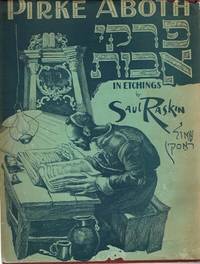
19387471NY: Academy Photo Offset Inc. Very Good in Good dust jacket. 1938. First Edition Thus. 1. Hard Cover. Publisher's full burgundy cloth Hebrew lettering gilt on cover. title page in color. Illustrated with fine etchings by Saul Raskin Text in English and Hebrew. Covers very lightly soiled Hebrew inscriptions on ffep very mildly shelf-worn else fine. The dust jacket now in Mylar is moderately chipped with some loss at the head of the spine. All of the etchings are in bright clean condition. VERY GOOD/VERY GOOD. . Etchings. 4to 11" - 13" tall. 124 2 pp . Academy Photo Offset, Inc. hardcover
1st edition. Period boards. 8vo. 15 pages each, 31 cm. In Yiddish. Title translates to Jewish Literary World. Vokhenshrif? Far li? Era? Ur, ? Uns? , kritik un kultur-fragen. " Abraham Reisen was leading Yiddish writer and a founder (with his brother Zalman, Chaim Zhitlovsky, I. L. Peretz, and his close friends Scholem Asch and Hersch Dovid Nomberg) of the Yiddishist movement and took part in the Czernowitz Yiddish Language Conference of 1908 at which Yiddish was proclaimed a national language of the Jews (Wikipedia, 2019) . SUBJECTS: Yiddish literature - periodicals. OCLC lists 16 copies worldwide (OCLC: 33025197) . Ex-library with usual markings. Binding is starting. Some pages are lightly worn. Overall Very good condition. (YID-32-25-DL)
Original Wraps. 8vo. 31 pages. 24 cm. Third edition. In German. 'On the Rights of Citizenship of German Jews. ' A general history of German state law concerning German-Jewish subjects. Written by Paul Rieger (18701939) , a German rabbi, scholar, and historian. Rieger, who was born in Dresden, served as rabbi to the Reform congregations at Potsdam (18961902) , Hamburg (190219) , Brunswick, and Stuttgart (192239) where he died. He published works on the terminology and technology of handicrafts in the Mishnah, Versuch einer Technologie und Terminologie der Handwerke in der Mischnah (1894) , and on various aspects of contemporary German-Jewish history. His major work was his participation, in collaboration with his friend Hermann Vogelstein, in a massive work on the history of the Jews in Rome (Geschichte der Juden in Rom) , as the result of a prize competition sponsored by the Moritz Rapoport Foundation in Vienna in 1890. - 2008 EJ. In the series: Das Licht, Heft 4. First published 1921 (second edition 1922) all by Philo Verlag. Subjects: Jews - Germany - History. Germany Law Jewish Communities. Heimatrecht. OCLC lists 19 copies of this edition. Light soiling to wraps, otherwise fresh. Good + condition. (GER-43-37)
New English Paperback. Pbo. Roy. 8vo. In English. 124 p. Ills. Contents: Abbreviations, Introduction, The place of the Jews in the prostitution marketplace of Constantinople, Michel Salomonovich chef des marchands, olice secrete a Constantinople, Edited by Albert Ettiges, 'Report of an enquiry made in Constantinople by S. Cohen., 'Prostitution' by Charles Trowbridge Rigss., Bibliography., Illustrations.
First edition. Original wrappers. 4to. 48 + [4] pages. 32cm. In Yiddish. Milgroym was published bi-monthly in separate Hebrew and Yiddish editions (The Hebrew editions were titled Rimon) from 1922-1924 for a total of 6 issues and "embraced the study, both retrospective and contemporary, of art in all its manifestations painting, sculpture, music, theatre. " In Geveb called Milgroym "arguably the most visually stunning of the interwar Yiddish journals." Each issue contains illustrations and literary works from a wide array of Jewish artists. Milgroym also published works by the likes of Chaim Nachman Bialik, Jacob Klatzkin, Marc Chagall, El Lissitzky, and A. Z. Idelson. The present issue features an essay on the Synaoguge of Mohilev, with illustrations, by El Lissitzky; and essay on Jewish Artists in Russia by Henryk Berlewi, an essay on the Magen David by Moses Gaster; an essay on the Posthumous Work of Israel Wachser by Chaim Bialik, as well as other articles and illustrations, many in color. For a detailed analysis of the importance and cultural context of Milgroym, see Naomi Brenner's excellent essay, "Milgroyms Cultural Context (https://ingeveb.org/blog/milgroym-s-cultural-context), part of In Geveb's series on Milgroym and other interwar Yiddish journals. For more on Milgroym, see the In Geveb special issue dedicated to this wonderful periodical (https://ingeveb.org/issues/the-milgroym-project). SUBJECT(S):Jews -- Periodicals. Yiddish literature Jewish arts -- Periodicals. Art, Modern -- 20th century -- Periodicals -- Yiddish. Germany. Jüdische Kunst. OCLC: 1200783324. Wrappers are very lightly soiled and browning. Spine is worn. Internally Very Good. (ART-27-6A)
First edition. Original wrappers. 4to. 48 + [4] pages. 32cm. In Yiddish. Final issue. Milgroym was published bi-monthly in separate Hebrew and Yiddish editions (The Hebrew editions were titled Rimon) from 1922-1924 for a total of 6 issues and "embraced the study, both retrospective and contemporary, of art in all its manifestations painting, sculpture, music, theatre. " In Geveb called Milgroym "arguably the most visually stunning of the interwar Yiddish journals." Each issue contains illustrations and literary works from a wide array of Jewish artists. Milgroym also published works by the likes of Chaim Nachman Bialik, Jacob Klatzkin, Marc Chagall, El Lissitzky, and A. Z. Idelson. For a detailed analysis of the importance and cultural context of Milgroym, see Naomi Brenner's excellent essay, "Milgroyms Cultural Context (https://ingeveb.org/blog/milgroym-s-cultural-context), part of In Geveb's series on Milgroym and other interwar Yiddish journals. She discusses this issue in particular in her essay, "Milgroym and Rimon, Fraternal Twins" (https://ingeveb.org/blog/milgroym-and-rimon-fraternal-twins). For more on Milgroym, see the In Geveb special issue dedicated to this wonderful periodical (https://ingeveb.org/issues/the-milgroym-project). SUBJECT(S):Jews -- Periodicals. Yiddish literature Jewish arts -- Periodicals. Art, Modern -- 20th century -- Periodicals -- Yiddish. Germany. Jüdische Kunst. OCLC: 1200783324. Wrappers are very lightly soiled and browning.Wear to spine. Internally Very Good. (ART-27-6C)
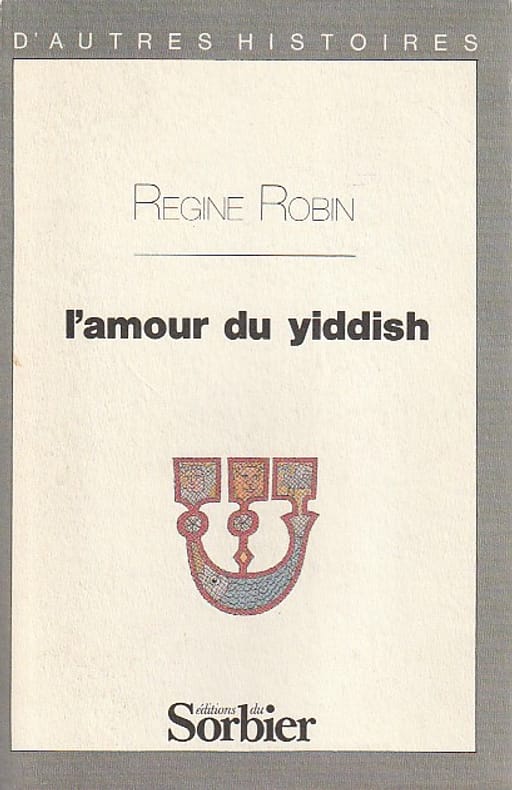
65889Sorbier, D'autres histoires, 1984, 321 pp., broché, couverture légèrement empoussiérée, dos très légèrement en gouttière, état satisfaisant.
Papers presented at a Conference held at the Jewish Public Library, Montreal in March 1988.[1] "Yiddish in Montreal: The Utopian Experiment" by David G. Roskies [2]"Montreal of Yesterday: A Snapshot of Jewish Life in Montreal During the Era of Mass Immigration" by Zachary M. Baker [3]"The Journal of Yaacov Zipper 1925-1926" by Ode Garfinkle and Mervin Butovsky [4] "HM Caiserman: Yiddish as a Passion" by Pierre Anctil [5]"'A Letter from the Sabbath Queen': Rabbi Yudel Rosenberg Addresses Montreal Jewry" by Ira Robinson [6] "Between Two Worlds: The Works of JI Segal" by Shari Cooper Friedman[7] "Public Lives in Private: Ida Maze and the Montreal Yiddish Renaissance" by Irving Massey. Also a glossary of terms from Aggadah to Zohar. 169p. index. Book
1377147Buenos Aires: Ejecutivo Sudamericano del Congreso Judiuo Mundial, 1979 in-8, 23 pages, portrait. Couverture abimée. "Biblioteca popular judia". Texte espagnol.
8vo. 368 pages. In Hebrew. SUBJECT (S) Aufsatzsammlung Rumanien Juden. In very good condition (Bible-6-17) .
pp. xvii, 262. Inscribed by Max Rosenfeld to Ron Lieberman (bookseller). 8vo. Original printed wraps. JUDAICA BOX 4
IN HEBREW AND YIDDISH. 23.5x15.5 cm. 252 pages. Gilt hardcover. Spine is slightly faded. Cover is slightly stained. Exlibris sticker on inside cover. Writing in pencil on some pages. Else in good condition.