3 887 résultats
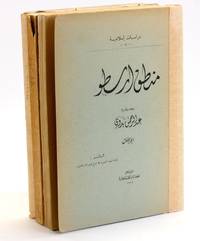
arabe Grand in-4 (160 pp. environ) ; cartonné de l'éditeur.
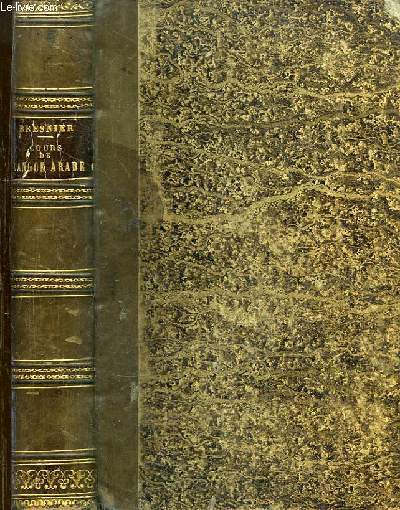
1855RO80099815BASTIDE, CHALLAMEL, DUPRAT. 1855. In-12. Relié demi-cuir. Bon état, Couv. défraîchie, Dos satisfaisant, Intérieur acceptable. 668 pages. Chromolithographie en frontispice avec serpente. Pièce de titre. Titre, filets et roulettes dorés sur demi-veau glacé.. . . . Classification Dewey : 492.7-Arabe
1846R320060235BASTIDE - ALGER.. 1846. In-8. Broché. Etat d'usage, 1er plat abîmé, Dos abîmé, Intérieur frais. 90 pages + quelques planches dont une en couleurs (Texte arabe). - 1er palt dechiré en coin mais cosnervé - Renfort papier au dos - 1 etiquette collée en 1er plat.. . . . Classification Dewey : 492.7-Arabe
1837RO40246286C. A. Schwetschke und Sohn. 1837. In-4. Relié demi-cuir. Bon état, Couv. convenable, Dos à nerfs, Intérieur acceptable. 694 pages. Texte sur 2 colonnes. Titre doré sur le dos. Etiquette de code sur la couverture. Quelques tampons de bibliothèque. Légères épidermures sur le dos.. . . . Classification Dewey : 492.7-Arabe
C. A. Schwetschke und Sohn. 1837. In-4 Carré. Relié demi-cuir. Bon état. Couv. convenable. Dos à nerfs. Intérieur acceptable. 694 pages. Texte sur 2 colonnes. Titre doré sur le dos. Etiquette de code sur la couverture. Quelques tampons de bibliothèque. Légères épidermures sur le dos. Edidit G.W. Freytag.
19190PARIS, A la Librairie Economique -de l'Imprimerie de Guilleminet - An IX - 21 volumes sur 22 (Manque T.7) - In-16 (13 x 8,5 cms) -Reliure pleine bazane de l'époque (coins frottés pour certains tomes) - Dos lisse à filets dorés - Pièce de tomaison en maroquin cerise, tomaison dorée - Pièce de titres verte, titre doré - Frontispices & Gravures PP dans pratiquement tous les ouvrages - 179, 218, 220 & 244, 242 & 222, 200,206 & 234, 210, 220 & 260, 243, 230,252, 276, 253, 247 & 232, 179 & 231 pages - Bel ensemble - envoi rapide et soigné
PARIS, A la Librairie Economique -de l'Imprimerie de Guilleminet - An IX - 21 volumes sur 22 (Manque T.7) - In-16 (13 x 8,5 cms) -Reliure pleine bazane de l'époque (coins frottés pour certains tomes) - Dos lisse à filets dorés - Pièce de tomaison en maroquin cerise, tomaison dorée - Pièce de titres verte, titre doré - Frontispices & Gravures PP dans pratiquement tous les ouvrages - 179, 218, 220 & 244, 242 & 222, 200,206 & 234, 210, 220 & 260, 243, 230,252, 276, 253, 247 & 232, 179 & 231 pages - Bel ensemble - envoi rapide et soigné Les tomes 15 à 21 sont des ouvrages posthumes
Very Good English Original 1/4 leather bound in Ottoman lettered gilt on spine. Roy. 8vo. (24 x 17 cm). In Ottoman script. [17], 640 p., 11 p. b/w plates. 1 genealogical tree. First Ottoman Turkish Edition of Poole's 'The Mohammedan dynasties: Chronological and genealogical tables with historical introductions' was printed in 1894. Ozege: 4502. Düvel-i Islamiye. Translator: Halil Edhem [Eldem]. [= The Mohammedan dynasties: Chronological and genealogical tables with historical introductions (1894)].
1952509101El Nahda el Masria 1952. Paperback. VERY GOOD. Critical Arabic text edited by Badawi. 1068pp in continuous pagination across the three volumes. 8vo's sewn binding in publisher's printed wraps. Wrappers show some wear spines reinforced with paper tape volume 1 front wrapper tail corner perished otherwise all volumes are sound and unmarked. [El Nahda el Masria] paperback
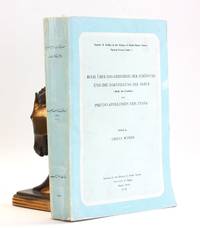
1979508629Institute for the History of Arabic Science 1979. Paperback. VERY GOOD. Critical text of Pseudo-Apollonios in Arabic with German introduction. 702pp. 4to sewn binding in publisher's printed wraps. Hinges reinforced with scotch tape tips a bit worn sound and unmarked otherwise. Quite a scarce volume. 'Here for the first time in the history of orientalist scholarship is a complete critical edition of the Kitäb sirr al-khaliqa The Book of the Secret of Creation in its Arabic text; it is also titled Kitab al-'ilal The Book of the Causes. A separate study of the tradition of the text together with a German abstract is planned to be published in the series Ars Medica. Together with the Tabula Smaragdina which originally had its place at the end of this treatise the Kitäb sirr al-khaliqa was one of the best known and most influential treatises in Arabic and Latin medieval alchemy and cosmology. Long ago this book was correctly identified as a spurious work of Apollonius of Tyana. No Greek predecessor is known and the Arabic text in the present form was probably composed around the time of the caliph Ma'mun A.D. 813-833. In many respects the Kitab sirr al-khaliqa resembles the Book of Treasures by Job of Edessa: like it the Kitäb sirr al-khaliga sheds a good deal of light on the broad spectrum of often rather crude explanations of the natural phenomena human physiology and pyschology and philosophical problems that provide the fertile soil for the growing scientific movement in the Islamic culture of the early ninth century. More specifically this Arabic text is of enormous interest for the study of the development of a scientific terminology in that language. The edition is mainly based on four manuscripts representing the most archaic recension and chosen from among seventeen that were examined out of some forty known to be extant. Even the critical edition of the Latin version prepared by M. T. D'Alverny and F. Hudry was consulted in a first draft. When we further consider that the editor had to write the 702-page Arabic text with all the variants diligently by hand the reader cannot fail to feel grateful for an amazingly well-executed contribution to the carly history of Arabic science.' Anton Heinen Review in History of Science Society. Institute for the History of Arabic Science paperback
Fine Turkish Original pictorial wrappers. Oblong large 8vo. (13 x 25 cm). In Turkish. [22] p., many b/w plates. Not recorded in any platform and library, extremely rare propaganda pamphlet prepared for 60's Turkey by the UAR, The United Arab Republic. On the frontispiece, the leader of the UAR, Egyptian President Gamal Abdel Nasser's iconic words with his portrait by Moheeb. The pamphlet includes the UAR's vision usually and its social and economic policies, projects, Suez Canal, Al-Wady al-Gadid, industry, navigation, mining, oil and its industry, agriculture and agricultural reforms, livestock, culture and education, medicine, water, tourism, etc. Extremely rare.
Very Good Turkish, Ottoman (1500-1928) Original decorative leather bdg. with six compartments on spine, in Ottoman traditional style. Foolscap 8vo. (18 x 12 cm). In Ottoman script. [3], 348 p. Nisanci Mehmed Pasha was one of the historians in the period of Kanuni Sultan Süleyman. His manuscript which has been named 'Tevârîh-i Âli Osmân'. Özege 19880 / 1. Köksal (ATYB) 171. (For Second Edition). First Edition. Extremely rare.
180935407Imprimerie Impériale | Paris 1809-1829 | 71 x 54 cm | une feuille
- Imprimerie Impériale, Paris 1809-1829, 71x53,5cm, une feuille. - Original, unshaved, full-page etching from the "Imperial edition" of the Description de l'Égypte, or 'Recueil des observations et recherches faites en Égypte pendant l'expédition française, publié par les ordres de Sa Majesté l'Empereur Napoléon le Grand [A Collection of the observations and research carried out in Egypt during the French expedition, published on the orders of his Majesty the Emperor Napoleon the Great]'. Produced between February 1802 and 1830 on the orders of Naopleon Bonaparte and published between 1809 and 1828, 1,000 copies were printed and distributed to institutions, on vergé paper with an 'Égypte ancienne et moderne' watermark, visible when held up to the light. Light marginal spotting not touching image, otherwise in very fresh, fine condition. An engraving from the Description de l'Egypte, one of the masterpieces of French printing and the birth of a new field: Egyptology. A gigantic survey of Egypt at the time of Bonaparte's conquests in 1798 and 1799, the work is divided into 13 volumes of engravings making up 892 plates, of which 72 colored, as well as presenting the splendors of the Egypt of the Pharaohs in 9 volumes. The other volumes discuss natural history and present a fascinating portrait of Coptic and Islamic Egypt as it was seen by Bonaparte's Eastern Armies. The 'Egyptian campaign', militarily a disaster, demonstrates, through the engravings of the Description d'Egypte, the scientific success it nonetheless became thanks to the 167 expert members of the Commission of the Sciences and Arts of the Institut d'Egypte [Egyptian Institute] who followed Napoleon's army. The Institut gathered together in Egypt the mathematician Monge, the chemist Berthollet, the naturalist Geoffroy Saint-Hilaire as well as numerous artists, engineers, architects and doctors. They were tasked with re-discovering modern and ancient Egypt and displaying its natural treasures as well as the know-how of its inhabitants. This edition, the so-called "Imperial" edition of the plates for the Description de l'Egypte was printed in four large formats, two of which were specially created for it and christened "Moyen-Egypte" and "Grand-Egypte". A special press was built to print it, the process extending over 20 years, from 1809 to 1829. The "Imperial" edition proved so popular that a second edition, this time in black and white and without the "Egypte ancienne et moderne" watermark - known as the "Royal Edition" - was published during the Restoration by the printing house of C.-L.-F. Panckoucke (Paris). The engravings of the Description d'Egypte owe a great deal to Baron Dominique-Vivant Denon, illustrator, diplomat, collector and later Director of the Musée Napoléon (the Louvre). His exploration of the South of Egypt gave Bonaparte the idea of sending the experts of the Institut there, thus creating a faithful and complete portrait of the area. This was the research gathered together from 1802 in the mammoth Description de L'Egypte. Denon embarked on this story of archeological exploration at the age of 51, reaching first Alexandria and then Cairo before exploring Upper Egypt. Along with the members of the Institut d'Egypte, the Natural History Museum's painter H.J. Redouté (brother of Pierre-Joseph Redouté, author of Roses), the mineralogist Dolomiue, and the draughtsman Joly, Denon then explored the Nile Delta and Lower Egypt. When, however, he joined the 21st Light Infantry Regiment as it marched across Upper Egypt in pursuit of the retreating Mameluks in November 1798, he found himself the only civilian. In the very midst of the battle itself, he reeled off sketches of the works of art that peppered his path right up to the threshold of the Sudan. He said that he had crossed "a country that is, apart from its name, entirely unknown to Europeans, and therefore everything was worth describing" (Voyages dans la Basse et la Haute Egypte pendant
35363Paris Plon-Nourrit et Cie, Imprimeurs-Editeurs 1919 in 12 (19x12) 1 volume broché, couverture imprimée, 300 pages [1]. La chevalerie, la noblesse et le culte des aïeux, le culte de la femme, le culte du cheval et des armes, le culte de l'honneur. Edition originale. Envoi autographe signé par l'auteur. Bon exemplaire ( Photographies sur demande / We can send pictures of this book on simple request )
ORD-1451Alger. Adolphe Jourdan. 1891. Première et seule édition. In-8 (160 x 225mm) broché, couverture gris bleu imprimée, 2ff., 222 pages, bien complet de la très grande carte plusieurs fois rempliée. Couverture abîmée, manque de papier au dos, marges inférieures mal massicotées, mais marges conséquentes. Exemplaire à relier. Rare. Tailliart, 1639.
180925340Imprimerie Impériale | Paris 1809-1829 | 70 x 53.50 cm | une feuille
180923388Imprimerie Impériale | Paris 1809-1829 | 71 x 54 cm | une feuille
180926337Imprimerie Impériale | Paris 1809-1829 | 71 x 53.50 cm | une feuille
180926339Imprimerie Impériale | Paris 1809-1829 | 71 x 53.50 cm | une feuille
180926376Imprimerie Impériale | Paris 1809-1829 | 71 x 53.50 cm | une feuille
180926388Imprimerie Impériale | Paris 1809-1829 | 71 x 53.50 cm | une feuille
- Imprimerie Impériale, Paris 1809-1829, 71x53,5cm, une feuille. - Gravure originale à l'eau-forte in plano, non rognée, extraite de l'édition dite « Impériale » de la Description de l'Égypte ou Recueil des observations et recherches faites en Égypte pendant l'expédition française, publié par les ordres de Sa Majesté l'Empereur Napoléon le Grand. Réalisée entre février 1802 et 1829 sur ordre de Napoléon Bonaparte et publiée à partir de 1809 [en réalité 1810], elle fut tirée à 1000 exemplaires sur Vergé filigrané « Égypte ancienne et moderne » et offerte aux institutions. Légères et marginales rousseurs sans atteinte à la gravure, sinon très bel état de fraîcheur et de conservation. Volume ETAT MODERNE, II : Le génie des savants de l'Institut se révèle particulièrement à travers les planches de la section dite Egypte Moderne. Architecture, industrie, structures sociales, état sanitaire, régime des eaux, musique, artisanat, sont exposés avec une précision et une qualité graphique exceptionnelle. L'esprit de L'Encyclopédie de Diderot et d'Alembert reste sous-jacent dans la démarche des dessinateurs de la Description de L'Egypte, qui accompagnent les volumes de textes de nombreuses planches détaillées, s'employant à dresser un portrait des populations empreint de beauté et de respect. Riches pachas ou simples artisans potiers sont représentés avec sensibilité, vaquant à leurs occupations au milieu de compositions esthétiques, sans pour autant tomber dans l'idéalisme ou la caricature. LA DESCRIPTION DE L'EGYPTE, édition IMPERIALE (1809-1829) : La Description de l'Egypte est un des chefs d'uvre de l'édition française et le point de départ d'une nouvelle science : l'égyptologie. Titanesque exposé de l'Egypte au temps des conquêtes de Bonaparte entre 1798 et 1799, elle est répartie en 23 volumes dont 13 volumes de gravures rassemblant près de 1000 planches en noir et 72 en couleur. Les 6 volumes de planches intitulées Antiquités sont consacrés aux splendeurs de l'Egypte pharaonique. L'Histoire naturelle est répartie en 3 volumes de gravures. Un volume est consacré aux Cartes géographiques et topographiques tandis que les 3 volumes : Etat Moderne dressent un portrait saisissant de l'Egypte copte et islamique telle qu'elle était vue par les armées d'Orient de Bonaparte. La « campagne d'Egypte », désastre militaire, dévoile à travers les gravures de la Description de l'Egypte la réussite scientifique qu'elle est devenue, grâce aux quelques 167 savants membres de la Commission des sciences et des arts de l'Institut d'Egypte qui suivaient l'armée de Napoléon. L'Institut a réuni en Egypte le mathématicien Monge, le chimiste Berthollet, le naturaliste Geoffroy Saint-Hilaire, ainsi que de nombreux artistes, ingénieurs, architectes, médecins... Ils eurent la charge de redécouvrir l'Egypte moderne et antique, d'en montrer les richesses naturelles, et le savoir-faire de ses habitants. L'édition originale, dite « Impériale », de la Description de l'Egypte fut réalisée sur quatre formats de grande taille, deux d'entre eux spécialement créés pour elle et baptisés formats « Moyen-Egypte » et « Grand-Egypte ». On construisit une presse spécifique pour son impression, qui s'étala sur vingt ans, entre 1809 et 1829. L'édition Impériale s'avéra si populaire qu'une deuxième édition en 37 volumes entièrement en noir et sans le filigrane « Egypte ancienne et moderne », dite édition « Panckoucke », fut publiée à partir de 1821 par l'imprimerie C.-L.-F. Panckoucke (Paris). La réalisation de ce monument d'érudition doit beaucoup au baron Dominique Vivant Denon, illustrateur, diplomate, collectionneur et par la suite directeur du musée Napoléon du Louvre qui accompagna Napoléon en Egypte avec de nombreux autres savants mais décida seul de s'aventurer dans le Sud du pays, alors que les autres scientifiques conviés restaient confinés dans la région du Caire. Les fabuleux croquis rapportés par Denon lors de sa romanesque chevauchée donnèrent l'idée à Bon
180329633Didot | Paris 1803 | 40 x 54 cm | une feuille
180329641Didot | Paris 1803 | 40.50 x 54 cm | une feuille