[ARABIC MANUSCRIPT].Biblio.com
1 788 résultats
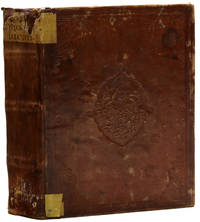
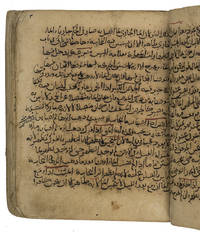
ABC_45853Levant 1290. Contemporary blind-tooled calf mostly covered with later calf leaving only the contemporary back cover exposed. 19th century European paper endpapers. With a loose leaf of 18th century European paper with Arabic manuscript writing on one side. Small 4to in 6s 17 x 14 cm. Arabic manuscript 15 to 17 lines to the page written in clear cursive ta'liq script on brown Middle Eastern paper. With occasional red rubrication. Lengthy and well preserved 13th century Arabic manuscript law book on the fatwa produced in the Levant by an anonymous author. A fatwa is legal advice given by a Muslim authority on request with the purpose of resolving a religious or legal problem that has arisen among members of Islam. The person who gives the legal information is familiar with Islamic jurisprudence fiqh and is referred to as a mufti; the one who asks for legal advice is called Mustafti. According to the famed 13th-century Islamic jurist Ibn al-Qaayyim al-Jawziya mufti were Gods agents". The present anonymous work seems to treat the jurisprudence of the fatwa itself rather than declaring fatwa on something. The title means "The book of kitab analisys or understanding al-waaqi of the fatwa fi'l-Fatawi". As described in the book itself this is the first volume of an unknown total.Fatwas were produced by jurists from the 10th century onward and in the 13th century when the present copy was made several important Islamic lawbooks were compiled in India at the Sultanate of Delhi.Provenance: 1963 Elghanyan to Hagop Kevorkian 1872-1962; sold at Sotheby's 18 April 1983 Kevorkian collection lot 25; private collector.Binding a bit short. Shelf marks on the front pastedown. Later annotations on the 19th century front endpapers. First leaf repaired. A few minor holes throughout paper browned 2 quires in the middle detached. Otherwise in remarkably good condition for its age.l Schoenberg Database: 29775. unknown
190055709Turkey 1900. Contemporary morocco. Very good. Small oblong folio 16 by 30 cm. 28 leaves. Quranic manuscript in Jali Diwani script; gilt text recto and verso 3 lines per page on polished cream paper interleaved with onionskin protective leaves. Contemporary deep brown paneled morocco wallet binding rubbed tooled in gilt and blind; decorative paper pastedowns. Binding skilfully rebacked to style; neat professional repair to tear at front cover panel. Light marginal tidemarks; notable old ink marks continuous line across two leaves; occasional small marginal perforations not affecting text. Very good.<br /> <br /> Rare example of a text from the Qur'an in the Jali Diwani script an elaborate intertwining Arabic cursive developed during the early Ottoman era in the sixteenth century. The text in the present manuscript is entirely in gilt and derives from Juz 29 entitled Tabaraka "Blessed is" after the opening word of the first sura. One of the thirty roughly equal portions into which the Qur'an is divided Juz 29 comprises four complete suras: Al-Mulk "The Dominion"; Nuh "Noah"; Al-Jinn "The Jinn"; Al-Mursalat "The Emissaries. Copies of the Qur'an found in mosques especially in earlier times when manuscripts where very costly were often bound into these thirty portions. According to Islamic tradition during the month of Ramadan the entire Qur'an is recited usually at the rate of one juz each evening. unknown
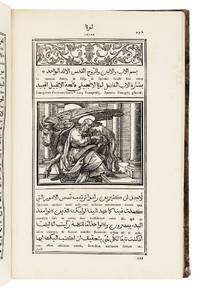
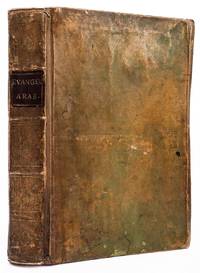
65425Romae Rome: In Typographia Medicea 1591. FIRST EDITION. Folio 32.25 x 21.25 cm. pp.9-4621 colophon. Full 18th-century marbled vellum spine with gilt rules gilt decoration and red morocco label. With 149 text woodcuts by Leonardo Parassole c.1570-c.1630 after Antonio Tempesta 1555-1630 their monograms appearing on a number of the illustrations. The woodcuts are remarkable examples of Tempesta's work notable for their clarity of composition and their didactic narrative of the episodes depicted. Old bibliographical remark in Latin to verso of final leaf. From a German private collection. Some partial browning due to paper stock and occasional light foxing generally a very handsome copy. First edition of the Gospels in Arabic and Latin - a landmark cultural encounter. In 1584 the last year of the papacy of Gregory XIII who had constantly endeavoured to effect a union between the Church of Rome and the eastern Christians Cardinal Ferdinando de' Medici the brother and later the successor of the Grand Duke of Tuscany founded a printing press in Rome with a vast selection of oriental types cut by the French typographer Robert Granjon. Run by a versatile orientalist Giovan Battista Raimondi the press had various aims. One was to produce propaganda which would attract the eastern Christians to Roman Catholicism. Another was to corner the publishing market in an area where typography was prohibited and to make a financial profit from the sale in the east of books printed in Arabic. The third aim was to further European knowledge and to provide good editions of Arabic versions of certain standard non-religious texts. These included the writings of Avicenna al-Idrisi's geographical compendium al-Tusi's adaptation of Euclid's text on geometry and various works on Arabic grammar and syntax. The first major publication was the 1591 edition of the Gospels. This copy has an interlinear Latin translation but the work was also issued solely in Arabic. It contains 149 fine woodcut illustrations made by Leonardo Parasole mainly after designs by one of the best known Florentine artists of his day Antonio Tempesta who owed much of his fame to the frescoes he painted in the Vatican and in a number of Roman palaces. The woodcut in the Gospel of St Mark of the presentation of the head of John the Baptist to Salome Mark 6:28 by a man in Turkish dress reminds us of the common association between the great enemy of Christendom in the sixteenth century and the ancient heathens. The Arabic text is printed in Robert Granjon's famous large fount generally considered the first satisfactory Arabic printing type; as all early printed editions of the Arabic Gospels it is based on the Alexandrian Vulgate cf. Darlow/M. 1636. The Latin version is by Leonardo Sionita. The work begins with page 9 without a title-page or any preliminary matter at all: "the intended prefatory matter was apparently never published" Darlow/M.; these first eight pages were not supplied until the 1619 re-issue. Brunet 1122-1123 Romae [Rome]: In Typographia Medicea, 1591. hardcover
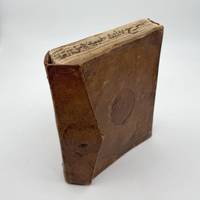
1770ABC_48344Probably Egypt 1770. Near-contemporary brown leather with a blind-stamped oriental rosette as a center piece and similar style corner pieces on both boards a partial manuscript title label on the spine. 4to ca. 17 x 22 cm. Arabic and Italian manuscript on paper 19 lines per extensum paginated throughout from right to left. Manuscript dictionary comprising some 9000 Arabic terms and their Italian translations. It was formerly owned by the German oriental scholar and Franciscan priest Arsenius Rehm 1738-1808 who lived in Cairo between 1769 and 1776 building a large collection of manuscripts which he brought with him when he worked for some time at the Franciscan abbey of Frauenberg at Fulda Hesse. After his death his collection remained at the monastery until it was purchased by the Benedictine Abbey of St Boniface Munich in 1852. The present volume which had not been part of the collection proper remained in Frauenberg whose library was dispersed in 2021 by the Franciscan Province. "The library includes a fairly extensive Arabic dictionary of his though not written by him. It offers only the Italian translation of the Arabic words. In the Arabic style it begins from our perspective at the end" cf. Bihl.With old stamps of the Frauenberg Abbey library on the final leaf with attribution to Arsenius Rehm in indelible pencil ca. 1900. The binding is somewhat rubbed and scuffed; remains of old spine labels. Interior shows only occasional light staining; very well preserved.l Michael Bihl Geschichte des Franziskanerklosters Frauenberg Fulda 1907 p. 137. hardcover
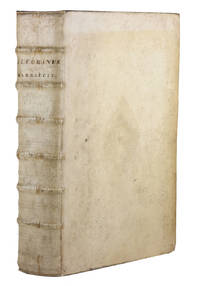
1698H4GD9LIIY5STPadova: Typographia Seminaria 1698. Blind-tooled vellum ca. 1800 reusing and retooling vellum from a slightly earlier blind-tooled binding sewn on 6 double cords each board with a large scrollwork centrepiece over traces of the old one in a panel design made of fillets and corner pieces with the title finely lettered in pen and ink in the 2nd of 7 compartments the old title still faintly visible underneath it and the old volume number VIII faintly visible in the 3rd compartment. Folio 35.5 x 25 cm. With 2 title pages 1 primary and 4 secondary divisional titles in volume 1 more than a dozen woodcut head- and tailpieces plus numerous repeats and dozens of woodcut decorated initials about 9 series plus numerous repeats. Set in roman italic and Arabic types 3 sizes of Arabic with incidental Greek and Hebrew. 2 volumes bound as 1. The first scholarly printed Quran prepared by the anti-Islamic Catholic Ludovico Marracci with a much more accurate Arabic text than any previously printed and the first accurate Latin translation also including extensive notes based on the Islamic commentaries as well as the editor's extensive "refutations" of each sutra. Each sura is given first in Arabic then in Latin translation followed by notes and then the refutation. The entire first volume of about 430 pages is taken up with preliminary matter including a 24-page life of Muhammad one of the first detailed biographies ever printed and again more accurate than its predecessors an 8-page profession of faith with the Arabic and Latin in parallel columns and additional commentaries and introductory matter. The fact that this edition was produced explicitly as an attempt to refute the views of Islam has naturally led Islamic scholars to dismiss it but both the Arabic text and the Latin translation were far better than any previously printed and had no serious rival until the Leipzig edition of 1834. The commentaries also made a great deal of Islamic scholarship available to a European audience for the first time and both the Arabic and the Latin text influenced nearly every edition for the next 150 years.With two bookplates and an occasional early manuscript note and a few letters or numbers inscribed in the foot margin of one leaf. With a tear running into the text of one leaf repaired but otherwise in very good condition. With generous margins. The boards are slightly bowed and there is a small tear repaired at the foot of the spine. A ground-breaking work of Quranic scholarship a valuable source for the study of the Quran and an essential source for European views of Islam.l Cat. Bibl. A.-R. Courbonne dont la vent . 1er février 1842 30 this copy; A. Hamilton Europe and the Arab world 34; Schnurrer 377; O. A. Sheikh Al-Shabab The place of Marraccis Latin translation of the Holy Quran: . in: Journal of King Saud University: language & tanslation 13 2001 pp. 57-74; USTC 1736471/1737617/1748538; not in Atabey; Blackmer; Philologia orientalis but cited in 225g 360a 380b 381c. Typographia Seminaria, hardcover
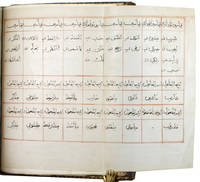
1830ABC_483971830. Contemporary navy blue morocco with the title lettered in gold on spine marbled endpapers. 4to 21.5 x 27 cm. With 2 folding tables 17 lines to the page written in red and black ink. A unique handwritten vocabulary and phrasebook of English and Arabic from the first half of the 19th century. This meticulously prepared manuscript is written in the fashion of a printed book opening with a title page and ending with an index of topics. It is divided into four main sections: nouns adjectives verbs and example sentences. The vocabulary especially in the nouns section is arranged by subjects which include such interesting headings as "Druggist" "Painter" "Merchant" "Cities" "the Bride's Paraphernalia" "Precious Jewels" "War" "The Church" "Clerical Vestments" "Ecclesiastical Degrees & Kinds of Sin" "Festivals" and "Monks their prayers and their dress". Presumably the dictionary was created to help a traveller or merchant who may have had an association with the Church. The final section offers an interesting selection of phrases and sheds some light on the experience of foreign language learning in the early 19th century. The phrases are a mixture of sentences that would be useful in daily life and such as would be included to practice the words from the vocabulary. Examples include: "We roasted a lamb and ate the whole of it and drank wine with it"; "I descended from above with the youth my enemy"; "I shot the bear in the water and he sank"; and "Why dost thou scratch thy head and spit in fire". As a cheat sheet for Arabic grammar the author includes two folding tables of Arabic verb tenses and conjugations. Overall a curious example of a 19th-century Arabic vocabulary and phrasebook.With a presentation note in English indicating it was a Christmas gift in 1881 presented by G. W. Bernard Esq. Binding and spine worn some browning and staining throughout. Otherwise in good condition. unknown
63499Romae Rome: Ex Typographia Medicea 1619. Folio 33.5x21 cm. pp. 4 9-462 2 with at recto the printer's letter repeated with the date of the 1591 original edition blank at verso. Contemporary green vellum spine with raised bands and gilt-decorated compartments red Morocco label marbled endpapers edges dyed red. Title printed in red and black with Medici's woodcut coat-of-arms printer's advice "Typographus lectori". With 149 text woodcuts by Leonardo Parassole c.1570-c.1630 after Antonio Tempesta 1555-1630 their monograms appearing on a number of the illustrations. The woodcuts are remarkable examples of Tempesta's work notable for their clarity of composition and their didactic narrative of the episodes depicted. Ex libris Luigi Bossi Milan 1758-1835 with his engraved heraldic bookplate to front pastedown along with T. Fenteman & Sons Leeds booksellers label to upper corner. Title-page lightly browned boards faded and discoloured some occasional light toning generally a very good copy printed on thick paper the woodcuts in strong impressions throughout. Rare 1619 reissue or of the original 1591 stock of the Arabic Medicean Gospels. The text lines are almost identical with those of the Arabic issue but now have an interlinear Latin version added which was prepared by Antonius Sionita. In 1584 the last year of the papacy of Gregory XIII who had constantly endeavoured to effect a union between the Church of Rome and the eastern Christians Cardinal Ferdinando de' Medici the brother and later the successor of the Grand Duke of Tuscany founded a printing press in Rome with a vast selection of oriental types cut by the French typographer Robert Granjon. Run by a versatile orientalist Giovan Battista Raimondi the press had various aims. One was to produce propaganda which would attract the eastern Christians to Roman Catholicism. Another was to corner the publishing market in an area where typography was prohibited and to make a financial profit from the sale in the east of books printed in Arabic. The third aim was to further European knowledge and to provide good editions of Arabic versions of certain standard non-religious texts. These included the writings of Avicenna al-Idrisi's geographical compendium al-Tusi's adaptation of Euclid's text on geometry and various works on Arabic grammar and syntax. The first major publication was the 1591 edition of the Gospels. This copy has an interlinear Latin translation but the work was also issued solely in Arabic. It contains 149 fine woodcut illustrations made by Leonardo Parasole mainly after designs by one of the best known Florentine artists of his day Antonio Tempesta who owed much of his fame to the frescoes he painted in the Vatican and in a number of Roman palaces. The woodcut in the Gospel of St Mark of the presentation of the head of John the Baptist to Salome Mark 6:28 by a man in Turkish dress reminds us of the common association between the great enemy of Christendom in the sixteenth century and the ancient heathens. The Arabic text is printed in Robert Granjon's famous large fount generally considered the first satisfactory Arabic printing type; as all early printed editions of the Arabic Gospels it is based on the Alexandrian Vulgate cf. Darlow/M. 1636. The Latin version is by Leonardo Sionita. The work begins with page 9 without a title-page or any preliminary matter at all: "the intended prefatory matter was apparently never published" Darlow/M. Darlow & Moule 1637 & 1643; Schnurrer Bibliotheca arabica 318; Brunet II 1122-23; Graesse II 531 Romae [Rome]: Ex Typographia Medicea, 1619. hardcover
1848ST14540Leipsic Leipzig: Guillaume Vogel fils 1848. FIRST EDITION. 225 x 142 mm. 8 3/4 x 5 1/2". XXV pp. 4 p.l. 231 pp. <br/> VERY ATTRACTIVE AND UNUSUAL CONTEMPORARY BLUE CLOTH BY F. J. CRUSIUS OF LEIPZIG his ticket on verso of front free endpaper WITH ORNATE STAMPED DECORATION IN THE ROMANTIC STYLE in gilt colors and blind covers with rocaille frame and large central arabesque in red and gilt smooth black roan spine with stylized gilt vine brown and tan lattice-work printed endpapers and edges. Text in French and Arabic on facing pages. Front flyleaf with AUTHOR'S INK PRESENTATION INSCRIPTION to Monsieur P. Desmaison see below. ◆One corner slightly bumped leaves lightly and uniformly browned due to paper quality a few other trivial imperfections but A NEARLY FINE AND VERY PLEASING COPY with few signs of wear inside or out.<br/> <br/> This is a beautifully preserved copy of a rare guide to spoken Arabic that features special provenance in an embossed and painted cloth binding that can almost pass as onlaid morocco. Our author Sheikh Mouhammad Ayaad El-Tantavy or al-Tantawi 1810-61 was an instructor of languages and literature at Al Azahr University in Egypt when he came to the attention of Russian diplomats in Cairo whose interpreter had attended his classes. The Russian consul to the Ottoman Empire which then occupied Egypt requested that El-Tantavy be lent to the Institute of Oriental Languages in the Russian foreign ministry and once he arrived in St. Petersburg in 1840 he never left. In addition to teaching languages at the school for Russian diplomats he was a professor of Arabic at St. Petersburg University eventually becoming the Chair of Arabic Studies. The present work is a guide to spoken Arabic for diplomats with the parallel texts in Arabic and French then the international language for diplomacy. France Russia and the Ottoman Empire had been engaged in a series of conflicts for some years so this tool would have had very practical application. It is recommended in the 1855 book "The Languages of the Seat of War in the East" by Friedrich Max Muller. The present copy is inscribed by the author to Jean-Jacques-Pierre Desmaisons 1807-73 the Franco-Russian director of training in Oriental languages in the Asiatic department of the Russian foreign ministry and El-Tantavy's supervisor there. The fact that Desmaisons would not have needed to make practical use of our volume goes some way to account for its fine condition. Binder F. J. Crusius developed machinery to facilitate the lavish decoration of bindings in innovative ways--like using paint to imitate leather as in the present example--achieving aesthetically pleasing results with far less labor and expense than would have been necessitated by hand work. The "Report of the Assessment Commission at the General German Industrial Exhibition in Munich in 1854" notes that Crusius displayed plan drawings of his invention at the fair. Copies of the first edition of this work are rare with OCLC finding just 12 in libraries worldwide and none in North America. We could find no copies recorded at auction. Guillaume Vogel fils unknown
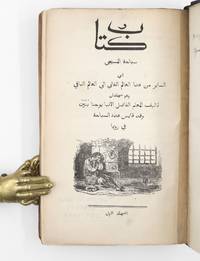
1834372732Malta: press of the Anglican Church Missionary Society 1834. First edition in Arabic. Title vignette of Bunyan in prison 7 plates captioned in Arabic. 6 281 1 imprint 2 blank pp. 1 vols. 8vo in 6s. Original silky cloth over boards twentieth-century binder's cloth spine. Joints crudely rehinged title leaf reinforced at gutter; binding cracked and a few leaves loosened. Contemporary presentation inscription on pastedown. Very good internally fine. First edition in Arabic. Title vignette of Bunyan in prison 7 plates captioned in Arabic. 6 281 1 imprint 2 blank pp. 1 vols. 8vo in 6s. Bunyan's Pilgrim's Progress translated into Arabic with a life of the author by Christoph Friedrich Schlienz. From the title page this is nominally the first volume but press marks are continuous and the text is complete: the end part twentieth sees the Pilgrim reach the Celestial City. Printed at Malta by the Anglican missionaries.<br /> <br /> William R. Whittingham 1805-1879 graduated the General Theological Seminary in 1825 and was named librarian of the newly founded school. He later accepted a position on the faculty in 1836. Whittingham was consecrated the fourth Bishop of Maryland in 1840 and served in that capacity until his death. <br /> <br /> This copy with his contemporary gift inscription to the GTS library "From the Rev. W.R. Whittingham 1834"<br /> <br /> RARE FIRST EDIITION IN ARABIC of a classic of English literature and of Christian devotion. Roper Arabic printing in Malta 1825-1845 56. OCLC: 57188645 Columbia Glasgow Tübingen 643954559 Manchester. Provenance: William R. Whittingham gif tinscription 1834; General Theological Seminary bookplates and inkstamps press of the Anglican Church Missionary Society unknown
First and only edition, small folio (305 x 190 mm), [12], xix, [1], 705, [1]pp., woodcut title page vignette in Arabic, woodcut head- and tail-pieces, several leaves folding, a couple of minor repairs to inner margin of title, recent half calf to style, marbled boards, spine tooled in gilt, red morocco spine label lettered in gilt, a handsome copy with text clean and fresh. This volume 'forms a complete treatise in itself, since the it exhausts the Science of Arabic Inflexion'?Preface. All published, the intended second volume of Arabic "syntax" never made it to print.
1925000514Damascus: al- Matba'a al- Haditha 1925 Book. As New. Hardcover. 4to - over 9¾ - 12" tall. A comprehensive work by a well-known scholar and politician from Damasscus about the city including the political social and the other aspects during the Ottoman synasty in the last period. Six volumes 4to. in Arabic printed between 1343 and 1347 AH. 1925 and 1927 AD. in Damascus. 309 317 271 310 308 425 p. in later fine bindings. al- Matba'a al- Haditha hardcover
37970London: H.S. Nichols Ltd. 1897. . Limited Library edition one of 570 sets and one of only a few sets issued in the publisher’s full morocco bindings set of twelve volumes full brown bevelled morocco with lavishly decorated boards in gilt gilt decorations to spine five raised bands inner dentelles gilt t.e.g. patterned endpapers b/w frontispiece portrait to first volume b/w plates with caption-sheets; neat ink ownership autograph to front paste-down endpaper and to front free endpaper verso light wear to leather at extremities a very good set. London: H.S. Nichols Ltd., 1897. hardcover
in-4. pp.16,358,4. Perg. Coeva. un legno nel testo con la sorgente del Nilo.
1833365677Ottoman lands 1833. Ink on thick burnished paper 21 lines per page in Levantine-style script in black ink with headings and occasional passages in red ink dated A.H. 1249 = C.E. 1833. 448 pp. The first few pages extensively annotated in margins in a later scholarly hand with numerous doodles and pen starts on last leaves. 1 vols. 8vo 8 x 6 inches. Leather wallet binding with fore edge guard boards decorated with a shamsa motif in blind top edge marked in ink "Sharh al-Shatibi". A bit shaken textblock loose in binding very good overall. Ink on thick burnished paper 21 lines per page in Levantine-style script in black ink with headings and occasional passages in red ink dated A.H. 1249 = C.E. 1833. 448 pp. The first few pages extensively annotated in margins in a later scholarly hand with numerous doodles and pen starts on last leaves. 1 vols. 8vo 8 x 6 inches. Ibn al-QÄsıh 1316-1399 C.E. an eminent scholar of Qira'at and Islamic textual transmission was born in Baghdad and studied in Egypt where he mastered the ten canonical recitations 'ashara. He later became a renowned instructor at Madânî Mosque where he taught many scholars. His works particularly Siraj al-QÄriʾal-mubtadî wa Tadhkar al-Muqriʾal-mutahi are critical to the tradition of Qira'at pedagogy.<br /> <br /> This manuscript is an early nineteenth-century copy of a standard work an extensive and detailed commentary on al-Shatıbi's Ḥırz al-Amani a foundational text in the science of Qur'anic recitation. While al-Shatıbi's work is a didactic poem that systematically presents the rules of Qira'at this commentary expands upon its meanings with in-depth linguistic grammatical and recitational analyses providing a comprehensive exegesis that was widely studied by advanced scholars. The presence of extensive marginal annotations suggests active scholarly engagement making this manuscript an invaluable resource for the study of classical Qira'at methodologies and textual transmission.<br /> <br /> A significant scholarly manuscript offering a deeply analytical and authoritative commentary on one of the most important texts in the Qira'at tradition. unknown
- Alger s.d. (circa 1870), Album : 13x17cm / photographies : 6,3x10,4cm, 28 portraits sur cartes de visite consignés dans un album. - Photographic album containing 28 portraits of Algerians finely enhanced with watercolour Algiers [ca 1870] | Album: 13 x 17 cm / photographs: 6.3 x 10.4 cm | 28 carte de visite portraits in an album Photographic album comprising 28 photograph portraits, in contemporary albumen print, pasted on card in carte-de-visite format. These photographs, well contrasted and finely enhanced with watercolour at the time, are of great intensity: the models stare at the photographer's lens with pride and nobility. Binding in full black grained leather, metal clasp, all edges gilt. Rubbing. Superb photographic testimony by one of the first European photographers established in Algeria. A Swiss expatriate in Algeria, Jean Geiser (1848-1923) was immersed in photography from childhood. In 1852, his mother joined forces with Antoine Alary, one of the pioneers of Algerian photography; together they founded a studio which lasted until 1867, when Jean Geiser took charge. Initially specialising in portraits of the city's European bourgeois, the photographer quickly understood the city's interest for folk images. These rare and magnificent "typical" portraits, depicting all the layers of the indigenous populations - from street children to caïd - are today sought after for their ethnographic value, testimony of an Algeria at the dawn of colonisation. [FRENCH VERSION FOLLOWS] Album photographique constitué de 28 portraits photographiques, en tirage albuminé d'époque, contrecollés sur des cartons au format carte de visite. Ces photographies, bien contrastées et finement rehaussées à l'aquarelle, sont d'une grande intensité : les modèles y fixent avec fierté et noblesse l'objectif du photographe. Reliure en plein cuir noir grainé, fermoir de métal, toutes tranches dorées. Frottements. Superbe témoignage photographique par l'un des premiers photographes européens établis en Algérie. Suisse expatrié en Algérie, Jean Geiser (1848-1923) a baigné dans la photographie depuis son enfance. En 1852, sa mère s'associe à Antoine Alary, l'un des pionniers de la photographie algérienne ; ensemble ils fondent un studio qui perdurera jusqu'en 1867 date à laquelle Jean Geiser prendra sa direction. D'abord spécialisé dans les portraits de bourgeois européens de la ville, le photographe comprend bien vite l'intérêt de la métropole pour les images folkloriques. Ces rares et magnifiques portraits « types », dépeignant toutes les couches de la population indigène - de l'enfant des rues au caïd - sont aujourd'hui recherchés pour leur valeur ethnographique, témoignage d'une Algérie à l'aube de la colonisation.
- Alger s.d. (circa 1870), Album : 13x17cm / photographies : 6,3x10,4cm, 28 portraits sur cartes de visite consignés dans un album. - Photographic album containing 28 portraits of Algerians finely enhanced with watercolour Algiers [ca 1870] | Album: 13 x 17 cm / photographs: 6.3 x 10.4 cm | 28 carte de visite portraits in an album Photographic album comprising 28 photograph portraits, in contemporary albumen print, pasted on card in carte-de-visite format. These photographs, well contrasted and finely enhanced with watercolour at the time, are of great intensity: the models stare at the photographer's lens with pride and nobility. Binding in full black grained leather, metal clasp, all edges gilt. Rubbing. Superb photographic testimony by one of the first European photographers established in Algeria. A Swiss expatriate in Algeria, Jean Geiser (1848-1923) was immersed in photography from childhood. In 1852, his mother joined forces with Antoine Alary, one of the pioneers of Algerian photography; together they founded a studio which lasted until 1867, when Jean Geiser took charge. Initially specialising in portraits of the city's European bourgeois, the photographer quickly understood the city's interest for folk images. These rare and magnificent "typical" portraits, depicting all the layers of the indigenous populations - from street children to caïd - are today sought after for their ethnographic value, testimony of an Algeria at the dawn of colonisation. [FRENCH VERSION FOLLOWS] Album photographique constitué de 28 portraits photographiques, en tirage albuminé d'époque, contrecollés sur des cartons au format carte de visite. Ces photographies, bien contrastées et finement rehaussées à l'aquarelle, sont d'une grande intensité : les modèles y fixent avec fierté et noblesse l'objectif du photographe. Reliure en plein cuir noir grainé, fermoir de métal, toutes tranches dorées. Frottements. Superbe témoignage par l'un des premiers photographes européens établis en Algérie. Suisse expatrié en Algérie, Jean Geiser (1848-1923) a baigné dans la photographie depuis son enfance. En 1852, sa mère s'associe à Antoine Alary, l'un des pionniers de la photographie algérienne ; ensemble ils fondent un studio qui perdurera jusqu'en 1867 date à laquelle Jean Geiser prendra sa direction. D'abord spécialisé dans les portraits de bourgeois européens de la ville, le photographe comprend bien vite l'intérêt de la métropole pour les images folkloriques. Ces rares et magnifiques portraits « types », dépeignant toutes les couches de la population indigène - de l'enfant des rues au caïd - sont aujourd'hui recherchés pour leur valeur ethnographique, témoignage d'une Algérie à l'aube de la colonisation.
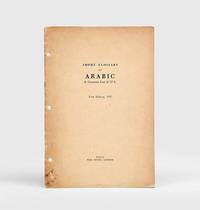
1947184799London: Geographical Section General Staff 1947. Arabic and military cartography Rare first and only edition of this Arabic glossary for use on foreign maps produced by the British War Office. It explains the use of Arabic terms on maps covering territories to the east of the Libyan-Egyptian border and was part of an extensive series published in the 1940s. The spelling and transliteration follow the RGS II System conventions devised by the Royal Geographical Society's Permanent Committee on Geographical Names in 1921 updating those used by the War Office and Admiralty after 1885. The introduction includes a survey of the history of the Arabic language its alphabet pronunciation and dialects in view of instructing soldiers pilots and surveyors on how to read and pronounce names on maps of the Middle East. "An Arabic word may appear on European maps in numerous transliterated forms each depending upon the national authority of the map and the principle of transliteration applied to the names on it" p. 2 due to the "considerable play" between a e and i and other such alternative renditions of specific letters and sounds. The four-column table provides abbreviations transliteration the Arabic-script version and the meaning of Arabic words commonly found on maps. For instance aqra' is rendered as "without vegetation" ashqar as "reddish" ghurd as "sand dune" and zallaq as "slippery place" specifying if a noun is a plural and/or in a different grammatical case. Words originating from other languages Berber Hebrew Greek Latin Turkish and Persian are also identified. Octavo 270 x 185 mm. pp. 28 2. Text in Arabic and English. Original printed brown paper wrappers three punch holes. Wrappers lightly waterstained along lower edge foot of spine rubbed traces of adhesive at foot of front wrapper contents toned but clean: a very good copy. unknown
In-8°, (30 cc) compreso ritratto, antiporta e frontespizio, pp. 272, 4 carte ripiegate, legatura in pelle con titolo al dorso. Prima edizione. La prima parte di questo lavoro, intitolata Compendium theologiae mohammedicae arabice et latine, è un'edizione in arabo, con traduzione, di una piccola opera simile al Mukhtasar di Abû Suj ed è probabilmente la prima edizione stampata di un'opera islamica così essenziale in Occidente . La seconda parte è il contributo più importante di Reelant per una migliore comprensione dell'Islam in cui si propone di correggere molte credenze popolari con citazioni dal Corano e da altre fonti arabe. In-8°, (30 cc) including portrait, frontispice and title page, pp. 272, 4 engraved folded plates, binding in calf with title at the spine. First edition.The first part of this work, entitled Compendium theologiae mohammedicae arabice et latine is an edition in Arabic, with translation, of a small work similar to Abû Sujâ s Mukhtasar and is probably the first printed edition of such an essential Islamic work in the West. The second part is Reelant’ s most important contribution towards a better understanding of Islam in which he sets out to rectify many popular misbeliefs with quotations from the Coran and other Arabic sources.
Very Good Arabic Original brown half leather bindings in Egyptian style, raised six bands to spine, title gilt on the second, volume nos on fourth, and alphabetical with the historical content of the volumes on sixth compartments and "Mahmoud Al-Tawawî" name. Minor foxing on some pages. Overall a very good set. Roy. 8vo. (24 x 17 cm). In Arabic. 14 books are complete set in 7 volumes. Extremely rare first printed edition of the most comprehensive and complete corpus on Baghdad city, which includes Al-Baghdadi's first-hand account of the collection of hadiths, biographies, and his travels in the 11th century Baghdad in traditional "al-râwî" style. Al-Baghdadi is known as a Muslim traveler in the pursuit of knowledge who compiled hadiths and traveled to many Islamic cities. He was born on the 24th ?jumada II, 392 (1002) at Darzidjan, a large village on the west bank of the Tigris below Baghdad. The son of a khatib [i.e. preacher], he began his studies very early and spent his youth traveling in search of ?adith. In this way, he visited Basra, Nishapur, I?fahân, Hamadân, and Damascus. Finally settling in Baghdâd, he held the office of a kha?îb and this was the origin of the name al-Khatîb al-Bag_dadi. After completing his education, he spent more than twenty years of his time writing "Tarikh Baghdad". He finished his corpus in 444 AH [1052-53]. He was a fellow student of Rîsürrüesâ Ibn al-Muslima who was the vizier of the Abbasid caliph Kâim-Biemrillâh. The vizier took Khatib, whom he appreciated in the science of hadith, under his patronage. The Abbasid caliph, therefore, ordered Khatib to be given permission to take hadith lessons from him. Khatib started to narrate hadiths from "Tarikh Baghdad" to his students here in his house near the Nizâmiya Madrasa, on the other hand, he started to read the books for which he had permission to narrate from many teachers, also write the books he planned. Several years after, the Turkish commander Besasiri (?-1060), who was a supporter of the Fatimid Caliph Mustansir-Billâh, entered Baghdad with the encouragement of the Fatimid caliph, deposed the caliph, and killed Ibn al-Muslima. Some members of the Hanbali sect, who had a grudge against Khatib because of what they wrote against some Hanbalis in Tarikh Baghdad, started to disturb him by taking the opportunity to kill the vizier. Therefore, he had to flee to Damascus. In his masterpiece, Khatibi, in addition to his account and descriptions of the city during his time in Baghdad, 7831 figures of people in total who lived or came in Baghdad before 450 (1058), statesmen such as caliphs, viziers, commanders, poets, judges, and other professions. This is an alphabetical work giving information about biographies of these figures, but it starts with the name "Muhammad" referring to the Muslim prophet. The first volume is about the establishment of Baghdad in the pre-Islamic period, its conquest by the Muslims, and its history. This masterpiece of him, published in fourteen volumes, is the most comprehensive corpus written on Baghdad in the Islamic world including the city's topography, history, et alli. Brockelmann, GAL, I, 401; Suppl., I, 563.; H. Gibb, "Islamic Biographical Literature".; F. Rosenthal, A History of Muslim Historiography, Leiden 1968, p. 14, 43. Only one set in OCLC in BnF (Bibliothèque nationale de France): 1198963531.
- Imprimerie Mourès & Cie, Alexandrie , in-4, relié. - Edition originale. Reliure moderne en demi-basane bleu foncé, dos lisse orné de filets dorés, plats de la couverture conservés, couverture renforcée, traces de lavage. Ce projet de réforme du Code Civil égyptien fut élaboré pendant le règne d'Ismaïl-Pacha. Il parut peu après l'inauguration du Canal de Suez. Le vice-roi puis khédive d'Égypte, qui avait été formé en France, notamment à l'École d'État-major, manifestait un désir sincère d'ouvrir l'Égypte au progrès. Nombreuses annotations manuscrites au crayon en début de volume. [ENGLISH DESCRIPTION ON DEMAND]
2 Vols., small folio (305 x 190 mm), xxxiii, [3], 49-458; [4], 582, [2]pp., text in English and Persian, occasional marginal pencil notes, title page and terminal leaf to both volumes browned, staining to inner upper corner of leaves to start and end of volume two, later vellum-backed marbled boards, title in manuscript to spines. One of the most extensive Persian grammars written in English. "Matthew Lumsden (1777?1835), orientalist, was fifth son of John Lumsden of Cushnie, Aberdeenshire, and a cousin of Sir Harry Burnett Lumsden (1821?1896), army general. After education at King's College, Aberdeen, he went to India as assistant professor of Persian and Arabic in the College of Fort William, and in 1808 succeeded to the professorship. In 1812 he was appointed secretary to the Calcutta Madrasa, and superintended various translations of English works into Persian then in progress. From 1814 until 1817 he had charge of the East India Company's press at Calcutta, and in 1818 he became secretary to the stationery committee."?(Oxford DNB). Provenance: John L. Platts? signature in pencil to title page.
Folio, cc. (8), 258; cc. (6), 277, 1 c.b., (12). Frontespizio stampato in nero e rosso, con marca tipografica incisa su legno. Il Supplementum ha un proprio frontespizio. All'ultima carta Registro e marca tipografica. Numerosi legni nel testo raffigurano le piante. Il testo è su due colonne con capilettera figurati incisi su legno. Legatura in mezza pergamena. enciclopedica opera di medicina, che è anche una farmacopea, di ibn Masawaih, originario di Damasco (777-875 ca) divenne direttore di un ospedale a Bagdad; fu scrittore assai prolifico, trattò di oftalmologia, fisica, dietologia, depressione ecc. botanica medicina medicine botany piante farmacologia segreti ricette recipe givanni costeo
- Paul Dupont, Paris 1852, 35,5x26,5cm, reliure de l'éditeur. - First edition, one of 185 copies numbered and justified by Paul Fort on vergé d'Arches paper and reserved for his friends. Publisher's binding. Retaining its 51 lithographs. Scattered foxing and light dampstain on some leaves. Very rare. [FRENCH VERSION FOLLOWS] Edition originale, un des 185 exemplaires numérotés et justifiés par Paul Fort sur vergé d'Arches et réservés à ses amis. Reliure de l'éditeur, plats de cartonnage sable comportant des auréoles claires et des rousseurs, dos de toile verte. Ouvrage bien complet de ses 51 planches lithographiées. Rousseurs éparses et mouillures claires sur certains feuillets. Très rare.
- Hoddesdon Herts 28 février 1871, 13,5x21cm, 4 pages sur un double feuillet et un simple. - Lettre autographe inédite signée de William Ellis, quatre pages rédigées à l'encre noire sur un double feuillet et un feuillet simple. Intéressante lettre du révérend William Ellis, missionnaire de la London Missionary Society à Madagascar et auteur des plus anciennes photographies de l'île. Beau témoignage de l'approche ethnographique d'Ellis qui se détache de la « théorie du sauvage » portée par le regard européen. Il donne à son interlocuteur de précieuses informations sur les Vazimba, encore non identifiés au XIXe siècle et décrits par les premiers explorateurs de l'île comme des pygmées belliqueux vivant dans les montagnes malgaches. Ellis se montre très critique envers les descriptions fantasmées de ces prédécesseurs et privilégie les témoignages directs des habitants gardant le souvenir de ce peuple disparu. Auteur de plusieurs ouvrages d'histoire malgache, Ellis décrit en détails les légendes sur l'ethnie Vazimba qui faisaient encore de cet habitant premier, caractérisé par sa petite taille et sa peau cuivrée, l'occupant des hauts plateaux de l'île. Ellis doute fort des descriptions issues des expéditions de Flacourt (1648) et de l'abbé Rochon (1768) qui désignent ce peuple sous le nom de "Kimos" ou "Quimos" et les décrivent comme une "race naine" ("dwarf race"). Il se fie davantage aux témoignages des habitants de l'île qu'il recueille pendant ses séjours chez les Hovas et les Betsiles, rapportant la crainte et le respect qu'inspirait encore les esprits et les sépultures des Vazimba. La lettre rassemble et critique les connaissances de l'époque et mentionne l'expérience de son successeur, le révérend Charles Jukes de la London Missionary Society, dont il célébra la messe de départ en mission le 8 juillet 1866. Il évoque dans cette lettre une hypothèse qui sera confirmée par les recherches scientifiques modernes : les Vazimba seraient une des communautés fondatrices de l'île, à l'origine de la langue et de la culture malgache. "[...] By the Hova's & others who spoke of them, they were called Vazimba. They were said to be smaller in stature and lighter in colour than the Hovas, & to be regarded with superstitious feelings by the other inhabitants, who hold their tombs in extreme veneration & frequently offer at their tombs sacrifices or gifts to the spirits of the Vazimba. During my own intercourse with people on the coast & in the interior I made repeated enquiries, but never met with a native who had seen a Vazimba. Their graves I saw frequently in my journeys among the people in the interior. I saw also many of their tombs at which offerings had been recently presented and found that many of the people regarded them with superstitious fear and seemed exceedingly afraid of doing any thing likely offend them. The Hovas didn't appear to know anything of the name of Kimos all elapses of whom I enquired call the diminutive race Vazimba & spoke of them as the ancient or earliest inhabitants of the country. [...] My friend informed me that the Betsiles do not speak of the Vazimba as remarkable on account of their small size or light colour, many of the Hovas are of quite a light colour. [...] My own opinion is that the Vazimba are the dwarf of which early writers speak & that they are not as diminutive as they have been represented to be. As our missionaries now occupy the Betsiles country, I have no doubt we shall soon have reliable accounts of the Vazimba relating of their present condition as well as their traditions of the past. If the foregoing statements should prove in any way revocable it will be gratifying so." Passionnante étude fouillée et documentée sur les moeurs et les origines des habitants de Madagascar qui révèle, dans l'intimité de cette correspondance privée, l'évolution du regard ethnologique et les questionnements d'un des principaux historiens de l'île au XIXe siècle. [ENGLISH DESCRIPTION ON DEMAND]
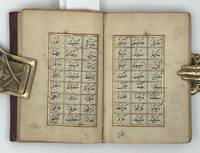
1730369933Ottoman Empire 1730. Polychrome double page ornamental opening text in black ink in a rounded naskh hand 8 lines per page fully vocalized with gold dot aya markers all within gilt rule borders. Attributes within gilt frames 30 per page. Occasional annotations in red. 117 ff. Dated at end A.H. 1143. 1 vols. 12mo. Late nineteenth century Islamic binding of red leather plaque stamped in silver with fore edge guard. Some minor smudging of passages a few paper flaws. Twentieth-century ownership inscriptions on first blank. Very good plus overall. Polychrome double page ornamental opening text in black ink in a rounded naskh hand 8 lines per page fully vocalized with gold dot aya markers all within gilt rule borders. Attributes within gilt frames 30 per page. Occasional annotations in red. 117 ff. Dated at end A.H. 1143. 1 vols. 12mo. Attractive pocket devotional with short surahs tables of the Attributes of Allah and other prayers. unknown