3 887 résultats
- Imprimerie Impériale, Paris 1809-1829, 53,5x71cm, une feuille. - Original, unshaved, full-page etching from the "Imperial edition" of the Description de l'Égypte, or 'Recueil des observations et recherches faites en Égypte pendant l'expédition française, publié par les ordres de Sa Majesté l'Empereur Napoléon le Grand [A Collection of the observations and research carried out in Egypt during the French expedition, published on the orders of his Majesty the Emperor Napoleon the Great]'. Produced between February 1802 and 1830 on the orders of Naopleon Bonaparte and published between 1809 and 1828, 1,000 copies were printed and distributed to institutions, on vergé paper with an 'Égypte ancienne et moderne' watermark, visible when held up to the light. Light marginal spotting not touching image, otherwise in very fresh, fine condition. An engraving from the Description de l'Egypte, one of the masterpieces of French printing and the birth of a new field: Egyptology. A gigantic survey of Egypt at the time of Bonaparte's conquests in 1798 and 1799, the work is divided into 13 volumes of engravings making up 892 plates, of which 72 colored, as well as presenting the splendors of the Egypt of the Pharaohs in 9 volumes. The other volumes discuss natural history and present a fascinating portrait of Coptic and Islamic Egypt as it was seen by Bonaparte's Eastern Armies. The 'Egyptian campaign', militarily a disaster, demonstrates, through the engravings of the Description d'Egypte, the scientific success it nonetheless became thanks to the 167 expert members of the Commission of the Sciences and Arts of the Institut d'Egypte [Egyptian Institute] who followed Napoleon's army. The Institut gathered together in Egypt the mathematician Monge, the chemist Berthollet, the naturalist Geoffroy Saint-Hilaire as well as numerous artists, engineers, architects and doctors. They were tasked with re-discovering modern and ancient Egypt and displaying its natural treasures as well as the know-how of its inhabitants. This edition, the so-called "Imperial" edition of the plates for the Description de l'Egypte was printed in four large formats, two of which were specially created for it and christened "Moyen-Egypte" and "Grand-Egypte". A special press was built to print it, the process extending over 20 years, from 1809 to 1829. The "Imperial" edition proved so popular that a second edition, this time in black and white and without the "Egypte ancienne et moderne" watermark - known as the "Royal Edition" - was published during the Restoration by the printing house of C.-L.-F. Panckoucke (Paris). The engravings of the Description d'Egypte owe a great deal to Baron Dominique-Vivant Denon, illustrator, diplomat, collector and later Director of the Musée Napoléon (the Louvre). His exploration of the South of Egypt gave Bonaparte the idea of sending the experts of the Institut there, thus creating a faithful and complete portrait of the area. This was the research gathered together from 1802 in the mammoth Description de L'Egypte. Denon embarked on this story of archeological exploration at the age of 51, reaching first Alexandria and then Cairo before exploring Upper Egypt. Along with the members of the Institut d'Egypte, the Natural History Museum's painter H.J. Redouté (brother of Pierre-Joseph Redouté, author of Roses), the mineralogist Dolomiue, and the draughtsman Joly, Denon then explored the Nile Delta and Lower Egypt. When, however, he joined the 21st Light Infantry Regiment as it marched across Upper Egypt in pursuit of the retreating Mameluks in November 1798, he found himself the only civilian. In the very midst of the battle itself, he reeled off sketches of the works of art that peppered his path right up to the threshold of the Sudan. He said that he had crossed "a country that is, apart from its name, entirely unknown to Europeans, and therefore everything was worth describing" (Voyages dans la Basse et la Haute Egypte pendant
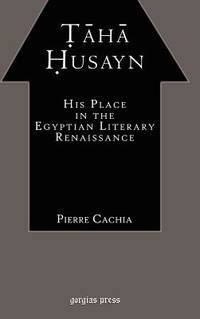
1966C59782Caire, 1966 472pp.avec illustrations, reliure toile rouge (dos en cuir rouge avec titre doré), 28cm., bel état, [texte en arabe, arabic text]
472pp.avec illustrations, reliure toile rouge (dos en cuir rouge avec titre doré), 28cm., bel état, [texte en arabe, arabic text]
- Didot, Paris 1803, 40x54cm, une feuille. - Original, unshaved, full-page etching from the "Imperial edition" of the Description de l'Égypte, or 'Recueil des observations et recherches faites en Égypte pendant l'expédition française, publié par les ordres de Sa Majesté l'Empereur Napoléon le Grand [A Collection of the observations and research carried out in Egypt during the French expedition, published on the orders of his Majesty the Emperor Napoleon the Great]'. Produced between February 1802 and 1830 on the orders of Naopleon Bonaparte and published between 1809 and 1828, 1,000 copies were printed and distributed to institutions, on vergé paper with an 'Égypte ancienne et moderne' watermark, visible when held up to the light. Light marginal spotting not touching image, otherwise in very fresh, fine condition. An engraving from the Description de l'Egypte, one of the masterpieces of French printing and the birth of a new field: Egyptology. A gigantic survey of Egypt at the time of Bonaparte's conquests in 1798 and 1799, the work is divided into 13 volumes of engravings making up 892 plates, of which 72 colored, as well as presenting the splendors of the Egypt of the Pharaohs in 9 volumes. The other volumes discuss natural history and present a fascinating portrait of Coptic and Islamic Egypt as it was seen by Bonaparte's Eastern Armies. The 'Egyptian campaign', militarily a disaster, demonstrates, through the engravings of the Description d'Egypte, the scientific success it nonetheless became thanks to the 167 expert members of the Commission of the Sciences and Arts of the Institut d'Egypte [Egyptian Institute] who followed Napoleon's army. The Institut gathered together in Egypt the mathematician Monge, the chemist Berthollet, the naturalist Geoffroy Saint-Hilaire as well as numerous artists, engineers, architects and doctors. They were tasked with re-discovering modern and ancient Egypt and displaying its natural treasures as well as the know-how of its inhabitants. This edition, the so-called "Imperial" edition of the plates for the Description de l'Egypte was printed in four large formats, two of which were specially created for it and christened "Moyen-Egypte" and "Grand-Egypte". A special press was built to print it, the process extending over 20 years, from 1809 to 1829. The "Imperial" edition proved so popular that a second edition, this time in black and white and without the "Egypte ancienne et moderne" watermark - known as the "Royal Edition" - was published during the Restoration by the printing house of C.-L.-F. Panckoucke (Paris). The engravings of the Description d'Egypte owe a great deal to Baron Dominique-Vivant Denon, illustrator, diplomat, collector and later Director of the Musée Napoléon (the Louvre). His exploration of the South of Egypt gave Bonaparte the idea of sending the experts of the Institut there, thus creating a faithful and complete portrait of the area. This was the research gathered together from 1802 in the mammoth Description de L'Egypte. Denon embarked on this story of archeological exploration at the age of 51, reaching first Alexandria and then Cairo before exploring Upper Egypt. Along with the members of the Institut d'Egypte, the Natural History Museum's painter H.J. Redouté (brother of Pierre-Joseph Redouté, author of Roses), the mineralogist Dolomiue, and the draughtsman Joly, Denon then explored the Nile Delta and Lower Egypt. When, however, he joined the 21st Light Infantry Regiment as it marched across Upper Egypt in pursuit of the retreating Mameluks in November 1798, he found himself the only civilian. In the very midst of the battle itself, he reeled off sketches of the works of art that peppered his path right up to the threshold of the Sudan. He said that he had crossed "a country that is, apart from its name, entirely unknown to Europeans, and therefore everything was worth describing" (Voyages dans la Basse et la Haute Egypte pendant les campagnes de Bonap
1882R320131675Adolphe Jourdan. 1882. In-16. Relié. Etat d'usage, Couv. légèrement passée, Coiffe en tête abîmée, Intérieur acceptable. XII + 608 pages - dictionnaire arabe français - étiquette collée sur le 1er plat - coins frottés - coiffe en tête abîmée.. . . . Classification Dewey : 492.7-Arabe
R260272037au bureau du journal. non daté. In-8. Broché. Très bon état, Couv. convenable, Dos satisfaisant, Intérieur frais. 120 pages environ augmentées de quelques photos en noir et blanc dans texte.. . . . Classification Dewey : 492.7-Arabe
1858R260237851Editio stereotypa. 1858. In-8. Relié demi-cuir. Etat d'usage, Coins frottés, Dos abîmé, Intérieur acceptable. 300 pages environ. Filets. Titre doré sur pièce de titre. Etiquette collée sur coiffe en pied.. . . . Classification Dewey : 492.7-Arabe
R320163200inconnu. non daté. In-8. Relié plein cuir. Etat d'usage, Coins frottés, Coiffe en pied abîmée, Intérieur acceptable. Ouvrage sur le catéchisme catholique en langue arabe - non paginé, environ 80 pages - ornements dorés sur le dos - dos à 4 nerfs - coiffes abîmées.. . . . Classification Dewey : 492.7-Arabe
2019RO30366181Non précisé.. 2019. In-8. Broché. Etat passable, Couv. convenable, Dos satisfaisant, Intérieur acceptable. Environ 130 pages. Jaquette passable, déchirures. Texte en arabe. Sens de lecture original.. . . . Classification Dewey : 492.7-Arabe
R300280220Non Renseigné. Non daté. In-12. Relié. Bon état, Couv. convenable, Dos satisfaisant, Intérieur frais. 250 pages environ. Signet conservé. Livre en arabe. Voir photos. Non daté.. . . . Classification Dewey : 492.7-Arabe
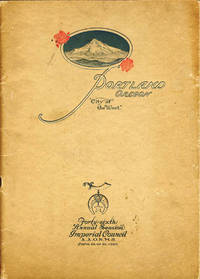
192040911Portland: Privately printed1920. 1920. OREGON. 10-1/2" x 7-1/2" printed wrappers. 60pp. to include wrappers. Frontispiece. Colorful pictures along with black and white photographs all have yellow borders. Three black and white full-page portraits include W. Freeland Kendrick 33 degree Imperial Potentate along with his Masonic Record; W.J. Hofmann General Chairman - Portland Committee; welcoming everyone to the beautiful city of Portland and all it offers; lastly A.H. Lea - Potentate - Al Kader Temple. "A "potentate" is a person who possesses great power as a sovereign monarch or ruler." A 2-page spread showing black and white pictures of the "Officers of the Imperial Council A A O N M S." Much information about the history of the shrine and a Shriner how officials are elected and who elects them information for the guests to include who to call should they need a physician the headquarters hotel and housing headquarters activities such as visiting the Portland sawmill golfing baseball mountain climbing trips swimming etc. There is an aerial view of Portland a picture of Multnomah which is the second highest waterfall in the United States municipal buildings a picture of a car covered in roses as a part of Portland's Rose Festival educational institutions et. al. The Program continues with activities for the rest of the week through Saturday the 26th. Another 2-page spread with black and white pictures of the Portland General Committee - Forty-Sixth Annual Session. Rubbing to wrappers and light wear to spine else a solid tight informative booklet. Privately printed,1920. unknown
190682672Los Angeles CA: The Imperial Council of the Ancient Arabic Order of the Nobles of the Mystic Shrine for North America Al Malaikah Temple 1906. Original Certificate Number 122761. Single sheet printed on one side. Good. Size is approximately 14 inches by 10 inches. Certificate has been folded into thirds and third again. Illustrations Gold color embossed seal. Bears the signatures of Edward Stanley Pauly H. A. Collins Imperial Potentate. R. M. Cowell Imperial Recorder and D. e. Barclay Recorder Al Malaikah Temple. Edward Stanley Pauly 1870- 1948 was a Vice President of Security-First National Bank. He began his career as a messenger boy served there in every department of the organization during his nearly 60 years with this renown financial institution. He was a member of the California Club Los Angeles Country Club Masons and Al Malaikah Temple of the Shriners. Architect Arthur R. Kelly designed the English Tudor Revival style house for Edward S. and Pauline L. Pauly in 1923. Arthur Rolland Kelly 1878-1957 was an American architect. The house is located at 114 South Rossmore Avenue in the Hancock Park neighborhood of Los Angeles California. His specialization was in homes of Spanish Colonial Revival style and Tudor Revival style. Most of his clients chose to have his designs built on lots they had purchased in Holmby Hills Beverly Hills and San Marino California. A few of Kelly's many designs included the William S. Hart Ranch in Newhall the Arthur Letts Jr. estate now known as The Playboy Mansion Beverly Hills estates for J. Crampton Anderson John Blystone Richard Dix Johnny Mack Brown and many others. Kelly also designed all the buildings for the Westlake School for Girls now known as Harvard-Westlake School in Bel-Air and the Wilshire Country Club in Hancock Park. Shriners International also commonly known as The Shriners or formerly known as the Ancient Arabic Order of the Nobles of the Mystic Shrine AAONMS is a Masonic society established in 1870 and is headquartered in Tampa Florida. Shriners International describes itself as a fraternity based on fun fellowship and the Masonic principles of brotherly love relief and truth. There are approximately 350000 members from 196 temples chapters in the US Canada Brazil Bolivia Mexico Panama the Philippines Europe and Australia. The organization is best known for the Shriners Hospitals for Children that it administers and the red fezzes that members wear. The organization was previously known as "Shriners North America". The idea of a new fraternity for Masons stressing fun and fellowship was discussed. Walter M. Fleming and William J. Florence took the idea seriously enough to act upon it. Florence a world-renowned actor while on tour in Marseille was invited to a party given by an Arab diplomat. The entertainment was something in the nature of an elaborately staged musical comedy. At its conclusion the guests became members of a secret society. Florence took copious notes and drawings at his initial viewing and on two other occasions once in Algiers and once in Cairo. When he returned to New York in 1870 he showed his material to Fleming. Fleming created the ritual emblem and costumes. Florence and Fleming were initiated August 13 1870 and they initiated 11 other men on June 16 1871 In an effort to encourage membership at the June 6 1876 meeting of Mecca Temple the Imperial Grand Council of the Ancient Order of the Nobles of the Mystic Shrine for North America was created. Fleming was elected the first Imperial Potentate. After some other reworking by 1878 there were 425 members in 13 temples in eight states and by 1888 there were 7210 members in 48 temples in the United States and Canada. By the Imperial Session held in Washington D.C. in 1900 there were 55000 members and 82 Temples. The Imperial Council of the Ancient Arabic Order of the Nobles of the Mystic Shrine for North America, Al Malaikah Temple unknown
Paris: Allouard et Kaeppelin, Se vend au Café de la Régence, sd Introduction datée novembre 1852, 1852. Edition originale - in-12 -1/2 Reliure chagrain (1 plat cassé) - Dos à nerfs orné ; iv, [5] - 372 pages - Frontispice :Pièce du jeu d'échec envoyé à Charlemagne par le Calif Haroun Al RASCHID - Figures dans le texte - diagrammes et pièces - rousseurs éparses - Envoi rapide et soigné "Se vend au Café de la Régence". l'un des premiers cafés de Paris, ouvert en 1681, qui devint le repaire de tout ce que le monde des échecs comptait d'amateurs et de champions à partir du milieu du XVIIIème siècle. Fréquenté par des célébrités (Napoléon, Robespierre, Diderot.) et de grands maîtres des échecs comme Stauntion, Horwitz, Saint-Amand, Stanley. dont on retrouve ici des parties. L'ouvrage débute par un chapitre historique et anecdotique qui relate l'histoire de l' "automate joueur" et se termine par quarante problèmes et leurs solution.
52108117like new. unknown
New English Original bdg. HC. 4to. (34 x 24 cm). In Turkish and Arabic. 698 p., color ills. Halep'te adim adim Osmanli'nin izinde. Halep'te Osmanli döneminde insa ve tadil edilen mimari eserlerin envanteri. Inventory of architectural works in Aleppo which were built or repaired during the Ottoman epoch. ARCHITECTURE Turkish and Islamic arts Ottoman Empire Ottoman art Aleppo Syria Architectural inventory Reference History of art.
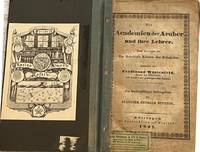
183724800Göttingen Germany: Vandenhoeck und Ruprecht 1837. Aged and foxed textblock in very good condition overall with edges and corners worn and scuffed; Many uncut leaves; Re-bound in plain gray cardstock with green cloth spine; Former owner's decorative bookplate inside front cover; Original printed front and rear covers retained; 136p. plus 20 pages in Arabic. Old Parisian bookseller's ticket at bottom left corner of original front cover. First Edition. Quarter Cloth. Good. 8vo - 7 3/4" - 9 3/4 " Tall. Hardcover. Vandenhoeck und Ruprecht Hardcover
1999AWP-2023-0012<p>Colour atlas with photomicrographs of blood smears of camels llamas alpacas and other camelids. Written in English and Arabic. Hardback. Tightly bound. No inscriptions. Weight 544 g - postage will be adjusted for weight.</p> Blackwell Wissenschafts-Verlag hardcover
1593333161.Ghardcover. Good. Access codes and supplements are not guaranteed with used items. May be an ex-library book. hardcover
180923448Imprimerie Impériale | Paris 1809-1829 | 70 x 51.50 cm | une feuille
180923472Imprimerie Impériale | Paris 1809-1829 | 70 x 51.50 cm | une feuille
180925838Imprimerie Impériale | Paris 1809-1829 | 54 x 71 cm | une feuille
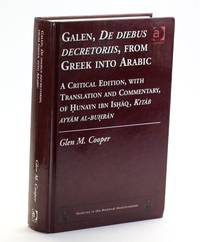
2011508901Ashgate 2011. Hardcover. FINE. 615pp. Perfectbound in printed hard covers sans DJ as issued. FINE copy entirely clean and sharp. 'This volume presents the first edition of the Arabic translation by Hunayn ibn Ishaq of Galen's Critical Days De diebus decretoriis together with the first translation of the text into a modern language. The substantial introduction contextualizes the treatise within the Greek and Arabic traditions. Galen's Critical Days was a founding text of astrological medicine. In febrile illnesses the critical days are the days on which an especially severe pattern of symptoms a crisis was likely to occur. The crisis was thought to expel the disease-producing substances from the body. If its precise timing were known the physician could prepare the patient so that the crisis would be most beneficial. After identifying the critical days based on empirical data and showing how to use them in therapy Galen explains the critical days via the moon's influence. In the historical introduction Glen Cooper discusses the translation of the Critical Days in Arabic and adumbrates its possible significance in the intellectual debates and political rivalries among the 9th-century Baghdad elite. It is argued that Galen originally composed the Critical Days both to confound the Skeptics of his own day and to refute a purely mathematical rationalist approach to science. These features made the text useful in the rivalries between Baghdad scholars. Al-Kindi d.c. 866 famously propounded a mathematical approach to science akin to the latter. The scholar-bureaucrat responsible for funding this translation Muhammad ibn Musa d. 873 al-Kindi's nemesis may have found the treatise useful in refuting that approach. The commentary and notes to the facing page translation address issues of translation as well as important concepts.'. Ashgate hardcover
Very Good Arabic Contemporary cloth. Roy. 8vo. (24 x 17 cm). In Arabic with bilingual title on cover. 424, [2], 43, [1] p., richly illustrated b/w. Only Vol. 3 (Turkoman Volume). Histoire de l'Iraq: Entre deux Occupations Vol. III: De l'an 814 a lân 941 de l'Hegire (de 1338 a 1534 de 1ere chretienne): Dynastie des Turcomans.= Tarîkh al-'Irâq bayna ihtilâlayn: Hukûmât al-Turkumânîyah min sanat 814 H- 1338 M ilâ sanat 941 H- 1534 M. Title on added t.p. in French. Signed and inscribed by Azzawi in Arabic.
Fine Arabic Original decorative full red leather bound. Gilt traditional style on boards. Large demy 8vo. (22 x 15 cm). Bilingual preface in German and Turkish. [12], [2], p., [49] p. facsimile in Arabic., ills. Das Achte Buch zu den Conica des Apollonios von Perge. Rekonstruiert von Ibn al-Haysam. Herausgegeben und eingeleitet von Nazim Terzioglu. Ibn al-Haytham (Alhazen) was born c. 965 to an Arab family in Basra, Iraq, which was at the time part of the Buyid emirate. He held a position with the title vizier in his native Basra, and made a name for himself for his knowledge of applied mathematics. As he claimed to be able to regulate the flooding of the Nile, he was invited to by Fatimid Caliph al-Hakim in order to realise a hydraulic project at Aswan. However, Ibn al-Haytham was forced to concede the impracticability of his project. Upon his return to Cairo, he was given an administrative post. After he proved unable to fulfill this task as well, he contracted the ire of the caliph Al-Hakim bi-Amr Allah, and is said to have been forced into hiding until the caliph's death in 1021, after which his confiscated possessions were returned to him. Legend has it that Alhazen feigned madness and was kept under house arrest during this period. During this time, he wrote his influential Book of Optics. Alhazen continued to live in Cairo, in the neighborhood of the famous University of al-Azhar, and lived from the proceeds of his literary production until his death in c. 1040. Among his students were Sorkhab (Sohrab), a Persian from Semnan, and Abu al-Wafa Mubashir ibn Fatek, an Egyptian prince. Signed and inscribed by Nazim Terzioglu, (1912-1976), was one of the first mathematicians in Turkish academia. One of the contributions of Terzioglu as the director of the Mathematics Research Institute to Turkey's mathematical culture and the history of science was the systematic scan of the Islamic literature relevant to mathematics and the presentation of the information related to conic sections in ancient mathematics to the scientific community. As a result of these efforts, the facsimile of two ancient texts of mathematics originally written in Arabic were realized. The first one is the preface of Mecmuatu'r-risail, the Arabic translation by Beni Musa b. Sakir (died in 873) of Conica, which is the work of Apollonius of Perga (BC 262-190) on the conic sections. This preface, published with the title Das Vorwort des Astronomen Bani Musa b. Sakir, describes how the Apollonius' Conica was acquired by the Islamic world. After that, Terzioglu published the facsimile of the copy of the lost 8th book of Apollonius' Conica which was rewritten by Ibnu'l-Heysem (965-1039) with the help from other sources. In the introduction part of this book with the title Das Achte Buch zu den Conica des Apollonios von Perge, the following information is provided in summary: In ancient mathematics, the interest for conics starts with Menaechmus (BC IV. Century) and reaches the summit with Apollonius of Perga. Apollonius wrote his famous work Conica by processing previous information and adding up his own inventions. The first 7 volumes of this work consisting of 8 volumes in total are known whereas the 8th volume is missing. The Islamic and Western mathematicians working in this field took place in the reconstruction of the 8th volume. The most successful one of these works is that of Edmund Halley's (1656-1742) Apollonii Per-gaei conicorum (Oxoniae, 1710). The 8th book of Conica reconstructed by Ibn el-Heysem is the 4th manuscript with the name Makalatu'l-Hasan b.el-Hasan b.el Heysem fi el-kitabu'l-mahrutat in the Mecmu'atu'r-risail, which is recorded under no. 1796 in Manisa Library. The fact that Ibn el-Heysem completed this work nearly 700 years before Halley is interesting.
New English Paperback. Folio. (32 x 24 cm). In English and Arabic. 161 p., color ills. Reverence for the Noble Prophet (PbuH) in Arabic calligraphy from the Collection of Mehmet Çebi.