3 888 résultats
Actes Sud, Sindbad, 2006, 115 pp., broché, lieu et date et étiquette sur la deuxième de couverture, étiquette sur la première page de garde, état très correct.
86424Paris, Editions Maison d'Ennour, 2001. 13 x 21, 127 pp., broché, bon état.
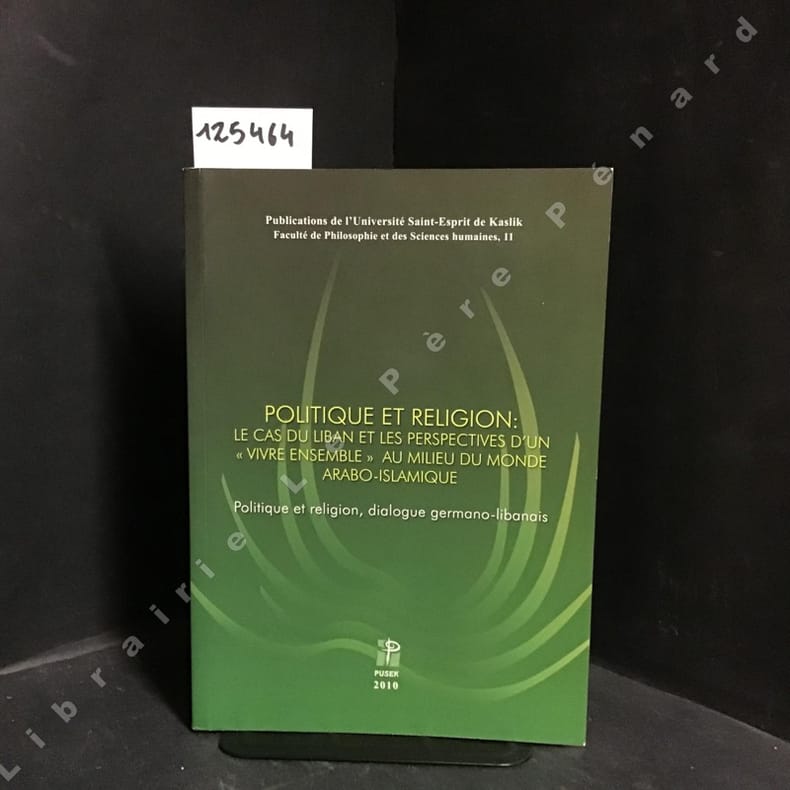
20101254642010 Editions Pusek - Publications de l'Université Saint-Esprit de Kaslik, Faculté de Philosophie et des Sciences humaine, 11 - 2010 - In-8 broché, couverture illustrée - 270 pages - Colloque organisé par Monsieur le professeur Raif Georges Khoury et Mme le professeur Hoda Nehmé - Texte en français et en allemand
180926192Imprimerie Impériale | Paris 1809-1829 | 71 x 53.50 cm | une feuille
180926315Imprimerie Impériale | Paris 1809-1829 | 71 x 53.50 cm | une feuille
- Imprimerie Impériale, Paris 1809-1829, 71x53,5cm, une feuille. - Original, unshaved, full-page etching from the "Imperial edition" of the Description de l'Égypte, or 'Recueil des observations et recherches faites en Égypte pendant l'expédition française, publié par les ordres de Sa Majesté l'Empereur Napoléon le Grand [A Collection of the observations and research carried out in Egypt during the French expedition, published on the orders of his Majesty the Emperor Napoleon the Great]'. Produced between February 1802 and 1830 on the orders of Naopleon Bonaparte and published between 1809 and 1828, 1,000 copies were printed and distributed to institutions, on vergé paper with an 'Égypte ancienne et moderne' watermark, visible when held up to the light. Light marginal spotting not touching image, otherwise in very fresh, fine condition. An engraving from the Description de l'Egypte, one of the masterpieces of French printing and the birth of a new field: Egyptology. A gigantic survey of Egypt at the time of Bonaparte's conquests in 1798 and 1799, the work is divided into 13 volumes of engravings making up 892 plates, of which 72 colored, as well as presenting the splendors of the Egypt of the Pharaohs in 9 volumes. The other volumes discuss natural history and present a fascinating portrait of Coptic and Islamic Egypt as it was seen by Bonaparte's Eastern Armies. The 'Egyptian campaign', militarily a disaster, demonstrates, through the engravings of the Description d'Egypte, the scientific success it nonetheless became thanks to the 167 expert members of the Commission of the Sciences and Arts of the Institut d'Egypte [Egyptian Institute] who followed Napoleon's army. The Institut gathered together in Egypt the mathematician Monge, the chemist Berthollet, the naturalist Geoffroy Saint-Hilaire as well as numerous artists, engineers, architects and doctors. They were tasked with re-discovering modern and ancient Egypt and displaying its natural treasures as well as the know-how of its inhabitants. This edition, the so-called "Imperial" edition of the plates for the Description de l'Egypte was printed in four large formats, two of which were specially created for it and christened "Moyen-Egypte" and "Grand-Egypte". A special press was built to print it, the process extending over 20 years, from 1809 to 1829. The "Imperial" edition proved so popular that a second edition, this time in black and white and without the "Egypte ancienne et moderne" watermark - known as the "Royal Edition" - was published during the Restoration by the printing house of C.-L.-F. Panckoucke (Paris). The engravings of the Description d'Egypte owe a great deal to Baron Dominique-Vivant Denon, illustrator, diplomat, collector and later Director of the Musée Napoléon (the Louvre). His exploration of the South of Egypt gave Bonaparte the idea of sending the experts of the Institut there, thus creating a faithful and complete portrait of the area. This was the research gathered together from 1802 in the mammoth Description de L'Egypte. Denon embarked on this story of archeological exploration at the age of 51, reaching first Alexandria and then Cairo before exploring Upper Egypt. Along with the members of the Institut d'Egypte, the Natural History Museum's painter H.J. Redouté (brother of Pierre-Joseph Redouté, author of Roses), the mineralogist Dolomiue, and the draughtsman Joly, Denon then explored the Nile Delta and Lower Egypt. When, however, he joined the 21st Light Infantry Regiment as it marched across Upper Egypt in pursuit of the retreating Mameluks in November 1798, he found himself the only civilian. In the very midst of the battle itself, he reeled off sketches of the works of art that peppered his path right up to the threshold of the Sudan. He said that he had crossed "a country that is, apart from its name, entirely unknown to Europeans, and therefore everything was worth describing" (Voyages dans la Basse et la Haute Egypte pendant
- Hachette, Paris 1910, 17x24cm, relié. - Edition originale sur vergé illustrée de 58 photographies en noir et blanc de l'auteur, ainsi que d'une carte de l'Afrique orientale anglaise. Reliure en demi basane à coins caramel, dos lisse orné de filets dorés et à froid, plats de papier à la cuve, garde et contre-plats de papier marbré, quelques coins légèrement frottés, couvertures et dos conservés. [ENGLISH DESCRIPTION ON DEMAND]
RO80175942MINBISTRE DE L'INSFORMATION ET DE LA CULTURE DE LA REPUBLIQUE ALGERIENNE. NON DATE. In-4. Cartonné. Bon état, Couv. convenable, Dos satisfaisant, Intérieur frais. Environ 50 pages. Nombreuses illustrations contre collées en couleur dans et hors texte. Jaquette en bon état. Boite en bon état.. Avec Jaquette. Sous Emboitage. . Classification Dewey : 492.7-Arabe
1911R320127740Firmin Didot et Cie. 1911. In-4. Broché. Etat d'usage, Plats abîmés, Dos abîmé, Intérieur acceptable. 208 pages - tampons sur le 1er plat - déchirures sur les plats - renfort papier sur le dos - tampon + annotation sur la page de titre - ouvrage en syriaque et en français.. . . . Classification Dewey : 492.7-Arabe
Very Good German Paperback. Some markings and highlights. 4to. (30 x 21 cm). In German and Arabic. [16], 45 p. Morgenlandische Geheimsekten in abendlandischer Forschung und die handschrift Kiel Arab. 19. Oriental secret sects in occidental research and manuscript Kiel Arabic 19.
Very Good German Paperback. Roy. 8vo. (24 x 16 cm). In German. 26, [2] p. Die Geschichte des Islams im spiegel der arabischen Volksliteratur. The history of Islam in the mirror of Arabic folk literature. First Edition.
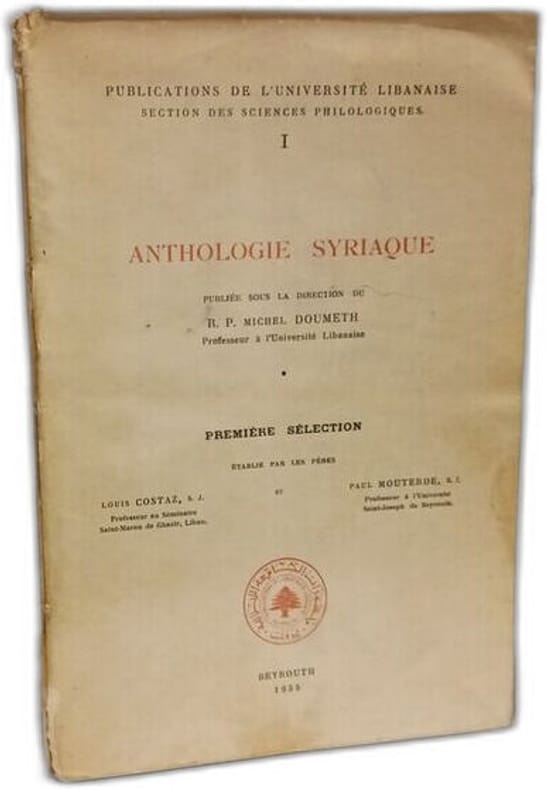
1955100146682Publications de l'Université Libanaise 1955 in8. 1955. Broché. Il s'agit d'une anthologie de textes syriaques publiée en 1955 par les Presses des Missionnaires Libanais dans le cadre des Publications de l'Université Libanaise. L'ouvrage dirigé par le R.P. Michel Doumeth présente une première sélection de textes établie par les Pères Louis Costaz et Paul Mouterde
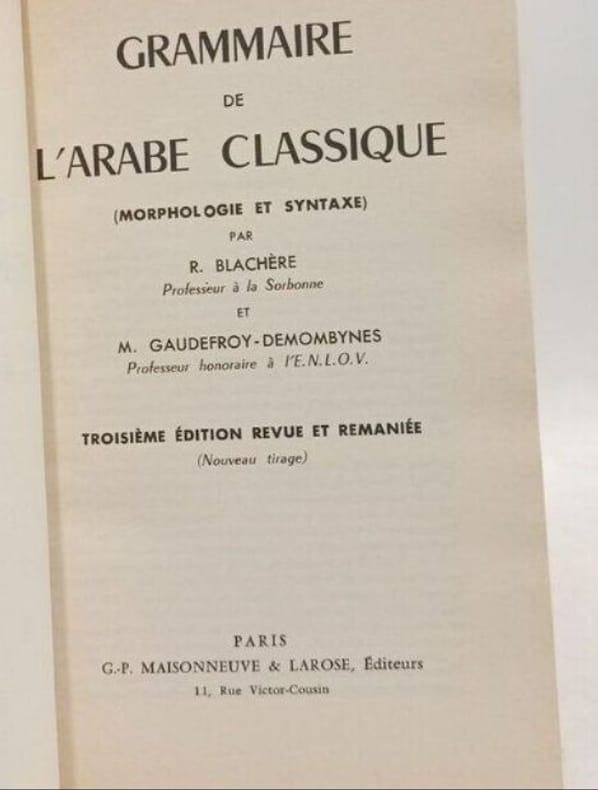
1970100144191G-P. Maisonneuve & Larose Editeurs 1970 in8. 1970. Cartonné.
Paperback octavo with white spine. 95 pages ; 21 cm In Arabic. Uncommon. || Short stories.
2618in 4 broché titre au dos en long et sur le premier plat titre 10 pages sur papier glacé,7 cartes dépliantes en couleurs30 pages standards et descriptions des races chevalines françaises.32 photos.Trait Comtois,trait Percheron,Pur sang anglais et pur sang anglo-arabe etc Ministère de l’agriculture éditeur 1953 très bon état
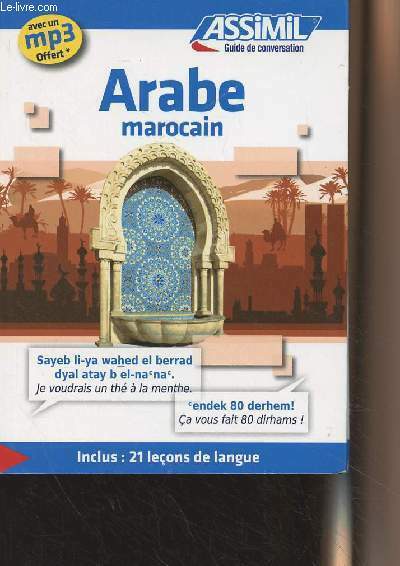
2013R300280300Assimil. 2013. In-12. Broché. Bon état, Couv. convenable, Dos satisfaisant, Intérieur frais. 160 pages. Plats contrepliés en un rabat.. . . . Classification Dewey : 492.7-Arabe
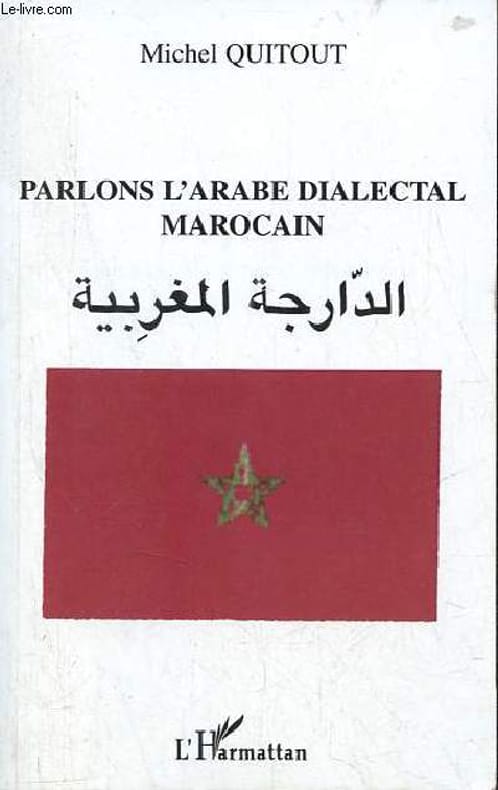
2001R100086302L'Harmattan. 2001. In-8. Broché. Bon état, Couv. convenable, Dos plié, Intérieur frais. 237 pages - une étiquette collée sur le 2ème plat.. . . . Classification Dewey : 492.7-Arabe
Broch?. 202 pages. Tr?s bon ?tat.
français In-8 de XXIV-243 pp.; demi-toile cartonné de l'éditeur. Troisième édition.
Very Good Turkish, Ottoman (1500-1928) Original color map. 21x19,5 cm. In Ottoman script. No scale, no mapmaker info. Slightly dumped on right margin. Little wear on peninsula view. Otherwise a good copy. Folded. [Ottoman map of Aden Bay and Port].
90687Paris, Louis Conard, 1920. 12 x 18, 343 pp., broché, état moyen (couverture défraîchie, papier légèrement jauni).
201712840Paris Lattès 2017 Un volume in-8 dos collé, couverture violette, 318 pages. Bon état.
180926299Imprimerie Impériale | Paris 1809-1829 | 53.50 x 71 cm | une feuille
180925339Imprimerie Impériale | Paris 1809-1829 | 53.50 x 70.50 cm | une feuille