3 889 résultats
Fine Turkish Paperback. Roy. 8vo. (24 x 17 cm). In Turkish. [viii], 135, [9] p. 1860-1861 Suriye buhrani: Osmanli diplomasisinden bir örnek olay.
Fine English Modern cloth bdg. Roy. 8vo. (24 x 17 cm). In Turkish. [xiii], 195 p. contemporary and modern Arab literature in 19th century in the Ottoman Empire. 19. yy. Osmanli döneminde yeni Arap edebiyati.
43587Paris Editions Maisonneuve et Larose 1992 in 8 (24x16) 1 volume broché, couverture illustrée, 314 pages [2]. Syrie, Liban, Palestine, Irak, Jordanie, Yémen, Koweit, Arabie Saoudite, Émirats arabes unis, Bahrein, Qatar, Oman, Somalie, Djibouti, Égypte, Soudan, Libye, Tunisie, Algérie, Maroc, Mauritanie. Etat neuf
11014broché -14x20.50 - 378pp - 1998 - éditions PHEBUS
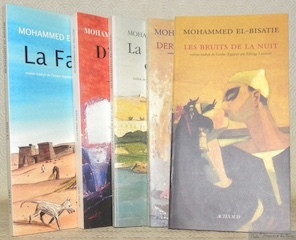
91744Arles, Actes Sud 1992, 2000, 2002, 220x115mm, broché. Exemplaire à l'état de neuf.
New English Paperback. Pbo. Demy 8vo. (22 x 15 cm). In English and Turkish. 73 p., color ills. 4. International Calligraphy Competition Exhibition.= 4. Hat Yarismasi Sergisi. [Exhibition catalogue].
84488Paris/Bruxelles, Elsevier Séquoia, 1977. "15 x 22, 259 pp., 16 planches en N/B, 4 cartes inédites, broché, bon état (1 cachet et signature ex particulier; dos défraîchi)."
91743Arles, Actes Sud 2011, 2006, 1996, 2000, 2003, 215x115mm, broché. Exemplaire à l'état de neuf.
- Hachette & Cie, Paris 1858, 12x19,5cm, relié. - Edition originale. Reliure en demi chagrin marron, dos à quatre nerfs sertis de guirlandes dorées orné de caissons dorés, initiales dorées en queue, plats de papier marbré marginalement décolorés, gardes et contreplats de papier à la cuve, légers frottements sur les coupes, reliure de l'époque. Quelques petites rousseurs. [ENGLISH DESCRIPTION ON DEMAND]
30051Bruxelles, Editions Complexe, 2006. 16 x 24, 395 pp., broché, très bon état.
ABE-15644698323138 CARTES POSTALES VERS 1900-6018: LA GRANDE PRIERE (NON VOYAGEE)-6297: MAURESQUE (NON VOYAGEE)-6607: JEUNE FILLE ARABE (NON VOYAGEE)-6612: JEUNE MAURESQUE (VOYAGEE)-6615: FILLETTES ARABES (NON VOYAGEE)-6617: OCCUPATIONS DOMESTIQUES FILLETTES ARABES (NON VOYAGEE)-6619: JEUX DE FILLETTES (NON VOYAGEE)-FEMMES MAURESQUES EN PROMENADE (NON VOYAGEE) (BCP6)
Very Good Arabic Original b/w lithographer print of Mecca. 21,5x17,5 cm. In Arabic. 1 p. [A FINE LITHOGRAPHER MECCA] Mecca al-Mukarrama Zad Al-Lah Sharifhâ al-ayyum al-qaima. It shows Mecca city with its building like Kaba, and walls besides its environment. Mecca is a city in the Hejazi region of Saudi Arabia. The city is located 70 km (43 mi) inland from Jeddah, in a narrow valley 277 m (909 ft) above sea level, 340 kilometres (210 mi) south of Medina, its population in 2012 was 2 million, although visitors more than triple this number every year during the ?ajj ("Pilgrimage"), held in the twelfth Muslim lunar month of Dhûl-Hijjah. It is the birthplace of Muhammad, a cave 3 km (2 mi) from Mecca was the site of Muhammad's first revelation of the Quran, and a pilgrimage to it, known as the Hajj, is obligatory for all able Muslims. Mecca is home to the Kaaba, one of Islam's holiest sites and the direction of Muslim prayer, and thus Mecca is regarded as the holiest city in Islam.
Very Good Arabic Original b/w lithographer print of Medina. 21,5x17,5 cm. In Arabic. 1 p. [A FINE LITHOGRAPHED MEDINA] Medina al-Munawwara ali sâhibhâ afzal al-tahiyya. It shows Medina city with its building and walls besides its environment. Medina is the capital of the Al-Madinah Region in Saudi Arabia. At the city's heart is al-Masjid an-Nabawi ('The Prophet's Mosque'), which is the burial place of the Islamic prophet, Muhammad. Medina is one of the three holiest cities in Islam, the other two being Mecca and Jerusalem. Medina was Muhammad's destination in his Hijrah (migration) from Makkah, and became the capital of a rapidly increasing Muslim Empire, under Muhammad's leadership, serving as the power base of Islam, and where Muhammad's Ummah (Community), composed of both locals and immigrants from Muhammad's original home of Mecca, developed. Medina is home to three prominent mosques, namely al-Masjid an-Nabawi, Quba Mosque, and Masjid al-Qiblatayn ('The mosque of the two Qiblas'). Muslims believe that the chronologically final surahs of the Quran were revealed to Muhammad in Medina, and are called Medinan surahs in contrast to the earlier Meccan surahs.
New Turkish Paperback. Roy. 8vo. (23 x 16 cm). Edition in Turkish. 304 p. [Abbasids] Abbâsîler. The Abbasids rose to power by bringing the Umayyad reign to an end with a revolution that has been described as a definitive turning point in the history of Islam. The Abbasids' accession to power, who reigned for over 500 years, bringing with them many changes in political, social, cultural and religious construct. This study, which aims to provide a historical account of the Abbasid period for those who are curious about the history of Islam, is designed to cover the political history of the Abbasid period, as well as topics related to culture&civilization. While analyzing the outlines of the Abbasid history, this book exhibits an approach that presents the period in a chronological stream and centers around the major events and facts that constitute the basic Dynamics of the era, rather than a caliph-centered narrative style.
Very Good Turkish, Ottoman (1500-1928) First and Only Ottoman Turkish translation and compilation (also in any Turkish / Turkic language) of 12th-century mystic Arab poet Ibn al-Farid [or Fariz] poems, with Mevlevi poet Nazim Pasha's annotations. This rare book includes Yaiyyah, Mimiyyah, and Raiyyah qasidahs styles of classical Arabic verse. Paperback. Cr. 8vo. (19 x 13 cm). In Ottoman script (Turkish with Arabic letters). 159 p. Ibn Farid was born in Cairo of Ayyubid Egypt to parents from Hama in Syria, lived for some time in Mecca, and died in Cairo. His poetry is entirely Sufic and he was esteemed as the greatest mystic poet of the Arabs. Some of his poems are said to have been written in ecstasies. The poetry of Shaykh Umar Ibn al-Farid is considered by many to be the pinnacle of Arabic mystical verse, though surprisingly he is not widely known in the West. Ibn al-Farid's two masterpieces are The Wine Ode, a beautiful meditation on the "wine" of divine bliss, and "The Poem of the Sufi Way", a profound exploration of spiritual experience along the Sufi Path and perhaps the longest mystical poem composed in Arabic. Both poems have inspired in-depth spiritual commentaries throughout the centuries, and they are still reverently memorized by Sufis and other devout Muslims today. Ibn al-Farid claimed to see many things happen that could be considered to be out of this world. He wrote of a lion kneeling down to him and asking him to ride. He also wrote of seeing a man descending a mountain, floating without using his feet. He claimed that a "great green bird" came down at the funeral of the greengrocer and "gobbled up his corpse". He also claimed to have conversed with Muhammad in a dream. Ibn al-Farid's son Kamal al-Din Muhammad described his ecstasies or trances as sometimes lasting ten consecutive days without eating, drinking, moving, speaking, or hearing outside noises. He would alternately stand, sit, lie on his side, and "throw himself down on his side." When he came to, his first words would be a dictation of the verse God had given him. Mehmed Nazim Pasha, (1840-1926) was an Ottoman statesman, governor of Thessaloniki [i.e. Salonica] poet, and translator. He was a Mevlevi. He wrote his mystic poems and he was the grandfather of famous Turkish leftist poet Nazim Hikmet Ran, (1902-1963). Only three copies in OCLC (German and Hungarian libraries, not in the US): 165173565 / 1132595242.; Özege 8358.
Very Good English Original dark green cloth bdg. Brief title and "Stirps Arabica Vicit" with a saber and crescent moon gilded on the front board. A very good copy. 4to. (30 x 24 cm). In English. 66 p., 5 engraved plates. First and only edition of this handsome and illustrated book of the first Arabian horses presented by Ottoman Sultan Abdulhamid II, bred by Huntington in North America. Arabian horse breeding in North America properly began with the world tour taken by General Ulysses S. Grant after he served as president of America, it is that in March of 1878 the General and his son Jesse arrived in Istanbul (Constantinople ), after the day the Grants toured the private stables of Sultan Abdul Hamid II are distinctly contradictory. Randolph Huntington was an American horse breeder who demonstrated the possibilities inherent in the Arab horse for the purpose of developing a new breed of saddle and road horses. During his first years on the farm, he bought and sold many colts and fillies as coach horses in New York City. He soon came to recognize the value of the Clay stock in that community which was largely the result of the breeding of a horse called Henry Clay which was brought to the nearby Genesee valley and whose stock was distributed through the valley. On May 31, 1879, there arrived in America two very fine stallions which were presented to General U.S. Grant by the Sultan of the Ottoman Empire. These stallions were named Leopard and Linden Tree. It is generally acknowledged that Linden Tree was a Barb-Arabian while Leopard was a pure Arabian. Prior to the time that these horses arrived in America, the very favorable results from inbreeding to produce typical Clay horses were shown to be practical. After seeing the stallions, Leopard and Linden Tree, Randolph Huntington at once started negotiations to breed three virgin Clay mares to each of these stallions. He hoped thereby to improve the road horse quality of his horses. In the following years, he called them Clay-Arabs. Since Huntington wanted to breed only virgin mares. Leopard was a Seglawi Jedran, desert-bred by the Anazeh, foaled in 1873 and presented by Jedaan Ibn Mheyd of the Fedaan Anazeh to the Turkish governor of Syria. (Some accounts list Ibn Mheyd as the breeder, while Carol Mulder, with typical caution, makes the distinction that we only know he presented the horse) The governor then presented the horse to Abdul Hamid II, who in turn gave him to General Grant.
Very Good Arabic Original pictorial wrappers. Cr. 8vo. (20 x 14 cm). In Arabic. 169, [1] p., many ills. First Beirut Edition and early edition in Arabic literature of this classic novel by Salih, who is one of Sudan's greatest authors of the twentieth century. The story is set in the fictional village of Wad Hamid, the same setting as Salih's famous Season of Migration to the North. It is a comic novella, centering on the unlikely nuptials of the town's eccentric Zein. Tall and odd-looking, with just two teeth in his mouth, Zein has made a reputation for himself as the man who falls in love over and over with girls who promptly marry other men, to the point where mothers seek him out in hopes that he will draw the eye of available suitors to their eligible daughters. "The Wedding of Zein" was made into a drama in Libya and won Kuwaiti filmmaker Khalid Siddiq an award at the Cannes Film Festival in the late 1970s. Some critics identify this novella may be considered part of the tradition of magical realism, although Salih considered it as a socialist realist one. Minor stains on cover and edges. Overall a good copy. Only two paper copies in OCLC in Library University of Amsterdam and Leiden University Library: 71470668. It's also the earliest edition in the OCLC.
Very Good Arabic Paperback. 4to. (27 x 19 cm). In Arabic. 32 p., color and b/w ills. [ARABIC MICKEY MOUSE] Miki: Mars 13, 1299 = 1986. [i.e. Mickey Mouse]. Early Arabic Edition of 'Mickey Mouse' by Walt Disney printed in Cairo. " [.] Translations of comic books from Europe and the US have had a significant impact on the development of the Arab comic. As early as the 1950s, the Adventures of Tintin were being published in children's magazines in Arabic, and the Egyptian children's magazine Miky translated the stories of Mickey Mouse and his friends. As time went on, Mickey Mouse developed his own Egyptian identity: The famous mouse celebrated religious and national holidays, wore traditional Egyptian clothing and ate typical Arab food. Miky was a familiar figure in all Arabic-speaking countries...". (Source: Qantara. Arab Comics From Micky Mouse to Handala).
171164014CBs.l., [um 1711]. 8°. 20 x 14 cm. [53] Blatt. Halblederband im Stile der Zeit mit marmoriertem Deckelbezug. [6 Warenabbildungen]
Light creasing to wraps. Browning to wraps. Pencil marginalia and underlining to some pages. Dampstaining to corner of Arabic titlepage. 1 small stain to English titlepage. Book has been very smartly rebound in quarter faux-leather spine with gilt lettering and marbled boards. Pages tanned. 1 lined page with Dutch writing has been bound after Arabic titlepage. Scholar's small bookplate to English titlepage. ; Text entirely in Arabic. ; Islamica 28; 387 pages
Very Good Turkish, Ottoman (1500-1928) Original autograph quotation and letter signed 'Hamdizâde Abdülkadir' [Erdogan]. Quotation from his book called 'Türk sözü'. Letter has 20 lines. Full. 1 p. It includes discovery and transcription of a Seljuk inscription in Zazadin (Saadeddin -Saadettin-) Han "located on Konya-Aksaray street, three hours from the city". He wrote and deciphered Arabic inscription. Some texts couldn't be read by him, so he used 'points' for these texts. He was born in 1879 in Konya city. He worked as a Persian teacher in Konya Sultanisi in 1913 and as a professor of Islamic History in Medrese-i Ilmiyye which was opened in 1915. Abdülkadir Erdogan, who was also thrown into politics for a while, was a member of Konya Provincial Assembly and a member of the Provincial Council. He was imprisoned in the same room with Abdulhalik Renda in 'Bekir Agha Bölük'. After leaving politics, he wrote exceptional articles that shed light on Konya's history, culture and folklore. Abdülkadir Erdogan, who left Konya and settled in Istanbul, was appointed as the assistant of Ibnülemin Mahmud Kemal Inal (1871-1957) to the Museum of Turkish Islamic Arts, which was established in 1932 in the Süleymaniye Complex. After the retirement of Ibnülemin Bey in 1935, he was appointed as deputy director and in 1937 as director.
New Arabic Original bdg. HC. 4to. (27 x 25 cm). Edition in Arabic. 141 p., ills., maps. [BAGHDAD IN THE LIGHT OF OTTOMAN ARCHIVE DOCUMENTS] Bagdad min khlâl wata'iq al-arsif al-Uthmani. This is a collection of historical documents, maps and photographs concerning Baghdad selected from the Ottoman Archives in Istanbul affiliated with the General Directorate of State Archives, Prime Ministry of Turkey. The book begins by Bayat's introductory article on the «Characteristics of the History of Baghdad during the Ottoman Era» which is a glimpse at the history of the city from the beginning of Ottoman administration in 1534 until the British occupation in 1917. The documents which are reproduced and translated in the book were chosen from the Mühimme registers contained in the Ottoman Archives and from various collections of the Archives. They include statistical tables copied from the Devlet-i Osmaniye Salnamesi (Almanach of the Ottoman State) the Nazaret-i Maarif Salnamesi (Almanac of the Ministry of Education), the Bagdat Vilayeti Salnamesi (Almanac of Baghdad Province). Photographs taken during the Ottoman period and reflecting various features of the city are also included, together with various maps of the city. The documents do not cover any specific aspect of the city but reflect general themes about its history in various periods.
Very Good Turkish, Ottoman (1500-1928) Original Ottoman cloth bdg. Cr. 8vo. (20 x 14 cm). In Ottoman script (Old Turkish with Arabic letters). 293 p., 17 b/w plates and 1 folding map, and 1 folding linguistic table (including alphabets used in India such as Sanskrit, Brahmi, Devanagari and their pronunciations in Latin and Arabic alphabets). Slightly loosed spine, skillfully repaired a part of the spine, fading and chipped on the board's extremities, slight stains on the plates. Overall a good copy. Extremely rare (with a map and the plate at the end of the book) first edition of this eye-witness travel account of the Indo-Islamic culture during the British Raj in the late 19th century, by the Hamidian period Turkish ambassador and scholar Sirvanî (1831-1890), who had written and translated three geographical books as well. Sirvânî completed his travel memoirs on his return from India to Constantinople, where he was sent as an ambassador by Sultan Abdulhamid II between 1877-1879. The narrative of his journey begins with the landing in India from Constantinople by ferry. He describes the splendid and fascinating British Indian cities, regions, and buildings such as Bombay, Poona, Dakkan, Udaipur, Baroda, Ajmer, Jaipur, Amber Fortress, Allahabad, Benares, Calcutta, Jaipur, Lucknow, Agra, Alexandre, Delhi, Nepal, Racputana, Indor, Sind, Bundelkhand, Datia, Chatarpur, Bina, Mihr, Bihar, Bengal, Ceylon, Aligarh, Sirhind, Lahore, Kashmir, Dekkan, Orissa, Avrang, Bijapur, Malia, Khandesh, Gujarat, Hugli, Madras, Maisur, Jehlam, Sialkot, Rawalpindi, Nevshar, Mardan, Swat (now in Pakistan), Beloojistan, Peshawar, Afghanistan, Kabul, Ghazna, Kandahar, Herat, Badakhshan, etc. This first-hand travel account offers an invaluable insight into the customs of Indian peoples living in the region as well as the onomastics and ethnography of India and Afghanistan. He met Sayyid Ahmed Khan, who was the founder of the Aligarh University which was famous as the Aligarh School (founded in 1877) among the Indian people. The Aligarh Movement was the push to establish a modern system of education for the Muslim population of British India, during the later decades of the 19th century. The work includes a large chapter of Mecca, where Sirvânî stayed for a long time. He gives detailed information on the Islamic pilgrimage (Haj) and the Arabian Peninsula in this chapter. OCLC 19769728, 1030091889 (Six copies worldwide).; Ihsanoglu, pp. 269-270.; Özege 7654.; Karatay I, 268.; TBTK 1438.
Very Good English Original color city map of Isfahan. 70x50 cm. In English. Folded. No scale. This detailed Isfahan city map includes a very detailed alphabetical index as well. There are some b/w photos indicated several important places and buildings on the map. Remarks says, "Please note that most Government Departments, Point 4, Fao, Banks etc. are situated around the Shah Sqaure. Ask for Ostandari i.e. the Governor's Office at F6 or find the Information Dept. at D6. All streets, avenues, kuchehs are listed under the name of khiaban eg. Khiaban Abbasssad is under K. not A. Historic places are listed both under their own names e.g. Ali-Qapu, Chehel-Sotoon etc.; and under Mosques, Minarets, etc.".
Very Good Arabic Early edition of this critical edition of Saad Zagloul's memoirs prepared by Mustafa al-Nahhas Jabr Pasha. Zaghloul was an Egyptian revolutionary and statesman, who was the leader of Egypt's nationalist Wafd Party. He served as Prime Minister of Egypt from 26 January 1924 to 24 November 1924. By working as a Europeanized lawyer, Zaghloul gained both wealth and status in a traditional framework of upward mobility. Despite this, Zaghloul success can equally be attributed to his familiarity with the Egyptian countryside and its many idioms. In 1918, he became politically active, as the founding leader of the Wafd Party, for which he was later arrested. Zaghloul became increasingly active in nationalist movements, and in 1919 he led an official Egyptian delegation (or wafd, the name of the political party he would later form) to the Paris Peace Conference demanding that the United Kingdom formally recognize the independence and unity of Egypt and Sudan (which had been united as one country under Muhammad Ali Pasha). The British in turn demanded that Zaghloul end his political agitation. When he refused, they exiled him to Malta, and later to Seychelles. In 1922, he was moved from Seychelles and was taken to Gibraltar due to ill health arriving there onboard HMS Curlew and he was released in 1923. Zaghloul's absence caused disturbances in Egypt, ultimately leading to the Egyptian Revolution of 1919. Upon his return from exile, Zaghloul led the Egyptian nationalist forces. Mu??afâ al-Nahhâs Pasha, (1879-1965), a statesman who, as the leader of the nationalist Wafd party, was a dominant figure in Egyptian politics until the revolution of 1952. A lawyer by profession, Na??âs was appointed a judge in the National Court at ?an?â in 1914. Soon after World War I he joined the recently formed Wafd; he was exiled with Sa'd Zaghlul in the early 1920s, and assumed the chairmanship upon Zaghlul's death in 1927. An imitation leather bdg., Arabic lettered gilt on front board. Foolscap 8vo. (18 x 12 cm). In Arabic. 280, [2] p., a portrait of Zaghloul, b/w ills. Offset lithography. OCLC 23485313, 784459538, 1044672960.