1 284 résultats
15912981Amsterdam: Herman Jansz. Muller 1591. 8vo 143 x 95 mm. Collation: A-T8 T8 blank. 302 pp. Text in gothic types stage directions and lists of actors in italic. Title woodcut of a family meal six text woodcuts of which 5 half-page and one smaller. Wormtrack in gutter of first few leaves dampstaining to foremargins and lower corners a fewer quires with larger dampstain. 17th-century stiff parchment manuscript spine title. Provenance: "Herman Lamberts Bellaer Anno 1685" signature on front flyleaf Bellaer was a notary in Weesp North Holland from 1656 to 1658; "no. 38" written on title; sheet of 20th-century paper with note tipped in at front.Only Edition of an anonymous vernacular play collection a late survival of a popular medieval performance tradition. These seven plays in Dutch verse dramatize the seven Works of Mercy from Matthew 25:35-46. They were written and performed in the open air on seven consecutive Sundays by the amateur Amsterdam literary and theatrical confraternity or "chamber of rhetoric" known as de Egelantier or Eglantier eglantine or wild rose allegedly in order to encourage the citizens of Amsterdam to participate in a lottery for the benefit of the Amsterdam insane asylum Poll p. 113. The edition was printed by one of the Eglantier members.In each play of the present collection an allegorical figure with a name like "Good Education" or "Brother Love" knocks on the door of the house of a different stock character - a burgher an artisan a farmer etc. - asking to be fed or clothed or given shelter. While these tradesmen comply a selfish character named "Most of the World" invariably rejects the stranger. Each play has a prologue and an epilogue that provides the moral of the story explaining that the stranger the naked the hungry the thirsty etc. are all Christ on the Cross.By the early sixteenth century every town and many villages of the Low Countries possessed their own "college" or chamber of rhetoric; these were literary confraternities whose origin lay in medieval French-speaking theater groups of Flanders and Brabant which performed mystery and miracle plays. Endowed with corporate structures emblematic names often flowers and their own blazons and regalia the chambers of rhetoric became a central cultural institution of Netherlandish life. After the Reformed church came to power in the northern provinces in 1581 it attempted to halt public performances of religious plays and even to suppress the chambers altogether but largely failed the chambers especially of larger towns usually retaining the support of local authorities. Hence one finds such "throwbacks" as the present series of religious plays. A peculiar to the modern reader mixture of traditional farce and didactic allegory it is typical of rhetoricians' plays which were usually "absolutely middle-class in tone and opposed to aristocratic ideas and tendencies in thought" EB 1911 8:721 with simple dramatic plots that were secondary to their educational value.Although founded later than many others at the end of the 15th century Amsterdam's de Eglantier was the most prominent Chamber of Rhetoric in the northern Netherlands. Its prestige was enhanced by the infusion of humanist writers and writers from the southern Netherlands who emigrated to the north during the religious wars. The Zeven Spelen is unique in containing the productions of a single city's Rhetorical Chamber: all other known Renaissance Dutch rhetoricians' collections contain the productions of several different towns performed in elaborate literary competitions known as landjuweelen.Six of the seven simple but charming woodcuts illustrating this edition in a consistent style and apparently by the same wood-engraver possibly the printer represent the first six acts of mercy the seventh play is illustrated with a smaller Last Judgment cut evidently from the printer's stock. Their charm lies in their portrayal of scenes from daily life: a family dining as a servant brings a platter and a mother feeds her baby; a vintner sitting cross-legged on a wine barrel in a medieval square pouring a welcome drink to a pair of wanderers while a neighbor quaffs behind him; naked men being clothed a prisoner in a stockade; a sickbed with a woman stirring gruel. The printer-publisher Harmen or Herman Jansz Muller ca. 1540-1617 was a member of a family of engravers printers and print- and booksellers who operated under the sign of "Den Vergulden Passer." Under his direction from ca. 1566 until his death the bookselling activities of the firm reached their apogee. As in many of his imprints Muller identifies himself here as a figuersnyder and it is possible that the title woodcut and the five larger cuts were his own work cf. Thieme-Becker 25:230 who suggested as much. Muller was also a member of De Egelantier and pubished a number of works for them.OCLC locates 5 copies in American libraries Folger Newberry National Gallery of Art Harvard and U. Michigan. STCN 844000841; The New Hollstein / The Muller Dynasty Part III 1999 75 and pp. 21-22; E. W. Moes De Amsterdamsche boekdrukkers en uitgevers in de zestiende eeuw 1900-1915 I p. 315 no. 223; Univ. of Amsterdam Library Catalogus van oudere werken op het gebied der Nederlandsche letteren 1921 no. 6; Scheepers collection Catalogus van een zeer belangrijke verzameling fraaie en zeldzame boeken der 16e-19e eeuw 1947 I:66. Cf. G. Kalff Geschiedenis der Nederlandsche letterkunde in de 16de eeuw part 2 1889 pp. 25 & 48-55; Klaas Poll Over de tooneelspelen van den Leidschen rederijker Jacob Duym 1898 p. 113-14; A. van Dixhoorn "Chambers of Rhetoric: performative culture and literary sociability in the Early Modern Northern Netherlands" in The Reach of the Republic of Letters: Literary and Learned Societies in Late Medieval and Early Modern Europe 2008 119-148; A-L. Van Braene "Faith on Stage: the Chambers of Rhetoric and Civic Religion in the Low Countries 1400-1700" K. Eisenbichler A Companion to Medieval and Early Modern Confraternities Brill 2019 pp. 365-84. Herman Jansz. Muller hardcover books
1817233514Périsse et compère 1817 292 pages in12. 1817. Relié. 292 pages.
Darmstadt, WBG, 2001, in-8, tela edit., sovracc., pp. 335, [1].
SANSONI 1960 442 PP. SOVRACCOPERTA UN PO' STANCA, TIMBRO DI BIBLIOTECA ESTINTA ALL'ANTIPORTA E AI MARGINI DI QUALCHE PAGINA (SENZA COMPROMISSIONE DI LETTURA DEL TESTO), SEGNO DI CATALOGAZIONE A BIRO ALL'ANTIPORTA, TALLONCINO ADESIVO AL CONTROPIATTO ANTERIORE, PER IL RESTO OTTIME ED ECCELLENTI CONDIZIONI GENERALI.
(1.I.7). - Il ricavato della vendita di questo libro sarà destinato ai progetti di ricerca e formazione promossi dalla "Fondazione Salvatore Calabrese"
(Collana : -) Prima edizione (1.VI.7). - Il ricavato della vendita di questo libro sarà destinato ai progetti di ricerca e formazione promossi dalla "Fondazione Salvatore Calabrese"
(Collana : Quaderni di poesia contemporanea - n. 5) Prefazione di Mario Luzi - Rime (1.XXIX.10). - Il ricavato della vendita di questo libro sarà destinato ai progetti di ricerca e formazione promossi dalla "Fondazione Salvatore Calabrese"
In-8°; PP. 168, 167, (1) nel testo finalini incisi su legno. Legatura in piena pergamena con titolo manoscritto al dorso. Timbro marginale al frontespizio.
Prima edizione Oscar Mondadori
Oscar Studio Mondadori
In 16 (cm 10 x 17), pp. 203 + (1 bianca). Ex libris al contropiatto anteriore e firma alla prima carta bianca. Galleria di tarlo alla prima carta bianca, al frontespizio, all'ultimo foglio bianco. Cartonatura coeva con segni d'uso. Seconda edizione di questo manuale di poesia latina e italiana. Angelo Mazzoleni nacque a Bergamo nel 1719, insegno' retorica nel Seminario della citta', e poi diresse il Collegio mariano.
(1.VI.7). - Il ricavato della vendita di questo libro sarà destinato ai progetti di ricerca e formazione promossi dalla "Fondazione Salvatore Calabrese"
Tre opere della seconda metà del '700, ad uso delle scuole del Regno di Sardegna, rilegate in un volumetto di cm 15 x 9 circa, in piena pelle coeva (nervi al dorso, tassello dei titoli e fregi oro agli scomparti): Anonimo "De arte rhetorica ad subalpinos libri III" Augustae Taurinorum, ex Typographia Regia, MDCCLXXIII [1773], di 144 p. // Anonimo "De expolienda oratione, atque stylo exercendo institutiones ex probatissimis auctoribus, et brevi, facilique methodo concinnatae" Augustae Taurinorum, ex Typographia Regia, MDCCLXVI [1766], di 118 p. // Benedetto Buommatei "Avvertimenti grammaticali per la lingua italiana riveduti, e corretti, a' quali si sono premesse le declinazioni de' verbi regolari, e irregolari, di Benedetto Buommattei, a uso delle regie scuole" In Torino, nella Stamperia Reale, 1770, 101 (1) pagine. Pelle vissuta (usure e screpolature, piccole mancanze); un allargamento interno (tra p. 24 e 25 della seconda opera) con leggera sporgenza di un quaderno; una macchia d'inchiostro (colatura di una gora) sul taglio frontale con interessamento dell'orlo di varie pagine; occasionali macchioline e qualche sgualcitura alle punte; fioriture alla terza opera. L'insieme reca, come molte opere scolastiche, tracce coeve d'uso, dovute allo studio (e alla noia) di ex-proprietatrio: righe manoscritte comprendenti la nota 'ex libri Cavalli Alexandri' nella prima di sguardia e nella carta bianca tra la seconda e terza opera; qualche crocetta, ad inchiostro sul margine bianco, per evidenziare dei punti del testo; svariati piccoli tratti a penna sul margine bianco di p. 44 della prima opera; una A (iniziale di Alessandro) a carattere capitale nelle sguardie di chiusura. Nel complesso, copia discreta.
15531214091553 Lutetia, Cura ac diligentia Caro Stephani, Cum privilegio Regis - M.D.LIII (1553) - Edition princeps - Grand in-octavo, reliure plein veau, dos à cinq nerfs, caissons et fleurons dorés, titre doré - Ex-libris sur l'intérieur du premier plat "Ex-Libris Antoni Marioe Dumas Rectoris de Chauffaille" - 611 pages - Texte sur deux colonnes - Ouvrage en latin
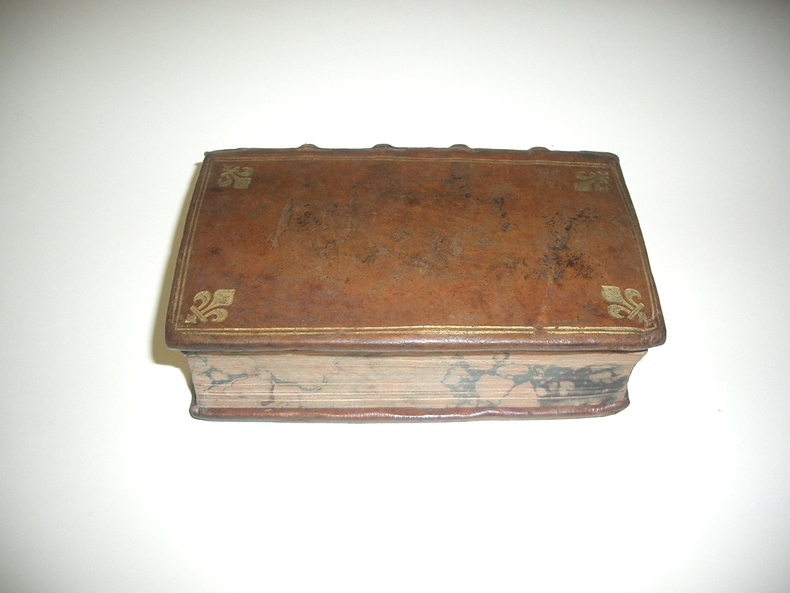
65859Parisiis, Apud Simonem Colinaeum, 1545, 1 volume de 7.5x11.5 cm environ, (1) ff., 218 ff. (1 numéro pour 2 pages) iv ff., (2) ff., reliure plein veau havane, dos à 4 nerfs avec titres dorés, entre-nerfs ornés de fleurs de lys,plats encadrés d'un double filet doré et d'une fleur de lys à chaque coins, tranches marbrées. Rares frottements, petit bijou bien conservé.Impression en italique.
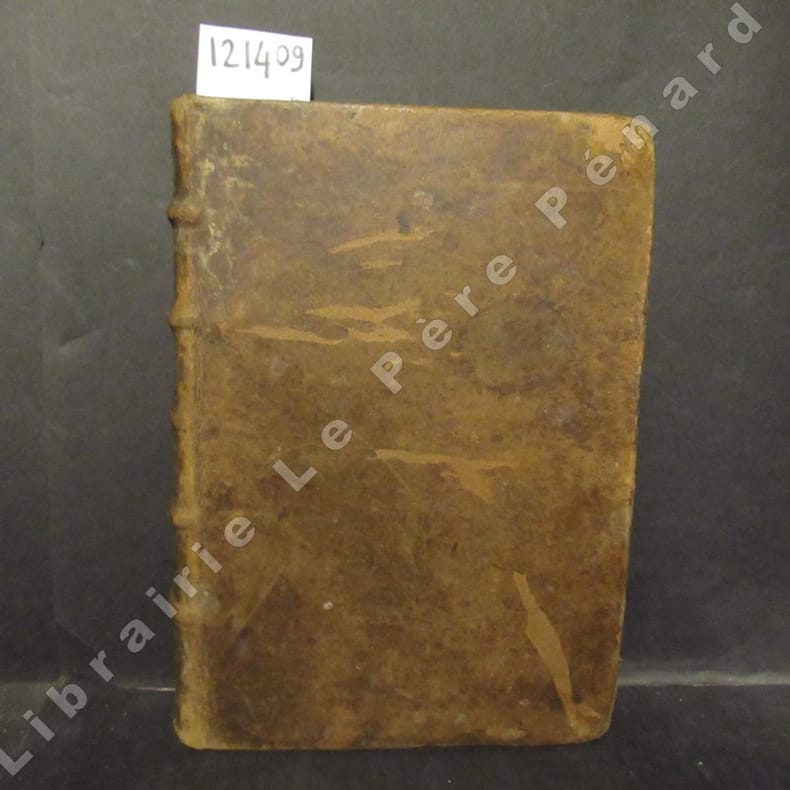
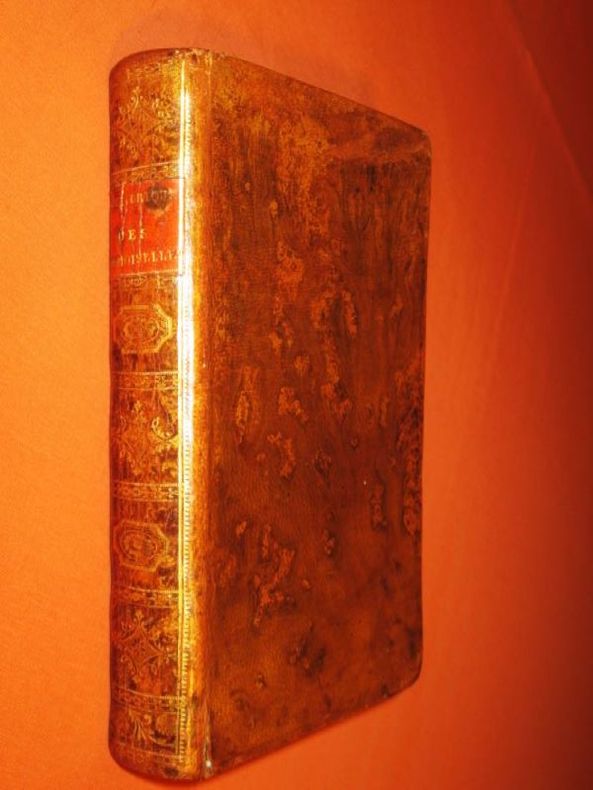
22588A Paris, chez Belin, Imprimeur-Libraire, rue Saint-Jacques, n° 22, An X - 1802, in-12 de 418 pages à tranches jaspées, reliure plein veau d'époque, titre doré sur pièce de titre rouge et ornementation dorée sur dos lisse. Corps frais, reliure solide et en bon état. Bel exemplaire.
Browning to endpapers. Very light staining to textblock. Front inner hinge weakening with split starting. ; Greek Text with Italian introduction. ; Testi E Documenti Per Lo Studio Dell'antichità III; 111 pages
Antonio Russo Oratori. , L'eloquenza 1933, Copertina cartonata sporca. Tagli sporchi di polvere e ingialliti, pagine ingiallite, cucitura allentata. Mediocre (Poor) . <br> <br> <br> <br>
un vol in 24 cm. 11x8,3 pp. 514-(14) Legatura coeva p. pergamena morbida titolo manoscritto (sbiadito) al dorso; marca tipografica al frontespizio capilettera Macchie diffuse della carta con qualche pp. leggeremente ed uniformamente brunita, gora d'acqua (non deturpante) alle ultime cc. ma buon esemplare ben conservato. Edizione torinese delle "Progymnasmata" di Aftonio retore di Antiochia tradotte in parte da Giovanni Maria Cataneo ed in parte da Rodolfo Agricola (Roelof Huesman)
400p. 13cm. Hardcover Ex-library, very good condition in worn calf, backstrip chipped hinges cracked With an additional engraved titlepage.
saggio (1.XXV.4). - Il ricavato della vendita di questo libro sarà destinato ai progetti di ricerca e formazione promossi dalla "Fondazione Salvatore Calabrese"
78637Vevey, Editions de l’Aire 1994, 210x125mm, 148pages, broché. Couverture à rabats. Exemplaire à l'état de neuf.
196422670Lausanne Skira 1964 in-4° 236 pp ; 60 planches en couleurs, 60 reproductions en noir et blanc ; bords de la jaquette un peu élimés par endroit, quelques rousseurs sur cartonnage et emboitage toile éditeur, rhodoïd
(Collana : Biblioteca classica economica) Con le annotazioni a ciascun canto e con le notizie dell'autore per cura di Eugenio Camerini (1.XXV.4). - Il ricavato della vendita di questo libro sarà destinato ai progetti di ricerca e formazione promossi dalla "Fondazione Salvatore Calabrese"