Jules MascaronLivre Rare Book
1 284 résultats
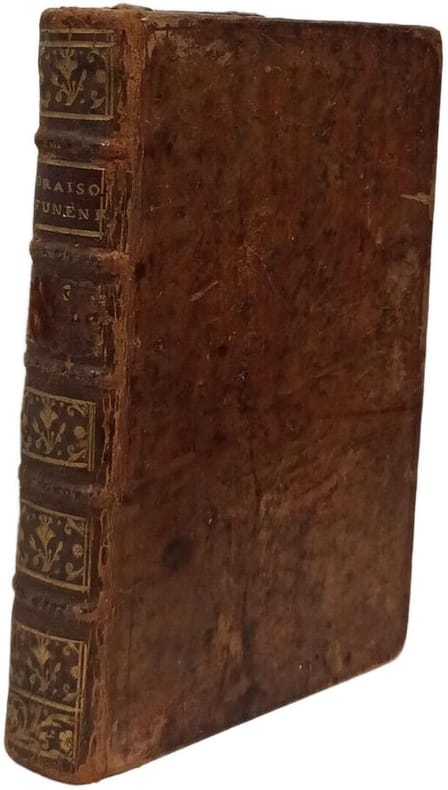
1745100145559Jean Desaint 1745 in12. 1745. Relié. Recueil publié en 1745 rassemblant les oraisons funèbres prononcées par Jules Mascaron évêque d'Agen et prédicateur du roi autour de 1670. L'ouvrage comprend une biographie de l'auteur et les éloges funèbres de cinq grandes figures de la cour de Louis XIV dont Anne d'Autriche Turenne et Henriette d'Angleterre exaltant leurs vertus chrétiennes et leur force face à l'épreuve
Italian introduction with Latin text and Italian translation. ; Edizioni E Saggi Universitari Di Filologia Classica 53; 130 pages
MAI SFOGLIATO: LIEVE INGIALLIMENTO, PER IL RESTO PERFETTO. Dalla toletta mattutina alla cena serale, le occupazioni e il tempo libero di Roma antica in un vivacissimo affresco storico. Jérôme Carcopino (1881-1970), uno dei più grandi storici dell'antichità romana, è stato direttore dell'École française di Roma e Accademico di Francia. Informazioni bibliografiche Titolo: La vita quotidiana a Roma all'apogeo dell'Impero Titolo originale: La vie quotidienne à Rome à l'apogée de l'Empire Introduzione di: Ettore Lepore Collana: Volume 25 di Biblioteca Universale Laterza Autore: Jérôme Carcopino Traduzione di: Eva Omodeo Zona Editore: Bari, Roma: Laterza, 1982 Lunghezza: 378 pagine; 22 cm Soggetti: Storia Romana, Storia sociale, Roma, Impero romano, Ambiente, Vita Romana, Quotidianità, Urbe, Foro Traiano, Case, Vie, Strade, Società, Denaro, Schiavitù, Morale, Caste, Censo, Plutocrazia, Sesterzi, Matrimonio, Femminismo, Dissolutezza, Dacia, Retorica, Religione, Toilette, Tempo Libero, Calendario Romano, Panem Et Circenses, Ornatrix, Tonsor, Matrone, Terme, Cena, Giustizia, Teatro, Imperatori, Cesare, Augusto, Daily Life in Ancient Rome: The People and the City at the Height of the Empire, Storici francesi, Ancient History, Cicerone, Filosofia, Classici
ria9780197677865_inpHardback. New. New Book; Fast Shipping from UK; Not signed; Not First Edition; In a surveillance culture the ubiquity of audio-visual recording devices has enabled the unprecedented documentation of private indiscretions scandalous conversations and obscene behaviors performed by both ordinary and high-profile hardcover
1971100138596PRINCETON UNIV PR 1971 364 pages in8. 1971. Cartonné jaquette. 364 pages.
Light spotting to boards. Minor shelfwear. DJ is a bit browned with chipping and tears (large tear to rear lower corner). ; 155pp. ; Twayne's World Authors Series; 155 pages
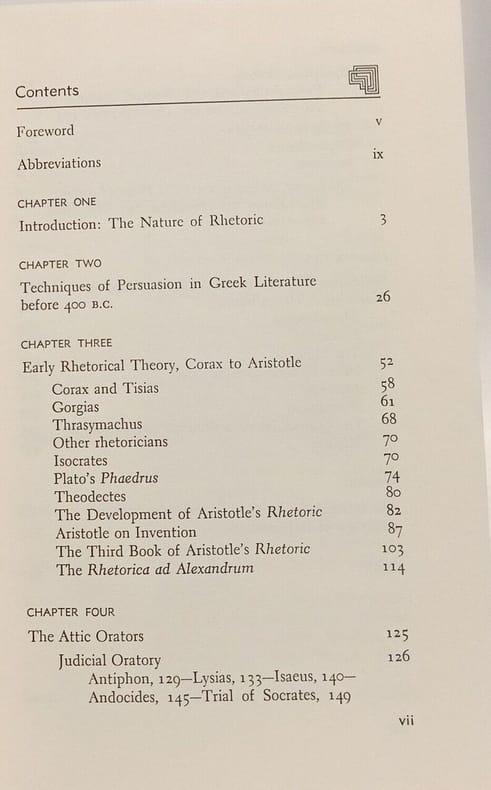
Underlining in marker to some pages with notes to endpapers. Former owner's name on inner cover and on ffep. Foxing to top of textblock. ; 350 pages; Explores rhetorical theory and practice from the fifth to first centuries B. C. Begins with the practical, creative rhetoric of the pre-Socratic era, progresses through the time of Aristotle and the Attic orators, and concludes with the ossification of rhetoric into a sterile, pedantic discipline during the Hellenistic period.
Dustjacket is protected in mylar. DJ has rubbing and edgewear to corners. 2 closed tears along DJ spine. ; Signed by author on ffep to Paul Fenimore Cooper, jr. ; 350 pages; Explores rhetorical theory and practice from the fifth to first centuries B. C. Begins with the practical, creative rhetoric of the pre-Socratic era, progresses through the time of Aristotle and the Attic orators, and concludes with the ossification of rhetoric into a sterile, pedantic discipline during the Hellenistic period. ; Signed by Author
Minor shelfwear. Foxing to top of textblock. ; 350 pages; Explores rhetorical theory and practice from the fifth to first centuries B. C. Begins with the practical, creative rhetoric of the pre-Socratic era, progresses through the time of Aristotle and the Attic orators, and concludes with the ossification of rhetoric into a sterile, pedantic discipline during the Hellenistic period.
9.2 X 6.2 X 0.7 inches; 256 pages
Creasing to spine. Minor edgewear to extremities. ; Comprehensive treatment on Greek rhetoric from late antiquity and including both pagan and Christian literature from AD 300 to 1300.; History of Rhetoric, Vol 3.; 12mo 7" - 7½" tall; 333 pages
Gift inscription from author to R. E. Fantham. Minor shelfwear. ; 171 pages; Signed by Author
Minor rubbing and shelfwear to wraps. DJ has edgewear with light chipping and a couple of small tears. ; Traces the development of Greek and Latin oratory and rhetorical theory from 300 BC to AD 300. During that period, he shows, the art of persuasion the Romans inherited from the greeks gradually became an art more concerned with the secondary characteristics of rhetoric: style and artistic effort. ; 0.76 x 9.2 x 6.1 Inches; 658 pages
Minor rubbing and shelfwear to wraps. Faint soiling to textblock. DJ has edgewear with chipping and tears in places. Some loss to top of spine (crudely repaired with clear tape). ; Traces the development of Greek and Latin oratory and rhetorical theory from 300 BC to AD 300. During that period, he shows, the art of persuasion the Romans inherited from the greeks gradually became an art more concerned with the secondary characteristics of rhetoric: style and artistic effort. ; 0.76 x 9.2 x 6.1 Inches; 658 pages
Minor rubbing and shelfwear to wraps. 1 corner has minor chipping. DJ has edgewear with chipping and small tears in places. Old Price-sticker on DJ. ; Traces the development of Greek and Latin oratory and rhetorical theory from 300 BC to AD 300. During that period, he shows, the art of persuasion the Romans inherited from the greeks gradually became an art more concerned with the secondary characteristics of rhetoric: style and artistic effort. ; 0.76 x 9.2 x 6.1 Inches; 658 pages
Romanzo (1.IV.2). - Il ricavato della vendita di questo libro sarà destinato ai progetti di ricerca e formazione promossi dalla "Fondazione Salvatore Calabrese"
139 pages. Hook surfer's attention. Write informative persuasive web text. Create dynamic personal and corporate web pages. Several light pencil markings. Very light wear. Clean. Excellent copy in attractive glossy covers. Book
1365 pages. Somewhat above-average wear. Unmarked. A sound working copy. Book
57980Sylvae-Ducis, Verhoeven Fratres 1855, 215x130mm, X- 414pages, reliure demi-basane. Plats papier marbré. Titre au dos. Charnières frottées. Coin supérieur de la page de garde et coin inférieur de la page de titre, découpés. Le feuillet de la page 265-268 se détache. Intérieur propre.
1903WIRT0226Wien, Wr. Volksbuchhdlg. Ignaz Brand 1903. IX, 719 S., schön illustr. OLnbd., abgegriffen, etwas braunfl., bestoß., vord. flieg. Vors. herausgeschnitten, Falz vor Inhaltsverz. aufgerissen, altersbed. schwach gebr., Farbkopfschn.
Top corners a bit bumped. Else book is fine. ; Traditionally, Homer's epics have been the domain of scholars and students interested in ancient Greek poetry, and Aristotle's rhetorical theory has been the domain of those interested in ancient rhetoric. Rachel Ahern Knudsen believes that this academic distinction between poetry and rhetoric should be challenged. Based on a close analysis of persuasive speeches in the Iliad, Knudsen argues that Homeric poetry displays a systematic and technical concept of rhetoric and that many Iliadic speakers in fact employ the rhetorical techniques put forward by Aristotle. Rhetoric, in its earliest formulation in ancient Greece, was conceived as the power to change a listener’s actions or attitudes through words? Particularly through persuasive techniques and argumentation. Rhetoric was thus a "technical" discipline in the ancient Greek world, a craft ( technê) that was rule-governed, learned, and taught. This technical understanding of rhetoric can be traced back to the works of Plato and Aristotle, which provide the earliest formal explanations of rhetoric. But do such explanations constitute the true origins of rhetoric as an identifiable, systematic practice? If not, where does a technique-driven rhetoric first appear in literary and social history? Perhaps the answer is in Homeric epics. Homeric Speech and the Origins of Rhetoric demonstrates a remarkable congruence between the rhetorical techniques used by Iliadic speakers and those collected in Aristotle's seminal treatise on rhetoric. Knudsen's claim has implications for the fields of both Homeric poetry and the history of rhetoric. In the former field, it refines and extends previous scholarship on direct speech in Homer by identifying a new dimension within Homeric speech? Namely, the consistent deployment of well-defined rhetorical arguments and techniques. In the latter field, it challenges the traditional account of the development of rhetoric, probing the boundaries that currently demarcate its origins, history, and relationship to poetry. ; 248 pages
Eriksson, JohanIn Pristine Condition. unknown
Book is fine. DJ has very light shelfwear else fine. ; Hellenistic oratory remains an elusive subject as not one Greek speech has survived from the end of the fourth century BC until the beginning of the first century AD. This collection of fourteen interdisciplinary essays offers a wide-ranging study of the different ways in which Hellenistic oratory can be approached. Written by a team of leading scholars in the field, it examines the different kinds of evidence which shed light on the dynamic character of oratory during the Hellenistic period. All essays stress the pervasive influence of Hellenistic oratory and survey its different manifestations in diverse literary genres and socio-political contexts, especially the dialogue between the Greek oratorical tradition and the developing oratorical practices at Rome. The volume opens with a detailed introduction, which sets the study of Hellenistic oratory within the context of current trends in Hellenistic history and rhetoric, and closes with an afterword which underlines the vibrancy and sophistication of oratory during this period. It will appeal to all students and scholars of Hellenistic history, society, and the history of rhetoric. ; 432 pages
(1.XI.6). - Il ricavato della vendita di questo libro sarà destinato ai progetti di ricerca e formazione promossi dalla "Fondazione Salvatore Calabrese"
177879151778 A Lyon, chez Faucheux, A Paris, chez la veuve Duchesne, 1778; in-8°, broché, couverture muette de papier marbré de l' époque; VIII, 188, (4)pp.