2 965 résultats
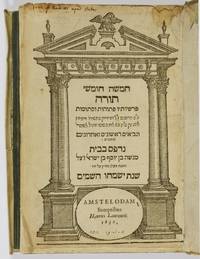
163155459Amsterdam: printed by Menasseh ben Israel for Henricus Laurentius 1631. First edition. Hardcover. Very good-. Octavo 16.8 by 11.4 cm. Collation: aleph-lamed-zayin8 = 296 leaves. 612 i.e. 592 pp: p. 464 erroneously numbered 484 465 as 485 and so on throughout. Two column text in unvocalized Hebrew; every fifth verse numbered in the margin. Title within architectural border; half titles with letterpress ornamentation for the Former and Latter Prophets. Contemporary vellumwith exposed thongs edges stained blue; yapp fore-edges; front joint cracked but holding strong. Intermittent light toning to text outmost leaves a bit more darkened; very occasional small stains. Title-page slighltly trimmed 4 mm at bottom edge; expert marginal repairs at bottom corners of 2 leaves; 1 leaf re-margined at fore-edge with no loss of text else a very good copy with crisp clean text.<br /> <br /> First Hebrew Bible published in Amsterdam printed by the rabbi diplomat publisher and religious thinker Menasseh ben Israel 1604-1657 one of the most distinguished members of the Portuguese Jewish community of Amsterdam and the first Jewish printer in the Northern Netherlands. The Amsterdam printer and publisher Hendrick Laurensz Lauretius provided the financing for this edition along with two other Bible editions and two editions of the Hebrew Psalms printed by Menasseh between 1631 and 1646. "These publications were not only made for the local market but mainly for international trade. Thanks to this financial help Menasseh was able to organize his printing office in a more professional way" Fuks hiring a Jewish compositor Judah Leb ben Mordecai Gimple from Posen and a gentile compositor Bartholomeus Laurensz. <br /> <br /> The printing activity of Menasseh was especially important in the steadily growing productions of the Hebrew press in the Northern Netherlands. Fulfilling the needs of the Sephardic community for Jewish ritual texts eliminated the need for expensive imports from Venice and Poland. Menasseh undersood that the relatively cheap paper and tools available in Amsterdam made it possible to compete in quality and prices with the Hebrew presses of Poland Italy and Basel. "Gentile publishers and booksellers in Amsterdam such as Jansonius and Laurentius were quick to see the opportunity of the opening Eastern European market and financed several of Menasseh's publications" Fuks. Menasseh was the first to introduce in the Netherlands waybertaytsch types for Yiddish publications along with illustrated Hebrew books. He was also the first Jewish printer to adopt the Dutch pocket-book format made famous by the Elzeviers.<br /> <br /> Notes on publication date and issue: The title is dated 1630 in Arabic numerals; the colophon notes the date of completion in Hebrew characters as 5 Adar 5391 = 7 February 1631 along with the printer's apology for being unable to provide the index of pericopes promised on the title-page due to lack of printing material. Darlow and Moule describe this issue as Variant A with a Latin imprint appearing in the cartouche beneath the Hebrew title.<br /> <br /> Provenance and annotations: early entry in brown ink at front paste-down with short Greek inscription Theos. dated 1700; old Latin inscription in black ink at top margin title in reference to Hebrew roots; date of 1812 beside Yiddish entry penned in black ink within imprint cartouche at title; old entry in German penned in black ink at verso title beneath which is an oval cartouche in imitation of the one at the title in which an owner has penned in black ink the Hebrew imprint information regarding Hendrick Laurensz as it would appear in the Varient B issue; old library shelf marks at rear paste-down; recent owner entry in blue ink in Hebrew at front paste-down. References: Darlow and Moule 5123a; Fuks/Fuks-Mansfeld no. 152; pp. 105; 111f.; Steinschneider no. 453; Vinograd Amsterdam 22.<br /> <br /> Full title and imprint: חמשה חומשי תורה פרשיותיו פתוחות וסתומות ×¢"פ ×”×¨×ž×‘× ×–"ל ומדוייק בחסירו' ויתרות להעתק ס"ת ×¢× ×œ×•×— בסופו מועיל לסופרי' ×•× ×‘×™××™× ×¨××©×•× ×™× ×•××—×¨×•× ×™× ×•×›×ª×•×‘×™×: × ×“×¤×¡ בבית ×ž× ×©×” בן ישר×ל ז׳׳צל והוגה בעיון × ×ž×¨×¥ על ידו ×©× ×ª ישמחו השמי×<br /> Amstelodami sumptibus Henrici Laurentii 1630. printed by Menasseh ben Israel for Henricus Laurentius hardcover
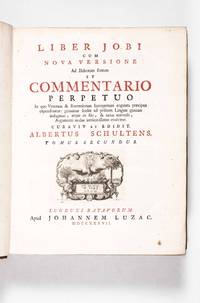
173749261Leiden: Jean Luzac 1737. First edition. Two volumes large quarto. 52 544; 2 545-1232 63 indices 1 corrigendapp. Text in two columns with Hebrew text and facing Latin translation interspersed with commentary. Titles in red and black with engraved vignettes. Contemporary speckled calf; gilt-tooled spine with raised bands and morocco lettering pieces; gilt dentelles; edges daubed in red and green. Light scuffing to boards and fading to spines. A very good set with crisp clean text throughout.<br /> <br /> First edition of this comprehensive commentary to the biblical Book of Job by the Dutch scholar of Semitic languages Albert Schultens 1686-1750 who maintained "that the true nature of the Hebrew language and the meaning of many of its words and idioms are to be found chiefly in the Arabic" Orme. Fifty-five pages of the indices constitute a brief lexicon and provide Latin as well as Arabic equivalents for more than 1000 Hebrew words. Schultens studied theology and eastern languages at Groningen where he received his degree in theology in 1709. After a brief career as a preacher in Wassenaar he was nominated professor of Hebrew and Jewish antiquities at Franeker in 1713. In 1729 he decamped for Leiden were he was first appointed reader in eastern languages and finally full professor in 1732.<br /> <br /> At this time a chief concern of Calvinist theologians was to liberate Old Testament exegesis from the Jewish Rabbinic as well as Catholic traditions. Schultens' influential and controversial solution was revealed as early as 1706 in his first public thesis Disputatio theologico philologica de utilitate linguae Arabicae in interpretanda S. Scriptura A Theologico-Philosophical Dissertation on the Utility of the Arabic Language for the Interpretation of the Holy Scriptures "a forceful attack" Brugman & Schröder on the Protestant sola scriptura methodology of Biblical exegesis. "With the help of Jacobus Golius' Arabic dictionary he perused with zeal and fervour the Old Testament and wrote prolifically. The lexical superiority of Arabic had led him to a reconsideration of the position of Hebrew: at first he had called Arabic 'the most splendid daughter of mother Hebrew' but in his oration of 1729 he proclaimed Hebrew and Arabic cognate twin sisters. This shocked conservative theologians as an outright profanation of God's Word" Brugman & Schröder. "In 1737 he applied his theories in his bilingual edition of the book of the prophet Job whom he regarded as an Arab. The Hebrew text and the Latin translation are all but totally submerged by the extensive commentary in which Schultens draws abundantly on Arabic texts such as the Hamasa an anthology of early Arabic poetry by the ninth-century poet Abu Tammam" Vrolijk & van Leeuwen. Schultens was not without his critics and by 1824 William Orme notes a turning of the tide: "Different opinions are entertained of the correctness of his views and also of his success in applying them; but it is now generally admitted that he carries his notions of the advantage of Arabic learning to the interpretation of the Scriptures too far." <br /> <br /> Jean Luzac 1728-1777 was a member of a well-known Huguenot family of printers; he published many works for the University of Leiden including three Hebrew books of Albert Schultens. Isaac van der Mijn is noted as the printer at the colophon of the second volume.<br /> <br /> Provenance: printed label of the Bibliotheca Seminarii Warmondani at the front endleaf of the first volume. Full title: Liber Jobi cum nova versione ad Hebraeum fontem et commentario perpetuo in quo Veterum et Recentiorum Interpretum cogitata præcipua expenduntur: genuinus sensus ad priscum Linguae genium indagatur atque ex filo et nexu universo Argumenti nodus intricatissimus evolvitur. Curavit et editit. Albertus Schultens. Tomus Primus. -Tomus Secundus<br /> <br /> References: J. Brugman & F. Schröder Arabic Studies in the Netherlands Leiden: E.J. Brill 1979 p.26f. Fuks/Fuks-Mansfeld 78. Orme Bibl. Biblica p. 390. A. Vrolijk & R. van Leeuwen Arabic Studies in the Netherlands a Short History in Portraits 1580-1950 Leiden: E.J. Brill 2014 pp. 73-79. Jean Luzac unknown
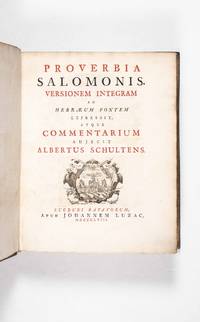
174849255Leiden: Jean Luzac 1748. First edition. Hardcover. Very Good. Quarto. 8 cviii 522 60 indices & corrigendapp. Text in two columns with Hebrew text and facing Latin translation interspersed with commentary. Title in red and black with engraved vignette; woodcut ornaments. Contemporary Dutch paneled vellum with blind-stamped vignettes and ruled borders; manuscript title at spine. Covers lightly soiled. Occasional touches of soiling and some leaves with mild embrowning. A very good copy generally crisp and clean.<br /> <br /> First edition of this comprehensive commentary to the biblical Book of Proverbs by the Dutch semitic language scholar Albert Schultens 1686-1750 who maintained "that the true nature of the Hebrew language and the meaning of many of its words and idioms are to be found chiefly in the Arabic" Orme. Forty-one pages of the indices constitute a brief lexicon and provide Latin as well as Arabic equivalents for more than 1000 Hebrew words. Schultens studied theology and eastern languages at Groningen where he received his degree in theology in 1709. After a brief career as a preacher in Wassenaar he was nominated professor of Hebrew and Jewish antiquities at Franeker in 1713. In 1729 he decamped for Leiden were he was first appointed reader in eastern languages and finally full professor in 1732.<br /> <br /> At this time a chief concern of Calvinist theologians was to liberate Old Testament exegesis from Jewish Rabbinic as well as Catholic traditions. Schultens' influential and controversial solution was revealed as early as 1706 in his first public thesis Disputatio theologico philologica de utilitate linguae Arabicae in interpretanda S. Scriptura A Theologico-Philosophical Dissertation on the Utility of the Arabic Language for the Interpretation of the Holy Scriptures "a forceful attack" Brugman & Schröder on the Protestant sola scriptura methodology of Biblical exegesis. "With the help of Jacobus Golius' Arabic dictionary he perused with zeal and fervour the Old Testament and wrote prolifically. The lexical superiority of Arabic had led him to a reconsideration of the position of Hebrew: at first he had called Arabic 'the most splendid daughter of mother Hebrew' but in his oration of 1729 he proclaimed Hebrew and Arabic cognate twin sisters. This shocked conservative theologians as an outright profanation of God's Word" Brugman & Schröder. <br /> <br /> Like his earlier commentary on the Biblical Book of Job one here finds that the "Hebrew text and the Latin translation are all but totally submerged by the extensive commentary in which Schultens draws abundantly on Arabic texts such as the Hamasa an anthology of early Arabic poetry by the ninth-century poet Abu Tammam" Vrolijk & van Leeuwen. Schultens was not without his critics and by 1824 William Orme notes a turning of the tide: "Different opinions are entertained of the correctness of his views and also of his success in applying them; but it is now generally admitted that he carries his notions of the advantage of Arabic learning to the interpretation of the Scriptures too far." <br /> <br /> Jean Luzac 1728-1777 was a member of a well-known Huguenot family of printers; he published many works for the University of Leiden including three Hebrew books of Albert Schultens. Isaac van der Mijn is noted as the printer at the colophon of the second volume.<br /> <br /> Provenance: bookplate of the Crozer Theological Seminary - Bucknell Library; bookseller's ticket of Librairie Ancienne et Moderne de Frederik Muller Amsterdam at the front paste-down. References: J. Brugman & F. Schröder Arabic Studies in the Netherlands Leiden: E.J. Brill 1979 p.26f. Fuks/Fuks-Mansfeld 78. Orme Bibl. Biblica p. 390. A. Vrolijk & R. van Leeuwen Arabic Studies in the Netherlands a Short History in Portraits 1580-1950 Leiden: E.J. Brill 2014 pp. 73-79. Jean Luzac hardcover
183952150Philadelphia: Bagster & Marshall 1839. First American edition. Hardcover. Good . Octavo. 6 10 778pp. Pointed Hebrew text in two columns the New Testament with only vocal marks. Continuous pagination in Arabic numerals; but separate Hebrew pagination for the Old and New Testaments. Contemporary three-quarter calf over pebbled cloth boards; spine with raised bands ruled and lettered in gilt. Decorative endleaves. Covers rubbed with wear at spine caps and corners. Library pressure stamp at title bookplate and pocket at paste-downs. A good ex-library copy with very clean fresh text throughout.<br /> <br /> First American edition of this Hebrew Bible earlier published by Samuel Bagster at London in 1835; it contains the first printing of the New Testament in Hebrew translation to appear in the United States. That translation was prepared by the philologist William Greenfield 1799-1831 the editorial superintendent of the British and Foreign Bible Society and first published by Samuel Bagster at London in 1831 D&M no. 5186. In preparing his revised Hebrew version Greenfield was allowed to utilise the London Jews' Society Hebrew New Testament published at London between 1813 and 1817 D&M no. 5170. Among the earliest publications of the society founded in 1809 this version was itself based upon Elias Hutter's Hebrew translation of the New Testament published at Nuremberg in 1599 D&M no. 5111. Prepared by a group of scholars under the supervision of Thomas Fry and William Bengo Collyer this London Jews’ Society edition employed only biblical words and translated Old Testament quotations from the Greek not citing them directly from the Hebrew Scriptures.<br /> <br /> The editor of the New Testament version in the present work appears to have had a notable gift for languages. William Greenfield began his Hebrew studies as a young man while apprenticed to a bookbinder taking lessons from one of his co-workers a Jew with some learning who had been described as "a reader of the law in the synagogue" ODNB. Greenfield subsequently left the business in 1824 in order to devote himself to languages and biblical criticism. His defence of the Serampore Mahratta version of the New Testament in response to an 1829 article in the Asiatic Journal brought him to the attention of the British and Foreign Bible Society who then hired him to superintend their editiorial department. "During his nineteen months in the society's service Greenfield wrote on twelve European five Asiatic one African and three American languages and acquired considerable knowledge of Peruvian African-English Chippeway and Berber" ODNB. His revision of the Hebrew New Testament earlier published by the London Jews' Society was among the last works he undertook for the British and Foreign Bible Society along with the revision of the Modern Greek Psalter as it went through the press.<br /> <br /> Provenance: Bookplate and other markings including withdrawal stamp of the Library of the Garrett Theological Seminary Evanston Illinois. Full title in Hebrew: ספר הקדש ×•×”×•× ×ª×•×¨×” × ×‘×™××™× ×•×›×ª×•×‘×™× ×’× ×›×ª×‘×™ ברית החדשה × ×¢×ª×§ מלשון ×™×•× ×™×ª ×ל לשון עברית <br /> Philadelphiae: Sumptibus Bagster et Marshall in via vulgo dicta Chestnut Street ad Repositorium Bibliorum Sacrorum etc. quae in linguis antiquis et hodiernis edita sunt. Anno erae Judaicae I rev. C; rev. C DXCIX.<br /> <br /> References: Goldman Hebrew Printing in America no. 6: "This was the first New Testament published in Hebrew in America." ODNB: "Greenfield William" Gordon Goodwin revised by H. C. G. Matthew. J. R. Marcus "Jewish Americana a Supplement to A. S. W. Rosenbach An American Jewish Bibliography" in: Monographs of the American Jewish Archives 1954 no. 1 no. 164. Cf. Darlow & Moule nos. 5111; 5170; 5186. Bagster & Marshall hardcover
177653321Oxford: The Clarendon Press 1776. First edition. Hardcover. Near fine. Two volumes folio published in 1776 and 1780. xxiii title and subscribers' list 1 blank VIII preface 684 1 catalogue of manuscripts 1 blank; 4 title and subscribers' list 732 129 1 blank 6 indicespp. Expertly rebound in modern quarter vellum over marbled boards spines titled in gilt. Titles darkened and dusty; very occasional light foxing or oxidation spots; dampstain at bottom quarter of the first twenty and final four leaves in the first volume else a nearly fine wide-margined set crisp and uncut.<br /> <br /> First edition and the "earliest attempt to provide a critical edition of the Hebrew Scriptures on a large scale†D&M and a notable early example of a large-scale scholarly project which attracted international financial and scholarly support. The biblical scholar Benjamin Kennicott 1718-1783 was educated at Oxford and "instructed in Hebrew by Professor Thomas Hunt and the greater part of his life was spent in the collation of Hebrew manuscripts with the object of producing a definitive original text of the Old Testament. Robert Lowth always his major patron first inspired him with a desire to test the accuracy of the Hebrew text of the Old Testament. With his formidable knowledge of Syriac early Latin the Septuagint and the Samaritan Pentateuch it was recognized that he was very well qualified for the task. His critical examination of manuscripts initially in the British Museum and the libraries of Oxford and Cambridge began in 1751 and when Thomas Secker then bishop of Oxford and also a member of Exeter College urged him in March 1758 to undertake their collation he agreed to the request. In return Secker when archbishop of Canterbury gave Kennicott his unstinting support and friendship when for a time he nurtured a project for producing a revised Authorized Version of the Bible. Meanwhile in 1753 Kennicott issued The State of the Printed Hebrew Text of the Old Testament Considered: a Dissertation and in 1759 he brought out a second dissertation on the same subject. He identified his object thus: to compare Scripture with itself to explain a difficult phrase or passage by a clear one that bears some relation to it to consider the natural force of the Original Words the tendency of the Context and the Design of the Writer; to compare the most ancient editions of the Original with one another and with the best copies of the most celebrated versions vol.1 p.12. These volumes were translated into Latin by W. A. Teller and published at Leipzig the first in 1756 the second with additions in 1765.<br /> <br /> Kennicott's scholarly endeavours attracted support in Britain and beyond. In England subscriptions amounted to £9119 7s. 6d.; in France the duc de Nivernois a former French ambassador to the court of St James patronized him and helped him to gain access to Parisian manuscript collections in 1767; the king of Denmark offered him the use of six ancient manuscripts; four quarto volumes of variant readings were sent to him on the king of Sardinia's orders; and the stadholder of the Netherlands made an annual donation of 30 guineas. His first report On the Collation of the Hebrew Manuscripts of the Old Testament was forwarded to the subscribers in December 1760 and a similar statement appeared each year until 1769. This annual summary afforded him an opportunity to defend the accuracy of his own collations the Hebraic scholarship of the staff assisting him and to print lists of subscribers. A copy of the entire work was personally presented by Kennicott to George III. Lowth called the 1776 variorum Old Testament 'a work the greatest and most important that has been undertaken and accomplished since the Revolution of Letters' B. Hepworth Robert Lowth p. 145" Nigel Aston ODNB. An early judgement on this seminal edition is provided by William Orme in his 1824 Bibliotheca Biblica: “This is beyond all comparison the most splendid edition of the Hebrew Scriptures ever published. It was patronized by most of the crowned heads of Europe. It occupied its learned editor in preparation or actual labour more than thirty years. More than six hundred MSS. and editions were collated for it in all parts of Europe. The text is that of Vander Hooght without the points. The Samaritan Pentateuch where it differs from the Hebrew text is printed in parallel columns in the Hebrew character. The various readings are almost innumerable and occupy in general the largest half of every page. The Dissertatio Generalis annexed to the second volume is invaluable for the information which it contains respecting the state of the original text and the sound principles of criticism which it exhibits." The final leaf lists 312 manuscripts and some printed editions which provided the various readings noted throughout the apparatus. The concluding Dissertatio Generalis was republished separately at Braunschweig in 1783 by professor Paul Jakob Bruns who assisted Kennicott in his collations.<br /> <br /> Provenance: Engraved bookplate of the Parochial Library of St Phillips Birmingham in the County of Warwick at front endleaf in both volumes. References: N. Aston "Benjamin Kennicott" in: ODNB. Darlow & Moule 5160. ESTC T147508. Orme Bibl. Biblica 238. For a notable recent discussion see J. Turner Philology: The Forgotten Origins of the Modern Humanities Princeton Univ. Press 2014 77f. An earlier assessment of the critical endeavors of Kennicott and De Rossi appears in N. P. Wiseman's 1836 Twelve Lectures on the Connexion between Science and Revealed Religion pp.368-371 ed. Dublin 1866. The Clarendon Press hardcover
170536556Amsterdam & Utrecht: H. Boom Joh. II van Waesberge Goethals Ger. Borstius Joh. Wolters Fr. Halma W. van de Water & W. Broedelet 1705. Third Edition . Hardcover - as published. Engraved title page in red & black plus four additional engraved title pages for each of the four parts into which the text is divided: 1 Genesis - Deuter.; 2 the Prophetae antiores; 3 the Prophetae posteriores; and 4 Hagiographa. Text is in Hebrew with the preliminaries and preface by van der Hooght & others as well as the printed marginalia in Latin. This is actually the third editon edited & revised by van der Hooght of the famous Hebrew Bible originally published by Joseph Athias in 1661. Thick octavo; a.e.g. Some light worming to end leaves pastedown & rear board; lacking rear front fly leaf & front rear fly leaf. Also first engraving detached. Spine is dry and rubbed along raised bands 5 panels with some light wear to edges & joints; head of spine is torn but without loss; rubbed label in 2nd panel present & readable; some worming at head of spine; small gouge on back board. A very nice internally clean tight copy of a scarce title. H. Boom, Joh. II van Waesberge, Goethals, Ger. Borstius, Joh. Wolters, Fr. Halma, W. van de Water, & W. Broedelet hardcover
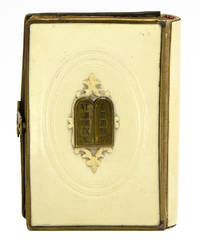
1857311893Vienna: Jos. Schlesinger Library 1857. Text in Hebrew and English. 875 3pp. Thick 12mo. Near contemporary binding of celluloid over cloth with bone and metal decorations and metal clasp. Light surface rubbing to covers text toned. Text in Hebrew and English. 875 3pp. Thick 12mo. Jos. Schlesinger Library unknown
Large 8vo; 154 + 10 pages; 1 essay (10 pages) by Moses Marx in English: The Last Hebrew Books Printed in the Fifteenth Century: The Second Edition of the Mashal Ha-Kadmoni and the Quarto Tur Orah Hayyim (on Gershom Soncino and includes 6 photo plates of the book) ; remainder of essays are in Hebrew. Bottom of spine bumped, Good Condition (FEST-6-6b) xx
(FT) Large 8vo. 7, 252 pages. Illustrated with charts and fold-outs. In Hebrew. SUBJECT(S) : Jews - history. OCLC lists 15 copies worldwide. Aescoly (1910-1948) was a "Hebrew writer, historian, and ethnologist. Aescoly studied in Berlin, Liège, and Paris, where for a short time he taught at the Ecole Nationale des Langues Orientales Vivantes. In 1925 he immigrated to Palestine, although he did scholarly research in Paris from 1925 to 1930 and from 1937 to 1939. From 1939 he directed the I. Epstein Training College for kindergarten teachers which he had founded. During World War II he served in the British Army and, as chaplain, in the Jewish Brigade. Aescoly's contributions to Jewish scholarship cover a wide field. His ethnological writings include Geza ha-Adam, Yisrael, and a number of studies on the Beta Israel. " (EJ, 2007) Hinges repaired, dent in spine, rubbed spots on front cover, good condition. (HebLit-4-17)
(FT) 12mo. 450 pages. In Hebrew. SUBJECT(S) : Poetry. OCLC lists no copies for this edition worldwide. Amir-Pinkerfeld (1902-1981) "was born in Galicia, into an assimilated family. Her father worked as an architect for the Austro-Hungarian government. She completed secondary school in Lvov, and published a book of verse in Polish at the age of 18, her first poem being the prayer of a Polish child for the liberation of his country. After studying at the universities of Leipzig and Lvov, she immigrated to Palestine in 1923. In 1921 she published another volume of verse in Polish, Piesni zycia. Thereafter, under the influence of Uri Zevi Greenberg, she began writing in Hebrew. The themes of her verse are love of nature, romantic love, and the joys of motherhood. Her long poem "Ahat" describes a young Jewish girl who immigrates to Israel after surviving the Holocaust and dies fighting for Israeli independence. [She] was the first poet to write poetry in Hebrew specifically for children and distinguished herself in this field. In 1978 she received the Israel Prize for children's literature. " (EJ, 2007) Shalom Spiegel's copy with his bookplate. Has dust jacket. Tanned, gift inscription on free endpaper, good+ condition. (HebLit-5-29)
(FT) 16mo. 195 pages. In Hebrew. English title: The achievements of modern Hebrew. SUBJECT(S) : Hebrew language. OCLC lists 26 copies worldwide. SERIES: Le-khol. Ex library with minimal markings and library binding. Light moisture marks on first and last couple pages, good+ condition. (HebLit-4-5)
(FT) 8vo. 333 pages. In Hebrew. English title: Shin Shalom : a selection of critical essays on his poetry. SUBJECT(S) : Shalon, Shin, b. 1904; Poetry, Hebrew. Shalom Spiegel's copy with his bookplate. Has rubbed dust jacket. Good+ condition. (HebLit-5-16)
(FT) 8vo. 269 pages. In Hebrew. Volume two, in two parts. SUBJECT(S) : Amoraim; Aggada. Ex library. Light wear, good condition. (HebLit-5-11)
(FT) 12mo. 310 pages. In Hebrew. SUBJECT(S) : Fiction. OCLC lists 18 copies worldwide. Ex library. Pages tanned, Water stains in corners, good condition. (HebLit-4-1)
(FT) 8vo. 221 pages. In Hebrew. Bavli, (18931961) , was a Hebrew poet and educator. Bavli, who was born in Pilvishki, Lithuania, attended yeshivot in Kovno and Vilna. In 1912 he immigrated to the United States and studied at Canisius College and Columbia University. From 1918 he taught modern Hebrew literature at the Jewish Theological Seminary of America, after 1937 with the rank of professor. Bavli's first poems appeared in a children's periodical, Ha-Perahim, in 1908. His first book of poetry, Neginot Arez ("Melodies of the Land") , was published in 1929. (EJ, Silberschlag) In very good condition in a very good jacket. (Heblit1-7)
(FT) 8vo. 346 pages. In Hebrew. SUBJECT(S) : Hebrew literature, Modern -- History and criticism. In good condition. (heblit1-12)
(FT) 12mo. 132 pages. In Hebrew. SUBJECT(S) : Hebrew language. In very good condition. (HEBLIT1-1)
(FT) 8vo. Xxx, 201 pages. In Hebrew. SUBJECT(S) : Fiction. SERIES: Sifre mofet le-vate midrash. Berdichevsky (1865-1921) , also know as Ben-Gorion, was born in Podalia, to a long line of rabbis. In his teens, he read the Haskalah writers, and this conflict between modernism and tradition informed his entire literary career. It also caused deep disagreements with teachers and family members. He began to be published in 1888, writing both fiction and non-fiction. In 1890, he moved to Russia, and was acquainted with David Frischmann; in 1892 he moved to Germany. In Berlin, he solidified a philosophy of personal and intellectual freedom in the face of "stultifying" tradition. His writing attacked any already-established position, including the Haskalah and Zionism, and demanded an expansion of the Jewish literary canon. Though a later trip back to Russia, and witnessing the realities of Jewish life there, slightly moderated his polemics, Berdichevsky wrote much of the same, though he also branched out to collections of legends and Jewish history. It is of no surprise that his readers were divided along generational lines; the younger readers flocked to his work, while older critics rejected his ideas. (Almagor, EJ) Ex library. Occasional pencil underlining, water stains throughout, good- condition. (HebLit-5-22)
(FT) 8vo. Xv, 234 pages. In Hebrew. Volume one (of two) only. First edition. SUBJECT(S) : Legends, Jewish. SERIES: Kol kitve Mikhah Yosef Berditsevski ; ; kerekh 1-2. Berdichevsky (1865-1921) , also know as Ben-Gorion, was born in Podalia, to a long line of rabbis. In his teens, he read the Haskalah writers, and this conflict between modernism and tradition informed his entire literary career. It also caused deep disagreements with teachers and family members. He began to be published in 1888, writing both fiction and non-fiction. In 1890, he moved to Russia, and was acquainted with David Frischmann, and in 1892 he moved to Germany. In Berlin, he solidified a philosophy of personal and intellectual freedom in the face of stultifying tradition. His writing attacked any already-established position, including the Haskalah and Zionism, and demanded an expansion of the Jewish literary canon. Though a later trip back to Russia, and witnessing the realities of Jewish life there, slightly moderated his polemics, Berdichevsky wrote much of the same, though he also branched out to collections of legends and Jewish history. It is of no surprise that his readers were divided along generational lines; the younger readers flocked to his work, while older critics rejected his ideas. (Almagor, EJ) Gilt title. Backstrip missing, edgeworn, title page missing, hinges starting, good- condition. (GER-27-27)
(FT) 8vo. Xv, 234 pages. In Hebrew. Complete in two volumes. First edition. SUBJECT(S) : Legends, Jewish. SERIES: Kol kitve Mikhah Yosef Berditsevski ; ; kerekh 1-2. Berdichevsky (1865-1921) , also know as Ben-Gorion, was born in Podalia, to a long line of rabbis. In his teens, he read the Haskalah writers, and this conflict between modernism and tradition informed his entire literary career. It also caused deep disagreements with teachers and family members. He began to be published in 1888, writing both fiction and non-fiction. In 1890, he moved to Russia, and was acquainted with David Frischmann, and in 1892 he moved to Germany. In Berlin, he solidified a philosophy of personal and intellectual freedom in the face of stultifying tradition. His writing attacked any already-established position, including the Haskalah and Zionism, and demanded an expansion of the Jewish literary canon. Though a later trip back to Russia, and witnessing the realities of Jewish life there, slightly moderated his polemics, Berdichevsky wrote much of the same, though he also branched out to collections of legends and Jewish history. It is of no surprise that his readers were divided along generational lines; the younger readers flocked to his work, while older critics rejected his ideas. (Almagor, EJ) Gilt titles. Inch-long section of backstrip missing at bottom on vol 2, corners worn, spines faded, tear along spine on vol 1, good condition. (GER-27-26)
8vo. 243 pages. In Hebrew. SUBJECT (S) : Philosophy, Modern -- 20th century. Bergman, (1883 1975) , was a philosopher. Bergman studied philosophy in Prague and Berlin. During his student days at Prague, he was a member of the Zionist student circle, Bar Kochba, and in 1903 began to publish articles on Zionist themes. During this period he came into contact with Martin Buber who had a lasting influence on him. From 1907 to 1919 Bergman was librarian at the University Library at Prague, except during World War I when he served in the Austrian army. In 1920 he emigrated to Palestine where he was the first director of the National and University Library, a position he held until 1935. He helped found the Histadrut ha-Ovedim and was elected a member of its executive council. (EJ, Rotenstriech) In good condition (heblit1-13)
(FT) 12mo. 90 pages. In Hebrew. SUBJECT(S) : Jews - biography; Jewish ethics. OCLC lists 11 copies worldwide. BOUND WITH: (jt) Bernfeld, Simon. DOR TAHAPUKHOT : MONOGRAFYOT MI-YEME RESHIT HASKALAT HA-YEHUDIM BE-GERMANYAH BI-SHENOT HA-MEAH HA-SHEMONEH-`ESREH. ? ? ? ? ? ? ? ? ? ? : ? ? ? ? ? ? ? ? ? ? ? ? ? ? ? ? ? ? ? ? ? ? ? ? ? ? ? ? ? ? ? ? ? ? ? ? ? ? ? ? ? ? ? ? ? ? ? ? ? ? Warsaw : Tushiyah, 1897-1898. 128, 87 pages. In Hebrew. Complete, two volumes bound in one. SUBJECT(S) : Jews -history - 1789-1945; Jew - Germany - history. OCLC lists 18 copies worldwide. "Bernfeld was born in Stanislav, Galicia, and was educated in Koenigsberg and Berlin. In 1886 he was appointed chief rabbi of the Sephardi community of Belgrade, Serbia; he remained there until 1894, when he returned to Berlin and devoted himself to scholarly pursuits. He continued his literary work until his death, despite blindness in his later years. Bernfeld wrote several monographs in Hebrew on Jewish history and philosophy, the earliest published when he was only 19." (Klausner, EJ) Tanned, good condition. (HebLit-5-25x)
(FT) 12mo. 128, 87 pages. In Hebrew. Complete, two volumes bound in one. SUBJECT(S) : Jews -history - 1789-1945; Jew - Germany - history. OCLC lists 18 copies worldwide. BOUND WITH: (jt) Bernfeld, Simon. DOR HAKHAM : MONOGRAFYAH `A. D. HOKHME `AMENU HA-METSUYANIM BA-MEAH HA-19 U-TEKUFATAM. ? ? ? ? ? ? : ? ? ? ? ? ? ? ? ? ? ? ? ? ? ? ? ? ? ? ? ? ? ? ? ? ? ? ? ? ? ? ? ? ? ? ? ? ? ? ? ? ? ? Warsaw : Toshiyah, 1896. 90 pages. In Hebrew. SUBJECT(S) : Jews - biography; Jewish ethics. OCLC lists 11 copies worldwide. "Bernfeld was born in Stanislav, Galicia, and was educated in Koenigsberg and Berlin. In 1886 he was appointed chief rabbi of the Sephardi community of Belgrade, Serbia; he remained there until 1894, when he returned to Berlin and devoted himself to scholarly pursuits. He continued his literary work until his death, despite blindness in his later years. Bernfeld wrote several monographs in Hebrew on Jewish history and philosophy, the earliest published when he was only 19." (Klausner, EJ) Has postage style Max Nordau stamp on title page. Tanned, bookplate, good condition. (HebLit-5-25x)
(FT) 8vo. In Hebrew. Tissue-papered frontispiece. Volume one (of two) only. SUBJECT(S) : Hebrew literature - history and criticism. Bialik (1873-1934) was "the greatest Hebrew poet of modern times. " His childhood and youth influenced his poetry - the fields and forests of Volhynia, the solitariness of his grandfather's house where he lived after his father died, and the yeshiva he went to in Volozhin. Other influences include Ahad Ha-Am, and Russian literature - which he began to read as he became disillusioned with the religiosity at the yeshiva, and further immersed himself in after leaving the yeshiva and going to Odessa. His first published work was the poem "El ha-Zippor, " which was published in 1892, in the first volume of Ha-Pardes. Later in life he lived also in Berlin, and settled in Palestine in 1924. (EJ, Spicehandler) Bookplate. Covers faded, wear at corners, good+ condition. (HebLit-5-28)
(FT) 8vo. In Hebrew. Volume one (of three) only. SUBJECT(S) : Aggada; Midrash. OCLC lists 20 copies worldwide. Bialik (1873-1934) was "the greatest Hebrew poet of modern times. " His childhood and youth influenced his poetry - the fields and forests of Volhynia, the solitariness of his grandfather's house where he lived after his father died, and the yeshiva he went to in Volozhin. Other influences include Ahad Ha-Am, and Russian literature - which he began to read as he became disillusioned with the religiosity at the yeshiva, and further immersed himself in after leaving the yeshiva and going to Odessa. His first published work was the poem "El ha-Zippor, " which was published in 1892, in the first volume of Ha-Pardes. Later in life he lived also in Berlin, and settled in Palestine in 1924. (EJ, Spicehandler) Marginalia throughout, otherwise good condition. (HebLit-5-7)