Livre Rare Book
70 résultats
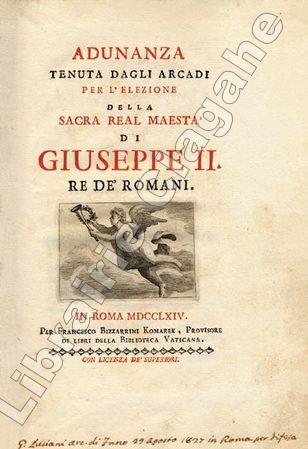
17644373Roma, 1764, per Francesco Bizzarini Komarek, Provisore di libri della Bibliotheca Vaticana ; grand in-8, plein vélin ivoire, titre manuscrit (reliure de l'époque) ; VIII, 120 pp., vignette de titre, lettrine et cul-de-lampe gravés, ouvrage entièrement imprimé en rouge et noir.
1735080937Amsterdam, J. Westenium & G. Smith, 1735. (5 Bl.), 112, 560, 38 S.; mit gstochenem Frontispiz u. mehreren, teils ausfaltbaren gestochenen Karten; Ganzledereinband der Zeit, mit Vorsätzen aus Marmorpapier, rundum Goldschnitt; fliegendes Blatt u. Titelblatt mit Besitzervermerken von alter Hand, Einband stärker berieben, frisch eingefettet Leder 16,1 cm Befriedigend [7 Warenabbildungen]
17091120591709 Franequerae, excudit Franciscus Halma, 1709, 2 tomes reliés en 1 fort volume in-4 de 200x245 mm environ, (22) ff. (faux-titre, frontispice, page de titre, Prolegomena, Subtexere heic potius), 1326 pages. Complet du frontispice de G. vander Gouwen et des 6 planches dépliantes. Plein velin d'époque au dos lisse muet, encadrement d'un double filet droit à froid, répliqué, sur les plats, petit fleuron central doré et quatre aux coins de l'encadrement intérieur, traces de lacets disparus. Manques en bordure des plats, plats tachés, une déchirure sur le dos, deux pages manuscrites au début de l'ouvrage, petite mouillure en bordure de quelques pages, quelques rousseurs, bon état pour le reste.
17991166BBNürnberg, A. G. Schneider- und Weigelsche Kaiserl. privilegierte Kunst- und Buchhandlung, 1799. 8°. XVIII, 340, (4) S. Halblederbd. d. Zt. mit goldgepr. Rückenschild + Wichtig: Für unsere Kunden in der EU erfolgt der Versand alle 14 Tage verzollt ab Deutschland / Postbank-Konto in Deutschland vorhanden +, 1166B (stärker berieben u. bestossen).
175316487Paris JOMBERT 1753 In-12 XI + 547 pp,et 20 planches dépliantes coiffes usées, manque de cuir à un coin
17542306160124xbvkSpain, 1754. Calligraphic titlepage in a handpainted watarcolour frame; 5 sheets dedication ''A LA REYNA DEL CIELO MARIA SSA. EN SU SOLEDAD DOLOROSA SA MADRE DEL AMOR HERMOSO, y delicias de la celestial Syon, aunque max grande de penas y amanguras de la gracia, que en el dura, pero o lorioso campe de la soledad ...''; 1 blank sheet; 2 sheets ''TABLA DE LAS SANTAS ANACORETAS CONTENIDAS EN ESTE SEGUNDO TOMO DEL DESIERTO DELICIOSO''; 2 sheets 'PROTESTA . . .' etc.; 334* sheets Description of the Saints. - Vellum binding of the periodover 4 raised bands with manuscript title at spine and possibly younger frangments of ribbon clasps; 4to.(ca. 24 x 19 x 6 cm; ca. 1,47 kg.).
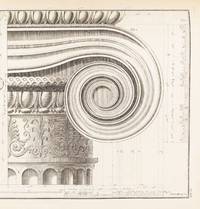
1758ST17496-017Paris: H. L. Guerin & L. F. Delatour Jean-Luc Nyon and Jean Neaulme 1758. FIRST EDITION. 608 x 445 mm. 24 x 17". xiv 56; 2 vi 28 pp. Two parts in one volume. <br/> Later early 20th century quarter sheep over marbled boards raised bands compartments gilt reddish-brown leather label with gilt lettering all edges untrimmed. With large woodcut vignette on title and 60 ENGRAVED PLATES by Le Bas Littret de Montigny Neufforge and Patte after Le Roy. Brunet III 103; Millard French 101. A little rubbing to corners and head and tail of spine leather a bit faded chafed and freckled in places but the binding entirely sound and still quite pleasing; very faint diagonal crease at lower corner of many leaves a handful of plates slightly browned one more noticeably so other minor issues but quite a fine copy internally--the vast majority of the contents clean and bright with deep impressions of the text with the engravings richly impressed and with vast margins.<br/> <br/> With engravings by the some of the most esteemed artists of the day this imposing work contains beautiful depictions of Greek ruins and monuments that proved extremely influential to the development of French Neoclassical architecture. The text is divided into two parts the first covering the history of various monuments and Le Roy's thoughts on the principles of architecture and the second primarily containing a discussion of the orders of columns--particularly the Doric order--as well as several reconstructions of ruined temples. According to Millard this work "breaks new ground in providing a synthesis of archaeological findings with a body of architectural theory developed and expanded from the important controversy of Claude Perrault and Francois Blondel i.e. quarrel of the Ancients and the Moderns. . . . Perhaps most important Le Roy's treatise provides the theoretical framework and many of the actual models for French neoclassical architecture." Although "Les Ruines" came under some criticism especially by British rivals James Stuart and Nicholas Revett it nevertheless "made a strong public impact" in the words of the Dictionary of Art Historians and "greatly influenced the architects of the day particularly Jacques-Denis Antoine Jean-Arnaud Raymond Alexandre-Théodore Brongniart and François-Joseph Bélanger." This was in no small part due to the exquisite plates that included many picturesque views engraved by talented artists such as Louis-Joseph Le Lorrain Pierre-Charles Le Mettay Claude-Antoine Littret de Montigny and Jacques Philippe Le Bas among others. The son of the horologer to Louis XV Julien-David Le Roy 1724-1803 was an architect art historian and archaeologist. He was a protégé of Jacques-François Blondel 1705-74 whom he later succeeded as professor at the Académie Royale d'Architecture. After winning the Prix de Rome in 1754 Le Roy spent time in Greece studying and measuring ancient architecture and developing many of the theories that he would eventually publish in the present work. H. L. Guerin & L. F. Delatour, Jean-Luc Nyon, and Jean Neaulme unknown
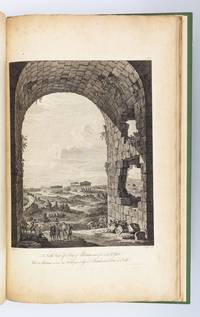
1768ST17496-011London: Chez l'auteur 1768. First Edition in French. 590 x 380 mm. 23 1/4 x 15". 52 2 pp. <br/> Modern brown quarter morocco over green linen boards brown morocco label with gilt lettering on smooth spine edges untrimmed. WITH 25 FULL-PAGE ENGRAVED PLATES OF GRECIAN RUINS and seven smaller engraved plates in text including one on dedication page. A Large Paper Copy. Fowler p. 157; Millard British 41; Blackmer 1065; Brunet III 1329. Head of spine partly torn but with no loss contents with not infrequent light marginal soiling though plates uniformly clean other minor imperfections but an excellent copy with greatly generous margins with deep impressions of the type and with strong impressions of the plates.<br/> <br/> This work is the first significant account of the ancient city of Paestum being in the words of Blackmer "larger and much more complete than any of the previous publications." Located in the Tyrrhenian Sea off the coast of southern Italy Paestum or Poseidonia in Greek was founded by Greek colonists in the sixth century B.C. and still contains beautifully preserved ruins from that period including temples an amphitheater and painted tombs. Abandoned in the Medieval period Paestum wasn't rediscovered by the West until the 18th century with the first modern publication of the site not appearing until 1764 when a suite of plans by G. P. M. Dumont appeared with no text based on the observations of Jacques-Germain Soufflot. As Millard indicates the genesis of the present publication has an extremely complex history we do not even know with certainty who wrote the text but we do know that engraver Thomas Major 1729-99 whom DNB calls "the first great English landscape engraver" was responsible for preparing the plates. Because he had no first-hand knowledge of the site Major relied on images by other artists including Antonio Joli Gaetano Magri Robert Mylne and Jacques-Germain Soufflot. The text was first published in English and then in French the same year. According to Fowler "this work . . . was an important eighteenth-century pioneer contribution to the knowledge of Greek architecture in England"; and Millard tells us that "the book was surprisingly well received by reviewers" in both England and France remaining "the standard reference to Paestum until 'Les Ruines de Paestum ou Posidonia' by C.-M. Delagardette was issued in 1798.". Chez l'auteur unknown
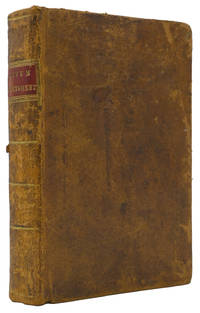
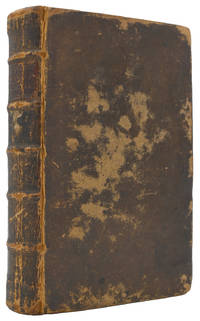
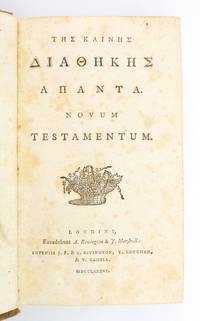
17867475Londini London: Excudebant A. Rivington & J. Marshall 1786. 12mo pp. 368 2 ads. Contemporary sheep spine divided by gilt rolls and rules red morocco label edges sprinkled red. A touch of spotting. Rubbed and a little marked some small sections of leather peeling. A scarce Greek New Testament recorded by ESTC in three North American institutions - Harvard Union Theological Seminary and Tennessee - and one private collection. ESTC N63834. Excudebant A. Rivington & J. Marshall hardcover
17997575Londini London: Apud G.G. & J. Robinson et al 1799. 12mo pp. 347 1. Half-title discarded. Contemporary sheep spine divided by gilt rules red morocco label edges sprinkled blue. Somewhat rubbed some areas of peeling and insect damage to rear board a little wear to extremities. Ownership inscriptions of Charles Kinloch to first few leaves dated 1802. A scarce London printing of the Greek New Testament: ESTC records just 5 copies. ESTC T176685. Apud G.G. & J. Robinson [et al] unknown
17517788Edinburgi Edinburgh: Apud Tho. & Wal. Ruddimannos 1751. 12mo pp. iv 402 frontispiece. Contemporary calf spine divided by raised bands between double gilt rules red morocco label. Somewhat rubbed joints starting some wear to extremities front flyleaf excised. Armorial bookplate of Sibbald to pastedown struck-through inscription of Charles Sibbald dated 1831 and of Donald Bruce to verso of frontispiece pencil notes to rear blanks. A pocket Greek New Testament printed by the Ruddimans. ESTC T94884; Darlow & Moule 4751. Apud Tho. & Wal. Ruddimannos hardcover
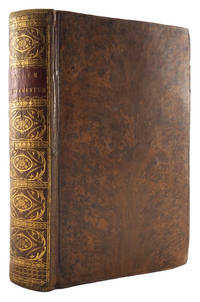
17632548Oxonii Oxford: E Typographeo Clarendoniano 1763. 8vo pp. iv 676. Near-contemporary tree calf spine elaborately gilt in compartments red morocco label marbled endpapers edges yellow. Some light toning and spotting. Expertly rebacked by Bernard Middleton with old backstrip laid down hinges relined. An attractive copy. In 1758 Baskerville proposed the casting of a new set of Greek types to the Oxford University Press and they ordered 2000 copies of this octavo New Testament plus 500 in quarto to be printed with the resulting type - which ended up being its only use. Negative critical reception may have contributed to its abandonment but Baskerville’s Greek face has recently been reassessed by Gerry Leonidas as an important predecessor of more modern types if perhaps not quite as elegant as that used by the Foulis press that had fallen afoul of an arbitrary typographic orthodoxy. Gaskell Add. 2; ESTC T94889; D&M 4756. E Typographeo Clarendoniano unknown
1786ST20133London: Excudebant A. Rivington & J. Marshall: Impensis J. F. & C. Rivington T. Longman & T. Cadell 1786. 175 x 105 mm. 7 x 4 1/4". 368 pp. 1 leaf ads. <br/> Contemporary brown "school cloth" rough linen raised bands. Front flyleaf with owner inscription of John Cutler dated Sept 21 1789 four lines of Latin doggerel threatening anyone who steals the book with hanging and two large copperplate trials of Cutler's signature. ESTC N63834. Not in Darlow & Moule. A little fraying at top and bottom of joints light foxing and toning throughout due to paper quality a couple of small ink stains but a surprisingly appealing copy the text extremely clean and the unsophisticated makeshift binding--remarkably--with no significant wear.<br/> <br/> This is an almost startling survival: an 18th century New Testament in Greek in its original utilitarian binding preserved in condition far better than what could be anticipated given the audience of generally uncareful pupils for which it was intended. Considering the usual depredations of school children the rough school cloth should have been worn to shreds long ago but against the odds it has fortuitously escaped hard use and now gives us a glimpse of an important element of the English schoolroom very close to its original condition. One particularly delightful aspect of our copy is the flamboyant declaration of ownership by a pupil called John Cutter who inked his name no fewer than four times in different styles and with calligraphic flourishes across the flyleaf. Cutter's neatly penned book curse threating any would-be thieves with hanging may have helped to preserve the book as it now exists. In fact there are few signs of use by any owner rightful or unlawful. The leaves are free from any markings and the insubstantial binding appears to have rarely left the shelf. Excudebant A. Rivington & J. Marshall: Impensis J. F. & C. Rivington, T. Longman, & T. Cadell unknown
1762125741762 Utrecht, Les Libraires associés, 1762; in-8 de XVIII ( dont le titre en noir et rouge) - 307- (1)pp. Plein veau brun raciné époque, triple filet doré encadrant les platdos à nerfs orné de compartiments de filet et filets pointillés dorés ornés de petits fers dorés, titre doré sur étiquette de maroquin rouge, double filet doré sur les coupes, tranches dorées.
17324237Londini London: Typis Gul. Bowyer; Impensis autem Joh. Osborn & Tho. Longman 1732. 8vo pp. xvi 279 1 1 plate. Contemporary calf boards bordered in blind edges sprinkled red. A few leaves lightly toned one or two rust-marks. Joints expertly repaired boards lightly marked and corners a touch worn. The sole edition of this Greek grammar by George Thompson d. 1739 master of the grammar school at Tottenham High Cross. Thompson is reported to have had assistance from the classical scholar Samuel Patrick 1684-1748 and the antiquary John Ward 1678/9-1758 who had also produced a new edition of Lily's Latin grammar around the same time. Attractively printed by William Bowyer in an edition of 1500 copies with an engraved plate of Greek manuscript ligatures it is now scarce: ESTC locates just four copies in the UK plus two in Europe and three in North America. ESTC T148505. Typis Gul. Bowyer; Impensis autem Joh. Osborn, & Tho. Longman hardcover
1743M136La Haye, 1743, in-12 (14,5x9cm), VIII-96 pp., reliure plein veau époque, dos lisse orné de filets et fleurons dorés, titre doré, filets d'encadrement dorés sur les plats, tranches dorées.
1725AQ30436Trajecti ad Rhenum i.s. Utrecht: Apud Guilielmum vande Water et Jacobum van Poolsum 1725. In two volumes. 138 24 903 1; 2 928pp. Titles in red and black. Text printed in double columns. Contemporary gilt-tooled calf marbled edges. Extremities rubbed wear to head and foot of both spines Vol. I without lettering-piece lettering-piece of Vol. II chipped. Ink library stamps and recent bookplates of R. A. Levisson to both FFEPs scattered spotting. The Septuagint or the Koine Greek version of the Hebrew Bible is the earliest translation of the Hebrew Bible into Greek appearing between the first and third centuries before Christ in Alexandria. Embraced by the Catholic Church which includes many of the texts that Reformed churches ignore or consider Apocryphral the authorised Papal version of the Septuagint was first produced in Rome 1587 under the reign of Pope Sixtus V. A direct by-product of the Council of Trent the production of the Septuagint was the suggestion of Cardinal Pole who encouraged making available the Bible in Hebrew and Greek as well as the Latin vulgate in order to counter charges of the Reformers. This edition was compiled by German oriental philologist and reformed theologian David Mill 1692-1756 and was published simultaneously in Amsterdam. Darlow and Moule 4736. First Millius edition. 8vo. Apud Guilielmum vande Water et Jacobum van Poolsum unknown
179580618AB1795. Vienna Trattnern 1795. 18cm x 12cm. 546 pages plus Appendix with " Lexicon Hermeneutico-Analyticum" 120 unnumbered pages. Original Hardcover in protective Collector's Mylar. Very good condition with only minor external signs of wear. Exemplar von Friedrich Georg Julius Heinrich Freiherr von Lasberg mit seinem Besitzvermerk auf dem Vorsatzblatt. Includes for example the following chapters: De elementis linguae graecae / De Etymologia / De Syntaxi / De Dialectis / De Prosodia / Chrestomathiae Graecae / Lexicon: Hermeneutica - Analyticum in Chrestomathiam Graecam. Provenance / Provenienz / From the library of: Friedrich Georg Julius Heinrich Freiherr von Lasberg 19. Juni 1766 in Braunschweig; 9. März 1839 in Düsseldorf war ein preußischer Offizier und Landrat. Der Protestant Friedrich von Lasberg war ein Sohn des Oberforstmeisters Moritz Franz Adolf Freiherr von Lasberg und dessen Ehefrau Sophia Dorothea geborene von Pestel. 1781 trat er als Fahnenjunker dem Regiment von Wunsch zu Prenzlow bei. Dort wurde er 1786 Fähnrich 1787 Sekondelieutenant 1797 Premierlieutenant und Inspektionsadjutant später Stabskapitän 1800 Wirklicher Kapitän und 1804 noch Major. Nachdem er 1808 aus preußischen Diensten verabschiedet worden war trat er als Bataillonschef in westfälische Dienste wo er 1809 Major sowie 1810 Oberst und Kommandeur wurde. Neben der 1813 erfolgten Beförderung zum Brigadegeneral wurde er zum Gouverneur der Pagen ernannt. Nach der Völkerschlacht bei Leipzig und dem Ende des Königreichs Westphalen trat Lasberg am 13. Dezember 1813 erneut in die preußische Armee ein wo er im Rang eines Obersts und Regimentskommandeurs eingestellt wurde. Mit Allerhöchster Kabinettsorder AKO vom 3. Oktober 1815 pensioniert wurde Lasberg zum 1. Mai 1816 zunächst kommissarisch zum Landrat des Kreises Düsseldorf ernannt seine definitive Ernennung folgte zu Beginn des Jahres 1817. Nach etwas mehr als 21 Dienstjahren wurde er mit AKO vom 27. September 1837 auf eigenen Antrag zum 31. Dezember 1837 in den Ruhestand versetzt den er bereits zum 1. Dezember 1837 antrat. Friedrich von Lasberg heiratete vor 1808 Charlotte Eichler von Auritz November 1772 in Ansbach; 24. Januar 1849 in Düsseldorf Tochter des ehemaligen markgräflich ansbachischen Hofmarschalls Carl Freiherr Eichler von Auritz und dessen Ehefrau Christine geborene Freiin von Remont. Wikipedia hardcover
1787G0941Rouen, l'Imprimerie Privilégiée, 1787 ; in-18, 8-208 pp., reliure plein cuir d'époque, dos lisse (coiffe de queue arrachée, frottements, épidermures) pièce de titre brun clair (papier fatigué). Phèdre naquit en 15 av. J.-C. D’abord esclave à son arrivée à Rome, il fut affranchi et se mit à écrire. Choisissant la fable comme genre littéraire, il adapta les fables d’Ésope et en profita pour en rédiger quelques-unes lui-même. Plus tard, La Fontaine adapta les fables d’Ésope et de Phèdre… Bon état.
1765A2613Bernae, Walthardi, 1765 ; in-8, 184 pp., reliure plein veau, dos lisse orné (traces de restauration ancienne). Édition imprimée à Berne, bilingue (latine et français) des "Satyres" de Perse. Perse, originaire d'une famille noble de la Rome du Ier siècle après J.-C., est un stoïcien. A Rome, il a fréquenté : Cornutus, Sénèque et Lucain. Nombreuses vignettes et gravures in texte (d'après l'antiquité). Bon état.
1768A2648Paris, Desaint, 1768 ; in-12, XL pp. + 314 pp. + 406 pp., reliés plein-veau, dos lisses ornés. (Manque une pièce de titre). Horace (Quintus Horatius Flaccus) fils d'un esclave affranchi, vécut aux environs de 50 avant J.-C. Il fit des études de grec et de philosophie. Il s’enrôla dans l'armée de Brutus et dut attendre une amnistie pour retourner à Rome. Horace brilla dans l'écriture de ses Satires et de ses Odes. Bon état.
1772A2673Paris, Duchesne, 1772 ; in-8, XV pp. + 278 pp., reliure demi-veau d’époque, dos lisse orné. Perse (Aulus Persius Flaccus) poète satirique latin, né en 34 à Volaterræ en Etrurie et mort en 62 après J.-C., était fils d’un chevalier romain. Il fut conduit à Rome, à l’âge de 12 ans, où il étudia avec le grammairien Rhemmius Palémon. Il devint un stoïcien ardent pratiquant. A Rome, il a fréquenta Cornutus, Sénèque et Lucain. État moyen.
1772A2677Paris, Lacombe, 1772 ; in-8, 348 pp., relié plein-veau, dos orné à nerfs (état moyen manques de cuir). Pindare, auteur grec du 5ème siècle avant J.-C., reste le plus célèbre poète lyrique, qui fut redécouvert à la fin du 18ème siècle et au début du 19ème. Pindare inspira beaucoup Ronsard, Suarès, Claudel, Char et fut traduit en allemand par Hölderlin. Nous proposons ici le quart de ses oeuvres. Bon état.
1703A2678Rotterdam, Reiner Leers, 1703 ; in-12, XXVIII pp. + 242 pp. + XVIII pp. + 287 pp., reliure pleine-basane tachetée, dos lisse. Pline le jeune (Caïus Cœcilius Plinius Secundus) écrivain et homme politique romain, vécut au 1er siècle après J.-C. Il fut l’un des témoins directs de l'éruption du Vésuve qui détruisit Pompéi et Herculanum. Ses lettres furent publiées sous Trajan, certaines d’entre elles lui sont d’ailleurs adressées. Bon état.
1750A2679Paris, Coignard & Boudet, 1750 ; in-12, 360 pp. + 331 pp., reliés plein-veau d'époque, dos lisse orné. Melchior de Polignac, prélat, diplomate et poète français de la fin du 17ème et de la première moitié du 18ème siècle, négocia le traité d'Utrecht et fut élu à l'Académie française à la place de Bossuet. Ici, une édition en français de la principale oeuvre de Polignac. Édition en latin de la principale oeuvre de Polignac. Bon état.