Xenophon - Charpentier, FrancoisAntiquariat.de

86 résultats
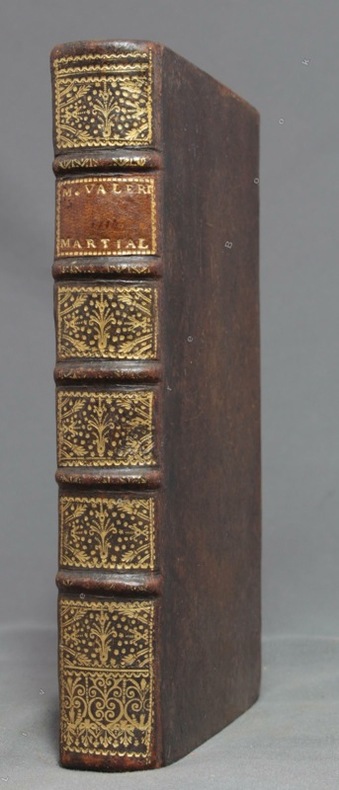
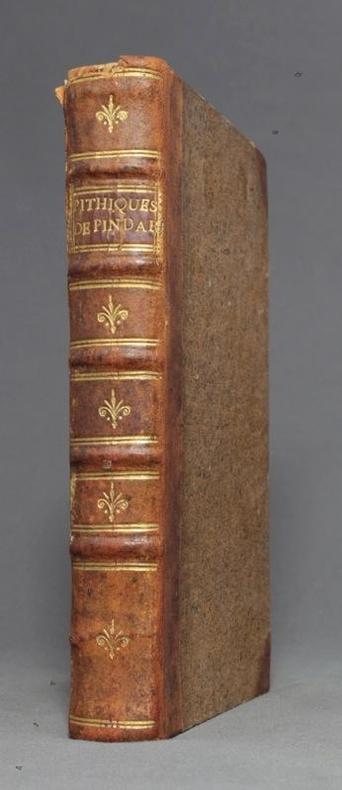
17458137BBAmsterdam, Francois L'Honore & Fils, 1745. Titelportrait (Portrait de Xenophon), gestochene Titelvignette, XXII, 401 Seiten, 34 Bl. Lederband der Zeit mit dekorativer Rückenvergoldung., xenophon Einband leicht berieben und minimal beschabt, Rückenkanten ganz minimal angeplatzt, Kopfkapital bestoßen und mit kleinem Einriß.
17162884Londini, Ex officina Jacobi Tonson, & Johannis Watts, 1716. In-8 (110 x 185) de [14]-286-[116] pages. Plein veau marron, dos à nerfs richement orné, pièce de titre maroquin havane, tranches rouges.
175931317ABZürich, Gessner, 1759. 8°. 115 S., (1) S. (Druckfehler). Mit gest. Titelvignette (Porträt) und eine gest. Schlussvignette. Späterer Pappband. + Wichtig: Für unsere Kunden in der EU erfolgt der Versand alle 14 Tage verzollt ab Deutschland / Postbank-Konto in Deutschland vorhanden +, 31317AB|31317AB_2 [2 Warenabbildungen] Nebst Pindars erster Ode.
175931317ABNebst Pindars erster Ode. Zürich, Gessner, 1759. 8°. 115 S., (1) S. (Druckfehler). Mit gest. Titelvignette (Porträt) und eine gest. Schlussvignette. Späterer Pappband.
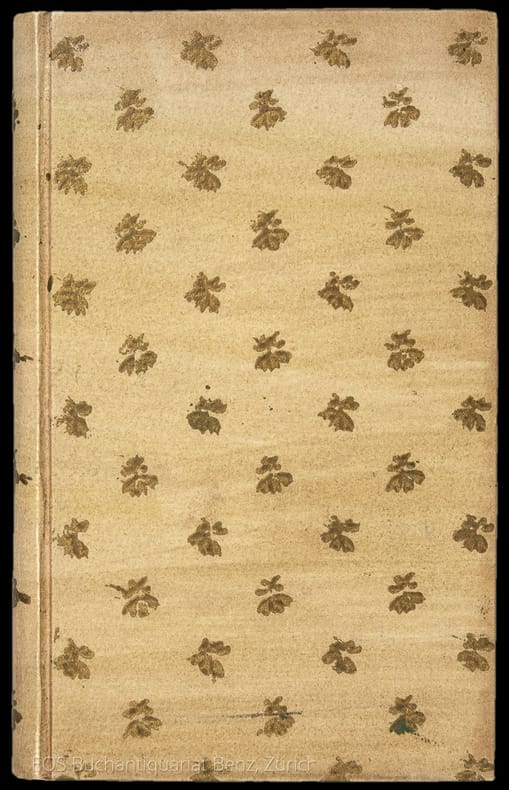
1752238051752 Paris : Chez Bauche, 1752.(Jean-Baptiste-Claude Bauche) Par Simon Mamin dont le nom apparaît au privilège.Front.Aux 22 dernières p. ch. : "Livres imprimés, ou qui se trouvent en nombre chez le même libraire."Description: [4]-IV-171-[5]-133-[1]-22-[5] p., [1] f. de pl. ; 2 volumes in-12,pleine basane époque,dos lisses ornés et titrés,texte frais,tranches rouges.Title-vignette reliée dans le texte.Trés rare édition.
1758180017Edinburgh, Hamilton u.a. 1758. M. gestoch. Front. VIII, 424 S., Ldr. a. 5 Bünden. Einbd. etws berieben. Vors. etwas fleckig u. m. Sign. v. alter Hd. Tit. u. ff. 2 Bl. m. kl. Randläsuren. Schnitt leicht fleckig.
17534903DBErlangen, Leipzig, Gotthard Poetsch; Augsburg, Veithische Handlung, 1753, 1766, 1767. 8°. 19 cm. [15] Blatt, 240, [4] Blatt, 183, 190 Seiten. Halblederband der Zeit mit goldgeprägtem Rückentitel.
179868553Couverture rigide. Reliure plein cuir d'époque. Dos orné. 376 pages.
1763138322Glasgow: Printed by Robert and Andrew Foulis 1763. First edition in English of Plato's Republic marking the first appearance in the English language of Plato's profoundly influential dialogue concerning the nature of justice. Quarto bound in full polished calf with raised gilt bands to the spine morocco spine label lettered in gilt all edges speckled red. Harry Spens was a minister at the parish of Wemyss in Fife and respected classicist. In his introduction he professes his intent in his translation is: "To give the English Reader a view of Plato's sentiments and manner of writing and to stir up the youth to the study of the Ancients." Richard Garnett in his own introduction of the Everyman's Library reprint of this translation laments the relative lack of critical attention paid to it writing: "On the whole Spens's version should not be lightly esteemed. It is clearly the work of a scholar and a man of considerable literary ability." The brothers Robert and Andrew Foulis were renowned printers of classical works in their time sometimes referred to as 'the Elzevirs of Britain.' Their works mostly intended for scholars were "much sought after as admirable specimens of typography and are noticeable for their severely plain elegance" DNB 7: 514. In very good condition. Rare and desirable. "Its setting and its characters are full of political meaning. Its arguments are tantalizing and its fables fascinating… Plato's utopia is alarming and his metaphysics are intoxicating" Levi 348. The Republic "has reinforced dedication awakened vocations to leadership and strengthened the morale of those modest and competent souls who are always in reality the guardians of society" Rexroth 79. Printed by Robert and Andrew Foulis unknown
1771F94932Oxonii [Oxford], E typographeo Clarendoniano, impensis J. & J. Fletcher bibliopolarum 1771 xiv + 157 + 32pp. + [160]pp. of indices, engraved vignet on title page, 22cm., bilingual: Greek-Latin, 19th cy. leather binding intact but with some spots (traces of burning?) on boards, text clean with some occasional foxing, typographically interesting publication from the 18th cy. Greek school of Oxford university, [contains an introduction in Latin, the life of Plato (Vita Platonis) by Olympiodorus in Greek with Latin translation, Albini's introduction to Plato's dialogues in Greek with translation in Latin, and Plato's 3 dialogues: "Alcibiades primus sive natura humana", "Alcibiades secundus sive de precatione" & "Hipparchus sive lucri studiosus" - all in Greek-Latin // Variae mectiones // Index], uncommon, F94932
17729762A Paris, Chez Lacombe, 1772. In-8 de 347 pages, demi-basane brune à coins, dos à 5 nerfs orné de filets, fleurons et titre dorés, tranches mouchetées rouges. Reliure un peu frottés, manque à la coiffe supérieure, 1 mors fendu sur 6 cm.
17775343BB2 Bde. in 1 Bd. Berlin u. Leipzig, George Jacob Decker, 1777 u. 1779. 8°. (1) Bl., (58) 146 (2) S.; (14) 248 (1) S., (1) Bl. Halblederbd. d. Zt. mit goldgepr. Rückenschild u. 2 mont. alten Bibliotheksschildern (berieben u. bestossen).
1770370441 vol. in-8 reliure de l'époque demi-basane marron, Palaephatus De incredibilibus Graece. Iterum edidit recensuit indicemque verborum graecorum adiecit Ioh. Frid. Fischerus, Sumtu Ioh. Frid. Langenhemi, Lipsiae [ Leipzig ], 1770, viii-38 pp. et 29 ff. n. ch., texte grec, préface et index en latin / Meletemata e Disciplina Antiquitatis. Opera Friderici Creuzeri (3 Tomes - Complet) I : Anecdota graeca ex codicibus maxime Palatinis Depromta ; II : Commentationes et commentarii in Scriptores graecos ; III : Commentationes et commentarii in Scriptores graecos, In Bibliopolio Hahniano, 1817-1819, 118 pp. et 1 f. ; 1 f., 108 pp. ; iv-212 pp./ Symbolas ad emendandum et illustrandum Philostrati Librum De Vitis Sophistarum in Medium attulit Albertus Jahnius, Impensis C.A. Jenni Filii, Bernae [ Berne ], 1837, viii-146 pp. et 1 ff.
1775ROD0033315Apud Viduam Etienne. 1775. In-12. Relié plein cuir. Etat passable, Plats abîmés, Dos abîmé, Pliures. 376p. En létat. gros manques et épidermures. Cuir décolé des plats. texte en latin. . . . Classification Dewey : 480-Langues helléniques. Grec
1728R100754Londini [London], Guil. Bowyer 1728 504pp., text in Greek, 15cm., contemporary full leather binding with gilt lettering and decorations on spine, vague stain on upper edges, text clean and bright except for few brown stains, small piece of paper detached from upper right corner of blanco endpaper and titlepage, old handwritten ex-libris on blanco endpaper by J. Van Erp & G. Wilmer (bishop of Haarlem in the Netherlands), good condition, R100754
1798117137Couverture souple. Reliure pleine basane.350 pages. Coiffe inférieure manquante.
1779983821Lucian cianucian Greek Lucianos Latin Lucianus born AD 120 Samosata Commagene Syria now Samsat Tur.—died after 180 Athens Greece<br /><br />Danza Dialogo di Luiano con Annotazioni con annotazioni. <br /><br />In Firenze : nella stamperia di Gaspero Pecchioni 1779. Original edition. 8vo. Old wrappers iv 44 p. Some stains to titlepage. Very good copy. In this dialogue the Cynic Crato who has no in pantomimic dancing or those who go to see it is converted to its appreciation by his friend Lycinus.<br />This is a translation into Italian with notes of Lucian's famous dialogue on pantomime or "tragic dancing" in ancient Greece. In "tragic" dancing a dramatic plot is enacted by a masked and costumed dancer supported by an actor. The dancer's lines are spoken for him by someone else. There is also a chorus and for accompaniment the flute and the syrinx with various instruments of percussion. The work is dedicated to Antonio Muzarelli who was ballet master at the Burgtheater in Vienna at a time when ballet was detested by Emperor Joseph II although the art form was gaining some popularity due to the reforms of Jean-Georges Noverre 29 April 1727 – 19 October 1810 the a French dancer and balletmaster generally considered the creator of ballet d'action. The dialogue was probably written in Antioch in 162–165 a.d. when the Emperor Verus was there in compliment to him because of his interest in pantomime at a time when visual art was held inferior to literary art. This work underscores the legitimacy of dance because Lucian recognizes the intellectual character of dance. He emphasizes that a dancer must be able to express his or her ideas and sentiments through the intelligibility of movement and posture. Lucian's dialogue on dancing remains popular today due to its clever dialogue and clarity of argument. Rare: two OCLC locations one in North America: NYP Pecchioni books
17383893FBAmsterdam, verlegt von Janssonius van Waesberge, 1738. 2°. 42 x 28 cm. [10] Blatt, 865 Seiten. Pergamentband der Zeit auf 7 Bünden mit goldgeprägten Amsterdamer Wappen und Rollstempeldruck auf Rücken und Deckel. [5 Warenabbildungen]
1717R120691Amstelaedami [Amsterdam], Ex officina Wetsteniana 1717 [8] + 337pp., with an engraved frontispiece & 2 folding maps, 15x9cm., full leather hardcover binding with blind-tooled ex-libris ("Seminarium Culenburgense") on both covers, title in red and black, text printed in two columns, text in Greek, few occasional stains, R120691
1708PH300Typis Gulielmi Sayes, Londini, 1708. Small folio, xxiii,124, i, 158, 13, 69, index. Some soiling, contemp. full calf binding with repaired back.
1741157711741 reliure plein veau brun in-seize (binding full calfskin sextodecimo), dos 5 nerfs (spine with 5 raised bands) - entre-nerfs à encadrement à filets pleins - fleuron au fer évidé - rinceaux aux angles et petits fers en remplissage (between the raised bands with framing and with gilt full lines - floweret with hollowed out blocking stamp and with foliages carried out with the curved line in angles and small blocking stamp in filling) - titre frappé or (gilt title), dos défraîchi (spine faded), coiffes manquantes (are missing the head and tail of the spine), charnières fendues (cracked joint), coins écornés (corners dog-eared), roulettes sur les coupes (fillets on the cuts) - manque de dorure (blurred gilding), toutes tranches rouges (all red edges) - décolorées (colourless edges), pages de garde blanches (white endpapers), illustrations : page de titre illustrée ornée d'une petite illustration en cul-de-lampe et orné de bandeaux et de lettrines et un cul-de-lampe (title page with a small illustration in tailpiece and illuminated of headpieces and dropped initials and a tailpiece), cicatrices de mouillures au coin de tête sur les premières pages (scars of waterstains on the top corner at the beginning of the work), feuillets de pièces liminaires (leaves of introductory pieces) + 394 pages + 20 pages avec Privilège de Sa Majesté (with Privilege of Her Majesty), 1741 à Paris Chez Thiboust Imprimeur du Roy - place de Cambray à la renommée,
17672096259Paris, chez Jacques-Francois Froullé 1767. (19), XXXX, 580 Seiten. Mit einem großen, gefalteten Portraitfrontispiz Guillaume de Lamoignons, gestochen von Daullé nach Valade, zahlreichen Kopfstücken, Zierbändern und Initialen im Holzschnitt sowie einem Titelkupfer von B. Audran nach Huguier (Joseph, Vespasian et Tite) und 4 großen Kupfertafeln. 4° (26 x 20 cm) Mormorierter Lederband der Zeit mit rotem, goldgeprägtem Rückenschild, reicher floraler Rückenvergoldung und goldgeprägten Deckelkanten sowie rotgefärbten Schnitten und Marmorpapiervorsätzen. [Hardcover / fest gebunden].
1701AUB-4498A Bruxelles, chez Eugène Henry Frick 1701. 5 volumes reliés, reliures pleine peau d'époque, dos ornés avec titres, petits format, 1428 pages avec planches et notes + avertissement, préface de l'auteur, tables des chapitres et table des matières + 913 pages avec notes et planches + avertissement, approbation, extrait du privilège, lavie de Joseph écrite par lui-même (59 p.), préface de Joseph, tables des chapitres et table des matières. Contient: la réponse de Joseph à ce qu'Appion avait écrit contre son histoire des juifs touchant l'antiquité de leur race. Le martyre des Machabées. La relation faite par Philon de l'ambassade dont il était le chef envoyée par les juifs d'Alexandrie vers l'Empereur Caïus Caligula.
177415633Londini, E Typographeo Richardsoniano, veneunt Apud T. Cadell, 1774. In-8 de [2]-XXXI-[1]-542-[2] pages, plein veau beige, dos à nerfs joliment orné de filets et fleurons dorés, pièce de titre en maroquin rouge, roulette dorée sur les coupes.
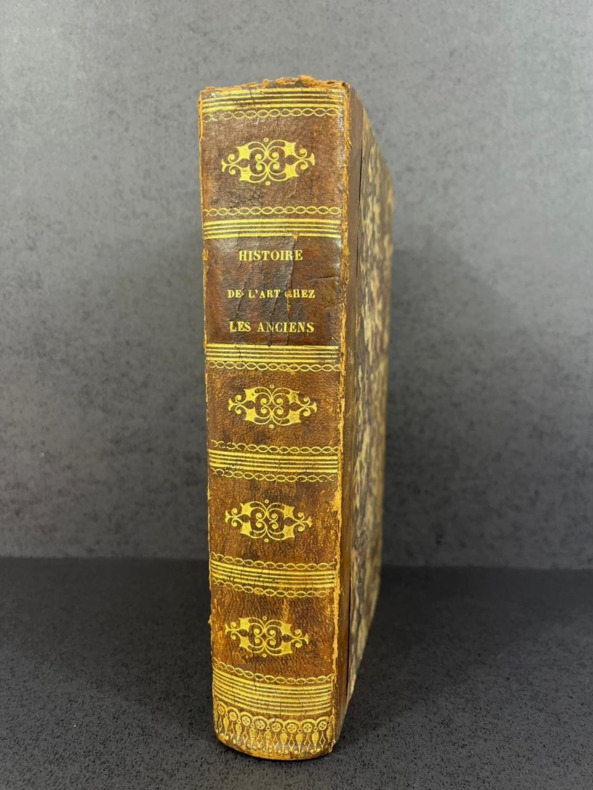
1766501Paris, Saillant, 1766. Rare édition originale en français, copiée la même année par un imprimeur d'Amsterdam. Traduction par Gottfried Sellius, revue par Jean-Baptiste-René Robinet. 2 volumes in-8 reliés en un, complet. 140 x 205 mm, (lvi) 360 pp. et (xxviii) 343 pp. Demi-chagrin tabac d'époque, dos lisse avec titre en doré sur pièce de titre, emplacements des coutures ornés de quadruples filets dorés avec motifs chaîne au-dessus et au-dessous, ornements doublés et roulette dorée en queue. Plats à motifs beige et ocre. Préface en début de premier tome, table des matières au début de chaque tome. Nombreuses gravures à travers l'ouvrage : 22 vignettes gravées sur cuivre, dont une signée de Frankendaad ; 2 sur les pages de titre, 11 en-têtes, 8 culs-de-lampe, 1 hors-texte. « Cet ouvrage a été le premier de langue allemande à recevoir une reconnaissance universelle. Winckelmann a mis en lumière l’importance des idéaux grecs pour le monde moderne, chose que personne n'avait faite avant lui. Sa connaissance unique des exemples d’art classique qui nous sont parvenus, enrichie par une vaste érudition spécialisée, lui a conféré une autorité incontestable. » (PMM) « Une œuvre importante, parfois considérée comme la première histoire moderne de l’art, aujourd’hui d’une grande utilité pour l’historiographie de l’art et pour l’étude de toutes les phases du mouvement néoclassique. » (Rainwater, H130) Brunet, V, col. 1463 ; Cohen, 1068.