86 résultats
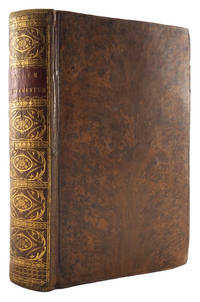
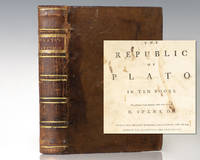
1763138322Glasgow: Printed by Robert and Andrew Foulis 1763. First edition in English of Plato's Republic marking the first appearance in the English language of Plato's profoundly influential dialogue concerning the nature of justice. Quarto bound in full polished calf with raised gilt bands to the spine morocco spine label lettered in gilt all edges speckled red. Harry Spens was a minister at the parish of Wemyss in Fife and respected classicist. In his introduction he professes his intent in his translation is: "To give the English Reader a view of Plato's sentiments and manner of writing and to stir up the youth to the study of the Ancients." Richard Garnett in his own introduction of the Everyman's Library reprint of this translation laments the relative lack of critical attention paid to it writing: "On the whole Spens's version should not be lightly esteemed. It is clearly the work of a scholar and a man of considerable literary ability." The brothers Robert and Andrew Foulis were renowned printers of classical works in their time sometimes referred to as 'the Elzevirs of Britain.' Their works mostly intended for scholars were "much sought after as admirable specimens of typography and are noticeable for their severely plain elegance" DNB 7: 514. In very good condition. Rare and desirable. "Its setting and its characters are full of political meaning. Its arguments are tantalizing and its fables fascinating… Plato's utopia is alarming and his metaphysics are intoxicating" Levi 348. The Republic "has reinforced dedication awakened vocations to leadership and strengthened the morale of those modest and competent souls who are always in reality the guardians of society" Rexroth 79. Printed by Robert and Andrew Foulis unknown
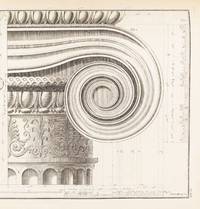
1758ST17496-017Paris: H. L. Guerin & L. F. Delatour Jean-Luc Nyon and Jean Neaulme 1758. FIRST EDITION. 608 x 445 mm. 24 x 17". xiv 56; 2 vi 28 pp. Two parts in one volume. <br/> Later early 20th century quarter sheep over marbled boards raised bands compartments gilt reddish-brown leather label with gilt lettering all edges untrimmed. With large woodcut vignette on title and 60 ENGRAVED PLATES by Le Bas Littret de Montigny Neufforge and Patte after Le Roy. Brunet III 103; Millard French 101. A little rubbing to corners and head and tail of spine leather a bit faded chafed and freckled in places but the binding entirely sound and still quite pleasing; very faint diagonal crease at lower corner of many leaves a handful of plates slightly browned one more noticeably so other minor issues but quite a fine copy internally--the vast majority of the contents clean and bright with deep impressions of the text with the engravings richly impressed and with vast margins.<br/> <br/> With engravings by the some of the most esteemed artists of the day this imposing work contains beautiful depictions of Greek ruins and monuments that proved extremely influential to the development of French Neoclassical architecture. The text is divided into two parts the first covering the history of various monuments and Le Roy's thoughts on the principles of architecture and the second primarily containing a discussion of the orders of columns--particularly the Doric order--as well as several reconstructions of ruined temples. According to Millard this work "breaks new ground in providing a synthesis of archaeological findings with a body of architectural theory developed and expanded from the important controversy of Claude Perrault and Francois Blondel i.e. quarrel of the Ancients and the Moderns. . . . Perhaps most important Le Roy's treatise provides the theoretical framework and many of the actual models for French neoclassical architecture." Although "Les Ruines" came under some criticism especially by British rivals James Stuart and Nicholas Revett it nevertheless "made a strong public impact" in the words of the Dictionary of Art Historians and "greatly influenced the architects of the day particularly Jacques-Denis Antoine Jean-Arnaud Raymond Alexandre-Théodore Brongniart and François-Joseph Bélanger." This was in no small part due to the exquisite plates that included many picturesque views engraved by talented artists such as Louis-Joseph Le Lorrain Pierre-Charles Le Mettay Claude-Antoine Littret de Montigny and Jacques Philippe Le Bas among others. The son of the horologer to Louis XV Julien-David Le Roy 1724-1803 was an architect art historian and archaeologist. He was a protégé of Jacques-François Blondel 1705-74 whom he later succeeded as professor at the Académie Royale d'Architecture. After winning the Prix de Rome in 1754 Le Roy spent time in Greece studying and measuring ancient architecture and developing many of the theories that he would eventually publish in the present work. H. L. Guerin & L. F. Delatour, Jean-Luc Nyon, and Jean Neaulme unknown
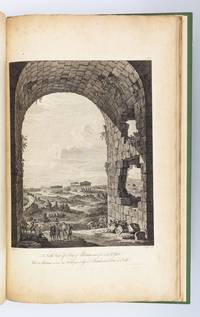
1768ST17496-011London: Chez l'auteur 1768. First Edition in French. 590 x 380 mm. 23 1/4 x 15". 52 2 pp. <br/> Modern brown quarter morocco over green linen boards brown morocco label with gilt lettering on smooth spine edges untrimmed. WITH 25 FULL-PAGE ENGRAVED PLATES OF GRECIAN RUINS and seven smaller engraved plates in text including one on dedication page. A Large Paper Copy. Fowler p. 157; Millard British 41; Blackmer 1065; Brunet III 1329. Head of spine partly torn but with no loss contents with not infrequent light marginal soiling though plates uniformly clean other minor imperfections but an excellent copy with greatly generous margins with deep impressions of the type and with strong impressions of the plates.<br/> <br/> This work is the first significant account of the ancient city of Paestum being in the words of Blackmer "larger and much more complete than any of the previous publications." Located in the Tyrrhenian Sea off the coast of southern Italy Paestum or Poseidonia in Greek was founded by Greek colonists in the sixth century B.C. and still contains beautifully preserved ruins from that period including temples an amphitheater and painted tombs. Abandoned in the Medieval period Paestum wasn't rediscovered by the West until the 18th century with the first modern publication of the site not appearing until 1764 when a suite of plans by G. P. M. Dumont appeared with no text based on the observations of Jacques-Germain Soufflot. As Millard indicates the genesis of the present publication has an extremely complex history we do not even know with certainty who wrote the text but we do know that engraver Thomas Major 1729-99 whom DNB calls "the first great English landscape engraver" was responsible for preparing the plates. Because he had no first-hand knowledge of the site Major relied on images by other artists including Antonio Joli Gaetano Magri Robert Mylne and Jacques-Germain Soufflot. The text was first published in English and then in French the same year. According to Fowler "this work . . . was an important eighteenth-century pioneer contribution to the knowledge of Greek architecture in England"; and Millard tells us that "the book was surprisingly well received by reviewers" in both England and France remaining "the standard reference to Paestum until 'Les Ruines de Paestum ou Posidonia' by C.-M. Delagardette was issued in 1798.". Chez l'auteur unknown
1701AUB-4498A Bruxelles, chez Eugène Henry Frick 1701. 5 volumes reliés, reliures pleine peau d'époque, dos ornés avec titres, petits format, 1428 pages avec planches et notes + avertissement, préface de l'auteur, tables des chapitres et table des matières + 913 pages avec notes et planches + avertissement, approbation, extrait du privilège, lavie de Joseph écrite par lui-même (59 p.), préface de Joseph, tables des chapitres et table des matières. Contient: la réponse de Joseph à ce qu'Appion avait écrit contre son histoire des juifs touchant l'antiquité de leur race. Le martyre des Machabées. La relation faite par Philon de l'ambassade dont il était le chef envoyée par les juifs d'Alexandrie vers l'Empereur Caïus Caligula.
1786019793Londini London: Ex Prelo Joannis Nichols Typis Jacksonianis 1786. Book. Very good condition. Hardcover. First Edition. Folio - over 12" - 15" tall. ii x ii xxxii 264 89 i blank. Complete with half-title and 3-leaf subscribers' list and one leaf containing a full-page engraving. Contains facsimile text in Alexandrian Greek type cut by Joseph Jackson. Contains minor scattered foxing on several pages near the beginning of the text and to the final few leaves of text. Previous owner's name stamped in upper margin of title page and again stamped much smaller on the following page. Contemporary decorated calf boards with some scratching peeling and wear refurbished; rebacked in leather with raised bands and a new gilt-stamped spine label. New endpapers retaining two original endpapers at the rear. The first three leaves were professionally and archivally light-bleached which removed most of the foxing. The first edition of the New Testament as preserved in the Codex Alexandrinus printed using a typeface that skilfully reproduced the appearance of the fifth-century original. The text is clean and unmarked. Folio: measures 18.5" x 11.75" 472mm x 297mm. Ex Prelo Joannis Nichols, Typis Jacksonianis Hardcover books
17542306160124xbvkSpain, 1754. Calligraphic titlepage in a handpainted watarcolour frame; 5 sheets dedication ''A LA REYNA DEL CIELO MARIA SSA. EN SU SOLEDAD DOLOROSA SA MADRE DEL AMOR HERMOSO, y delicias de la celestial Syon, aunque max grande de penas y amanguras de la gracia, que en el dura, pero o lorioso campe de la soledad ...''; 1 blank sheet; 2 sheets ''TABLA DE LAS SANTAS ANACORETAS CONTENIDAS EN ESTE SEGUNDO TOMO DEL DESIERTO DELICIOSO''; 2 sheets 'PROTESTA . . .' etc.; 334* sheets Description of the Saints. - Vellum binding of the periodover 4 raised bands with manuscript title at spine and possibly younger frangments of ribbon clasps; 4to.(ca. 24 x 19 x 6 cm; ca. 1,47 kg.).
1723WRCLIT65879Lipsiæ Leipzig: Sumptibus Filii J. Fridericii Gleditschii 1723. 221682632pp. including special presentation prelim. Folio signed in 4s. Full 18th century gilt paneled vellum gilt extra with Amsterdam College arms in central panel and variations on Amsterdam city arms as corner pieces and as central devices in 5 of 7 spine compartments. Title in red and black. Engraved title vignette; engraved headpieces; tailpieces; initials some historiated. Greek and roman letter. Binding a bit rubbed and lightly soiled early and careful restoration of lower 12cm of spine in vellum ink bookseller's annotations on front and rear pastedowns extreme lower blank forecorner torn from 2I3 not approaching text small receding brown spot from A4 to B4 otherwise a very good or better copy. Second edition of Ludolph Kuster's revision of Mill's New Testament text the latter first published in Oxford in 1707. The first edition of Kuster's revision appeared at Amsterdam/Rotterdam with a Leipzig imprint in 1710. This is an interesting copy in an elaborate prize binding and including a specially printed singleton presentation leaf bearing an engraved vignette of the Amsterdam City arms and eleven lines of boilerplate letterpress with the variables executed in manuscript: in this case in 1760 to one "Joanni Meyer" signed in ink by the examiner. Mill's text accompanied by its "Prolegomena" described by D&M as "monumental" is "perhaps the most famous Greek Testament of the eighteenth century" - D&M 4725. An attractive copy. DARLOW & MOULE 4375 OCLC: 3041133. Sumptibus Filii J. Fridericii Gleditschii hardcover books
1798191868London: Printed for T. Cadell Junior and W. Davies 1798. The official publication of a scholarly pastiche First illustrated edition and the first authorized public one. These fictitious letters describing Athens during the Peloponnesian War were the work of a circle of Cambridge dons and students including the Bluestocking Catherine Talbot 1721-1770 who is named in the author key to this edition. Athenian Letters names more than one prominent female letter-writer from antiquity real and fictive. The work's instigators Philip Yorke second Earl of Hardwicke 1720-90 and his brother Charles 1722-70 are pictured in the frontispieces. The first edition of 1741 consisted of 12 copies followed by 100 in 1781 and a pirated edition. 2 vols quarto 274 x 212 mm pp. lxii 2 436; xv 1 466. Portrait frontispieces to each volume 12 engraved plates of busts folding map. Contemporary tree calf flat spines divided by gilt rolls blue and green labels central gilt tools to compartments green edges. Contemporary booklabels of Fasque the Gladstone family home. Head caps a little worn and split spines rubbed a few patches of stripping corners worn minimal foxing. A very good set. ESTC T84382. unknown
1766501Paris, Saillant, 1766. Rare édition originale en français, copiée la même année par un imprimeur d'Amsterdam. Traduction par Gottfried Sellius, revue par Jean-Baptiste-René Robinet. 2 volumes in-8 reliés en un, complet. 140 x 205 mm, (lvi) 360 pp. et (xxviii) 343 pp. Demi-chagrin tabac d'époque, dos lisse avec titre en doré sur pièce de titre, emplacements des coutures ornés de quadruples filets dorés avec motifs chaîne au-dessus et au-dessous, ornements doublés et roulette dorée en queue. Plats à motifs beige et ocre. Préface en début de premier tome, table des matières au début de chaque tome. Nombreuses gravures à travers l'ouvrage : 22 vignettes gravées sur cuivre, dont une signée de Frankendaad ; 2 sur les pages de titre, 11 en-têtes, 8 culs-de-lampe, 1 hors-texte. « Cet ouvrage a été le premier de langue allemande à recevoir une reconnaissance universelle. Winckelmann a mis en lumière l’importance des idéaux grecs pour le monde moderne, chose que personne n'avait faite avant lui. Sa connaissance unique des exemples d’art classique qui nous sont parvenus, enrichie par une vaste érudition spécialisée, lui a conféré une autorité incontestable. » (PMM) « Une œuvre importante, parfois considérée comme la première histoire moderne de l’art, aujourd’hui d’une grande utilité pour l’historiographie de l’art et pour l’étude de toutes les phases du mouvement néoclassique. » (Rainwater, H130) Brunet, V, col. 1463 ; Cohen, 1068.
177717837Weidmann, Leipzig 1777. XVI, 432 S. mit 7 gefalt. Karten u. Plänen. Halbleder der Zeit mit Rückenschild. Etwas beschabt u. bestoßen. Rücken mit mehreren kleinen Wurmspuren, im Falz teils etwas beschädigt. Kapitale mit kleinen Fehlstellen. Buchblock teils etwas fleckig, Plan von Athen etwas ungenau gefaltet, im Ganzen innen aber schön und sauber erhalten.
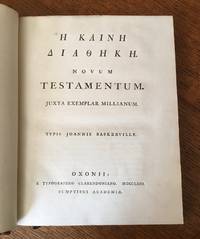
176310588<p>E Typographeo Clarendoniano. Sumptibus Academiae. Oxonii. 1763. FIRST BASKERVILLE EDITION. 4to in 2's. 12.2 x 9.7 inches. Half title Title page 415pp. One of 500 copies printed using the fine Baskerville Greek type. A clean and crisp copy in a very good contemporary leather binding of full diced dark brown calf boards with floral gilt roll borders. Professionally re-spined at a later date with a matching coloured Morocco spine ruled decorated and lettered in gilt. Board edges ruled in gilt. Marbled endpapers. Gilt inner dentelles. All edges marbled. A small patch of rubbing to the front free endpaper and some rubbing and bumping to the edges but overall a very good copy of this beautifully printed book in an attractive 18th century binding.</p> E Typographeo Clarendoniano. Sumptibus Academiae. Oxonii. 1763 hardcover
177410669Goettingae: Recudi fecit vidua b. Abr. Vandenhoeck 1774. 4to 23 cm. 2 494 pp. <br><br>Signed presentation copy from the Rev. Edward Bouverie Pusey Regius Professor of Hebrew Oxford University dated 1835. Edited by Simon de Magistris. Greek and Latin text printed in parallel columns. Illustrated with an engraving on p. 104 and engravings of Greek coins on p. 194. WorldCat locates only one copy of this edition in U.S. libraries. <br>Â Â Â Â <br>Â Â Â Â Not in Darlow & Moule but see 4760 for the 1773 edition and 4759 for the first edition. Contemporary plain wrappers paper over spine chipped and with lengthwise cracks; binding coming apart with final 14 pages separated. Gift inscription dated 1835 on verso of title-page. Bookplate of a theological seminary on inside of front cover. Some pages unopened. Foxed. Dog-eared. => Uncut mostly unopened copy. Recudi fecit vidua b. Abr. Vandenhoeck unknown books
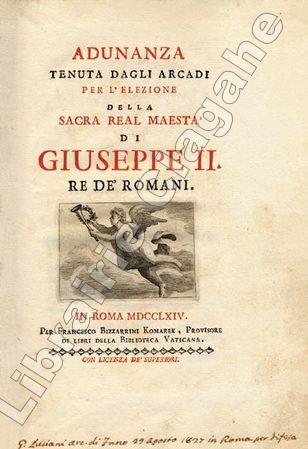
17644373Roma, 1764, per Francesco Bizzarini Komarek, Provisore di libri della Bibliotheca Vaticana ; grand in-8, plein vélin ivoire, titre manuscrit (reliure de l'époque) ; VIII, 120 pp., vignette de titre, lettrine et cul-de-lampe gravés, ouvrage entièrement imprimé en rouge et noir.
1785PHO-1815Parme, Ex regio Parmensi typographio (Bodoni), 1785, grand in-4, 16ff.-(2)-XXXV-248pp.-110pp., relié pleine basane marron légèrement postérieure, filet à froid aux plats, tranches rouges, petits frottements, coins usés, mouillure marginale.
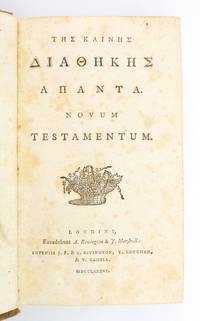
1786ST20133London: Excudebant A. Rivington & J. Marshall: Impensis J. F. & C. Rivington T. Longman & T. Cadell 1786. 175 x 105 mm. 7 x 4 1/4". 368 pp. 1 leaf ads. <br/> Contemporary brown "school cloth" rough linen raised bands. Front flyleaf with owner inscription of John Cutler dated Sept 21 1789 four lines of Latin doggerel threatening anyone who steals the book with hanging and two large copperplate trials of Cutler's signature. ESTC N63834. Not in Darlow & Moule. A little fraying at top and bottom of joints light foxing and toning throughout due to paper quality a couple of small ink stains but a surprisingly appealing copy the text extremely clean and the unsophisticated makeshift binding--remarkably--with no significant wear.<br/> <br/> This is an almost startling survival: an 18th century New Testament in Greek in its original utilitarian binding preserved in condition far better than what could be anticipated given the audience of generally uncareful pupils for which it was intended. Considering the usual depredations of school children the rough school cloth should have been worn to shreds long ago but against the odds it has fortuitously escaped hard use and now gives us a glimpse of an important element of the English schoolroom very close to its original condition. One particularly delightful aspect of our copy is the flamboyant declaration of ownership by a pupil called John Cutter who inked his name no fewer than four times in different styles and with calligraphic flourishes across the flyleaf. Cutter's neatly penned book curse threating any would-be thieves with hanging may have helped to preserve the book as it now exists. In fact there are few signs of use by any owner rightful or unlawful. The leaves are free from any markings and the insubstantial binding appears to have rarely left the shelf. Excudebant A. Rivington & J. Marshall: Impensis J. F. & C. Rivington, T. Longman, & T. Cadell unknown
17632548Oxonii Oxford: E Typographeo Clarendoniano 1763. 8vo pp. iv 676. Near-contemporary tree calf spine elaborately gilt in compartments red morocco label marbled endpapers edges yellow. Some light toning and spotting. Expertly rebacked by Bernard Middleton with old backstrip laid down hinges relined. An attractive copy. In 1758 Baskerville proposed the casting of a new set of Greek types to the Oxford University Press and they ordered 2000 copies of this octavo New Testament plus 500 in quarto to be printed with the resulting type - which ended up being its only use. Negative critical reception may have contributed to its abandonment but Baskerville’s Greek face has recently been reassessed by Gerry Leonidas as an important predecessor of more modern types if perhaps not quite as elegant as that used by the Foulis press that had fallen afoul of an arbitrary typographic orthodoxy. Gaskell Add. 2; ESTC T94889; D&M 4756. E Typographeo Clarendoniano unknown
172334825Lipsiae: Sumptibus filii J. Friderici Gleditschii 1723. Folio cm ". 20 168 2 632 pp.; illus. <br><br>Based on John Mill's much-lauded 1707 edition of the Greek New Testament this is the second issue of Ludolph Küster's revised version originally published in 1710. A scholar from the Westphalia region of Germany Küster 16701716 specialized in paleography and Greek; this printing includes his preface and Prolegomena and extensive commentary in Latin below the main text. Using twelve new manuscripts in his research Küster significantly added to Mill's 16451707 collation.<br>Â Â Â Â The title-page printed in red and black features an => engraved vignette of the Virgin Mary enthroned above the Earth flanked by an eagle a lion a bull and an angel representing the Four Evangelists and there are => five additional large illustrative engraved vignettes functioning as headpieces in the text. Printed double-column and divided in the middle of each page by a paragraph of citations the text is dotted by a variety of woodcut floriated and historiated initials and factotum Greek capitals.<br>Â Â Â Â Provenance: Front pastedown with pencilled inscription "C.B.P.B. 1709" and with bookplate of Newton Theological Institution properly deaccessioned noting gift from library of Edward Cushing Mitchell D.D. class of 1853. <br>Â Â Â Â <br>Â Â Â Â Darlow & Moule 4735. Contemporary mottled sheep rebacked some time ago; scuffed and worn front joint starting from head and foot extremities rubbed and chipped. Front pastedown with inscription and bookplate as above; two text pages institutionally pressure-stamped. Offsetting to margins of first and last few leaves; waterstaining to inner portions of first 80 and a few final pages touching but not obscuring text on some pages and a small area of the first headpiece. One proud corner folded over several other corners bumped; scattered spots of light staining and ink smears not obscuring sense; occasional small edge nick. One early inked marginal annotation in English and Greek. Very readable and usable. Sumptibus filii J. Friderici Gleditschii unknown books
1770370441 vol. in-8 reliure de l'époque demi-basane marron, Palaephatus De incredibilibus Graece. Iterum edidit recensuit indicemque verborum graecorum adiecit Ioh. Frid. Fischerus, Sumtu Ioh. Frid. Langenhemi, Lipsiae [ Leipzig ], 1770, viii-38 pp. et 29 ff. n. ch., texte grec, préface et index en latin / Meletemata e Disciplina Antiquitatis. Opera Friderici Creuzeri (3 Tomes - Complet) I : Anecdota graeca ex codicibus maxime Palatinis Depromta ; II : Commentationes et commentarii in Scriptores graecos ; III : Commentationes et commentarii in Scriptores graecos, In Bibliopolio Hahniano, 1817-1819, 118 pp. et 1 f. ; 1 f., 108 pp. ; iv-212 pp./ Symbolas ad emendandum et illustrandum Philostrati Librum De Vitis Sophistarum in Medium attulit Albertus Jahnius, Impensis C.A. Jenni Filii, Bernae [ Berne ], 1837, viii-146 pp. et 1 ff.
1763DC8_2013e typographeo Clarendoniano sumptibus academiae Oxonii. Clarendon Press Oxford: . 1763 pp. 4 415 1. Small age and damp stains to the first and last 40 leaves or so. Wide margined. Large 4to. 300mm. All edges gold gilt. Early plain full vellum binding. Marbled endpapers. Hand lettered ownership of: J.M Hicks Winton September 1910. Sole quarto printing of the Greek New Testament using Baskerville type i.e. Greek type that Baskerville designed and cut himself. The text follows the 1707 edition by John Mill 1645-1707 with seven variations. This quarto edition was limited to 500 copies and is much scarcer than the 8vo edition issued around the same time. Gaskell - Add. 1; Darlow & Moule 4755. John Baskerville 1706-1775 was the greatest printer of his era. Born in Wolverley Hereford - Worcester England he became a writing master in Birmingham. He also carried on a successful japanning varnishing business there. In about 1750 he began to make experiments in letter founding and produced the wonderful series of types now named after him. His first book the Virgil of 1757 was also the first to be printed upon wove paper manufactured by a process that he invented. In 1758 he became printer to Cambridge University. There he designed other fonts including his remarkable Greek type. All of his books bear the marks of fine craftsmanship and a refined sense of design.PRICE JUST REDUCED! All other examples of this edition are priced on-line at over $1000.00! I held this in my own bible collection since 1995. It is a great bargain. SAFE ADD 1. Hardcover. Very Good. e typographeo Clarendoniano, sumptibus academiae, Oxonii. (Clarendon Press, Oxford): . hardcover
176334979Oxoni: E typographeo Clarendoniano 1763. 8vo in 4s 23.5 cm 9.25". 4 676 pp. <br><br>Sole octavo printing of the Greek New Testament using Baskerville type i.e. Greek type that Baskerville designed and cut himself; and indeed this pleasingly was printed from the only set of Baskerville type that survives to this day still at Oxford's Clarendon Press. The text was based on the Mill edition of the Greek N.T.; Darlow and Moule notes that while the text "generally reproduces that of Mill . . . Reuss notes seven variations." => An important example of 18th-century fine printing of the Bible.<br>Â Â Â Â This copy retains its half-title.<br>Â Â Â Â Provenance: The Howell Bible Collection Pacific School of Religion properly released. <br>Â Â Â Â <br>Â Â Â Â Gaskell enlarged ed. Add. 2; Darlow & Moule 4756. Contemporary acid-stained calf rebacked some time ago with morocco spine with gilt-stamped title and publication information; edges and extremities rubbed sides and spine with small scuffs. New endpapers with pencilled annotations; back pastedown with California bookseller's small ticket. No library markings. Title-page with tiny nick in upper edge. Pages very slightly age-toned with a very few scattered small spots otherwise crisp and clean. E typographeo Clarendoniano unknown books
17383893FBAmsterdam, verlegt von Janssonius van Waesberge, 1738. 2°. 42 x 28 cm. [10] Blatt, 865 Seiten. Pergamentband der Zeit auf 7 Bünden mit goldgeprägten Amsterdamer Wappen und Rollstempeldruck auf Rücken und Deckel. [5 Warenabbildungen]
177415633Londini, E Typographeo Richardsoniano, veneunt Apud T. Cadell, 1774. In-8 de [2]-XXXI-[1]-542-[2] pages, plein veau beige, dos à nerfs joliment orné de filets et fleurons dorés, pièce de titre en maroquin rouge, roulette dorée sur les coupes.
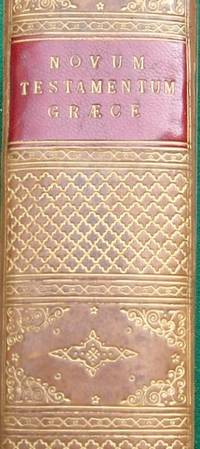
179312481BASKERVILLE'S GREEK TYPE <br />first edition thus in Baskerville type tall 8vo. in fours 676pp. printed on fine ie. thick paper attractive three-quarter sprinkled calf probably nineteenth century smooth spine very richly decorated in gilt in panels of contrasting and alternating design scarlet morocco label gilt marbled paper on sides and as endpapers half-title and last leaf a trifle dusty rear joint cracking else a fine fresh and bright copy. A particularly handsome copy. <br /><br />ESTC t94889 Darlow & Moule 4756<br />Only two books were printed in this type the octavo and quarto Testaments both in 1763. Edited by John Mill. 2000 copies printed. E Typographeo Clarendoniano hardcover
17091120591709 Franequerae, excudit Franciscus Halma, 1709, 2 tomes reliés en 1 fort volume in-4 de 200x245 mm environ, (22) ff. (faux-titre, frontispice, page de titre, Prolegomena, Subtexere heic potius), 1326 pages. Complet du frontispice de G. vander Gouwen et des 6 planches dépliantes. Plein velin d'époque au dos lisse muet, encadrement d'un double filet droit à froid, répliqué, sur les plats, petit fleuron central doré et quatre aux coins de l'encadrement intérieur, traces de lacets disparus. Manques en bordure des plats, plats tachés, une déchirure sur le dos, deux pages manuscrites au début de l'ouvrage, petite mouillure en bordure de quelques pages, quelques rousseurs, bon état pour le reste.
1725L0823Amstelodami: Sumptibus Societatis David Millius. G : in Good condition without dust jacket. Covers rubbed. Loss to spine leather of volume 2. Occasional slight foxing. 1725. Seventh Edition. Brown hardback leather cover. 170mm x 100mm 7" x 4". 903pp; 928pp. Written in Greek. Bookplate of Montagu Burgoyne. Title page with small woodcut engraving. The second recognised edition from the Vatican in Rome. . Sumptibus Societatis [David Millius] hardcover