22 298 résultats
158883711588 Francfort, chez André Wechel, 1588. Un volume in-folio cousu mais non endossé dans une chemise en vélin ivoire, titre manuscrit au dos, 694 pages,texte en grec et latin, sur deux colonnes. Manquent les feuillets de titre, frontispice, et préface, mouillure claire et quelques rousseurs. Mérite restauration.
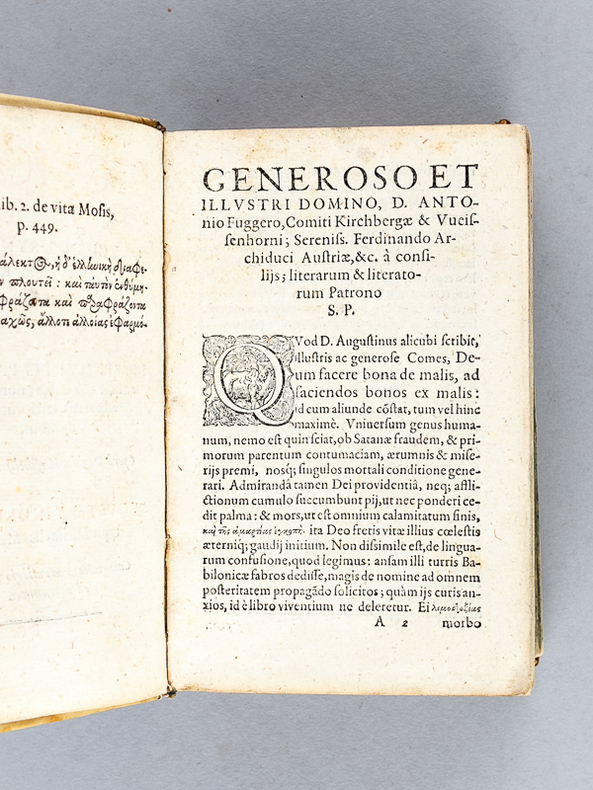
160055298Emendata Obiter, multis partibus auctior qua antea ; nonnusquam adnotatis auctorum nominibus, Opera Davidis Hoeschelii Augustani, 1 vol. in-8 reliure de l'époque plein vélin blond à lacets, plats estampés à froid, dos à 3 nerfs, Typis Michäelis Mangeri [Michael Manger ], Augustae Vindelicorum [Augsbourg ], 1600, A-Z8 2A-Z8 3A-G8, 3H3
Emendata Obiter, multis partibus auctior qua antea ; nonnusquam adnotatis auctorum nominibus, Opera Davidis Hoeschelii Augustani, 1 vol. in-8 reliure de l'époque plein vélin blond à lacets, plats estampés à froid, dos à 3 nerfs, Typis Michäelis Mangeri [Michael Manger ], Augustae Vindelicorum [Augsbourg ], 1600, A-Z8 2A-Z8 3A-G8, 3H3 Très belle reliure en vélin (sans les lacets, mention "Pars I" grattée en page de titre, très bel état par ailleurs) pour cette première partie (que l'on trouve communément seule). L'humaniste protestant allemand David Hoeschel (1556-1617) bénéficia du mécénat des Fugger (auquel il dédié le présent volume). Correspondant des grands humanistes du temps (Scaliger, Juste Lipse, Camerarius, etc...) son dictionnaire latin-grec connut le succès et fut plusiurs fois réimprimé. Grec
181366240Ad fidem librorum scriptorum emendavit Ioannes Gottlob Schneider Saxo, Accedunt versiones Latinae metrica et prosaica plurima anecdota et index Graecitatis, 1 vol. in-8 reliure de l'époque demi-basane verte, toutes tranches marbrées, Apud Ioa. Aug. Gottl. Weigel, Lipsiae [ Leipzig ], 1813, XV-250-98 pp. [ Oppiani De Venatione Libri IV Carmine Latino Redditi a Davide Peifero I.C. Anno MDLV ]
Former owner's names to Vols 1 & 2. Light creasing to wraps of a couple of vols. Vol 1 is discolored and sunned along with upper edge of rear wrap. Vol 4 lower corner of front wrap creased. Vol. 3 & 6 digitally reprinted. ; This is a six-volume Commentary on Homer's Iliad, under the General Editorship of professor G. S. Kirk. This Commentary will be an essential reference work for all students of Greek literature. Archaeologists and historians will also find that it contains matters of relevance to them. ; 6 Volume Set COMPLETE. The Iliad: a Commentary; Vol. 1; 8vo 8" - 9" tall; V1: (1987) isbn: 0521281717; V2: (1990) isbn: 0521281725; V3: (2005) isbn: 0521281733; V4: (1995) isbn: 0521281741; V5: (1995) isbn: 0521312086; V6: (2003) isbn: 0521312094
173411158Lugduni Batavorum, apud Joannem van Abcoude, 1734. In-8 de [16]-871-17 pages, plein vélin blanc (plus tout à fait blanc), dos orné de fleurs de lys et roulettes dorées, plats ornés d'un légionnaire s'appuyant sur un boulier orné de la cigogne (armoiries de la Haye) ainsi que d'un hibou dorés, le tout surmontant la mention "Hagae Comitis", fleurs des lys dans les coins.
1779983821Lucian cianucian Greek Lucianos Latin Lucianus born AD 120 Samosata Commagene Syria now Samsat Tur.—died after 180 Athens Greece<br /><br />Danza Dialogo di Luiano con Annotazioni con annotazioni. <br /><br />In Firenze : nella stamperia di Gaspero Pecchioni 1779. Original edition. 8vo. Old wrappers iv 44 p. Some stains to titlepage. Very good copy. In this dialogue the Cynic Crato who has no in pantomimic dancing or those who go to see it is converted to its appreciation by his friend Lycinus.<br />This is a translation into Italian with notes of Lucian's famous dialogue on pantomime or "tragic dancing" in ancient Greece. In "tragic" dancing a dramatic plot is enacted by a masked and costumed dancer supported by an actor. The dancer's lines are spoken for him by someone else. There is also a chorus and for accompaniment the flute and the syrinx with various instruments of percussion. The work is dedicated to Antonio Muzarelli who was ballet master at the Burgtheater in Vienna at a time when ballet was detested by Emperor Joseph II although the art form was gaining some popularity due to the reforms of Jean-Georges Noverre 29 April 1727 – 19 October 1810 the a French dancer and balletmaster generally considered the creator of ballet d'action. The dialogue was probably written in Antioch in 162–165 a.d. when the Emperor Verus was there in compliment to him because of his interest in pantomime at a time when visual art was held inferior to literary art. This work underscores the legitimacy of dance because Lucian recognizes the intellectual character of dance. He emphasizes that a dancer must be able to express his or her ideas and sentiments through the intelligibility of movement and posture. Lucian's dialogue on dancing remains popular today due to its clever dialogue and clarity of argument. Rare: two OCLC locations one in North America: NYP Pecchioni books
Minor shelfwear. Top of spine is slightly knocked. Stamp to top of textblock: "Write-Off" else NF. ; Contents include but are not exhaustive: Herodian's Historical Methods and Understanding of History; Erodiano e la crisi dell'impero; Furcht und Schrecken bei Herodian; Claudius Aelianus und sein Werk; Les 'Histoires variees' d'Elien. L'agencement de la mosaique; Asinio Quadrato storico di Filippo l'Arabo; Longinus Platonicus Philosophus et Philologus, II. Longinus Philologus; Menander Rhetor and the works attributed to him; Time and Narrative Technique in Heliodorus' Aethiopica; Etat present des recherches sur Nemesien; Lettura di Reposiano; Alcestis Barcinonensis; Terentianus Maurus...; Apollonius of Tyre: last of the Troublesome Latin Novels; On the fringes of the Canon: Work on the Fragments of ancient Greek Fiction; Emperor and Empire in the works of Greek-speaking Authors of the Third Century AD; W. Curtius Rufus' Historiae Alexandri Magni; Problemi di lingua e stile nei Moralia di Plutarco; Forma letteraria nei Moralia di Plutarco...; ANRW; Vol. 34.4; 2.1 x 9.9 x 7.2 Inches
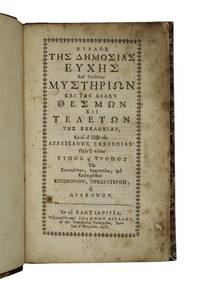
166529955AB1665. En te Kantabrigia Cambridge Ioannou Phieldou John Field 1665. Duodecimo 85 cm x 15 cm. Pagination: Volume I: 36 126 2 pages / Volume II: 2 115 3 11771 1 pages / Volume III: 1-273 1 pages. Hardcover / Original 17th century leather with tooled ornaments to spine and boards. Firm and in very good condition with only minor signs of external wear and only very minor damage to pastedown. Interior in unusually clean and bright condition. From the library of Daniel Conner Connerville / Manch House with his Exlibris / Bookplate loosely attached to endpaper. This is an example of the rare original John Field - Edition not the long undetected John Hayes Reprint of the Bible / Septuagint after the Vatican Edition which is mentioned in an important article in the Journal of Theological tudies Vol. 6 No. 24 July 1905 pp. 611-614 4 pages. Darlow & Moule 4702 hardcover
055322Paris Chez Desray, libraire. De l'imprimerie de Didot le Jeune 1817 in 8 (21,5x13,5) 7 volumes reliures demi chagrin violine, dos à nerfs ornés de beaux fleurons dorés. Tome 1: portrait gravé en frontispice, X, CLII et 367 pages, Tome 2: II et 517 pages, Tome 3: VI et 496 pages, Tome 4: VI et 507 pages, Tome 5: VI et 495 pages, Tome 6: [1] et 454 pages, Tome 7: VI et 493 pages. Cinquième édition. Complet des 6 volumes de texte, l'atlas de format in 4 manque (41 planches gravées). Ensemble en bel état ( Photographies sur demande / We can send pictures of this book on simple request )
44305Paris Librairie Renouard, 1878-1892 1878 in 8 (23x15) 6 volumes reliures à la bradel demi percaline verte, dos lisses ornés d'un fleuron doés, pièces de titre de cuir rouge. Tome 1: V et 420 pages [1]. Tome 2: XII et 531 pages. Tome 3: IX et 385 pages. Tome 4: VIII et 400 pages. Tome 5: 500 pages, XII. Tome 6: XXIII et 267 pages [1], quelques rousseurs éparses. Edme Cougny, 1818-1889. Edition bilingue. Texte grec et traduction française en regard. Bel exemplaire, bien relié ( Photographies sur demande / We can send pictures of this book on simple request )
64938, Brepols, 2022 Hardback, cliv + 435 pages, Size:155 x 245 mm, Language(s):Greek, English. ISBN 9782503528076.
24294Paris Xhrouet, imprimeur; Déterville, libraire; Lenormant; Petit, libraire 1807 in 8 (20,5x13) 1 volume reliure demi basane marron de l'époque, dos lisse, pièce de titre de cuir noir, II et 476 pages, petite trace de mouillure claire dans la marge supérieure interne du faux-titre et du titre, et des 6 derniers faux-feuillets. Suivi d'un extrait du Voyage de James Grant à la Nouvelle-Hollande, exécuté par ordre de S.M. Britannique, dans les années 1800, 1801 et 1802. Traduit de l'anglais par A.J.N. Lallemant, l'un des secrétaires de la Marine, membre de la Société française d'Afrique, instituée à Marseille, et traducteur de plusiurs relations de Voyages. Rare. Bon exemplaire ( Photographies sur demande / We can send pictures of this book on simple request )
1998BN216236CRC PR INC 1998. 1998. Hardcover. Aspects of Modern Language Teaching in Europe <br/><br/>Aspects of Modern Language Teaching in Europe Greek German CRC PR INC hardcover
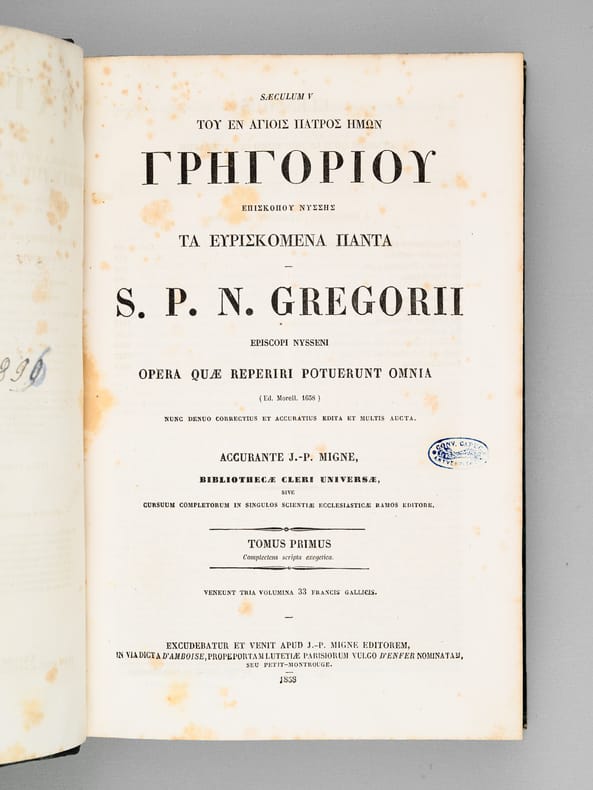
185868680Accurante J.P. Migne, 3 vol. in-4 reliure de l'époque demi-chagrin vert, dos à 4 nerfs dorés, Apud J.P. Migne, Petit-Montrouge, 1858 Rappel du Titre complet : S.P.N. Gregorii Episcopi Nysseni Opera quae reperiri potuerunt omnia (3 Tomes - Complet). Patrologiae Cursus completus. Series Graeca. Tomus XLIV, XLV, XLVI [ Patrologia Graeca Tomes 44, 45, 46 - Saint Grégoire de Nysse ]
FIRST AND ONLY EDITION of one of the great catalogue of Greek manuscripts. XXXIX, 336 pp. 432 manuscripts thoroughly described. Fully indexed. Beautifully printed on fine watermarked wove paper. 4to. Bound in recent buckram. Fine and bright. Very scarce.
1665AQ25869En te Kantabrigia i.e. Cambridge: Exetypothe par' Ioannou Phieldou. 1665. 36 126pp 2. With a terminal blank leaf. Title and imprint including date are transliterated from the Greek. ESTC R204258 Wing B3632. Bound with: Psalterion tou Dabid. En te Kantabrigia i.e. Cambridge. Exetypothe par' Ioannou Phieldou. 1664. 2 115 3 117-171pp 1. Title and imprint including date are transliterated from the Greek. ESTC R204259 Wing B2720A. 12mo. Recent calf-backed marbled paper boards lettered in gilt to spine. A trifle rubbed spine sunned. Bookplate of King Edward VI School Southampton to FEP Inked notes to recto of front blank fly-leaf title page of first mentioned work marked with small marginal hole scattered spotting. A early edition in Greek of the 1662 revised Anglican Book of Common Prayer together with a contemporary edition of the Psalms of David. . Exetypothe par' Ioannou Phieldou... hardcover
Volume I: light shelfwear and scuffing to boards. Inner hinges slightly weakening. Light tanning to pages. VG in no DJ. Volume II: DJ is in good condition with chipping to corners and spine ends. Large tears to DJ but mostly intact. Rubbing to front panel has worn away a couple of letters of title. Book is VG and has light foxing to textblock. Light tanning to pages. A few pages have minor creasing to upper corner. Otherwise both volumes very sound; Published for the department of Art and Archaeology of Princeton University. Errata slip inserted (v. 1). 13 individual manuscripts of the Roman comic dramatist in all, including an introductory "genealogy", plus a partial list of later illustrated manuscripts. ; 2 Volume Set COMPLETE. Illuminated Manuscripts of the Middle Ages. ; Vol. 1/2/2022; Folio 13" - 23" tall; 231 pages
Minor pencil underlining and notes by Jenifer Neils to a few pages [for a review by Neils]. Else book has minor shelfwear with a couple of rounded corners. Minor creasing along top edge of DJ. ; The pictures on Athenian vases of the late Archaic period often play upon the tension between an image and its material support, and between the sense of depth and the sense of surface. Richard Neer's study tracks design and imagery on Athenian vases in four domains: the symposium, with its elaborate riddles and poems; the development of 'naturalistic' techniques, such as foreshortening and shading; the birth of self-portraiture at the end of the sixth century; and the treatment of overtly political subject-matter in the early democracy. In each case, formal ambiguity provided vase painters and their audiences with a means of creating new conceptions of civic identity. Focusing on 'how pictures show what they show' leads the author to a re-examination of basic ideas about Greek art and its history, with particular regard to naturalism, realism, allegory, and the relation of ceramics to social life. ; Cambridge Studies In Classical Art And Iconography; 9.9 X 7.1 X 0.8 inches; 328 pages
Both books have been rebound in Green boards with gilt lettering to spine. ; 1887-1891 Reimer edition. ; 2 Volumes Bound in 1 COMPLETE
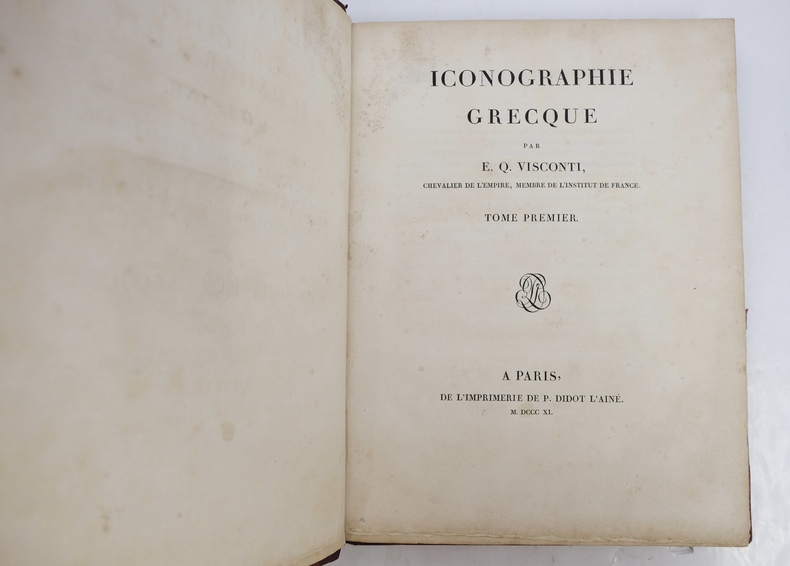
LATIN817M1811, P. Didot l'Ainé, Paris. 3 volumes de textes in-4, reliés, demi-chagrin à coins, dos lisses ornés. 322-374-334pp. Manque volume de planches. Reliures frottées, quelques enfoncement des bords. Intérieur frais. Ensemble des volumes de texte en état satisfaisant.
2004R78957Turnhout, Brepols 2004 XCV + 227pp.+ 65 microfiches, in the series "Corpus Christianorum. Thesaurus Patrum Graecorum", hardcover (publisher's green cloth with gilt lettering), 32cm., fine condition, [editor's new price: 495 euro], ISBN 978-2-503-51406-5, R78957
XCV + 227pp.+ 65 microfiches, in the series "Corpus Christianorum. Thesaurus Patrum Graecorum", hardcover (publisher's green cloth with gilt lettering), 32cm., fine condition, [editor's new price: 495 euro], ISBN 978-2-503-51406-5, R78957
24038Ten of the poems dated to 1912; one from Burnham Beeches. Prose piece without date or place. Archaeologist poet soldier writer of crime fiction - it seems extraordinary that such a man should not have been accorded an entry in the Oxford DNB. In 2001 Napier University in Edinburgh published twenty-one of her father’s ‘Poems from the Great War’ transcribed from his notebook by his daughter Lady Jennifer MacLellan. At least ten of the eleven poems present here date from before the war. The are conventional in structure and somewhat immature in tone: the influence of Francis Thompson is apparent. The prose piece is altogether more successful. In choosing as his subject a fictitious individual with an almost primal connection with rock and stone Casson could almost be writing about himself. He was the author of ‘The Technique of Early Greek Sculpture’ 1933 and ‘Sculpture of To-day’ 1939 and carefully oversaw the transportation of the two and a half tons of sculptured marble and iron railings of Rupert Brooke’s monument to the remote olive grove where he is buried. All eleven poems present here are fair copies in autograph nor has the typescript prose piece any manuscript emendations. There is no indication that any of the items were ever published. The eleven poems are grouped over two bifoliums and two loose leaves each of the four groups dating from a different time. ONE: Six poems on a bifolium headed ‘Sept. 1912. M. F.’ 3pp 12mo. The first lines of the six poems are as follows. First poem twelve lines: ‘Little Brothers of the Grasses / Let me stay awhile with you.’ Second poem five lines: ‘On the warm stones beside the sea I lie’. The last four poems appear to have the collective title ‘Sea Sorrow.’ Third poem four lines: ‘Wild waves that fling their foam & fall’. Fourth poem eight lines: ‘O passionate waves that never tire!’ Fifth poem eight lines: ‘’Tween grey of the sea & grey of the sky’. Sixth poem four lines: ‘Over the downs at dusk of day’. TWO: Three poems on a single leaf headed ‘Burnham Beeches. / Oct. 1912. M. F.’ 1p 4to. First poem twelve lines: ‘Deep down in the woods when the leaves are falling’. Second poem six line: ‘A cold gold moon climbed up a steely sky’. Third poem sixteen lines: ‘Life like leaves that were green & now are sere’. THREE: Single poem twenty-one lines on bifolium headed ‘MÆSTITIA DIERVM NON REVOCANDARVM QUIA CONFECTARVM. / Nov. 1912.’ First of three stanzas: ‘Amind the singing of the stars / Amid the singing of the sea / The old dead days from devious ways / Came drifting drifting up the / hilltop still and secretly. / All grey the earth and grey the sky / As the ghosts of days went drifting by.’ FOUR: Single poem ten lines on one side of torn piece of paper. 1p landscape 12mo. Begins: ‘What has been and what is to be / Surges around and covers me.’ FIVE: Mimeographed typescript of a prose piece titled ‘THE MAN FROM THE HILLS’ with the author’s name given at top right as ‘S. CASSON.’ 5pp 4to. Printed on one side each of five leaves held together with a brass stud. Neatly folded twice. Reminiscences and assessment of the character of a almost certainly fictional departed friend of the narrator’s an otherworldly figure with a ‘close friendship of inanmate things’ and in particular stone ‘He told me once that the grandest feeling he had ever experienced was when he was crossing the Aegean and knew he was near Paros and its marble quarries.’. First paragraph reads: ‘His senses told him of the proximity of mountains just as we of cruder sensibility know when we are near the sea. He was not endowed with the more abnormal gifts of those in whose hands hazel twigs bend at the knowledge of flowing water or who can tell without enquiry what sort of men they were who scarred the hilltops with trenches or carved the slopes into lynchets. He was just an ordinary man but his capacities had bever been blunted with the trivialities of routine or the banal things of everyday existence.’ Ten of the poems dated to 1912; one from Burnham Beeches. Prose piece without date or place. unknown
185046403064Paris, Firmin Didot, 1850 ; in-8°, plein maroquin vert, encadrement filet doré, nerfs, caissons et ornements dorés, dentelle intérieure dorée, tranches dorées. (Smeers) 2 ff., VII p., (1 p.), 104 pp., 1 f.Edition bilingue. Texte grec donné par N. Piccolos et EDITION ORIGINALE de la traduction française par Alfred Didot.L’ouvrage est imprimé par la papa.“Je me proposais d’abord de ne donner que le texte seul de ce morceau d’histoire, suivi de quelques observations sur la totalité des fragments, dont on est redevable à Mr Ambroise Firmin Didot. Grâce à l’ancienne et constante amitié qui nous lie, j’ai appris que son jeune fils, M. Alfred Didot, avait traduit, pour l’avenir de cette honorable maison, où le culte du beau et de la littérature grecque semble se transmettre de génération en génération. M. Alfred Didot promet de marcher dignement sur les traces de ses pères. J’ai dû insister longtemps pour vaincre sa modestie timide, et lui persuader de me livrer son travail” (Piccolos. Préface). Le jeune Didot était modeste, en effet. Seules ses initiales figurent sur le titre. Somptueux exemplaire relié par Smeers.DIDOT (Alfred-Firmin)Fils d’Ambroise Didot (1790-1876), Alfred naquit en 1821. Il dirigea avec son cousin Paul les divers établissements d’imprimerie de la famille, et se spécialisa dans l’étude des langues anciennes. Il est l’auteur d’une traduction du grec, publiée d’abord chez son père, et reprise par Malassis douze ans plus tard.