Benjamin Da TudelaMareMagnum
Libro Di Viaggi
8vo, br. ed. pp.125. esaurito fuori catalogo

Pali s.r.l. · Roma, IT40,00 €
445 résultats
8vo, br, ed, 372pp. This book presents for the first time the complete text of the earliest known Ladino-language memoir, transliterated from the original script, translated into English, and introduced and explicated by the editors. The memoirist, Sa'adi Besalel a-Levi (1820-1903), wrote about Ottoman Jews' daily life at a time when the finely wrought fabric of Ottoman society was just beginning to unravel. His vivid portrayal of life in Salonica, a major port in the Ottoman Levant with a majority Jewish population, thus provides a unique window into a way of life before it disappeared as a result of profound political and social changes and the World Wars. Sa'adi was a prominent journalist and publisher, one of the most significant creators of modern Sephardic print culture. He was also a rebel who accused the Jewish leadership of Salonica of being corrupt, abusive, and fanatical; that leadership, in turn, excommunicated him from the Jewish community. The experience of excommunication pervades Sa'adi's memoir, which documents a world that its author was himself actively involved in changing.
8vo, br. ed. text in english and ladino (turkish sefardi), pp.372. This book presents for the first time the complete text of the earliest known Ladino-language memoir, transliterated from the original script, translated into English, and introduced and explicated by the editors. The memoirist, Sa'adi Besalel a-Levi (1820-1903), wrote about Ottoman Jews' daily life at a time when the finely wrought fabric of Ottoman society was just beginning to unravel. His vivid portrayal of life in Salonica, a major port in the Ottoman Levant with a majority Jewish population, thus provides a unique window into a way of life before it disappeared as a result of profound political and social changes and the World Wars. Sa'adi was a prominent journalist and publisher, one of the most significant creators of modern Sephardic print culture. He was also a rebel who accused the Jewish leadership of Salonica of being corrupt, abusive, and fanatical; that leadership, in turn, excommunicated him from the Jewish community. The experience of excommunication pervades Sa'adi's memoir, which documents a world that its author was himself actively involved in changing.
8vo, 310 pages 1 line diagram 3 half-tones . sex bible literature. sesso bibbia.
In -4°, pp. 112, brossura editoriale. Libro intonso. La tiratura totale comprendeva solo altre 350 copie. Il libro, in prima edizione, è un resoconto contemporaneo della nascita dello stato di Israele. Il suo autore, Nicolas Baudy, nato in Ungheria decise di emigrare in Francia molto giovane, considerato il numero chiuso imposto ai tempi nel suo Paese di nascita agli ebrei circa l’accesso agli studi. Dopo aver militato nella legione straniera ed essere stato prigioniero dei tedeschi riuscì a evadere dal campo di concentramento e a unirsi alla Resistenza francese. Dal 1949, anno di pubblicazione di questo libro, al 1963, fu redattore capo della rivista “Evidences”, pubblicata dall’American Jewish Committee.
8vo, br. ed. pp.125. esaurito fuori catalogo
8vo, br. ed. xxix + 321pp., b/w pls., index. a rarely considered yet critical dimension of anti-Semitism that was instrumental in the conception and perpetration of the Holocaust: the association of Jews with criminality. Drawing from a rich body of documentary evidence, including memoirs and little-studied photographs, Michael Berkowitz traces the myths and realities pertinent to the discourse on "Jewish criminality" from the eighteenth century through the Weimar Republic, into the complex Nazi assault on the Jews, and extending into postwar Europe.
2 volumes brochés, 362pp 474pp, collection mémoire
8vo, br. ed. senz indicazione di luogo e data, ma Milano 1991. raro.
large 8vo, br. 233 x 153 mm. Language: English . Brand New Book. The Holocaust has never been so widely commemorated, but our understanding of the accepted narrative has rarely, if ever, been questioned. David Cesarani s sweeping reappraisal challenges accepted explanations for the anti-Jewish politics of Nazi Germany and the inevitability of the Final Solution . The persecution of the Jews was not always the Nazis central preoccupation, nor was it an inevitable process. Cesarani also reveals that in German-occupied countries it unfolded erratically, often due to local initiatives. Ghettos were improvised while the mass shooting of Jews during the invasion of Russia owed as much to the security situation as to anti-semitism. In this new interpretation, war is critical to the Jewish fate. Military failure denied the Germans opportunities to expel Jews into a distant territory and created a crisis of resources that led to starvation of the ghettos and intensified anti-Jewish measures. It was global war that eventually triggered genocide in Europe. Cesarani disputes the iconic role of railways, deportation trains and even Auschwitz, and reveals that plunder was more a cause of anti-Jewish feeling than a consequence of it. Using diaries and reports written in ghettos and camps, he exposes the extent of sexual violence and abuse of Jewish women by the Germans, their collaborators and, shockingly, by Jews themselves. But Cesarani also reveals the courage and ingenuity of those who struggled to evade capture and fought back wherever they could. And unlike previous histories, he follows the Jews journey to the Displaced Persons camps; camps which have so often been merely a footnote in the story but where Jews languished behind barbed wire for years after liberation . This moving and dramatic account captures the fate of the Jews, the horror and the heroism, in their own words. Resting on decades of scholarship it is compelling, authoritative, and profoundly disturbing.
1806GITg418A Paris chez Le Normant 1806. In-8 XXXIII 358pp imprimées sur 2 colonnes. Demi basane bleu nuit, dos lisse orné de fleurons dorés et à froid, frise dorée en queue, relié vers 1840. Bel exemplaire frais, sans rousseurs et bien complet.
106621Droz, Travaux d'Humanisme et Renaissance n°CCXXVI, 1988, 439 pages, pleine toile rouge de l'éditeur, bon état.
8vo, br. ed. come nuovo,221pp. con la sua cassetta. raro.
8vo, br. ed. 448pp. Dopo Auschwitz, è possibile pensare l'antisemitismo come ideologia politica? L'antisemitismo europeo è stato talvolta considerato dalla ricerca storica come un atteggiamento irrazionale, senza precisi obiettivi politici. Anche nella storiografia italiana sono stati finora pochi i contributi che indagavano gli aspetti teorico-politici dell'antisemitismo. Questo è invece da considerare un vero e proprio universo ideologico, alla stregua del liberalismo e del marxismo. Come qualsiasi altra ideologia, non solo l'antisemitismo ha avuto i suoi ideologi, ma ha un proprio mercato politico, i ceti medi e soprattutto quei settori della società borghese liberale timorosi che le crisi finanziarie possano erodere il loro status. Possiamo definire l'antisemitismo come un progetto di rivoluzione antiborghese, ma non anticapitalistica. In altri termini, esso è da considerarsi un socialismo del capitale, ovvero un socialismo della circolazione contrapposto al socialismo della produzione di impianto marxista.
large 8vo, as new cloth in dj with a repaired tear (no loss), 864 pp. Written by 118 scholars in the field, the book is arranged chronologically, moving from the 11th century to the present. Throughout, it depicts the contribution that Jewish writers have made to German culture and at the same time explores what it means to the "other" within that mainstream culture. The contributors view German-Jewish literature as a historical and cultural phenomenon from a wide array of critical perspectives. Many essays focus on significant social and political events that affected the relationship between Germans and Jews: others concentrates on a particular genre, author, group of writers, cultural debate, or literary movement. Entries include an account of the Crusades in 1076, a treatment of Jewish mysticism in the Renaissance, a 17th-century memoir by a woman, the description of a meeting between Heinrich Heine and Karl Marx in 1843 and discussions of works by such luminaries as Sigmund Freud, Arthur Schnitzler, Joseph Roth, Martin Buber, Walter Benjamin, Elias Canetti, Hermann Broch, Hannah Arendt, Theodor Adorno and Peter Weiss. heavy will require extra shipping for international customers.
8vo, br. ed. 470pp. Nell'estate del 1934, all'età di trentasette anni, Jacob Glatstein si mise in viaggio da New York a Lublino, in Polonia, per accorrere al capezzale della madre morente, attraversando l'Atlantico, la Francia e la Germania nazista e ripercorrendo in senso inverso la rotta delle migrazioni ebraiche in un momento in cui chi poteva tentava con ogni mezzo di fuggire dalla trappola europea. Il racconto di quel viaggio è più di un semplice romanzo, è un viaggio sperimentale, poetico e artistico alla scoperta di nuove modalità espressive, tra realtà e irrealtà. E, per l'autore, è un viaggio interiore, alla ricerca della sua identità, delle sue origini, del motivo profondo del suo essere al mondo e del suo essere ebreo. È anche un viaggio nel tempo, dove passato e presente, tradizione e modernità si sovrappongono in un dialogo serrato, e nella storia, dove il presente incombe minaccioso e la riflessione si fa politica e filosofica.
8vo, pp. vii-356. f.owner's signature on front fep, a repaired tear on the jacket, ow. fine
8vo, broch. pp. 350.
8vo, hardcover in dj, 262pp. In Quarantine! Howard Markel traces the course of the typhus and cholera epidemics that swept through New York City in 1892. The story is told from the point of view of those involved?the public health doctors who diagnosed and treated the victims, the newspaper reporters who covered the stories, the government officials who established and enforced policy, and, most importantly, the immigrants themselves. Drawing on rarely cited stories from the Yiddish American press, immigrant diaries and letters, and official accounts, Markel follows the immigrants on their journey from a squalid and precarious existence in Russia's Pale of Settlement, to their passage in steerage, to New York's Lower East Side, to the city's quarantine islands. At a time of renewed anti-immigrant sentiment and newly emerging infectious diseases, Quarantine! provides a historical context for considering some of the significant problems that face American society today.
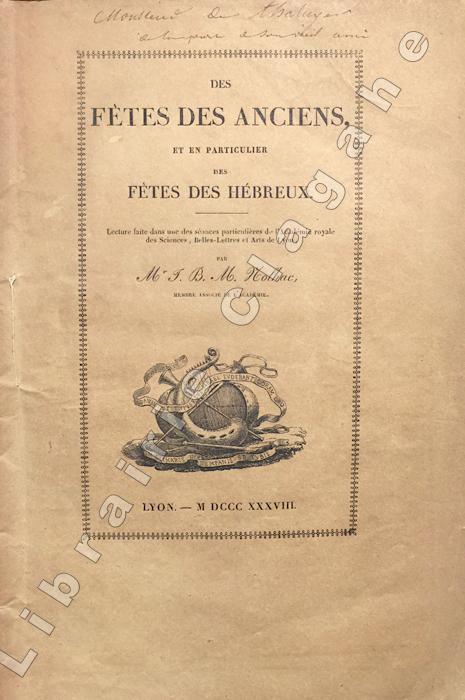
18389562Lyon, Imprimerie typographique et lithographique de Louis Perrin, 1838 ; in-8, broché ; 44 pp, couverture marron ornée.
8vo, br. ed. pp.448.
8vo, br. ed. 186pp. Les Khazars : une énigme historique de la taille d'un empire disparu qui aurait duré du VIIe au XIe siècle de notre ère et qui s'étendait entre la mer Caspienne et la mer Noire, de la Volga à la chaîne du Caucase, au croisement des grandes routes commerciales et des zones d'influence des trois spiritualités chrétienne, juive et musulmane. Comment retracer l'histoire de ce peuple cavalier d'origine turco-mongole ? Pourquoi les Khazars se sont-ils convertis massivement au judaïsme ? Pourquoi leur empire s'est-il écroulé ? Pourquoi ont-ils été si longtemps oubliés ? Et pourquoi, d'Arthur Koestler à Marek Halter, font-ils rêver ? Voilà les questions auxquelles tente de répondre cet ouvrage, mettant à contribution spécialistes et passionnés de la Russie.
In 8°,pp. XVI,603,(7). Tela editoriale con sovracoperta figurata. Copia in buono stato. Collana di studi religiosi. problema delle origini della Kabbalà, forma della mistica e della teosofia ebraica che sembra sorgere a un tratto nel secolo XIII, è uno dei più complessi e importanti nella storia religiosa dell'ebraismo dopo la distruzione del Tempio. Il volume sintetizza i risultati di oltre quarant'anni di lavoro. Le accurate e sistematiche ricerche compiute dall'autore sui manoscritti del periodo arcaico non solo dissipano diffidenze troppo a lungo diffuse per pregiudizio razionalistico o entusiasmo romantico, ma rinnovano completamente gli studi sul movimento. L'approfondito lavoro filologico e storico-critico condotto sulle fonti ha consentito di rilevare che il "Séfer Bahir" - testo fondamentale della Kabbalà prima dello "Zòhar" (fine del XIII secolo) - è redatto su materiali più antichi, tutti con caratteristiche gnostiche. Proprio attraverso il "Bahir", il pensiero gnostico mitopoietico ha fatto la sua ricomparsa all'interno del giudaismo e ha caratterizzato per secoli quella che oggi, grazie agli studi di Scholem, può essere definita, religiosamente e culturalmente, la corrente più vitale e originale del giudaismo. In antitesi a studi precedenti, l'autore sottolinea inoltre che la Kabbalà è nata da bisogni religiosi interni al giudaismo e non da apporti culturali esterni. In questo senso è espressione genuina e profonda dell'anima ebraica e differisce in modo sostanziale dalla filosofia, nella quale l'apporto greco e arabo è stato invece determinante.
8vo, br, ed. xxv + 641pp., map, index, Account of living through the 'Antisemitic Factory' of Bucharest in the 30s and WWII through the diary of a young Jewish writer.
8vo, tela ed. in sovracoperta. pp.451. esaurito fuori catalogo. firma di app. altrimenti ottimo.