445 résultats
Da questo libro autobiografico in cui Jona Oberski descrive la sua tragica esperienza di bambino ebreo deportato insieme ai genitori in un campo di concentramento, il regista Roberto Faenza ha tratto nel 1993 il film: Jona che visse nella balena. Volume N. 22 appartenente alla Collana: Schulim Vogelmann. In 16mo (cm. 19,9); brossura originale con titoli al piatto e al dorso; pp. 119
1713AUB-9256A Amsterdam chez les Frères Chatelain 1713. Bon exemplaire relié, dos à 5 nerfs avec dorures et titres dorés, pet in-8 (17x11), LXXIV + 379 page + table + errata + planches.
8vo, Hardcover in dj, pp.624. . 16.46 x 24.18 cm. escribes how Judaism has been viewed as a dangerous force to be opposed, criticized, attacked and eliminated for centuries, from the Romans' destruction of the Second Temple, through the Inquisition and up to the Holocaust. Questions of how we are Jewish and, more critically, how and why we are not have been churning within the Western imagination throughout its history. Ancient Egyptians, Greeks, and Romans; Christians and Muslims of every period; even the secularists of modernity have used Judaism in constructing their visions of the world. The thrust of this tradition construes Judaism as an opposition, a danger often from within, to be criticized, attacked, and eliminated.
Octavo, glossy paper covers, viii, 406 pp., notes on contributors, index Introduction by the editors. Articles are "The Origins of Anti-Semitism: Ancient Evidence and Modern Interpretations," Nicholas de Lange, "The Lamb and the Scapegoat: The Dehumanization of the Jews in Medieval Propaganda Imagery," Moshe lazar, "Traditional Prejudice and Reigious Reform: The Theological and Historical Foundations of Luther's Anti-Judaism," Jeremy Cohen, "Responses to Anti-Semitism in Midrashic Literature," Pinchas Hacohen Peli, "Jews as Magicians in Reformation Germany," R. Po-chia Hsia, "Stepping Out: The Writing of Difference in Rahel Varnhagen's Letters," Liliane Weissberg, Dualistic Thinking and the Rise of Ontological Antisemitism in Nineteenth-Century Germany: from Schiller's Franz Moor to Wilhelm Raabe's Moses Freudenstein," Walter H. Sokel, 'The Theme of Anti-Semitism in the Work of Austrian Jews," Ruth Kluger, "The Modern Charcater of Nienteenth-Century Russian Antisemitism," Alexander Orbach, Antisemtiism in Crisis Times on the United States: The 1920s and 1930s," Leonard Dinnerstein, "1918 and After: The Role of Racial Antisemitism in the Nazi Analysis of the Weimar Republic," Katz, "anti-semitism and the Killing of Latvia's Jews," Andrew Ezergailis, "The Rhetoric of Anti-Semitism in Postwar American Literature," Guy Stern, "Jewish Writers in Contemporary Germany: The Dead Author Speaks," Gilman, "The Arab World Discovers Anti-Semitism," Bernard Lewis, "The Jews of Iran: Between Shah and Khomeini," David Menashri, "German Reunification and the Jews," Gilman.
New English Paperback. Pbo. Demy 8vo. (21 x 13,5 cm). In English. 418 p. The official line that successive Turkish regimes have frequently repeated and which has firmly established itself in both Turkish and foreign public opinion is that the Republic of Turkey is one of those rare countries in which antisemitism has never taken root, and in which Jews have thus lived for centuries within a tolerant atmosphere of peace and tranquility, but it simply isn't true. Along with antisemitism are the conspiracy theories in which the "Jew" or the "Zionist" feature as the main actors that are widely seen throughout Turkish society. In fact, this state of affairs is not only pervasive but has even become "normal" to the point of banality, so much so that it tends to draw no reaction from either the country's intellectuals or politicians. This book contains a collection of author's published articles on the subject-a subject that has received no serious treatment in Turkey, and as such attempts to fill the gaping hole in our knowledge of this widespread yet rarely discussed phenomenon and, as such, stands as an indispensible source for those interested in Turkey and antisemitism.
8vo, br con sovracoperta. illuminismo questione ebraica rivoluzione francese, testo del 1789
8vo, br. ed. 463pp. L'amicizia fra Benjamin e Scholem spicca, nel Novecento, come una tra le più affascinanti e vitali. E quando nel 1980 Scholem pubblica questo carteggio, che copre gli ultimi otto anni della vita di Benjamin, vuole rendere giustizia a un rapporto complesso e non privo di contrasti, ma improntato a una profonda fedeltà. Grande studioso della Qabbalah e della mistica ebraica, Scholem è, nel 1932, già da tempo in Palestina e ormai a un passo dalla cattedra; la vita di Benjamin, cabbalista in incognito e profondo innovatore del pensiero, attraversa invece la sua fase più tormentata: ospite di volta in volta a Ibiza, Parigi, Sanremo e in Danimarca, è costantemente alla ricerca di una base di sussistenza. Tra i due, fortemente segnati dalla formazione nella Berlino di inizio secolo e subito attratti dalle ricerche l'uno dell'altro, si sviluppa un confronto incessante che investe l'attualità politica, i libri letti, le comuni conoscenze (da Buber a Bloch, da Brecht ai francofortesi), e che trova il suo fulcro nei densissimi scambi a proposito di Kafka. Un dialogo a distanza - se si esclude il breve incontro parigino dell'inverno del 1938 - e non di rado drammatico, intessuto com'è anche di malintesi, puntute allusioni, eloquenti silenzi, ma che resta una prova convincente delle parole con cui Benjamin definì il suo rapporto con Scholem: «fra Gerhard e me le cose stanno così: ci siamo persuasi a vicenda».
New English Paperback. Pbo. Roy. 8vo. (24 x 17 cm). In French. [vii], 33, [35] p. Balat: Faubourg Juif d'Istanbul.
1973LFA-126724377Un ouvrage de 132 pages, format 160 x 235 mm, broché, publié en 1973, Deutsche Bibelstiftung Stuttgart, bon état
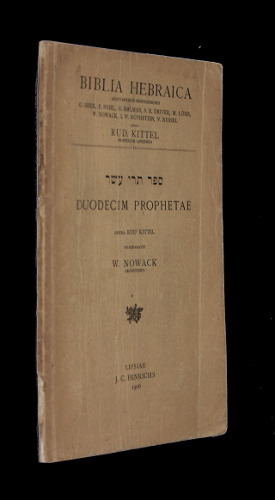
1906gm482Hinrichs J. C. Biblia Hebraica Broché 1906 In-8 -14.5x22.5 cm), broché, 831 à 907 pages, de droite à gauche, Biblia hebraica n°10 : Duodecim prophetae ; coiffes et dos frottés, manque de 3 cm au dos, assez bon état. Livraison a domicile (La Poste) ou en Mondial Relay sur simple demande.
1909gm206Hinrichs J. C. Biblia Hebraica Broché 1909 In-8 -14.5x22.5 cm), broché, 1161 à 1221 pages, de droite à gauche, Biblia hebraica n°14 : Libri Danielis esrae et Nehemiae, ouvrage en hébreu ; coiffes et dos frottés, rares annotations, assez bon état. Livraison a domicile (La Poste) ou en Mondial Relay sur simple demande.
First edition. Tall octavo, viii + 402 pp. Bound in black and gray boards. Photographs on inner front cover and front free fly and back cover and back free fly. Glossary. Notes on sources. Selected bibliography. Photograph credits. Index
8vo, br. ed. in italiano.
8vo. Original full dark blue cloth binding, 371pp. 7 full page plates.
12406Montrouge, La Marbrerie de Bagneux, 1985, 1 br., couverture illustrée. in-12 de 48 pp., plans, texte en hébreux avec la traduction française en regard ;
8vo - over 7¾" - 9¾" tall. "Containing the structure, growth and preservation of the Bible, introductions to the several books with summaries of the contents, history and chronology, indexes, a concordance and maps of places" 746pp 8 double page coloured maps rear of book
20251Lugduni Batavorum ( Leyde ) Apud Samuelem et Johannem Luchtmans 1764 in 4 (27x21,5) 1 volume reliure plein cartonnage ancien, étiquette de titre manuscrite au dos, page de titre, 9 faux-feuillets non chiffrés, 300 pages, avec 18 tableaux dépliants in fine. Bon exemplaire ( Photographies sur demande / We can send pictures of this book on simple request )
Grey cloth, very good, dj., 5 maps 184+226+211p., 98 b.w. photos, illustrations, second edition ( three vols. reprinted-in-one) with new introd. by Cecil Roth, Index, bibliography, appendix. reprint of secondo edition ( Toronto 1942 First). both original editions and reprint scarce . . The most important book on the subject. Living among the Chinese for over a thousand years, the Jews of Kai Feng survived until very recently. The definitive work on the Jews in China by a christian missionary. Based on Inscriptional tablets, genealogical charts, ancient historical and philosophical writings, and the peculiar manuscripts written both in chinese and hebrew .
2004161136Peabody, Mass.: Hendrickson 2004. XVI, 555 Seiten. Gr. 8° (22,5-25 cm). Solider Orig.-Leinenband mit goldgeprägten Titeln auf schwarzem und grünem Rückenschild / Solid Original cloth binding with gold-embossed titles on black and green spine label. [Hardcover / fest gebunden].
8vo, rilegat. ed. sovracoperta, cofanetto. 510pp. «La letteratura dei palazzi, o Hekalot, come si chiamano in ebraico, è antica, misteriosa, difficile. Mette soggezione anche al lettore esperto, abituato a vedersela con i testi astrusi della qabbalah, la sapienza segreta del giudaismo, che si è forgiata tra il XIII e il XVI secolo. Per quanto siano complesse le allegorie dei mistici medievali e della prima età moderna, questi palazzi a perpendicolo su dirupi di luce rimangono una meta proibitiva, quasi irraggiungibile. La letteratura degli Hekalot precede la qabbalah. La precede nel tempo, giacché comincia a costituirsi nei primi secoli dell'età volgare, e la precede nell'ordine mentale e nell'immaginario collettivo. Chi giunge alle dimore divine, e riesce a penetrarvi, entra in un'aristocrazia sapienziale, invidiata e ambita. Il percorso è pericoloso. Alle porte degli edifici superni vigilano guardiani scorbutici e maneschi. Bisogna saperli prendere con le buone, ingraziarseli, oppure aggirarli ricorrendo a qualche aiuto altolocato. Ma non è solo l'itinerario difficile a respingere molti, o forse quasi tutti. Il problema, con cui si scontrava l'adepto in età antica, e che ancora oggi scoraggia più di un lettore, è capire il perché di tanta fatica. Cosa si trova in cielo? Beninteso, non nel cielo volgare dei nostri viaggi intercontinentali. Quello che qui importa è il cielo incontaminato della sapienza primordiale. Il cielo abitato da Dio e dalla sua corte celeste. Il cielo affollato di angeli, protetto da mura altissime di tizzoni accesi, a un tempo percorso da melodie dolcissime e scosso da paurosi boati. Cosa c'è da vedere, cosa c'è da sapere? Questo è l'argomento del nostro libro. Le pagine che seguono sono una risposta alla domanda che, da sempre, s'è fatta a chi torna. Cos'hai visto? Ne valeva la pena? Cosa c'è "là"»? (dall'Introduzione)
8vo, br. ed. 288 pages. 8.98x5.91x0.87 inches.]Old Odessa, on the Black Sea, gained notoriety as a legendary city of Jewish gangsters and swindlers, a frontier boomtown mythologized for the adventurers, criminals, and merrymakers who flocked there to seek easy wealth and lead lives of debauchery and excess. Odessa is also famed for the brand of Jewish humor brought there in the 19th century from the shtetls of Eastern Europe and that flourished throughout Soviet times. From a broad historical perspective, Jarrod Tanny examines the hybrid Judeo-Russian culture that emerged in Odessa in the 19th century and persisted through the Soviet era and beyond. The book shows how the art of eminent Soviet-era figures such as Isaac Babel, Il'ia Ilf, Evgenii Petrov, and Leonid Utesov grew out of the Odessa Russian-Jewish culture into which they were born and which shaped their lives.
1948GIT00947Paris Commission Intersyndicale Juive auprès de la CGT 1948. In-8 broché 277 XLIIIpp. Nombreux portraits dans le texte.
jj4008Editions l'Arche du Livre Cartonnage d'éditeur In-8° cartonnage d'éditeur, 494 pp., erratum inséré dans le volume, sans date ; cartonnage légèrement frotté, très bon état Livraison a domicile (La Poste) ou en Mondial Relay sur simple demande.
8vo, br. ed. pp.301. In the wake of modern genocide, we tend to think of violence against minorities as a sign of intolerance, or, even worse, a prelude to extermination. Violence in the Middle Ages, however, functioned differently, according to David Nirenberg. In this provocative book, he focuses on specific attacks against minorities in fourteenth-century France and the Crown of Aragon (Aragon, Catalonia, and Valencia). He argues that these attacks--ranging from massacres to verbal assaults against Jews, Muslims, lepers, and prostitutes--were often perpetrated not by irrational masses laboring under inherited ideologies and prejudices, but by groups that manipulated and reshaped the available discourses on minorities. Nirenberg shows that their use of violence expressed complex beliefs about topics as diverse as divine history, kinship, sex, money, and disease, and that their actions were frequently contested by competing groups within their own society. Nirenberg's readings of archival and literary sources demonstrates how violence set the terms and limits of coexistence for medieval minorities. The particular and contingent nature of this coexistence is underscored by the book's juxtapositions--some systematic (for example, that of the Crown of Aragon with France, Jew with Muslim, medieval with modern), and some suggestive (such as African ritual rebellion with Catalan riots). Throughout, the book questions the applicability of dichotomies like tolerance versus intolerance to the Middle Ages, and suggests the limitations of those analyses that look for the origins of modern European persecutory violence in the medieval past.
8vo, 271pp . good and evil in religions, Egypt, Mesopotamia and India, through Iranian and Jewish prophets, to early Christian beliefs.