611 résultats
1726GITg317A Toulon chez la Veuve de Pierre Loüis Mallard 1726. Petit in-12 1 feuillet non chiffré (titre) 3-336pp. Pleine basane havane mouchetée, dos à nerfs muet, reliure de l'époque. Papier très légèrement bruni, coupure sans manque (4,5cm) page 297. Exemplaire bien complet, reliure muette solide.
173348288ABLyon, Petrus Valfray 1733. 8°. XX, 910 S., [24] Bl. (das letzte leer). Leder der Zeit auf 5 Bünden mit reicher Rückenvergoldung und rotem Rückenschild. Berieben, die Kanten bestoßen. Titel mit Randbeschädigungen (Ausrisse), geringf. Buchstabenverlust (ein Buchstabe). Name am Titel. Etwas gebräunt. [2 Warenabbildungen]
176845203ABAntwerpen, ex Architypographia Plantiniana 1768. Gr.-12° [18] Bll., 664, CCXXXVI, (4), 11, 65-128 S. Leder der Zeit mit 5 imitierten Bünden, Rückenvergoldung, Deckelfileten, Deckel-Eckfleurons, Goldschnitt. Insgesamt etwas berieben, Ecken und Kanten teils etwas stärker, eine Ecke bestoßen. Vergoldung verblaßt. Vorderes Innengelenk und Titelblatt etwas gelockert. Teils etwas gebräunt oder leicht braunfleckig, der Kopfsteg stellenweise geringf. wassserrandig. Vorsatz etwas stockfleckig. Name am Vorsatz. 4 Bll. mit kl. Randeinrissen und etwas angerändert. Der letzte Teil mit einigen hs. Anmerkungen von alter Hd.
172416349Roma, Typis Reu. Cam. Apostolicae (Stamperia della reveranda Camera apostolica), 1724 ; in-4 ; vélin ivoire de l’époque, titre manuscrit au dos ; (2) ff. d’Index. Suivi par : Compendio delle cose principali Contenute nel Ceremoniale di Gregorio XV. De electione Romani Pontificis. Per facilitare alli Signori Cardinali il nuovo modo di elegere il Papa, e per istruttione delli Maestri di Ceremonie. Roma, nella Stamperia della Reu. Cam. Apost., 1724 ; (6) ff. y compris le titre séparé, 11 pp., (1 bl.) ; (10) ff.: Riforma delle Spese solite farsi in tempo di Sede Vacante, e per il Conclave. Vignette sur bois identique aux deux titres, aux armes du Vatican.
1758B.C5.C512Editions de la Porte Verte, Fac-similé du Codex Parisiensis de 1758, cxxxij +320 pages.
17195981BBLeipzig, Johannes Gross, 1719. 8°. (1) Bl., (28) S. (Titels., a3-b5), 882, (60) S. Mit 1 doppelblattgr. Holzschnitt-Frontispiz. Pergamentbd. d. Zt. mit goldgepr. Rückenschild + Wichtig: Für unsere Kunden in der EU erfolgt der Versand alle 14 Tage verzollt ab Deutschland / Postbank-Konto in Deutschland vorhanden +, 5981B (leicht fleckig).
175935663BBAmstelaedami, apud Franciscum Houttuyn, MDCCLIX. [1759]. 2 Teile in einem Band. 8°. XVI, 347/640 S. + Index, 6 Kupferstiche. Goldgeprägter Pergamenteinband. Avers und Revers Amsterdamer Wappen, Einband mit kleinen Flecken, ansonsten sehr schön und sauber erhalten.
178941423ABBiponti [Zweibrücken], ex Typographia Societatis 1789. [Titel], XLV, 354 S., [32] Bll. HLdr des 19. Jhdts mit schwarzem Rückenschild. Etwas berieben. Schwach stockfleckig. Anmerkungen (Bleistift).
1738P2-7B-7Paris, aux dépens des Libraires associés pour les Usages du Diocèse, 1738. In-8 (170x100mm)., relié plein maroquin vert. Dos et plats richement ornés, pièce de titre. Très bel exemplaire. RELIURE STYLE DEROME LE JEUNE. 8vo (170x100mm), contemporary full green morocco. Profusely tooled in gold. Large crowned and gilt monogram surrounded by broad gilt dentelles on upper and lower covers. Dentelles with stamps off shells and flowers. Spine likewise richly gilt in 6 compartments. Tittle label with gilt lettering. Nice set.
1737LCI-6429Lyon, Fratres deville 1737 1 in -4 plein cuir 1144 [p.p] Le dictionnaire de référence pour l'étude du latin sous l'Ancien Régime, spécialement conçu pour l'instruction du Dauphin. Cette édition lyonnaise de 1737 est un monument de la lexicographie franco-latine. La solidité de la reliure et la clarté de l'impression témoignent du soin apporté à ces outils de savoir destinés à traverser les siècles.
17807625BBEinsiedeln, s.n., 1780. 8°. 160, 89 S. Kalbleder d. Zt. mit rotem R'schildchen. + Wichtig: Für unsere Kunden in der EU erfolgt der Versand alle 14 Tage verzollt ab Deutschland / Postbank-Konto in Deutschland vorhanden +, A|B 2 Bde. in 1. [2 Warenabbildungen]
1712001633Paris Antoine Dezallier 1712
173142483ABAntwerpen, Plantin 1731. 8°. [24] Bll., 741, (27) S. Ganzleder-Band der Zeit mit 5 angedeuteten Bünden, reicher Rücken-, Deckel- und Kantenvergoldung, Goldschnitt mit Punze. Kantenvergoldung etwas verblaßt, wenige Bll. im Fuß sachgerecht verstärkt, ein Bl. mit minimalem Buchstabenverlust. Eine Ecke durchgerieben.
17477570BBVenedig, Nicolo Pezzana, 1747. 2°. Bd. 1: Titel mit grosser gest. Vignette, gest. Frontispiz, gest. Kopfstück (von Francesco Zucchi), (18) Bl., 335 S. (recte 670); Bd. 2: VIII S. (1) S. Inhalt, 295 S. (recte 590), S. 296-32, S. 228-337 (recte 218), S. 338-369, S. 370-404 (recte 70), S. 404-474; Bd.3: VIII S., (1) S. Inhalt, 499 S. (recte 998); Bd. 4: Titel: Novum Jesu Christi Testamentum complectens praeter Vulgatam, Guidonis Fabrici è Syriaco, et Benedicti Ariae Montani translationes, insuper Desiderii Erasmis Roterodami auctoris damnati versionem permissam. XV S., 326 S. (recte 652). Halbpgt. d. Zt., rote und grüne Rückenschildchen, mit einfacher Goldprägung. + Wichtig: Für unsere Kunden in der EU erfolgt der Versand alle 14 Tage verzollt ab Deutschland / Postbank-Konto in Deutschland vorhanden + 4 Bde.
178140609ABVenedig, Antonius Astolphus 1781. 8°. 440 S. Pgmt der Zt mit Rückentitel. Einband etwas altersfleckig, Rückentitel verblaßt, oberes Kapital geringf. gestaucht. Die ersten Bll. schwach wasserrandig, teils geringf. (braun)-fleckig. Kl. 'kalligraphische' Versuche am Titel, letzte S. mit Anmerkungen (alles von alter Hd).
174236337ABFrankfurt an der Oder, bei Joh. G. Conradi [Druck: Hübner] 1742-43. Kl.-4°. [4] Bll., 191, (1 leere) S., [4] Bll., 195-377 S. Spätere schlichte HLwd. Kanten stärker berieben, kl. Loch am vord. Deckel; teils geringf. gebräut; einige Marginalien von alter Hd.
171048537Hauniae, (København), H.C. Paulli, 1710. 4to. Contemp. full calf. Blindtooled lettering to spine. Raised bands. Spine a little rubbed.Engraved frontispiece. (16),548 pp. + Index. A few scattered brownspots. The copy has belonged to the former Danish Minister of Foreign Affairs Holger Christian Reedtz (1800-1857).
171050853Hauniae, (København), H.C. Paulli, 1710. 4to. Contemp. full vellum. handwritten title on spine. Engraved frontispiece. (16),548 pp. + Index. Internally clean and fine.
171050858Hauniae, (København), H.C. Paulli, 1710. 4to. Contemp. full calf. Raised bands. Richly gilt spine. Title stamped in blind. Engraved frontispiece. (16),548 pp. + Index. Internally clean and fine.
171055541Hauniae, (København), H.C. Paulli, 1710. 4to. Pragtfuldt samtidigt helpergamentsbind med overdådig rygforgyldning og forgyldt skindtitel. Permer indfarvet i marmormønster. Rødt snit. Kobberstukket frontispiece. (16),548 pp. + Index. Frisk, velbevaret.
1752119641752 Bourges, chez la veuve de Jacques Boyer, 1752; fort in-12° de (2) ff. - XI - 560pp.; plein veau brun granité, dos lisse, filets et petits fers dorés, titre doré, tranches mouchetées de rouge. Texte sur 2 colonnes, latin en regard du français. Ex-libris manuscrit au titre " Thérèse Zévort à Bourges".
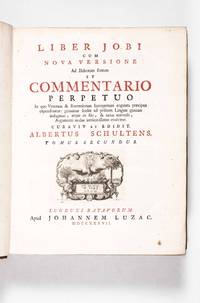
173749261Leiden: Jean Luzac 1737. First edition. Two volumes large quarto. 52 544; 2 545-1232 63 indices 1 corrigendapp. Text in two columns with Hebrew text and facing Latin translation interspersed with commentary. Titles in red and black with engraved vignettes. Contemporary speckled calf; gilt-tooled spine with raised bands and morocco lettering pieces; gilt dentelles; edges daubed in red and green. Light scuffing to boards and fading to spines. A very good set with crisp clean text throughout.<br /> <br /> First edition of this comprehensive commentary to the biblical Book of Job by the Dutch scholar of Semitic languages Albert Schultens 1686-1750 who maintained "that the true nature of the Hebrew language and the meaning of many of its words and idioms are to be found chiefly in the Arabic" Orme. Fifty-five pages of the indices constitute a brief lexicon and provide Latin as well as Arabic equivalents for more than 1000 Hebrew words. Schultens studied theology and eastern languages at Groningen where he received his degree in theology in 1709. After a brief career as a preacher in Wassenaar he was nominated professor of Hebrew and Jewish antiquities at Franeker in 1713. In 1729 he decamped for Leiden were he was first appointed reader in eastern languages and finally full professor in 1732.<br /> <br /> At this time a chief concern of Calvinist theologians was to liberate Old Testament exegesis from the Jewish Rabbinic as well as Catholic traditions. Schultens' influential and controversial solution was revealed as early as 1706 in his first public thesis Disputatio theologico philologica de utilitate linguae Arabicae in interpretanda S. Scriptura A Theologico-Philosophical Dissertation on the Utility of the Arabic Language for the Interpretation of the Holy Scriptures "a forceful attack" Brugman & Schröder on the Protestant sola scriptura methodology of Biblical exegesis. "With the help of Jacobus Golius' Arabic dictionary he perused with zeal and fervour the Old Testament and wrote prolifically. The lexical superiority of Arabic had led him to a reconsideration of the position of Hebrew: at first he had called Arabic 'the most splendid daughter of mother Hebrew' but in his oration of 1729 he proclaimed Hebrew and Arabic cognate twin sisters. This shocked conservative theologians as an outright profanation of God's Word" Brugman & Schröder. "In 1737 he applied his theories in his bilingual edition of the book of the prophet Job whom he regarded as an Arab. The Hebrew text and the Latin translation are all but totally submerged by the extensive commentary in which Schultens draws abundantly on Arabic texts such as the Hamasa an anthology of early Arabic poetry by the ninth-century poet Abu Tammam" Vrolijk & van Leeuwen. Schultens was not without his critics and by 1824 William Orme notes a turning of the tide: "Different opinions are entertained of the correctness of his views and also of his success in applying them; but it is now generally admitted that he carries his notions of the advantage of Arabic learning to the interpretation of the Scriptures too far." <br /> <br /> Jean Luzac 1728-1777 was a member of a well-known Huguenot family of printers; he published many works for the University of Leiden including three Hebrew books of Albert Schultens. Isaac van der Mijn is noted as the printer at the colophon of the second volume.<br /> <br /> Provenance: printed label of the Bibliotheca Seminarii Warmondani at the front endleaf of the first volume. Full title: Liber Jobi cum nova versione ad Hebraeum fontem et commentario perpetuo in quo Veterum et Recentiorum Interpretum cogitata præcipua expenduntur: genuinus sensus ad priscum Linguae genium indagatur atque ex filo et nexu universo Argumenti nodus intricatissimus evolvitur. Curavit et editit. Albertus Schultens. Tomus Primus. -Tomus Secundus<br /> <br /> References: J. Brugman & F. Schröder Arabic Studies in the Netherlands Leiden: E.J. Brill 1979 p.26f. Fuks/Fuks-Mansfeld 78. Orme Bibl. Biblica p. 390. A. Vrolijk & R. van Leeuwen Arabic Studies in the Netherlands a Short History in Portraits 1580-1950 Leiden: E.J. Brill 2014 pp. 73-79. Jean Luzac unknown
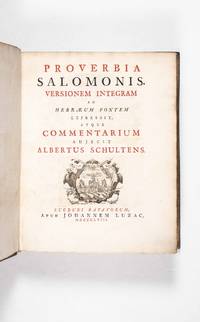
174849255Leiden: Jean Luzac 1748. First edition. Hardcover. Very Good. Quarto. 8 cviii 522 60 indices & corrigendapp. Text in two columns with Hebrew text and facing Latin translation interspersed with commentary. Title in red and black with engraved vignette; woodcut ornaments. Contemporary Dutch paneled vellum with blind-stamped vignettes and ruled borders; manuscript title at spine. Covers lightly soiled. Occasional touches of soiling and some leaves with mild embrowning. A very good copy generally crisp and clean.<br /> <br /> First edition of this comprehensive commentary to the biblical Book of Proverbs by the Dutch semitic language scholar Albert Schultens 1686-1750 who maintained "that the true nature of the Hebrew language and the meaning of many of its words and idioms are to be found chiefly in the Arabic" Orme. Forty-one pages of the indices constitute a brief lexicon and provide Latin as well as Arabic equivalents for more than 1000 Hebrew words. Schultens studied theology and eastern languages at Groningen where he received his degree in theology in 1709. After a brief career as a preacher in Wassenaar he was nominated professor of Hebrew and Jewish antiquities at Franeker in 1713. In 1729 he decamped for Leiden were he was first appointed reader in eastern languages and finally full professor in 1732.<br /> <br /> At this time a chief concern of Calvinist theologians was to liberate Old Testament exegesis from Jewish Rabbinic as well as Catholic traditions. Schultens' influential and controversial solution was revealed as early as 1706 in his first public thesis Disputatio theologico philologica de utilitate linguae Arabicae in interpretanda S. Scriptura A Theologico-Philosophical Dissertation on the Utility of the Arabic Language for the Interpretation of the Holy Scriptures "a forceful attack" Brugman & Schröder on the Protestant sola scriptura methodology of Biblical exegesis. "With the help of Jacobus Golius' Arabic dictionary he perused with zeal and fervour the Old Testament and wrote prolifically. The lexical superiority of Arabic had led him to a reconsideration of the position of Hebrew: at first he had called Arabic 'the most splendid daughter of mother Hebrew' but in his oration of 1729 he proclaimed Hebrew and Arabic cognate twin sisters. This shocked conservative theologians as an outright profanation of God's Word" Brugman & Schröder. <br /> <br /> Like his earlier commentary on the Biblical Book of Job one here finds that the "Hebrew text and the Latin translation are all but totally submerged by the extensive commentary in which Schultens draws abundantly on Arabic texts such as the Hamasa an anthology of early Arabic poetry by the ninth-century poet Abu Tammam" Vrolijk & van Leeuwen. Schultens was not without his critics and by 1824 William Orme notes a turning of the tide: "Different opinions are entertained of the correctness of his views and also of his success in applying them; but it is now generally admitted that he carries his notions of the advantage of Arabic learning to the interpretation of the Scriptures too far." <br /> <br /> Jean Luzac 1728-1777 was a member of a well-known Huguenot family of printers; he published many works for the University of Leiden including three Hebrew books of Albert Schultens. Isaac van der Mijn is noted as the printer at the colophon of the second volume.<br /> <br /> Provenance: bookplate of the Crozer Theological Seminary - Bucknell Library; bookseller's ticket of Librairie Ancienne et Moderne de Frederik Muller Amsterdam at the front paste-down. References: J. Brugman & F. Schröder Arabic Studies in the Netherlands Leiden: E.J. Brill 1979 p.26f. Fuks/Fuks-Mansfeld 78. Orme Bibl. Biblica p. 390. A. Vrolijk & R. van Leeuwen Arabic Studies in the Netherlands a Short History in Portraits 1580-1950 Leiden: E.J. Brill 2014 pp. 73-79. Jean Luzac hardcover
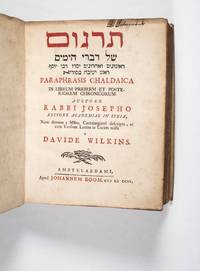
171549239Amsterdam: Jan Boom 1715. First edition. Hardcover. Very Good. Small quarto. asterisk4 a-f4 -blank f4 A-3F4 = 235 leaves. 54 415 1 blankpp. Contemporary vellum with exposed thongs boards somewhat bowed spine darkened early manuscript title in Hebrew and Latin at spine. Old owner entry at top margin title memorial label at front paste-down. A very good copy amply-margined with fine crisp text throughout.<br /> <br /> Important edition of this Aramaic version of the biblical books of Chronicles attributed to Joseph ben Hiyya d. 333 a Babylonian amora and head of the Pumbedita academy near present-day Falluja Iraq. "Ben Hiyya was also distinguished in biblical exegesis and left an Aramaic translation of parts of the Bible which is often quoted. It is not to be assumed however that Joseph translated the whole Bible though the Aramaic translation of the Books of Chronicles is ascribed to him. Enc. Jud. The editio princeps edited from an Erfurt manuscript by Matthias Frederick Beck and accompanied by substantial annotations was published at Augsburg in 1680. "After this David Wilkins gave the public an edition from a Cambridge manuscript of which the text was more pure and more complete. The critic should unite both these editions the former for the value of its learned notes and the latter for its full and accurate text†The Biblical Repertory. <br /> <br /> The Coptic scholar David Wilkens 1685–1745 was born of Prussian parentage in Memel Lithuania. Little is known about his education in Germany probably in Berlin or how he acquired his knowledge of ancient and Semitic languages which was extensive rather than profound. He referred to the antiquarian Ezechiel Spanheim the elector of Brandenburg's ambassador in England from 1701 to 1710 as his former teacher. By 1707 Wilkins was studying at the Bodleian Library in Oxford and had encountered a group of clerical protectors in London. In 1709 engaged in preparing a history of the patriarchs of Alexandria which remained in manuscript and the editio princeps of the Coptic Bohairic New Testament the Novum Testamentum Aegyptium 1716 he left for the continent. He called on scholars examined manuscripts in Vienna Rome and Paris and stopped in Amsterdam in 1714 to see to the publication of his first works -- an edition of the Aramaic paraphrasis of the books of Chronicles and an Armenian version of the apocryphal third epistle to the Corinthians 1715 -- and of John Chamberlayne's polyglot edition of the Lord's prayer to which he contributed. Wilkins was an industrious scholar. In the three years he spent as librarian at Lambeth he made important contributions to the cataloguing of manuscripts. In 1721 he edited the Anglo-Saxon laws in 1725–6 the complete works of John Selden and in 1731 the Coptic Pentateuch. His main work was his Concilia Magnae Britanniae et Hiberniae an account of British church councils from 446 to 1717. Wilkins had many detractors -- John Gagnier the professor of Arabic at Oxford who deplored his incompetence in Arabic and Hebrew Edward Harley who described him as ‘a very great scoundrel’ and the cantankerous Thomas Hearne who as librarian at the Bodleian had watched him turn from a young man ‘of a civil Courteous and modest behaviour’ into ‘a vain ambitious man of little judgement tho' great industry’ ready to ‘do anything in the World for a little Money’ Alastair Hamilton: "Wilkens David" -- ODNB online.<br /> <br /> Provenance: From the library of G.H.A. Juynboll 1935-2010 the celebrated scholar of Islamic Hadith literature with his printed memorial label at front paste-down. Hebrew title: ×ª×¨×’×•× ×©×œ דברי ×”×™×ž×™× ×¨××©×•× ×™× ×•××—×¨×•× ×™× ×™×¡×“×• ר×ש ישיבה בסורי×<br /> <br /> References: The Biblical Repertory 1834 6:248-249. Brunet 3:574 - "Livre recherché et peu commun". Enc. Jud. 10:229. Le Long Bibliotheca sacra 1723 1:92B. Le Long-Masch 2.1 p. 48: “Multo correctior est editio ac praecedens Beckiana.†long note in which the relation with the never published version by Clarke is discussed. Cf. D&M 2416: The editio princeps of the Targum on Chronicles printed from an Erfurt MS. and edited with a Latin translation by M. F. Beck Augsburg 1680-3 2 vols 4to. The present edition is “a more complete form of the text from a Cambridge MS. . edited with a Latin translation by D. Wilkins. Jan Boom hardcover
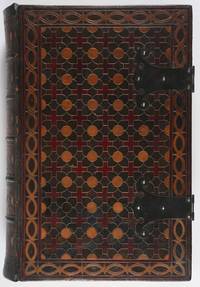
170153475Liege: Jean-François Broncart 1701. First edition thus. Hardcover. Very good. Two tomes each in two parts bound in one volume folio: 6 lxxix 1 blank 544; 1 title 1 blank 545-957 1 blank xx Cantique des cantiques 96 La sagesse; Ecclesiastique de Jesus fils de Sirach; 1 title 1 blank 468; 1 title 1 blank 430 16 Oratio Manassae; Liber Esdrae - tertius et quartus pp. Main titles for each tome in red and black; secondary titles in black only all four titles with engraved printer's device; each dated 1701. Text in two columns Latin and French. Illustrated with 6 engraved plates: frontispiece Johann Friederich Karg von Bebenburg; folding plate with 16 vignettes 4x4 depicting well-known biblical scenes; 4 folding maps The Holy Land; The Promised Land Apportioned by Tribe; Jerusalem in the Second Temple Era - after Lamy; The World Known to the Evangelists. Quarter-page engraved vignettes at the head of each of the 30 biblical books; historiated initials; printed marginalia. Exquisitely bound in the 19th century in levant morocco extra over wooden boards with mosaic compartments in crimson ochre; and dark brown bordered in fine gilt line; spine with raised bands lightly rubbed; pair of brass mounts finished in black with steel rivets at both covers clasps and catched perished. All edges gilt and elaborately gauffered in textured floral motif; gilt inner dentelles; decorative endleaves renewed in orange and black; crimson silk ribbon marker. The work of a master binder. Expertly repaired at spine caps. Occasional faint embrowning; marginal dampstains beginning in second half mostly at outer corners; expanding to fore-edge and darkening considerably in final 20 leaves. Overall a very good copy with crisp text throughout though incomplete: lacks Antoine Arnould's "Concorde des quatre Evangélistes" along with its accompanying Latin version and the concluding index.<br /> <br /> Amply margined copy of this sumptuous edition of the Bible comprising the Latin Sixto-clementine Vulgate and the Port-Royal French translation printed in parallel columns. Isaac-Louis Lemaistre de Sacy 1613-1684 was the principal translator of the French version which was edited and completed after his death by Pierre Thomas du Fossé 1634-1698 and Henri-Charles de Beaubrun 1655-1723 who also provide annotations throughout. According to Barbier the French controversialist Thierry de Viaixnes 1659-1735 who found himself often at odds with his superiors was the principal editor of the work; at the time of its preparation he was serving as director of an academy at Hautvilliers in the diocese of Rheims McClintock & Strong.<br /> <br /> Dedicated to Johann Friederich Karg von Bebenburg 1648-1719 whose signed portrait was drawn and engraved by C. Gustav of Amling. An advocate of maximal papal power Karg served as Privy Councilor of the Prince-Bishop of Bamberg and Würzburg Peter Philipp von Dernbach then of Elector Max Emanuel of Bavaria. He served as Dean of Our Lady in Munich and was entrusted by Emperor Leopold I with a legation to Pope Innocence XI. By these efforts he secured in 1688 the election of Prince Joseph Clemens of Bavaria as Archbishop of Cologne as a result of which he was made Chancellor and Minister of State here noted on the frontispiece.<br /> <br /> Provenance and annotations: Bookplate of Herman Blum Blumhaven Library & Gallery with his ticket below; two gilt-stamped ex-libris morocco labels: Henry W. Poor oval; Adolph Lewisohn octogonal. References: Darlow & Moule 3779; Deleveau & Hillard Bibles imprimées du XVe au XVIIe siècles conservées è Paris 605; ADB 15 1882 "Karg: Johann Friedrich; Jean-François Broncart hardcover