1 201 résultats
19269150Waltham St Lawrence: The Golden Cockerel Press 1926. Limited edition number 180 of 250 copies of a beautifully achieved piece of Biblical private press printing from the 1920s illustrated by Eric Gill. Cream buckram clean and fresh; pages unopened along top fold; gutter visible between pages 8 and 9; limitation statement numbered in black ink with cockerel emblem. A very good copy. Gill contributes two full page and four vignette illustrations. Initial letters printed in red. The jacket is chipped and worn fair only but has done an excellent job protecting the book itself. Please contact Christian White Rare Books Ltd for more information or images of this item 1926 The Golden Cockerel Press hardcover
1932CA02463 volumes. xxix-574 pages with 4 folding maps; 466 pages with folding coats of arms 6 folding native illustrations and map; 469 pages with 2 coats of arms one folding and 6 folding native illustrations. Royal octavo 9 1/2" x 7" bound in three quarter blue leather with raised spine bands and gilt lettering to spine. Introduction by Rafael Lopez. From the library of George Foster. Publicaciones del Archivo General de la Nacion volume XVII XVIII and XIX.<br /><br />There are only meager biographical data about Pablo de la Purísima Concepción Beaumont whose work is a major source on Michoacán. Despite its title "Chronicle of the Holy Apostles St Peter and St Paul of Michoacán" Beaumont's work in fact spans a much greater area including much of western Mexico northward to New Mexico and tending toward a general history. It provides details to 1565. Beaumont divided his total work into tow major parts the firs or Aparato intended to be introductory to the second or the Crónica proper. the first seems complete but the second was never finished. The Aparato takes up fully a third of the extant Beaumont work although nominally introductory. It deals with the discovery of America and the conquest of Mexico to the year 1521. It was twice published before appearance of the total work. Far more valuable is the Crónica. It consists of two books and one chapter of book 3. Beaumont drew on a wide variety of sources. He tell us us that he gathered a large quantity of manuscripts from various Franciscan archives as well as listing 30 standard writers in printed sources. He gives full copies of some of his documents of which several have since disappeared. He speaks of obtaining a native painting possibly from which his illustrations came. These paintings show incidents of the first visits of Spaniards to Michoacán there reception by Tarascans labors of the Franciscans coats of arms of principal cities of Michoacán. It is usually through that Beaumont composed his work around 1777. That is the last date in the later copies of the original manuscript. Unfortunately his original manuscript is lost. It was copied in Mexico City around 1792 to for volumes 7-11 of a 32 volume Collection of Memories on New Spain ordered by Viceroy Conde de Revilla Gigedo and compiled by Manuel de la Vega. Three partially complete sets of these Vega Memorias are known; from one or another of them come other recopied manuscript copies as well as the printed versions. Editions of the work have a somewhat unfortunate publishing history. In 1826 Bustamante published an incomplete and useless edition of the Aparato attributing it to Vega who had owned the manuscript Bustamante used. In 1873-74 a five volume edition of both Aparato and Crónica appeared in Mexico; it lacks the Indian drawings and was based on a secondary manuscript copy made b y J F Ramirez that then belonged to Alfredo Chavero. A three volume version was published by the National Archives of Mexico in 1932 based on their copy of the 1792 collection of Memorias; it contains the Indian drawings and an introduction by Rafael Lopez. The text seems slightly corrupt but it may be near the original as Beaumont said his Spanish was defective owing to his Parisian rearing.<br /><br />George McClelland Foster Jr born in Sioux Falls South Dakota on October 9 1913 died on May 18 2006 at his home in the hills above the campus of the University of California Berkeley where he served as a professor from 1953 to his retirement in 1979 when he became professor emeritus. His contributions to anthropological theory and practice still challenge us; in more than 300 publications his writings encompass a wide diversity of topics including acculturation long-term fieldwork peasant economies pottery making public health social structure symbolic systems technological change theories of illness and wellness humoral medicine in Latin America and worldview. The quantity quality and long-term value of his scholarly work led to his election to the National Academy of Sciences in 1976. Virtually all of his major publications have been reprinted and/or translated. Provenance from the executor of Foster's library laid in.<br /><br />Condition:<br /><br />Some underlining in pencil through out by Foster. Foster's date of acquire on front paste down early owner's name on front end paper. some light soiling and rubbing to extremities else a very good set.<br /><br /> Talleres Graficos de la Nacion hardcover
elala2742Venice: Apud Guerilios 1663. This Tridentine missal is of the third revision by Pope Urban VIII which first appeared in 1634. No further revision was undertaken until 1884 under Pope Leo XIII. This illustrations here include an engraved title by Giovanni Georgi and three full-page engravings of the Annunciation the Crucifixion by I.Pecini and the Ascension. Appended with separate title is ‘Missa S. Francisci Xaverii with with same imprint. Later material has been bound or tipped in here as is often the case: ‘Missae Propriae Sanctorum Tum De Praecepto tum ad Libitum; Iuxta recentiora Decreta Summorum Pontificum Emanatae’ Venice: Ex Typographia Balleoniana 1751 pp. 31 1 cropped ‘Missae Propriae Sanctorum Pro Diocesi Florentina’ Florence: 1745 pp. 4 and ‘In Festo Sancti Felicis A Cantalicio Confessoris’ Rome & Florence: 1739 pp. 2 indicating that the missal was used in Florence. Weale-Bohatta 1324n. folio. pp. 22 p.l. 491 lxxxv 3 8 4. 38 pages of related inserted matter at end. text in red & black in double columns. musical notation. additional engraved title & 3 full-page engravings. engraved title vignette. additions with separate titles with woodcut vignettes. 19th century panelled sheep in antique style with blind-stamped ornament in centre of covers bit worn pp. 239-40 repaired with missing text entered in ms. on ten lines. armorial bookplate of an Italian count Venice: Apud Guerilios, 1663 unknown
1868L3 box672 b9Oeuvres de Virgile; Traduction nouvelle accompagnee du texte Latin et precedee d'une notice biographique et litteraire. Quatrieme Edition. Tome 1 & Tome 2. Par Emile Pessonneaux. 1868 Charpentier Libraire-Editeur. Partial leather bound hardcover two volumes total 856 pages: 424 pp tome 1 432 pp tome 2. The books are in poor condition but no missing pages. Charpentier, Libraire-Editeur. hardcover
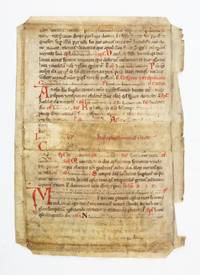
ST19350-013Germany early 13th century. 273 x 193 mm. 10 3/4 x 7 1/2". Single column 31 lines text in two sizes in a gothic hand. <br/> Rubrics in red several one- and two-line initials in red and two larger initials in red. A few lines with neumes later notations in the margins now quite faded. ◆Vellum a bit soiled and creased as expected fading to four or five lines where the spine was placed several notches along one edge other imperfections due to its reuse as binding scrap but still an excellent specimen that is almost entirely legible.<br/> <br/> Written in a neat and attractive hand this sizable leaf from a Missal remains mostly quite legible with all its rubrication intact despite having been used as part of a binding. A few lines also show musical notation from the earliest generation of neumes. They are described as "in campo aperto" which means literally "in an open field" because they and they alone occupy the space or "field" above the text. They are also described as adiastematic because they appear in a straight line whereas later diastematic neumes reflect changes in pitch by being placed in a higher or lower vertical position above the text. At the time the present leaf was written out the neumes here simply served as an "aide memoire" to the singer who had already learned the melody orally. unknown
17671232331767. Paris: Boudet Desaint et Avignon Merande 1767-1773. <br /> <br /> 17 vols 4to 33 engraved plates some folding 6 letterpress tables some folding. Contemporary/original mottled calf spines gilt and gilt-lettered. A bit dry and worn but quite sound.<br /> <br /> § A lovely quarto edition of the Bible in Latin and French also issued in 8vo -- this is much the more preferable version. The plates and maps are outstanding and the physical feat of printing all seventeen volumes in six years is astonishing. Complete sets in commerce are surprisingly scarce though widely held by institutions. Brunet I 888: "Ce livre connu sous le nom de Bible de Vence mais qui devrait plutôt porter celui de Rondet son éditeur est fort estimé." Not in Darlow and Moule under Latin or French. unknown
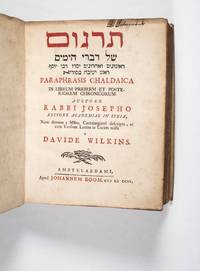
171549239Amsterdam: Jan Boom 1715. First edition. Hardcover. Very Good. Small quarto. asterisk4 a-f4 -blank f4 A-3F4 = 235 leaves. 54 415 1 blankpp. Contemporary vellum with exposed thongs boards somewhat bowed spine darkened early manuscript title in Hebrew and Latin at spine. Old owner entry at top margin title memorial label at front paste-down. A very good copy amply-margined with fine crisp text throughout.<br /> <br /> Important edition of this Aramaic version of the biblical books of Chronicles attributed to Joseph ben Hiyya d. 333 a Babylonian amora and head of the Pumbedita academy near present-day Falluja Iraq. "Ben Hiyya was also distinguished in biblical exegesis and left an Aramaic translation of parts of the Bible which is often quoted. It is not to be assumed however that Joseph translated the whole Bible though the Aramaic translation of the Books of Chronicles is ascribed to him. Enc. Jud. The editio princeps edited from an Erfurt manuscript by Matthias Frederick Beck and accompanied by substantial annotations was published at Augsburg in 1680. "After this David Wilkins gave the public an edition from a Cambridge manuscript of which the text was more pure and more complete. The critic should unite both these editions the former for the value of its learned notes and the latter for its full and accurate text†The Biblical Repertory. <br /> <br /> The Coptic scholar David Wilkens 1685–1745 was born of Prussian parentage in Memel Lithuania. Little is known about his education in Germany probably in Berlin or how he acquired his knowledge of ancient and Semitic languages which was extensive rather than profound. He referred to the antiquarian Ezechiel Spanheim the elector of Brandenburg's ambassador in England from 1701 to 1710 as his former teacher. By 1707 Wilkins was studying at the Bodleian Library in Oxford and had encountered a group of clerical protectors in London. In 1709 engaged in preparing a history of the patriarchs of Alexandria which remained in manuscript and the editio princeps of the Coptic Bohairic New Testament the Novum Testamentum Aegyptium 1716 he left for the continent. He called on scholars examined manuscripts in Vienna Rome and Paris and stopped in Amsterdam in 1714 to see to the publication of his first works -- an edition of the Aramaic paraphrasis of the books of Chronicles and an Armenian version of the apocryphal third epistle to the Corinthians 1715 -- and of John Chamberlayne's polyglot edition of the Lord's prayer to which he contributed. Wilkins was an industrious scholar. In the three years he spent as librarian at Lambeth he made important contributions to the cataloguing of manuscripts. In 1721 he edited the Anglo-Saxon laws in 1725–6 the complete works of John Selden and in 1731 the Coptic Pentateuch. His main work was his Concilia Magnae Britanniae et Hiberniae an account of British church councils from 446 to 1717. Wilkins had many detractors -- John Gagnier the professor of Arabic at Oxford who deplored his incompetence in Arabic and Hebrew Edward Harley who described him as ‘a very great scoundrel’ and the cantankerous Thomas Hearne who as librarian at the Bodleian had watched him turn from a young man ‘of a civil Courteous and modest behaviour’ into ‘a vain ambitious man of little judgement tho' great industry’ ready to ‘do anything in the World for a little Money’ Alastair Hamilton: "Wilkens David" -- ODNB online.<br /> <br /> Provenance: From the library of G.H.A. Juynboll 1935-2010 the celebrated scholar of Islamic Hadith literature with his printed memorial label at front paste-down. Hebrew title: ×ª×¨×’×•× ×©×œ דברי ×”×™×ž×™× ×¨××©×•× ×™× ×•××—×¨×•× ×™× ×™×¡×“×• ר×ש ישיבה בסורי×<br /> <br /> References: The Biblical Repertory 1834 6:248-249. Brunet 3:574 - "Livre recherché et peu commun". Enc. Jud. 10:229. Le Long Bibliotheca sacra 1723 1:92B. Le Long-Masch 2.1 p. 48: “Multo correctior est editio ac praecedens Beckiana.†long note in which the relation with the never published version by Clarke is discussed. Cf. D&M 2416: The editio princeps of the Targum on Chronicles printed from an Erfurt MS. and edited with a Latin translation by M. F. Beck Augsburg 1680-3 2 vols 4to. The present edition is “a more complete form of the text from a Cambridge MS. . edited with a Latin translation by D. Wilkins. Jan Boom hardcover
1720TTUocLIT5Paris: Dominican Convent & College of St. James c1720. 1720. 2 Parts in 1. 4to. pp. 1 p.l. 132 34; 1 p.l. 128. numerous manuscript additions incl. paste-overs 2 full-page additon in first part & 14 full-page addition in second part. engraved thoughout with vignette headpieces & decorative initials. music on 4-line staves. contemporary mottled calf gilt back spine damaged. ms. note: 'ce livre est a l'usage to ma soeur marie de sainte agnes'. Hardcover. Good. Paris: Dominican Convent & College of St. James, [c1720]. Hardcover
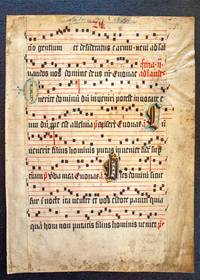
15166584Germany 15th or 16th century. Good. Manuscript leaf on vellum 290 x 400mm. Eight staves and eight lines of text on recto and verso. Seven elaborate polychrome decorated letters in blue black green and gold. Text in black with rubrication staves in red. Old inscription in upper margin of recto old pencil notes in lower margin. <br /><br />Single leaf extracted from an antiphonary. Main text is from Isaiah 55. Remarkable decorated initials in Gothic style. hardcover
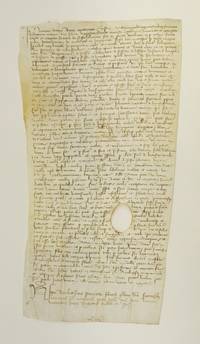
1429ST12778-0360Italy 1429. 323 x 173 mm. 12 3/4 x 6 3/4". Single column 60 lines in a neat cursive script. <br/> Notarial signature at lower left; verso with a date and notations in contemporary hands. ◆Vellum trimmed a little close four horizontal and three vertical fold creases slight darkening to verso five very small holes no text obscured and one larger naturally-occurring hole in the text otherwise in excellent condition with a very clear hand.<br/> <br/> This is a notarized document recording an agreement made between the chapel and convent i.e. the whole community of the house of St. John a group of female religious located in the parish of St. Peter and the brothers of Bonsignioribus another religious house in the parish of St. Laurence Major. The women of St. John agree to pay to the brothers of Bonsignioribus a sum of 11 libras 8 soldas and 9 denarios. The reason for this payment is unclear pending further investigation into some of the more abbreviated portions of the text. The document is of additional interest for the fact that several female members of the house of St. John are mentioned by name. Based on these names and that of the notary Ambrosius Spanzota . . . Parmensis it would appear that the document was written in Italy possibly in Parma and that the two houses were also located there. unknown
1755CA0114<p>24531 pages with engraved allegorical frontispiece and index. Small folio 11 1/2" x 8 1/2" bound in original full leather with raised spine bands and decorative gilt lettering. Palau 266572. Sabin 70785 First edition.<br /><br />Full of original documents respecting the establishment of the Church in the Indies and the protection of the Indians together with all the bulls referred to from that of Alexander VI to the time of publication. With the additional 24 preliminary leaves not in all printings.<br /><br />The ancestors of Rivadeneira on both sides had served the Crown for centuries in the Reconquista in high positions of Church and State and in the conquests of Mexico and the Darién. Among his relatives is the Marquis de Moncada lieutenant colonel of the Puebla Regiment. Rivadeneira received a bachelor's degree in Philosophy and Law from the University of Mexico. He obtained a scholarship at the Colegio Mayor de Todos Santos on November 11 1731 served in various positions competed for the Chair of Institutes and remained in residence until 1746. The Audiencia de México approved him to practice as a lawyer in 1733. While still in Todos Santos Rivadeneira began serving in various positions. He was an advisor to the mayors of the city and town of Carrión in Valle Atrisco. The interim viceroy-archbishop Juan de Bizarrón appointed him a lawyer for the poor of the Courtroom of the Audiencia in 1739 with similar capacity in the Tribunal del Santo Oficio the city of Puebla and the Agustino Convent of Mexico. In 1744 Rivadeneira became fiscal agent of the room of the Crime. He served as an advisor to the viceroy Duke of the Conquest and was commissioned to settle a dispute over land by his successor the Count of Fuenclara. In 1746 Rivadeneira decided to go to Spain for family businesses and to secure a position. For a payment of 13000 pesos he obtained the appointment as supernumerary judge of the Audiencia de Guadalajara by decree of January 30 and title of February 20 1748. Without occupying this position he obtained the criminal prosecution of the Audiencia de Mexico on December 22 of 1753. He obtained a license to sail to New Spain with the servants José Ostos of Écija; Diego Ibiricu from Cádiz; Antonio de la Cruz from Zacatecas and Manuel Tagle a "free black". Rivadeneira returned to New Spain in 1755 in the same vessel in which the new viceroy Marquis de las Amarillas went and assumed his post on October 30 1755. As a prosecutor he opposed the activities of the Tribunal de Acordada. Assigned to the civil prosecutor's office to replace Luis de Mosquera and Aranda by consultation of April 28 and title of June 21 1760 the following year by consultation of May 14 and title of August 15 was appointed to replace the deceased Francisco López Adán as judge of the Audiencia. He served until his death. While he was an oidor he was denounced for possessing forbidden books. While in Spain in 1752 Rivadeneira published <em>El Pasatiempo for the use of Ex.mo Señor Carvajal and Lancaster a history of the world from creation to Fernando VI</em> in three volumes. This long didactic and religious poem was an effort to obtain a position and Beristain perhaps not knowing of the payment of 13000 pesos by Rivadeneira considered his first appointment of audience due to the sponsorship of José de Carvajal. As a prosecutor in 1755 Rivadeneira wrote the <em>Handbook compendium of the Indian Board of Trustees</em> which traced the royal patronage to the Book of Genesis an achievement for which the Crown gave him 4000 pesos. He also wrote the <em>Defense of Royal Jurisdiction</em> in 1763 <em>the remarkable newspaper of His Excellency Marquise de las Amarillas</em> and the draft of the protest sent to Spain by the City Council of Mexico City in 1771 on a claim of appointments for Americans.<br /><br /><strong>Condition:</strong><br /><br />Missing some of spine label small crack along the heal font hinge spine ends chipped light rubbing to extremities with the corners rubbed through internally very nice over all a very good copy.</p> Antonio Marín hardcover
185632458Cleveland: L.E. Barnard & Company 1856. Hardcover. First Edition in North America. Lyman's translation was only the second appearance in English after the London edition of 1729. 5 x 8in. xi. 88pp. Publisher's blind-stamped diamond cloth boards with gilt titling and decoration. VERY GOOD. Shows the boards marginally shelf rubbed and toned two former owner names of the period at the first blank otherwise the binding is strong and tight the text is clean and unmarked and the boards remain bright and distinct. An exceptionally maintained copy. As pictured. L.E. Barnard & Company hardcover
elala2064Quebec: John Neilson 1812 i.e. 1814. 12mo. pp. 7 p.l. 2-379 4. contemporary calf rebacked corners worn. Second Edition. The last two leaves contain the index and approbation dated 12 February 1814 in which the Bishop of Quebec advises that this second edition was necessary as the first was out of print. Neilsons Heures Romaines was originally published in 1795. Lande 2156. Vlach 260 incorrect pagination. Vlach IQ 470. Dionne I 104 & Gagnon I 1660 pp. 379. TPL 6937. Quebec: John Neilson, 1812 [i.e. 1814]. unknown
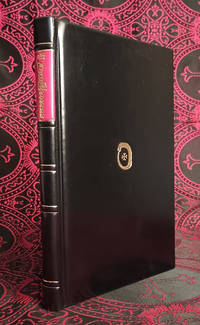
2010932697<p>Seattle WA: Ouroboros Press / Ars Obscura : "Printed after the 1617 edition at the sign of the Ouroboros" 2010. NEW / Limited to 75 copies only Hand-bound by Ars Obscura Bookbinding. From the Publisher see images - Full black leather handbound with gilt title and device raised spine bands marbled endsheets and silk bookmark. Aviary folding plate. Fine typography with emblematic ornaments. Limited to 75 copies only. Jocus Severus was originally published in 1617 by Count Michael Maier and is here rendered into the English tongue from the Latin text by the remarkably able translator Darius Klein. Like his work on Giordano Bruno's Cantus Circaeus this is the First English Translation. In addition to the new translation the Ouroboros Press edition of Jocus Severus distinguishes itself by employing new emblematic illustration work by Benjamin A. Vierling who in keeping with our publishing style has produced fine illustrative ornaments and a fold-out plate depicting the aviary creatures of the text. These graphic elements complement the typographical details with an effect befitting a piece of fine Renaissance book art. Michael Maier is well known in the historical milieu of alchemy due largely to his important work on alchemy and music Atalanta Fugiens yet his other works have remained obscure and unobtainable until now. An excellent biography of Maier can be found in the work of Hereward Tilton The Quest for the Phoenix: Spiritual Alchemy and Rosicrucianism in the Work of Count Michael Maier 1569-1622. In the foregoing work Tilton indicates the thrust of the Jocus Severus thus: The Jocus Severus takes the form of a court of judgment upon the bird of wisdom sacred to Pallas Athena the Owl in this instance embodying chemia as the highest science. The Owl stands accused of a number of misdemeanours by an assembly of squawking and cantankerous birds who represent the various critics of chemia. Council for the defense is the Hawk; presiding over the court is the Phoenix the symbol of the Work's perfection . . . . After facing her fellow birds accusations the Owl and her Art are eventually vindicated by the Hawk's expert defense and she is adjudged Queen of the Birds by the Phoenix". First English Language Edition. Hard Cover/Full-Leather/Sewn. New. Illus. by Benjamin A. Vierling "Illustrative Ornaments and A Fold-out Plate Depicting The Aviary Creatures Of The Text". 8vo size - 8¾" tall.</p> Ouroboros Press / Ars Obscura : "Printed after the 1617 edition at the sign of the Ouroboros" hardcover
1680506930Samuel Roycroft 1680. Leather. NEAR FINE. 16 1328pp. 4to recently and finely rebound in brown calf with burgundy morocco label with tissue repairs by the same binder to a few outer leaves and an earlier tape-backing to the title page by an earlier and less-skilled hand; pen markings to a few pages of the preface original trim with petina to edges entirely sound and clean internally. Samuel Roycroft unknown
elala2341<p>Antwerp: Plantin Press 1762. Late Plantin press edition of the long-standing third revision of the Tridentine version by Pope Urban VIII which first appeared in 1634 and was not superceded until 1884 Pope Leo XIII. 8vo. ff. 48 pp. 772 clviii 8 12. text in red & black in double columns. music in the text. Plantin device in red on p. clviii. title engraving of the Last Supper. 10 full-page engravings. historiated woodcut initials. contemporary calf gilt edges extremities worn tabs & marginal repairs to some leaves pp. 357-70</p> Antwerp: Plantin Press, 1762
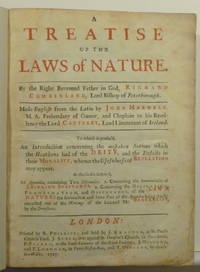
172727439London: Printed by R. Phillips; and Sold by J. Knapton 1727. .May Appear. At the End is subjoin'd An Appendix containing two Discourses. I. Concerning the Immateriality of Thinking Substance. 2. Concerning the Obligation Promulgation and Observance of the Law of Nature." Thick quarto in four parts with separate title pages. A very good copy newly rebound in handsome three-quarter calf with hand marbled paper covered boards. Raised spine bands with gilt decorated compartments and red morocco labels titled in gilt. Title page printed in red and black. Illustrated with copper plate engravings including an armorial headpiece and two fold-out plates depicting the nervous system and the solar system. A very handsome copy of this scarce book. . Hard Cover. Very Good. 4to - over 9¾" - 12" tall. Printed by R. Phillips; and Sold by J. Knapton Hardcover
31111London: Printed for the Editor by Richard Reily in Little-Britain 1741. First edition 4to 280 x 220 mm xxii 403 1 3 11 pp. with a list of subscribers and an index 13 contemporary hand-coloured plates by John Martyn light brown mark on inner margin of title cont. full calf rebacked with original gilt spine laid-down red morocco lettering piece joints cracked upper cover holding by cords. Provenance: Early armorial bookplate of The Rt. Hon. William Middleton Noel 1789-1859 to front paste-down. London: Printed for the Editor, by Richard Reily, in Little-Britain, 1741 unknown
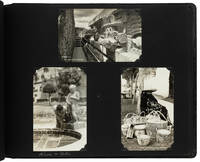
1930205481930. Early twentieth century travel photo album compiled by "Jake"documents the working life and global mobility of a merchant ship crewman during the 1930s and 1940s with sustained visual attention to port cities across Africa the Americas and the United States. The album supports research into maritime labor informal American commercial presence abroad and everyday interactions between traveling workers and local populations under late colonial conditions. Photographs taken in Beira and Dondo in Mozambique and Angola Durban and Cape Town in South Africa and Accra in the Gold Coast record encounters shaped by European colonial infrastructures and tourist economies including images captioned "Typical Ricksha Boy" depicting South African rickshaw pullers in elaborate headdress and dress and scenes of women in Accra balancing baskets and trays of food. Additional captions such as "Sam and his 'girls'" showing uniformed workers marked "Sea View Hotel" and "me and my gals" portraying informal social contact provide direct evidence of how American maritime workers framed and recorded relationships with local communities. The album further situates this mobility within a broader circuit including the Panama Canal Mexico City and Vera Cruz and U.S. port cities such as Galveston New York and Boston.<br /> <br /> Travel photo album compiled circa 1930s to 1940s likely by an American merchant marine crewman identified as Jake. String-bound black cloth album containing 44 leaves with 218 silver gelatin photographs and postcards mounted or cornered in along with one original sketch of an African man. Images span multiple global locations including Beira Dondo Durban Cape Town Accra Vera Cruz Mexico City the Panama Canal Powell River Vancouver Galveston New York and Boston. Several photographs depict shipboard life and crew activity aboard the S.S. Nemiskam Park with additional images of small craft landings including African men canoeing crew members ashore. A sequence of photographs taken in Boston shows the compiler in maritime work gear wearing thigh-high boot wraps rubber gloves and an oxygen mask captioned "At last -- working for a change." Nineteen photographs document Mexico including rancheros and rancheras in embroidered dress scenes of bullfighting and crew members wearing sombreros and sarapes.<br /> <br /> This album provides a concentrated record of interwar and wartime-era maritime circulation linking North American labor to colonial and postcolonial port environments offering primary visual evidence of how working-class American travelers documented race labor and leisure across imperial geographies. The inclusion of commercial signage hotel uniforms and transport labor such as rickshaw pulling situates the photographs within local economies shaped by tourism and global trade while the Panama Canal images anchor the album within a critical artery of twentieth-century shipping and U.S. strategic infrastructure. The juxtaposition of African Mexican and U.S. scenes underscores the continuity of maritime networks that connected these regions and the album's captions provide insight into informal language humor and perception among traveling crewmen. Minor edge wear to album corners with some mounts loosening; leaves and photographs remain clean and stable. Overall very good condition. unknown
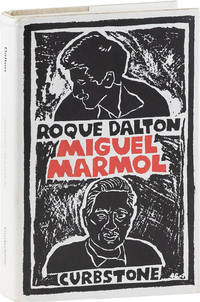
198759799New York: Curbstone Press 1987. First English Language Edition. First printing. Octavo. Tan cloth hardcover; dustjacket; xviii19-503pp. Inscribed on front flyleaf: "Para la camarada Kendra Alexander y adelante con la lucha solidaria con el pueblo Salvadoreño y Centroamerica" signed by Miguel Mármol dated 1988. Mild bumps to board corners a bit of rippling to cloth on spine still Near Fine a slightly faded but still Near Fine dustwrapper. <br /> <br /> A terrific association copy inscribed by Miguel Mármol to American communist and civil rights activist Kendra Alexander. Mármol 1905-1993 founding father of the Salvadoran Communist Party in 1930 and a leading figure of the Salvadoran worker-revolutionary movement for over five decades told his story over the course of several weeks in 1966 to the Salvadoran communist poet Roque Dalton. In his introduction Dalton who was assassinated in 1973 describes the experience as "one of the greatest satisfactions of my life" and the result was indeed one of the most popular and important works of Latin American revolutionary literature of the decade - Mármol's tumultuous life most of it spent in exile came both to exemplify and inspire the revolutionary movement in El Salvador and Central America.<br /> <br /> Though Miguel Mármol was first published in 1972 and went into numerous subsequent printings in Cuba and the Soviet Union there was no English-language translation until this 1987 edition from the small Latin-American publisher Curbstone. The cloth issue is hard to find and inscribed copies are rare; this a compelling association copy inscribed to the American civil rights leader and Communist Party leader Kendra Alexander 1945-1993 perhaps best-remembered as a close associate of Angela Davis whose Defense Committee she co-chaired during Davis's 1971 conspiracy trial. 59799. Curbstone Press unknown
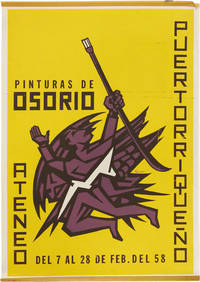
195855418San Juan: Ateneo Puertorriqueño 1958. Original illustrated poster silkscreened in three colors on white stock measuring 47.25cm x 67.25cm 18.5" x 26.5". Light wear and handling some faint creases short tear to upper left margin with masking tape along upper and lower margins on recto and some faint adhesive streaking; unbacked; Very Good / B. Striking poster announcing a 1958 exhibition of paintings by Puerto Rican painter and printmaker Carlos Osorio 1927-1984 at the Ateneo Puertorriqueño the country's oldest private cultural institution. The exhibition featured 41 works including oil paintings watercolor and drawings. The poster designed by Puerto Rican artist Carlos Rivera 1923-1999 features a powerful central image of a winged man holding aloft a staff which is both his paintbrush and his machete. Not separately listed in OCLC though we note an example held by the University of Puerto Rico. Ateneo Puertorriqueño] unknown
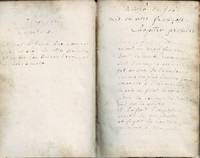
6651Manuscript on paper bound. 19th century. Good. Octavo 18 cm; 1 78 leaves paginated in manuscript. Latin and French text on facing pages. Bound in waste vellum manuscript in French no longer easily legible. Pages thumbed and toned at edges. Interlinear corrections in text as well as tipped in overleavers with corrected text. <br /><br />All we know of this manuscript book derives from examination of the physical evidence. The text does not correspond to any known French verse translation of the Book of Job so it seems to be a private endeavor. The unprofessional cursive orthography accords stylistically with handwriting typical of the 19th century but the structure and materials of the binding could indicate an earlier origin. The Latin text of the Vulgate appears on the pages facing the translation. Manuscript on paper, bound. hardcover
1800E0068viii514 pages with frontispiece map. Quarto 10 1/2" x 8 3/4" housed in a custom slipcase. Translated by Maurice Keatinge. First English edition.<br /><br /> Bernal Dïaz del Castillo was a conquistador who wrote an eyewitness account of the conquest of Mexico by the Spaniards under Hernan Cortes himself serving as a rodelero under Cortes. Born in Medina del Campo Spain he came from a family of little wealth and he himself had received only a minimal education. He sailed to Cuba in 1514 to make his fortune but after two years found few opportunities there. Much of the native population of the island had already been killed by epidemics and forced labor and in 1517 an expedition was sent to the smaller Caribbean islands to find alternative sources of labor. Dïaz joined this group under the command of Francisco Hernandez de Cordoba. It was a difficult venture and although they discovered the Yucatan coast by the time the expedition returned to Cuba they were in disastrous shape. Nevertheless Dïaz returned to the coast of Yucatan the following year on an expedition led by Juan de Grijalva with the intent of exploring the newly discovered lands. Upon returning to Cuba he enlisted in a new expedition this one led by Hernan Cortes. In this third effort Dïaz took part in one of the legendary military campaigns of history bringing an end to the Aztec empire in Mesoamerica. During this campaign Dïaz spoke frequently with his companions in arms about their experiences collecting them into a coherent narration. The book that resulted from this was Historia verdadera de la conquista de la Nueva Espana English: The True History of the Conquest of New Spain. In it he describes many of the 119 battles in which he claims to have participated culminating in the fall of the Aztec Empire in 1521.As a reward for his service Dïaz was appointed governor of Santiago de los Caballeros present-day Antigua Guatemala. He began writing his history in 1568 almost fifty years after the events described in response to an alternative history written by Cortes's chaplain who had not actually participated in the campaign. He called his book the Verdadera Historia True History in response to the claims made in the earlier work. Dïaz died in 1585 without seeing his book published. A manuscript was found in a Madrid library in 1632 and finally published providing an eye-witness account of the events often told from the perspective of a common soldier. Today it is one of the most important sources in understanding the campaign that led to the collapse of the Aztec Empire and the Spanish conquest of Mexico.<br /><br /><b>Condition:</b>Spine renewed with new period spine label and original boards which the corners and edges are heavily rubbed some foxing to early pages. Frontispiece map repaired. Custom made red slipcase with Japanese toggles and leather spine label in gilt lettering else about a very good copy in a near fine case. Printed for J Wright by John Dean hardcover
1882CA0128xv488 pages with appendices. Octavo 8 1/2" x 5" bound in quarter leather with gilt lettering to spine in stiff boards. From the library of Professor George M Foster. Second edition.<br /><br />Alonso de la Rea was born in Queretaro in 1610. He wrote his Cronica in 1637-1639 providing data on Michoacán and Jalisco. For many matters he leaned heavily on Torquemada who in turn had copied them from Mendieta. Ricard quoting an 18th century opinion mentions that Rea lacked interest in chronology to an excessive degree. His work was however an official and methodical chronicle of the province preserving considerable detail about it. Rea's Cronica . 1639 was first published in 1643 and is now a bibliographical rarity. The volume is divided into three books totaling 92 chapter. Book 1 describes the region products people their dealings with Aztecs their general traits religious rites the last native emperors and coming of the Spaniards. This is followed by arrival of the Franciscan missionaries with biographies of some of these pioneer friars. Book 2 begins with the division of the province between Michoacán and Jalisco 1606 and contains numerous biographies of the members of that order. Book 3 is also a series of lives and an account of the Custodio del Rio Verde. The second edition was published in Mexico 1882. It includes additional relevant documents in three appendices. At the end of the text there is a table of contents but no index.<br /><br />George McClelland Foster Jr born in Sioux Falls South Dakota on October 9 1913 died on May 18 2006 at his home in the hills above the campus of the University of California Berkeley where he served as a professor from 1953 to his retirement in 1979 when he became professor emeritus. His contributions to anthropological theory and practice still challenge us; in more than 300 publications his writings encompass a wide diversity of topics including acculturation long-term fieldwork peasant economies pottery making public health social structure symbolic systems technological change theories of illness and wellness humoral medicine in Latin America and worldview. The quantity quality and long-term value of his scholarly work led to his election to the National Academy of Sciences in 1976. Virtually all of his major publications have been reprinted and/or translated. Provenance from the executor of Foster's library laid in.<br /><br />Condition:<br /><br />Foster's stamp to title. Corners bumped edge wear to boards rubbing to paper boards else a very good copy. Imprenta de J R Barbedillo hardcover
1643TTUMLITU6Paris: Mathurin Hénault 1643. 1643. 2 Parts in 1 second part with title: Hagiologion Franco-Galliae Excerptum A. Philippo Labbé.Cum Sacra Galliarum Topographia. 4to. pp. 14 p.l. 422 1 leaf 164. first title in red & black. woodcut ornaments initials & title vignettes. contemporary mottled calf gilt back front joint splitting extremities worn & chipped some light browning marginal dampstains to first few leaves. First Edition of the French Translation by Philippe Labbé 1607-1667. Not in Goldsmith BM STC French. F. Hardcover. Paris: Mathurin Hénault, 1643. Hardcover