(Bible Latin Vulgate)Biblio.com
1 201 résultats
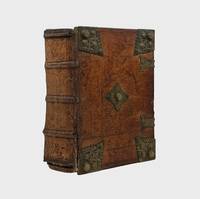
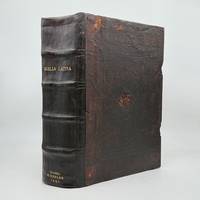
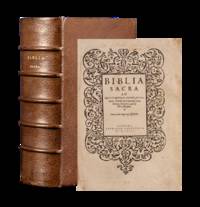
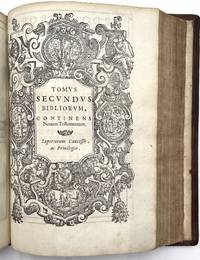
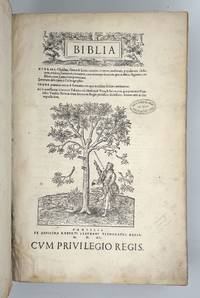
1540372229Paris: Ex officina Roberti Stephani typographi Regii 1540. Third edition and the first with these illustrations. Printer's device on title pages woodcut illustrations in text including 5 full-page ornamental initials. 10 268; 1 104 i.e. 103 error in pagination omitting leaf 83; 90; 92 ff. Collation: 10 a-z⸠A-I⸠K-LⶠAa10 Bb-Mm⸠NnⶠAA-KK⸠LL10 2a-2l⸠2mâ´. Early manuscript annotations. 1 vols. Folio 17x11-1/4 inches. Contemporary blindstamped pigskin over bevelled wooden boards title stamped on the upper cover lacks bosses hinges and clasps upper joint cracked darkening to spine other wear. Early vellum manuscript waste at inner hinges. Minor staining minor foxing a few scattered edge tears. Provenance: Christopher Jonas a Taubenheim early inscription mentioning commentary by Rabbi Moses ben Nahman Gerondi; Polling Monastery armorial bookplate; Duplum Bibliothecae Regiae Monacensis; General Theological Seminary stamps bookplate. Third edition and the first with these illustrations. Printer's device on title pages woodcut illustrations in text including 5 full-page ornamental initials. 10 268; 1 104 i.e. 103 error in pagination omitting leaf 83; 90; 92 ff. Collation: 10 a-z⸠A-I⸠K-LⶠAa10 Bb-Mm⸠NnⶠAA-KK⸠LL10 2a-2l⸠2mâ´. Early manuscript annotations. 1 vols. Folio 17x11-1/4 inches. The third and finest folio edition of Latin Vulgate Bible prepared by scholar/printer Robert Estienne 1503-59. Though the edition was entered into the Vatican's Index of Prohibited Books and is correspondingly scarce ultimately this text served as the foundation of the official Roman Vulgate. The illustrations of Noah's ark the Tabernacle of Moses and Temple of Solomon were widely copied.<br /> <br /> The general title page and the Prophetae are dated 1540; that of the New Testament is dated 1539; and that for the Hebraea Chaldaea Graeca & Latina Nomina . cum Interpretationis and Index is dated 1538. "The text was revised from additional MS sources; a list given at the end of the preface enumerates at least 16 MSS and 3 printed editions. This edition contains the first printing of the Prayer of Manasses in Greek and Latin. It is the text of this monumental edition which became the foundation of the official Roman vulgate ." Schreiber. The text of the Oratio Manassae is printed here for the first time leaf v8v.<br /> <br /> This is a tall and generally well preserved copy with good margins. Darlow & Moule 6117; Renouard pp. 48-9 no. 1; Copinger 275; Schreiber Estiennes 359; Adams B1022; Mortimer French 16th cent. 68 Ex officina Roberti Stephani typographi Regii unknown
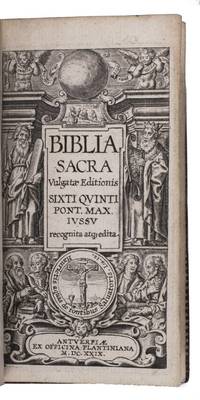
16291052Antwerp: Officina Plantiniana = Balthasar I Moretus grandson of Christophe Plantin 1629. Uniform gold-tooled goatskin morocco ca. 1700 sewn on 4 supports richly gold-tooled spines gold-tooled turn-ins and board edges the boards in a panel design each board with a double frame of triple fillets the inner 2 fillets in each frame closer together than the outer with an ornament stamped on the intersections of the fillets at the corners of both frames and a flower in each corner between the frames with its head toward the corner; the spine with the title - BIBLIASACRA or NOVVMTESTA - and volume - TOM. I. etc. - in the 2nd of 5 compartments INDEX in the 3rd compartment of volume VII and the other compartments filled with curls and dots: a style sometimes called grotesque gold-tooled turn-ins marbled pastedowns blue red white and yellow extensively swirled headbands in green and white gilt edges. Seven volumes with the ca. 1711 engraved armorial bookplate of Jean Le Normand 1662-1733 Bishop of Evreau and probably bound for him his bookplate probably removed from volumes II and III as bound. 24mo in 8s 11.5 x 7 cm. With a richly engraved general title page 6 volume title pages each with the same Plantin-Moretus woodcut compasses device a smaller woodcut compasses device plus 3 of 4 repeats 2 appear on the back of the colophon; each of the others on an otherwise blank leaf woodcut tailpieces woodcut decorated initials. Set in roman and italic types. The present copy with 3 extra letterpress divisional title pages perhaps specially printed for this copy when it was bound. 7 volumes bound as 9 Old Testament I-VII & New Testament I-II. A small Latin Vulgate bible printed by the Plantin-Moretus office in Antwerp the smallest-format edition of the Sixtine-Clementine authorized Catholic text. The first volume of the Old Testament has only the engraved general title-page while each of the remaining Old Textament volumes as printed has a separate volume title-page naming the books it covers including the volume with the apocrypha miscellaneos texts and the indexes. After the general title-page follow a preface to the reader the decree of the Council of Trent "Paulus Papa V. Ad futuram rei memoriam" Pope Paul V died in 1621 and a privilege dated Brussels 1611. The Old Testament also has prefaces to the books. The New Testament has no preliminaries except its title-page. In 1546 the Council of Trent ordered a revision of the Vulgate Latin Bible to establish an authorized Catholic text. Pope Sixtus V ordered the preparation of the new edition printed by the Vatican Press and published in 1590. The book has been variously described as 12mo 16mo and 24mo but it is in fact a 24mo in 8s. The three divisional titles possibly printed specially for this copy have vertical chainlines and may be in 18mo format. The binding stamps are finely cut and skilfully applied especially the curls on the spine so it is likely to have been executed by one of the great French binders of ca. 1700.With an owner's inscription on a free endleaf in volume IV as bound "ce livre apartient a monseigneur L'Evesque D'Evreux" presumably Jean Le Normand 1662-1733 Bishop of Evreux from 1711 to his death whose bookplate appears in 7 of the 9 volumes: the handwriting is old-fashioned for 1711 so the book could have come to Le Normand from an earlier Bishop of Evreux but perhaps he simply wrote in an old-fashioned style. The pagination of volume ii accidentally omits numbers 577-578 but no leaf is missing there. Very slightly browned with an occasional minor spot and with the library stamps on the letterpress title-pages abraded but still generally in very good condition. With small cracks in the hinges of 4 volumes minor wear on the board edges and corners and volume III as bound vol. ii as printed darkened but the binding is also otherwise in very good condition with the tooling clear and sharp. A lovely little Catholic bible beautifully bound ca. 1700 in French gold-tooled red morocco an unusually small format for a Catholic bible.l Darlow & Moule 6211 New Testament only; STCV 6650952; USTC 1003882; not in www.bibliasacra.nl. Officina Plantiniana [= Balthasar I Moretus, grandson of Christophe Plantin], hardcover
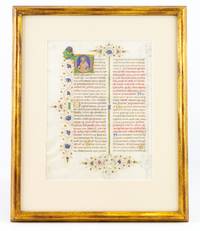
1441ST19880Italy Ferrara 1441-48. Visible leaf: 245 x 187 mm. 9 5/8 x 7 3/8"; Frame: 380 x 315 mm. 15 x 12 1/4". Double column 30 lines in a very fine rounded gothic hand a few lines of text in the same hand but smaller. <br/> Mounted and in a simple but pleasing gold frame. Visible side with rubrics in red one-line initials in burnished gold or painted blue one two-line initial in burnished gold on a pale pink ground with white tracery a lovely illuminated bar between the columns with a central plant knot AND SPROUTING IN UPPER AND LOWER MARGINS CLUSTERS OF FLOWERS AND LEAVES IN VARIOUS COLORS AS WELL AS GOLD BEZANTS outer margin with swirling penwork studded with gilt bezants running the length of the column each penwork swirl enclosing a painted and gilt flower with ONE FIVE-LINE HISTORIATED INITIAL DEPICTING ST. PAUL HOLDING A SWORD AND BOOK the initial painted pink with green leaves and a blue and green acanthus extension on a gilt ground. ◆Not examined outside of frame but in very fine condition: vellum slightly wavy text in the bottom margin just a bit faded but by all appearances A VERY CLEAN BRIGHT LEAF SPARKLING WITH GILT.<br/> <br/> Executed with great skill and delicacy and in sensitive Italianate colors highlighted especially by spring green and pink the present leaf is from a manuscript intended for a powerful aristocrat. It comes from the celebrated Breviary illuminated for the chapel of the Marquises of Este rulers of Ferrara and Mantua a manuscript commissioned by Leonello d'Este duke of Ferrara from 1441-50. Because the d'Este family kept excellent records we have confidence that this manuscript was done for Leonello by Giorgio d'Alemagna Bartolomeo de Benincà Guglielmo Giraldi and Matteo de' Pasti see Toniolo "La Miniatura a Ferrara dal Tempo di Cosmè Tura all'eredità di Ercole de' Roberti" 1998 pp. 19-20 and 76-77. The leaves show subtle variations in the style of the illuminations a result of work done by a team of artists doing variations on a theme. At one time in a Spanish library the manuscript was brought to Britain during the Peninsular War and came to be owned by the Rolls family later Lords Llangattock of Monmouth in Wales from whom it takes its name. By the time the work reached Britain most of the miniatures had already been cut out. The Breviary sold at Christie's on 8 December 1958 lot #190 to Goodspeed's of Boston who broke it up. The intact first quire of 10 leaves was purchased by Philip Hofer and given to Harvard cf. Wieck "Late Medieval and Renaissance Illuminated Manuscripts" p. 130 and fig. 74 and individual leaves appeared in 1967 in the catalogues of Folio Fine Art "the quality of the leaves is extremely high" Maggs Brothers "of a very high quality" and Alan Thomas "of exquisite quality". The present example is especially desirable for the portrait of St. Paul who is depicted holding a sword and book and whose carefully molded features reflect the growing interest in realistic portraiture in Renaissance Italy. unknown
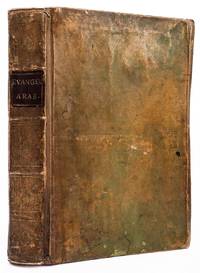
63499Romae Rome: Ex Typographia Medicea 1619. Folio 33.5x21 cm. pp. 4 9-462 2 with at recto the printer's letter repeated with the date of the 1591 original edition blank at verso. Contemporary green vellum spine with raised bands and gilt-decorated compartments red Morocco label marbled endpapers edges dyed red. Title printed in red and black with Medici's woodcut coat-of-arms printer's advice "Typographus lectori". With 149 text woodcuts by Leonardo Parassole c.1570-c.1630 after Antonio Tempesta 1555-1630 their monograms appearing on a number of the illustrations. The woodcuts are remarkable examples of Tempesta's work notable for their clarity of composition and their didactic narrative of the episodes depicted. Ex libris Luigi Bossi Milan 1758-1835 with his engraved heraldic bookplate to front pastedown along with T. Fenteman & Sons Leeds booksellers label to upper corner. Title-page lightly browned boards faded and discoloured some occasional light toning generally a very good copy printed on thick paper the woodcuts in strong impressions throughout. Rare 1619 reissue or of the original 1591 stock of the Arabic Medicean Gospels. The text lines are almost identical with those of the Arabic issue but now have an interlinear Latin version added which was prepared by Antonius Sionita. In 1584 the last year of the papacy of Gregory XIII who had constantly endeavoured to effect a union between the Church of Rome and the eastern Christians Cardinal Ferdinando de' Medici the brother and later the successor of the Grand Duke of Tuscany founded a printing press in Rome with a vast selection of oriental types cut by the French typographer Robert Granjon. Run by a versatile orientalist Giovan Battista Raimondi the press had various aims. One was to produce propaganda which would attract the eastern Christians to Roman Catholicism. Another was to corner the publishing market in an area where typography was prohibited and to make a financial profit from the sale in the east of books printed in Arabic. The third aim was to further European knowledge and to provide good editions of Arabic versions of certain standard non-religious texts. These included the writings of Avicenna al-Idrisi's geographical compendium al-Tusi's adaptation of Euclid's text on geometry and various works on Arabic grammar and syntax. The first major publication was the 1591 edition of the Gospels. This copy has an interlinear Latin translation but the work was also issued solely in Arabic. It contains 149 fine woodcut illustrations made by Leonardo Parasole mainly after designs by one of the best known Florentine artists of his day Antonio Tempesta who owed much of his fame to the frescoes he painted in the Vatican and in a number of Roman palaces. The woodcut in the Gospel of St Mark of the presentation of the head of John the Baptist to Salome Mark 6:28 by a man in Turkish dress reminds us of the common association between the great enemy of Christendom in the sixteenth century and the ancient heathens. The Arabic text is printed in Robert Granjon's famous large fount generally considered the first satisfactory Arabic printing type; as all early printed editions of the Arabic Gospels it is based on the Alexandrian Vulgate cf. Darlow/M. 1636. The Latin version is by Leonardo Sionita. The work begins with page 9 without a title-page or any preliminary matter at all: "the intended prefatory matter was apparently never published" Darlow/M. Darlow & Moule 1637 & 1643; Schnurrer Bibliotheca arabica 318; Brunet II 1122-23; Graesse II 531 Romae [Rome]: Ex Typographia Medicea, 1619. hardcover
1489371804Strasbourg: Johann Prüss 1489. Text in double columns 52 lines per column. 450 leaves with erratic pagination and collation. Two leaves present in early manuscript facsimile Interpretations of Hebrew Names leaves b2 and b7. Partially rubricated. Contemporary manuscript marginalia with chapter summaries in the lower margins throughout and shoulder notes in the OT with extensive annotation on the title. Folio. Early blindstamped pigskin later brass bosses and clasps joints splitting some loss at bottom of spine. Title mounted with paper losses at fore-edge and lower margins affecting the manuscript annotation but not the text. Cloth clamshell box. Text in double columns 52 lines per column. 450 leaves with erratic pagination and collation. Two leaves present in early manuscript facsimile Interpretations of Hebrew Names leaves b2 and b7. Partially rubricated. Contemporary manuscript marginalia with chapter summaries in the lower margins throughout and shoulder notes in the OT with extensive annotation on the title. Folio. The second Prüss Bible. Place of publication and printer from Goff publication date from colophon Kk5v. Not in Darlow and Moule. This copy from the famed bible collection of W. A. Copinger. See his lengthy bibliographic description in Incunabula Biblica item 79 and plate XLI. ISTC ib00588000; GW 4265; Hain-Copinger 3104; Proctor 543; Goff B588; BM 15th cent. I 122 IB.1658; Walsh J.E. 15th cent. printed books 196; Stillwell B516; Bodleian Lib. 15th cent. B-297; Copinger W. Incunabula Biblica 79; BSB-Ink B-462. Provenance: W. A. Copinger bookplate; General Theological Seminary booklabel blindstamp on the title Johann Prüss unknown
1491372087Basel: Nicolaus Kesler Kessler 1491. With one small polychrome gilt illuminated initial F on a2 initials in red or blue thoughout. Printed marginalia present on a2 and a7. 436 ff. 872 pp. final page is blank. 1 vols. Folio. Old leather tooled in blind clasps perished. Rebacked edges repaired last few leaves with marginal repairs final leaf of Names backed with small losses at head. Ownership marks struck out on title leaf. Very good. Cloth folding box. With one small polychrome gilt illuminated initial F on a2 initials in red or blue thoughout. Printed marginalia present on a2 and a7. 436 ff. 872 pp. final page is blank. 1 vols. Folio. Kesler's second Bible a page-for-page reprint of the edition 9 October 1487. These editions are notable for including at end the section headed "Translatores Biblie" with two notes "dealing with 1 ancient versions . and 2 with the methods of interpreting the Holy Scripture" D&M and form part of the apparatus accompanying many later editions of the Latin Bible. The first use of a title page for the Bible is ascribed to Johann Pruess in the 1486 Strassburg edition; here it is simply: Biblia. ISTC ib00591000; GW 4268; Goff B591; Copinger Incunabula Biblica 88; Darlow & Moule note at 6086. Provenance: W. A. Copinger bookplate; General Theological Seminary gift of Cornelius Vanderbilt and Dean Augustus Hoffman bookplates and blindstamps Nicolaus Kesler (Kessler) unknown
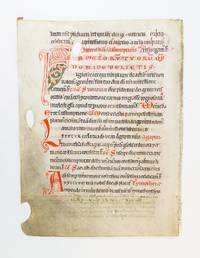
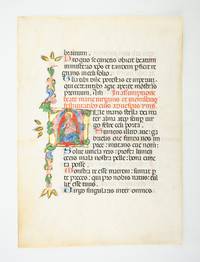
ST17236Germany mid- to late 12th century. 290 x 217 mm. 11 3/8 x 8 1/2". Single column 21 lines in an attractive proto-gothic book hand. <br/> Rubrics in red several one-line initials in red five red initials measuring two to four lines long and with penwork embellishment A LOVELY SEVEN-LINE WHITE-VINE INITIAL outlined in red and with a pale yellow wash along the edge the lower half of the ground filled with green wash. Lower margins with notations in later Medieval hands. ◆A handful of original holes in the vellum no doubt from stretching the skin during processing with the scribe writing around the flaws where necessary a little soiling to lower outside corner one or two negligible spots otherwise IN FINE CONDITION the ink unusually rich and the paint very bright.<br/> <br/> From a Sacramentary a service book that contained the prayers said during Mass subsumed by the Missal in the 13th century this early leaf was once part of an attractive manuscript of very high quality. The very large and superb "F" opens the Mass for the Feast of the Assumption and the other readings here include Masses for Sts. Hippolytus and Cassian celebrated on 13 August; St. Eusabius 14 August; Vigil of the Assumption of the Virgin 14 August; Assumption of the Virgin 15 August; St. Agapitus 18 August; and the beginning of the Mass for Sts. Timothy Hippolytus and Symphorian 22 August. Sister leaves from this same manuscript have previously appeared in Sam Fogg Cat. 16 "Text Manuscripts and Documents 2200BC to 1600AD" 1995 nos. 30 and 31; Maggs Bros. European Bulletin 20 1995 no. 37; Quaritch Cat. 1270 "Bookhands of the Middle Ages VI" 2000 nos. 69 and 70; Sotheby's 6 December 2001 lot 8; and Bloomsbury 6 December 2017 lot 16. The Fogg description notes that similar initials can be seen in French German and Flemish manuscripts of the period "but very few manuscripts have the special characteristics of this one." For example the initials on the sister leaves described by Fogg contain atypically mauve and green as well as an "unusual . . . exterior contoured ground which is not confined by any geometric form." This means there is no line or shape to box in or define the capital's form; rather it appears as if surrounded by an aura or gentle shadow. Our initial contains a green ground only no mauve but the same unusual and attractive yellow aura. It is rare to find Romanesque leaves of this size and caliber in such fine condition and the present leaf with its beautiful regular proto-gothic hand exceptional white-vine initial and several large decorative initials in red is especially desirable. unknown
152966850Lyons: Per Johanem Crespin 1529. BIBLE IN LATIN. Lyons: Per Johanem Crespin 1529.<br> <br> Second Crespin edition reprinted from the 1527 edition. Folio 13 15/16 x 10 inches; 354 x 252 mm. 304 leaves 18 CCLXVIII 18 leaves. Complete with final blank leaf. Gothic type. Text in double columns within rule borders. Title printed in red and black with small woodcut of St. Jerome repeated three times in the text with Jerome's prefaces within a four-part woodcut border showing God the Father and two angels in a tympanum the six days of Creation and the Last Supper. Large six-part Creation woodcut at the beginning of Genesis half-page woodcut of King Solomon at the beginning of Proverbs full-page Nativity woodcut at the beginning of the New Testament and 121 small text woodcuts including twenty-three repetitions: ninety-one Old Testament woodcuts within strip borders including eight repetitions and thirty New Testament woodcuts without borders including fifteen repetitions. Decorative woodcut initials. The Eusebian canons leaves D1-D3 are printed in red and black in a red architectural framework.<br> <br> Contemporary pigskin over wooden boards roll-tooled in blind to a panel design. Lacking clasps. Original index tabs. Binding worn with some loss of pigskin on upper corner of front cover. Title soiled lower margin of first few leaves wormed and frayed with some loss to woodcut title border a few short marginal tears some mostly marginal dampstaining minor worming to lower inner margins a few inkstains slight discoloration throughout. Despite these minor flaws this is a beautiful example of a French woodcut Bible completely unsophisticated. Contemporary ink inscription on back pastedown dated 1534 contemporary ink inscription on the recto of D4 beneath the Nativity cut eighteenth- or nineteenth-century inscription on title: B.V. Maria in Fürstenfeld. Some early underlining and coloring of woodcuts in red. A few early ink marginalia. Housed in a custom quarter brown morocco clamshell case.<br> <br> The illustrations follow the schema of the Sacon Bibles printed in Lyons in 1518 and 1521. Crespin's blocks with the exception of the Creation are close copies of those used in Jacques and Jean Mareschal's Lyons Bibles of 1523-1541 as is the layout of the text within ruled columns. The borders for the Old Testament blocks include a strip with the initials "PBA."<br> <br> Fairfax Murray French 36. Harvard French 66. Not in Brunet Rothschild Darlow and Moule.<br> <br> HBS 66850.<br> <br> $9500. Per Johanem Crespin unknown
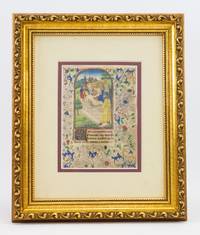
ST19540bSouthern Netherlands Bruges third quarter of 15th century. Matted leaf: 150 x 150 mm. 5 7/8 x 4 3/8". Frame: 307 x 258 mm. 12 x 10 1/4". Single column with four lines below the miniature and the obverse with 17 lines in a batarde hand. <br/> Attractively matted and framed the leaf slightly shifted in the mat revealing top and side edges but in no danger of damage. Rubrics in red four one-line initials and three three-line initials all but one in burnished gold on blue and red ground with white tracery the initial beneath the miniature painted pink on a burnished gold ground and filled with painted ivy vines AN ARCH-TOPPED LARGE MINIATURE DEPICTING THE ENTOMBMENT the body of Christ surrounded by seven other people depicted in an outdoor setting with the turrets of a walled city in the background the miniature in a double frame of gold and pink surrounded by A FULL BORDER composed of hairline vines acanthus colorful flowers and gilt bezants and inhabited by a small bird. Minor soiling and a faint thumb print to borders but IN VERY FINE CONDITION THE MINIATURE BEAUTIFULLY PRESERVED.<br/> <br/> This is a beautifully rendered and deeply touching scene depicting the entombment of the crucified Christ and the pathos experienced by those at his side. Holding the sheet on which the body is lowered into the sarcophagus are on the far left the richly clothed Joseph of Arimathea and on the far right Nicodemus who dons an especially lovely yellow garment with delicate embroidery. Between the two men in the foreground but behind the body are the Virgin Mary who presses the hand of her deceased son to her lips; John the Evangelist whose body is turned toward the Virgin in a gesture of support but whose gaze is focused on the Savior; and Mary Magdalene who holds a small ointment jar. Two other women with halos stand closely behind them consoling one another. The artist has done a masterful job at creating a composition that captures the emotional gravity of the scene: Christ's body gently cradled in a white sheet is on full display with blood still trickling from the wounds on his head and side. Despite there being seven people crowded around him our attention is drawn to the action between Christ and the Virgin who gently grasps his hand with motherly affection and bids him a final farewell. Flickers of different emotions appear on the faces of his followers including pity sorrow stoicism and disbelief--echoing perhaps the viewer's own range of feelings upon viewing this image. The level of detail excellence of composition care seen in the molded bodies and faces and the convincing setting suggest that the artist was quite practiced and that the original manuscript from which the leaf comes was of very high quality. unknown
15546212Lyon: Jean de Tournes 1554. First edition. Octavo 6 3/4 x 4 3/4 inches; 171 x 121 mm. . 16 1152 76 pp bound without the last two blank leaves as in most copiese.g. Mortimer OCLC. The penultimate leaf had only a fleuron at the foot of the page and the final leaf was blank. Arabesque title border and 198 with 1 repeat woodcuts in the text by Bernard Salomon. Title-page with faint early ink "ex-Libris petri ------ at top blank margin. Title-page expertly cleaned some occasional mainly marginal faint foxing otherwise a superb example of this wonderfully illustrated mid sixteenth-century Latin Bible. Bound ca. 1880 by Chambolle-Duru in full brown crushed levant morocco spine with five raised bands lettered in gilt gilt ruled board edges decorative gilt turn-ins marbled endpapers all edge gilt. Armorial bookplate "In Memori: Weiler Bibliotheca Trautner Falkiana" on verso of front free endpaper.<br /> <br /> First De Tournes Latin Bible based on Robert Estienne's text and beautifully illustrated with 198 woodcuts by Bernard Salomon. "Considerable work could be done on Salomon's sources for these cuts. The Expulsion from Paradise suggests Holbein's version; the New Testament shows some dependence on the set owned by Sébastien Gryphius. the Apocalypse blocks are enlarged copies of the fine Janot Apocalypse. But the cumulative effect of Salomon's carefully detailed scenes is that of an individual contribution to Bible illustration. Particularly interesting from the point of view of technique are the night scenes in Exodus and the storm over Noah's ark. In this 1554 Bible the New Testament blocks are printed with arabesque strip borders at the sides. Arabesque and type ornament headpieces." Mortimer Contents include: Old Testament; Psalms; New Testament Epistles Acts; Index Testimoniorum & Index Epistolarum.<br /> <br /> Robert I Estienne 1503-1559 was a French protestant printer and scholar born into a printmaking family. He would take over his family's Paris firm in 1526 where he printed significant works in Latin Greek Hebrew and other languages. His 1531 Thesaurus linguae latinae is considered a major milestone in lexicography. Despite his many commissions for the King religious tensions forced Estienne to flee to Geneva. <br /> <br /> This bible was illustrated by Bernard Salomon c.1508-1561 a French artist who is known for engravings and illustrations. Although little is known about his life his art reveals stylistic influences from Mannerism and the School of Fontainebleau executed in a detailed and small scale. Salomon is known to have collaborated with the printer Jean de Tournes and produced decoration for emblem books bibles and classic texts. Many of his engravings also appear as source material for art objects such as a Faience plate at the MET featuring the Sacrifice of Noah.<br /> <br /> Brunet I 876 & Supplement I 125; Darlow & Moule 6134 note; Mortimer French no. 81. Jean de Tournes unknown
3144Professionally rebacked extremities bumped. Occasional light foxing and browning to some sheets small tear paper flaw to the fore-edge margin of Mi small triangular tear with slight loss to the fore-edge margin of HHiiiii. Generally a very clean and fresh copy. Very good. <p>Sacra Biblia Acri Studio Ac Diligentia Emendata Rerum atque Verborum permultis & perquàmdignis Indicibus aucta. Superiorum Concessu ac Privilegiis. Venice: Apud Iolitos 1588. </p> <br /> <p> Octavo. Two parts in one small quarto volume. 16 679; 199 1 blank 200 indices pp. General and New Testament titles within ornate woodcut borders. Illustrated with 246 woodcuts. Full nineteenth-century blindstamped leather spine with raised bands and title lettered in gilt. All edges stained brown. </p> . unknown
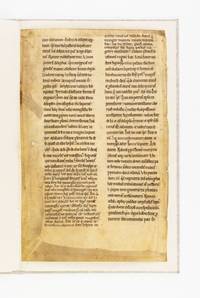
ST17768<p>England second half of 12th century but before 1180. 313 x 198 mm. 12 1/4 x 7 3/4. Double column 32 lines in a lovely late Caroline hand verso with some lines erased and corrected in a smaller hand. <br />Mounted in a fine tan cloth folder between sheets of textured acid-free paper. Front pastedown with book label of the Schøyen Collection with their shelf mark MS 237 written in ink. ◆Recovered from a binding and thus with overall toning and soiling recto somewhat browned from binder's glue but almost entirely confined to three margins and the verso virtually unaffected other trivial imperfections but in surprisingly good condition given its history the very rich ink especially dark and well preserved.<br /><br />This is an exceptionally lovely example of an early English book hand standing at the crossroads of the Caroline and proto-gothic calligraphic traditions. According to Thompson "In the twelfth century the scribes seem to have vied with each other in producing the best types of book-writing of which they were capable with the result that remarkable precision in the formation of the letters was attained and that the century may be named as excelling all others for the beauty of its MSS." "Greek and Latin Paleography" p. 436 The present leaf certainly lives up to this description being notable for its exceptionally neat and legible script written with uncommonly pretty and regular letter forms by a practiced and confident hand. The Caroline tradition is apparent in certain tendencies such as the use of "&" for "et" and the lack of biting curves between letters while a shift toward the proto-gothic can be seen in the vertical and compressed letter forms as well as the increased use of abbreviations and ligatures. Although the present work has often been credited to Haymo of Halberstadt due to a longstanding error in attribution reaching back to the 15th century modern scholarship now recognizes Haimo of Auxerre a monk at the Abbey of Saint-Germain in Auxerre d. ca. 875 as its true author. A prominent theologist and writer during the Caroline Renaissance Haimo produced a number of influential commentaries on various books of the Bible. The provenance on this leaf can be traced back as far as the mid-19th century when it was auctioned at Sotheby's on 21 August 1858 lot 119.2 sold as part of an album containing various leaves and fragments put together by Philip Bliss 1787-1857 registrar of the University of Oxford. It then went into the celebrated collection of Sir Thomas Phillipps 1792-1872 and was eventually sold by the Robinson Brothers on 24 April 1911 lot 390.3. This leaf has previously appeared in Quartich's catalogue 1036 "Bookhands of the Middle Ages" no. 79.5 and was most recently in the collection of Martin Schøyen his MS 237.</p>
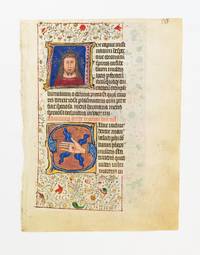
1465ST17243aBruges ca. 1465. 193 x 145 mm. 7 5/8 x 5 3/4". Single column 21 lines in a gothic book hand. <br/> Rubrics in red WITH THREE LARGE HISTORIATED INITIALS: ONE WITH A PORTRAIT OF CHRIST WEARING THE CROWN OF THORNS AND TWO WITH DISEMBODIED HANDS SHOWING THE STIGMATA each initial in pink or blue with white tracery filled with dark pink or blue with thin gilt lines and dots hands with wavy blue rays radiating from behind the appendage all within a thin gilt frame both sides with a three-quarter border consisting of hairline vines gold bezants and a few colorful flowers. ◆Margins with a little light soiling BUT IN FINE CONDITION THE PAINT OF THE INITIALS ESPECIALLY RICH AND WELL PRESERVED.<br/> <br/> From a manuscript probably produced in Bruges for the English market this leaf contains arresting initials that direct the viewer's attention to the wounds endured by Christ during the Passion. According to Roger Wieck Passion Cycle images enjoyed a particular vogue in 15th century Dutch Flemish and English Books of Hours including those that were exported to England. In the present example the strikingly unusual imagery includes a portrait of Christ wearing the Crown of Thorns his gaze fixed directly at the viewer and in separate initials his left and right hands appear disembodied and displaying the stigmata. A sister leaf to the present item features three additional initials showing the wounds of the left and right foot as well as the spear injury to Christ's side depicted as an oval piece of flesh with a laceration across the center. The parent manuscript containing the present leaf sold at Christie's on 15 November 2006 lot 16 the description for which gives us additional information about the book's contents and provenance: it was made for the Use of Sarum included a calendar with the English saint Thomas Becket and Popes Gregory and Silvester with their names crossed out indicating that it was in England through at least the time of the Reformation and contained an early ownership inscription of a woman named Bridget Lowe with a Middle English inscription on the pastedown. Christie's also attributed the parent manuscript to the workshop of William Vrelant with miniatures possibly by his chief assistant the Master of the "Vraie Cronique Descoce." They note that this work is "of higher quality than many of the works that satisfied the English demand for Netherlandish illumination" and that it "demonstrates why Vrelant appealed to the great bibliophiles of the Burgundian Netherlands." Vrelant was the leading purveyor of books of private devotion in Bruges during the third quarter of the 15th century and his prominent position among Flemish illuminators of the time is indicated by the considerable number of manuscripts illustrated in his manner by other miniaturists both in Bruges and in nearby cities in Flanders. Similar examples to the present leaf can be found in intact Books of Hours at the Philadelphia Free Library MS Widener 3 and the Huntington HM 1086--both of which were produced in Flanders or the Netherlands around the same time as the present work--but the present leaf surpasses both of these examples in terms of excellence of the artistic hand and level of detail depicted. unknown
1460ST12839Paris ca. 1460. 153 x 110 mm. 6 x 4 3/8". Single column 14 lines of text in a fine gothic book hand. <br/> One-line initial in burnished gold on a pink and blue ground with white tracery a two-line initial and a three-line initial in pink with white tracery on a ground of burnished gold the center filled with twining blue vines bearing pink and scarlet flowers verso with a rinceau panel border featuring twining hairline stems bearing burnished gold ivy leaves and fruit blue and gold acanthus leaves and flowers recto WITH AN ARCH-TOPPED MINIATURE OF THE HOLY TRINITY SURROUNDED BY THE HEAVENLY HOST this and the accompanying text enclosed by a pink blue and burnished gold bar border on one side and a brushed gold bar border with pink lotus flowers on two sides the whole surrounded by A FULL RINCEAU BORDER DENSE WITH ACANTHUS LEAVES FOLIAGE FRUIT FLOWERS AND TINY GOLD BERRIES on hairline stems. ◆A little paint flaked from the book held by the Trinity a couple of small spots in the margin otherwise in fine condition--clean and smooth with comfortable margins and bright gold.<br/> <br/> The Trinity is shown here seated on a canopied throne with God the Son his hand raised in blessing to the left of the Father. The latter in a towering crown holds a gold orb and the Father and Son together support a large book opened between them. The dove of the Holy Spirit hovers above the book radiating golden beams. The Trinity is flanked on both sides by cherubim and seraphim in rich red and soft yellow. It is the rendering of this angelic ambiance that elevates the level of aesthetic achievement here: both red and yellow celestial beings are given a ghostly appearance as if appearing out of a filmy yellow or a densely red fog. The artistic qualities as a whole suggest that this leaf comes from a manuscript commissioned by a person of significant means. unknown
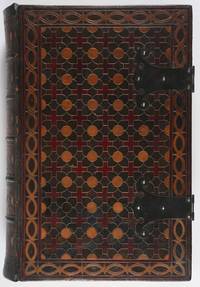
170153475Liege: Jean-François Broncart 1701. First edition thus. Hardcover. Very good. Two tomes each in two parts bound in one volume folio: 6 lxxix 1 blank 544; 1 title 1 blank 545-957 1 blank xx Cantique des cantiques 96 La sagesse; Ecclesiastique de Jesus fils de Sirach; 1 title 1 blank 468; 1 title 1 blank 430 16 Oratio Manassae; Liber Esdrae - tertius et quartus pp. Main titles for each tome in red and black; secondary titles in black only all four titles with engraved printer's device; each dated 1701. Text in two columns Latin and French. Illustrated with 6 engraved plates: frontispiece Johann Friederich Karg von Bebenburg; folding plate with 16 vignettes 4x4 depicting well-known biblical scenes; 4 folding maps The Holy Land; The Promised Land Apportioned by Tribe; Jerusalem in the Second Temple Era - after Lamy; The World Known to the Evangelists. Quarter-page engraved vignettes at the head of each of the 30 biblical books; historiated initials; printed marginalia. Exquisitely bound in the 19th century in levant morocco extra over wooden boards with mosaic compartments in crimson ochre; and dark brown bordered in fine gilt line; spine with raised bands lightly rubbed; pair of brass mounts finished in black with steel rivets at both covers clasps and catched perished. All edges gilt and elaborately gauffered in textured floral motif; gilt inner dentelles; decorative endleaves renewed in orange and black; crimson silk ribbon marker. The work of a master binder. Expertly repaired at spine caps. Occasional faint embrowning; marginal dampstains beginning in second half mostly at outer corners; expanding to fore-edge and darkening considerably in final 20 leaves. Overall a very good copy with crisp text throughout though incomplete: lacks Antoine Arnould's "Concorde des quatre Evangélistes" along with its accompanying Latin version and the concluding index.<br /> <br /> Amply margined copy of this sumptuous edition of the Bible comprising the Latin Sixto-clementine Vulgate and the Port-Royal French translation printed in parallel columns. Isaac-Louis Lemaistre de Sacy 1613-1684 was the principal translator of the French version which was edited and completed after his death by Pierre Thomas du Fossé 1634-1698 and Henri-Charles de Beaubrun 1655-1723 who also provide annotations throughout. According to Barbier the French controversialist Thierry de Viaixnes 1659-1735 who found himself often at odds with his superiors was the principal editor of the work; at the time of its preparation he was serving as director of an academy at Hautvilliers in the diocese of Rheims McClintock & Strong.<br /> <br /> Dedicated to Johann Friederich Karg von Bebenburg 1648-1719 whose signed portrait was drawn and engraved by C. Gustav of Amling. An advocate of maximal papal power Karg served as Privy Councilor of the Prince-Bishop of Bamberg and Würzburg Peter Philipp von Dernbach then of Elector Max Emanuel of Bavaria. He served as Dean of Our Lady in Munich and was entrusted by Emperor Leopold I with a legation to Pope Innocence XI. By these efforts he secured in 1688 the election of Prince Joseph Clemens of Bavaria as Archbishop of Cologne as a result of which he was made Chancellor and Minister of State here noted on the frontispiece.<br /> <br /> Provenance and annotations: Bookplate of Herman Blum Blumhaven Library & Gallery with his ticket below; two gilt-stamped ex-libris morocco labels: Henry W. Poor oval; Adolph Lewisohn octogonal. References: Darlow & Moule 3779; Deleveau & Hillard Bibles imprimées du XVe au XVIIe siècles conservées è Paris 605; ADB 15 1882 "Karg: Johann Friedrich; Jean-François Broncart hardcover
1462001313Mainz: Johann Fust & Peter Schoeffer 14 August 1462 1462. Fust and Schoeffer 48-line Bible Leaf. Royal folio 413 x 286 mm. Leaf 194 from gathering 20 of book one text from 2 Esdras chapter 15 and 16. Double column 48-lines printed in Gothic type. Titles and chapters in alternating red and blue letters red and blue two-line initials rubricated capital initials. Lines 35 to 41 in both columns of recto only are reset. 2 -inch closed tear to outer margin just slightly affecting text expertly repaired two old paper-clip ghosting marks to upper margin. Leaf housed in a cloth portfolio; slipcase with gilt lettered red morocco spine label. A fine leaf from the fourth edition of the Vulgate Bible or the 48- line Bible preceded only by the 42-line Gutenberg Bible the 36-line Pfister Bible Bamberg and the 49-line Mentelin Bible Strassburg. The first also to include the date of publication the place of printing and bear the name of the printer. Mainz: Johann Fust & Peter Schoeffer, 14 August 1462, hardcover
1587ST14247Venetiis Venice: Hieronymus Polus 1587. 213 x 146 mm. 8 3/8 x 5 5/8". 12 p.l. 1126 pp. <br/> ESPECIALLY PLEASING CONTEMPORARY CALF covers with gilt French fillet frame and oval wreath of olive branches the center of the wreath in the shape of a cross flat spine ruled in gilt red morocco label. Title page with elaborate wood-engraved frame text profusely illustrated WITH 600 WOOD ENGRAVINGS depicting scenes from scripture after Holbein Bernard Salomon le Petit Bernard and others a handful of these a bit indistinct. Front pastedown with ex-libris of Leonis S. Olschki. Adams B-1093; STC Italian 93. Not in Darlow & Moule. ◆A little wear to joints and extremities spine a bit crackled separation at hinges but no looseness occasional minor browning or foxing otherwise in remarkably fine condition the text clean and crisp and in a still-lustrous entirely solid unsophisticated original binding.<br/> <br/> This is a very well-preserved handsomely bound and lavishly illustrated edition with distinguished provenance of the Louvain Bible first printed in Venice in 1578. Our edition contains 600 wood engravings illustrating the text ranging from portraits of prophets saints and evangelists to dramatic scenes from the histories of the Old Testament and the life of Christ and ending with an imaginative Apocalypse cycle. Many of these are the work of Lyonnaise artist Bernard Salomon 1506-61 known by the sobriquet "Le Petit Bernard" for his small engravings rich with detail. Others are based on the biblical woodcuts of Hans Holbein. The binding here is likely French; the flat spine with just one large gilt-framed panel and the olive branch decoration on the covers is characteristic of late 16th century and early 17th century French work. The exceptional condition here is typical of books from the collection of Leo Samuel Olschki 1861-1940 scion of a family of Prussian Jewish printers whose interest in printing history led to his becoming a celebrated antiquarian bookseller author founder of the journal "The Bibliophile" and publisher of works in the humanities. Hieronymus Polus unknown
15192682Lyon: Jacques I Mareschal for Simon Vincent 1519. <p>8vo 180 x 126 mm. 30 500 54 pp. with pagination errors. Title and first table printed in red and black text in two columns with printed marginalia indices and summary in 3 columns. Colophon on fol. RR4v. Publisher’s woodcut device Baudrier no. 2 on title and final verso full-page woodcut showing the six days of Creation within ornamental border historiated woodcut initials throughout; red paragraph marks to opening page and red highlighting to the facing woodcut. Mainly faint marginal dampstain in upper margins light discoloration to outer margins. Contemporary Flemish blind-tooled calf over wooden boards sides with leafy roll-tool border enclosing central panel with intersecting triple fillets forming a saltire design the compartments filled with a repeated foliate tool arranged symmetrically one of two fore-edge clasps two catches; many deckle edges preserved worn a few small chips to leather pastedown endpapers renewed. Provenance: early ownership inscriptions on title: Mrr Cornelius Adamus ter Borch; and Siba Lÿken; contemporary marginal notes and some text markings crosses in margins and underlinings in first few books Genesis-Deuteronomy; abundant 17th and/or 18th-century philological annotations in Genesis and Exodus and in the indices including full page of notes on blank page 2E5v.<br /> <br /> A complete portable Bible printed in very small types containing an ample scholarly apparatus and finding aids for the use of theology students and scholars; this copy with contemporary annotations and in a contemporary blind-tooled calf binding probably Flemish. This compact glossed Bible densely and economically printed with no break between the Old and New Testaments is enlivened by hundreds of historiated woodcut initials from woodcut alphabets designed by Guillaume Leroy who also designed the six-part full-page woodcut of the Creation. <br /> <br /> Mareschal’s useful “pocket†Bibles were bestsellers this being the fourth of six octavo editions from his press. They were among the first Bible editions to include a rhyming mnemonic Biblical summary by the minorite friar Franciscus Gothi in which each four-line verse summarizes a Biblical chapter. Occupying here the final two quires and called for in the colophon it is not recorded by Baudrier or Gültlingen. Possibly buyers had the choice of including it or not in their copies. Otherwise the text of Mareschal’s octavo Bibles follows that of the Bible printed in Basel in 1509 by Johann Petri and Froben using the text edited by the Dominican Alberto Castellano and supplying for the first time marginal notes citing canon law. The apparatus includes four tables and a glossary of Hebrew names. As in the Petri editions a six-line commendatory poem by Matthias Sambucellus is printed on the title here with the first word of the last line incorrectly given as “Omne†instead of “Omine.â€<br /> <br /> The publisher Simon Vincent belonged to Lyon’s powerful booksellers' guild the Compagnie des Libraires whose members helped Mareschal during his early years impressed by his skill conscientiousness and sobriety â€a rare trait among printers of this period†notes Baudrier qualities which contrasted markedly with those of the printer Michel Topie whose press Mareschal had acquired in 1512 Baudrier 11:383.<br /> <br /> USTC 145003; Adams B-997; Pettegree & Walsby French Vernacular Books III: 57271. Darlow & Moule II: 6093 note; Baudrier Bibliographie lyonnaise 11: 401 and pp. 380 397 & 448; Gültlingen Bibliographie des livres imprimés à Lyon 2:209 no. 56.</p> Jacques I Mareschal [for Simon Vincent] unknown
1465ST17243bBruges ca. 1465. 193 x 145 mm. 7 5/8 x 5 3/4". Single column 21 lines in a gothic book hand. <br/> Rubrics in red one two-line initial in gold filled with blue on pink ground WITH THREE LARGE HISTORIATED INITIALS: ONE FEATURING AN OVAL-SHAPED PIECE OF FLESH WITH A GASH IN THE CENTER AND TWO WITH CHRIST'S DISEMBODIED FOOT SHOWING THE PUNCTURE WOUND FROM THE CRUCIFIXION each initial in pink or blue with white tracery filled with dark pink and thin gilt lines and dots four wavy blue rays radiating from behind each appendage all within a thin gilt frame both sides with a three-quarter border consisting of hairline vines gold bezants and a few colorful flowers. ◆Vellum a shade less than bright faint marginal rumpling trivial paint transfer on one initial BUT IN FINE CONDITION the initials richly painted and extremely well preserved.<br/> <br/> From a manuscript probably produced in Bruges for the English market this leaf contains arresting initials that direct the viewer's attention to the wounds endured by Christ during the Passion. According to Roger Wieck Passion Cycle images enjoyed a particular vogue in 15th century Dutch Flemish and English Books of Hours including those that were exported to England. In the present example the strikingly unusual imagery includes the wounds of the left and right foot as well as the spear injury to Christ's side depicted as an oval piece of flesh with a laceration across the center. A sister leaf to the present item features three additional initials showing a portrait of Christ wearing the Crown of Thorns his gaze fixed directly at the viewer and in separate initials his left and right hands appear disembodied and displaying the stigmata. The parent manuscript containing the present leaf sold at Christie's on 15 November 2006 lot 16 the description for which gives us additional information about the book's contents and provenance: it was made for the Use of Sarum included a calendar with the English saint Thomas Becket and Popes Gregory and Silvester with their names crossed out indicating that it was in England through at least the time of the Reformation and contained an early ownership inscription of a woman named Bridget Lowe with a Middle English inscription on the pastedown. Christie's also attributed the parent manuscript to the workshop of William Vrelant with miniatures possibly by his chief assistant the Master of the "Vraie Cronique Descoce." They note that this work is "of higher quality than many of the works that satisfied the English demand for Netherlandish illumination" and that it "demonstrates why Vrelant appealed to the great bibliophiles of the Burgundian Netherlands." Vrelant was the leading purveyor of books of private devotion in Bruges during the third quarter of the 15th century and his prominent position among Flemish illuminators of the time is indicated by the considerable number of manuscripts illustrated in his manner by other miniaturists both in Bruges and in nearby cities in Flanders. Similar examples to the present leaf can be found in intact Books of Hours at the Philadelphia Free Library MS Widener 3 and the Huntington HM 1086--both of which were produced in Flanders or the Netherlands around the same time as the present work. The present leaf surpasses both of these examples in terms of excellence of the artistic hand and attention to detail. unknown
1480376224Venice: Octavianus Scotus 1480. Text printed in double column 52 lines. Initials left blank. 460 leaves. 1 vols. Small 4to. Twentieth century brown morocco. Rebacked spine with traces of soiling and fire damage. Bound without a1 blank repair at foot of a1 and at corner of last leaf; cc14 mounted. Lacking H5-6 text supplied in near contemporary manuscript on 3 leaves. Text printed in double column 52 lines. Initials left blank. 460 leaves. 1 vols. Small 4to. Early work from the press of Scotus who became one of the most prolific Venetian publishers issuing numerous books until his death in 1498. Nice example of a smaller format bible. The text for the missing New Testament leaves omittted in binding at a very early stage Titus Philemon Hebrews 1-7 are supplied in a clear near contemporary hand. ISTC ib00570000; GW 4245. Provenance: General Theological Seminary gift of Cornelius Vanderbilt and Dean Augustus Hoffman bookplates and blindstamps Octavianus Scotus unknown
17562896Rome: Gioacchino & Giovanni Giuseppe Salvioni 1756. <p>8vo 208 x 133 mm. 24 407 1 pp. 2 parts the Office of the Dead separately titled. Printed in red and black. Engraved frontispiece and 12 full-page engravings by Arnold Van Weserhout and Jacob Frey after Joseph Passarus Giuseppe Passaro two engraved title vignettes 12 engraved tailpiece vignettes a few unsigned others by Frey after Passaro or by M. Schedi engraver 3 engraved capital initials numerous red-printed woodcut initials. Foxing occasionally severe short marginal tear to fol. Z7.<br /> Slightly later eighteenth-century Roman gold-tooled red goatskin covers with large dentelle border composed of a triple neo-classical roll-tooled outer frame enclosing six large ornaments each with a basketweave design of diagonally crossing gilt fillets framed in volutes and leafy sprigs a few tiny petal or star tools board edges protected with a probably later frame of silver or silver-plated metal discreetly nailed to the binding two elaborately chased silver fore-edge clasps and catches spine in six uniformly gold-tooled compartments gilt edges with gauffred border design pair of green ribbon page markers marbled endpapers; 20th-century black morocco felt-lined case. Provenance: with Gumuchian Catalogue XII/1930/225; Maurice Burrus bookplate purchased from Gumuchian in 1934 purchase notes at end. <br /> <br /> A striking rococo binding in fine condition on a luxuriously printed and illustrated Office of the Virgin from the official Vatican press.<br /> <br /> From the mid- to late eighteenth century the Salvioni press used one or more bookbinding workshops that produced finely gold-tooled bindings for their Vatican publications. Although often referred to as the “Salvioni bindery†this appellation is circumstantial: â€the Salvioni firm was responsible for promoting the bindings but it is not known which workshop produced them†British Library Database of Bookbindings. Some of these “Vatican†bindings incorporated variously colored or mottled leather. This example with its basketweave cartouches relies purely on tooling for its effect. An example evidently from the same workshop on a book printed at Rome in 1791 by Salomini using analogous cartouches as corner-pieces as well as a similar “spiraling†border design and some of the same leafy spray and star tools is reproduced in Legature papali no. 264.<br /> <br /> “Whereas the . more flamboyant bindings produced by the Salvioni Bindery rely frequently on polychrome enamel heightening these Vatican bindings strike a somewhat more sober note with their very fine dark-red morocco and rich gold-tooling of high quality†Martin Breslauer Catalogue 107/428.<br /> <br /> Gumuchian Catalogue de Reliures du XVe au XIXe siecle no. 225 plate 68. Cf. British Library Database of Bookbindings Shelfmark c27e18; For other “Salvioniâ€Â bindings see Miner / Walters Art Gallery The History of Bookbinding no. 523; Biblioteca Apostolica Vaticana Legature papali da Eugenio IV a Paolo VI no. 264 plate CXCIII. </p> Gioacchino & Giovanni Giuseppe Salvioni unknown
1500ST20810RParis ca. 1500. 163 x 115 mm. 6 1/2 x 4 1/2". Single column 18 lines in a gothic book hand. <br/> Rubrics in red line fillers in blue and pink with gold bezant six one-line initials in burnished gold on pink and blue ground two two-line initials in blue on gold ground with a flower in the center one three-line initial in blue filled with ivy on gold ground verso with panel border of colorful flowers and acanthus recto with A LARGE ARCH-TOPPED MINIATURE OF THE CORONATION OF THE VIRGIN with an "L" shaped frame of burnished gold and painted flowers and A FULL BORDER of acanthus flowers a man playing a bagpipe and a hybrid creature wearing a hat all on a painted gold ground. Very minor wrinkling to vellum but the leaf IN LOVELY CONDITION with the gold everywhere gleaming brightly.<br/> <br/> From a luxuriously appointed Book of Hours this leaf features a handsome miniature of the Coronation of the Virgin attributed to the workshop of Jean Pichore fl. ca. 1502-20 a major figure among illuminators of the period and one of the most sought-after artists in France at the turn of the 16th century. Executed with imagination and delicacy the miniature features the traditional subject associated with the hour of Compline showing the Virgin being crowned Queen of Heaven following her Death and Assumption. The composition here is quite intimate with the Virgin kneeling before her son as she accepts with humility the crown he lays upon her head. Christ is depicted barefoot and slightly bowed toward his mother in a gentle display of respect. The artist creates a wonderful backdrop for this scene composed entirely of seraphim painted gold blue light pink and green closely packed together. Two of the seraphim hold up light pink draperies behind the central figures as if to shield this tender moment from prying eyes. The borders here are a source of delight featuring a figure wearing a jester-like cap and playing the bagpipe as well as a creature with the body of a bird and the face of a human donning a rather fashionable bycocket cap. The illumination here is of high quality features a liberal use of gold and contains unique marginal details suggesting that the original manuscript must have been a costly commission for a wealthy patron. unknown
1500ST20810PParis ca. 1500. 165 x 117 mm. 6 1/2 x 4 5/8". Single column 18 lines in a gothic book hand. <br/> Rubrics in red line fillers in blue and pink with gold bezant five one-line initials in burnished gold on pink and blue ground one two-line initial in blue on gold ground with a flower in the center one three-line initial in blue filled with ivy on gold ground recto with panel border of colorful flowers vase and acanthus verso with A LARGE ARCH-TOPPED MINIATURE OF THE ANNUNCIATION TO THE SHEPHERDS surrounded by A FULL BORDER of acanthus flowers and two birds all on a painted gold ground. Slight soiling to vellum but a very well-preserved leaf in fine condition.<br/> <br/> From what was surely a costly Book of Hours this leaf features a charming and skillfully painted miniature of the Annunciation to the Shepherds attributable to the workshop of Jean Pichore fl. ca. 1502-20 a major figure among illuminators of the period and one of the most sought-after artists in France at the turn of the 16th century. Depicting the traditional subject associated with the hour of Terce our miniature portrays as usual an angel appearing to shepherds tending their flock bringing news of the birth of Christ. Although the biblical narrative suggests that the shepherds were startled by the angel's appearance the three figures in this miniature appear remarkably unmoved--in fact only one of them seems to take any notice at all. The first shepherd sits on the ground looking straight ahead; the second holds his hands in prayer but looks little more than well prayerful at the angel in the sky; and a third figure maintains a slightly aloof expression taking no particular interest in the unfolding miraculous event. What may seem to be indifference can be explained easily enough by the artist's successful portrayal of nighttime cold! All three shepherds are thickly dressed one with his arms pressed tightly against his chest another with a hood partly covering his face and the sheep are tightly huddled together into one woolly white cluster. Another manifestation of the artist's success here is seen in the particularly well done molding of the faces with subtle shading attractively rendered features and clear individuation. Moreover although the shepherds seem essentially unmoved their garments are dusted with a glistening gold radiance from above a further subtle touch revealing a high level of achievement on the part of the painter. Finally the borders are one last source of delight with a small bird shown in mid-flight and a second one investigating a single strawberry that seems to have been placed there just for him. All of these indications of sophistication suggest that the original manuscript must have been commissioned by a patron able to pay a premium for the work of a highly skilled atelier. unknown
ST20973Italy 15th century. 364 x 260 mm. 14 3/8 x 10 1/4". Single column 22 lines in a rounded gothic book hand. <br/> Rubrics in red versal initials alternating red and blue with purple penwork one three-line initial in blue with purple penwork A SIX-LINE "A" DEPICTING THE ASSUMPTION OF THE VIRGIN the initial painted pink with red green and blue nodes and acanthus on a burnished gold ground with extensions running the length of the text column incorporating more acanthus and small gold embellishments with sprays of the gold leaves at the top bottom and center. A little rubbing to the paint negligible soiling and small spots to margins but in excellent condition overall.<br/> <br/> This very large handsomely preserved leaf features a strikingly attractive initial of the Virgin opening the beloved hymn "Ave Maris Stella" "Hail Star of the Sea". Dating back to at least the ninth century and traditionally associated with the hour of Vespers on Marian feast days as here the hymn praises the Virgin's purity meekness and mercy calling upon her as the "Nurturing Mother of God" to dispel evil and free us from our sins. Inside the gilt and painted initial is a lovely portrait of the Virgin who is depicted seated against a red mandorla dressed in pink and wrapped in a green and blue mantle--perhaps a reference to the colors of the ocean. Her hands are raised in prayer fingers lightly touching above her heart and her well-defined features appear both strong and serene. Judging from the size of the initial liberal use of gold and the wide margins of this leaf the original manuscript must have been a costly item produced for a wealthy church or monastery. unknown
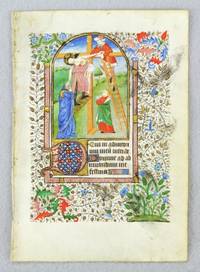
1420ST12005fFrance probably Paris ca. 1420. 210 x 146 mm. 8 1/4 x 5 3/4". Single column recto with five lines of text verso with 16 lines all in a very pleasing very regular gothic book hand. <br/> Attractively matted. Rubrics in red verso with a one-line and two two-line initials as well as a line filler in colors and burnished gold recto with a one-line initial and a line filler in the same style and with a quite large five-line "D" in pink and white with enclosed floral diapering all on a burnished gold ground the same side WITH A LOVELY FULL BORDER of swirling hairline stems bearing numerous leaves and berries of burnished gold and with sprays of acanthus leaves and flowers in multiple colors spilling from the corners this ENCLOSING A POIGNANT ARCH-TOPPED MINIATURE OF THE REMOVAL OF CHRIST FROM THE CROSS measuring approximately 85 x 60 mm. the miniature within a thin gold frame and enclosed in turn on three sides by bars in colors and gold the scene showing two men on ladders unfastening Christ's lifeless body from the cross while Joseph of Arimathea waits below clutching cloth to be used for a burial shroud as the Madonna at the lower left of the picture reaches up to clasp her son's bloody arm. With a small cross stitched in white thread in each upper corner. ◆A little soiling right along hinge edge a few smudges in the border a couple of tiny flakes of paint missing from the cross and the sky otherwise fine the vellum clean and fresh the colors rich and the gold lustrous.<br/> <br/> This is an especially sorrowful scene depicted with power grace and sensitivity by an artist demonstrating very considerable skill in composition and execution. The scene is well designed with the cross providing a device for focus at the center of the miniature. Nicodemus identified by his expensive attire is atop a ladder behind the cross lowering Christ's limp body onto the shoulder of another man probably a servant whose ladder is set against the front. Despite the fact that the corpse is more bones than flesh the artist has made it seem a heavy burden draped over the shoulder of the man as he walks backward down his ladder. Fully stretched out Christ's left arm is held for balance by Nicodemus at the top right while the other arm hangs down toward the Virgin. While we can only see her back her image evokes great pathos as she reaches up with both hands to grasp the mangled arm of her son his blood running from his hand onto hers. Joseph of Arimathea whose position anchors the right side of the picture looks on with concern tightly holding linen to shroud the body. St. John and Mary Magdalen conventional participants in the Deposition are not present in this miniature. While it is possible and even likely that the same artist produced this scene and the miniature of Christ Carrying the Cross this one is better as the faces are more deftly painted and the folds in the various garments are more clearly defined. unknown