Barberini, Maffeo [d.i. Papst Urban VIII]Antiquariat.de

26 128 résultats
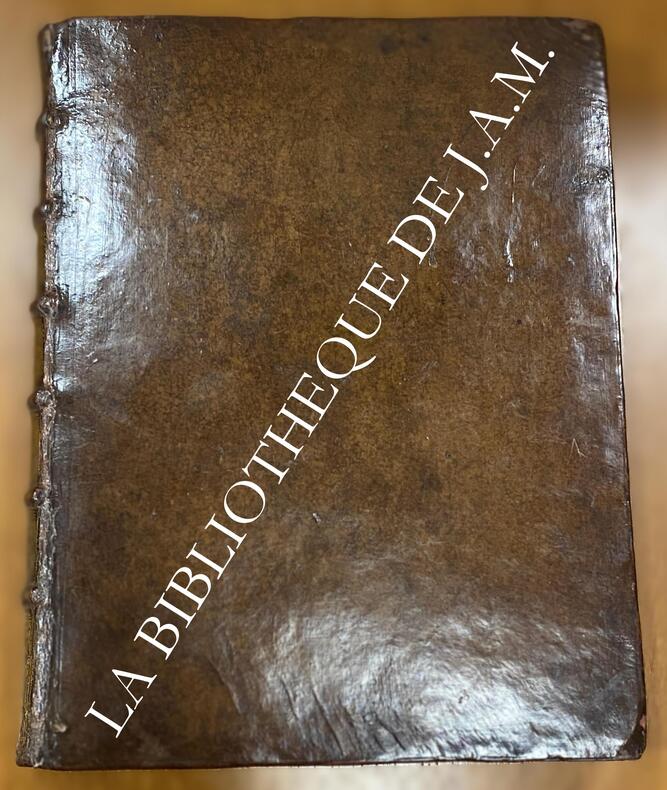
16343891FBAntwerpen, gedruckt in der Offizin Plantin-Moretus, 1634. Groß-8°. 24 x 20 cm. 290 Seiten, [2] Blatt. Restaurierter Lederband der Zeit auf 5 Bünden mit goldgeprägtem Titel auf rotem Lederrückenschild, Streicheisenlinien auf den Deckeln, erneuerten Vorsätzen und Rundum-Rotschnitt. [8 Warenabbildungen]
16643761DBAntwerpen, Plantiniana, 1664. 4°. (3) Bl., 1055, (1), 30 S., (26) Bl. Lederband der Zeit. + Wichtig: Für unsere Kunden in der EU erfolgt der Versand alle 14 Tage verzollt ab Deutschland / Postbank-Konto in Deutschland vorhanden +, Abb.
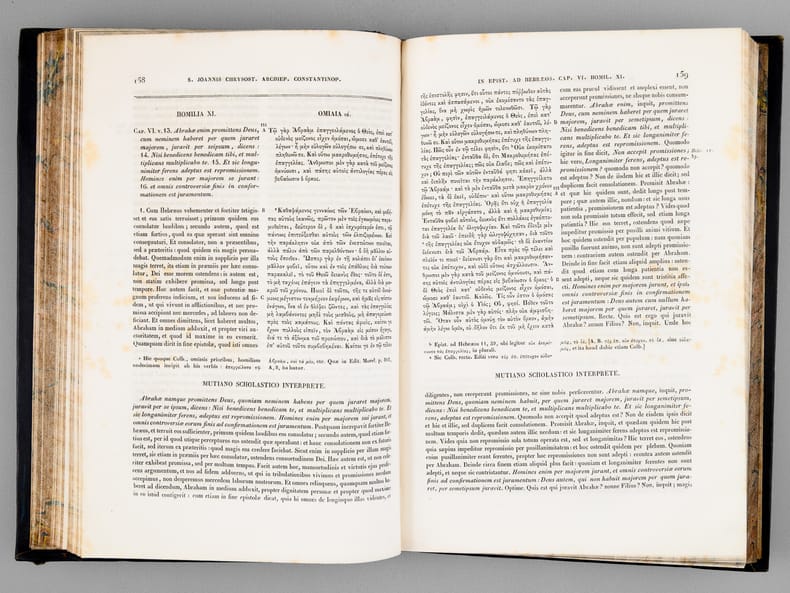
18356870425 vol. grand in-8 reliure de l'époque pleine basane mauve, dos à 4 nerfs, plats estampés à froid, toutes tranches marbrées, [Apud Gaume Fratres - Gaume Frères - Paris, 1835-1839 ]
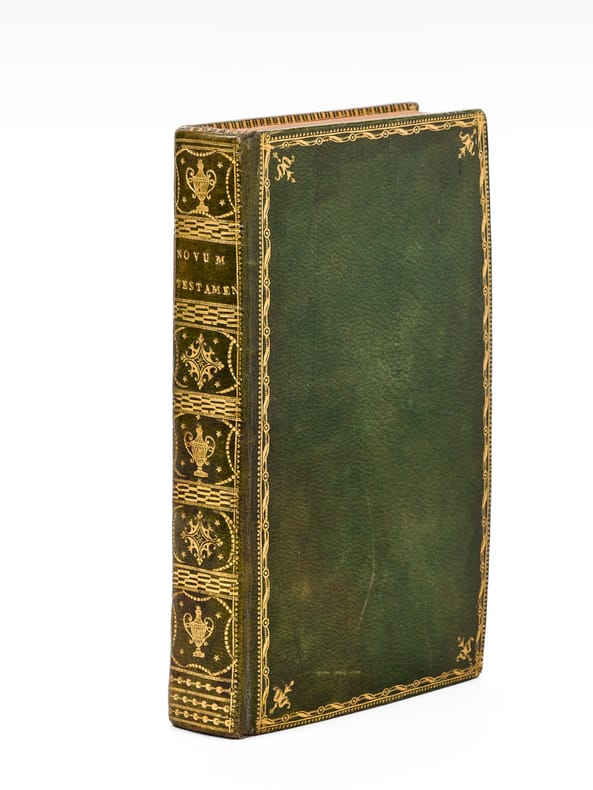
179668142Cura et studio quorundam ex eodem clero Wintoniae commorantium, 1 vol. in-12 reliure de l'époque plein maroquin vert, dos lisse orné, belle roulette d'encadrement en plats, coupes et chasses guillochées, toutes tranches dorées, E Typographeo Clarendoniano, Oxonii [ Oxford ], 1796, 1 f., 473 pp.
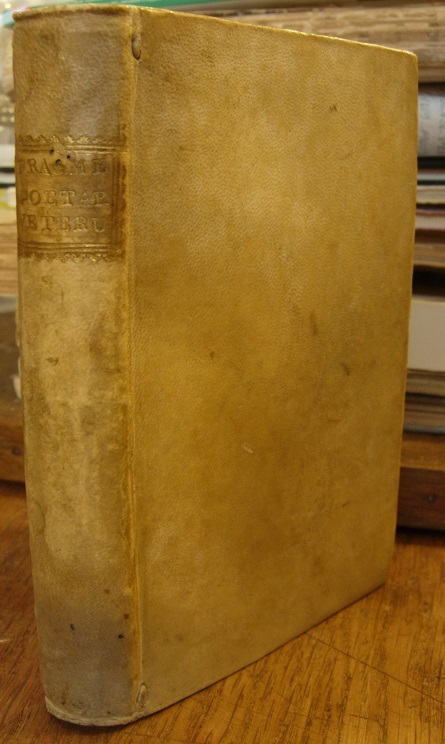
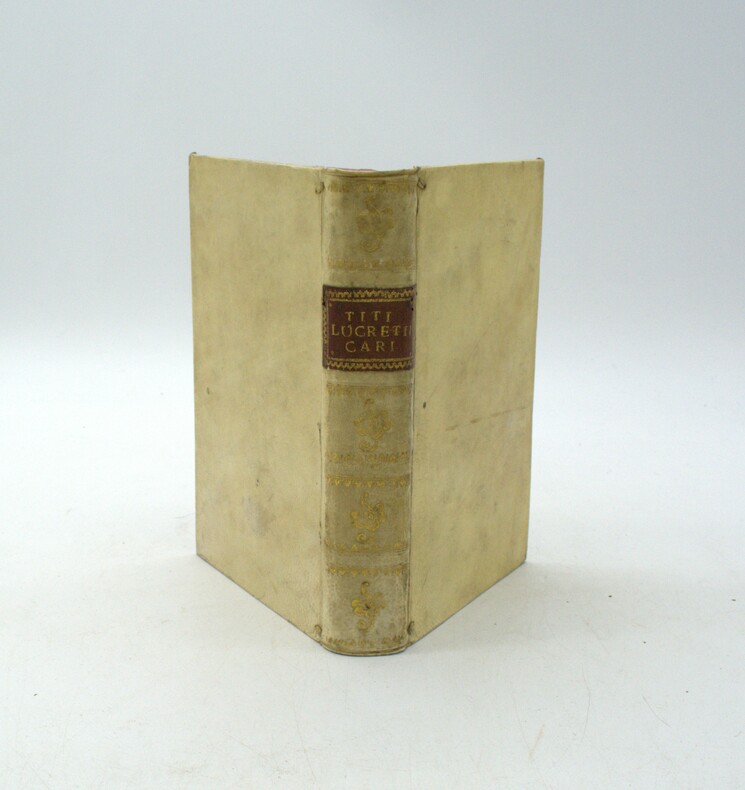
15647337[Genève] Henri Estienne (Henricus Stephanus) 1564 Petit in-8 plein vélin ivoire XVIIe, pièce de titre dorée, tranches rouges, 433 pages dont page de titre. Bel exemplaire malgré quelques annotations sur les gardes. Edition princeps pour certains des auteurs latins.
1682001914Bruxelles Foppens 1682
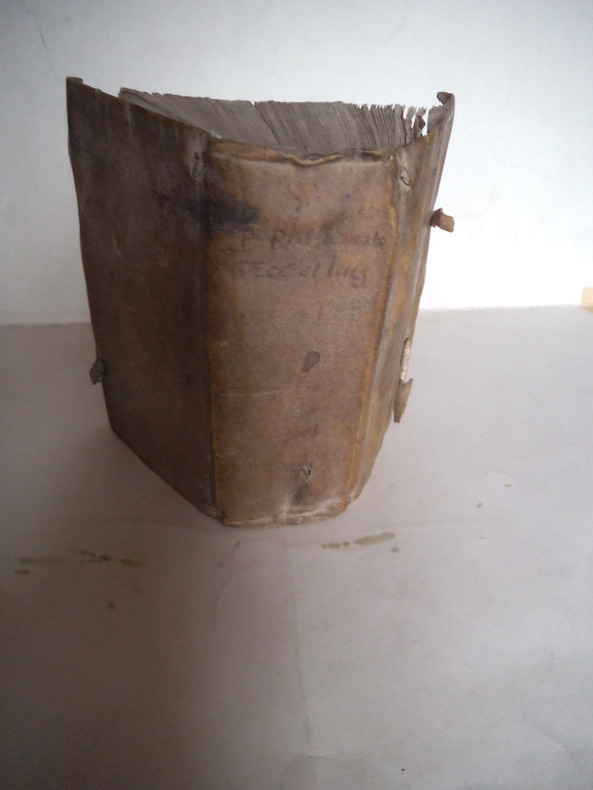
16563030FBHolmiae [Stockholm], Ex Officina Johannis Janssonii [Johannes Janssonius], 1656. 8°. 16,5 x 10 cm. [16], 327, [9] Seiten. Pergamentband der Zeit mit Rückentitel in Tinte. [5 Warenabbildungen]
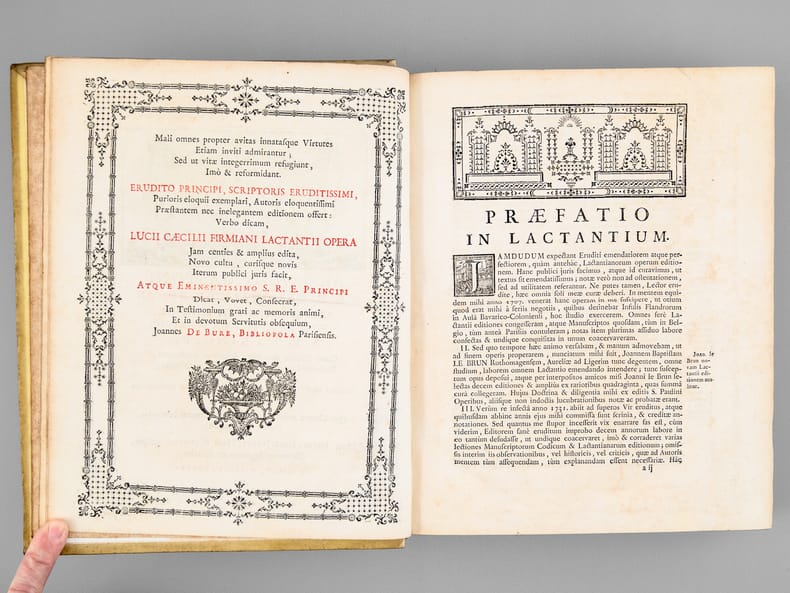
174868259Cui manum primam adhibuit Joannes-Baptista Le Brun, Rothomagensis ; extremam Imposuit Nicolaus Lenglet Dufresnoy, Presbyter ac Theologus Parisiensis, 2 vol. in-4 reliure de l'époque plein vélin blanc, dos à 6 nerfs, plats estampés à froid, Apud Joannem de Bure [ Jean de Bure ], Lutetiae Parisiorum [ Paris], 1748, 2 ff., clij-750 pp. et 1 f. n. ch. ; 2 ff., lxxxij-827 pp. avec 5 planches hors texte
1751PHO-1923Patavii (Padoue), excudebat Josephus Cominus, 1751, in-8, XLIV-426pp.-1f.-125pp.-vélin époque, dos lisse orné avec pièce d’auteur, gardes en papier dominoté, tranches rouges, ex-libris armorié au premier feuillet. De la bibliothèque du Marquis de Terzi avec son ex-libris et étiquette.
113947Spoleto, Firenze, C.I.S.M.E.L., 1980 - 1998.
384 pages. Extensive index. Notes on bibliography. Illustrated in color and black and white. Map endpapers. "Author served Israel's Ministry of Foreign Affairs in Columbia, Panama and Haiti. In those places, and many others in the Americas to which he traveled, he encountered descendants of Jewish colonists who recalled their religious heritage. Arbell has devoted a good part of his life to uncovering and documenting the elusive story of the Jews who lived in areas of Central and South America at one time ruled by the French, the Dutch, the Danish and the British." - from back board. Clean, bright and unmarked with very light wear. An excellent copy. Book
1 vol. in-8 reliure de l'époque demi-basane marron, Palaephatus De incredibilibus Graece. Iterum edidit recensuit indicemque verborum graecorum adiecit Ioh. Frid. Fischerus, Sumtu Ioh. Frid. Langenhemi, Lipsiae [ Leipzig ], 1770, viii-38 pp. et 29 ff. n. ch., texte grec, préface et index en latin / Meletemata e Disciplina Antiquitatis. Opera Friderici Creuzeri (3 Tomes - Complet) I : Anecdota graeca ex codicibus maxime Palatinis Depromta ; II : Commentationes et commentarii in Scriptores graecos ; III : Commentationes et commentarii in Scriptores graecos, In Bibliopolio Hahniano, 1817-1819, 118 pp. et 1 f. ; 1 f., 108 pp. ; iv-212 pp./ Symbolas ad emendandum et illustrandum Philostrati Librum De Vitis Sophistarum in Medium attulit Albertus Jahnius, Impensis C.A. Jenni Filii, Bernae [ Berne ], 1837, viii-146 pp. et 1 ff. Rare exemplaire réunissant trois éditions peu communes. Etat très satisfaisant (dos lég. frotté avec petite fente à un mors, manque d'origine en marge de la page 177 à la page 212 du tome 3 de Creuzer, avec qq. atteintes au texte, essentiellement en note, à partir de la page 193). Grec
17584A Lyon, chez Jean Certe, imprimé par les soins de monsieur l'abbé Périchon Prévost de St Salvadour, 1701, 1 plein veau d'époque, dos à nerfs, orné, plats frottés, coins et coupes émoussées, manques au dos, coiffes manquantes, reliure solide mais nécessitant de petites restaurations. in-folio de 1 feuillet blanc, titre frontispice gravé, illustré d'outils du tourneur et d'objets tournés formant un encadrement ornemental, titre avec une belle marque d'imprimeur gravée par Sébastien Le Clerc, 13 feuillets non chiffrés contenant une dédicace à Michel Begon, surmontée de ses armoiries, gravées par Le Clerc, une préface, table des chapitres, approbations, privilèges et table des planches, 187 pages, texte sur 2 colonnes, français et latin en regard, 71 planches gravées comprenant le frontispice, dont 1 dépliante ( bien complet des planches), l'ordre chronologique des planches n'a pas été respecté, 2 feuillets blancs in-fine, petite déchirure de 2 cm dans la marge haute de la page 126, dechirure sans manque au haut de la planche 48 et petite déchirure sur la planche 73, sans gravité, petite tache de mouillure brunie de 5 x 6 cm au bas de la charnière des marges centrales sur les 40 premiers feuillets, quelques rousseurs sur le premier feuillet blanc, petites pliures sur la page de titre ;
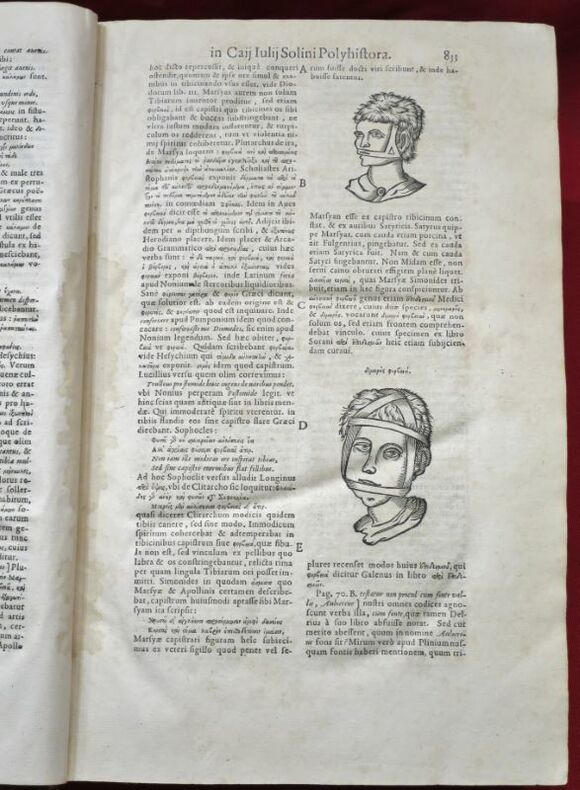
109830Parisiis, Apud Hieronymum Droüart via Iacobaea sub Scuto Solari, 1629, 2 volumes in-folio de 355x230cm environ, plein veau fauve d'époque, dos à 6 nerfs portant titres et tomaisons dorés sur pièces de titre havane, orné de caissons à fleurons dorés, encadrements des plats d'un double filet doré, tranches mouchetées, impression sur 2 colonnes par page (3colonnes dans l'index).Tome 1 : 1f.blanc, 26ff. ( faux-titre, titre avec vignette de titre à la marque de l'imprimeur : bouquet de chardons à la devise " Patere aut abstine, nul ne si frote", Serenissimae Venetorum reipublicae, prolegomena in solinum, Caii Iulii Solini grammatici polyhistor ab ipso edius et recognitus, C. Iulius solinus adventos), 824 pages, avec 20 figures gravées dans le texte. Trous de ver dans les marges et sur les contreplats, des rousseurs et pages brunies, un tampon sur la page de titre, - Tome 2 : page de titre avec de titre à la marque de l'imprimeur, tipographus lectoris, pagination continue sur les 2 volumes, tome II : 825 (numéroté 285 par erreur) à 1367 pages (addenda compris), +254 ff. ( Index rerum & verborum), avec 28 figures gravées dans le texte. Mouillure dans la marge des 16 premières pages (tome II), frottements, épidermures, rayures et traces d'adhésif sur le cuir, mors en partie fendus, coiffes manquantes, nombreuses erreurs de pagination mais aucun manque n'est à déplorer, des galeries de ver dans les marges, sans atteinte au texte. Texte en latin.
FIRST AND ONLY EDITION of this early Italian translation of Tacitus' Annales and Historiae. 424 leaves (i.e., 848 pp.), complete with the final blank leaf. 8vo. Bound in later full vellum. Some discoloration to first few leaves, else FINE AND BRIGHT, with the paper very fresh and clean throughout. Adams T45; Moss II, 660. Scarce, and certainly very rare in such fine condition.
1429ST12778-0360Italy 1429. 323 x 173 mm. 12 3/4 x 6 3/4". Single column 60 lines in a neat cursive script. <br/> Notarial signature at lower left; verso with a date and notations in contemporary hands. ◆Vellum trimmed a little close four horizontal and three vertical fold creases slight darkening to verso five very small holes no text obscured and one larger naturally-occurring hole in the text otherwise in excellent condition with a very clear hand.<br/> <br/> This is a notarized document recording an agreement made between the chapel and convent i.e. the whole community of the house of St. John a group of female religious located in the parish of St. Peter and the brothers of Bonsignioribus another religious house in the parish of St. Laurence Major. The women of St. John agree to pay to the brothers of Bonsignioribus a sum of 11 libras 8 soldas and 9 denarios. The reason for this payment is unclear pending further investigation into some of the more abbreviated portions of the text. The document is of additional interest for the fact that several female members of the house of St. John are mentioned by name. Based on these names and that of the notary Ambrosius Spanzota . . . Parmensis it would appear that the document was written in Italy possibly in Parma and that the two houses were also located there. unknown
pp. [viii], 182, [ii], 79, [i]. Woodcut Estienne device on title page. Greek and Latin in parallel columns. Text uniformly foxed. Manuscript description of the acquistion (in 1800) of this copy and other bibliographic points. 4to. 26 cm. 18th century full limp vellum binding. Herodianus, supposed to have been a Syrian Greek, flourished during the third century A.D. In 203 he was in Rome, where he held some minor posts. His great historical work was written in Greek and narrates the events of the fifty-eight years between the death of Marcus Aurelius and the proclamation of Gordianus III. (180-238). The narrative is of special value as supplementing Dion Cassius, whose history ends with Alexander Severus. Chronicling the events of his own times, gifted with ordinary powers of observation, indubitable candour and independence of view his work is of inestimable value. He gives a lively account of many events such as: the death of Commodus; the assassination of Pertinax; how Didius Julianus bought the Roman Empire at auction; etc. Extensive use has been made of Herodianus by later chroniclers, especially the 'Scriptores historiae Au gustae' and John of Antioch. Poliziano did the first translation into Latin (1493) which conferred celebrity status on Herodian for the duration of the Renaissance. This Herodian was described by Dibdin as `an elegant, rare and critical edition', with notes and textual revisions by Henri Estienne. This is the first edition of any part of Zosimus (Editio Princeps), although Estienne only printed the first two books, translated by Leunclavius. The volume was dedicated to Sir Philip Sidney. Estienne (Etienne) (Latinized as Stephanus) was a great family of Parisian and Genevan printers of the 16th and 17th century, distinguished through five generations in scholarship as well as in their craft. Henri Estienne , Jr. (1531?-1598), was the greatest scholar of the family. He inherited his father's (Robert) press on the express condition that it should not be moved from Geneva. He was a well-trained scholar and devoted years to searching for manuscripts. Although humanism was far advanced, he, nevertheless, discovered numerous works of classical authors of which he issued first editions. His editions of Greek and Latin works are remarkable for their accuracy and textual criticism. Renouard 149/7; Schreiber 209; Dibdin II, 15; Adams H388, S1738. **PRICE JUST REDUCED! Small Box OST 1
1744YRG-482In-4° (environ 25 × 20 cm). Reliure : Plein cuir marbré d’époque, veau brun marbré, dos à cinq nerfs orné de fleurons dorés, tranches rouges, usure naturelle : coins émoussés. Pagination : Environ 476 pages + index + notes (impression nette sur papier vergé). Gravure : Sans frontispice (conforme à cette édition ; vignette ornée sur le titre). PIERRE MORTIER. AMSTERDAM.
Book is in excellent condition in black cloth with gilt print at spine. Binding is solid and square, covers have sharp corners, exterior shows no blemishes, text/interior is clean and free of marking of any kind; as new. Dust jacket shows the slightest signs of shelf wear only, no tears. 714 pages, heavily illustrated with b&w photos, some color prints, maps, architectural drawings, coins, relics, iconography, etc. Over 400 illustrations This book tells the story of the Architecture and the Figural Art produced for the Crusaders after the battle of Hattin and the fall of Jerusalem in 1187, during the one hundred years that Acre was the capital of the Latin Kingdom of Jerusalem, 1191 -- 1291. It is an art sponsored by kings and queens, patriarchs and bishops, clergy, monks, friars, knights and soldiers, aristocrats and merchants, all men and women of means, who came as pilgrims, Crusaders, settlers, and men of commerce to the Holy Land. The artists are Franks and Italians born and/or resident in the Holy Land, Westerners who traveled to the Latin East, Eastern Christians, and even Muslims, who worked for Crusader patrons. Notes begin on p. 561 and go to 711. Unopened CD-rom at back contains a complete set of more than 500 illustrations from Crusader manuscripts.
1784bf5194Sabellus Sélection Abraxas-libris Relié 1784 50 GRAVURES DE SCÈNES ÉROTIQUES. Petit in-4 (20,5 x 25,5 cm.), 1784, relié demi-basane, pièce de titre rouge au dos lisse orné de filets dorés, tranches mouchetées de rouge, 98 pages, un texte décrit chacune des L gravures, une gravure en frontispice, passages en latin, grandes marges ; légers frottements aux bords et coins, quelques rousseurs, par ailleurs bel état. Livraison a domicile (La Poste) ou en Mondial Relay sur simple demande.
5619In-16, plein vélin à recouvrement,d’époque,titre manuscrit à la plume.Restes de cordons sur les plats.Titre,XXX,703 pages. [Genevae],Excudebat Henricus Stephanus,illustris viri Huldrichi,Fggentypographus 1568. Bon exemplaire Henri Estienne"collection populaire d'anecdotes grecques, sur le modèle de Apophtegmata Erasmus ... C'est le dernier livre de Henri Estienne qui styles lui-même Viri Huldrichi Fuggeri typographus…"(Shreiber) "Henri Estienne's popular collection of greek anecdotes, modelled after Erasmus's Apophtegmata...This is the last book in which Henri Estienne styles himself Viri Huldrichi Fuggeri typographus..." (Schreiber) Caractères grecs de corps 12 dit Cicero de Garamond. Renouard, p.131, n°5 ; Schreiber, n°172
1755CA0114<p>24531 pages with engraved allegorical frontispiece and index. Small folio 11 1/2" x 8 1/2" bound in original full leather with raised spine bands and decorative gilt lettering. Palau 266572. Sabin 70785 First edition.<br /><br />Full of original documents respecting the establishment of the Church in the Indies and the protection of the Indians together with all the bulls referred to from that of Alexander VI to the time of publication. With the additional 24 preliminary leaves not in all printings.<br /><br />The ancestors of Rivadeneira on both sides had served the Crown for centuries in the Reconquista in high positions of Church and State and in the conquests of Mexico and the Darién. Among his relatives is the Marquis de Moncada lieutenant colonel of the Puebla Regiment. Rivadeneira received a bachelor's degree in Philosophy and Law from the University of Mexico. He obtained a scholarship at the Colegio Mayor de Todos Santos on November 11 1731 served in various positions competed for the Chair of Institutes and remained in residence until 1746. The Audiencia de México approved him to practice as a lawyer in 1733. While still in Todos Santos Rivadeneira began serving in various positions. He was an advisor to the mayors of the city and town of Carrión in Valle Atrisco. The interim viceroy-archbishop Juan de Bizarrón appointed him a lawyer for the poor of the Courtroom of the Audiencia in 1739 with similar capacity in the Tribunal del Santo Oficio the city of Puebla and the Agustino Convent of Mexico. In 1744 Rivadeneira became fiscal agent of the room of the Crime. He served as an advisor to the viceroy Duke of the Conquest and was commissioned to settle a dispute over land by his successor the Count of Fuenclara. In 1746 Rivadeneira decided to go to Spain for family businesses and to secure a position. For a payment of 13000 pesos he obtained the appointment as supernumerary judge of the Audiencia de Guadalajara by decree of January 30 and title of February 20 1748. Without occupying this position he obtained the criminal prosecution of the Audiencia de Mexico on December 22 of 1753. He obtained a license to sail to New Spain with the servants José Ostos of Écija; Diego Ibiricu from Cádiz; Antonio de la Cruz from Zacatecas and Manuel Tagle a "free black". Rivadeneira returned to New Spain in 1755 in the same vessel in which the new viceroy Marquis de las Amarillas went and assumed his post on October 30 1755. As a prosecutor he opposed the activities of the Tribunal de Acordada. Assigned to the civil prosecutor's office to replace Luis de Mosquera and Aranda by consultation of April 28 and title of June 21 1760 the following year by consultation of May 14 and title of August 15 was appointed to replace the deceased Francisco López Adán as judge of the Audiencia. He served until his death. While he was an oidor he was denounced for possessing forbidden books. While in Spain in 1752 Rivadeneira published <em>El Pasatiempo for the use of Ex.mo Señor Carvajal and Lancaster a history of the world from creation to Fernando VI</em> in three volumes. This long didactic and religious poem was an effort to obtain a position and Beristain perhaps not knowing of the payment of 13000 pesos by Rivadeneira considered his first appointment of audience due to the sponsorship of José de Carvajal. As a prosecutor in 1755 Rivadeneira wrote the <em>Handbook compendium of the Indian Board of Trustees</em> which traced the royal patronage to the Book of Genesis an achievement for which the Crown gave him 4000 pesos. He also wrote the <em>Defense of Royal Jurisdiction</em> in 1763 <em>the remarkable newspaper of His Excellency Marquise de las Amarillas</em> and the draft of the protest sent to Spain by the City Council of Mexico City in 1771 on a claim of appointments for Americans.<br /><br /><strong>Condition:</strong><br /><br />Missing some of spine label small crack along the heal font hinge spine ends chipped light rubbing to extremities with the corners rubbed through internally very nice over all a very good copy.</p> Antonio Marín hardcover
185632458Cleveland: L.E. Barnard & Company 1856. Hardcover. First Edition in North America. Lyman's translation was only the second appearance in English after the London edition of 1729. 5 x 8in. xi. 88pp. Publisher's blind-stamped diamond cloth boards with gilt titling and decoration. VERY GOOD. Shows the boards marginally shelf rubbed and toned two former owner names of the period at the first blank otherwise the binding is strong and tight the text is clean and unmarked and the boards remain bright and distinct. An exceptionally maintained copy. As pictured. L.E. Barnard & Company hardcover
elala2064Quebec: John Neilson 1812 i.e. 1814. 12mo. pp. 7 p.l. 2-379 4. contemporary calf rebacked corners worn. Second Edition. The last two leaves contain the index and approbation dated 12 February 1814 in which the Bishop of Quebec advises that this second edition was necessary as the first was out of print. Neilsons Heures Romaines was originally published in 1795. Lande 2156. Vlach 260 incorrect pagination. Vlach IQ 470. Dionne I 104 & Gagnon I 1660 pp. 379. TPL 6937. Quebec: John Neilson, 1812 [i.e. 1814]. unknown
16643761DBAntwerpen, Plantiniana, 1664. 4°. (3) Bl., 1055, (1), 30 S., (26) Bl. Lederband der Zeit.