Polyglot Bible|Walton, Brian (ed)Biblio.com
52 résultats
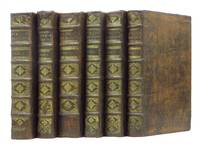
165512173London Thomas Roycroft/Apparatus: Zürich Heinrich Bodmer 1657 colophon Vol.2: 1655 Vol.3: 1656/Apparatus: 1673. Biblia Sacra Polyglotta Complectentia Textus Originales Hebraicum cum Pentateucho Samaritano Chaldaicum Graecum. Versionumque antiquarum Samaritanae Graecae LXXII Interp. Chaldaicae Syriacae Arabicae Aethiopicae Persicae Vulg. Lat. Quicquid comparari poterat. Cum Textuum & Versionum Orientalium Translationibus Latinis. Ex Vetustissimis Mss. Undique Conquisitis optimiisque Exemplaribus impressis summâ fide collatis. Quae in prioribus Editionubus deerant suppleta. Multa antehac inedita de novo adjecta. Omnia eo ordine disposita ut Textus cum Versionibus uno intuitu conferri possint. Cum Apparatu Appendicibus Tabulis Variis Lectionibus Annotationibus Indicibus & c. Opus totum in sex Tomos tributum. Edidit Brianus Waltonus. WITH: Briani Waltoni Angli Viri Celeberrimi Biblicus Apparatus Chronologico- Topographico- Philologicus: Pront ille tomo praeliminari Operis eximii Polyglotti Londini Anno Christi MDCLVIII. editi continetur. Exhibens Tractatus varios eósque integros Diversorum Virorum doctissimorum & in omni Literatura exercitatissimorum de ratione Sacrorum Temporum Locorum ut Terrae promissae Templi Urbis Ierosolymitanae &c. Nummorum Mensuarum Ponderum nec non Idiotismorum Scripturae sacrae Linguarum & Versionum Orientalium. Adjiciuntur Johannis Drusii De Proverbiis sacris Classes duae. Nunc in gratiam omnium qui Musas has sanctissimas sanctè colunt seorsim excusi & Indicibus exornati. 6 volumes and 1 portrait frontispiece 14 865 889 1 29 1 447 1 389 1 227 1 149 1 87 1 3 1 128 23 1 20 159 1 390 983 1 2 72 56 98 80 196 140 24 58 36 36 96 =74 2 p. H. 46 x W. 295 cm. Contemporary Leather with 6 raised bands decorated with gilt large Folio Apparatus 6 570 6 p. later Vellum with 5 raised bands Folio. This is the last edition of the four great Polyglots following that of Alcalá 1514-1517 in four languages Antwerp 1569-1573 in five and Paris 1628-1645 in seven. It's the most extensive edition of the great Polyglot Bible the London Polyglot or the Walton Polyglot after the compiler Brian Walton 1600-1661. According to Brunet this edition ""is the most sought after being more complete and correct than the others and containing nine different languages"" with Ethiopian and Persian added to the seven languages of the Paris Polyglot. So it includes the text of the Bible in 9 different languages: Hebrew Samaritan Aramaic Greek Latin Ethiopic Syriac Arabic and Persian. All of the texts that are not in Latin are accompanied by Latin translations and all are arranged side by side or one over another on the two pages open before the reader. The first three volumes contain the Old Testament. They give the Hebrew text with the Samaritan Pentateuch the Latin Vulgate the Greek Septuagint the Aramaic Targum and the Syriac and Arabic paraphrases. The fourth part contains the Apocrypha and the Triplex Targum i.e. Targumim I and II of Jerusalem and the Persian version of Jacob ben Joseph Tawus. The fifth volume is devoted to the New Testament printed in Greek Latin Syriac Arabic and Ethiopian. Finally the last section contains the critical apparatus. Volume 1 is illustrated with multiple engravings in the text a portrait of Brian Walton a frontispiece 2 plans a map and 3 engravings all double-page except 1 plan. An extra volume by Brian Walton the Apparatus contains parts of the Polyglot such as codices chronologies proverbs and Holy Land details. Vol. 1 missing blank leaf after pp. 865. Spines restored portrait and title print frayed with creases some browning and staining. A copy of the second edition without the reference to Cromwell's protectorate in the preface. It does not contain the dedicated epistle to King Charles II but does contain the one mentioned by Brunet at the beginning of the first volume p. 48. From the library of the Scholasticate of Differt Belgium with a dry-stamp and stamp on the title. A firm and complete set of this influential work. Darlow T.H./Moule H.F. 1963. Historical Catalogue of the Printed Editions of Holy Scripture Vol.II 1 no. 1446 on p. 23-26 / Wing B2797 / Brunet I 852. London, Thomas Roycroft/Apparatus: Zürich, Heinrich Bodmer hardcover
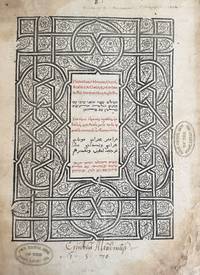
1516371021Genoa: Petrus Paulus Porrus 1516. Title printed in red and black within woodcut arabesque border printer's device on final leaf. Parallel text in Hebrew Latin Greek Arabic and Chaldaean Aramaic 4 columns to a page 41 lines. 13 woodcut floriated initials. A10 B-Z8 &8 con6; 200 leaves complete. Folio 13-1/8 x 9-3/8 inches. Contemporary blind tooled pigskin over bevelled wooden boards boards with repeated roll of hound hunter and stag spine with floral tools. Clasps perished early repairs with vellum at lower corners; spine darkened with chip at foot joint starting wormholes to the covers. Toning throughout worm holes throughout but heavier to the preliminary and terminal leaves paper loss not affecting text at the lower outer corners of the first 3 leaves minor dampstaining at the lower corners of most leaves and extending from the top inner margin. Scattered early marginalia. Title printed in red and black within woodcut arabesque border printer's device on final leaf. Parallel text in Hebrew Latin Greek Arabic and Chaldaean Aramaic 4 columns to a page 41 lines. 13 woodcut floriated initials. A10 B-Z8 &8 con6; 200 leaves complete. Folio 13-1/8 x 9-3/8 inches. The Genoa Psalter also known as the Octaplum or Quadruplex Psalter was the first polyglot psalter to be published and the first polyglot edition of any part of the Bible. Financed by the Oriental language scholar Bishop Agostino Giustiniani and printed in Genoa in 1516 it presents the psalms laid out in eight columns i.e. four per page on double-page spreads: in Hebrew a Latin paraphrase the Vulgate Latin the Septuagint Greek Arabic Chaldean Aramaic a Latin paraphrase and the editor's notes. "A monument of Renaissance typography this Psalter was linguistically the most ambitious work attempted to date and the first Polyglot work ever published. It provides the Psalms in five languages as well as a marginal scholarship based largely on rabbinic sources. The Arabic text is one of the first two texts and the first biblical text ever printed in this language. The Hebrew types used in this book were apparently never used again" B. Sabin Hill Hebraica from the Valmadonna Trust The Piermont Morgan Library 1989 no. 18.<br /> <br /> Notably within a lengthy editor's note to Psalm XIX is what is considered the first printed biography of Christopher Columbus along with a very early description of his voyage. A native son of Genoa Giustiniani presents the discovery of the new world as a fulfilment of Biblical prophecy appropriately glossing verse four of Psalm XIX to include his biography of Columbus: "Their sound is gone out through all the earth and their words to the end of the world." <br /> <br /> The text of the biography of Columbus written a decade after his death includes a brief account of his childhood and continues at length on his discovery of America. Translated from the Latin it begins: "And so their words have reached unto the ends of the earth at least in our own times in which by the marvelous daring of Christopher Columbus of Genoa almost another world was discovered and joined to the community of Christians. And since Columbus often declared that he was chosen by God so that through him this prophecy would be fulfilled I did not consider it unsuitable to include his life here. Therefore Christopher surnamed Columbus a Genoese by birth . lived in our age and through his own efforts explored more lands and seas in a few months than almost all other mortals had done throughout all previous ages . More swiftly than the Portuguese had done he approached new lands and new peoples and at last penetrated regions unknown before now. The news of this matter quickly reached the King who - both out of rivalry with the Portuguese kings and a desire for such new marvels and glory that might accrue to him and his descendants - after long discussions with Columbus finally ordered two ships to be outfitted. With these Columbus set sail from the Fortunate Islands directing his course slightly off the western line . After many days of sailing they had covered great distances. While the others having lost all hope urged a change in course Columbus persisted asserting by reason and conjecture that continuing but a little longer might lead them to discover continents or islands. Nor was he wrong. On the following dawn they sighted land. From this event immense confidence arose in human minds. Later it was learned that these were islands and observations were made of certain peoples there uncultivated and prone to raids on their neighbors even devouring human flesh like wolves. There were violent encounters yet eventually some of these islanders were brought safely to Spain astonishing and delighting all who saw them because they were at first timid unfamiliar with approach easy to persuade and marveling at everything as new."<br /> <br /> An important and desirable work from a liturgical linguistic and historical perspective. Adams B1370; BM STC Italian p. 97; Darlow & Moule 1411; Sabin 66468; European Americana 516/4; Harrisse BAV 88; JCB 3 I:64; Smitskamp 236; Roper Early Arabic Printing in Europe in Sprachen des Nahen Ostens und die Druckrevolution p. 132; Vinograd Genoa 1. Provenance: Cenobii Alois 1570 inscription below title; Bibliotheca Regia Monacensi pencil inscription on the inside front board identifying it as a duplicate; General Theological Seminary ink and blindstamps and other markings Petrus Paulus Porrus unknown