University of Natal Dept of EnglishBiblio.com
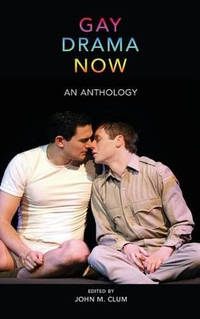
Gay Drama Now
19576812like new. unknown

GreatBookPrices · États-Unis155,16 $US≈ 131,28 €
8 080 résultats
1996ZB3934241996-97. volumes 8-9 complete volumes ex library partly bound PRICE IS FOR THE LOT. - If you are reading this this item is actually physically in our stock and ready for shipment once ordered. We are not bookjackers. Buyer is responsible for any additional duties taxes or fees required by recipient's country. unknown
191719-6Used - Very Good. Pages intact with possible writing/highlighting. Binding strong with minor wear. Dust jackets/supplements may not be included. Stock photo provided. Product includes identifying sticker. Better World Books: Buy Books. Do Good. unknown
1970ZB393901University of Illinois at Chicago 1970. volumes 1-5 1970-1974 an uninterrupted run of complete volumes partly bound library markings textually clean & tight price is for the lot. - If you are reading this this item is actually physically in our stock and ready for shipment once ordered. We are not bookjackers. Buyer is responsible for any additional duties taxes or fees required by recipient's country. Photos available upon request. University of Illinois at Chicago unknown
0195686527New. Brand new and still unused unknown
19576812like new. unknown
19576812-nnew. unknown
A9781604978421Hardback. New. hardcover
1988ZB385812NY: University of Wisconsin 1988-91. volumes 1-2 4; partly bound ex library price is for the lot. - If you are reading this this item is actually physically in our stock and ready for shipment once ordered. We are not bookjackers. Buyer is responsible for any additional duties taxes or fees required by recipient's country. NY: University of Wisconsin unknown
1016458029.Ghardcover. Good. Access codes and supplements are not guaranteed with used items. May be an ex-library book. hardcover
63-8399Columbia MO: University of Missouri English Dept. 2012-2015. Periodicals. 8vo. ca. 200 pp. each. Soft Covers Photographs Illustrated covers. Very Good. 9 Issues in all. Columbia, MO: University of Missouri English Dept., 2012-2015. paperback
19872090202120809132Not Available 1987. Soft Cover. Fine. Volume: 1 Not Available paperback
DADAX097782957XBrand: Trialtea USA 0000-00-00. 1. paperback. New. 0.00x0.00x0.00. Buy with confidence. Excellent Customer Service & Return policy. Brand: Trialtea USA paperback
0982838816.Gpaperback. Good. Access codes and supplements are not guaranteed with used items. May be an ex-library book. paperback
1357593112.Ghardcover. Good. Access codes and supplements are not guaranteed with used items. May be an ex-library book. hardcover
1356356982.Ghardcover. Good. Access codes and supplements are not guaranteed with used items. May be an ex-library book. hardcover
18770009039NAPLES ALEXANDRIA CAIRO SUEZ JAFFA JERUSALEM. Good. 1877. On offer is a fascinating journal written by an English woman of a trying and difficult voyage from Naples Italy to the Holy Land of Jerusalem in 1877. The journal is 35 pages long and is of a trip of a small group who travel first to Alexandria via Sicily then by rail to Cairo and Ismailia through the newly constructed Suez Canal and finally an extraordinary months journey on horseback with tented camping in the desert at night. The trip is a very difficult journey and at one point the woman writes this was our first experience of travelling in Palestine and I can assure you it was a most trying one. The authors handwriting is beautiful and is an easy pleasure to read. These pages seem to be notes for a talk the woman is going to give. There are also corrections of the writing in pencil by the woman herself and the book ends as if the words were meant to be spoken to an audience. The journal begins: Naples to Jerusalem Notes by the way Naples which is to be my starting point tonight is beautifully situated on one of the finest bays in the world. The city extends for three miles along the short of the bay but rows of houses villages and small towns extend almost entirely around it. Nearly opposite Naples is Mount Vesuvius from whose summit have poured in times past the streams of lava and showers of ashes which have again and again buried whole towns and villages situated on its sides and even at some distance from its foot; and from which a light cloud of smoke is always rising.; We went on board a steamer bound for Alexandria at two p.m. on Sunday February the 18th 1877 but did not sail until five oclock during which time we had a fine view of the city and its surroundings.On the following morning we entered the straits of Messina and about 11 oclock landed at Messina capital of Sicily where we stayed a short time and walked through the town. We sailed about 12 and it was quite smooth through the straits our companions came on deck.Soon after we got through the straits a storm burst upon us. The guards were fixed on to the table today to keep the things in their places but did not remedy all the evil for as you know anything liquid will find its own level so that when we had soup before us and the boat rolled to an angle of 45 de. It was either running over the opposite edge of the plat or pouring over us which was far from pleasant we had no more soup during the three days that the storm commenced. They reach Alexandria a few rough days later: Pompeys pillar and Cleopatras needles are the most striking monumental relics of Alexandria and we drove to Pompeys pillar first. It stands on rising ground the highest in the neighborhood and close to it is a Mohammedan cemetery. The writer is a smart woman adept at conveying events with skillful detail grativats and occasionally humor. She is also quite a worldly woman often bringing in recent world events to give context: Recent events have brought Egypt to the notice of all newspaper readers and the bombardments of the forts of Alexandria by the British Fleet and the subsequent setting on fire of the principal parks of the city and especially of the European part has been brought very vividly before the public by the Illustrated Papers. The Great Square is where the principal buildings of the city were situated. The buildings surrounding it were of imposing appearance here were the Consulates the principal Banks the finest shops and the largest hotel.All this is now a heap of ruins. She goes on to describe the contrast in dress between native women and European women: you often see for instance an Egyptian woman covered from head to foot with a long thick veil which hides all but her eyes and walking close behind her an European lady dressed in the height of Paris fashion. The European gentlemen are of course dressed as we are accustomed to see them except that all wear the Turkish fez and the higher class Egyptians mostly wear the same dress but the lower classes all wear loose petticoat trousers reaching to the ankles and a loose jacket and round the waist they often have a gaily coloured sash or shawl. After Alexandria the writer takes a train to Cairo. She describes the train ordinary first class ones made in England and sent out and the landscape she sees the land is well cultivated and is watered by the annual overflowing of the Nile and is also artificially irrigated by means of numerous canals cut for the purpose from the Nile.. Cairo is a more purely Oriental city than Alexandria and we stay here five days. The writer describes the contrast between old Cairo and new Cairo as well stating that the new Cairo is built after the style of the boulevards of Paris with wide streets and trees planted on the side paths shops and houses in the European style while the old Cairo is truly Eastern narrow irregular streets merely of earth trampled smooth though far from being level. In Cairo the writer describes many different places she sees travelling around the city by donkey indeed there are regular stands for them and anyone who wishes to go out calls for one as we call for a cab and especially the shops in the bazaars. While in Cairo she takes a donkey trip to the Island of Rhoda to see the famous Nilometer that measures flood height. She also goes to see the Boulak Museum the finest collection of Egyptian Antiquities in the world the University of the East and observes the Muslim call to prayer at the University: At 12 o.c. the call to prayer was heard from the minarets of the mosk mosque and instantly all spread their prayer carpets on which they knelt down with their faces turned towards Mecca and utterly regardless of our presence they went through their devotions. From Cairo there are day trips to Sakkara and Memphis where the writer sees and writes of many statues sculptures and sacred bulls all very well preserved and recently discovered and excavated. After the five days in Cairo the author sets off for Ismailia a place on the Suez canal about half way between Suez and Port Said. She comments on the refilling of the dry Lake Imshah after Suez Canal construction just 8 years or so earlier. She writes Ismailia has entirely grown up since the canal was made it was before nothing but desert but a freshwater canal supplies it and other stations on the Suez Canal. It seems as if wherever water can be got on to the land the desert may be turned into a garden for already they have a few good gardens there and many avenues of trees. The author than travels to Port Said across the Suez Canal by steamer. From Port Said she goes onto Jaffa. During the time we had our only experience of the Kamseen which is a hot dry wind full of fine sand blowing off the desert and looks like a thick yellow fog. The sand was so fine that it penetrated all our clothes and we had to go into the cabin for protection. In Jaffa she comments on the numerous orange and lemon groves the poor sanitary situation in the city and the many muddy dirty and crooked streets of the city our first impressions were not pleasant. In Jaffa she goes to Simon the Tanners house and also to where Peter had his vision of a sheet let down from Heaven knit at the four corners and filled with all manner of beasts etc. She also visits a Mission school run by an English lady attended by Jews Mohammedans and Syrians alike. The school is Methodist. From Jaffa the author and her companions set out for the month long horseback trip to Jerusalem sleeping in tents at night. We rode between orange and lemon groves for some distance the road was fenced off with prickly pear a close growing thorny cactus which reaches about 6ft high a fence which will defy man or beast. From the onset of the journey there are persistent problems with the horses: my horse had a bad trick of pulling up suddenly if I tried to pass the foremost of the party they cing very tenaciously to each other and there was no attempt to run away with any of us.We were in the saddle for over five hours with the sun fiercely shining on us from a cloudless sky and if there had not been a nice breeze we should have found it much worse than we did. Despite the problems the write is astounded with the beauty of the Middle Easter landscape. The Plain of Sharon was gay with flowers particularly with a small anemone of a very bright scarlet and as we got into the hill country the ledges of the rocks were filled with beautiful varieties of cyclamen. At night she describes the tents they have brought along and the new experience of sleeping in tents which seemed almost like sleeping out of doors. They have brought along five sleeping tents a saloon tent and a kitchen tent with a Union Jack flag flying from one and Stars and Stripes from the other. It is obvious the people on the trip come from wealth as she describes the extraordinary five course dinner they are served in their camp site: first course soup 2nd stewed tongue with fried potatoes 3rd cauliflower browned with egg & breadcrumbs 4th chicken and asparagus 5th apricot tarts and dessert nuts raisins & Jaffa oranges after which we had a large cup of tea to finish off with. The first nights are cold and noisy nights with dogs barking and frogs croaking. They wake up each morning with a servant blowing a rams horn trumpet. The writer is taken by the Biblical ground through which she travels: Our route to day is over ground of great interest and where great events in the early history of the subjugation of Palestine by Joshua took place. It was here that Joshua uttered the memorable words at the battle of Beth Horon Sun stand thou still upon Gibeon and thou Moon in the valley of Aijalon.I have no doubt they would take the same road we were going for we reached Kirjath Jearim where the Ark was kept so long early in the day. Finally the author and her companions reach Jerusalem. Here she writes clearly and beautifully of Jerusalem of its hills and deep valleys and twisting roads. We descend the Mount of Olives past the garden of Gethsemane then across the brook Hedron and up the other side of the valley passing the traditional site of Stephen's martyrdom. Enter Jerusalem by St. Stephen's gate and along the Via Dolorosa return to our hotel. The journal ends like so We spent several days in visiting the places of interest in the city and its neighbourhood but it would take too long for me to attempt a description of them. I can only hope in conclusion that some here present may have the pleasure of seeing for themselves that wonderful city and land. The journal consists of four gatherings of roughly 10 pages each though these gatherings are not bound and many pages are loose or very close to being unattached. The paper shows some wear and coloration from age but it does not hinder the experience of reading this amazing travelogue at all.; Manuscript; Folio - over 12" - 15" tall; KEYWORDS: HISTORY OF PILGRIMAGE TO THE HOLY LAND JERUSALEM PRE-STATE ISRAEL NAPLES MESSINA ITALY SICILY ALEXANDRIA CAIRO EGYPT ISMAILIA SUEZ CANAL ARABIAN DESERT TRAVEL BY HORSEBACK 19TH CENTURY FEMALE TRAVEL IN THE 1800s BAZAARS OF EGYPT NOTES FOR A LECTURE TRIP THROUGH THE ARAB WORLD NORTH AFRICA MIDDLE-EASTERN TRAVEL RAIL TRAVEL IN THE LEVANT KHAMSIN WIND JAFFA SHARON PLAIN LUXURY TRAVEL BIBLE TRAIL DESCRIPTIONS OF MIDDLE EASTERN LANDSCAPE BRITANNICA HANDWRITTEN MANUSCRIPT DOCUMENT LETTER AUTOGRAPH WRITER HAND WRITTEN DOCUMENTS SIGNED LETTERS MANUSCRIPTS HISTORICAL HOLOGRAPH WRITERS AUTOGRAPHS PERSONAL MEMOIR MEMORIAL ANTIQUITÉ CONTRAT VÉLIN DOCUMENT MANUSCRIT PAPIER ANTIKE BRIEF PERGAMENT DOKUMENT MANUSKRIPT PAPIER OGGETTO DANTIQUARIATO ATTO VELINA DOCUMENTO MANOSCRITTO CARTA ANTIGÜEDAD HECHO VITELA DOCUMENTO MANUSCRITO PAPEL . hardcover
1996Q-0878910131Research & Education Association 1996-06-02. paperback. New. In shrink wrap. Looks like an interesting title! Research & Education Association paperback
199719316New York NY: Columbia University Press 1997. 2nd printing. Hardcover. Good. Thick small quarto oversized. Slight wear to edges and corners. All 4 corners at foredge bumped. Slight scuffing and a few marks at edges of textblock. Some check marks in pencil at margins. xii 591 p. w/endnotes b&w illus. name & subject indexes. includes discussion of the land cathedrals court Tour de France monuments books notably Proust street names gastronomy and more. <br/><br/> Columbia University Press hardcover
ria9780192849335_inpHardback. New. New Book; Fast Shipping from UK; Not signed; Not First Edition; This book investigates the role of exemplarity as a rhetorical device in late Elizabethan and Jacobean literature and culture. Ullyot argues that exemplarity is driven by both reader and author and that positive moral examples were pre hardcover
1333897057.Gpaperback. Good. Access codes and supplements are not guaranteed with used items. May be an ex-library book. paperback
152777922X.Gpaperback. Good. Access codes and supplements are not guaranteed with used items. May be an ex-library book. paperback
1852692731.Gpaperback. Good. Access codes and supplements are not guaranteed with used items. May be an ex-library book. paperback
43920HARVARD UNIVERSITY PRESS 1989. 1ST EDITION. A FINE HARDBACK COPY IN A FINE GLASSINE PROTECTED DUSTWRAP. SCARCE. HARVARD UNIVERSITY PRESS, 1989 hardcover
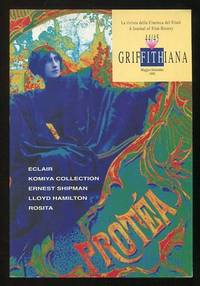
199228476Gemona Italy: La Cineteca del Friuli. Near Fine. 1992. No. 44/45. Journal. virtually as-new with just the teensiest bit of handling wear. facsimiles B&W photos color poster reprod. A double number of this highly-specialized film history journal published in conjunction with the Pordenone Silent Film Festival and generally keyed to the contemporaneous festival offerings and presentations. Major topics of this issue/festival were the Eclair Company a French film producing firm that also had an American branch and silent comedian Lloyd Hamilton. All articles are presented in both English and Italian. The Eclair section begins with an overview of the studio's history by Richard Abel followed by a reminiscence of "My First Visit to the Eclair Studio" in Fort Lee New Jersey by art director Ben Carré a checklist of the company's French films 1907-1919 and a "filmographic chronology" of the American arm of the company covering the years 1911-1915 derived from the trade press and the company's own house organ. There are two articles about Lloyd Hamilton by Bo Berglund and Richard M. Roberts plus a filmography. Also in this issue: an article about the discovery of the Komiya Collection a large private collection of early European cinema that was donated to a Japanese museum in 1988; an article about Ernest Shipman an early Canadian film producer by D.J. Turner; an article by Scott Eyman about the clashes between Ernst Lubitsch and Mary Pickford during the making of ROSITA 1923 the former's first American film starring the latter; and an article about "The First Danish Film with Photographic Sound" presented in 1923. . La Cineteca del Friuli unknown
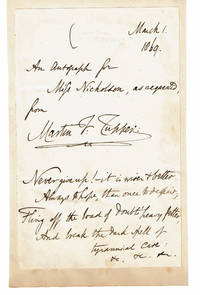
186996305Guildford Surrey U.K.: March 1 1869. 1869. Good. - A note on a 7 inch high by 4-1/2 inch wide sheet of his letterhead sending his autograph to a Miss Nicholson as requested and quoting 4 lines from one of his most famous poems. The letterhead has been mounted on a slightly larger sheet of card by the recipient. There are a few small stains to the edge of the note with light glue staining to the bottom edge of the mount. The note has been folded twice for mailing. Good. <p>Tupper quotes the first four lines of his famous poem "Never Give Up!": "Never give up!--it is wiser and better / Always to hope than once to despair; / Fling off the load of doubt's heavy fetter / And break the dark spell of tyrannical care / &c. &c. &c.". Tupper makes a change to the third line which reads "Doubt's cankering fetter" in the published version.<p>Martin Farquhar Tupper 1810-1889 was an English writer and poet. He was the author of "Proverbial Philosophy". Guildford, Surrey, U.K.: March 1, 1869. unknown