581 résultats
1956X112193Gent, 1956 xiv + 414pp. + 1p. theses, text in english (with sanskrit passages), 28cm., Doctoral Dissertation (Rijksuniversiteit Gent, Belgium), stamp at verso of title page, softcover, copy from the collection of the Belgian scholar Frans Olbrechts (with his signature and ex-libris tipped in), good condition, [added: typed letter by Frans Olbrechts to the author Ludo Rocher], X112193
xiv + 414pp., signed with short dedication by author, text in english (with sanskrit passages), in the series "Gentse Orientalistische Bijdragen" vol.I, 28cm., softcover, good condition, X50593
xiv + 414pp. + 1p. theses, text in english (with sanskrit passages), 28cm., Doctoral Dissertation (Rijksuniversiteit Gent, Belgium), stamp at verso of title page, softcover, copy from the collection of the Belgian scholar Frans Olbrechts (with his signature and ex-libris tipped in), good condition, [added: typed letter by Frans Olbrechts to the author Ludo Rocher], X112193
330230D B Taraporevala Sons & Co 1963. Quarto light brown buckram boards gilt lettering to spine patterned eps illus prelims xvi 272pp illus/photos VG light bruising/rubbing to extrems light to moderate adhesive staining to board edges & eps light to moderate tanning & foxing/soiling to page edges light foxing & soiling to prelilms & terminals occasional sl cracking to gutters in d/w G v heavy creasing & chipping/tearing to edges with some failing yellowing tape repairs to internal sides heavy fading to spine heavy wrinkling & chafing/surface loss D B Taraporevala Sons & Co 1963 hardcover
(Buddismo - Orientalismo - Buddha - Vinaya - Gandhara - Testi in sanscrito) In 8°, legatura editoriale in piena tela grigia con titolo in bianco al dorso e disegno al piatto anteriore, sovrac. ill. a colori, pp. 310,(2), con numerose illustrazioni in b/n nel testo tratte da fotografie di Francesca Bonardi su sculture Gandhara. Collana ''All'insegna dell'orizzonte'' (29). Volume ben conservato.
1999Khe03176Zürich ( Manesse ) 1999 (= Erste Auflage). 8°, Originalkarton mit illustriertem Originalumschlag (Hardcover) 165 S, ISBN 3717582488 1
1999144149Zürich: Manesse Verlag 1999. 165 Seiten. 8° (17,5-22,5 cm). Orig.-Pappband mit Orig.-Schutzumschlag. [Hardcover / fest gebunden].
19792091202133211134Prajna Press 1979. Soft Cover. Fine. Volume: 1 Prajna Press paperback
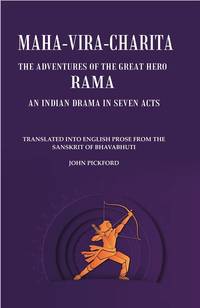
2024BIBHB0113224192024. Hardcover. New. About The Book: In ""Mahaviracharita"" the author explores the timeless story of Rama deeply rooted in Hindu literature. Drawing parallels with early mythologies the narrative symbolizes the cosmic struggle between celestial forces�Rama Sita and Ravana. The saga evolves from natural phenomena to a spiritualized allegory of good versus evil rooted in ancient myth and agriculture. Bhavabhuti's play opens with a sutradhara's prayer setting the stage for an exploration of the Ramayana. The acts unfold with Rama's encounters conflicts and triumphs deviating at times from the traditional plot. The play showcases diverse poetic meters emphasizing heroism and expressing varied emotions including anger and disgust. About The Author: Bhavabhti an 8th-century Indian scholar and poet known as the ""Poet of Karun Rasa"" authored plays and poetry in Sanskrit. Born in Padmapura Vidarbha he was a Deshastha Brahmin. His plays equal to Kalidasa's include ""Malatimadhava"" set in Padmavati where Malati and Madhava's love story unfolds amid political plots. Bhavabhuti possibly the court poet of King Yashovarman of Kannauj drew inspiration from Kautilya's Arthashastra in his works emphasizing his debt to classical Indian political thought. John Pickford was an accomplished scholar held the titles of M.A. Late Scholar of Brasenose College and Boden Scholar at the University of Oxford. Additionally he served as a distinguished Professor of Sanskrit in Madras showcasing his academic excellence and expertise in the field. The Title 'Maha-Vira-Charita: The Adventures of the Great Hero Rama. An Indian Drama in Seven Acts written/authored/edited by Translated into English prose from the sanskrit of Bhavabhuti John Pickford' published in the year 2024. The ISBN 9788121259729 is assigned to the Hardcover version of this title. This book has total of pp. 196 Pages. The publisher of this title is Gyan Publishing House. This Book is in English. The subject of this book is Religion Hinduism. Size of the book is 14.34 x 22.59 cms Vol: hardcover
1333805675.Gpaperback. Good. Access codes and supplements are not guaranteed with used items. May be an ex-library book. paperback
0365774626.Gpaperback. Good. Access codes and supplements are not guaranteed with used items. May be an ex-library book. paperback
1333296827.Gpaperback. Good. Access codes and supplements are not guaranteed with used items. May be an ex-library book. paperback
1979133358Gallimard 1979 In-8 broché, 280 pages. Marques adhésives au titre.
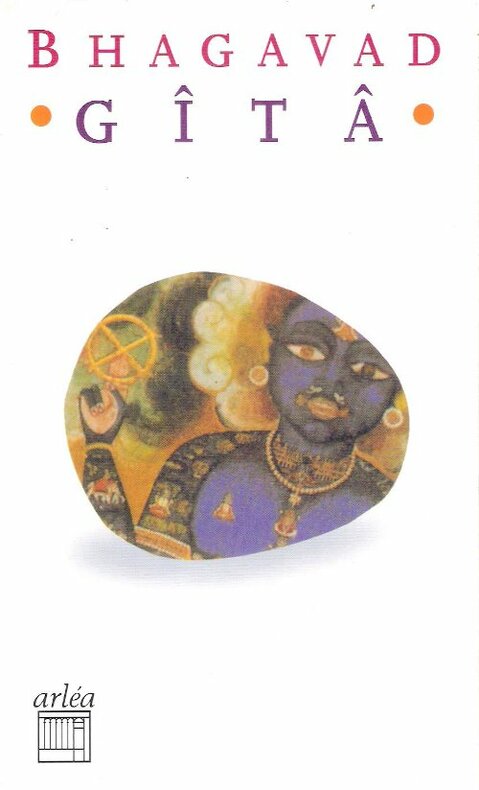
2007023778Paris arléa 2007 In-12 Collection " Poche-retour aux grands textes " Domaine Sanskrit n° 6 . Religion Spiritualité . - 174 p. , 250 gr.
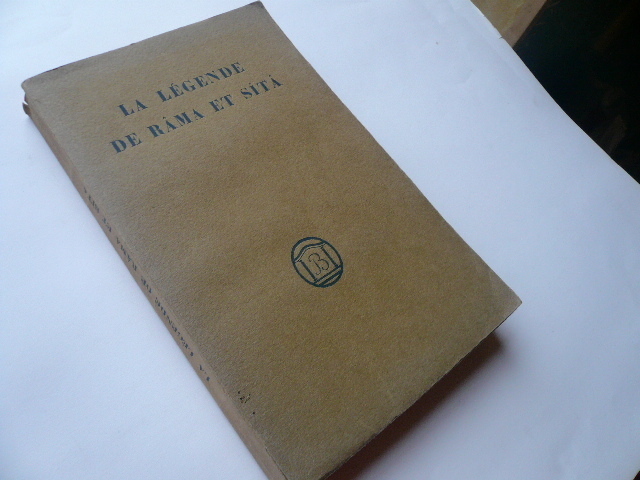
192775726Paris, Editions Bossard. Les classiques de l'orient, 1927, in-8, broché, 272 pages. Bon état. Un des 1500 ex. sur vélin bouffant, après 155 ex. sur vélin d'Arches. Bois dessinés et gravés par Andrée Karpelès.
497Paris L' édition d' art H. Piazza Collection Ex Oriente Lux 1922 1 vol. broché in-16 ( 15,5 x 11 cm ) ( poids = 350 g ) 173 ( 2 ) pp. . En 7 Actes , avec Table . Titre et texte encadrés , décorés de frises et ornements vert lichen et fauves . Broché à couverture souple illustrée . Ex-libris Philippe van Heurck contrecollé à une garde . Couverture jaunie , manque le coin inférieur du premier plat , bords du second plat abîmés . Intérieur correct , légèrement et uniformément jauni . Cet exemplaire est dépourvue de la miniature en frontispice d ' A. Touchet .
200240458BBTokyo, Soka Gakkai, 2002. Facsimile Edition. Original single sheets (color facsimiles) in original cloth-cassette (lockable). Very good Condition. Language: Sanskrit, English, and Japanese. (Lotus Sutra Manuscript Series, No. 4).
670514; 13 folding leaves. Two parts in one vol. Large 8vo cont. or later dark wrappers dyed with persimmon juice shibubiki new stitching. Japan probably Kyoto: printed with moveable types ca. 1615-40. A very rare edition printed with moveable types apparently unrecorded in the standard bibliographies of the story - or legend - of the creation of the first statue of Siddhartha Gautama or Gautama Buddha the founder of Buddhism. The statue executed while Buddha was still alive was commissioned by King Udayana of Kaushambi a contemporary of Buddha. It was the very first image of Buddha and is especially important as it was carved from life. Copies of this statue made their way to China with the spread of Buddhism and later as we shall see to Japan. The text provides a history of the creation of the first statue of Buddha which is perhaps the most famous of all Buddha images. King Udayana commissioned the statue "so that he could gaze upon the sacred form of the Buddha while the latter was off preaching to his mother in the heaven of Indra. Buddha's disciple Maudgalyayana transported thirty-two craftsmen up to the heavenly realm so that they could observe the special marks of the Buddha firsthand thereby insuring the representational accuracy of the image they created. When the Buddha eventually returned to the earth King Udayana's statue rose into the air to greet him of its own accord and the Buddha proclaimed that it would one day help to transmit his teachings."-Brown ed. The Oxford Handbook of Religion and the Arts p. 371. We learn that the statue was carved out of sandalwood and that later copies were made of gold silver bronze lead tin or iron as well as of wood. This text was translated by the Khotanese monk Tiyunbanruo d. 691 or 692 whose original Sanskrit name was Devendraprajna. Khotan was an ancient Iranian Saka Buddhist kingdom on the branch of the Silk Road that ran along the southern edge of the Taklamakan Desert near modern-day Xinjiang. Tiyunbanruo came to Luoyang the "Eastern Capital" of the Tang dynasty of China in about 688 with a considerable reputation as a Buddhist missionary and set up a bureau to translate Buddhist texts into Chinese. An earlier edition of this text was published in Beijing in 1593 and only one copy is known at the BnF. This book was probably printed and issued as a way to reinforce the legitimacy of the famous Buddha statue of the temple of Seiryoji in the Saga fields of Kyoto. It is one of the chief objects of religious veneration in Kyoto. A copy of the original statue also commissioned by King Udayana was brought from the castle at Kaushambi in north-central India to China by Hsuan-tsang in 645. The statue moved many times and ultimately arrived at Kaifeng the Sung capital. The Japanese monk Chonen 938-1016 who spent the years 983-86 in China studying and collecting texts had worshiped the statue in Kaifeng and commissioned men in 984 to carve a copy to bring back to Japan. The copy was ultimately installed at Seiryoji and according to Japanese tradition the Chinese "original" and Chonen's copy had miraculously changed places - the Seiryoji Buddha was actually the authentic example commissioned by Udayana. The Seiryoji Buddha is "probably the most important best-documented and best-preserved sculpture now existing which represents the school and tradition of Buddhist sculpture connected with the sacred Udayana image of the living Buddha of which Hsuan-tsang brought a copy to the court at Ch'ang-an."-Henderson & Hurvitz "The Buddha of Seiryoji: New Finds and New Theory" Artibus Asiae Vol. 19 No. 1 1956 p. 43-and see the whole fascinating article. As mentioned above this rare work is printed with moveable types. It was at one time owned by the great Japanese dealer Shigeo Sorimachi. The chitsu has the characteristic handwriting on the label of Sorimachi's assistant Mr. Mori who has written: "Zozo kudoku kyo. Genna kan'ei chu kan. Kokatsu ban" "Creation of the Statue a Pious Act. From Genna to mid-Kan'ei edition ca. 1615-40. Moveable type". It is not cited by Kazuma Kawase Kokatsuji-ban no kenkyu Study of the Early Typographic Editions of Japan 1967 the definitive bibliography of Japanese moveable type books. There is no copy in WorldCat nor the Union Catalogue of Early Japanese Books. In very good condition. The first ten folding leaves which are a little stained have some repaired worming and strengthening. The following leaves have some worming some carefully repaired and others as the worming lessens not repaired. Several characters affected by the worming. As mentioned above the wrappers have been dyed with persimmon juice which serves a dual purpose: to strengthen the paper and act as an insect repellent. ❧ Wang Zhenping "Chonen's Pilgrimage to China 983-986" Asia Major Third Series Vol. 7 No. 2 1994 pp. 63-97. Martha L. Carter The Mystery of the Udayana Buddha Naples: 1990. unknown books
161567051615. 14; 13 folding leaves. Two parts in one vol. Large 8vo cont. or later dark wrappers dyed with persimmon juice shibubiki new stitching. Japan probably Kyoto: printed with moveable types ca. 1615-40.<br/> <br/> A very rare edition printed with moveable types apparently unrecorded in the standard bibliographies of the story — or legend — of the creation of the first statue of Siddhartha Gautama or Gautama Buddha the founder of Buddhism. The statue executed while Buddha was still alive was commissioned by King Udayana of Kaushambi a contemporary of Buddha. It was the very first image of Buddha and is especially important as it was carved from life. Copies of this statue made their way to China with the spread of Buddhism and later as we shall see to Japan.<br/> <br/> The text provides a history of the creation of the first statue of Buddha which is perhaps the most famous of all Buddha images. King Udayana commissioned the statue “so that he could gaze upon the sacred form of the Buddha while the latter was off preaching to his mother in the heaven of Indra. Buddha’s disciple Maudgalyayana transported thirty-two craftsmen up to the heavenly realm so that they could observe the special marks of the Buddha firsthand thereby insuring the representational accuracy of the image they created. When the Buddha eventually returned to the earth King Udayana’s statue rose into the air to greet him of its own accord and the Buddha proclaimed that it would one day help to transmit his teachings.â€â€“Brown ed. The Oxford Handbook of Religion and the Arts p. 371. We learn that the statue was carved out of sandalwood and that later copies were made of gold silver bronze lead tin or iron as well as of wood.<br/> <br/> This text was translated by the Khotanese monk Tiyunbanruo d. 691 or 692 whose original Sanskrit name was Devendraprajna. Khotan was an ancient Iranian Saka Buddhist kingdom on the branch of the Silk Road that ran along the southern edge of the Taklamakan Desert near modern-day Xinjiang. Tiyunbanruo came to Luoyang the “Eastern Capital†of the Tang dynasty of China in about 688 with a considerable reputation as a Buddhist missionary and set up a bureau to translate Buddhist texts into Chinese. An earlier edition of this text was published in Beijing in 1593 and only one copy is known at the BnF.<br/> <br/> This book was probably printed and issued as a way to reinforce the legitimacy of the famous Buddha statue of the temple of Seiryoji in the Saga fields of Kyoto. It is one of the chief objects of religious veneration in Kyoto. A copy of the original statue also commissioned by King Udayana was brought from the castle at Kaushambi in north-central India to China by Hsuan-tsang in 645. The statue moved many times and ultimately arrived at Kaifeng the Sung capital. The Japanese monk Chonen 938-1016 who spent the years 983-86 in China studying and collecting texts had worshiped the statue in Kaifeng and commissioned men in 984 to carve a copy to bring back to Japan. The copy was ultimately installed at Seiryoji and according to Japanese tradition the Chinese “original†and Chonen’s copy had miraculously changed places — the Seiryoji Buddha was actually the authentic example commissioned by Udayana.<br/> <br/> The Seiryoji Buddha is “probably the most important best-documented and best-preserved sculpture now existing which represents the school and tradition of Buddhist sculpture connected with the sacred Udayana image of the living Buddha of which Hsuan-tsang brought a copy to the court at Ch’ang-an.â€â€“Henderson & Hurvitz “The Buddha of Seiryoji: New Finds and New Theory†Artibus Asiae Vol. 19 No. 1 1956 p. 43–and see the whole fascinating article.<br/> <br/> As mentioned above this rare work is printed with moveable types. It was at one time owned by the great Japanese dealer Shigeo Sorimachi. The chitsu has the characteristic handwriting on the label of Sorimachi’s assistant Mr. Mori who has written: “Zozo kudoku kyo. Genna kan’ei chu kan. Kokatsu ban†“Creation of the Statue a Pious Act. From Genna to mid-Kan’ei edition ca. 1615-40. Moveable typeâ€. It is not cited by Kazuma Kawase Kokatsuji-ban no kenkyu Study of the Early Typographic Editions of Japan 1967 the definitive bibliography of Japanese moveable type books. There is no copy in WorldCat nor the Union Catalogue of Early Japanese Books.<br/> <br/> In very good condition. The first ten folding leaves which are a little stained have some repaired worming and strengthening. The following leaves have some worming some carefully repaired and others as the worming lessens not repaired. Several characters affected by the worming. As mentioned above the wrappers have been dyed with persimmon juice which serves a dual purpose: to strengthen the paper and act as an insect repellent.<br/> <br/> â§ Wang Zhenping “Chonen’s Pilgrimage to China 983-986†Asia Major Third Series Vol. 7 No. 2 1994 pp. 63-97. Martha L. Carter The Mystery of the Udayana Buddha Naples: 1990. unknown
Pages tanned. Foxing to top of textblock. Light foxing passim. Minor shelfwear. ; 1959: 492 pp ; Indogermanische Bibliothek. ; Vol. 1.2; 492 pages
Upper joint is rubbed with a bit of the blue cloth abrased off. Light tanning to pages. Still in excellent condition. ; Indogermanische Bibliothek. Vol 1 Only; Vol. 1; 538 pages
1958X77701Heidelberg, Carl Winter 1958 Volume I,1 (Einleitung und Lautlehre): xvi + 347pp., hardback (editor's blue cloth), 20cm., 3rd revised edition, Good condition, X77701
Volume I,1 (Einleitung und Lautlehre): xvi + 347pp., hardback (editor's blue cloth), 20cm., 3rd revised edition, Good condition, X77701
1953022541Heidelberg CARL WINTER - UNIVERSITATSVERLAG 1953 un volume in-8°, XII 355 pp. Reliure éditeur toilée bleue à la Bradel, dos titré or. (jaquette manquante, premier plat légèrement sali). Peu courant.
Very Good Very Good English Original bdg. Dust wrapper. Roy. 8vo. (23 x 16 cm). In English. [Lvii], 236 p. Two Tamil folktales: The story of King Matanakâma - The story of peacock Râvana. Translated from the Tamil by Kamil V. Zvelebil. "Taamil literary folklore has so far received little attention, in spite of a few early publications which appeared mostly in the 19th century. Mosst of Tamil literary texts translated into Western languages, or analyzed in Indological literature, belonged too the Tamil 'Great Tradition' of high literary culture. And yet, there exists an enormous wealth of oral and semi-oral traditions of verbal art in Tamil, as in any other Indian language; some of these pieces of literary folklore have appeared in print as chapbooks and are very popular with Tamil readers, but ignored by 'respactable' literary scholarship. The two folk-narratives translated in this book belong to the favourite pieces of Tamil folklore. Apart from being expressions of sheer narrative joy and creative fantasy of the Tamil people,they are a rich source of comparative data on various motifs, customs, stylistic devices etc., and therefore they will not only amuse and delight the general reader, but be of great use to all students of Indian literatures, and of comparative folklore.".