VatsyayanaAntiquariat.de
Deutsche Nitschiren Schoschu e.VAntiquariat.de
DAS GONGYO DER NITSCHIREN SCHOSCHU.
1985239270Frankfurt, 1985.

Antiquariat Ehbrecht · DE - Ilsede19,80 €
581 résultats
195822660Lindau, Rudolph, o.J. [1958]. Gr. 8°, IX, 231 Seiten. mit 28 montierten, teils farbigen Abbildungen. Orig.Leinen mit Goldprägung und OSU im Schuber.
1985239270Frankfurt, 1985.
49744Leipzig und Berlin B.G. Teubner 1914 in 8 (26,5x17,5) 1 volume reliure à la bradel demi velin ivoire de l'époque, pièce de titre de cuir vert, XVIII et 459 pages, bel ex-libris gravé. Johannes Hertel, Zwickau 1872 - Leipzig 1955. Sprache: Deutsch (First edition). Bel exemplaire
1893X71799Bonn, COHEN Friedrich 1893 [8] + 256pp., 24cm., 1st ed., cart.cover, leather spine (partly damaged), small stain of humidity on top of pages (not affecting the text), rare, [Hermann Georg Jacobi, 1850-1937], X71799
xv, 240 p. ; 19 cm. Hardcover Very good condition
1333841779.Gpaperback. Good. Access codes and supplements are not guaranteed with used items. May be an ex-library book. paperback
1903EROT0204aLeipzig, Lotus Verlag, (1903). IV, 156 S., neuer, schön marmorierter Pappband, Textblock gebräunt. (= Altindische Schelmenbücher, Bd. II). [2 Warenabbildungen]
670514; 13 folding leaves. Two parts in one vol. Large 8vo cont. or later dark wrappers dyed with persimmon juice shibubiki new stitching. Japan probably Kyoto: printed with moveable types ca. 1615-40. A very rare edition printed with moveable types apparently unrecorded in the standard bibliographies of the story - or legend - of the creation of the first statue of Siddhartha Gautama or Gautama Buddha the founder of Buddhism. The statue executed while Buddha was still alive was commissioned by King Udayana of Kaushambi a contemporary of Buddha. It was the very first image of Buddha and is especially important as it was carved from life. Copies of this statue made their way to China with the spread of Buddhism and later as we shall see to Japan. The text provides a history of the creation of the first statue of Buddha which is perhaps the most famous of all Buddha images. King Udayana commissioned the statue "so that he could gaze upon the sacred form of the Buddha while the latter was off preaching to his mother in the heaven of Indra. Buddha's disciple Maudgalyayana transported thirty-two craftsmen up to the heavenly realm so that they could observe the special marks of the Buddha firsthand thereby insuring the representational accuracy of the image they created. When the Buddha eventually returned to the earth King Udayana's statue rose into the air to greet him of its own accord and the Buddha proclaimed that it would one day help to transmit his teachings."-Brown ed. The Oxford Handbook of Religion and the Arts p. 371. We learn that the statue was carved out of sandalwood and that later copies were made of gold silver bronze lead tin or iron as well as of wood. This text was translated by the Khotanese monk Tiyunbanruo d. 691 or 692 whose original Sanskrit name was Devendraprajna. Khotan was an ancient Iranian Saka Buddhist kingdom on the branch of the Silk Road that ran along the southern edge of the Taklamakan Desert near modern-day Xinjiang. Tiyunbanruo came to Luoyang the "Eastern Capital" of the Tang dynasty of China in about 688 with a considerable reputation as a Buddhist missionary and set up a bureau to translate Buddhist texts into Chinese. An earlier edition of this text was published in Beijing in 1593 and only one copy is known at the BnF. This book was probably printed and issued as a way to reinforce the legitimacy of the famous Buddha statue of the temple of Seiryoji in the Saga fields of Kyoto. It is one of the chief objects of religious veneration in Kyoto. A copy of the original statue also commissioned by King Udayana was brought from the castle at Kaushambi in north-central India to China by Hsuan-tsang in 645. The statue moved many times and ultimately arrived at Kaifeng the Sung capital. The Japanese monk Chonen 938-1016 who spent the years 983-86 in China studying and collecting texts had worshiped the statue in Kaifeng and commissioned men in 984 to carve a copy to bring back to Japan. The copy was ultimately installed at Seiryoji and according to Japanese tradition the Chinese "original" and Chonen's copy had miraculously changed places - the Seiryoji Buddha was actually the authentic example commissioned by Udayana. The Seiryoji Buddha is "probably the most important best-documented and best-preserved sculpture now existing which represents the school and tradition of Buddhist sculpture connected with the sacred Udayana image of the living Buddha of which Hsuan-tsang brought a copy to the court at Ch'ang-an."-Henderson & Hurvitz "The Buddha of Seiryoji: New Finds and New Theory" Artibus Asiae Vol. 19 No. 1 1956 p. 43-and see the whole fascinating article. As mentioned above this rare work is printed with moveable types. It was at one time owned by the great Japanese dealer Shigeo Sorimachi. The chitsu has the characteristic handwriting on the label of Sorimachi's assistant Mr. Mori who has written: "Zozo kudoku kyo. Genna kan'ei chu kan. Kokatsu ban" "Creation of the Statue a Pious Act. From Genna to mid-Kan'ei edition ca. 1615-40. Moveable type". It is not cited by Kazuma Kawase Kokatsuji-ban no kenkyu Study of the Early Typographic Editions of Japan 1967 the definitive bibliography of Japanese moveable type books. There is no copy in WorldCat nor the Union Catalogue of Early Japanese Books. In very good condition. The first ten folding leaves which are a little stained have some repaired worming and strengthening. The following leaves have some worming some carefully repaired and others as the worming lessens not repaired. Several characters affected by the worming. As mentioned above the wrappers have been dyed with persimmon juice which serves a dual purpose: to strengthen the paper and act as an insect repellent. ❧ Wang Zhenping "Chonen's Pilgrimage to China 983-986" Asia Major Third Series Vol. 7 No. 2 1994 pp. 63-97. Martha L. Carter The Mystery of the Udayana Buddha Naples: 1990. unknown books
161567051615. 14; 13 folding leaves. Two parts in one vol. Large 8vo cont. or later dark wrappers dyed with persimmon juice shibubiki new stitching. Japan probably Kyoto: printed with moveable types ca. 1615-40.<br/> <br/> A very rare edition printed with moveable types apparently unrecorded in the standard bibliographies of the story — or legend — of the creation of the first statue of Siddhartha Gautama or Gautama Buddha the founder of Buddhism. The statue executed while Buddha was still alive was commissioned by King Udayana of Kaushambi a contemporary of Buddha. It was the very first image of Buddha and is especially important as it was carved from life. Copies of this statue made their way to China with the spread of Buddhism and later as we shall see to Japan.<br/> <br/> The text provides a history of the creation of the first statue of Buddha which is perhaps the most famous of all Buddha images. King Udayana commissioned the statue “so that he could gaze upon the sacred form of the Buddha while the latter was off preaching to his mother in the heaven of Indra. Buddha’s disciple Maudgalyayana transported thirty-two craftsmen up to the heavenly realm so that they could observe the special marks of the Buddha firsthand thereby insuring the representational accuracy of the image they created. When the Buddha eventually returned to the earth King Udayana’s statue rose into the air to greet him of its own accord and the Buddha proclaimed that it would one day help to transmit his teachings.â€â€“Brown ed. The Oxford Handbook of Religion and the Arts p. 371. We learn that the statue was carved out of sandalwood and that later copies were made of gold silver bronze lead tin or iron as well as of wood.<br/> <br/> This text was translated by the Khotanese monk Tiyunbanruo d. 691 or 692 whose original Sanskrit name was Devendraprajna. Khotan was an ancient Iranian Saka Buddhist kingdom on the branch of the Silk Road that ran along the southern edge of the Taklamakan Desert near modern-day Xinjiang. Tiyunbanruo came to Luoyang the “Eastern Capital†of the Tang dynasty of China in about 688 with a considerable reputation as a Buddhist missionary and set up a bureau to translate Buddhist texts into Chinese. An earlier edition of this text was published in Beijing in 1593 and only one copy is known at the BnF.<br/> <br/> This book was probably printed and issued as a way to reinforce the legitimacy of the famous Buddha statue of the temple of Seiryoji in the Saga fields of Kyoto. It is one of the chief objects of religious veneration in Kyoto. A copy of the original statue also commissioned by King Udayana was brought from the castle at Kaushambi in north-central India to China by Hsuan-tsang in 645. The statue moved many times and ultimately arrived at Kaifeng the Sung capital. The Japanese monk Chonen 938-1016 who spent the years 983-86 in China studying and collecting texts had worshiped the statue in Kaifeng and commissioned men in 984 to carve a copy to bring back to Japan. The copy was ultimately installed at Seiryoji and according to Japanese tradition the Chinese “original†and Chonen’s copy had miraculously changed places — the Seiryoji Buddha was actually the authentic example commissioned by Udayana.<br/> <br/> The Seiryoji Buddha is “probably the most important best-documented and best-preserved sculpture now existing which represents the school and tradition of Buddhist sculpture connected with the sacred Udayana image of the living Buddha of which Hsuan-tsang brought a copy to the court at Ch’ang-an.â€â€“Henderson & Hurvitz “The Buddha of Seiryoji: New Finds and New Theory†Artibus Asiae Vol. 19 No. 1 1956 p. 43–and see the whole fascinating article.<br/> <br/> As mentioned above this rare work is printed with moveable types. It was at one time owned by the great Japanese dealer Shigeo Sorimachi. The chitsu has the characteristic handwriting on the label of Sorimachi’s assistant Mr. Mori who has written: “Zozo kudoku kyo. Genna kan’ei chu kan. Kokatsu ban†“Creation of the Statue a Pious Act. From Genna to mid-Kan’ei edition ca. 1615-40. Moveable typeâ€. It is not cited by Kazuma Kawase Kokatsuji-ban no kenkyu Study of the Early Typographic Editions of Japan 1967 the definitive bibliography of Japanese moveable type books. There is no copy in WorldCat nor the Union Catalogue of Early Japanese Books.<br/> <br/> In very good condition. The first ten folding leaves which are a little stained have some repaired worming and strengthening. The following leaves have some worming some carefully repaired and others as the worming lessens not repaired. Several characters affected by the worming. As mentioned above the wrappers have been dyed with persimmon juice which serves a dual purpose: to strengthen the paper and act as an insect repellent.<br/> <br/> ⧠Wang Zhenping “Chonen’s Pilgrimage to China 983-986†Asia Major Third Series Vol. 7 No. 2 1994 pp. 63-97. Martha L. Carter The Mystery of the Udayana Buddha Naples: 1990. unknown
In 16°, br. edit. ill., testo in francese, copia molto buona. (ZE4) (La spedizione standard è SEMPRE tracciata con raccomandata - piego di libri, eventuale FATTURA da richiedere all'ordine) (ZE4)
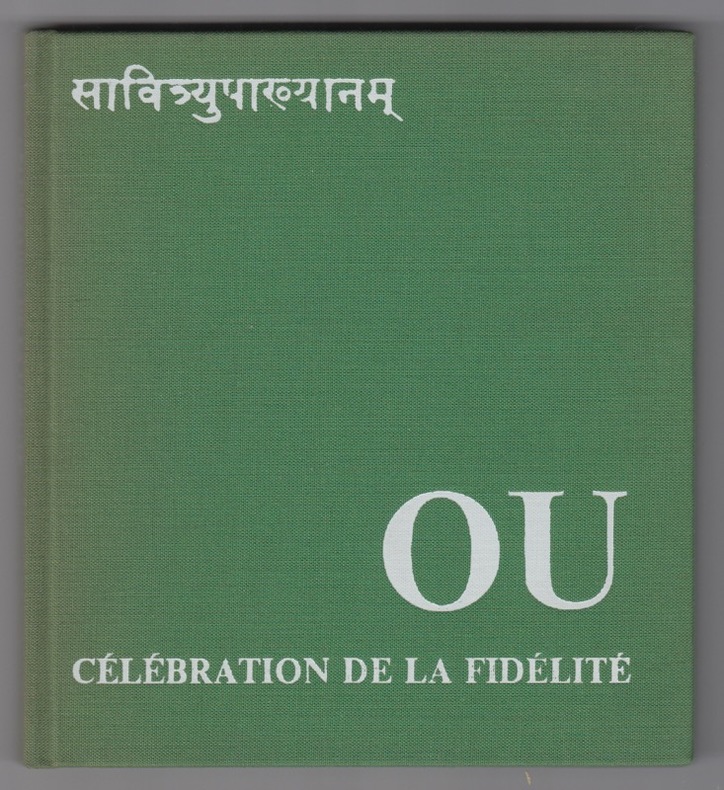
5606ROBERT MOREL- 1968, Ed. ORIGINALE Hors-Commerce, in-12 carré, relié toile fine verte, 74 pages.dos leg.passé,
brossura Per tanti aspetti il sanscrito è una lingua unica. Grande lingua di cultura della civiltà indiana, ha dato voce al più raffinato pensiero filosofico del mondo pre-moderno, a un'altissima spiritualità, a una grande letteratura. Lingua di sconcertante concisione e insieme di meravigliosamente intricate architetture, a suo agio tanto nella più sfrenata ambiguità quanto nella precisione più maniacale, nella sua dimensione "classica" (successiva, cioè, alla fase vedica) è rimasta praticamente immutata dal VI sec. a.C ai giorni nostri, permettendo a chi la conosce l'accesso a una sterminata letteratura. Il Corso di sanscrito - edizione italiana del fondamentale testo di Ashok Aklujkar - combina l'agile e ricchissima trattazione dell'originale con l'apporto della linguistica moderna. Corredato di esercizi graduali e di un ampio glossario, il volume si rivolge a tutti coloro che, dentro o fuori l'università aspirino a un incontro ravvicinato con una delle più straordinarie culture dell'umanità. Il CD-Audio allegato contiene la presentazione dei fonemi del sanscrito pronunciati dalla viva voce di Ashok Aklujkar, a cui è dovuta anche la lettura di alcune delle parole sanscrite proposte negli esercizi. Delle frasi e dei versi è offerta inoltre una traduzione italiana, letta da Carmela Mastrangelo. Il CD-Audio si chiude con uno stofra ("inno di lode") tratto dalla "Sivastotravali", raccolta di inni a Siva composta dal filosofo kashmiro Utpaladeva intorno al X secolo d.C.
br. Il Corso di sanscrito di Carlo Della Casa è un manuale pensato per chi si accosta con serie intenzioni allo studio della complessa, magnifica lingua sacra e profana dell'India antica. Il manuale si divide in due parti. Nella prima parte viene presentata, in maniera chiara e concisa, l'intera grammatica della lingua sanscrita: fonetica, morfologia, elementi indeclinabili del discorso, formazione delle parole, composizione nominale. La seconda parte si compone di un eserciziario graduato e di una selezione di brani e racconti brevi tratti da opere della letteratura sanscrita. Questi ultimi sono preceduti da un'introduzione alla scrittura devanagara e sono proposti nel volume in tale scrittura, affinché lo studente possa esercitarsi nella sua comprensione. Il Corso si chiude con un utile Vocabolario, costruito sui testi degli esercizi e dei brani.
16882"La description des six ""Cakra"" et quelques textes sanscrits sur le Kundalini Yoga." Paris. Le courrier du livre.. 1979. Grand in-8 (24x15). 298 pages + 84 pages de textes sanscrits et tables. Broché, couverture illustrée.
… in the periodical "Idem" Jahrgang 1961 nr.1, pp.1-25 // III: Rigveda-Studien, in the periodical "Indo-Iranian Journal" vol.2 (1958) nr.2, pp.85-109 /// IV: Eine Sanskrit-Sammelhandschrift des Linden-Museums mit Miniaturen, in the periodical "Tribus" vol.10 (1961), pp.69-88 + 2 plates out-of-text // V: Review of "Subbarao, Bendapudi: the personality of India", in the periodical "Zeitschrift für Ethnologie" vol.12 nr.2 pp.287-289 // VI: Sinn und Bedeutung des Wortes dhasi und seiner Belegstellen im Rigveda und Awesta, [summary of Janert's doctoral dissertation], [6pp.] // VII: Sakata, in the periodical "Zeitschrift für vergleichende Sprachforschung auf dem Gebiete der indogermanischen Sprachen. Neue Folge" vol.71 nr.1/2, pp.108-109 // VIII: review of "Kern, Fritz: Asoka", in the periodical "Orientalistische Literaturzeitung" 1957 nr.1/2, columns 68-73 // Colours in early Tamil, a study based on Cilappatikaram, in the periodical "International journal of Dravidian Linguistics" 2,1 (1973), pp.141-150 // reliure demi-toile, bon état, X71259
(Milano) 1963, 8vo stralcio con copertina posticcia muta, pp. 339/394. - !! ATTENZIONE !!: Con il termine estratto (o stralcio) intendiamo riferirci ad un fascicolo contenente un articolo di rivista, sia che esso sia stato stampato a parte utilizzando la stessa composizione sia che provenga direttamente da una rivista. Le pagine sono indicate come "da/a", ad esempio: 229/231 significa che il testo è composto da tre pagine. Quando la rivista di provenienza non viene indicata é perchè ci è sconosciuta. - !! ATTENTION !!: : NOT A BOOK : “estratto” or “stralcio” means simply a few pages, original nonetheless, printed in a magazine. Pages are indicated as in "from” “to", for example: 229/231 means the text comprises three pages (229, 230 and 231). If the magazine that contained the pages is not mentioned, it is because it is unknown to us.
Bross. edit. in-8, copert. ill.ta, coll. Connaissance de l'Orient, pp. 232-(4), traduit du Sanskrit et annotés par L. Renou, in fine Note. Ottimo.
1989239207MOTILAL BANARSIDASS PUBLISHERS PRIVATE LIMITED. DELHI, 1989.
1957X71259, 1957-1973 in the periodical "Idem" Jahrgang 1961 nr.1, pp.1-25 // III: Rigveda-Studien, in the periodical "Indo-Iranian Journal" vol.2 (1958) nr.2, pp.85-109 /// IV: Eine Sanskrit-Sammelhandschrift des Linden-Museums mit Miniaturen, in the periodical "Tribus" vol.10 (1961), pp.69-88 + 2 plates out-of-text // V: Review of "Subbarao, Bendapudi: the personality of India", in the periodical "Zeitschrift für Ethnologie" vol.12 nr.2 pp.287-289 // VI: Sinn und Bedeutung des Wortes dhasi und seiner Belegstellen im Rigveda und Awesta, [summary of Janert's doctoral dissertation], [6pp.] // VII: Sakata, in the periodical "Zeitschrift für vergleichende Sprachforschung auf dem Gebiete der indogermanischen Sprachen. Neue Folge" vol.71 nr.1/2, pp.108-109 // VIII: review of "Kern, Fritz: Asoka", in the periodical "Orientalistische Literaturzeitung" 1957 nr.1/2, columns 68-73 // Colours in early Tamil, a study based on Cilappatikaram, in the periodical "International journal of Dravidian Linguistics" 2,1 (1973), pp.141-150 // reliure demi-toile, bon état, X71259
1425796044.Ghardcover. Good. Access codes and supplements are not guaranteed with used items. May be an ex-library book. hardcover
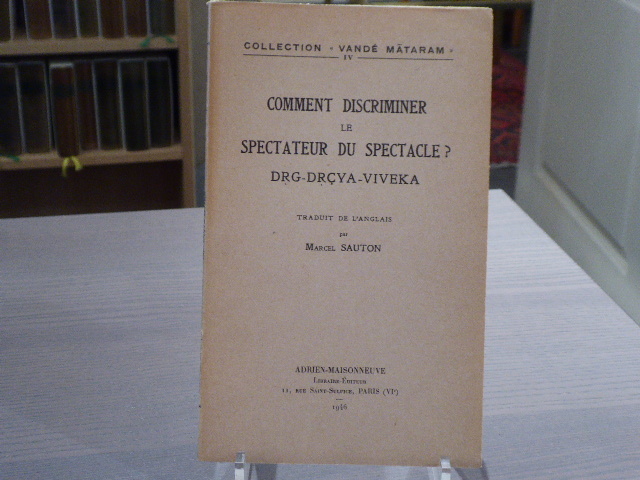
918569Adrien Maisonneuve Paris 1945 In-8 ( 225 X 140 mm ) de 85 pages, broché sous couverture imprimée. EDITION ORIGINALE. Bel exemplaire.COMMENT DISCRIMINER LE SPECTATEUR DU SPECTACLE? DRG-DRCYA-VIVEKA. selon la version anglaise du Swami Nikhilananda , avec une preface de M. P. Masson-Oursel et avant-propos du Swami Siddheswarananda de l'Ordre de Ramakrichna. Pour servir d'introduction a l'étude des ouvrages védantiques.
1778952307Paris: Imprimerie de Stoupe. 1778. Quarto. 248 x 191 mm. (Einband etwas verzogen, etwas bestoßen und berieben, innen frisch, gutes Exemplar) [9 Warenabbildungen] [1] (Vortitel), [1 weiße], [1] (Titel), [1 weiße], lx, 341, [2], [1 weiße] Seiten,. Ganzleder der Zeit mit Rückenvergoldung und rotgefärbtem Schnitt,
2048Paris. Olympia Press. 1958. In-12 broché. 186 pages. E.O.
Bross. edit. in-8, pp. 31-(1)-34 (in sanscrito)-19-(1)-II. L’opera è divisa in tre parti: 1) Grammatica. 2) Estratti di testi in sanscrito. 3) Lessico francese-sanscrito. Mancanze al ds., ma nel complesso buona copia. Altra copia con un quinterno staccato e ripreso con adesivo giallo (sic!)
1948X119687Paris, Adrien-Maisonneuve 1948 31 + [34] + 19 + ii pp., 25cm., brochure originale, Publication de l'Institut de civilisation indienne, bon état, X119687