LONGUSABAA

809 résultats
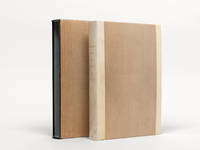
1937283036London: Zwemmer 1937. hardcover. fine. Translated out of the Greek by George Thornley. Engravings by Aristide Maillol. Beautifully printed on hand made paper hand pressed deckled edges 212 pages small 8vo full white vellum. London: A. Zwemmer 1937. Limited Edition. A lovely book in fine condition.<br/><br/> Number 103 of only 250 copies signed in pencil by Aristide Maillol.<br/><br/> Zwemmer unknown books
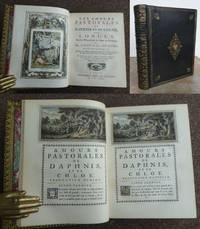
1745018270Paris: Quillau 1745. Book. Very good condition. Hardcover. Early edition. Octavo 8vo. ii 150 pages of text. Contains an engraved title page by Coypel 28 engraved plates by Audran followed by one engraving by le Compte de Caylus. The Caylus engraving is titled "Conclusion du Roman" but is best known as the "petit pieds" plate. Translated by J. Amyot Bishop of Auxerre. The engravings by B. Audran are from designs by Philip Duke of Orleans. Full red morocco binding by Simier is heavily worn on the extremities and hinges where it has been inexperty recolored but this poor attempt at recoloring does not distract from the elegance and beauty of the elaborate gilt-stamped decorations. The front endpaper marbled is detached. The text is clean and unmarked. Early edition with different pagination that the editions that appear on the market. No publisher listed but published by Quillau. Quillau Hardcover
1745018270Paris: Quillau 1745. Book. Very good condition. Hardcover. Early edition. Octavo 8vo. ii 150 pages of text. Contains an engraved title page by Coypel 28 engraved plates by Audran followed by one engraving by le Compte de Caylus. The Caylus engraving is titled "Conclusion du Roman" but is best known as the "petit pieds" plate. Translated by J. Amyot Bishop of Auxerre. The engravings by B. Audran are from designs by Philip Duke of Orleans. Full red morocco binding by Simier is heavily worn on the extremities and hinges where it has been inexperty recolored but this poor attempt at recoloring does not distract from the elegance and beauty of the elaborate gilt-stamped decorations. The front endpaper marbled is detached. The text is clean and unmarked. Early edition with different pagination that the editions that appear on the market. No publisher listed but published by Quillau. Quillau Hardcover books
1919000387<p><strong>One of the most beautiful books illustrated by Carlègle. With 33 original woodcuts. With two extra suites of illustrations on Japon ancien and on Chine all signed by the artist. No. 2 of 20 numbered and signed copies of the special edition on Japon ancien à la forme. "C'est la meilleure illustration de l'artiste" Carteret. </strong></p><p><strong>Description:</strong> Vellum spine and fore edge with wood veneer covered boards filleted in gilt; flat spine lettered and decorated in gilt. Housed in the original slipcase covered with wood veneer and black leather entry. Bound by Devauchelle signed. Quarto: 27 × 19 cm; pp. 144 1ll. 33 plates on Japan 33 plates on China. Top edge gilt.</p><p><strong>Ref.:</strong> Carteret: iv 242</p><p><strong>Condition:</strong> Slipcase with slightly torn edges otherwise a near fine copy.</p><p><strong>Notes:</strong> Charles Émile Egli born in Aigle in 1877 was a Swiss illustrator and artist. Under the name Carlègle he worked in Paris from 1900 until his death in 1937 for numerous magazines such as Le Rire Gazette du Bon Ton and La Vie Parisienne. From 1908 he began to illustrate books working for publishers such as Georges Briffaut Calmann-Lévy collection "Pour nos enfants" Mornay the Société de Bibliophile the Société Littéraire de France and Léon Pichon. The edition of the "Amours Pastorales" is one of Carlègle's most elaborate works. The total edition consisted of 395 copies of which only copies 1-20 were signed.</p> Léon Pinchon hardcover
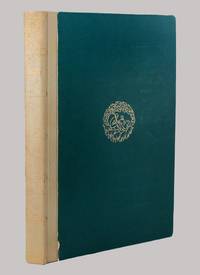
1933087819N: The Ashendene Press 1933. Traduction de Messie J. Amyot editee et corrigee par Paul-Louis Courier. Text in French. Pp. iviv164last blank printed in red & black text illustrations 4 full page the decorative initials drawn in blue by Graily Hewitt and his assistants printer's mark C in red at colophon; narrow cr. 4to; qr. vellum lettered and ruled in gilt turquoise papered boards with vellum corner-tips circular gilt design by Gwen Raverat at centre of upper board the edges of the paper very slightly chipped; uncut; within patterned papered slipcase which is slightly worn; lower hinge tender a little light foxing; printed by C. H. St. John Hornby The Ashendene Press Chelsea 1933. Edition limited to 310 copies; this being one of 290 copies printed on paper. Franklin pages 242-3. The penultimate book from The Ashendene Press. The wood-engraved illustrations by Gwen Raverat are described by Colin Franklin The Ashendene Press page 243 as 'the only worthwhile original illustrations in an Ashendene book'. The Ashendene Daphnis et Chloe was intended for publication in 1931 but that edition was printed on Japanese vellum and because the sheets were packed before the slow-drying ink had sufficiently hardened all but 10 copies had to be destroyed. The Ashendene Press unknown
175746402091A Paris, Imprimés pour les curieux, 1757 ; in-4, plein veau blond, encadrement de filets dor., dos lisse avec décor doré, tranches rouges. (Reliure de l’époque) VIII pp., 269 pp., (1 p.) - Frontispice et 29 planches hors-texte.Superbe édition illustrée, la première de ce format, la première aussi à donner, en face de la version d’Amyot, la nouvelle traduction, dite anonyme sur le titre, et qui est d’Antoine LECAMUS, un médecin né à Paris en 1722, mort en 1772. Pour se distraire de ses travaux de médecine, il a publié dans sa jeunesse quelques variétés littéraires, des poèmes, des allégories. Lecamus devint célèbre pour avoir rédigé les notices médicales du Journal Oeconomique de 1753 à 1765, puis comme régent de la Faculté de médecine de Paris.Toutes les pages de cette édition sont dans un encadrement typographique. L’illustration comprend 1 frontispice de Coypel, les 29 planches du Régent retouchées et entourées de magnifiques cadres avec sujets divers, 1 fleuron de titre, 8 grandes vignettes en-tête et 8 culs-de-lampe par Cochin, le tout gravé par Audran et Fokke. La célèbre figure des “petits pieds”, différente de celle de l’originale est ici placée p. 162. - Cohen 653.Très bel exemplaire en veau blond de l’époque.
171846404984S. l. [Paris, Quillau], 1718 ; petit in-8, plein maroquin rouge, large encadrement d’une triple série de filets avec dentelles fleurdelisées, dos lisse orné de faux-nerfs et ornements dorés, dentelle intérieure dorée, doublé et gardes de tabis bleu, tranches dorées. (Reliure de l’époque) 6 ff. n. ch., 164 pp., frontispice et 28 figures hors-texte.PERMIER TIRAGE. Célèbre édition, dite “du Régent”, ornée d’un frontispice par COYPEL et de 28 planches par le Régent PHILIPPE D’ORLÉANS, gravées par AUDRAN, 1 vignette en-tête par Scotin et 6 lettres ornées. TIRAGE À 250 exemplaires.Le Régent avait fait graver les estampes par Benoît Audran, d’après les peintures que le roman de Longus lui avait inspirées en 1714. Il existe une figure supplémentaire dite des petits pieds, attribuée à Caylus, qui ne fait pas partie de ce premier tirage, car elle n’a été gravée qu’en 1728. Elle a été ajoutée à de nombreux exemplaires mais ce n’est pas le cas ici. Cohen 648.Exemplaire relié en maroquin à l’époque. Il est à grandes marges. La marge inférieure du premier feuillet de texte est refaite ; quelques taches. L’exemplaire a figuré sous le n°708 dans le catalogue de la Vente de feu M. L. A. Barbet. Giraud-Badin, 1932.
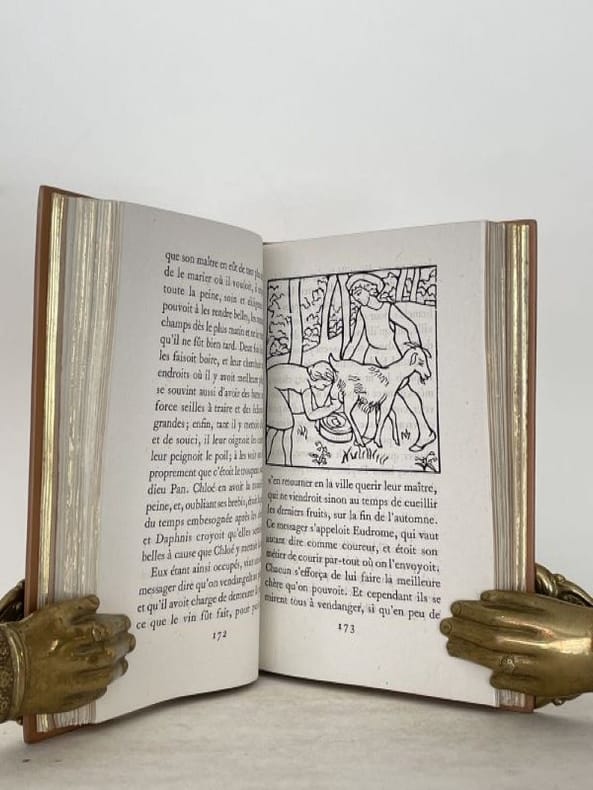
193775939Paris Gonin 1937 1 vol. relié petit in-8, plein box chair, dos lisse orné d'un triple filet doré en séparateur du nom de l'auteur et du titre et également en pied et en tête, plats de soie moirée chair largement bordés de box chair et rehaussé d'un filet doré en encadrement, gardes également de soie moirée chair, doubles gardes de papier moucheté, tranches dorées sur témoins, couvertures et dos conservés, étui bordé (Georges Cretté), non paginé. Premier tirage de cette célèbre illustration de Maillol comprenant 48 bois originaux gravés, plus quelques lettrines, dans la tradition des grands livres à figures du XVIe siècle. Avec une remarquable économie de moyens, le sculpteur célèbre en une ligne pure la grâce juvénile des amants, tandis que la traduction de Courier, revue sur celle d'Amyot, restitue toute la poésie et la fraîcheur de ce délicieux roman d'apprentissage. Un des 25 exemplaires de tête numérotés sur Chine, tirage hors commerce signé au colophon par l'artiste, enrichi de deux suites (couvertures conservées), l'une en sanguine de 51 bois gravés, l'autre en noir de 10 "épreuves rares" où apparaissent les marges de la matrice. Superbe exemplaire, parfaitement relié par Cretté.
193775939Paris Gonin 1937 1 vol. relié petit in-8, plein box chair, dos lisse orné d'un triple filet doré en séparateur du nom de l'auteur et du titre et également en pied et en tête, plats de soie moirée chair largement bordés de box chair et rehaussé d'un filet doré en encadrement, gardes également de soie moirée chair, doubles gardes de papier moucheté, tranches dorées sur témoins, couvertures et dos conservés, étui bordé (Georges Cretté), non paginé. Premier tirage de cette célèbre illustration de Maillol comprenant 48 bois originaux gravés, plus quelques lettrines, dans la tradition des grands livres à figures du XVIe siècle. Avec une remarquable économie de moyens, le sculpteur célèbre en une ligne pure la grâce juvénile des amants, tandis que la traduction de Courier, revue sur celle d'Amyot, restitue toute la poésie et la fraîcheur de ce délicieux roman d'apprentissage. Un des 25 exemplaires de tête numérotés sur Chine, tirage hors commerce signé au colophon par l'artiste, enrichi de deux suites (couvertures conservées), l'une en sanguine de 51 bois gravés, l'autre en noir de 10 "épreuves rares" où apparaissent les marges de la matrice. Superbe exemplaire, parfaitement relié par Cretté.
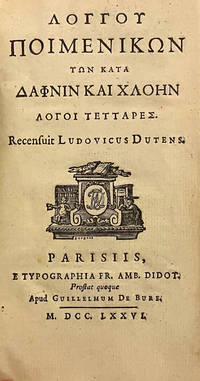
1776102736<p>Paris typographia Fr. Amb. Didot 1776. 12mo. viii 157 pp. Contemporary full red morocco binding spine goldtooled covers with a three-line border inner dentelles gilt all edges gilt.</p><p>Edition in Greek with a preface in Latin of the pastoral romance by Longus or Longos 2nd century AD. The work was first printed Florence in 1598. The present edition was established by Louis Dutens 1730-1812 and is one of two editions in Ancient Greek that were published during the eighteenth century the other Amsterdam 1754. It was published by the François-Ambroise Didot who may be said to have laid the foundation of the subsequent typographic celebrity of the house of Didot. He made great improvements in type-founding and his founts of type were superior to all that had been produced previously in France. <strong>According to Brunet this edition was printed in only 200 copie.s</strong> c.f. Bigmore & Wyman I p. 176; Brunet 3 1155.</p> Didot
192525296Paris Chez l'Artiste 1925 Préface de Eugène Marsan. Paris, Chez l'Artiste, 1925, in-8, veau noir, plats mosaïqués de 2 grands motifs géométriques or et argent, triple filets intérieur or et argent palladium, tête dorée, dos avec bandeau argenté portant titre et auteur, pièce d'arme en pied (sir Abdy), sous étui, 168 pages, (Creuzevault relieur).
180046402614Paris, Imprimerie de P. Didot l’aîné, an VIII, 1800 ; in-4, plein maroquin vert à longs grains, large encadrement de fil. en pointillé, guirlandes et motifs dorés à l’antique (grecques, amphores et thyrses), dos orné de filets et grands fleurons dorés, dentelle intérieure dorée, non rogné, tranches dorées sur témoin. (Loutrel) VIII pp., 200pp. - 9 planches hors-texte.PREMIER TIRAGE. Un des plus beaux livres illustrés néo-classique. Superbe typographie de Didot l’aîné.9 tableaux de genre hors-texte dont 3 dessinés par PRUDHON et 6 par GÉRARD, gravés sur cuivre par B. Roger, Godfroy, Marais et Massard. “Les figures de Prudhon sont dignes du grand artiste” dit Cohen 656 - Brunet 1159.Bel exemplaire sur vélin fort, non rogné.
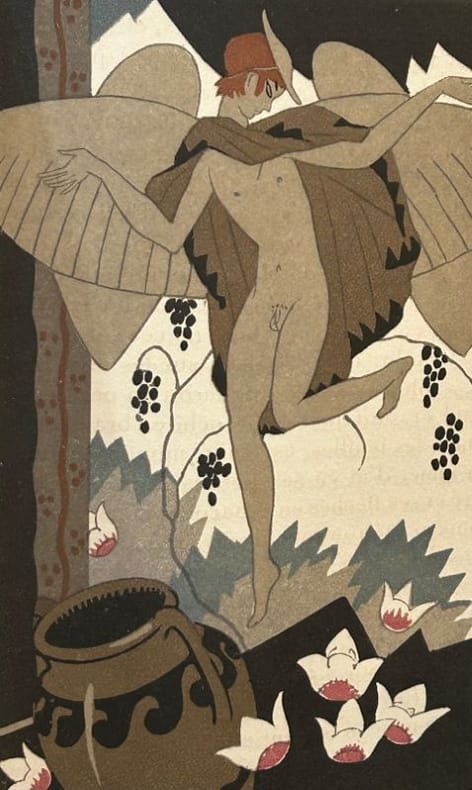
192852441Sous étui bordé. Reliure plein maroquin turquoise. Dos lisse avec titre doré. Plats décorés de demi-cercles dorées en soleil. Tête dorée. Couverture et dos conservés. Reliure signée F. FERRAN Agen. Édition illustrée de 23 gravures originales en noir et en couleurs d'Henri LE RICHE.
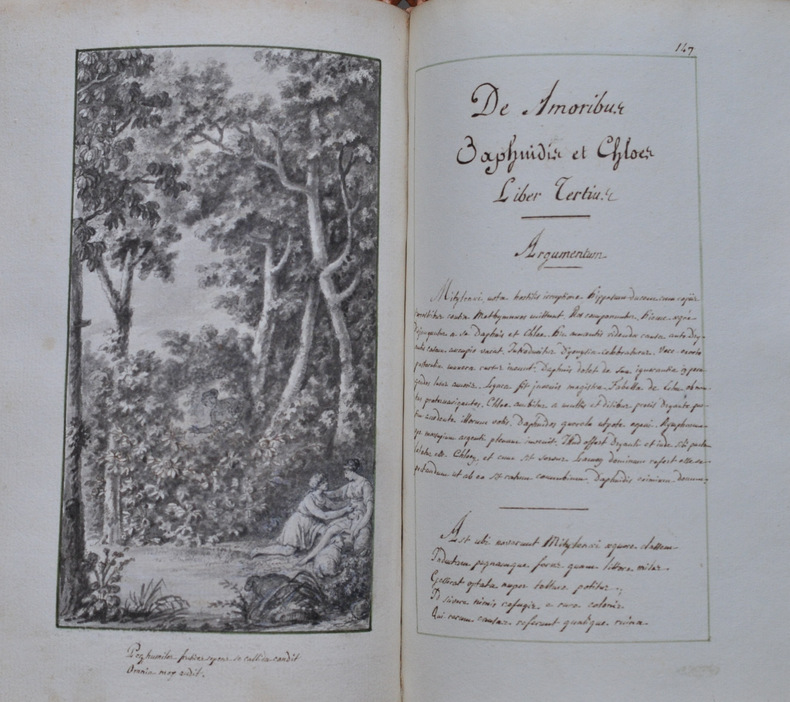
46400195, MANUSCRIT AUTOGRAPHE avec ornements et illustrations; grand in-8, demi-maroquin rouge, coins, dos lisse orné de grecques et fleurons dorés, tranches jaunes. (Reliure de l'époque). XXXIV et 308 pp. rédigées au recto sur papier vergé. "PRECIEUX MANUSCRIT AUTOGRAPHE. Il s'agit d'une traduction en vers latins modernes de Daphnis et Chloé de Longus. Le beau poète néo-latin, auteur de cette version est le célèbre chirurgien français Philippe Petit-Radel. Il naquit à Paris en 1749 et mourut dans la même ville en 1815. Il séjourna aux Indes de 1774 à 1777 et exerça comme chirurgien major à Surate. En 1782 il fut pourvu de la chaire de chirurgie à Paris. Le 10 août 1792, après avoir prononcé un discours en latin d'apparat, il s'éloigna brusquement et s'enfuit à Bordeaux. Enrôlé dans l'armée malgré lui, il s'échappa et s'embarqua pour l'île Bourbon en 1793 et de là partit pour l'Amérique. Il rentra en France en 1797 et fut appelé en 1798 à la chaire de clinique chirurgicale. Petit-Radel fut un latiniste distingué et militant. Il s'efforça toujours à rétablir dans les milieux médicaux l'ancien usage de parler latin. Outre ses importants travaux médicaux il nous a laissé divers livres latins De amoribus Pancharitiis et Zoroae. Poema erotico-didacticon (en 1798 et 1801); une traduction en vers latins des Hymnes de Callimaque ( 1810) et cette traduction de Longus qui parut chez Agasse à Paris en 1809. Le manuscrit est daté 1806. Titre calligraphié dans un encadrement d'emblèmes dessinés à la plume. En frontispice portrait gravé e Petit-Radel par J. Bouilliard. 4 belles compositions à pleine page dessinées au lavis par l'auteur et 7 vignettes dans le texte également au lavis. Toutes les pages de texte sont encadrées d'un filet bistre. Les 34 premières pages sont une préface en prose latine. Elle est datée de Paris 1806. En tête du livre figure un billet autographe du célèbre poète DELILLE, daté de Paris 11 juillet 1806. Il dit: """"J'ai entendu avec plaisir la lecture de quelques morceaux d'une traduction du grec en vers latins des hymnes de Callimaque et de Longus, faites par Monsieur Petit-Radel médecin, je ne doute point que la publication de ces deux ouvrages ne fasse plaisir aux amateurs des langues grecque et latine"""". Ce beau manuscrit provient de la bibliothèque de Charles Palissot (Nancy 1730-Paris 1814) le célèbre auteur dramatique qui fut aussi l'un des conservateurs de la bibliothèque Mazarine.
193767381937 Paris: Philippe Gonin, 1937. 2 vol. en feuilles sous chemises et étui: 14 x 22 cm. I/ 217-[4] pp.; II/ [47] pl. grav. pour la suite en noir, [47] pl. grav. pour la suite en sanguine, [9] ff. sup. Édition illustrée par Maillol de 46 bois originaux dans le texte, une vignette sur la couverture, et de nombreuses lettrines initiales répétées. Un des exemplaires hors commerce marqués en chiffres romains (no. XLVI) et signés au crayon par Maillol et léditeur au colophon. Exemplaire imprimé en grandes marges comportant UNE DOUBLE SUITE COMPLÈTE DES BOIS, lune tirée en noir et lautre en sanguine. Le premier volume contient le texte intégral illustré. Le deuxième contient les deux suites complètes des 46 bois à pleine page et des 15 lettrines tirées sur une seule page. Il se trouve également une chemise contenant la plaquette de vente et 4 feuillets des versions divergentes de celle du texte « définitif » (pp. 117-120 ; pp. 141-144 en deux versions ; pp. 161-164). Couvertures de papier écru illustrées dun bois original, chemises en demi-parchemin, auteurs et titre en noir au dos, étuis assortis. En excellent état.
1954002315Paris: Manuel Bruker 1954. First Limited Edition. Wraps. Very Good. No. 12 of 20. With a folio of three original ink drawings signed by Vertes a folio of 10 engravings that were rejected for use in the book proper and a suite of all the engravings used in the book. This copy is also inscribed by the artist to the collector/owner which is not something called for in the limitation. 204 pp. Stylistically the Hungarian-American Vertes brought a loose near-abstraction sensibility to what nonetheless remained lucidly representational art. He executed his images with a spare economy while keeping his lines fluid and flowing. At times his output could look slapdash and improvisational; this effect though splendidly captured the emphemeral moment in an ever-changing scene and we can sense easily movement and motion. Vertes was a modernist very much of his time and place. His was an oeuvre that dared to please the average man and thus his work decorate such places as the lobby of the Carlyle Hotel in New York. Vertes was also a costume designer who won an Academy Award for his art direction and costume designs in the movie "Moulin Rouge" released in 1952. Manuel Bruker unknown
1954002315Paris: Manuel Bruker 1954. First Limited Edition. Wraps. Very Good. No. 12 of 20. With a folio of three original ink drawings signed by Vertes a folio of 10 engravings that were rejected for use in the book proper and a suite of all the engravings used in the book. This copy is also inscribed by the artist to the collector/owner which is not something called for in the limitation. 204 pp. Stylistically the Hungarian-American Vertes brought a loose near-abstraction sensibility to what nonetheless remained lucidly representational art. He executed his images with a spare economy while keeping his lines fluid and flowing. At times his output could look slapdash and improvisational; this effect though splendidly captured the emphemeral moment in an ever-changing scene and we can sense easily movement and motion. Vertes was a modernist very much of his time and place. His was an oeuvre that dared to please the average man and thus his work decorate such places as the lobby of the Carlyle Hotel in New York. Vertes was also a costume designer who won an Academy Award for his art direction and costume designs in the movie "Moulin Rouge" released in 1952. <br/><br/> Manuel Bruker paperback books
193726800Paris Gonin 1937 In-8, en feuilles, couverture illustre (embotage de l'diteur).46 bois originaux d'Aristide Maillol. Tirage numrot limit 500 exemplaires sur papier Maillol et 70 exemplaires rimposs dont 20 sur peau de chvre, 25 japon ancien et 25 chine, tous signs au crayon par l'artiste. Un des 500 exemplaires sur papier Maillol, enrichi d'une suite part de tous les bois tirs en noir, augmente d'une preuve d'artiste pour trois des illustrations correspondant aux pages 23, 166 et 218, soit au total 49 bois.
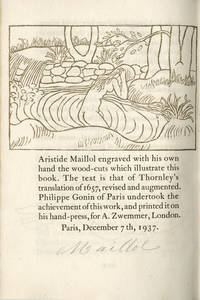
1937353London: A. Zwemmer printed in Paris by Philippe Gonin 1937. Limited Edition. Fine. Aristide Maillol 1861-1944. 8vo 7 3/4 x 5 1/2 in. 200 x 132 mm; pp. 6 blank vi 211 colophon 12 blank; Copy 21 of 250 numbered copies on hand-made Maillol paper and SIGNED BY THE ARTIST on the colophon with 52 original woodcuts and 4 woodcut initials printed in bistre; leading and bottom edges deckle. Full vellum with laced-in thongs gilt lettering on spine faint; pencil notations and tipped in label from earlier booksellers on inside front cover edges stained on first 2 and last 2 blanks. <br /> EXTRA SUITE of 45 WOODCUTS in a separate vellum portfolio printed in black. <br /> Fine copy in simple cardboard slipcase.<br /> <br /> Colophon: "Aristide Maillol engraved with his own hand the wood-cuts which illustrate this book The text is that of Thronley's translation of 1657 revised and augmented. Philippe Gonin of Paris undertook the achievement of this work and printed it on his hand-press for A. Zwemmer London. Paris December 7th 1937" followed by MAILLOL'S SIGNATURE IN PENCIL. <br /> <br /> Garvey 174; Garvey Wick 22; BNF32393010. According to Eleanor Garvey "The Artist and the Book" p. 122 this work is "perhaps the most harmonious of Maillol's illustrated books."<br /> An ancient Greek novel written during the Roman Empire the only known work of the 2nd century CE Greek novelist and romance writer Longus translated by George Thornley in 1657 the story of Daphnis and Chloe inspired the French-Catalan sculptor Aristide Maillol 1861-1944 to create an extensive set of sometimes mischievous woodcuts of nymphs and lovers using the same classical lines that typify his sculpture. The format of the book is particularly suited "to the black and white balance of the decorated page" François Chapon. The images the luscious hand-made paper the sensual tone of the engravings all contribute to this piquant book meant to educate and titillate the "young beauties" to whom the book is dedicated. The Epistle Dedicatory reads "To Young Beauties". "The ceremonies customes & manners of the ancient Greekes; with delightfull interspersion of their old and sweet Tales: And in short; nothing to vex you unless perchance in your own conscience. A. Zwemmer [printed in Paris by Philippe Gonin] unknown
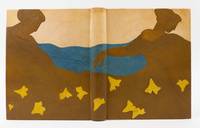
ST16989London: Willow Press 1982. No. 31 OF 55 COPIES SIGNED by artist and binder Susan Allix. 300 x 230 mm. 12 x 9". 4 p.l. 91 1 pp. 1 leaf colophon. Translated by A. M. Burnett. <br/> WHIMSICAL PICTORIAL MOROCCO BY SUSAN ALLIX stamp-signed on rear pastedown the wrap-around design showing Daphnis and Chloe in blind-tooled brown morocco silhouetted against a blue morocco sea and cream morocco sky beneath the lovers a blind-tooled vine with 11 inlaid or onlaid citron morocco leaves blind-stamped lettering to front cover turquoise blue pastedowns and white free endpapers painted with blue fore edge of front free endpaper cut into wave pattern showing a glimpse of the yellow handmade paper front flyleaf edges untrimmed and lightly brushed with blue paint. In the original felt-lined tan linen clamshell box blind-lettered cream and blue morocco label on back. With etched frontispiece and 20 etchings 14 in color and six in sepia by Allix. As new.<br/> <br/> This is a modern take on the most popular romance of ancient Greece from book artist Susan Allix who is responsible for the binding illustrations and the printing through her Willow Press imprint. The third century pastoral romance was newly translated from the Greek by Andrew M. Burnett and illustrated with etchings based on Allix's travels in Greece. The binding in Allix's words "creates an atmosphere of the sea landscape and figures in the story." Born in 1943 and educated at the Royal College of Art Allix began her career as a printmaker before creating her first hand-crafted book in 1973. Mark Dimunation Chief of the Rare Book Division at the Library of Congress wrote of Allix's work: "her books launch you on a visual journey. Each book is a voyage propelled by color texture image impression and material. . . . Because she insists on creating the entire book--from letterpress to illustration to binding--her work has a certain recognizable aesthetic; a malleable signature that responds to the particular character of a piece but is still unquestionably hers. Allix conceives each book visually. 'I am concerned with visual things so I see books as full of colour and form in a pictorial sense as well as through the images created in my mind by the words and through the sculptural qualities a book possesses.' The real narrative of her books is the flow of color and image as they move throughout the piece.". Willow Press unknown
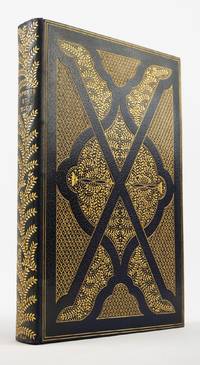
1890ST20732Paris: H. Launette et Cie 1890. No. 196 of 1000 copies and 100 Large Paper Copies with the etchings in multiple states. 255 x 165 mm. 10 x 6 1/2". 3 p.l. viii 190 pp. 3 leaves.Translated into French by Jacques Amyot. <br/> LOVELY DARK BLUE MOROCCO GILT BY CAPTAIN GLADSTONE stamp-signed C. E. G. on front dentelle covers divided into multiple compartments that at center a lobed mandorla all of the compartments densely gilt the inner compartments with swirls of leafy branches on a dotted background the others diapered by diagonal gilt fillets into lozenge-shaped compartments containing a single gilt dot smooth spine covered with leafy branches gilt lettering wide inner dentelles with sprays of leafy branches green silk pastedowns and endleaves top edge gilt imperceptible repair at top of spine. With 12 full-page etchings and 29 in-text illustrations by Champollion after the designs of Raphaël Collin. Ray "French" p. 377. Spine just faintly sunned though difficult to see with all its gilt occasional very minor foxing otherwise a fine copy clean and fresh internally with vast margins in a well-preserved binding bright with gilt.<br/> <br/> A unique combination of decadence and sweet innocence Longus' charming pastoral novel appears here with a series of engravings that were considered to be some of the most attractive of the period and in an impressive binding that emphasizes its pastoral setting and that has an origin clouded with mystery. Ray says that in a survey conducted in 1895 our "Daphnis et Chloé" with the Collin engravings came in fourth in a poll to determine the 10 most successful modern French illustrated books. Our edition uses the popular translation of Jacques Amyot 1513-93 first printed in 1559 and always recognized for its graceful style. Naval Commander Charles Elsden Gladstone 1855-1919 or "Captain Gladstone" as he is commonly called was an English bookbinder of great technical skill working in the late 19th Century but no one seems to know how or by whom he was trained. We know he had many hobbies including microscopy and optical magic lanterns per family accounts suggesting a curious mind and attention to detail both useful in bookbinding. Although testimony from the period indicates that Gladstone personally bound his books there are no known contemporaneous i.e. 1880-1910 exhibitions or auction records of the sale of any of his bindings and no information exists about his being an apprentice. Since the degree of complexity and beauty of his bindings--clearly in evidence here--is extraordinary one wonders if he did in fact personally bind the books. Yes he could have been a self-taught genius binding for his own pleasure but it is not inconceivable that he commissioned someone like Alfred de Sauty as finisher requiring that his own initials always be placed on the dentelles. Regardless of their origin Captain Gladstone bindings are exquisitely crafted filled with lovely all-over gilt-tooled work and characterized by innovative design features. Whoever produced them they are among the best to be found in England around the turn of the century. H. Launette et Cie unknown
175753169<p>Paris Imprimées pour les curieux 1757. HAND COLOURED EDITION 1757. Small 4to approximately 200 x 150 mm 7¾ x 6 inches title in red and black with engraved vignette engraved frontispiece by Benoit Audran after A. Coypel 29 further engraved plates 28 by Audran after Phillippe Duc d'Orléans 1 unsigned plate after the Comte de Caylus including the plate of Les petits pieds at page162 each within decorative border by S. Focke all engravings HAND COLOURED including initials and 16 head- and tailpieces 20 heightened with gilt parallel text. Pages: viii 1-269 1 bound in 19th century black morocco by Masson-Debonnelle his name on first lower dentelle gilt lettering and decoration to spine covers with central gilt-blocked bird quiver of arrows and torch motif corners with rose device triple fillet border gilt decorated dentelles all edges gilt marbled endpapers. Spine professionally relaid small brown stain to top inner margin of title page most plates have pale foxing to margins in varying degrees pale foxing to blank side of plates occasional foxing to text otherwise a very good copy of a hand coloured copy. The earlier translation is by Jacques Amyot 1513-1593. See Brunet Manuel du Libraire Volume 3 page 1158; Bonham's Auction Lot 41 29th July 2020 who sold a hand coloured edition see Google. MORE IMAGES ATTACHED TO THIS LISTING ALL ZOOMABLE FURTHER IMAGES ON REQUEST. POSTAGE AT COST.</p> Paris, Imprimées pour les curieux, 1757. hardcover
51-6792Paris: Ambroise Vollard 31 octobre 1902. 4to. 24.5 x 30cm. 10. 294 4pp.Original wraps in a contemporary half calf chemise with marbled boards in a matching slipcase repaired. One of 250 numbered copies.Francis Bouvet The Complete Graphic Work no. 75; Luc Monod Manuel. no. 7262; François Chapon Le Peintre et le livre pp. 67-68 -- The Artist & the Book 28 -- Rauch 22; OCLC Number / Unique Identifier:54167315.One of the most famous modern illustrated books – copy on hollande paper. Seduced by his first collaboration with Pierre Bonnard on Parallel by Verlaine 1900 Ambroise Vollard commissioned a second one from him these Pastorales. Where Parallel with its daring layout and the choice of printing the lithographs in pink had been disconcerting the layout of this second book is more classical the illustration being clearly separated from the text. However at the time of its publication it remained "shunned by bibliophiles who for a long time refused to see it as an appropriate illustration technique for luxury books because it was considered too commercial even vulgar" Limited edition. Vollard Petiet et l'estampe de maîtres pp. 44-45. .This judgment has largely been revised by their successors and the work is today considered one of the greatest successes of the illustrated book. Carteret Illustrés IV p. 242: a beautiful work highly sought after and highly rated. One of the greatest stars of modern books. ; « Like Bonnard’s earlier lithographs for Parallèlement and Manet’s for Le Corbeau these subtle plates had little appeal in 1902 for a public that preferred the sharply defined realism of the professional engraver.The book is today considered one of the finest of its periodâ€. The Artist and the Book n°28 ; Mahé II col. 695 ; Mornand Vingt-deux artistes du livre pp. 45-46 “Daphnis et Chloé fut pour Bonnard l’occasion de montrer toute la souplesse de son talent non seulement par la pureté du style bien antique des personnages mais par le caractère des paysages essentiellement grecsâ€. Paris: Ambroise Vollard, 31 octobre 1902. paperback
193755850Paris Philippe Gonin 1937 In-8, maroquin vert orn sur les plats en passant par le dos d'un important dcor pouss or et froid, compos de lignes obliques qui s'entrecroisent et de jeux de filets dors pouvant voquer le scintillement de petites toiles; doublures bord bord en box noir, gardes de soie moire verte, tranches dores sur brochure, couverture illustre. Chemise, tui (H. Alix). 46 bois originaux in texte de Maillol. Tirage limit 500 exemplaires numrots sur papier Maillol et 70 exemplaires rimposs dont 20 sur peau de chvre, 25 japon ancien et 25 chine, tous signs au crayon par l'artiste. Un des 25 exemplaires sur japon ancien, enrichi d'une double suite en noir et en bistre de tous les bois et de 8 preuves d'tat imprimes en noir sur diffrents papiers. Les suites et les preuves supplmentaires ont t runies dans un second volume reli en demi-maroquin vert coins.
1937ST11995Paris: Les Frères Gonin 1937. No. CXXV OF 500 COPIES SIGNED BY THE ARTIST this is one of the hors commerce copies with an additional suite of plates. 219 x 149 mm. 8 5/8 x 5 7/8". 2 217 5 pp. One volume and one portfolio. Translated by Jacques Amyot. <br/> MOST ATTRACTIVE BEIGE CRUSHED MOROCCO BY IRMGARD HACCIUS stamp-signed "I. H." in gilt on rear cover front cover with gilt titling arranged in 10 short descending rows surrounded by blind-tooled leaves and grasses rear cover with three-inch column of blind-tooled leaves bearing gilt berries and the binder's initials flat spine with titling in blind top edge gilt. Housed with the portfolio of plates in its original printed paper wrapper in a matching marbled paper folding box with beige morocco spine and edges no doubt done by Haccius as well. WITH 47 WOODCUTS BY ARISTIDE MAILLOL depicting scenes from the text AND WITH AN EXTRA SUITE OF 48 PLATES printed in sanguine the additional plate bearing the 15 woodcut initials used in the text. Front pastedown with armorial bookplate of German bibliophile and music publisher Ludwig Strecker. The Artist and the Book 174. ◆A SPLENDID COPY clean and bright in a luxurious unworn binding.<br/> <br/> This version of Longus' charming Greek pastoral novel of awakening love long retained its popularity and was published frequently often with illustrations. And perhaps the chief virtue of the present edition is the unaffected sometimes mischievous woodcuts of nymphs and lovers by the French-Catalan artist Aristide Maillol 1861-1944 best known for his sculpture. His engravings here have the same classical lines that typify his three-dimensional works. According to "The Artist and the Book" the work is "perhaps the most harmonious of Maillol's illustrated books." The very attractive and intelligent binding is by Mainz master bookbinder Irmgard Haccius 1916-2003 whose work here is entirely in keeping with the illustrator's graceful simplicity. Haccius studied at the art academies in Munich and Berlin in addition to completing advanced training in book binding at the Academy of Fine Arts at Castle Giebenstein Hall. She was one of the first faculty members at the State University Institute for Art and Handicraft in Mainz before joining Johannes Gutenberg University in 1973 as a professor in the Department of Visual Arts. Les Frères Gonin unknown