BONNARD (Pierre). LONGUS.Livre Rare Book
809 résultats
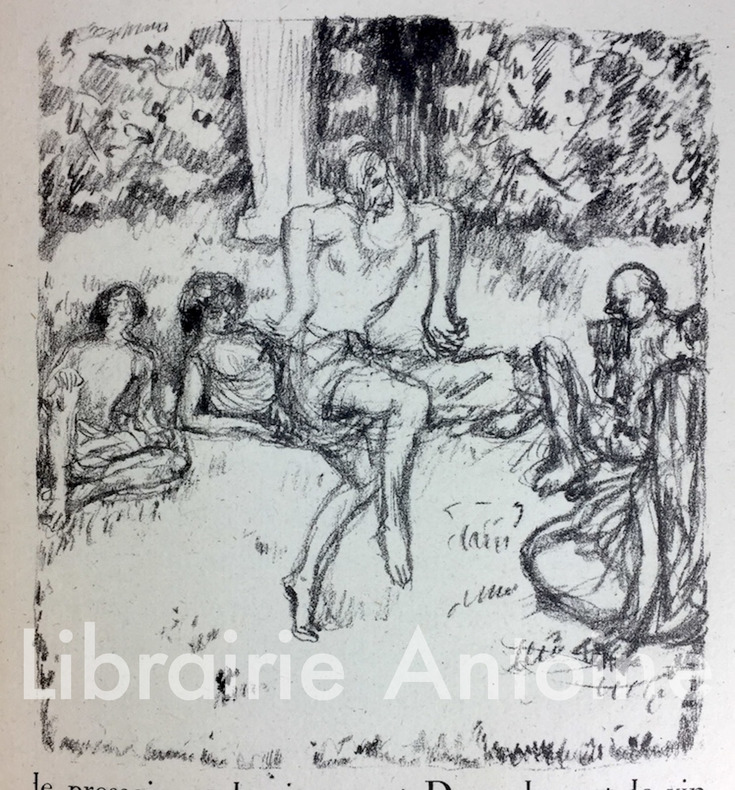
19022840Paris Ambroise Vollard 1902 In-4 (290 x 238 mm). 294 pp. 151 lithographies originales de Pierre Bonnard, couverture conservée. Pleine reliure de maroquin vert, gardes de soie verte, filets sur les coupes et les contreplats, dos à nerfs, tête dorée, étui (reliure signée David). Tirage limité à 250 exemplaires numérotés, celui-ci un des 200 sur Hollande van Gelder (numéroté 108).
1937CLL-296Paris, Philippe Gonin, 1937 In-8 de (1) f., 218 pp., (2) ff., maroquin bleu nuit, plats et dos entièrement ornés d'un décor de cercles entrecroisés tracés en points or et paladium de tailles variées, entrelacs mosaïqués beige et rouge aux angles, dos lisse, doublures de maroquin bleu nuit ornées du même décor avec au centre un large rectangle de soie dorée ornée d'ocelles crème, gardes de soie de même, tranches dorées sur témoins, chemise à recouvrement, étui bordé, couvertures et dos conservés (J. Anthoine-Legrain).
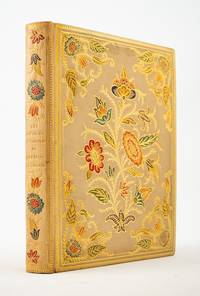
1745ST20826Paris: s.n. 1745. 205 x 155 mm. 8 x 6". 6 p.l. first blank 159 1 xx pp.Translated by Jacques Amyot. <br/> SPLENDID CREAM-COLORED MOROCCO BEAUTIFULLY GILT AND INLAID BY RENÉ KIEFFER stamp-signed on front turn-in verso of front flyleaf with his Rue Seguier ticket covers framed by dogtooth roll and plain rule border a charming spray of flowers at center inlaid in scarlet orange citron indigo turquoise lilac pink and violet morocco tooled with gilt on graceful gilt branches with leaves in three shades of green morocco smaller sprays of inlaid flowers and leaves in similar shades at corners the whole giving the effect of an elegant embroidered sampler smooth spine framed in gilt and with a chain of four inlaid morocco blossoms in brilliant hues extending from the head and foot of spine gilt lettering at center of spine turn-ins with frame of cream morocco inlaid with strips of emerald green morocco tooled with a ribbon and floral chain roll orange morocco squares at corners stamped with gilt flowers gold silk endleaves marbled flyleaves all edges gilt. In a kid-lined blue marbled chemise with navy morocco spine and lips and in a matching suede-lined slipcase. Additional engraved pictorial title by Coypel four engraved headpieces of putti four tailpiece vignettes by Cochin and 33 ENGRAVED PLATES consisting of 28 plates after Philippe d'Orléans by Audran the oft-lacking final plate "Les petits pieds" by the Comte de Caylus and EXTRA-ILLUSTRATED with four engraved headpiece vignettes by Fokke after Eisen mounted on blank leaves. A Large Paper Copy. Cohen-de Ricci 652-53; Ray 2A. Four small very faint water spots to boards one plate somewhat foxed in all other ways A GORGEOUS COPY clean and fresh internally with immense margins and in an unworn binding.<br/> <br/> This exceptionally desirable copy of Longus' unique combination of decadence and sweet innocence is printed on quarto-sized paper enhanced with engravings from some of the greatest Rococo illustrators and offered in an exquisite binding by a modern Parisian master. The charming pastoral novel appears here in the popular translation of Jacques Amyot 1513-93 first printed in 1559 and always recognized for its graceful style. The illustrations were created in 1714 by Philippe duc d'Orléans and Regent of France 1674-1723 engraved by Benoît Audran and published for the first time in 1718. Although Ray indicates that Philippe's work is clearly an amateur's he says that the plates "do tell the story in their halting way and the background landscapes in some of the larger plates have a naïve appeal." The plates were re-engraved for our 1745 printing and the always elegantly graceful tailpiece vignettes by Charles-Nicholas Cochin were created for this edition. Cochin 1715-90 is generally considered on a par with the three Rococo masters Gravelot Eisen and Moreau. Ray notes that works from his early career like the engravings here "are marked not only by the mastery of outline and firmness of composition which never deserted him but also by acute observation and unpretentious humor." Our volume also contains an extra plate by the Comte de Caylus omitted from some copies for its suggestive nature as it shows the feet of the entwined lovers Mon Dieu! protruding from the privacy of a grotto. Additionally a previous owner added four engravings created for the 1754 Longus by the great Charles Eisen 1720-78 Louis XV's Court painter and drawing master to Madame de Pompadour. Ray describes him as "the master of the small design" with "a marvelous talent for pleasing." The beauty of this copy was further--and gloriously--enhanced ca. 1910 when binder René Kieffer created the striking binding with its bouquets of fantastical flowers in a riot of colors and gold. Kieffer 1875-1963 was in the first class of students to graduate from the École Étienne where he concentrated on becoming a doreur learning to tool gold designs in the well-established style. After leaving school he worked for Chambolle-Duru until 1898 at which time he established his own studio. According to Duncan & De Bartha he "became a disciple of Marius Michel moving gradually away from his traditional training towards a more emblematic and modern style." He would become one of the most innovative and progressive binders in Paris in the 20th century earning a well-deserved reputation for producing widely variable bindings that defied typification. s.n. unknown
192649677Paris Editions d'Art H. Pi 1926 In-4, maroquin vert bouteille orn sur chaque plat d'une composition gomtrique mosaque en maroquin vert, beige et dor, mle quatre motifs floraux pousss froid; trs lger rappel du dcor sur le dos sans nerfs portant le nom de l'auteur et le titre de l'ouvrage en petites capitales dores; doublures serties d'un listel de maroquin beige et ornes d'un large encadrement gomtrique compos de filets ondulants froid et de mosaques en maroquin brun et dor, gardes de soie verte, tte dore, non rogn, couverture illustre. Chemise, tui (Gruel).25 compositions de Carlos Schwabe, dont 2 vignettes tires en spia (une sur la couverture et une sur la page de titre) et 23 en couleurs (4 en-ttes, 12 hors-texte et 7 in-texte). Cet ouvrage, publi dans la collection Les Cent Onze, a t tir 111 exemplaires numrots. Un des 31 premiers exemplaires sur japon imprial, seuls comporter une double suite des illustrations sur vlin, en couleurs et en noir. Exceptionnelle reliure double de Gruel.
19371720691937. MAILLOL Aristide. Les Pastorales de Daphnis and Chloe. By Longus. With 52 woodcuts by Aristide Maillol. Two volumes. 8vo. original illustrated wrappers and publisher's vellum-backed slipcases. Paris: Gonin 1937. A unique copy of the most beloved of all Maillol's books. This is the publisher's copy accompanied by 6 autograph letters from Maillol to the publisher discussin varuious aspects of the making of the book. As with all his books Maillol was closely involved in all aspects of production and the result is an extremely pleasing work "perhaps the most harmonious of Maillol's illustrated books" Garvey. This is copy number 1 of 25 hors commerce copies on large paper containing a double suite of the plates one in black and white and one in sanguine. It is also accompanied by a somewhat foxed example of the wedding invitation which Maillol printed for Gonin and a letter from Gonin to the original purchaser of this copy. Signed by Maillol on the colophon. The Artist and the Book 174. hardcover
LCS-17957Superbe exemplaire à grandes marges (hauteur : 167 mm) revêtu d’une élégante reliure en maroquin rouge du XVIIIe siècle de Derome le Jeune avec son étiquette. S.l. [Paris, Quillau], 1718. Petit in-8 de (7) ff. dont (1) f. frontispice, 164 pp., 29 planches hors-texte non-numérotés dont 13 sur double-page. Maroquin rouge, diverses roulettes dorées encadrant les plats avec fleuron d'angle, dos lisse finement orné, coupes décorées, roulette intérieure dorée, tranches dorées, doublures et gardes de tabis bleu. Reliure du XVIIIe siècle de Derome le jeune avec son étiquette. 167 x 98 mm.
18931276951893. LAWRENCE T.E. LONGUS. Daphnis and Chloe: A Most Sweet and Pleasant Pastoral Romance for Young Ladies. London: Vale Press 1893. Quarto contemporary full black crushed morocco elaborately gilt-decorated spine and covers raised bands top edge gilt uncut. $15000.An exceptional association copy: the finely printed and beautifully illustrated Vale Press Daphnis and Chloeone of only 210 copies 200 of which were for sale with 36 charming woodcuts in the Italian style by Charles Ricketts and Charles Shannon with ""T.E.L.""likely in T.E. Lawrence's handfaintly penciled in the upper right corner of the front free endpaper and a note from recipient Charles Francis Bell describing the circumstances in which Lawrence presented this copy to him. Beautifully bound in full morocco-gilt by C. & C. McLeish.""There are works which will never cease to be reprinted and which artists will ever love to illustrate according to their own individual fancies"" Jules Claretie Preface. This classical Greek work whose author Longus has not been fully identified has been dated to the 2nd or early 3rd century CE. Described by one scholar as ""an unknown best seller"" Giles Barber Daphnis and Chloe is considered ""the original or earliest survivor"" of the idyllic/pastoral romance Hardin Love in a Green Shade 1. This large-format illustrated edition is one of the Vale Press' most impressive books. It uses the quaint 17th-century translation of Thornley designed to convert the lascivious tale into reading matter for young ladies. One homosexual passage is left in the original Greek. In the Art Nouveau style the illustrations by Ricketts and Shannon effectively capture Longus' combination of decadence and sweet innocence.Born in 1859 binder Charles McLeish was apprenticed to Andrew Grieve in Edinburgh then came to London in 1890 to work for Riviere. When Cobden-Sanderson founded the Doves Bindery in 1893 he hired McLeish as the firm's finisher. McLeish held that estimable position until 1909 when he left to go into partnership with his son Charles who had apprenticed under Roger de Coverly. Although the senior McLeish was no longer in the employ of Cobden-Sanderson all of the bindings that were signed ""Doves Bindery"" between 1909 and 1921 were actually done in the McLeish workshop. The work produced by the McLeishes was beautifully designed and impeccably executed as evidenced in the present volume. With publisher's scarce four-page prospectus bound in at rear. Bookplate of recipient art historian Charles Francis Bell with his handwritten note regarding the circumstances of Lawrence presenting this copy to him tipped to the front free endpaper: ""This book was bound by McLeish for Colonel T.E. Lawrence whose initials in pencil in his own writing are in the top corner of the opposite endpaper. It was given by him to me at All Souls College Oxford on November 16 1920. C.F. Bell."" Bell 1871-1966 was curator of the Department of Fine Art in the Ashmolean Museum Oxford where he met Lawrence when the latter had brought fragments of pottery into the Ashmolean for identification. The two became friends and frequently discussed their shared enthusiasm for Medieval art and architecture. Although the brevity and faintness of the initials on the front free endpaper make it difficult to verify it as being in Lawrence's hand it is consistent with Lawrence's known practice of initialing his own books.Mild offsetting from woodcuts; offsetting from morocco turn-ins partially obscuring penciled initials in upper corner of front free endpaper binding beautiful and fine. An excellent association copy with distinguished provenance. hardcover
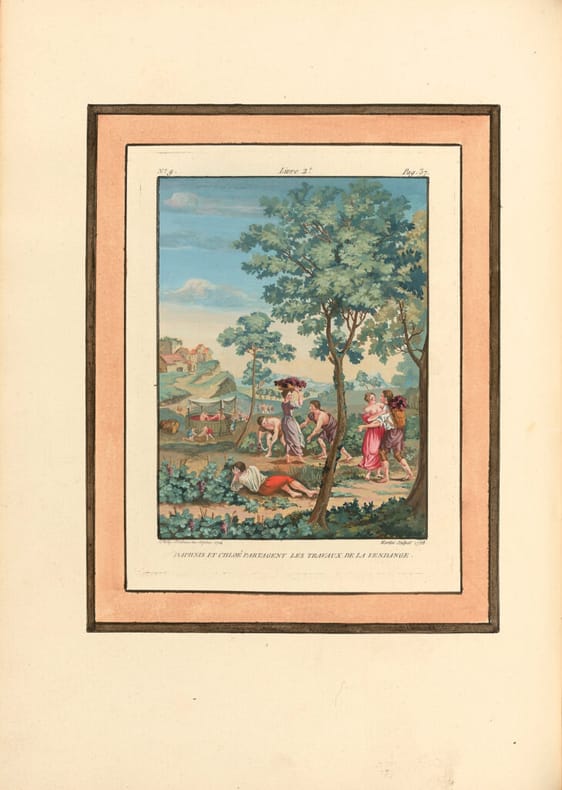
LCS-18396L’un des rarissimes exemplaires de luxe contenant les 29 figures gouachées tirées sur vélin des Amours de Daphnis et Chloé, l’un des plus célèbres livres illustrés du XVIIIe siècle. Paris, de l’Imprimerie de Monsieur, 1787. Petit in-folio de (1) f. bl., viii pp., (1) f., 175 pp., 29 planches hors-texte en couleurs numérotés, protégées par des serpentes. Maroquin rouge, filet et guirlande dorés encadrant les plats, dos lisse finement orné, pièce de titre de maroquin vert, coupes décorées, roulette intérieure dorée, tranches dorées. Etui. Reliure de l’époque. 319 x 240 mm.
JUINBB07<p>Paris de l'Imprimerie de Monsieur 1787.</p><p>Small folio 319 x 240 mm of 1 bl. l. viii pp. 1 l. 175 pp. 29 numbered plates out of text in color protected by silky papers. Red morocco gilt fillet and garland around the covers flat spine finely decorated lettering piece in green morocco inner gilt roll-stamp gilt edges. Case. <i>Contemporary binding.</i></p><p><b>Very beautiful edition of the most famous French illustrated book of the 18th century printed on the Comte de Provence's private press Louis XVI's brother and future Louis XVIII illustrated with 29 line duplicates</b><b> of the original figures of the Regent engraved by martini.</b></p><p><b>One of the very rare deluxe copies containing the 29 gouaches printed on vellum.</b></p><p>The paintings are of an exceptional freshness.</p><p><i>"Publisher Lamy had suites of these engravings printed on vellum gouached and inserted them in deluxe copies."</i> Cohen 655.</p><p>Monsieur's press was directed by Pierre-François Didot called "Didot jeune" since 1779.</p><p>In this Greek novel by Longus end of the 2nd century AD the author tells the story of the simple and naive love of Daphnis and Chloe two poor abandoned children.</p><p>The peculiarity of Longus' work in comparison with the other works of the same kind is to have left the ups and downs in the background and to have given full relief to the sentimental adventures of the protagonists.</p><p>Daphnis and Chloe have discovered in a slow progression their sexuality and the novel ends precisely on the accomplishment of the carnal act. The novel is celebrating Eros obviously but also Pan and the Nymphs.</p><p><b>This book translated in all languages was made fashionable again in France thanks to the regent philippe d'orleans </b>and appeared in several beautiful illustrated editions throughout the 18th century.</p><p>This edition offers a new translation by <i>de Bure Saint-Fauxbon</i>.<br /></p><p><b>Superb copy of which all the engravings have been painted in gouache at the time and enhanced with a painted salmon and black double frame preserved in its contemporary morocco binding.</b></p><p><b>This precious copy belonged to Napoleon III</b><b> </b>as evidenced by his ex-libris affixed to the contreplat of the binding.</p><p>Charles-Louis-Napoléon Bonaparte third and last son of Louis King of Holland and Hortense-Eugénie de Beauharnais and nephew of Napoleon I was born in Paris at the Château des Tuileries on April 20 1808 and became on July 22 1832 on the death of the Duke of Reichstadt the direct representative of the Napoleonic dynasty; first settled in Switzerland where he was appointed Captain of artillery in Bern in 1824 he tried in 1836 in Strasbourg to overthrow Louis-Philippe in a military movement; arrested and sent to the United States he made in August 1840 in Boulogne a second failed attempt which resulted in his perpetual imprisonment but he managed to escape from the Fort of Ham on May 26 1846 and reached Belgium; back in France during the 1848 Revolution he was elected Deputy in June 1848 then President of the Republic on December 10 of the same year. His coup of December 2 1851 against the Legislative Assembly gave him the presidency for ten years; finally proclaimed Emperor following a plebiscite of November 21-22 1852 on December 1 1852 Napoleon III married on January 29 1853 Marie-Eugénie de Gusman Countess of Téba second daughter of the Count of Montijo. Under his reign France enjoyed great industrial and commercial prosperity due in part to a number of public utility measures taken by the government while outside a series of wars including the end of the conquest of Algeria gave us Savoy County of Nice and Cochinchina. Following the defeat of Sedan where the Emperor had been taken prisoner the Republic was proclaimed in Paris on September 4. Napoleon III died in exile in Chislehurst England on January 9 1873. Olivier Pl. 2659 15.</p><p><u>FRENCH</u><br /></p><p>Paris de l'Imprimerie de Monsieur 1787.</p><p>Petit in-folio de 1 f. bl. viii pp. 1 f. 175 pp. 29 planches hors-texte en couleurs numérotés protégées par des serpentes. Maroquin rouge filet et guirlande dorés encadrant les plats dos lisse finement orné pièce de titre de maroquin vert coupes décorées roulette intérieure dorée tranches dorées. Etui. <i>Reliure de l'époque. </i></p><p>319 x 240 mm.</p><p><b>Très belle édition du plus célèbre livre illustré français du XVIIIe siècle imprimée sur la presse privée de Monsieur comte de Provence frère de Louis XVI futur Louis XVIII ornée de 29 copies au trait des figures originales du Régent gravées par Martini.</b></p><p><b>Un des rarissimes exemplaires de luxe contenant les 29 figures gouachées tirées sur vélin.</b></p><p>Les peintures sont d'une extrême fraîcheur.</p><p>" <i>L'éditeur Lamy fit gouacher des suites de ces gravures au trait tirées sur vélin et les inséra dans des exemplaires de luxe</i>. " Cohen 655.</p><p>L'imprimerie de Monsieur était dirigée par Pierre-François Didot dit Didot jeune depuis 1779.</p><p>Dans ce roman grec de Longus fin du IIe siècle après Jésus-Christ l'auteur raconte l'histoire de l'amour simple et naïf de Daphnis et Chloé deux pauvres enfants abandonnés.</p><p>La particularité de l'ouvrage de Longus par comparaison avec les autres ouvrages du même genre c'est d'avoir laissé les péripéties au second plan et d'avoir donné tout le relief aux aventures sentimentales des protagonistes.</p><p>Daphnis et Chloé ont découvert en une lente progression leur sexualité et le roman s'achève précisément sur l'accomplissement de l'acte charnel. Le roman célèbre Éros bien sûr mais aussi Pan et les Nymphes.</p><p><b>Ce livre traduit dans toutes les langues fut remis au goût du jour en France par le Régent Philippe d'Orléans</b> et connut plusieurs belles éditions illustrées tout au long du XVIIIe siècle.</p><p>La présente édition offre une traduction nouvelle par <i>de Bure Saint-Fauxbin</i>.</p><p><b>Superbe exemplaire dont l'ensemble des gravures ont été gouachées à l'époque et rehaussées d'un double cadre peint en saumon et noir conservé dans sa première reliure en maroquin de l'époque.</b></p><p><b>Ce précieux exemplaire a appartenu à Napoléon III</b> comme en atteste son ex libris apposé au contreplat de la reliure.</p><p>Charles-Louis-Napoléon Bonaparte troisième et dernier fils de Louis roi de Hollande et Hortense-Eugénie de Beauharnais et neveu de Napoléon Ier naquit à Paris au château des Tuileries le 20 avril 1808 et devint le 22 juillet 1832 à la mort du duc de Reichstadt le représentant direct de la dynastie napoléonienne ; d'abord fixé en Suisse où il fut nommé capitaine d'artillerie à Berne en 1824 il essaya en 1836 à Strasbourg de renverser Louis-Philippe dans un mouvement militaire ; arrêté et envoyé aux Etats-Unis il fit en août 1840 à Boulogne une seconde tentative qui échoua et qui lui valut l'emprisonnement perpétuel mais il réussit à s'enfuir du fort de Ham le 26 mai 1846 et à gagner la Belgique ; de retour en France lors de la révolution de 1848 il fut élu député en juin 1848 puis président de la république le 10 décembre de la même année. Le coup d'Etat du 2 décembre 1851 qu'il fit contre l'Assemblée législative lui donna la présidence pour dix ans ; enfin proclamé empereur à la suite d'un plébiscite des 21-22 novembre 1852 le 1er décembre 1852 Napoléon III épousa le 29 janvier 1853 Marie-Eugénie de Gusman comtesse de Téba seconde fille du comte de Montijo. Sous son règne la France jouit d'une grande prospérité industrielle et commerciale due en partie à nombre de mesures d'utilité publique prises par le gouvernement tandis qu'à l'extérieur une suite de guerres dont la fin de la conquête de l'Algérie nous donnait la Savoie le comté de Nice et la Cochinchine. A la suite de la défaite de Sedan où l'empereur avait été fait prisonnier la république fut proclamée à Paris le 4 septembre. Napoléon III mourut en exil à Chislehurst en Angleterre le 9 janvier 1873.</p><p>Olivier Pl. 2659 15.</p> hardcover