2 370 résultats
182384888Chez Aime Payen Libraire. As New. 1823. Hardcover. FREE UPGRADE to Courier/Priority Shipping Upon Request - IN STOCK AND IMMEDIATELY AVAILABLE FOR SHIPMENT - AS NEW THE TEXT BLOCK IS PRISTINE CLEAN UNMARKED AND IN EXCELLENT CONDITION - - Text in French 283 pages; on the lives of the most illustrious philosophers of antiquity concise / abridged edition .Includes 26 illustrations. -- with a bonus offer-- . Chez Aime Payen, Libraire hardcover
199574616Le Cateau-Cambresis Nord France: Musee Matisse. New. 1995. Paperback. 2907545175 . FREE UPGRADE to Courier/Priority Shipping Upon Request - IN STOCK AND IMMEDIATELY AVAILABLE FOR SHIPMENT - FLAWLESS COPY PRISTINE NEVER OPENED -- with a bonus offer-- . Musee Matisse paperback
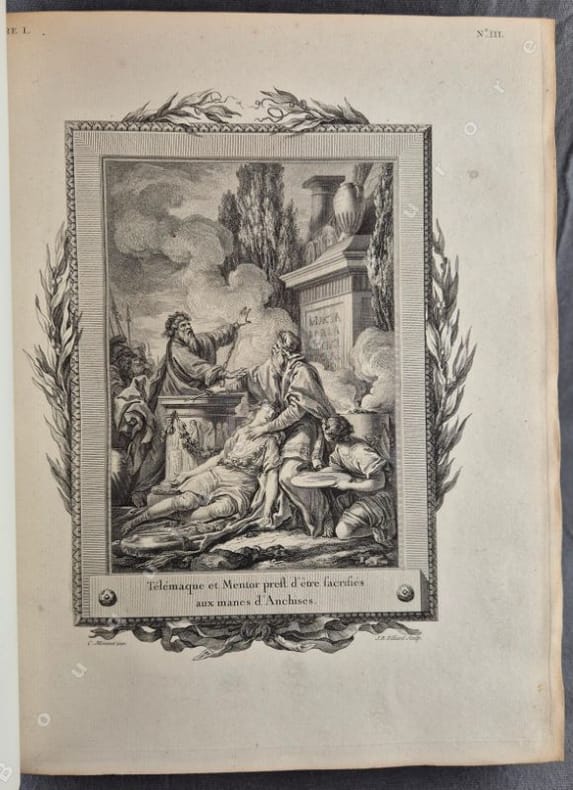
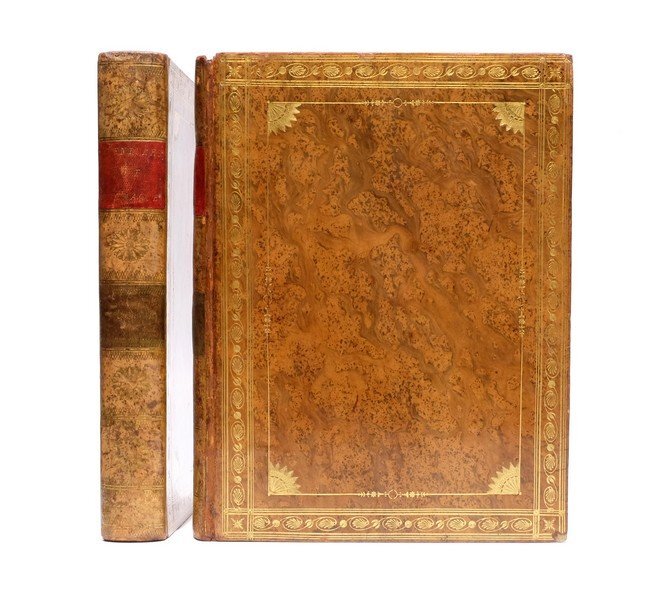
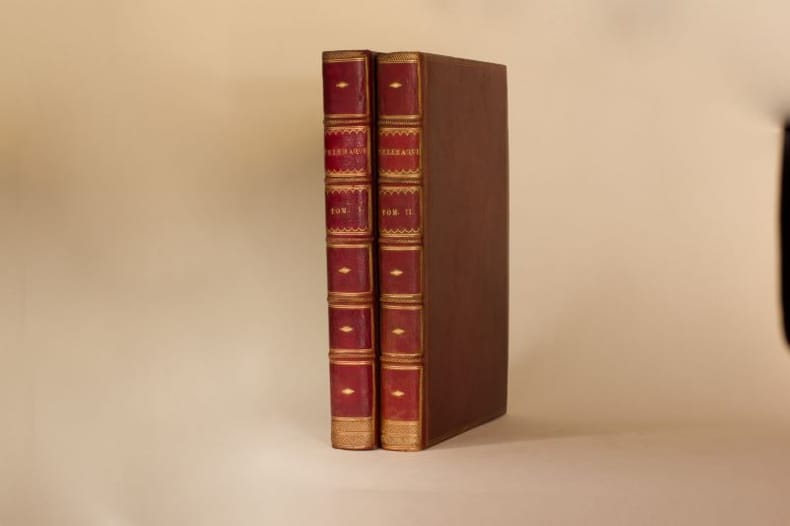
1783113161Paris De l'imprimerie de Franç. Ambr. Didot l'Aîné, "Collection des auteurs classiques français et latins" 1783 2 vol. Relié 2 vol. in-4, plein maroquin grenat, dos à nerfs guillochés, caissons encadrés de filets dorés et en pointillé avec losanges dorés au centre, triple filet doré en encadrement des plats, roulette intérieure dorée, double filet doré sur les coupes, coiffes guillochées, tranches dorées, 4 (p.) + 613 (pagination continue). Superbe édition typographique "imprimée par ordre du Roi pour l'éducation de Monseigneur le Dauphin", avec cette justification à la fin du second volume : "Cette édition in-4° dont le prix est de 48 liv. le vol. broché en carton, a été imprimée au nombre de 200 exemplaires, avec les nouveaux caractères de Didot l'Aîné, sur papier-vélin grand raisin de France, de la fabrique de Matthieu Johannot, d'Annonai en Vivarais". Rappelons que ce roman d'apprentissage destiné au dauphin était paru anonymement en 1699. Il avait valu à Fénelon d'être éloigné de la cour, le roi y ayant vu une critique de la monarchie absolue. On cite souvent Fénelon comme précurseur des Lumières, et Télémaque fut pendant plus de deux siècles un ouvrage de référence pour l'apprentissage du français. Très légers frottements et une petite tâche d'encre au plat supérieur du premier volume, mais exemplaire très frais, recouvert d'élégantes reliures du temps dans le style de Dérôme le jeune.
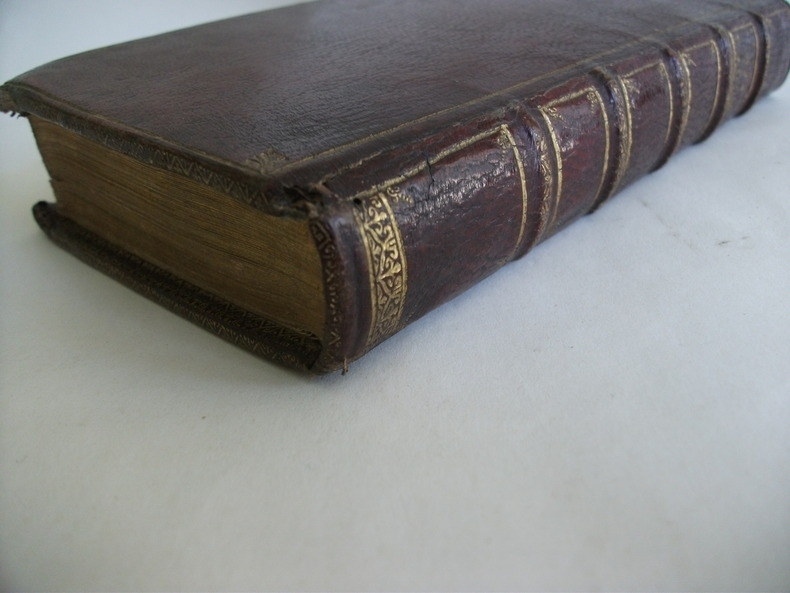
173422235Amsterdam & Rotterdam: J. Wetstein & G. Smith & Zacharie Chatelain; Jean Hofhout 1734. Nouvelle Edition. leather_bound. Contemporary full mottled calf. Aeg. Very good/Near fine. 2 X XVII 424 pages. 28.5 x 23 cm. Folding map 24 plates engraved by Balthasar Bernaerts Philipp Van Gunst Louis Surugue and Jacob Folkema after Louis Fabricius Dubourg Bernard Picart and Guillaume-François-Laurent Debrie with 22 engraved tail pieces. There was also a 1734 folio edition of this work limited to 150 copies. The engravings of the two editions are similar. Our copy contains the suppressed "Ode" last six pages of the text. First edition published 1699: it was also considered an attack on the divine right of absolute monarchy and the the most popular book of its time. BRUNET. p.1214 calls it a "belle edition." GORDON N. RAY. p.8: depicts frontispiece herein. Bookplate of Armand-Jules de Rohan Archbishop of Reims. Raised bands spine panels in gilt floral arabesques triple gilt border panels marbled endpapers spine ends conserved. J. Wetstein & G. Smith, & Zacharie Chatelain; Jean Hofhout unknown
173422235Amsterdam & Rotterdam: J. Wetstein & G. Smith & Zacharie Chatelain; Jean Hofhout 1734. Nouvelle Edition. leather_bound. Contemporary full mottled calf. Aeg. Very good/Near fine. 2 X XVII 424 pages. 28.5 x 23 cm. Folding map 24 plates engraved by Balthasar Bernaerts Philipp Van Gunst Louis Surugue and Jacob Folkema after Louis Fabricius Dubourg Bernard Picart and Guillaume-François-Laurent Debrie with 22 engraved tail pieces. There was also a 1734 folio edition of this work limited to 150 copies. The engravings of the two editions are similar. Our copy contains the suppressed "Ode" last six pages of the text. First edition published 1699: it was also considered an attack on the divine right of absolute monarchy and the the most popular book of its time. BRUNET. p.1214 calls it a "belle edition." GORDON N. RAY. p.8: depicts frontispiece herein. Bookplate of Armand-Jules de Rohan Archbishop of Reims. Raised bands spine panels in gilt floral arabesques triple gilt border panels marbled endpapers spine ends conserved. J. Wetstein & G. Smith, & Zacharie Chatelain; Jean Hofhout unknown books
2340in 12 plein maroquin rouge à nerfs,titre,filets,palmette dorés,roulette dorée intérieure et sur les coupes,filets dorés en encadrement sur les plats avec petits fers aux angles;Titre en rouge et noir avec monogramme gravé de l’éditeur.1 feuillet de table des matières 275 pages,6 pages de privilège,1 page d’errata,3 pages de catalogue, tranches dorées,Pierre Auboin Pierre Emery et Carles Clousier 1687 Edition originale rare avec les caractéristiques du premier tirage à savoir manque de pagination pages 193 à 198,la page 163 marquée par erreur 103,page 275 omise dans l’errata mais non corrigée.Très bon exemplaire "Premier ouvrage de Fénelon qui contribua à sa réputation. Composé à la demande de la duchesse de Beauvilliersqui réclamait un guide pour l’éducation de ses enfants,ce livre est devenu une référence.Fénelon prend ouvertement le parti d’une instruction mesurée,mais réelle,à l’encontre d’une conception réductrice,cantonnant les filles et les femmes dans l’ombre de l’origine du péché originel"
1790D14222Paris: de l'Imprimerie de Monsieur 1790. Hardcover. Very Good. Ornately gilt-stamped early 19th-century straight-grain red morocco a.e.g. pale blue silk doublures and endleaves; complete set of 2 volumes 8vo; pp. 4 half-title p. title-p. viii 4 426; 6 half-title p. title-p. "livre treizieme" title-p. 408; plus frontispiece portrait of Fenelon after Vivien and 24 plates after Marillier. Some light scuffing along joints and edges of boards; corners lightly bumped. Foxing in plate margins and on tissue-guards but overall text blocks are bright and clean. A beautiful set of books. <br/><br/>In this set the portrait after Vivien and plates after Marillier are substituted for the plates after Cochin and Moreau called for on the title-page. Cohen-de Ricci 386. de l'Imprimerie de Monsieur hardcover books
1783143731783 P., de lImprimerie de P. A. Didot laîné ; 1783, 2 vol. in-4° (325 x 235 mm) reliés à la Bradel plein vélin teinté vert, dos lisse très richement orné, date en pied dorée, pièces de titre et de tomaison en maroquin bordeaux, double filet doré en encadrement des plats avec petit fer de fleur en écoinçons, têtes dorées (VERMOREL), de (4) ff. - pp. 1 à 312 ; (2) ff. pp. 313 à 613.Quelques rousseurs essentiellement marginales, très bel exemplaire non rogné par ailleurs dans une très belle reliure pastiche de Vermorel.
1809ST14310fLondon: J. Hatchard 1809. 210 x 133 mm. 8 1/4 x 5 1/4". xvi 291 pp.Translated by Louisa A. Marshall. <br/> Contemporary dark blue straight-grain morocco covers bordered with gilt rule flat spine with simple gilt rules and titling gilt-ruled turn-ins all edges gilt and WITH A FINE FORE-EDGE PAINTING OF A SCENIC RIVER VIEW FEATURING CHRIST CHURCH PRIORY in Hampshire. Front free endpaper with owner signature of E. A. Fetherston. Slight variation in color of boards half title with one inch trimmed away at head probably removing owner inscription leaves a shade less than bright occasional minor foxing or offsetting in the text bed but still an excellent copy the text clean and fresh the pleasant binding entirely sound and the lovely fore-edge painting very well preserved.<br/> <br/> The typically bucolic fore-edge scene here--boat in tranquil water stately building occupying center stage trees all around puffy clouds--stands out for the level of achievement in execution by the artist. The clouds are painted in a delicately applied range of shades so that they are very convincing; there is considerable architectural detail visible on the side of the church; and it seems as if one can almost see individual leaves in the trees. These features are all hallmarks of the work of the so-called "Dover Painter" the name given by Jeff Weber to the artist who produced very high quality painted fore edges in the 1920s and 1930s. He did work for the famous London bookseller Marks & Company for Dawson's Bookshop in Los Angeles and for J. W. Robinson Company the Los Angeles department store. Estelle Doheny 1875-1958 whose library comprised one of the great collections of the 20th century bought actively from Dawson's and Weber estimates that approximately half of the very considerable number of especially fine fore-edge paintings in the Doheny collection in Camarillo California were done by the Dover Painter. As the fore-edge painting here evokes a feeling of serenity so too does the content religious meditations by François Fénélon 1651-1715 priest writer and tutor to King Louis XIV's grandson for whom he composed his best-known work "The Adventures of Telemachus.". J. Hatchard unknown
182887901Paris: Froment et Lequien 1828. Fine. Froment et Lequien Paris 1828 12.50 x 21 cm 2 volumes reliés New edition preceded by the Discourse on Epic Poetry and on the Excellence of the Telemachus poem by Ramsay. One portrait frontispiece and 11 neoclassical figures hors-texte under tissue guards in volume 1 and 13 in volume 2 totaling 25 figures. Contemporary full glazed navy calf binding signed Thouvenin at the foot of volume 1. Raised band spine decorated with 3 richly ornamented compartments series of fillets on the bands and roulettes at head and foot. Boards stamped in blind with a large central Restoration rosette and large Rococo corner ornaments blind decorative border and gilt fillet frame. Interior decorative border. Gilt edges. Light rubbing. Some scattered foxing. Very handsome copy rare in this condition. Froment et Lequien hardcover
377Paris : Lefèvre, rue de l'éperon, n° 6, Brière, rue S.-André, n° 68, 1824. LE « PETIT » TÉLÉMAQUE DU CABINET DU ROI RELIÉ À SES ARMES
9677774Short description: In Russian. Fenelon Francois de Salignac de la Mothe. Nature's Spectacle about the Being of God. printed at Imperial Moscow University. The image is provided for reference only. It may reflect condition of one of the available copies or only help in identifying the edition. Please feel free to contact us for a detailed description of the copies available. SKU9677774 unknown
1763CLL-740Paris, Chez les Frères Estienne, 1763 2 volumes in-12 de XLVIII, 380pp., (2)ff. - (2) ff., 480pp., veau fauve, encadrement de triple filet doré sur les plats, fleurons aux angles, dos à nerfs ornés de caissons de fleurons dorés, pièces de titre et de tomaison de maroquin rouge, les secondes agrémentées d'une guirlande dorée, coupes et bordures décorées, tranches dorées sur marbrure (Pagnant).
10956Paris, Jacques Estienne, 1717. 2 vol. in-12, veau brun marbré, dos à nerfs ornés de caissons dorés, pièces de titre en maroquin rouge, roulette dorée sur les coupes, tranches marbrées. Reliures de l'époque, charnières fendillées, coins râpés. Bon exemplaire. Ex-libris ms. au contreplat de François Dupin, 1718. Portrait h.-t. par Bailleul gravé en taille-douce par Duflos, 1 frontispice h.-t. pour le tome II et 24 fig. h.-t. par Bonnart gravées en taille-douce par Giffart, 1 carte h.-t. repliée, (1) f., lviij pp., (1) f., 267 pp.; (1) f. (faux-titre), pp. 269 à 526, (1) f. Petite rustine à la p. iii du tome I.
985Paris : Franç. Ambr. Didot l'Aîné, 1783. EXEMPLAIRE IN-4° DU PREMIER VOLUME DE LA COLLECTION DU DAUPHIN IMPRIMÉ PAR DIDOT, DANS UNE ÉLÉGANTE RELIURE À L'ÉVENTAIL
1796798Paris, Pierre Didot l'aîné, 1796 ; 4 vol. in-18 de [2] ff., 240 pp. ; [2] ff., 292 pp. ; [2] ff., 248 pp. ; [2] ff., 260 pp., reliures de l'époque maroquin rouge à long grain, filet doré, dos lisses ornés, roulette sur les chasses, doublures et gardes de moire prune, verte ou bleu ciel selon le volume, frise dorée bordant la doublure, tranches dorées (Rel. p. Purgold).
168712094<p>A Paris: Chez Pierre Aubouin Pierre Emery et Charles Clousier… 1687 First edition mixed issue of Fénelon's 1651-1715 most important book. This copy has no errata as is the case with first issue copies according to Tchermerzine. It follows Tchermerzine's description of the second issue with p. 167 line 20 having the reading "sans vivre de son esprit" . However it has the errors on p. 275 "manifiques" and "simplieté" as does the first issue. Both O4 pp. 167-8 and pp. 275-6 Z3 are on stubs. . Contemporary calf gilt-decorated spine. . Twelvemo. Spine ends corners lightly worn. Some light browning but generally a very good copy. Instructions for the Education of a Daughter was "…the first systematic attempt ever made to deal with that subject as a whole. Hence it was probably the most influential of all Fénelon's books and guided French ideas on the question all through the 18th century. It holds a most judicious balance between the two opposing parties of the time. On the one side were the précieuses enthusiasts for the 'higher' education of their sex; on the other were the heavy Philistines so often portrayed by Molière who thought that the less girls knew the better they were likely to be. Fénelon sums up in favour of the cultivated house-wife; his first object was to persuade the mothers to take charge of their girls themselves and fit them to become wives and mothers in their turn" Encyclopedia Britannica 13th edition. "Il faut considérer outre le bien que font les femmes quand elles sont bien élevées le mal qu'elles causent dans e monde quand elles manquent d'une education qui leur inspire la vertu. Il est constant que la mauvaise éducation des femmes fait plus de mal que celle des hommes puisque les désordres des hommes viennent souvent & de la mauvaise éducation qu'ils ont receüe de leurs mères & des passions que d'autres femmes leur ont inspirées dans un âge plus avancé. Quelles intrigues se presentent à nous dans les Histoires quel renversement des lois & des moeurs quelles guerres sanglantes quelles nouveautez contre la religion quelles révolutions d'Etat causées par le déreglement des femmes! Voilà ce qui prouve l'importance de bien élever les filles" pp. 7-8.</p> Chez Pierre Aubouin, Pierre Emery et Charles Clousier…
30944Paris Didot l'AineÌ An IV 1796. 4 vol. 90 x 145 mm de 240 292 248 et 260 p. avec 1 f. front. au tome I et 2 f. catalogue au tome IV. Maroquin rouge dos aÌ€ nerfs orneÌs de compartiments doreÌs pieÌ€ces de titre et pastilles de tomaison vertes filets et roulettes doreÌs encadrant les plats contreplats et gardes papier à décor floral tranches doreÌes reliure de l'époque. . Un des 200 exemplaires sur vélin avec les figures avant la lettre signées à la pointe-sèche. Portrait de FeÌnelon d'apreÌ€s Vivien graveÌ par Gaucher et 24 figures de Quéverdo graveÌes par Dambrun Delignon Delaunay Gaucher et Villerey. . On joint reliée à part la rare suite des eaux-fortes pures à toutes marges de Quéverdo reliée en demi-percaline aÌ€ coins. Roman didactique de Fénelon probablement écrit dans les années 1694 et suivantes Les Aventures de Télémaque sont publiées pour la première fois - à l'insu de l'auteur - en 1699. Il fut interprété comme une satire du règne de Louis XIV où l'arrogant prince Idoménée transparaît comme une image particulièrement évocatrice du Roi Soleil. Cette critique implicite de l'absolutisme du monarque apparut immédiatement comme un manifeste transparent en faveur du droit naturel contre le droit divin. Le roman rencontra un vif succès et fut pendant deux siècles de 1699 à 1914 un des livres les plus réédités et les plus lus de toute la littérature française « tellement traduit en Europe que le décompte exact de ses traductions reste encore à faire ». Sa diffusion fut telle qu'il servit de support d'apprentissage de la langue française avec de nombreuses éditions bilingues y compris étrangères : « ainsi dans l'espace allemand on publie de nombreuses versions traduites en italien ou en anglais du roman de Fénelon avec une évidente visée d'apprentissage linguistique . Télémaque est historiquement en 1726 le premier livre publié en anglais sur le sol allemand et c'était aussi le premier roman à être traduit en turc publié en 1862 » Nathalie Ferrand Les circulations européennes du roman français Presses universitaires de Rennes 2010. Une édition identique sera imprimée en 1797 dans le même format avec la même collation et toujours chez Pierre Didot mais avec des gravures de Lefebvre nettement moins séduisantes et recherchées. Des bibliothèques A. Gransire puis Paul Eudel ex-libris. Paul Eudel était collectionneur critique d'art et auteur dramatique ; ex-libris armorieÌ aÌ€ la devise In Procellis impavidae Calmes dans la tempeÌ‚te. Sa bibliotheÌ€que fut dispersée en vente publique en 1898 et 1913. Cohen 388-389 ; voir le blog du Dr J.P. Fontaine le 17 mai 2019 : « Le Tite-Live de l'Hotel des Ventes ». Paris, Didot l'AineÌ, An IV, 1796. 4 vol. (90 x 145 mm) de 240, 292, 248 et 260 p. avec [1] f. (front.) au tome I et [2] f. (ca unknown
174742147A La Haye, chez Jean Neaulme, 1747. In-12 de XIVI-102-(1) pp., veau marbré, dos orné à nerfs, pièce de titre en maroquin rouge (reliure de l'époque).
1784lu2498A Paris, de l'Imprimerie de Didot l'Ainé Collection des auteurs classiques françois et latins, Sélection Abraxas-libris Relié 1784 Deux volumes in-8 reliés, 19 x 11.50 cm., reliure plein veau marbré, 5 nerfs, dos orné de caissons dorés, pièces de titre et de tomaison, filets dorés sur les plats et les bords, tranches dorées, 453 et 438 pages, premier volume de la collection du Dauphin imprimé par Didot, 1 des 350 exemplaires sur vélin d'Annonai ; rares rousseurs, 5 petits (et anciens) trous de ver sur la reliure, petits frottements sur les mors, les nerfs, les coiffes et les coins, belle reliure d'époque. Livraison a domicile (La Poste) ou en Mondial Relay sur simple demande.
179630944Télémaque en maroquin rouge, avec les 24 figures Paris, Didot l'Aine, An IV, 1796. 4 vol. (90 x 145 mm) de 240, 292, 248 et 260 p. avec [1] f. (front.) au tome I et [2] f. (catalogue) au tome IV. Maroquin rouge, dos a nerfs ornes de compartiments dores, pieces de titre et pastilles de tomaison vertes, filets et roulettes dores encadrant les plats, contreplats et gardes papier à décor floral, tranches dorees (reliure de l'époque). Un des 200 exemplaires sur vélin, avec les figures avant la lettre signées à la pointe-sèche. Portrait de Fenelon d'apres Vivien grave par Gaucher et 24 figures de Quéverdo gravees par Dambrun, Delignon, Delaunay, Gaucher et Villerey.
22207Paris, Pierre Auboin, Pierre Emery et Charles Clousier, 1697. In-12, [36]-272-[1] pp., veau moucheté brun, dos à nerfs orné de caissons dorés, pièce de titre rouge, tranches mouchetées (petits manques et épidermures, quelques petites taches éparses).
175632426AB1756. A Londres London Chez Nourse & Vaillant 1756. Octavo 10.8 cm wide x 18 cm high. Pagination: Frontispiece XXXII 386 pages plus 22 unnumbered pages of a Dictionary for Mythology and Geography to the rear of the volume. With ten engravings plus one folded map throughout the Volume resulting in 11 engravings including Frontispiece plus Map. Hardcover / Original full leather with gilt lettering on spine-label. Edges of bookblock and binding slightly rubbed. Overall in very good and firm condition with only minor signs of wear. Few dogears. Front free endpaper partially torn name of pre-owner Reverend Richard Meade verso the frontispiece. From the library of Richard Meade Ballymartle with his Exlibris / Bookplate loosely inserted. "Les Aventures de Télémaque fils d'Ulysse" English: The Adventures of Telemachus son of Ulysses is a didactic novel by François Fénelon Archbishop of Cambrai who in 1689 became tutor to the seven-year-old Duc de Bourgogne grandson of Louis XIV and second in line to the French throne. It was published anonymously in 1699 and reissued in 1717 by his family. The slender plot fills out a gap in Homer's Odyssey recounting the educational travels of Telemachus son of Ulysses accompanied by his tutor Mentor who is revealed early on in the story to be Minerva goddess of wisdom in disguise. The tutor Mentor is arguably the true hero of the book much of which is given over to his speeches and advice on how to rule. Over and over Mentor denounces war luxury and selfishness and proclaims the brotherhood of man and the necessity of altruism though that term would only be coined in the 19th century by Auguste Comte. He recommends a complete overhaul of government and the abolition of the mercantile system and taxes on the peasantry and suggests a system of parliamentary government and a Federation of Nations to settle disputes between nations peacefully. As against luxury and imperialism represented by ancient Rome Fénelon holds up the ideal of the simplicity and relative equality of ancient Greece an ideal that would be taken up by in the Romantic era of the 19th century. The form of government he looks to is an aristocratic republic in the form of a constitutional monarchy in which the ruler-prince is advised by a council of patricians. Although set in a far off place and ancient time Télémaque was immediately recognized by contemporaries as a scathing rebuke to the autocratic reign of Louis XIV of France whose wars and taxes on the peasantry had reduced the country to famine. Louis XIV who had previously banished Fénelon from Versailles and confined him to his diocese because of a religious controversy was so angered by the book that he maintained those restrictions on Fénelon's movements even when the religious dispute was resolved. Yet a few years later royal panegyrists were hailing the young king Louis XV as a new Telemachus and flattering his tutors as new "Mentors". Later in the century royal tutors gave the book to their charges and King Louis XVI 175493 was strongly marked by it. The French literary historian Jean-Claude Bonnet calls Télémaque "the true key to the museum of the eighteenth-century imagination".2 One of the most popular works of the century it was an immediate best-seller both in France and abroad going through many editions and translated into every European language and even Latin verse first in Berlin in 1743 then in Paris by Étienne Viel 173787. It inspired numerous imitations such as the Abbé Jean Terrasson's novel Life of Sethos 1731; it also supplied the plot for Mozart's opera Idomeneo 1781. With its message of world peace simplicity and the brotherhood of man Télémaque was a favorite of Montesquieu and of Jean-Jacques Rousseau and through him of the French revolutionaries and of German Romantics such as Johann Gottfried Herder 17441803 who approvingly quotes Fénelon's remark "I love my family more than myself; more than my family my fatherland; more than my fatherland humankind". It was also a favorite of Thomas Jefferson who re-read it frequently. It was also widely read in the Ottoman Empire and in Iran. One critic explains the popularity of Télémaque this way: Fénelon's story stood as a powerful rebuke to the aristocratic court culture that dominated European societies with its perceived artificiality hypocrisy and monumental selfishness. The book did not simply express these feelings; it helped shape and popularize them. From its wellspring of sentimentality a river of tenderly shed tears would flow straight through the eighteenth century fed by Richardson Greuze and Rousseau among others finally to pour out into the broad sea of Romanticism. Influence on Rousseau In Rousseau's Émile 1762 a treatise on education the eponymous pupil is specifically given only two novels although as a young man he also reads poetry and other literature: as a child he is given Daniel Defoe's Robinson Crusoe to inculcate him in resourcefulness and self-reliance; and when he becomes a young man the political treatise Télémaque which is put into his hands by his intended Sophie who has read it and fallen in love with the fictional hero. The education of Émile is completed by a journey during which the institutions of various nations are to be studied. His tutor inculcates principles into him which sum up the essentials of the Social Contract. But it is with a Telemachus in hand that teacher and pupil establish a "scale of measurement" for judging various existing societies. Fénelon's story presents models and counter models of monarchs. The princes and governments of the real world will be compared with them. In Rousseau's novel Émile and his tutor travel to Salento which formerly included much of what is now Calabria and Apulia Italy to seek the "good Idomeneo" whom Fénelon's novel had relocated from his former kingdom in Crete to the kingship of a new and reformed government. Contrary to Louis XIV whom he resembles in many traits of character Idomeneus renounces conquest and is able to make peace with his neighbors. The prosperous fields and laborious capital are schools of virtue where law rules over the monarch himself. Everything here is brought down to a "noble and frugal simplicity" and in the harmony of a strictly hierarchical society everything combines in a common utility. Wikipedia _____________________________________________________ Telemachus Romanized: Telemakhos lit. 'far-fighter' is the son of Odysseus and Penelope in Greek mythology and a central character in Homer's Odyssey. When Telemachus reached manhood he visited Pylos and Sparta in search of his wandering father. On his return to Ithaca he found that Odysseus had reached home before him. Then father and son slayed the suitors who had gathered around to woo Penelope. According to later tradition Telemachus married Circe after Odysseus's death. The first four books of the Odyssey focus on Telemachus's journeys in search of news about his father who has yet to return home from the Trojan War and are traditionally given the title Telemachy. Telemachus's name in Greek means "far from battle" or perhaps "fighting from afar" as a bowman does. In Homer's Odyssey Telemachus under the instructions of Athena who accompanies him during the quest spends the first four books trying to gain knowledge of his father Odysseus who left for Troy when Telemachus was still an infant. At the outset of Telemachus's journey Odysseus had been absent from his home at Ithaca for twenty years due to the Trojan War and the intervention of Poseidon. During his absence Odysseus's house has been occupied by hordes of suitors seeking the hand of Penelope. Telemachus first visits Nestor and is well received by the old man who regales him with stories of his father's glory. Telemachus then departs with Nestor's son Peisistratus who accompanies him to the halls of Menelaus and his wife Helen. While there Telemachus is again treated as an honored guest as Menelaus and Helen tell complementary yet contradictory stories of his father's exploits at Troy. Telemachus also learns from Menelaus that his father was last seen stranded on Ogygia. Telemachus focuses on his father's return to Ithaca in Book XV. He visits Eumaeus the swineherd who happens to be hosting a disguised Odysseus. After Odysseus reveals himself to Telemachus due to Athena's advice the two men plan the downfall of the suitors. Telemachus then returns to the palace to keep an eye on the suitors and to await his father as the beggar. When Penelope challenges the suitors to string Odysseus's bow and shoot an arrow through the handle-holes of twelve axe heads Telemachus is the first to attempt the task. He would have completed the task nearly stringing the bow on his fourth attempt; however Odysseus subtly stops him before he can finish his attempt. Following the suitors' failure at this task Odysseus reveals himself and he and Telemachus bring swift and bloody death to the suitors. The Telegony was a short two-book epic poem recounting the life and death of Odysseus after the events of the Odyssey. In this mythological postscript Odysseus is accidentally killed by Telegonus his unknown son by the goddess Circe. After Odysseus's death Telemachus returns to Aeaea with Telegonus and Penelope and there marries Circe. Seemingly later tradition included the character of Cassiphonethe daughter of Odysseus and Circe and therefore half-sister of Telemachusin the narrative. In this account Telemachus still marries Circe but Odysseus is resurrected by Circe at some point. From the Dictionary of Greek and Roman Biography and Mythology: In the post-Homeric traditions we read that Palamedes when endeavouring to persuade Odysseus to join the Greeks against Troy and the latter feigned idiocy placed the infant Telemachus before the plough with which Odysseus was ploughing. In Contest of Homer and Hesiod it is alleged that the Roman Emperor Hadrian asked the Delphic Oracle about Homer's birthplace and parentage. The Oracle replied that Homer came from Ithaca and that Telemachus was his father by Epicasta daughter of Nestor. According to Aristotle and Dictys of Crete Telemachus married Nausicaa King Alcinous's daughter and fathered a son named Perseptolis or Ptoliporthus. Eustathius says that the mother was Polycaste the daughter of Nestor. Others relate that he became the father of Latinus by Circe. He is also said to have had a daughter called Roma who married Aeneas. Servius makes Telemachus the founder of the town of Clusium in Etruria. Wikipedia hardcover
1718335Très bel état; Publié par Gabriel- Jacques de Salignac, marquis de La Mothe Fenelon qui signe l'épitre dédicatoire (1688-1746) (24)-278 pp.L'autre éditeur est Jacques Estienne, même année.Ex-dono émouvant à la comtesse de La Bédoyère sur la page de garde. Ex-libris Arnaud de Torcy sur page de titre. Pl. maroquin rouge ancien, dos à nerfs orné de caissons dorés, triple filets dorés d'encadrement sur les plats, double filets sur les coupes, dentelles intérieures, tranches dorées, rel. 19è signée AM Très bon Paris Delaulne 1718 1 volume in-12.