1 986 résultats
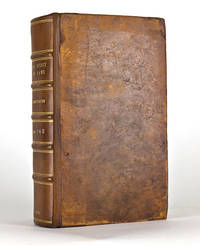
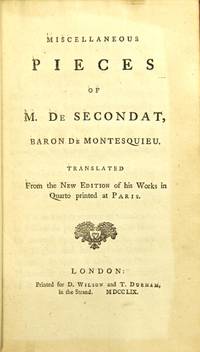
175927584London: printed for D. Wilson and T. Durham 1759. First edition in English 8vo pp. vi 2 334 plus final blank; contemporary full calf red morocco label on gilt-decorated spine; extremities rubbed top of spine slightly chipped and cracked upper joint starting but in all a good sound copy or better. Contains the Eulogium on Montesquieu by Monsieur d'Alembert; The Analysis of the Spirit of laws by M. d'Alembert; An Oration Pronounced the 24th of January 1728 by Montesquieu; and An essay upon taste; New Persian letters; The Temple of Gnidus; and A defence of the Spirit of laws: to which are added some explanations all by Montesquieu. <br/><br/> printed for D. Wilson and T. Durham unknown books
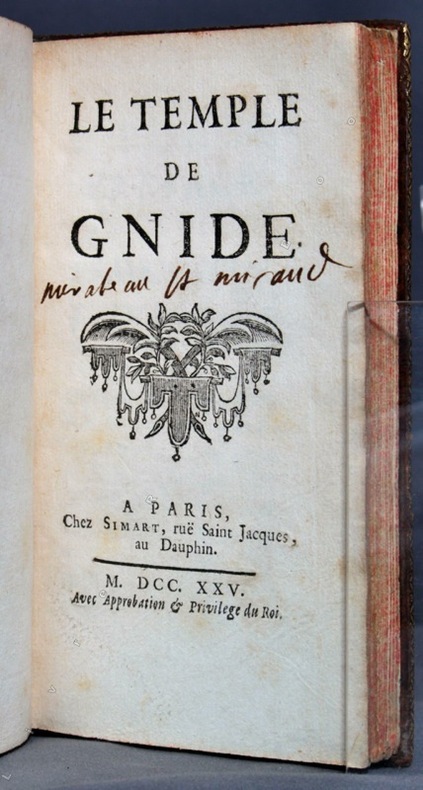
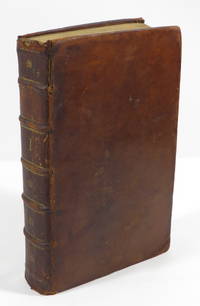
17258844A Paris, Chez Simart, 1725. In-12 de [12]-82-[2] pages, plein veau brun, dos à nerfs orné de filets et fleurons dorés, mors proprement restaurés.
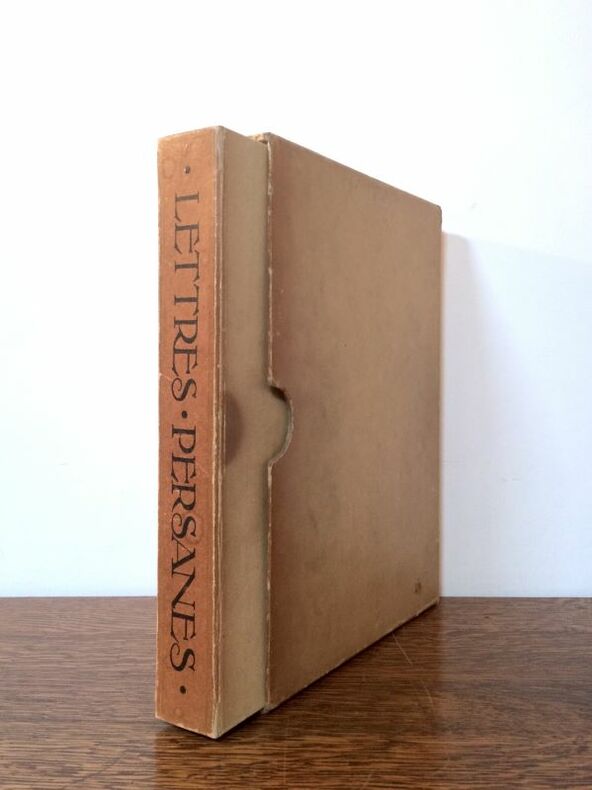
10181 Broché, couverture imprimée rempliée d'édition, chemise et étui (ces derniers passés). 27 x 21 cm, [6]-IV-[2]-282-[2] p. + 4 ff. libres. Paris, pour les bibliophiles du Palais, M. CM. XXVI. [1926].
10181 Broché, couverture imprimée rempliée d'édition, chemise et étui (ces derniers passés). 27 x 21 cm, [6]-IV-[2]-282-[2] p. + 4 ff. libres. Paris, pour les bibliophiles du Palais, M. CM. XXVI. [1926].
173423064Amsterdam Jacques Desbordes 1734 In-12 basane de l'époque, dos à nerfs orné de fers dorés, tranches rouges mouchetées. (2 ff)-277 pp et 1 feuillet d'errata. Papier bruni sur la marge extérieure de la page de titre (voir photo)
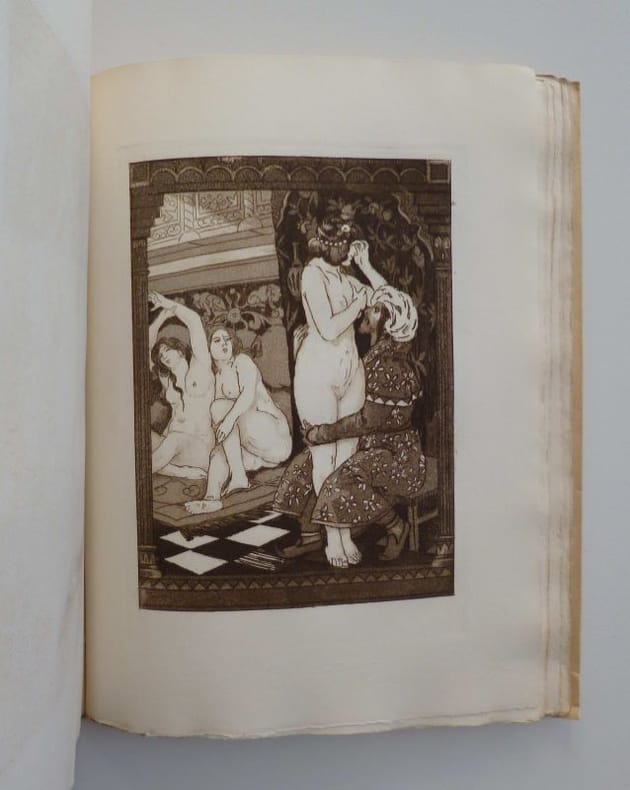
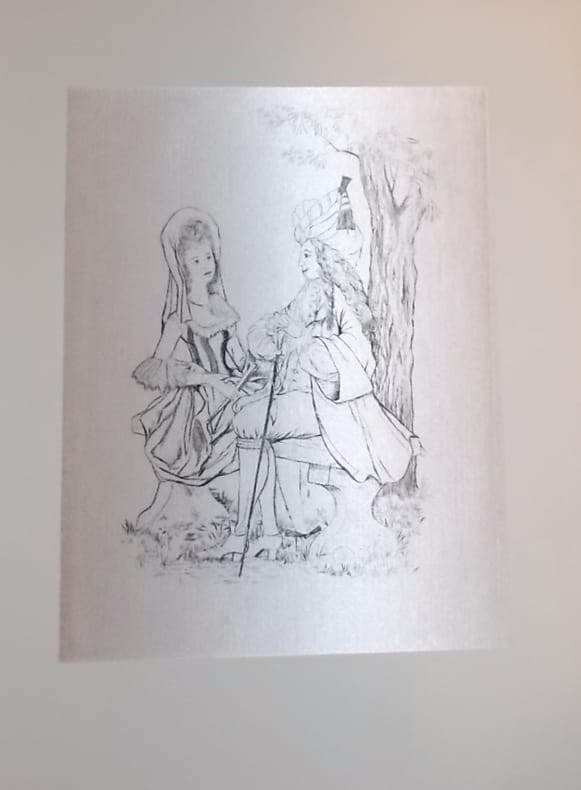
97Aux Éditions de la Lampe d'or, Chez L. Baudel, Paris, 1925, In-quarto (19,4 x 25,5 cm), 418 pages, sous couverture à rabats. Édition illustrée de 30 eaux-fortes en couleurs de Maurice de Becque tirées à la poupée, dont 14 planches hors-texte. L'ouvrage est également orné par l'illustrateur de lettrines, bandeaux et vignettes en violine. Tirage limité à 330 exemplaires, celui-ci un des 50 exemplaires numérotés sur papier de Rives, avec une suite des gravures en bistre (Seulement 175 exemplaires du tirage comportent les gravures tirées en couleurs à la poupée. Il existe également une édition courante comprenant 25 dessins en fac-similé). Superbe interprétation teinté d'érotisme oriental de ce grand classique par Maurice de Becque, doublé d'une impression et mis en couleurs des plus contrastés et lumineuses. Un fort et luxueux volume tel que paru, dans une condition de fraîcheur excellente.
175716543A Troyes, chez la Veuve Oudot, et se trouve à Paris chez Duchesne, sans date [et] 1757. 2 tomes en un volume in-12 de 166-[4] et [12]-190-[2] pages, plein maroquin cerise, dos à nerfs orné de filets et petits fleurons dorés, triple filet doré encadrant les plats, roulette dorée aux coupes aux chasses, tranches dorées.
17428208Londres, s.d. (Paris), Huart, 1742. Petit in-8 (157 x 110 mm), frontispice, titre, 1 f. n. ch., viii et 85 pp. Maroquin rouge, triple filet, dos à nerfs orné, roulette intérieure, tranches dorées sur marbrures (Vve Brany).
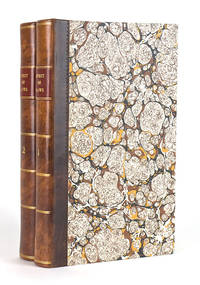
52030Londres. Nourse.1767.2 vols.in-4 en veau moucheté d'époque.Esprit des Loix et Défense de l'Esprit des Loix.Complets.Sans le Tome III contenant les autres oeuvres de Montesquieu.527 et 641 p.Bon état.
180265202Worcester: Printed by Isaiah Thomas Jun. sold by him and by Mathew Carey Philadelphia; also by the various Booksellers throughout the United States 1802. First American edition. The first edition was published in 1748. The first translation into English was by Thomas Nugent in 1750 1752 according to the DNB which went through several editions. It may be this translation in the American edition. 8vo. Two volumes bound as one. Contemporary calf. Rebacked new endpapers hole in upper margin of title and adjacent leaves tear on final leaf affecting a few letters browning and offsetting. In a leather tipped brown cloth open end case. First American edition. The first edition was published in 1748. The first translation into English was by Thomas Nugent in 1750 1752 according to the DNB which went through several editions. It may be this translation in the American edition. 8vo. In thirty-one books Montesquieu treats the historical origins and principles of laws. The books fall into six sections the first dealing with forms of government and law in general eight books; the second with taxation and military arrangements five books; the third with manners and customs and their "dependence on climatic conditions" six books; the fourth with economic matters four books; the fifth consisting of three books relates to religion; and the last five books sixth section with Roman French and feudal law. This work is "an assemblage of the most fertile original and inspiriting views on legal and political subjects put in language of singular suggestiveness and vigour illustrated by examples which are always apt and luminous permeated by the spirit of temperate and tolerant desire for human improvement and happiness and almost unique in its entire freedom at once from doctrinairism from visionary enthusiasm from egotism and from an undue spirit of system" Ency. Brit. "One of the greatest masterpieces of political theory and a pioneering work in sociology . In its stress on the historical role of the nobility as a check to royal power it provided a theoretical justification for the resurgance of aristocratic power which was so important in the origins of the French Revolution . its emphasis on the separation of powers of government and on a system of checks and balances profoundly influenced constitutional thought in both America and France" Charles B. MacNamara "France in the Age of Revolution" Cornell 1981. Montesquieu's disapproval of slavery and of religious intolerance are both voiced in this work as are his views on witchcraft sceptical. In the "Preface" the author writes "I have laid down the first principles and have found that the particular cases apply naturally to them that the histories of all nations are only consequences of them; and that every particular law is connected with another law or depends on some other of a more general extent." One of the primary evidences of Montesquieu's teachings that "in a republican government the whole power of educaion is required if the virtue that makes men choose public over private interest is to be sustained" appears in Jefferson's "Bill for More General Diffusion of Knowledge" of 1779 Cremin "American Education" p. 439. Shaw and Shoemaker 2682; Tchemerzine viii 459/60 and PMM 197 for the first edition; McCulloch pp. 356-8 for the first English edition Printed by Isaiah Thomas, Jun. sold by him and by Mathew Carey, Philadelphia; also by the various Booksellers throughout the Uni unknown books
180265201Worcester: Printed by Isaiah Thomas Jun. sold by him and by Mathew Carey Philadelphia; also by the various Booksellers throughout the United States 1802. First American edition. The first edition was published in 1748. The first translation into English was by Thomas Nugent in 1750 1752 according to the DNB which went through several editions. It may be this translation in the American edition. 2 vols. 8vo. Modern calf backed marbled boards. Some browning of text generally light. With the signature Jos. Allen on titles. First American edition. The first edition was published in 1748. The first translation into English was by Thomas Nugent in 1750 1752 according to the DNB which went through several editions. It may be this translation in the American edition. 2 vols. 8vo. In thirty-one books Montesquieu treats the historical origins and principles of laws. The books fall into six sections the first dealing with forms of government and law in general eight books; the second with taxation and military arrangements five books; the third with manners and customs and their "dependence on climatic conditions" six books; the fourth with economic matters four books; the fifth consisting of three books relates to religion; and the last five books sixth section with Roman French and feudal law. This work is "an assemblage of the most fertile original and inspiriting views on legal and political subjects put in language of singular suggestiveness and vigour illustrated by examples which are always apt and luminous permeated by the spirit of temperate and tolerant desire for human improvement and happiness and almost unique in its entire freedom at once from doctrinairism from visionary enthusiasm from egotism and from an undue spirit of system" Ency. Brit. "One of the greatest masterpieces of political theory and a pioneering work in sociology . In its stress on the historical role of the nobility as a check to royal power it provided a theoretical justification for the resurgance of aristocratic power which was so important in the origins of the French Revolution . its emphasis on the separation of powers of government and on a system of checks and balances profoundly influenced constitutional thought in both America and France" Charles B. MacNamara "France in the Age of Revolution" Cornell 1981. Montesquieu's disapproval of slavery and of religious intolerance are both voiced in this work as are his views on witchcraft sceptical. In the "Preface" the author writes "I have laid down the first principles and have found that the particular cases apply naturally to them that the histories of all nations are only consequences of them; and that every particular law is connected with another law or depends on some other of a more general extent." One of the primary evidences of Montesquieu's teachings that "in a republican government the whole power of educaion is required if the virtue that makes men choose public over private interest is to be sustained" appears in Jefferson's "Bill for More General Diffusion of Knowledge" of 1779 Cremin "American Education" p. 439. Shaw and Shoemaker 2682; Tchemezine vii 459/460 and PMM 197 for the first edition McCulloch pp. 356-8 for the first English edition Printed by Isaiah Thomas, Jun. sold by him and by Mathew Carey, Philadelphia; also by the various Booksellers throughout the Uni unknown books
175026081London: Printed for J. Nourse and P. Vaillant. Good with No dust jacket as issued. 1750. First Edition. Hardcover. Volume One only of two volumes. Rubbing to spine and joints. Some rubbing and some wear to leather at edges of boards. 8mm loss of leather at head of spine. 35mm splits to leather at head of joints. 25mm split to leather at tail of rear joint. Lacking lettering piece from spine although the title is blind-stamped in the second spine panel. Some bruising and creasing to leather at lower corner of front board. Lacking front and rear free endpapers. Gutters split at hinges. Title page with ink numbers and word "No. 507 crossed out Pax No. 160". The Errata listed on leaf a6v 11 in Vol. I have been neatly corrected on the pages where they occur in an early ink hand. One leaf pages 159-160 protrudes from the text block at the outer margin. However this is not because the leaf is loose but because the outer margin of this leaf was folded over when the text block edges were trimmed and the outer margin of this leaf is now larger than the other leaves.; First edition in English. Volume One only of two volumes. viii 20 452 46 Index 2 advertisements pages. Collation: A8 a6 B-Ff8 Gg2 Kk-Mm8. Contemporary full calf binding. Spine with 5 raised bands. Small gilt crown tool in 4 of the spine panels. Gilt number "65" in top panel of spine. "SPIRIT / OF / LAWS" blind-stamped in second panel of spine. Page dimensions: 200 x 123mm. Text in English translated by Thomas Nugent from the 1748 French first edition "De l'Esprit des Lois." Book IX on pages 183-192 has content on the nature of a confederate republic. "This form of government is a convention by which several small states agree to become members of a larger one which they intend to form. It is a kind of assemblage of societies that constitute a new one capable of increasing by means of new associations till they arrive to such a degree of power as to be able to provide for the security of the whole united body." - pp. 183-184. "It is difficult for the united states to be all of an equal bigness and power. The Lycian republic was an association of twenty three towns; the large ones had three votes in the common council the middling ones two the small towns one. The Dutch republic consists of seven great or small provinces that have each one voice." - page 186. Content on slavery on pages 336-357 "Book XV. In what manner the Laws of civil Slavery are relative to the Nature of the Climate": Of civil Slavery; Origin of the Right of Slavery among the Roman Civilians; Another Origin of the Right of Slavery; Another Origin of the Right of Slavery; Of the Slavery of the Negroes; True Origin of the Right of Slavery; Another Origin of the Right of Slavery; Inutility of Slavery among us; Several Kinds of Slavery; Regulations necessary in respect to Slavery; Abuses of Slavery; Danger from the Multitude of Slaves; Of armed Slaves; The same subject continued; Precautions to be used in moderate Governments; Regulations between Masters and Slaves; Of Infranchisements; Of Freedmen and Eunuchs. The Index in this volume is to both Volumes One and Two. Reference: PMM 197 for the 1748 first edition in French - "Yet his theories underlay the thinking which led up to the American and French revolutions and the United States Constitution in particular is a lasting tribute to the principles he advocated." . Printed for J. Nourse, and P. Vaillant hardcover
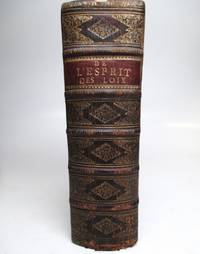
1749262455Amsterdam: Zacharie Chatelain 1749. hardcover. very good. Three volumes in one. Separate title pages for each volume. xxiv 356pp. xvi 358pp. xii 383pp. thick 8vo full leather gilt-decorated spine; scattered light foxing and browning some minor chipping at spine ends cover rubbed. Amsterdam: Chez Zacharie Chatelain 1749. Nouvelle Edition. A very good copy.<br/><br/> "In many ways one of the most remarkable works of the eighteenth century. It took four years to write and when it was finished almost all his friends advised him not to publish it. Montesquieu paid no attention and it was printed in Geneva in the autumn of 1748. The most distinctive aspect of this immense syllabus is its moderation: a quality not designed to achieve official approval in 1748. It is an always original survey which is neither doctrinaire visionary eccentric nor over-systematic. The scheme that emerges of a liberal benevolent monarchy limited by safeguards on individual liberty was to prove immensely influential. His theories underlay the thinking which led up to the American and French Revolutions and the United States Constitution in particular is a lasting tribute to the principles he advocated."<br/><br/> Zacharie Chatelain unknown books
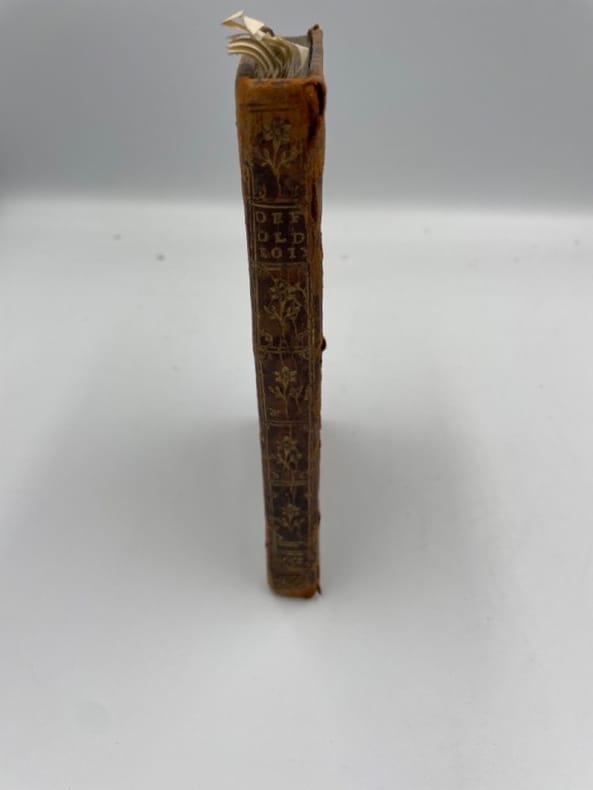
236595Genève, Barrillot & fils, 1750 in-12, 207 pp., y compris le titre, veau fauve marbré, dos lisse orné, tranches marbrées (reliure de l'époque). Usures au dos, mors supérieur fendu.
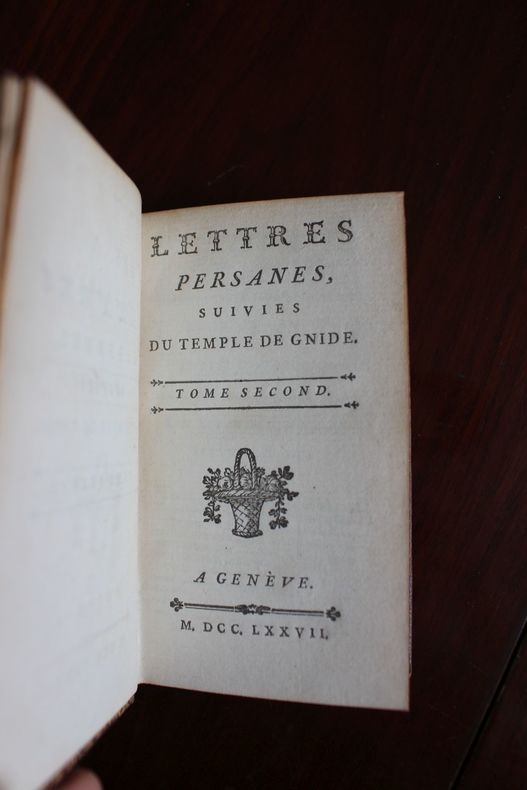
011134Charles de Secondat, baron de la Brède et de Montesquieu, Lettres persanes, suivies du temple de Gnide. Genève, s.n., 1777. 2 volumes in-24, front.-[4]-215p & [4]-242p. Belle édition type « Cazin », répertoriée comme faux Cazin (Fontaine, 197) avec son frontispice gravé par Nicolas de Launay d'après Clément-Pierre Marillier. Plein maroquin d'époque, dos orné, pièces de titre, tranches dorées. Petits defauts. Bel exemplaire, peu commun.
17493370A Geneve, Chez Barrillot & Fils, 1749 1749 • [IV] + XXIV + 356 pp. , •• [IV] + XVI + 358 pp. , & ••• [IV] + XII + 442 pp. - 3 volumes in-8 en pleine basane marbré, dos cinq à nerfs orné, pièce de titre, tranches rougies, intérieur frais. Intéressante reliure étrangère de l'époque (suisse?)- Titres imprimés bicolores rouge et noir avec la marque d'imprimeur à la devise « ex recto decus ». - Quelques accidents aux coiffes et mors , quelques galeries de vers sur les plats. - Édition non citée par Tchemerzine et Brunet.
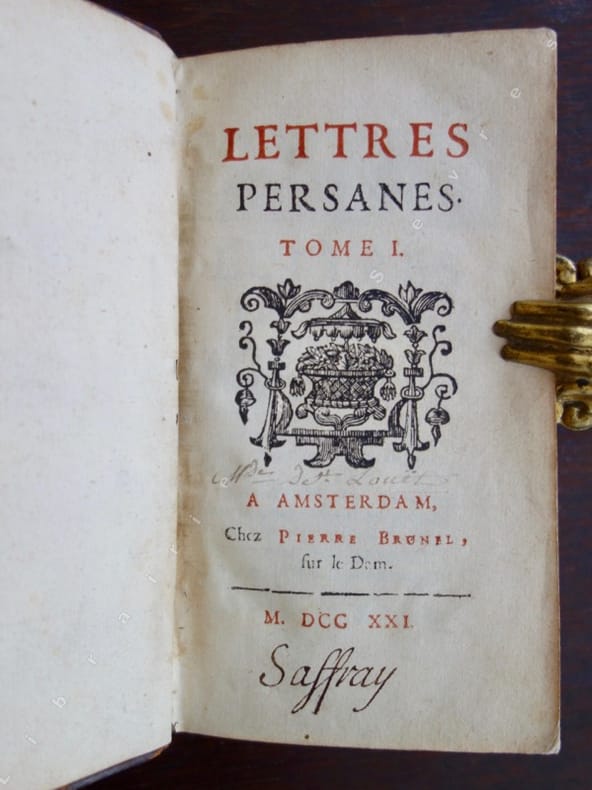
172135504252Amsterdam, Pierre Brunel, , 1721 ; 2 volumes in-12, veau brun, dos ornés, tranches rouges. (Reliure de l’époque) 1 f., 311 pp. - 336 (mal chiffrées 338) pp.Édition à la date de l’originale, non décrites dans les bibliographies. Il s’agit probablement d’une édition française faite à Rouen comme toutes les éditions Brunel. Tchémerzine VIII p. 451 décrit bien une édition de Brunel à cette date, mais elle diffère de la nôtre en ce que le titre du tome II porte une marque montrant une mappemonde et non une géode à facettes comme dans notre exemplaire. Aussi, le tome II comporte 336 pp. chiffrées 338 (le feuillet Dd6 étant paginé 323 - 326) et non 347pp. comme chez Tchémerzine. Ce dernier signale en outre des fautes qui sont corrigées dans notre exemplaire, qui doit donc appartenir à une édition postérieure. Certaines coquilles typographiques ont été corrigées à la plume à l’époque. Mouillures pâles sur qq. feuillets, coin d’un feuillet manquant sans atteinte au texte. Coiffes coins et dos usagés.
1721211581721 A Amsterdam, chez Pierre Brunel sur le Dam, (Rouen), 1721, 2 tomes en 1 volume in-12 de (2)-311 pp. - (2)-347 pp., vignette sur le titre gravé sur bois "au panier fleuri" au premier tome, et à la sphère au deuxième, robuste reliure de l'époque, de plein veau brun foncé, dos à nerfs avec titre doré, la coiffe supérieure manque mais le tranche fil demeure présent, bon exemplaire.
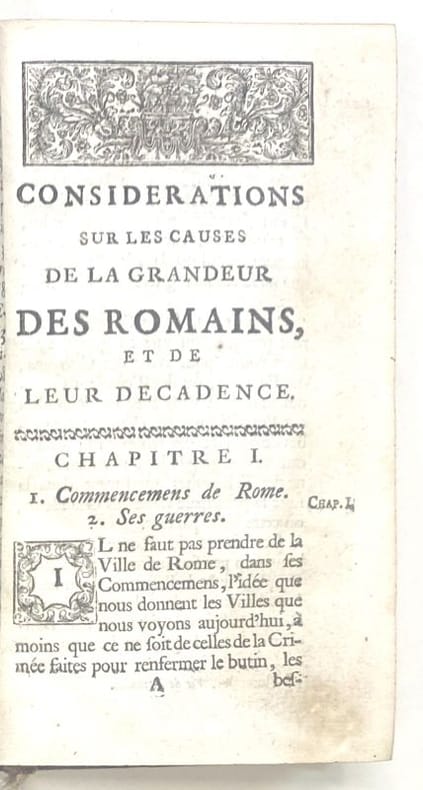
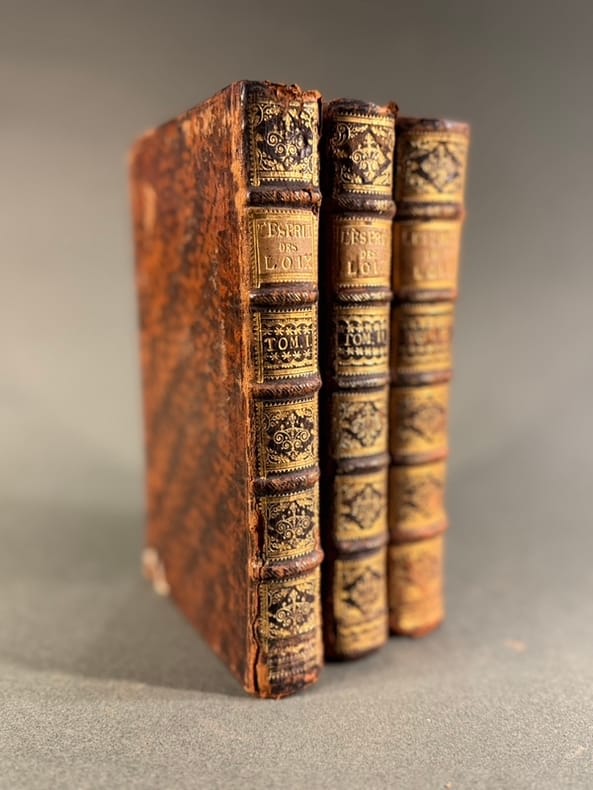
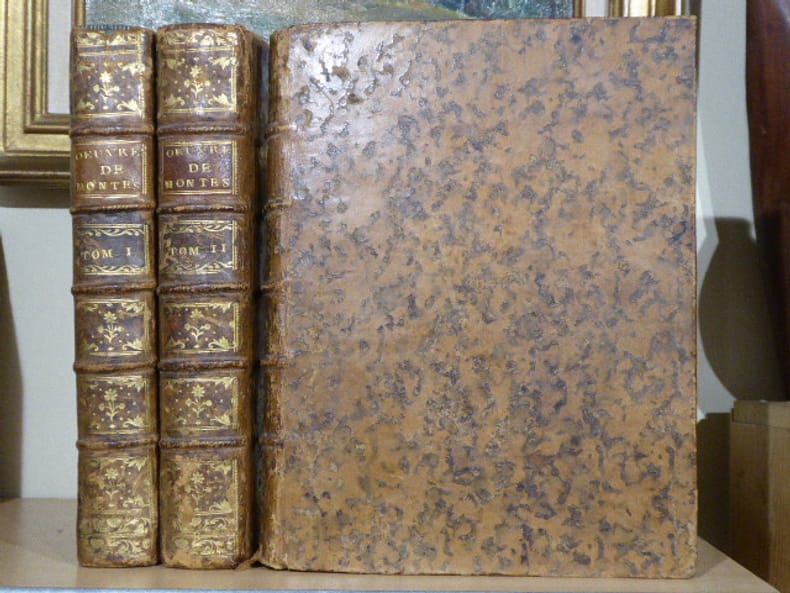
502068Nourse Londres 1767 3 volumes in-4 carré ( 260 X 195 mm ) de ( 2 )-32-LXXXVI-527 ( 4 )-XVI-643 et ( 4 )-747 pages, plein veau fauve marbré, dos à nerfs orné de caissons et fleurons dorés, coupes et coiffes filetées d'or, tranches brique ( Reliure de l'époque ). Belle gravure en frontispice et deux cartes dépliantes hors-texte. Beaux exemplaires.- I: Eloge de Montesquieu par M. d'Alembert - Discours de Montesquieu lors de sa réception à l'Académie française - Les XXI premiers livres de l'Esprit des Loix. - II: Les X derniers livres de l'Esprit des Lois - La Défense de l'Esprit des Loix - Lysimaque - Remerciment sincère - Table générale des matières de l'Esprit des Loix. - III:: Les Lettres persanes - Les Considérations sur les causes de la grandeur des Romains et leur décadence - Le Temple de Gnide - L'Essai sur le goût.
40669Paris, Editions de L'Ibis, 1967. 2 volumes in-4°, 155-180p. Reliures d'éditeur d'inspiration mauresque pleine basane à rabats bordeaux, formant portefeuille, dos lisses ornés et plats décorés d'un motif oriental blanc et or, têtes dorées, sous emboitages de toile beige.
175820427A Amsterdam, et à Leipsick, Chez Arkstée et Merkus, 1758. 3 volumes in-4 de [4]-LXXXVI-527; [4]-XVI-634; [4]-648 pages, plein veau marbré, dos à nerfs ornés de filets et fleurons dorés, étiquette de titre et tomaison rouge et brune, tranches marbrées.
In-12, demi-veau blond, dos romantique orné de 4 faux nerfs guillochés or, fleuron à froid estampé entre-nerfs, filets et palettes dorés, tranches marbrées (rel. vers 1830), (4), v, (2), 129 p. Edition originale et unique. La deuxième oeuvre du "berger Sylvain", alors jeune homme âgé de 21 ans, futur "homme sans dieu", et sa véritable entrée dans le monde littéraire. Cet hommage à Montesquieu et au 'Temple du Gnide' auquel il se réfère est également marqué par la sensibilité héritée de J.-J. Rousseau et sa conception de la "vertu". "Par l'agrément, la grâce et la légèreté de cette oeuvre" (M. Dommanget, p. 27), Sylvain Maréchal va gagner sa place dans deux salons littéraires: celui du poète épicurien Guillaume Vassé et celui de Madame Lépine, la diva italienne de la rue Neuve Saint Eustache où l'auteur rencontre la future Madame Roland, Manon Phlipon. (Conlon, 'Siècle des Lumières', 71:1155. Dommanget, 'S. Maréchal', Bibliographie, p. 445). Le livre est peu commun: WorldCat ne recense que 4 exemplaires dans le monde, dont un unique en France, celui de la BnF. Infime défaut à la coiffe supérieure. Petit accroc de papier en coin du faux titre et en marge supérieure p. 59 sans perte. Quelques petites auréoles claires. Bon exemplaire, bien relié.
184689865Cherbourg: Imprimerie de Thomine 1846. Fine. Imprimerie de Thomine Cherbourg 1846 13.2 x 21 cm Broché Rare first edition. Our copy is issued in its original state unbound and preserved in wrappers. Not recorded by Oberlé. Only two copies located in the CCFr Cherbourg and Montpellier. Alexandre Lesdos 1813-1865 was a member of the Société d'Agriculture and of the Société Académique de Cherbourg. In this work he devotes an entire chapter to the wines of Saint-Émilion noted for their ""bouquet as delicate as that of the violet."" our own translation Imprimerie de Thomine unknown
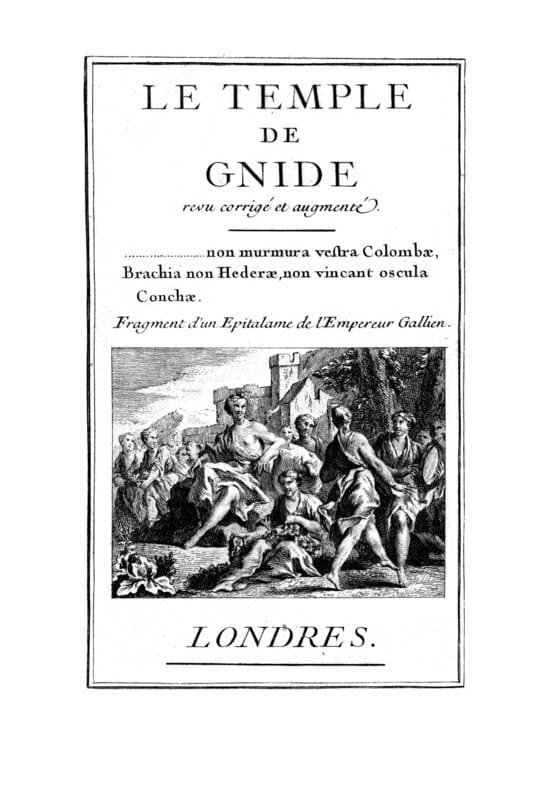
17429139[Huart] 12 x 18 Londres [Paris] 1742 Petit in-8, s.d. [1742], reliure plein veau porphyre de l'époque, dos lisse orné de motifs floraux et de filets dorés, titre doré, plats encadrés d'une dentelle dorée, roulette dorée sur les coupes, tranches rouges, gardes marbrées, 2 ff. bl., frontispice, titre avec vignette gravée, explications des figures et vignettes, VIII-85-[1] pp., 2 ff. bl. 8 vignettes gravées, attribuées à De Sève, introduisant les sept chants et la dernière pièce "Céphise et l'Amour". Portrait de Montesquieu gravé d'après Chaudet par Alexandre Tardieu, 1818, contrecollé sur la première garde (Portraits de Montesquieu, répertoire analytique, 2014, n° 96).. "Le temple de Gnide" est paru en 1725 sous le couvert de l'anonymat, chez Simart à Paris, dans un format in-12. L'édition de 1742 est la première illustrée, imprimée par Huart, à qui Montesquieu avait déjà confié la réimpression des "Considérations...sur les Romains." L'in-octavo confère au Temple de Gnide une qualité typographique nouvelle, la présence des gravures le mettant d'emblée au nombre des publications luxueuses" (Introduction et présentation, Nouvelle édition par Philip Stewart et Catherine Volpilhac-Auger, 2021). La critique récente (ibid., 2021) s'est éloignée de la thèse qui faisait du Temple de Gnide un divertissement littéraire inspiré, dans une Régence finissante, par les amours de Marie-Anne de Bourbon-Condé (1697-1742), dite Mademoiselle de Clermont, princesse de sang, soeur du duc de Bourbon, premier ministre depuis le décès de Philippe d'Orléans en 1723. Le Temple de Gnide (cf. la préface) tient des "Lettres persanes" (1721). La ville de Gnide est le sanctuaire de Vénus, où l'on célèbre l'amour, les plaisirs et la beauté. "Au-delà dune gracieuse variation sur les plaisirs champêtres ou dune aimable célébration horatienne du carpe diem, il faut plutôt y reconnaître laffirmation intemporelle des forces de vie à travers la toute-puissance de la beauté, le refus des contraintes que sont la jalousie et les liens voulus par la société, laspiration à une liberté des coeurs et des corps, mais aussi le risque de se perdre en soi-même"...Reliure élégante, en très bon état, vignettes agréables, rousseurs éparses notamment sur les premières pages, étiquette de libraire sur le premier contre plat. Très bon exemplaire. Peu fréquent. (RochBbis2) PHOTOS NUMERIQUES DISPONIBLES PAR EMAIL SUR SIMPLE DEMANDE-DIGITAL PHOTOGRAPS MAY BE AVAILABLE ON REQUEST
17429139[Huart] 12 x 18 Londres [Paris] 1742 Petit in-8, s.d. [1742], reliure plein veau porphyre de l'époque, dos lisse orné de motifs floraux et de filets dorés, titre doré, plats encadrés d'une dentelle dorée, roulette dorée sur les coupes, tranches rouges, gardes marbrées, 2 ff. bl., frontispice, titre avec vignette gravée, explications des figures et vignettes, VIII-85-[1] pp., 2 ff. bl. 8 vignettes gravées, attribuées à De Sève, introduisant les sept chants et la dernière pièce "Céphise et l'Amour". Portrait de Montesquieu gravé d'après Chaudet par Alexandre Tardieu, 1818, contrecollé sur la première garde (Portraits de Montesquieu, répertoire analytique, 2014, n° 96).. "Le temple de Gnide" est paru en 1725 sous le couvert de l'anonymat, chez Simart à Paris, dans un format in-12. L'édition de 1742 est la première illustrée, imprimée par Huart, à qui Montesquieu avait déjà confié la réimpression des "Considérations...sur les Romains." L'in-octavo confère au Temple de Gnide une qualité typographique nouvelle, la présence des gravures le mettant d'emblée au nombre des publications luxueuses" (Introduction et présentation, Nouvelle édition par Philip Stewart et Catherine Volpilhac-Auger, 2021). La critique récente (ibid., 2021) s'est éloignée de la thèse qui faisait du Temple de Gnide un divertissement littéraire inspiré, dans une Régence finissante, par les amours de Marie-Anne de Bourbon-Condé (1697-1742), dite Mademoiselle de Clermont, princesse de sang, soeur du duc de Bourbon, premier ministre depuis le décès de Philippe d'Orléans en 1723. Le Temple de Gnide (cf. la préface) tient des "Lettres persanes" (1721). La ville de Gnide est le sanctuaire de Vénus, où l'on célèbre l'amour, les plaisirs et la beauté. "Au-delà dune gracieuse variation sur les plaisirs champêtres ou dune aimable célébration horatienne du carpe diem, il faut plutôt y reconnaître laffirmation intemporelle des forces de vie à travers la toute-puissance de la beauté, le refus des contraintes que sont la jalousie et les liens voulus par la société, laspiration à une liberté des coeurs et des corps, mais aussi le risque de se perdre en soi-même"...Reliure élégante, en très bon état, vignettes agréables, rousseurs éparses notamment sur les premières pages, étiquette de libraire sur le premier contre plat. Très bon exemplaire. Peu fréquent. (RochBbis2) PHOTOS NUMERIQUES DISPONIBLES PAR EMAIL SUR SIMPLE DEMANDE-DIGITAL PHOTOGRAPS MAY BE AVAILABLE ON REQUEST