PETRARCH, FRANCESCOBiblio.com
2 153 résultats
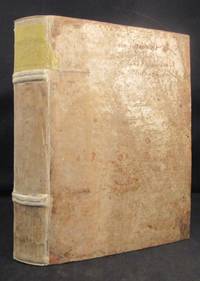
149628938Basel: Johann Amerbach 1496. 1496. The first edition of Petrarch's collected works. ISTC ip00365000; Goff P-356; BMC III 757; Fowler Catalogue of the Petrarch Collection Cornell University Library pages 1-2. Margin of the first leaf trimmed and window-mounted at an early period surrounded by relevant marginalia dated 1743; first five gatherings with the bottom margins repaired with occasional trimming type; next four gatherings with lower margin chipped and slightly damp-stained a few other similar repairs throughout including repair to corners of final few gatherings; binding a little soiled and rubbed with early manuscript labels at the head and foot of the spine. Folio 26 x 18.7 cm 18th century blind-stamped pigskin over wooden beveled boards all edges stained red. 388 leaves; without the final blank. Lacking clasps and catch-plates. Decorated initials in red and blue. An important early collection of the letters dialogues tracts and poetry of Francesco Petrarch 1302-74 in Latin with many individual pieces appearing in print for the first time including most notably Secretum Francisci Petrachæ his famous dialogue with Saint Augustine. The text was edited by Sebastian Brant 1458-1521 who was employed by printer Johann Amerbach for whom Brant edited numerous scholarly works. Provenance: Franciscan Minorites dissolved in 1802 Cologne with their bookplate on the front paste-down; in the margins around the mounted first leaf are annotations by F. Adamus Putz dated 1743 about the binding and life of Petrarch; Gymnasium-Bibliothek of Cologne with their duplicate release stamp; collector Estelle Getz 1880-1943 her sale American Art Association November 1936 lot 1255. [Basel: Johann Amerbach, 1496.] unknown
in-12 (mm.130x65), ff. 164, 5 di indice n.n. e 1 bianco, (numerazione errata all'inizio del Trionfo del Tempo: 142-145 ripetuta ai ff. M10-N1 e N2-N5). La paginazione delle due opere di Sannazaro è pp. 287; 96. In una magnifica rilegatura in marocchino rosso con ricchissima decorazione con volute, uccellini e stelline e mascherone barbuto a figura intera; ricchi fregi al dorso a 4 nervi, tagli riccamente cesellati, dorati e goffrati. Molto particolare è il ferro delle due mani che si stringono, che compare su entrambi i piatti della legatura e che possiede una valenza allegorica: il simbolo, derivato dai sarcofagi nuziali romani ("Fidei simulacrum"), sta a significare fedeltà. Compare prevalentemente su legature italiane e francesi del Cinquecento, come fregio singolo oppure a ripetizione, attorno a un cartiglio, al centro dei piatti. La bella edizione è illustrata dal ritratto di Petrarca e Laura sul verso del frontespizio; iniziali, fregi e 6 vignette in xilografia ad adornare i Trionfi. Contiene anche dal f. N11v: Capitolo di m. Francesco Petrarca, che fu da lui stesso rifiutato in vita da e altre poesie. Lo splendido volume riunisce Petrarca e Sannazaro, due poeti spesso affiancati: comprende i Sonetti in vita e quelli in morte, i Trionfi; e poi l'Arcadia e le Rime. Un importante saggio di Dionisotti del 1963, ha ben spiegato che "la divisione (tra le due opere di Sannazaro) non si modella in alcun modo su quella che attraversa il Canzoniere di Petrarca, e per contro sostiene che a rigore non si tratta neppure di una divisione, dato che solo la seconda parte avrebbe andamento di canzoniere, mentre la prima raccoglierebbe in maniera disorganica una serie di testi sparsi". Bell'esemplare ottimo anche internamente, nota mss. cancellata a inchiostro al titolo; abile integrazione con carta dell'epoca al margine bianco del f.7. Entrambe le edizioni del Sannazaro non sono comuni, ma quella di Petrarca è piuttosto rara: è conservata in 8 biblioteche pubbliche italiane (di cui 2 mutili) e manca alla collezione Speck. . Per il fregio delle mani cfr. Biblioteca Digitale Archiginnasio di Bologna; Hobson, The Origins and Diffusion of the Humanistic Bookbinding... 1989, p. 176..
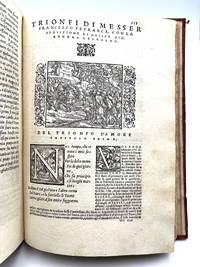
1533 (Stampato in Vinegia per Giouann'Antonio di Nicolini & fratelli da Sabbio, 1533 del mese di Luglio) Pergamena marezzata seicentesca con tassello con titolo al dorso (mm. 205 x 148) cc. [23], 1 bianca, CCCLXXXIIII, [4]; [79] La seconda parte contiene: I Triomphi del Petrarcha colla spositione di misser Giouanni Andrea Gesualdo da Traetto Ottimo esemplare completo anche delle pagine 194/196, che in molti esemplari vennero tolte per censura: Già Roma hor Babilonia falsa... O fucina d'inganni... Putta sfacciata.. Prima edizione di Rime accompagnata dal commento di Giovanni Andrea Gesualdo . Il Canzoniere è dedicato alla marchesa della Palude [sic per Padula], Maria Cardona. I Trionfi sono dedicati a Suzanna Gonzaga. Antonio Minturno, in una celebre lettera a Camillo Scorziati, del 15 ottobre 1538, definì il commento di Gesualdo un "parto elefante" per la sua grandezza. Convinto che il Petrarca non raccolse mai i suoi componimenti in un corpus unico (e dunque sostenitore dell'autonomia tra cronologia interna ed esterna all'opera), il G. giustifica la sua fedeltà all'ordine vulgato con la volontà di non sconvolgere inutilmente la tradizione, sottolineando come la struttura dei Fragmenta ricordi più le raccolte innografiche ed elegiache classiche, prive di un ordine interno, che l'organismo simmetrico del poema. Nasce così la seconda redazione della Spositione, rivisitata alla luce dell'opera del Vellutello e terminata negli anni 1529-30, ma non immediatamente pubblicata: il manoscritto venne dapprima affidato all'editore veneziano M. Sessa e poi trasferito per intervento del tipografo T. Giunti, amico del Minturno, nella bottega del Niccolini da Sabbio. La scelta di Venezia, resasi necessaria per la diffusa crisi dell'editoria napoletana e per la ricerca di approvazione e di confronto con l'autorità letteraria veneta, fu la causa del lungo stallo editoriale, conclusosi solo dopo le numerose sollecitazioni del duca di Monteleone Ettore Pignatelli, viceré di Sicilia e protettore del Minturno, e la dichiarazione di conformità del manoscritto, emessa da P. Bembo e da F. Vallaresso. Al di là dei risultati della disputa editoriale, il commento del G. ebbe maggiore fortuna dei lavori del Fausto e del Venafro - solo fino al 1852 se ne ebbero altre otto edizioni - ed è considerato come uno dei più ricchi e utili commenti cinquecenteschi al Canzoniere. Bibl: Brunet, IV, 549 - Marsand, 44 - Hortis, 56 - Fiske, 31 - Olschki, 27 - Fowler, p. 95-96 - Balsamo, Pétrarque, 1533 (cinque esemplari censiti in Francia) - Ascarelli/Menato, p. 354 - Ley, 113 (censisce 25 esemplari) - Edit16 (25 esemplari).
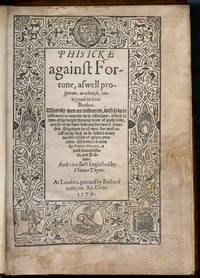
1579384London: Richard Watkyns 1579. First Edition. Very Good. Small 4to; 7 1/2 x 5 5/8 in. 190 x142 mm; pp. 4 xiv 1-152 First Booke Physicke for Fortune: 153-343 Second Booke Phisicke against Fortune vi table of contents 2. Each book with Epistolary preface by Franucis Petrarche. Translated into English from Latin by Thomas Twyne whose introduction dedicates the work to "Richard Bertie Esquier." Title within woodcut decorative border woodcut decorative initials set in gothic and latin type lacking sig.B and final blank lower corner of title torn and repaired with loss supplied first gathering lower corners repaired some dampstaining and toning throughout but sheets supple and intact. 19th century calf gilt panels from early English blind-stamped binding laid down on covers corners worn rubbed. Front pastedown with small engraved bookplate with initials "I N"<br /> <br /> Title page reads: «Physicke against Fortune as well prosperous as adverse contained in two Bookes<br /> Whereby men are instructed with lyke in differencie to remedie theyr affections aswell in tyme of the bright shyniyng sunne of prosperities as also of the foule lowiyng stonnes of adversities. Expedient for all men but most necessary for such as be subiect to any notable insult of eyther extremities. Written in Latine by Francis Petrarch a most famous Poet and Oratour. And now first Englished by Thomas Twyne.»<br /> <br /> STC 19809; ESTC S114602. This is the first edition in English of "De Remediis Utriusque Fortunae" "Remedies for Fortune Fair and Foul" written in Latin by the Humanist Francesco Petrarca 1304-1374 commonly known as Petrarch a collection of 254 dialogues mostly drawn from classical sources which seeks to instruct on moral philosophy and show how thought and deed can generate happiness on the one hand or sorrow and disillusionment on the other. It touches on a number of diverse subjects including dancing ball games gambling wrestling hunting and hawking alchemy libraries schoolmasters spectacles toothache lechery gout blindness and deafness. In a recurring theme throughout the dialogues Petrarch advises humility in prosperity and fortitude in adversity. It remained a popular book in Europe over the ages and was translated into English by the Elizabethan physician Thomas Twyne 1543-1613.<br /> <br /> "Latin work by Petrarch begun in 1354 but completed between 1360 and 1366 on how to deal with both good and bad fortune. The first of its two parts contains 122 dialogues between Ratio Gaudium and Spes and deals with how one should behave at times of good fortune; the second contains 131 dialogues between Ratio Dolor and Timor and deals with the behaviour appropriate to adverse fortune. It is a practical manual of moral philosophy and was widely read until the 17th c." Oxford Companion to Italian Literature. Richard Watkyns unknown
154975611549 In Vinegia : Per Pietro & Gioanmaria fratelli de Nicolini da Sabio, ad instanza di M. Giombattista Pederzano libraro al segno della Torre appresso il ponte di Rialto & compagni, 1549. In-8: 16x21,5 cm, 1 f. de titre avec «A gli Studiosi del Petrrarcca Giovanbattista» au vo., 11 ff. n. chiff. dintroduction et «Tavola dei Sonetti», 237 ff. Chiff. 1 à 237 pour les Sonetti et la Canzoni, 3 ff. n. chiff des «Altri sonetto del detto» et dachevé d'imprimer. Précieuse édition XVIe des oeuvres de Pétrarque (1304-1374) établie par léditeur vénitien Giovanni Antonio de Nicolini da Sabio et enrichie dune page de titre entièrement gravée avec les portraits du poète et de Laura en médaillon, de six figures sur bois à demi-page et de nombreuses lettrines initiales historiées. Une édition très correcte qui contient un texte très pur. (Graesse, V, 227). Il sagit de la deuxième édition, très augmentée et illustrée des six bois gravés pour les Trionfi, de lédition de 1541 du Canzoniere établie par Giovanni Antonio de Nicolini da Sabio, accompagnée des commentaires de Bernardino Daniello repris des notes de Trifone Gabriele. Lédition de 1549 « est plus belle et plus soignée que la précédente». (Brunet, IV, 550). «Fu fatta con molta diligenza, e nitidezza de caratteri; e graziose pur sono le stampe dintaglio, che adornano i Trioni». (Marsand, Biblioteca petrarchesca, pp. 57-58). Reliure en vélin. Dos à cinq nerfs avec titre et fleuron manuscrits à lencre noir. Tranches bleues. Ex-libris: André Gutzwiller. En excellent état avec un papier particulièrement frais et blanc.
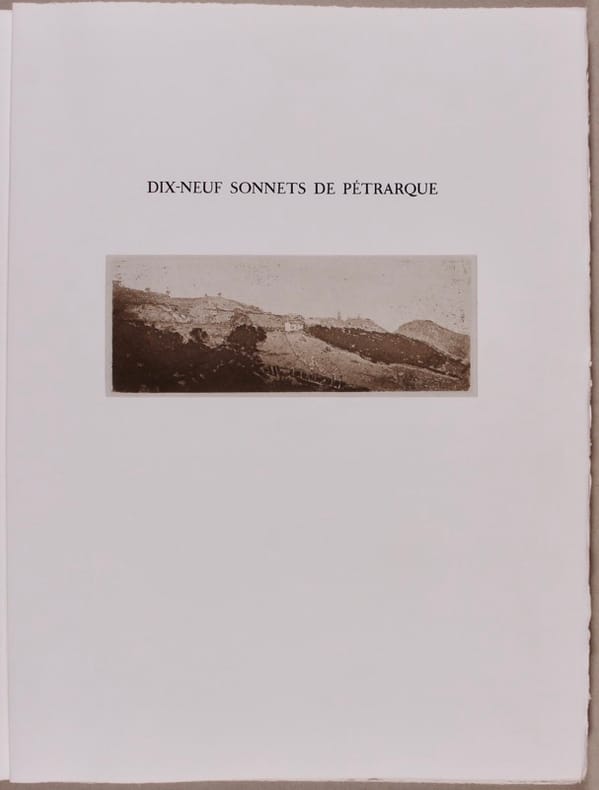
4059Meaux, Editions de la Revue Conférence, 2005. Un volume grand in-4 (281 x 380) en feuilles de 44 pages non chiffrées. Couverture blanche rempliée, sous emboîtage pleine toile brune. Parfaite condition.
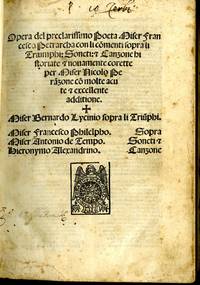
1512047500Venice: Angelo Scinzenzeler 1512. Early Edition. Hardcover Full Leather. Good Condition. Rebound in modern tooled leather. With the Opera bound before the Sonnets - with only 3 of the 6 engravings otherwise complete. Lacking the leaves at g5 i4 and q7 each with an engraving on the verso. 10 125 of 128; 116pp. With some mispagination and a switch to Arabic numerals from 89 but mispaginated 69 to 96. Modest foxing throughout lighter and heavier in spots first and lst pages worn. Old ink stains to Triumph of Time plate. and a few other stray old ink drops. Still very good or better overall save for the missing leaves. <br /> <br /> A rare edition a reimpression of Scinzenzeler's 1507 edition and with fine engravings by an unknown artist from the 1494 edition. Size: Folio. 2-volume set complete. Quantity Available: 1. Shipped Weight: Under 1 kilo. Category: Poetry; Inventory No: 047500. Angelo Scinzenzeler hardcover
15392109100001Venetia : Stampato per Francesco Marcolino 1539. Hardcover. Very Good. Early Italian Emblem Book 2 volumes bound as one. Octavo 15 cm. Bound in later 1/2 vellum over marbled boards. Leather spine labels. Good binding and cover. 4 354 18 pages 180 leaves. Architectural title vignette with portrait of Petrarch. Engraved printer's device at end of first volume. Second volume has an engraved title with a portrait of Alunno. <br> Provenance: From Professor John MacQueen's library of Scotland. Includes related ephemera associated with Renaissance studies. "It is appropriate that Petrarch be printed in Italics a type invented in 1501 by the famous Venetian printer Aldus Manutius was said to have adopted Petrarch's own handwriting for . creating the new type." - Note inside front cover. <br> Refs: Fiske / Fowler 97; Ley 159-161; Brunet III 477. Venetia : Stampato per Francesco Marcolino hardcover
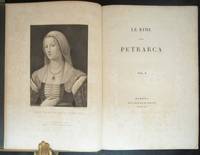
181932220Padova: Nella Tipografia del Seminario 1819-1820. 2 volumes. The especially handsome folio edition of Petrarca and Marsand. This Copy on Large and Grand paper the best of the editions. Volume I with the very fine portraits beautifully engraved on copper by Raffaello Morghen and Mauro Gandolfi. The text in a fine and handsome Bodoniesque typography. Two engraved plates showing a view of Valchiusa engraved by Federico Lose the other showing a facsimile of the celebrated words of the poet handwritten on the Virgilian manuscript and another five plates depicting landscapes and the monument of Petrarca. Folio 33 by 23 cm very handsomely bound in full dark green grained morocco the spines with raised bands ruled in gilt the compartments with gilt panels formed by concentric squares tooled in gilt lettered in gilt in two compartments the covers and turnovers multi-ruled in gilt at the borders dark green endleaves all edges gilt. lix 375; 2 444 pp. A very regal and handsome set the bindings elegant with some unobtrusive age mellowing to the vellum and textured cloth the leather labels a bit rubbed. Internally both volumes are sound and sturdy the hinges fine and tight. The text with some light spotting to which the paper is prone this copy less than is typical and always quite mild. ONE OF THE FINEST PRINTINGS OF THE GREAT ITALIAN POET THIS REMINISCENT OF THE GREAT BODONI PRINTINGS The work is a connoisseur's and bibliophile's treasure printed in a small number of copies on large paper. Published with the valuable work and study of Antonio Marsand and the true reference edition for all later publications. Notable for its refinement and typographic elegance comparable to Bodoni's editions and for the scrupulous attention paid to the critical analysis of texts. At the end of the book a rich and accurate bibliography of all the previous editions of Pertrarca's works.<br> One of the "great triumvirate" of Italian poets Francesco Petrarch's sonnets were admired and imitated throughout Europe during the Renaissance and they served as the model for nearly all later Western lyrical poetry. He was also the first true reviver of learning in Medieval Europe. He was a great student of the classical works-- histories poetry law and orations and he included in his studies many ancient books and manuscripts that the medieval period had ignored for nearly a millennium. He also closely followed the politics and learning of his own age. It was with Petrarca that the ancient and the modern eras met together and a new stadium for the Human spirit that which we are wont to style Renaissance was opened.<br> Many have stated that the book is as beautiful as a Bodoni printing.<br> <br>Brunet IV 556. Graesse V 229. Marsand p. 126. Hortis 232. Fiske p. 125. Bellini "storia della tipografica del Seminario di Padova Nella Tipografia del Seminario hardcover
152832165Venegia: Maestro Bernardino de Vidali 1528. A very early Edition of the Vellutello Petrarca. With fine heraldic ownership label. Illustrated with the rare two page view of the Valchiusa. This copy with the Babylonian Sonnets 165 ff not censored and still included in the text. Rare thus. 4to mm. 190 x 140 handsomely bound in fine full vellum of the period. 11ff 185 ff 51 ff Del Triumpho pp. A contemporarily bound copy in a pleasing state of preservation generally crisp and clean throughout some interesting notes in very early hands to the pastedowns a few here and there in the margins of the text-block interesting notes concerning prohibition to the leaves that contain the Babylonian verses the back sometime strengthened the vellum binding strong and in good order. A FINE AND VERY EARLY PRINTING OF THE VELLUTELLO PETRARCA. The volume was dedicated to Carlo Grotta Chancellor to Cardinal Cristofor Madruzzo Principe Vescovo of Trent and organizer of the Council of Trent. This edition of Petrarca with the commentary of Vellutello is considered the most important. Especially important is the celebrated commentary on the Canzoniere out of the edition of 1525. Also important is the biography of the poet.<br> This copy contains the Babylonian Sonnets which were generally censored and seldom included in copies of Petrarca's writings. These Babylonian sonnets a group of three poems that criticized the Avignon Papacy were initially banned because they were included in a prohibited Protestant work. In 1557 Pier Paolo Vergerio wrote Alcuni importanti luochi an attack against the Church that emphasized those three sonnets from Petrarch. Many clerics denounced the greed and corruption of the Avignon papacy. In the 1340s Petrarch wrote “I am living in the Babylon of the West†comparing Avignon to the biblical city of vice and corruption. He went on to condemn the habits of prelates who feasted at “licentious banquets†and rode white horses “decked in gold fed on gold and soon to be shod in gold if the Lord does not check this slavish luxury†Petrarch in Tuchman p. 29. His disgust found fuller expression in several sonnets among them Sonnet 138 which he addressed to the papal court at Avignon: “O foundry of deceits cruel prison where good dies and evil is / created and nourished a hell for the living: it will be a great / miracle if Christ does not finally show his anger against you†<br> The Canzoniere poetic “songbook†is also known as the Rime Sparse “scattered rhymesâ€. The work is a series of erotic poems that Petrarch wrote in the Italian vernacular about his love for the mysterious beauty “Laura†whom he first encountered on April 6 1327 at the church of St. Clare. Apparently in 1348 Laura and Cardinal Colonna both succumbed to the Black Death the bubonic plague that was ravaging Europe. Petrarch himself escaped the plague though he recorded these devastating personal losses in the Canzoniere; Laura’s death in particular shaped the resolution of the sequence of poems. Tiring of Church politics Petrarch left Avignon in 1353 and spent his remaining years in various Italian provinces. He continued work on the Canzoniere sorting and arranging its poems until his death in 1374. Although Petrarch was best known among contemporaries for his Latin writings his vernacular works especially the Canzoniere are now regarded as his masterpieces. His exploration of the emotional states of love yearning and spiritual aspiration in this work would have a major influence on future generations of poets. Maestro Bernardino de Vidali hardcover
1701PG003<p>Com un Nuouo discorso sopra la qualità del suo amore: Et la coronatione fatta in Campidoglio de Roma & il suo Priuilegio. IN VENETIA Appresso Alessandro deÂ’ Vecchi. M. D. CVI. 1606</p>_x000d_<p>De 133x82 cm. com 48 350 10 págs.</p>_x000d_<p>Encadernação da época inteira em pergaminho flexÃvel e áspero de ambos os lados.</p>_x000d_<p>Ilustrado com gravura na folha de rosto retrato de Petrarca e Laura em xilogravura na quarta página preliminar não numerada 6 gravuras alegóricas/emblemata nos inÃcios dos triunfos capitulares decorativas cabeções xilogrados e flores de remate.</p>_x000d_<p>As ilustrações da obra são todas xilogravuras encontrando-se na folha de rosto uma vinheta alegórica representando o pecado original uma cobra enrolada numa macieira. As capitulares de cada parte ou capÃtulo são “falantes” isto é contêm figuras de animais entrelaçados nas letras começando por exemplo com a letra G com um gato e depois a letra S uma esfinge Sphinx a letra M com um macaco O de urso Oso etc. As vinhetas de cada um dos seis triunfos são de reduzidas dimensões.</p>_x000d_<p>A impressão é pouco cuidada apresentando caracteres pouco esmaltados vinhetas com elevado uso tipográfico e as numerações desencontradas e com algarismos trocados no entanto a colação encontra-se correcta.</p>_x000d_<p>Textos das folhas preliminares e do Ãndice em caracteres redondos corpo da obra todo em caracteres itálicos. </p>_x000d_<p>Este exemplar da obra <em>Il Petrarca nuouamente ridotto alla vera lettione</em> n. b. na base USTC procurar: IL PETRARCA NUOVAMENTE Ridotto alla vera Lettione apresenta os seguintes danos:</p>_x000d_<p>Manchas inscrições e traços de pena caneta de tinta da época grafitados da época em todas as margens da folha de rosto. Folha de guarda em branco com falta do canto superior direito. VestÃgios de uma leve mancha de humidade em todas as folhas. Canto inferior da dianteira das folhas com ponta afectada por corrosão ferrogálica. Leve trabalho de traça no pé das últimas páginas não numeradas. Forte trabalho de traça marginal nas páginas 133 a 192 sem afectar o texto. Fortes vestÃgios de páginas grafitadas no final do Triunfo da Fama páginas 314 e 315 e páginas 348 e 349 com leves rasgos. </p>_x000d_<p>As páginas preliminares sem numeração contêm dedicatória de Sennuccio Fiorentino ao Can della Scala retrato de Petrarca e Laura em xilogravura descrição do coroamento de Petrarca em Roma privilégio da Coroação de Petrarca por Orso Conde dalÂ’ Anguillara soneto de Varchi sobre Madama Laura e um Discurso sobre a qualidade do amor de Petrarca. As 10 páginas finais sem numeração incluem o Ãndice dos primeiros versos.</p>_x000d_<p>Edição muito rara que contém tal como outras edições anteriores a primeira parte do cancioneiro «Em vida de Laura» a segunda parte «Na morte de Laura» os Triunfos a partir da página 257 canções e sonetos do autor assim como poesias de outros autores.</p>_x000d_<p>Aqui colocamos o resumo exaustivo do conteúdo da obra: Prefácio de Senuccio Fiorentino sobre a coroação e o triunfo do poeta Petrarca nas primeiras 22 páginas não numeradas; Privilégio da Coroação de Petrarca por Orso conde de Angillara nas seguintes 7 páginas não numeradas; Soneto de Varchi no túmulo de Petrarca nas seguintes 3 páginas não numeradas; Discurso sobre a qualidade do amor em Petrarca nas seguintes 14 páginas não numeradas da autoria de Pietro Cresci e datado de Veneza 10 de Março de 1585; seguem-se os Sonetos e Canções «In vita di Madonna Laura» com a falta expressa dos sonetos CVI CVII e CVIII desde a página 1 até à página 185; de seguida da página 186 até à página 256 a segunda parte com os Sonetos e Canções «In Morte de M. Laura»; depois os 6 Triunfos de Petrarca encabeçados por 6 vinhetas xilográficas Triunfo do Amor pág. 257; Triunfo da Castidade pág. 281; Triunfo da Morte pág. 288; Triunfo da Fama pág. 301; Triunfo do Tempo pág. 316; e Triunfo da Divindade pág. 322.</p>_x000d_<p>Segue-se um capÃtulo de M. Francisco Petrarca em verso no qual se incluem as Canções del Medesimo pág. 333 e os Sonetos del Medesimo pág. 337; a partir da página 341 as dedicatórias em verso dirigidas a Petrarca por vários autores seus contemporâneos nomeadamente: Geri Gianfigliacci; Giovani de Dondi; Sennuccio; e Iacomo Colonna. Segue-se na página 244 as Canzone di M. Guido Cavalcanti; e na página 346 as Canzone di Dante. Finalmente a obra termina com a Canzon di M. Cino. O fim «Il Fine» é na página seguinte 350 seguindo-se o Ãndice da obra Tavola com 10 páginas não numeradas terminando com a palavra «Il Fine» e sem apresentar um cólofon de averbamento dos cadernos. A Tavola é um Ãndice alfabético referenciado pelo começo dos poemas e não pela sequência na obra ou pelos géneros nem pelos temas poéticos.</p>_x000d_<p>Colação e ficha bibliográfica da USTC:</p>_x000d_<p>USTC REFERENCE NO: 4034690 PRIMARY AUTHOR: Petrarca Francesco SHORT TITLE: Il Petrarca nuovamente ridotto alla vera lettione. Con un Nuovo discorso sopra la qualità del suo amore: et la coronatione fatta in Campidoglio di Roma & il suo Privilegio IMPRINT: Venezia appresso Alessandro Vecchi 1606 PLACE: Venezia DATE: 1606 FORMAT: 12o PP/FF: pp. 48 350 10 CITATION: LIBRARY COPIES: Châlons-en-Champagne Fr Bibliothèque municipale Trieste It Biblioteca civica Attilio Hortis</p>_x000d_<p>Outra edição referenciada no mesmo ano: Petrarca nuovamente ridotto alla vera lettione Autor Francesco Petrarca Editora Appresso Daniel Bissuccio 1606 Número de páginas 350 páginas</p>_x000d_<p><strong>O Autor</strong></p>_x000d_<p><strong>Francisco Petrarca 1304-1374</strong> pesquisador e filólogo divulgador e escritor é tido como o "pai do Humanismo" no entanto a sua fama deve-se principalmente a este seu romanceiro e aos seus poemas redigidos em lÃngua italiana. Petrarca é também considerado o inventor do soneto tipo de poema composto de 14 versos.</p>_x000d_<p>Pietro Bembo no século XVI criou o modelo para o italiano moderno com base no trabalho de Petrarca e também de Dante e Boccaccio.</p>_x000d_<p>Petrarca viajou intensamente pela Europa na qualidade de embaixador. Gostava de escrever cartas sendo Boccaccio um dos seus amigos mais notáveis. Durante as suas viagens coleccionou manuscritos latinos antigos e tornou-se um dos primeiros a redescobrir o conhecimento clássico de Roma e da Grécia Antiga.</p>_x000d_<p>Participou na primeira tradução latina de Homero e em 1345 descobriu pessoalmente uma colecção inédita de cartas de CÃcero. Na última parte da sua vida viajou bastante pelo norte da Itália.</p>_x000d_<p>Em 1367 Petrarca fixou-se em Pádua onde passou seus últimos anos em contemplação religiosa tendo vindo a falecer a 19 de Julho de 1374 em Veneza. Doou a sua notável Biblioteca de manuscritos à cidade de Veneza estando os mesmos actualmente integrados no núcleo da Biblioteca Marciana.</p>_x000d_<p>EN Dim.: 13.3x8.2 cm with 48 350 10 pp.</p>_x000d_<p>Binding: Contemporary full limp parchment.</p>_x000d_<p>Illustrated with an allegoric woodcut engraving depicting the original sin a snake around an apple tree; the portrait of Petrarch and Laura on the fourth preliminary unnumbered page; 6 allegoric figures at the beginning of the Triumphs; Head pieces and tail fleurons. The decorated capital letters of each part or chapter are historiated i.e. they have animal depicted on each letter starting for instance with the letter G with a <em>gato</em> Cat then the S with a Sphinx the letter M with a monkey O of <em>Oso</em> Bear etc.</p>_x000d_<p>The print is a bit careless with characters not being very sharp woodcut vignettes that have been used many times and mismatched numbering with the figures swapped however the collation is correct.</p>_x000d_<p>Text of the preliminary pages and index in round characters the body of the work all in italic characters. </p>_x000d_<p>This copy of the work <em>Il Petrarca nuouamente ridotto alla vera lettione</em> n.b. at the USTC database please search: IL PETRARCA NUOVAMENTE Ridotto alla vera Lettione presents the following damages:</p>_x000d_<p>Spots inscriptions and lines of quill contemporary graffiti along the margins of the title page. Blank endpaper missing the top right corner. Traces of moist stain on all pages; Bottom corner of the recto of all leaves affected by corrosion due to the iron Gall ink. Small bookworm traces at the bottom of the unnumbered last pages. Marginal wormholes on pages 133 through 192 not affecting text. Heavy graffiti at the end of the Triumph of Fame pages 312 and 315 and small tares on pages 348 and 349. </p>_x000d_<p>The unnumbered preliminary pages include Dedication by Sennuccio Fiorentino to Can della Scala; woodcut engraved portrait of Petrarch and Laura; description of the crowning of Petrarch in Rome; privilege of the Crowning of Petrarch by Orso Conde dalÂ’ Anguillara; sonnet of Varchi about Madama Laura; and a speech about the quality of PetrarchÂ’s love. The final tem unnumbered pages contain the index of the first poems.</p>_x000d_<p>This is a very rare edition that includes as usual the first part of the songbook “Life of Laura”; the second part “Death of Laura”; the Triumphs from page 257 on; songs and sonnets by the author as well as poetry by other authors.</p>_x000d_<p><strong>The Author</strong></p>_x000d_<p><strong>Francesco Petrarca 1304-1374</strong> researcher philologist promoter and writer is considered to be the father of Humanism; however his fame is owed mainly to this songbook and to his poems written in Italian. Petrarch is also considered to be the creator of the sonnet a poem with 14 verses.</p>_x000d_<p>Pietro Bembo in the 16th century created the model for the modern Italian language based on Petrarch"s work and also on those of Boccaccio and Dante.</p>_x000d_<p>Petrarch travelled all over Europe as Ambassador. He liked to write letters being Boccaccio one of his most famous friends. During his travels he collected ancient Latin manuscripts and became one of the first to rediscover the classic knowledge of Ancient Rome and Greece.</p>_x000d_<p>He participated on the first Latin translation of Homer and in 1345 he personally discovered an original collection of letters from Cicero.</p>_x000d_<p>Late in life he travelled all over the north of Italy. In 1367 he settled in Padua where he lived his final years in religious contemplation dying in Venice on July 19<sup>th</sup>. He donated his remarkable Library of manuscripts to the city of Venice which are now part of the collection of the Biblioteca Marciana National Library of St Mark"s.</p>_x000d_<p>Ref.: Collation and bibliographic description of USTC:</p>_x000d_<p>USTC REFERENCE NO: 4034690 PRIMARY AUTHOR: Petrarca Francesco SHORT TITLE: Il Petrarca nuovamente ridotto alla vera lettione. Con un Nuovo discorso sopra la qualità del suo amore: et la coronatione fatta in Campidoglio di Roma & il suo Privilegio IMPRINT: Venezia appresso Alessandro Vecchi 1606 PLACE: Venezia DATE: 1606 FORMAT: 12o PP/FF: pp. 48 350 10 CITATION: LIBRARY COPIES: Châlons-en-Champagne Fr Bibliothèque municipale Trieste It Biblioteca civica Attilio Hortis</p>_x000d_<p>Another edition referenced on the same year: <em>Petrarca nuovamente ridotto alla vera lettione</em>. Author: Francesco Petrarca. Editor: Appresso Daniel Bissuccio 1606. Number of pages: 350 pages.</p>_x000d_<p> </p> M-5-E-22 unknown
1708JC001<p><strong>Et diligentemente corretto.</strong> In Venetia apresso Nicolò Beuilacqua. 1570.</p>_x000d_<p>In 12º 109 x 6 cm com 357 aliás 346 13 págs.</p>_x000d_<p>A colação apresenta um erro tipográfico na numeração entre as páginas 182 e 193.</p>_x000d_<p>Encadernação da época em pergaminho flexível com o título e o nome do autor manuscritos na lombada.</p>_x000d_<p>Edição em miniatura ilustrada com emblemática tendo uma vinheta na folha de rosto xilogravura alegórica com o mote «Superanda omnes fortuna» gravura com Petrarca e Laura no verso da folha de rosto tarjas decorativas xilográficas no início dos capítulos e capitulares decorativas no início do texto dos mesmos.</p>_x000d_<p>Apresenta 6 vinhetas alegóricas historiadas com 'emblemata' no início de cada capítulo na última parte da obra pág. 267 em diante representando respectivamente o Triunfo do Amor pág. 267 o Triunfo da Castidade pág. 289 o Triunfo da Morte pág.296 o Triunfo da Fama pág.309 o Triunfo do Tempo pág. 322 e o Triunfo da Divindade pág.328.</p>_x000d_<p>Exemplar com leves vestígios de tinta e humidade no exterior do corte das folhas e com breves sublinhados e anotações marginais da época no texto e no cólofon. De resto exemplar belo e bem preservado.</p>_x000d_<p>Rara edição em miniatura ilustrada com emblemática publicada no ano de 1570 verificando-se a existência no Museu Britânico de uma cópia on line Refª 240C72. No entanto quando comparada com a nossa a paginação e impressão a partir da página 320 exclusive são diferentes da nossa cópia. A partir desta página e até ao cólofon inclusive a referida cópia do Museu Britânico tem idêntico arranjo gráfico mas com numeração diferente e também diferentes vinhetas e capitulares que não pertencem à colação antecedente.</p>_x000d_<p>O nosso exemplar estará mais correcto na colação na impressão e na ilustração xilográfica.</p>_x000d_<p>Tal como noutras edições também esta edição contém a vida do poeta e o retrato de Petrarca e da Madona Laura em xilogravura e o cancioneiro «Em vida de Laura». Na segunda parte - «Na morte de Laura» - os triunfos canção e sonetos do autor assim como poesias de outros autores. Inclui ainda um discurso de Petrarca sobre a qualidade do amor. O índice encontra-se nas páginas finais não numeradas.</p>_x000d_<p>Notas sobre as edições:</p>_x000d_<p>Brunet não menciona esta edição. A primeira edição impressa de Petrarca foi publicada com o título Soneti Canzoni et Triomphi. Venetiis Vindelinus de Spira 1470. vide Brunet Vol IV 534.</p>_x000d_<p>Brunet menciona as seguintes edições na mesma época sendo anteriores a esta as edições de Veneza 'Il Petrarca di nuovo ristampato e diligentemente correcto'. Venegia Vicenzo Valgrizi 1558. Outra reimpressão de Valgrizi com os mesmos caracteres e no mesmo formato em 1559. Posteriores a esta edição a de Venetia appresso Domenico Nicolini 1572 e também a de 1573 vide Brunet Vol. IV 554.</p>_x000d_<p>Outras referências bibliográficas retiradas de OPAC SBN - Istituto centrale per il catalogo unico respeitantes a esta edição: Hortis 123 Pesante 1974 n. 1803; Sh. t. it. 505; Fowler p. 108.</p>_x000d_<p> </p>_x000d_<p>Nota sobre as bibliotecas nas quais se encontra esta edição num total de 11 cópias.</p>_x000d_<p>Em Itália existem apenas 5 exemplares:</p>_x000d_<p>Biblioteca civica Romolo Spezioli - Fermo - AP0012 SIPFM</p>_x000d_<p>Biblioteca comunale centrale - Milano MI0162 LO101</p>_x000d_<p>Biblioteca Civica di Padova PD0090 PUV55</p>_x000d_<p>Biblioteca civica Attilio Hortis - Trieste - TS0013 TSABC</p>_x000d_<p>Istituzione pubblica culturale Biblioteca civica Bertoliana - Vicenza -VI0096 VIABE</p>_x000d_<p>Em outros países:</p>_x000d_<p>Trinity College Cambridge G.25.58</p>_x000d_<p>British Library 11422.aa.14.</p>_x000d_<p>British Museum on line Ref. 240C72</p>_x000d_<p>Biblioteca Nacional de Espanha Madrid R/21368</p>_x000d_<p>Mèdiathèque Municipal d'Orleans Rès. D 13165</p>_x000d_<p>Biblioteca Publica del Estado Palma de Mallorca Espanha 11.690</p>_x000d_<p> </p>_x000d_<p>Notas sobre o impressor Niccolò Bevilacqua:</p>_x000d_<p>Nicolaus Bevilaqua ou Nicolaus Tridentinus foi um tipógrafo activo em Veneza de 1554 a 1572 e em Turim 1572 a 1573 nascido no segundo decénio de 1500.</p>_x000d_<p>Aprendeu a sua arte na tipografia e no atelier de Paulo Manuzio em Veneza. Desconhece-se quando abriu a sua tipografia. no entanto em 1549 tinha actividade em Santa Marina tendo ficado com a prensa e respectivos caracteres de Francesco Marcolini quando este cessou a sua actividade.</p>_x000d_<p>Em 1568 por insistência de Paulo Manuzio então director da Stamperia del Popolo Romano foi para Roma colaborar na preparação do novo breviário requerido pelo Papa Pio V mas não chegou a um acordo.</p>_x000d_<p>Trabalhou em colaboração com Francesco de Franceschi Gaspare Bindoni O Velho e Damiano Zenaro. Em 1572 transferiu-se para Turim chamado pelo Duque Emanuel Filiberto para instalar uma tipografia ducal.</p>_x000d_<p>No final de 1573 em Turim constitui-se a Compagnia della Stampa da qual faziam parte além de Bevilacqua o mesmo Emanuel Filiberto e Giovani Domenico Tarino. Em Maio de 1573 a nova tipografia iniciou a actividade mas Bevilacqua morreu em Agosto desse mesmo ano. Algumas edições de 1574 ainda foram publicadas com o seu nome.</p>_x000d_<p> </p>_x000d_<p>O Autor</p>_x000d_<p>Francisco Petrarca 1304-1374 pesquisador e filólogo divulgador e escritor é tido como o "pai do Humanismo" no entanto a sua fama deve-se principalmente ao seu romanceiro e aos seus poemas redigidos em língua italiana. Petrarca é também considerado o inventor do soneto tipo de poema composto de 14 versos.</p>_x000d_<p>Pietro Bembo no século XVI criou o modelo para o italiano moderno com base no trabalho de Petrarca e também de Dante e Boccaccio.</p>_x000d_<p>Petrarca viajou frequentemente por toda a Europa na qualidade de embaixador. Gostava de escrever cartas sendo Boccaccio um dos seus amigos mais notáveis. Durante as suas viagens coleccionou manuscritos latinos antigos e foi um dos primeiros a redescobrir o conhecimento clássico de Roma e da Grécia Antiga.</p>_x000d_<p>Participou na primeira tradução latina da obra de Homero e em 1345 descobriu pessoalmente uma colecção inédita de cartas de Cícero.</p>_x000d_<p>Em 1367 Petrarca fixou-se em Pádua onde passou seus últimos anos em contemplação religiosa tendo vindo a falecer a 19 de julho de 1374 em Veneza.</p>_x000d_<p>Doou a sua notável Biblioteca de manuscritos à cidade de Veneza estando os mesmos actualmente integrados no núcleo da Biblioteca Marciana.</p>_x000d_<p> </p>_x000d_<p>EN In 12º 10.9 x 6 cm with 357 i.e. 346 13 pp.</p>_x000d_<p>Collation presents a typographic mistake in the numbering between pages 182 and 193.</p>_x000d_<p>Binding: Contemporary flexible parchment with handwritten title and name of the author on spine.</p>_x000d_<p>Miniature edition illustrated with symbols with a vignette on the title page allegoric woodcut with the motto «Superanda omnes fortuna» etching portraying Petrarca and Laura on the back of the title page; decorative woodcuts on top of the beginning of each chapter and decorative capital letters starting the text of the chapters .</p>_x000d_<p>There are six allegoric vignettes with 'emblemata' at the beginning of each chapter on the last part of the work after page 267 depicting the Triumph of Love pp. 267; the Triumph of Chastity pp.289; the Triumph of Death pp. 296; the Triumph of Fame pp. 309; the Triumph of Time pp. 322; and the Triumph of Deity pp. 328.</p>_x000d_<p>Copy with slight traces of paint and moisture in the outer edge of the leaves. Some contemporary underlines and marginal notes both in text and the colophon. Otherwise a beautiful and well preserved copy.</p>_x000d_<p>There is a copy in the British Museum on line ref. 240C72 which however has different pagination and printing from page 320 on from our copy. From the mentioned page on and ending on the colophon the British Museum"s copy has a similar graphic layout but with different page numbers different vignettes and decorative capital letters which do not match the previous collation.</p>_x000d_<p>Our copy will thus be more accurate in what concerns collation printing and woodcut illustration.</p>_x000d_<p>This edition like others includes the life of the poet the woodcut portrait of Petrarca and Laura and the songbook «In vita de Madona Laura». In the second part - 'In the death of Laura' - the triumphs song and sonnets of the author as well as poetry from other authors. It also includes a speech of Petrarca on the quality of love. The index occupies the unnumbered pages.</p>_x000d_<p> </p>_x000d_<p>Notes on the editions:</p>_x000d_<p>BRUNET:</p>_x000d_<p>Brunet does not mention this edition.</p>_x000d_<p>The first printed edition of Petrarca was published under the title Soneti Canzoni et Triomphi. Venetiis Vindelinus de Spira 1470. cf. Brunet Vol IV 534.</p>_x000d_<p>Brunet mentions the following editions of that time being the Venice editions previous to ours 'Il Petrarca di nuovo ristampato e diligentemente correcto': Venegia Vicenzo Valgrizi 1558; another Valgrizi print with the same characters and format in 1559. Those published after 1970 are: the Venetia appresso Domenico Nicolini puvblished in 1572 and also the 1573 edition cf. Brunet Vol. IV 554.</p>_x000d_<p> </p>_x000d_<p>OTHER BIBLIOGRAPHIC REFERENCES from OPAC SBN - Istituto centrale per il catalogo unico concerning the present edition: Hortis 123 Pesante 1974 n. 1803; Sh. t. it. 505; Fowler p. 108.</p>_x000d_<p> </p>_x000d_<p>Libraries having this edition in a total of 11 copies:</p>_x000d_<p>In Italy only 5 copies:</p>_x000d_<p>Biblioteca civica Romolo Spezioli - Fermo - AP0012 SIPFM</p>_x000d_<p>Biblioteca comunale centrale - Milano MI0162 LO101</p>_x000d_<p>Biblioteca Civica di Padova PD0090 PUV55</p>_x000d_<p>Biblioteca civica Attilio Hortis - Trieste - TS0013 TSABC</p>_x000d_<p>Istituzione pubblica culturale Biblioteca civica Bertoliana - Vicenza -VI0096 VIABE</p>_x000d_<p>In other countries:</p>_x000d_<p>Trinity College Cambridge G.25.58</p>_x000d_<p>British Library 11422.aa.14.</p>_x000d_<p>British Museum on line Ref. 240C72</p>_x000d_<p>Biblioteca Nacional de Espanha Madrid R/21368</p>_x000d_<p>Mèdiathèque Municipal d'Orleans Rès. D 13165</p>_x000d_<p>Biblioteca Publica del Estado Palma de Mallorca Espanha 11.690</p>_x000d_<p> </p>_x000d_<p>Notes on the editor Niccolò Bevilacqua:</p>_x000d_<p>Nicolaus Bevilaqua aka Nicolaus Tridentinus born on the second decade of the 16<sup>th</sup> century was a printer working between 1554 and 1572 in Venice and later in Turin between 1572 and 1573.</p>_x000d_<p>He learned his art with Paulo Manuzio in Venice. There are no registries of the date he opened his own printing shop however in 1549 he was working in Santa Marina keeping the press and characters of Francesco Marcolini when he retired.</p>_x000d_<p>In 1568 instigated by Paulo Manuzio who was at the time Director of the Stamperia del Popolo Romano we travelled to Rome to cooperate in the preparation of the new breviary requested by Pope Pius V but ended up not reaching an agreement.</p>_x000d_<p>He worked with Francesco de Franceschi Gaspare Bindoni The Old and Damiano Zenaro. In 1572 he travelled to Turin by request of the Duque Emanuel Filiberto to install a ducal print house.</p>_x000d_<p>By the end of 1573 in Turim the Compagnia della Stampa is founded by Bevilacqua himself Emanuel Filiberto and Giovani Domenico Tarino. In May 1573 the new print house started its work but Bevilacqua died in August of that same year. Some 1574 editions were still published with his name.</p>_x000d_<p> </p>_x000d_<p>The author</p>_x000d_<p>Francisco Petrarca 1304-1374 researcher and philologist promoter and writer is considered to be the Father of Humanism however his fame is mainly due to his Songbook and his poems written in Italian. Petrarca is also considered to be the inventor of the sonnet a type of poem with 14 lines.</p>_x000d_<p>Pietro Bembo in the 16th century based his model of modern Italian on the works of Petrarca and also Dantes and Boccaccios.</p>_x000d_<p>Petrarca travelled all around Europe as an ambassador. He liked to write letters having Bocaccio as one of his most notable friends. During his travels he collected old Latin manuscripts and was one of the first to rediscover the classic knowledge of Ancient Rome and Ancient Greece.</p>_x000d_<p>He cooperated on the first Latin translation of Homers works and in 1345 he discovered a unique manuscript with Ciceros letters.</p>_x000d_<p>In 1367 he settled in Padua where he spent his last years in religious contemplation. He died in Venice on June 19<sup>th</sup> 1374.</p>_x000d_<p>His notorious manuscript library was donated to the city of Venice and nowadays belongs to the Biblioteca Marciana.</p>_x000d_<p> </p> M-10-E-28 unknown
1554242933Vinegia: Giovan. Griffio 1554. hardcover. very good. Griffin and putti woodcut device on title page griffin passant device at end 5 large woodcut illustrations and historiated letters. Italic and roman letter. 218 pages small 4to full vellum lacks title label on spine. Vinegia: Giovan. Griffio 1554. A beautiful copy of a scarce book.<br/><br/> Not in Brunet; Cornell 104; not in Graesse; Haym 73 9; Hortis 55 99; Marsand 68.<br/><br/> Giovan. Griffio unknown books
1554242933Vinegia: Giovan. Griffio 1554. hardcover. very good. Griffin and putti woodcut device on title page griffin passant device at end 5 large woodcut illustrations and historiated letters. Italic and roman letter. 218 pages small 4to full vellum lacks title label on spine. Vinegia: Giovan. Griffio 1554. A beautiful copy of a scarce book.<br/> <br/> Not in Brunet; Cornell 104; not in Graesse; Haym 73 9; Hortis 55 99; Marsand 68.<br/> <br/> Giovan. Griffio unknown
Seprian32<p>The Triumphs of Francis Petrarch Vol.I° Code 2581 Les Triumphes de Petrarque Vol.I°; Petrarch s Triumphs. Vienna Österreichische Nationalbibliothek Austrian National Library. Imago 2017.</p><p>The manuscript early 16th century is the French translation of the Italian text. The number of miniatures made by artists from the school of Rouen is very important. Leather binding with gold impressions on the plates and back. Size 21x33 cm. Pages 586 293 cards. Brown canvas case 275x395 cm. Commentary in Italian. Limited edition of 100 numbered copies. Excellent condition. 5500g. Leather with gold impressions on plates and back</p> Imago hardcover
155381681In Vinegia Venice: Apresso Gabriel Giolito de Ferrari 1553. Fine. Apresso Gabriel Giolito de Ferrari In Vinegia Venice 1553 15.30 x 22.50 cm relié Third edition of these works by Petrarch commented by Gesualdo the first of which appeared in Venice in 1533. They comprise the Canzoniere in italics prima parte and seconda parte with commentary distributed around it and the Trionfi also accompanied by commentary. 2 engraved title pages the first general one with portraits of Laura and Petrarch on either side of the portico and the second for the Trionfi. Numerous engraved and historiated initials and 6 title vignettes for the trionfi. A map of the Vaucluse site where Petrarch lived. Later Italian binding ca 1840 in half cherry red morocconized shagreen with red percale boards. Spine with 4 false flat raised bands decorated with 3 tools and blind frames roulettes on the bands and thick blind fillets. Initials in one of the compartments: CG. Traces of rubbing. Stains on boards and rubbing. Title-frontispiece cropped short with small lacks to corners and outer margin. Traces of pale yellow dampstains in margin of first 5 preliminary leaves then on Petrarch's life on 2 leaves dampstain trace at mid-page and in margin. Gathering 553 detached. On leaves 647 to 657 outer margin nibbled for 1cm then diminishing. Some scattered light foxing in margins but overall relatively fresh notably the text of the Canzoniere; more significant but still very light foxing at end of work. The preliminary pages include a stylistic analysis the lives of Petrarch and Laura. This edition of Gesualdo's commentary was revised in light of Vellutello's critical edition published later. Addressing very diverse and erudite questions Gesualdo's commentary is renowned for its great elegance. Apresso Gabriel Giolito de Ferrari hardcover
155381681Apresso Gabriel Giolito de Ferrari | In Vinegia 1553 | 15.30 x 22.50 cm | relié
1993135131Berkeley / Santa Cruz CA: Foolscap Press 1993; large 4to. full leather clamshell box; 138 pages. <br /><br />Limited to 175 numbered copies. Here is a book that fairly crackles with wit and wisdom for six hundred years have not dimmed its ability to speak to our minds through the clarity of its perspective the power of its language and the vivid pertinence of its thought. Because of the genius shown in his lyrical works Francesco Petrarca 1304-1374 inspired the Renaissance in Italy. He set patterns and standards for the revival of learning and at the same time was a powerful advocate for the preservation of valuable manuscript material. From the classic models Petrarch transmitted a refinement of taste and thought and a polish and politeness of speech and style. <br /><br /> This copy is bound in a full artist-binding by Don Etherington bookbinder and former director of Conservation at both the Library of Congress and the Harry Ransom Center Austin TX. The binding is a full black and gray crushed moracco with leather onlay panels and ruling in blind. Leather spine label with title stamped in gray ink. Handmade headbands. Beautiful marbled paper makes up the pastedowns and endpapers. Stamped by the binder on the rear pastedown 'Don Etherington 2018'. The book is housed in a custom cloth-covered boards clamshell box with a leather spine label with the title stamped in gray. <br /><br /> Petrarch's original manuscript De remediis utriusque fortunae or Remedies for Both Good and Bad Fortune or Phisicke Against Fortune is a work of prose consisting of two hundred and fifty-three dialogues that he completed near the end of his life. It represents a distillation of his moral philosophy arranged as a treatise that shows how our ideas and actions help us create either true happiness or sorrow and disillusionment. Throughout this long concatenation of dialogues Petrarch counsels modesty in prosperity and courage in adversity; he warns us against putting all our hope of happiness in mundane victories here on earth; instructs us on how to deal with our "Importunate Neighbours" tells us how to cope with "Loss of Time" and what to do when we experience "A Disagreeably Wavering Mind." <br /><br /> For Foolscap Press the most difficult choice has been to select from the entire range of Petrarch's dialogues the forty-six that make up this edition. <br /><br /> Introduction by Lewis W. Spitz <br /> Lewis W. Spitz William R. Kenan Jr. University Professor Professor of history at Stanford University brings his considerable scholarship to the question of Petrarch's influence on the northern Renaissance as well as providing an overview of Petrarch's written works. Through background and example he shows why Phisicke Against Fortune is as he says "a mirror for mankind." <br /><br /> Illustrations by Hans Weiditz <br /> Hans Weiditz c.1495-c.1536 was an important member of the small group of outstanding woodcut designers of the German Renaissance whose membership included Albrect D'rer Hans Holbein and Hans Burgkmair. The fact that he was nearly alone in illustrating a great number of secular books makes him in many ways a more interesting artist than his more famous colleagues. <br /><br /> Weiditz is best known for his illustrations for "Brunfels' Herbal" which is recognized as the most important herbal of the period and the first botanical book to contain realistic and accurate illustrations. Weiditz's imagination and close observation of real life show most clearly in this herbal and in his handling of the woodcuts for the dialogues of Petrarch. In illustrating Phisicke Against Fortune Weiditz demonstrates his highly individualized style and addresses an astounding range of issues among which are: an individual's relationship to society; secular versus religious perspective; how we perceive and respond to nature and natural laws; and how we behave toward each other. <br /><br /> As an appendix to the text we have included notes on the Weiditz illustrations based on information from Walther Scheidig and translated especially for this edition from the German by Beate Reid. <br /><br /> Essay by William M. Ivins Jr. <br /> In his essay on Hans Weiditz William M. Ivins Jr. 1881-1961 former Curator of Prints at the Museum of Modern Art shares his infectious enthusiasm for the artist whose life had remained largely unappreciated until modern scholarship brought to light his great contribution to German Renaissance art. <br /><br /> Translation by Thomas Twyne <br /> The Elizabethan Age was great both for the depth of its literature and the translations into English of many foreign works. Thomas Twyne's translation of Phisicke Against Fortune from Latin into English was completed in 1579. Now newly transcribed from the Elizabethan blackletter with the spelling and punctuation standardized Twyne's translation can be clearly enjoyed. We have retained intact the particular character of the work and the marvelous flavor of the language. <br /><br /> This edition brings together for the first time Thomas Twyne's translation of Phisicke Against Fortune and Hans Weiditz's wonderful woodcut illustrations which were made for the German edition of 1532. The original German edition contained two hundred and sixty-one woodcuts illustrating all of Petrarch's dialogues. We have selected forty-six dialogues that represent the enduring wisdom of Petrarch and the impressive imagery of Hans Weiditz. <br /><br /> Limited to 175 copies each book measures 12 x 9 inches and consists of 160 pages printed letterpress on Lana Royal a mould-made paper from France. The text was set in Monotype as well as handset type using Poliphilus Bembo Italic and Forum with Calligraph Initials printed in red. 135 copies are hand-sewn and the rounded spine is covered in red Japanese cloth and is stamped in gold. Printed paper sides cover the boards. 40 copies are specially bound in quarter goatskin and red Japanese cloth and come in a slipcase covered in cloth and printed paper sides. Foolscap Press books
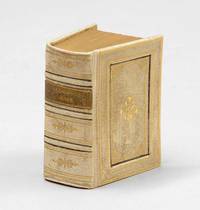
187960835Venice: Ferd. Ongania Edit. 1879. The "fly's eye" miniature Petrarch First edition thus first impression number 281 of 1000 copies only. This edition contains six sonnets that had recently been discovered by G. Veludo the dedicatee. Ongania explains in his preface that this edition is uniform with Salmin's famous "fly's eye type" miniature Dante of the previous year the success of which inspired him to produce the Petrarch. This copy is inscribed on the verso of the front free endpaper "To P.M. with every good wish from V.J.S. 23 May 1914". P.M. is very likely Philip Morrell 1870-1943 husband of Ottoline Morrell chatelaine of Garsington. The book was part of a lot offered for sale at Christie's South Kensington 1 November 2006 Modern First Editions including Books from the Library of Lady Ottoline Morrell and Family. Miniature book 2 vols in 1 tricesimo-secundo 54 x 35 mm. Portrait frontispiece and engravings throughout. Original panelled vellum spine gilt in compartments patterned endpapers all edges gilt. Bookseller's ticket to recto of rear free endpaper. Binding lightly rubbed and toned. An excellent copy. Bondy p. 96; Houghton 270; Mikrobiblion 189; Welsh 5665. hardcover
16932Meaux, Editions de la Revue Conférence, 2005. Un volume grand in-4 (281 x 380) en feuilles de 44 pages non chiffrées. Couverture blanche rempliée, sous emboîtage pleine toile brune. Parfaite condition.
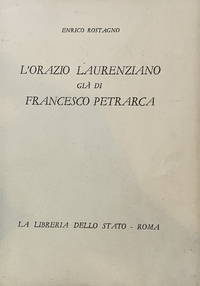
lom-MS000217In Russian. Short description: Rostagno E. L'Orazio laurenziano gia di Francesco Petrarca. - Rome: Libreria dello stato 1933. - 3-60 p. 1 l. Edition limited to 500 copies. The facsimile reproduces a manuscript of the writings of Horace dating from the late X - early XI century acquired by Francesco Petrarca in 1347 and now in the Biblioteca Mediceo-Laurenziana Florence. Please feel free to contact us for a detailed description of the copies available. SKUMS000217 unknown
lom-MS000217In Russian. Short description: Rostagno, E. L'Orazio laurenziano gia di Francesco Petrarca. - Rome: Libreria dello stato, 1933. - [3]-60 p., 1 l. Edition limited to 500 copies. The facsimile reproduces a manuscript of the writings of Horace dating from the late X - early XI century, acquired by Francesco Petrarca in 1347 and now in the Biblioteca Mediceo-Laurenziana, Florence. Please feel free to contact us for a detailed description of the copies available. SKUMS000217
Canzoniere, Trionfi (Petrarca Queriniano). Brescia, Biblioteca Queriniana, Inc. G V 15. Salerno Editrice, Roma, 2016. Riproduzione in facsimile dell’ incunabolo veneziano di Vindelino da Spira del 1470, con figure dipinte da Antonio Grifo. Suntuoso manoscritto cartaceo corredato di un grandioso apparato di chiose manoscritte e di rappresentazioni figurative che occupano ogni spazio bianco della pagina, in una ricchissima decorazione pressoché continua dalla prima all’ultima pagina. Legatura in piena pelle con capitelli e tagli in colore, fregi e incisioni in oro e a secco sui piatti e sul dorso. Commentario a cura di Ennio Sandal, Giordana Mariani Canova, Giuseppe Frasso. Cofanetto in plexiglass. Tiratura di 499 esemplari numerati. Condizione di nuovo.
1821022774Firenze: Dalla Tipografia 1821. Octavo. In two volumes. 366 9 pp. and 470pp. Each with a fore-edge painting. Volume 1 with a fore-edge painting depicting Ducal Palace and volume 2 depicts a painting of The Rialto Venice.From the publisher."So that this reprint of ours is in no way less valuable than the Padua edition the publishers will scrupulously reproduce everything that was published by the famous Professor Antonio Marsand in his 1818 following the order he gave to the rhymes to the illustrations and c imitating the invention of the branches and also the typographical correction. A beautiful set with each volume displaying a meticulously painted fore-edge painting. Bound in full dark blue levant triple ruled in gilt with corner flourishes raised bands gilt with title gilt marbled endpapers all edges gilt previous owner's name cannot decipher neatly written on verso of free endpaper. Some staining to covers but nonintrusive. A very handsome set housed within a custom lined slipcase. Dalla Tipografia unknown
35790Lausanne, André et Pierre Gonin, 1977. Pt. in-4°, 86p. en feuilles, sous couverture imprimée rempliée, chemise et étui.